CISA Releases Part One of Zero Trust Microsegmentation Guidance

 ​CISA released Microsegmentation in Zero Trust, Part One: Introduction and Planning as part of its ongoing efforts to support Federal Civilian Executive Branch (FCEB) agencies implementing zero trust architectures (ZTAs). 
This guidance provides a high-level overview of microsegmentation, focusing on its key concepts, associated challenges and potential benefits, and includes recommended actions to modernize network security and advance zero trust principles.
Microsegmentation is a critical component of ZTA that reduces the attack surface, limits lateral movement, and enhances visibility for monitoring smaller, isolated groups of resources.
While the guidance focuses on FCEB references, its principles are applicable to any organization. As part of its Journey to Zero Trust series, CISA plans to release a subsequent technical guide to offer detailed implementation scenarios and technical considerations for implementation teams. Visit our Zero Trust webpage for more information and resources. 

CISA released Microsegmentation in Zero Trust, Part One: Introduction and Planning as part of its ongoing efforts to support Federal Civilian Executive Branch (FCEB) agencies implementing zero trust architectures (ZTAs). 

This guidance provides a high-level overview of microsegmentation, focusing on its key concepts, associated challenges and potential benefits, and includes recommended actions to modernize network security and advance zero trust principles.

Microsegmentation is a critical component of ZTA that reduces the attack surface, limits lateral movement, and enhances visibility for monitoring smaller, isolated groups of resources.

While the guidance focuses on FCEB references, its principles are applicable to any organization. As part of its Journey to Zero Trust series, CISA plans to release a subsequent technical guide to offer detailed implementation scenarios and technical considerations for implementation teams. Visit our Zero Trust webpage for more information and resources.

 Read More

CISA and Partners Release Updated Advisory on Scattered Spider Group

 ​CISA, along with the Federal Bureau of Investigation, Canadian Centre for Cyber Security, Royal Canadian Mounted Police, the Australian Cyber Security Centre’s Australian Signals Directorate, and the Australian Federal Police and National Cyber Security Centre, released an updated joint Cybersecurity Advisory on Scattered Spider—a cybercriminal group targeting commercial facilities sectors and subsectors. This advisory provides updated tactics, techniques, and procedures (TTPs) obtained through FBI investigations conducted through June 2025.
Scattered Spider threat actors have been known to use various ransomware variants in data extortion attacks, most recently including DragonForce ransomware. While Scattered Spider often changes TTPs to remain undetected, some TTPs remain consistent. These actors frequently use social engineering techniques such as phishing, push bombing, and subscriber identity module swap attacks to obtain credentials, install remote access tools, and bypass multi-factor authentication.
The Mitigations section of the Scattered Spider joint Cybersecurity Advisory offers critical infrastructure organizations and commercial facilities recommendations to fortify their defenses. 

CISA, along with the Federal Bureau of Investigation, Canadian Centre for Cyber Security, Royal Canadian Mounted Police, the Australian Cyber Security Centre’s Australian Signals Directorate, and the Australian Federal Police and National Cyber Security Centre, released an updated joint Cybersecurity Advisory on Scattered Spider—a cybercriminal group targeting commercial facilities sectors and subsectors. This advisory provides updated tactics, techniques, and procedures (TTPs) obtained through FBI investigations conducted through June 2025.

Scattered Spider threat actors have been known to use various ransomware variants in data extortion attacks, most recently including DragonForce ransomware. While Scattered Spider often changes TTPs to remain undetected, some TTPs remain consistent. These actors frequently use social engineering techniques such as phishing, push bombing, and subscriber identity module swap attacks to obtain credentials, install remote access tools, and bypass multi-factor authentication.

The Mitigations section of the Scattered Spider joint Cybersecurity Advisory offers critical infrastructure organizations and commercial facilities recommendations to fortify their defenses.

 Read More

CISA Adds Three Known Exploited Vulnerabilities to Catalog

 ​CISA has added three new vulnerabilities to its Known Exploited Vulnerabilities (KEV) Catalog, based on evidence of active exploitation.

CVE-2025-20281 Cisco Identity Services Engine Injection Vulnerability
CVE-2025-20337 Cisco Identity Services Engine Injection Vulnerability
CVE-2023-2533 PaperCut NG/MF Cross-Site Request Forgery (CSRF) Vulnerability

These types of vulnerabilities are frequent attack vectors for malicious cyber actors and pose significant risks to the federal enterprise.
Binding Operational Directive (BOD) 22-01: Reducing the Significant Risk of Known Exploited Vulnerabilities established the KEV Catalog as a living list of known Common Vulnerabilities and Exposures (CVEs) that carry significant risk to the federal enterprise. BOD 22-01 requires Federal Civilian Executive Branch (FCEB) agencies to remediate identified vulnerabilities by the due date to protect FCEB networks against active threats. See the BOD 22-01 Fact Sheet for more information.
Although BOD 22-01 only applies to FCEB agencies, CISA strongly urges all organizations to reduce their exposure to cyberattacks by prioritizing timely remediation of KEV Catalog vulnerabilities as part of their vulnerability management practice. CISA will continue to add vulnerabilities to the catalog that meet the specified criteria. 

CISA has added three new vulnerabilities to its Known Exploited Vulnerabilities (KEV) Catalog, based on evidence of active exploitation.

  • CVE-2025-20281 Cisco Identity Services Engine Injection Vulnerability
  • CVE-2025-20337 Cisco Identity Services Engine Injection Vulnerability
  • CVE-2023-2533 PaperCut NG/MF Cross-Site Request Forgery (CSRF) Vulnerability

These types of vulnerabilities are frequent attack vectors for malicious cyber actors and pose significant risks to the federal enterprise.

Binding Operational Directive (BOD) 22-01: Reducing the Significant Risk of Known Exploited Vulnerabilities established the KEV Catalog as a living list of known Common Vulnerabilities and Exposures (CVEs) that carry significant risk to the federal enterprise. BOD 22-01 requires Federal Civilian Executive Branch (FCEB) agencies to remediate identified vulnerabilities by the due date to protect FCEB networks against active threats. See the BOD 22-01 Fact Sheet for more information.

Although BOD 22-01 only applies to FCEB agencies, CISA strongly urges all organizations to reduce their exposure to cyberattacks by prioritizing timely remediation of KEV Catalog vulnerabilities as part of their vulnerability management practice. CISA will continue to add vulnerabilities to the catalog that meet the specified criteria.

 Read More

Phishers Target Aviation Execs to Scam Customers

​KrebsOnSecurity recently heard from a reader whose boss’s email account got phished and was used to trick one of the company’s customers into sending a large payment to scammers. An investigation into the attacker’s infrastructure points to a long-running Nigerian cybercrime group that is actively targeting established companies in the transportation and aviation industries. 

KrebsOnSecurity recently heard from a reader whose boss’s email account got phished and was used to trick one of the company’s customers into sending a large payment to scammers. An investigation into the attacker’s infrastructure points to a long-running Nigerian cybercrime ring that is actively targeting established companies in the transportation and aviation industries.

Image: Shutterstock, Mr. Teerapon Tiuekhom.

A reader who works in the transportation industry sent a tip about a recent successful phishing campaign that tricked an executive at the company into entering their credentials at a fake Microsoft 365 login page. From there, the attackers quickly mined the executive’s inbox for past communications about invoices, copying and modifying some of those messages with new invoice demands that were sent to some of the company’s customers and partners.

Speaking on condition of anonymity, the reader said the resulting phishing emails to customers came from a newly registered domain name that was remarkably similar to their employer’s domain, and that at least one of their customers fell for the ruse and paid a phony invoice. They said the attackers had spun up a look-alike domain just a few hours after the executive’s inbox credentials were phished, and that the scam resulted in a customer suffering a six-figure financial loss.

The reader also shared that the email addresses in the registration records for the imposter domain — roomservice801@gmail.com — is tied to many such phishing domains. Indeed, a search on this email address at DomainTools.com finds it is associated with at least 240 domains registered in 2024 or 2025. Virtually all of them mimic legitimate domains for companies in the aerospace and transportation industries worldwide.

An Internet search for this email address reveals a humorous blog post from 2020 on the Russian forum hackware[.]ru, which found roomservice801@gmail.com was tied to a phishing attack that used the lure of phony invoices to trick the recipient into logging in at a fake Microsoft login page. We’ll come back to this research in a moment.

JUSTY JOHN

DomainTools shows that some of the early domains registered to roomservice801@gmail.com in 2016 include other useful information. For example, the WHOIS records for alhhomaidhicentre[.]biz reference the technical contact of “Justy John” and the email address justyjohn50@yahoo.com.

A search at DomainTools found justyjohn50@yahoo.com has been registering one-off phishing domains since at least 2012. At this point, I was convinced that some security company surely had already published an analysis of this particular threat group, but I didn’t yet have enough information to draw any solid conclusions.

DomainTools says the Justy John email address is tied to more than two dozen domains registered since 2012, but we can find hundreds more phishing domains and related email addresses simply by pivoting on details in the registration records for these Justy John domains. For example, the street address used by the Justy John domain axisupdate[.]net — 7902 Pelleaux Road in Knoxville, TN — also appears in the registration records for accountauthenticate[.]com, acctlogin[.]biz, and loginaccount[.]biz, all of which at one point included the email address rsmith60646@gmail.com.

That Rsmith Gmail address is connected to the 2012 phishing domain alibala[.]biz (one character off of the Chinese e-commerce giant alibaba.com, with a different top-level domain of .biz). A search in DomainTools on the phone number in those domain records — 1.7736491613 — reveals even more phishing domains as well as the Nigerian phone number “2348062918302” and the email address michsmith59@gmail.com.

DomainTools shows michsmith59@gmail.com appears in the registration records for the domain seltrock[.]com, which was used in the phishing attack documented in the 2020 Russian blog post mentioned earlier. At this point, we are just two steps away from identifying the threat actor group.

The same Nigerian phone number shows up in dozens of domain registrations that reference the email address sebastinekelly69@gmail.com, including 26i3[.]net, costamere[.]com, danagruop[.]us, and dividrilling[.]com. A Web search on any of those domains finds they were indexed in an “indicator of compromise” list on GitHub maintained by Palo Alto NetworksUnit 42 research team.

SILVERTERRIER

According to Unit 42, the domains are the handiwork of a vast cybercrime group based in Nigeria that it dubbed “SilverTerrier” back in 2014. In an October 2021 report, Palo Alto said SilverTerrier excels at so-called “business e-mail compromise” or BEC scams, which target legitimate business email accounts through social engineering or computer intrusion activities. BEC criminals use that access to initiate or redirect the transfer of business funds for personal gain.

Palo Alto says SilverTerrier encompasses hundreds of BEC fraudsters, some of whom have been arrested in various international law enforcement operations by Interpol. In 2022, Interpol and the Nigeria Police Force arrested 11 alleged SilverTerrier members, including a prominent SilverTerrier leader who’d been flaunting his wealth on social media for years. Unfortunately, the lure of easy money, endemic poverty and corruption, and low barriers to entry for cybercrime in Nigeria conspire to provide a constant stream of new recruits.

BEC scams were the 7th most reported crime tracked by the FBI’s Internet Crime Complaint Center (IC3) in 2024, generating more than 21,000 complaints. However, BEC scams were the second most costly form of cybercrime reported to the feds last year, with nearly $2.8 billion in claimed losses. In its 2025 Fraud and Control Survey Report, the Association for Financial Professionals found 63 percent of organizations experienced a BEC last year.

Poking at some of the email addresses that spool out from this research reveals a number of Facebook accounts for people residing in Nigeria or in the United Arab Emirates, many of whom do not appear to have tried to mask their real-life identities. Palo Alto’s Unit 42 researchers reached a similar conclusion, noting that although a small subset of these crooks went to great lengths to conceal their identities, it was usually simple to learn their identities on social media accounts and the major messaging services.

Palo Alto said BEC actors have become far more organized over time, and that while it remains easy to find actors working as a group, the practice of using one phone number, email address or alias to register malicious infrastructure in support of multiple actors has made it far more time consuming (but not impossible) for cybersecurity and law enforcement organizations to sort out which actors committed specific crimes.

“We continue to find that SilverTerrier actors, regardless of geographical location, are often connected through only a few degrees of separation on social media platforms,” the researchers wrote.

FINANCIAL FRAUD KILL CHAIN

Palo Alto has published a useful list of recommendations that organizations can adopt to minimize the incidence and impact of BEC attacks. Many of those tips are prophylactic, such as conducting regular employee security training and reviewing network security policies.

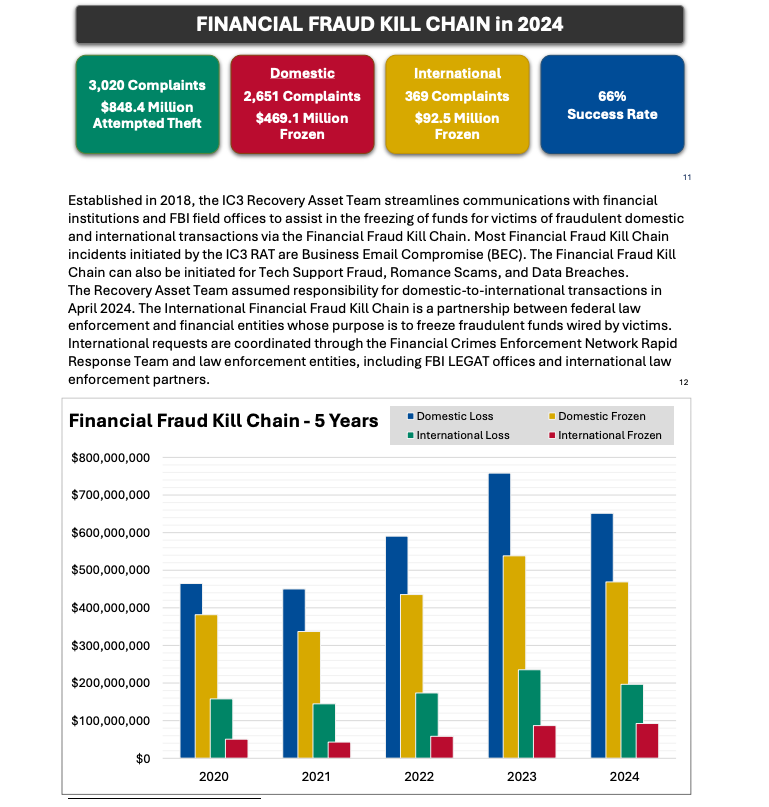
But one recommendation — getting familiar with a process known as the “financial fraud kill chain” or FFKC — bears specific mention because it offers the single best hope for BEC victims who are seeking to claw back payments made to fraudsters, and yet far too many victims don’t know it exists until it is too late.

Image: ic3.gov.

As explained in this FBI primer, the International Financial Fraud Kill Chain is a partnership between federal law enforcement and financial entities whose purpose is to freeze fraudulent funds wired by victims. According to the FBI, viable victim complaints filed with ic3.gov promptly after a fraudulent transfer (generally less than 72 hours) will be automatically triaged by the Financial Crimes Enforcement Network (FinCEN).

The FBI noted in its IC3 annual report (PDF) that the FFKC had a 66 percent success rate in 2024. Viable ic3.gov complaints involve losses of at least $50,000, and include all records from the victim or victim bank, as well as a completed FFKC form (provided by FinCEN) containing victim information, recipient information, bank names, account numbers, location, SWIFT, and any additional information.


Read More

LG Innotek Camera Model LNV5110R

 ​View CSAF
1. EXECUTIVE SUMMARY

CVSS v4 8.3
ATTENTION: Exploitable remotely
Vendor: LG Innotek
Equipment: Camera Model LNV5110R
Vulnerability: Authentication Bypass Using an Alternate Path or Channel

2. RISK EVALUATION
Successful exploitation of this vulnerability could allow an attacker to gain administrative access to the device.
3. TECHNICAL DETAILS
3.1 AFFECTED PRODUCTS
The following model of LG Innotek CCTV Camera is affected:

LNV5110R: All versions

3.2 Vulnerability Overview
3.2.1 AUTHENTICATION BYPASS USING AN ALTERNATE PATH OR CHANNEL CWE-288
An authentication vulnerability exists in the LG Innotek camera model LNV5110R firmware that allows a malicious actor to upload an HTTP POST request to the devices non-volatile storage. This action may result in remote code execution that allows an attacker to run arbitrary commands on the target device at the administrator privilege level.
CVE-2025-7742 has been assigned to this vulnerability. A CVSS v3 base score of 7.0 has been calculated; the CVSS vector string is (AV:N/AC:H/PR:N/UI:N/S:U/C:H/I:L/A:L).
A CVSS v4 score has also been calculated for CVE-2025-7742. A base score of 8.3 has been calculated; the CVSS vector string is (AV:N/AC:H/AT:N/PR:N/UI:N/VC:H/VI:L/VA:L/SC:N/SI:N/SA:N).
3.3 BACKGROUND

CRITICAL INFRASTRUCTURE SECTORS: Commercial Facilities
COUNTRIES/AREAS DEPLOYED: Worldwide
COMPANY HEADQUARTERS LOCATION: South Korea

3.4 RESEARCHER
Souvik Kandar reported this vulnerability to CISA.
4. MITIGATIONS
LG Innotek is aware of the vulnerability but has noted this is an end-of-life product that can no longer be patched.
Please visit the LG Security Center for further guidance.
CISA recommends users take defensive measures to minimize the risk of exploitation of this vulnerability, such as:

Minimize network exposure for all control system devices and/or systems, ensuring they are not accessible from the Internet.
Locate control system networks and remote devices behind firewalls and isolating them from business networks.
When remote access is required, use more secure methods, such as Virtual Private Networks (VPNs), recognizing VPNs may have vulnerabilities and should be updated to the most current version available. Also recognize VPN is only as secure as the connected devices.

CISA reminds organizations to perform proper impact analysis and risk assessment prior to deploying defensive measures.
CISA also provides a section for control systems security recommended practices on the ICS webpage on cisa.gov/ics. Several CISA products detailing cyber defense best practices are available for reading and download, including Improving Industrial Control Systems Cybersecurity with Defense-in-Depth Strategies.
CISA encourages organizations to implement recommended cybersecurity strategies for proactive defense of ICS assets.
Additional mitigation guidance and recommended practices are publicly available on the ICS webpage at cisa.gov/ics in the technical information paper, ICS-TIP-12-146-01B–Targeted Cyber Intrusion Detection and Mitigation Strategies.
Organizations observing suspected malicious activity should follow established internal procedures and report findings to CISA for tracking and correlation against other incidents.
No known public exploitation specifically targeting this vulnerability has been reported to CISA at this time. This vulnerability has a high attack complexity.
5. UPDATE HISTORY

July 24, 2025: Initial Publication 

View CSAF

1. EXECUTIVE SUMMARY

  • CVSS v4 8.3
  • ATTENTION: Exploitable remotely
  • Vendor: LG Innotek
  • Equipment: Camera Model LNV5110R
  • Vulnerability: Authentication Bypass Using an Alternate Path or Channel

2. RISK EVALUATION

Successful exploitation of this vulnerability could allow an attacker to gain administrative access to the device.

3. TECHNICAL DETAILS

3.1 AFFECTED PRODUCTS

The following model of LG Innotek CCTV Camera is affected:

  • LNV5110R: All versions

3.2 Vulnerability Overview

3.2.1 AUTHENTICATION BYPASS USING AN ALTERNATE PATH OR CHANNEL CWE-288

An authentication vulnerability exists in the LG Innotek camera model LNV5110R firmware that allows a malicious actor to upload an HTTP POST request to the devices non-volatile storage. This action may result in remote code execution that allows an attacker to run arbitrary commands on the target device at the administrator privilege level.

CVE-2025-7742 has been assigned to this vulnerability. A CVSS v3 base score of 7.0 has been calculated; the CVSS vector string is (AV:N/AC:H/PR:N/UI:N/S:U/C:H/I:L/A:L).

A CVSS v4 score has also been calculated for CVE-2025-7742. A base score of 8.3 has been calculated; the CVSS vector string is (AV:N/AC:H/AT:N/PR:N/UI:N/VC:H/VI:L/VA:L/SC:N/SI:N/SA:N).

3.3 BACKGROUND

  • CRITICAL INFRASTRUCTURE SECTORS: Commercial Facilities
  • COUNTRIES/AREAS DEPLOYED: Worldwide
  • COMPANY HEADQUARTERS LOCATION: South Korea

3.4 RESEARCHER

Souvik Kandar reported this vulnerability to CISA.

4. MITIGATIONS

LG Innotek is aware of the vulnerability but has noted this is an end-of-life product that can no longer be patched.

Please visit the LG Security Center for further guidance.

CISA recommends users take defensive measures to minimize the risk of exploitation of this vulnerability, such as:

  • Minimize network exposure for all control system devices and/or systems, ensuring they are not accessible from the Internet.
  • Locate control system networks and remote devices behind firewalls and isolating them from business networks.
  • When remote access is required, use more secure methods, such as Virtual Private Networks (VPNs), recognizing VPNs may have vulnerabilities and should be updated to the most current version available. Also recognize VPN is only as secure as the connected devices.

CISA reminds organizations to perform proper impact analysis and risk assessment prior to deploying defensive measures.

CISA also provides a section for control systems security recommended practices on the ICS webpage on cisa.gov/ics. Several CISA products detailing cyber defense best practices are available for reading and download, including Improving Industrial Control Systems Cybersecurity with Defense-in-Depth Strategies.

CISA encourages organizations to implement recommended cybersecurity strategies for proactive defense of ICS assets.

Additional mitigation guidance and recommended practices are publicly available on the ICS webpage at cisa.gov/ics in the technical information paper, ICS-TIP-12-146-01B–Targeted Cyber Intrusion Detection and Mitigation Strategies.

Organizations observing suspected malicious activity should follow established internal procedures and report findings to CISA for tracking and correlation against other incidents.

No known public exploitation specifically targeting this vulnerability has been reported to CISA at this time. This vulnerability has a high attack complexity.

5. UPDATE HISTORY

  • July 24, 2025: Initial Publication

 Read More

CISA Releases Six Industrial Control Systems Advisories

 ​CISA released six Industrial Control Systems (ICS) advisories on July 24, 2025. These advisories provide timely information about current security issues, vulnerabilities, and exploits surrounding ICS.

ICSA-25-205-01 Mitsubishi Electric CNC Series
ICSA-25-205-02 Network Thermostat X-Series WiFi Thermostats
ICSA-25-205-03 Honeywell Experion PKS
ICSA-25-205-04 LG Innotek Camera Model LNV5110R 
ICSMA-25-205-01 Medtronic MyCareLink Patient Monitor 
ICSA-22-202-04 ICONICS Suite and Mitsubishi Electric MC Works64 Products (Update A)

CISA encourages users and administrators to review newly released ICS advisories for technical details and mitigations. 

CISA released six Industrial Control Systems (ICS) advisories on July 24, 2025. These advisories provide timely information about current security issues, vulnerabilities, and exploits surrounding ICS.

CISA encourages users and administrators to review newly released ICS advisories for technical details and mitigations.

 Read More

Medtronic MyCareLink Patient Monitor

 ​View CSAF
1. EXECUTIVE SUMMARY

CVSS v4 7.0
ATTENTION: Low attack complexity
Vendor: Medtronic
Equipment: MyCareLink Patient Monitor 24950, 24952
Vulnerabilities: Cleartext Storage of Sensitive Information, Empty Password in Configuration File, Deserialization of Untrusted Data

2. RISK EVALUATION
Successful exploitation of these vulnerabilities could lead to system compromise, unauthorized access to sensitive data, and manipulation of the monitor’s functionality.
3. TECHNICAL DETAILS
3.1 AFFECTED PRODUCTS
The following Medtronic products are affected:

MyCareLink Patient Monitor model 24950: All versions
MyCareLink Patient Monitor model 24952: All versions

3.2 Vulnerability Overview
3.2.1 CLEARTEXT STORAGE OF SENSITIVE INFORMATION CWE-312
Medtronic MyCareLink Patient Monitor uses an unencrypted filesystem on internal storage, which allows an attacker with physical access to read and modify files.
CVE-2025-4394 has been assigned to this vulnerability. A CVSS v3.1 base score of 6.8 has been calculated; the CVSS vector string is (AV:P/AC:L/PR:N/UI:N/S:U/C:H/I:H/A:H).
A CVSS v4 score has also been calculated for CVE-2025-4394. A base score of 7.0 has been calculated; the CVSS vector string is (AV:P/AC:L/AT:N/PR:N/UI:N/VC:H/VI:H/VA:H/SC:N/SI:N/SA:N).
3.2.2 EMPTY PASSWORD IN CONFIGURATION FILE CWE-258
Medtronic MyCareLink Patient Monitor has a built-in user account with an empty password, which allows an attacker with physical access to log in with no password and access/modify system functionality.
CVE-2025-4395 has been assigned to this vulnerability. A CVSS v3.1 base score of 6.8 has been calculated; the CVSS vector string is (AV:P/AC:L/PR:N/UI:N/S:U/C:H/I:H/A:H).
A CVSS v4 score has also been calculated for CVE-2025-4395. A base score of 7.0 has been calculated; the CVSS vector string is (AV:P/AC:L/AT:N/PR:N/UI:N/VC:H/VI:H/VA:H/SC:N/SI:N/SA:N).
3.2.3 DESERIALIZATION OF UNTRUSTED DATA CWE-502
Medtronic MyCareLink Patient Monitor has an internal service that deserializes data, which allows a local attacker to interact with the service by crafting a binary payload to crash the service or elevate privileges.
CVE-2025-4393 has been assigned to this vulnerability. A CVSS v3.1 base score of 6.5 has been calculated; the CVSS vector string is (AV:L/AC:H/PR:L/UI:N/S:U/C:L/I:H/A:H).
A CVSS v4 score has also been calculated for CVE-2025-4393. A base score of 5.9 has been calculated; the CVSS vector string is (AV:L/AC:H/AT:P/PR:L/UI:N/VC:L/VI:H/VA:H/SC:N/SI:N/SA:N).
3.3 BACKGROUND

CRITICAL INFRASTRUCTURE SECTORS: Healthcare and Public Health
COUNTRIES/AREAS DEPLOYED: Worldwide
COMPANY HEADQUARTERS LOCATION: Ireland

3.4 RESEARCHER
Ethan Morchy from Somerset Recon and Carl Mann, an independent researcher, reported these vulnerabilities to Medtronic.
4. MITIGATIONS
The identified vulnerabilities were reported as low-risk findings. An attacker would need to physically tamper with the monitor to exploit them. In response, starting in June 2025, Medtronic began deploying security updates to address these findings.
Medtronic recommends the following actions:

The security update process is performed automatically when the monitor is connected to the internet. Users should ensure that their remote monitor is plugged in to receive updates.
Physicians should continue to prescribe monitors as intended.
Users should maintain possession of their home monitor.
Users should only use home monitors provided directly from a healthcare provider or a Medtronic representative.

Users needing additional assistance should contact security@medtronic.com.
For more information regarding these vulnerabilities, refer to Medtronic’s security bulletin.
Users should follow CISA’s guidance in the following areas:

Securing the Internet of Things
Home Network Security

CISA reminds organizations to perform proper impact analysis and risk assessment prior to deploying defensive measures.
CISA also provides a section for control systems security recommended practices on the ICS webpage on cisa.gov/ics. Several CISA products detailing cyber defense best practices are available for reading and download, including Improving Industrial Control Systems Cybersecurity with Defense-in-Depth Strategies.
CISA encourages organizations to implement recommended cybersecurity strategies for proactive defense of ICS assets.
Additional mitigation guidance and recommended practices are publicly available on the ICS webpage at cisa.gov/ics in the technical information paper, ICS-TIP-12-146-01B–Targeted Cyber Intrusion Detection and Mitigation Strategies.
Organizations observing suspected malicious activity should follow established internal procedures and report findings to CISA for tracking and correlation against other incidents.
No known public exploitation specifically targeting these vulnerabilities has been reported to CISA at this time. These vulnerabilities are not exploitable remotely.
5. UPDATE HISTORY

July 24, 2025: Initial Publication 

View CSAF

1. EXECUTIVE SUMMARY

  • CVSS v4 7.0
  • ATTENTION: Low attack complexity
  • Vendor: Medtronic
  • Equipment: MyCareLink Patient Monitor 24950, 24952
  • Vulnerabilities: Cleartext Storage of Sensitive Information, Empty Password in Configuration File, Deserialization of Untrusted Data

2. RISK EVALUATION

Successful exploitation of these vulnerabilities could lead to system compromise, unauthorized access to sensitive data, and manipulation of the monitor’s functionality.

3. TECHNICAL DETAILS

3.1 AFFECTED PRODUCTS

The following Medtronic products are affected:

  • MyCareLink Patient Monitor model 24950: All versions
  • MyCareLink Patient Monitor model 24952: All versions

3.2 Vulnerability Overview

3.2.1 CLEARTEXT STORAGE OF SENSITIVE INFORMATION CWE-312

Medtronic MyCareLink Patient Monitor uses an unencrypted filesystem on internal storage, which allows an attacker with physical access to read and modify files.

CVE-2025-4394 has been assigned to this vulnerability. A CVSS v3.1 base score of 6.8 has been calculated; the CVSS vector string is (AV:P/AC:L/PR:N/UI:N/S:U/C:H/I:H/A:H).

A CVSS v4 score has also been calculated for CVE-2025-4394. A base score of 7.0 has been calculated; the CVSS vector string is (AV:P/AC:L/AT:N/PR:N/UI:N/VC:H/VI:H/VA:H/SC:N/SI:N/SA:N).

3.2.2 EMPTY PASSWORD IN CONFIGURATION FILE CWE-258

Medtronic MyCareLink Patient Monitor has a built-in user account with an empty password, which allows an attacker with physical access to log in with no password and access/modify system functionality.

CVE-2025-4395 has been assigned to this vulnerability. A CVSS v3.1 base score of 6.8 has been calculated; the CVSS vector string is (AV:P/AC:L/PR:N/UI:N/S:U/C:H/I:H/A:H).

A CVSS v4 score has also been calculated for CVE-2025-4395. A base score of 7.0 has been calculated; the CVSS vector string is (AV:P/AC:L/AT:N/PR:N/UI:N/VC:H/VI:H/VA:H/SC:N/SI:N/SA:N).

3.2.3 DESERIALIZATION OF UNTRUSTED DATA CWE-502

Medtronic MyCareLink Patient Monitor has an internal service that deserializes data, which allows a local attacker to interact with the service by crafting a binary payload to crash the service or elevate privileges.

CVE-2025-4393 has been assigned to this vulnerability. A CVSS v3.1 base score of 6.5 has been calculated; the CVSS vector string is (AV:L/AC:H/PR:L/UI:N/S:U/C:L/I:H/A:H).

A CVSS v4 score has also been calculated for CVE-2025-4393. A base score of 5.9 has been calculated; the CVSS vector string is (AV:L/AC:H/AT:P/PR:L/UI:N/VC:L/VI:H/VA:H/SC:N/SI:N/SA:N).

3.3 BACKGROUND

  • CRITICAL INFRASTRUCTURE SECTORS: Healthcare and Public Health
  • COUNTRIES/AREAS DEPLOYED: Worldwide
  • COMPANY HEADQUARTERS LOCATION: Ireland

3.4 RESEARCHER

Ethan Morchy from Somerset Recon and Carl Mann, an independent researcher, reported these vulnerabilities to Medtronic.

4. MITIGATIONS

The identified vulnerabilities were reported as low-risk findings. An attacker would need to physically tamper with the monitor to exploit them. In response, starting in June 2025, Medtronic began deploying security updates to address these findings.

Medtronic recommends the following actions:

  • The security update process is performed automatically when the monitor is connected to the internet. Users should ensure that their remote monitor is plugged in to receive updates.
  • Physicians should continue to prescribe monitors as intended.
  • Users should maintain possession of their home monitor.
  • Users should only use home monitors provided directly from a healthcare provider or a Medtronic representative.

Users needing additional assistance should contact security@medtronic.com.

For more information regarding these vulnerabilities, refer to Medtronic’s security bulletin.

Users should follow CISA’s guidance in the following areas:

CISA reminds organizations to perform proper impact analysis and risk assessment prior to deploying defensive measures.

CISA also provides a section for control systems security recommended practices on the ICS webpage on cisa.gov/ics. Several CISA products detailing cyber defense best practices are available for reading and download, including Improving Industrial Control Systems Cybersecurity with Defense-in-Depth Strategies.

CISA encourages organizations to implement recommended cybersecurity strategies for proactive defense of ICS assets.

Additional mitigation guidance and recommended practices are publicly available on the ICS webpage at cisa.gov/ics in the technical information paper, ICS-TIP-12-146-01B–Targeted Cyber Intrusion Detection and Mitigation Strategies.

Organizations observing suspected malicious activity should follow established internal procedures and report findings to CISA for tracking and correlation against other incidents.

No known public exploitation specifically targeting these vulnerabilities has been reported to CISA at this time. These vulnerabilities are not exploitable remotely.

5. UPDATE HISTORY

  • July 24, 2025: Initial Publication

 Read More

Mitsubishi Electric CNC Series

 ​View CSAF
1. EXECUTIVE SUMMARY

CVSS v3 7.0
ATTENTION: Exploitable from a local network
Vendor: Mitsubishi Electric
Equipment: CNC Series
Vulnerability: Uncontrolled Search Path Element

2. RISK EVALUATION
Successful exploitation of this vulnerability could allow an attacker to execute malicious code by getting setup-launcher to load a malicious DLL.
3. TECHNICAL DETAILS
3.1 AFFECTED PRODUCTS
The following versions of Mitsubishi Electric CNC Series are affected:

NC Designer2: All versions
NC Designer: All versions
NC Configurator2: All versions
NC Analyzer2: All versions
NC Analyzer: All versions
NC Explorer: All versions
NC Monitor2: All versions
NC Monitor: All versions
NC Trainer2: “AB” and prior
NC Trainer2 plus: “AB” and prior
NC Trainer: All versions
NC Trainer plus: All versions
NC Visualizer: All versions
Remote Monitor Tool: All versions
MS Configurator: All versions
Mitsubishi Electric Numerical Control Device Communication Software (FCSB1224): All versions
Mitsubishi Electric CNC communication software runtime library M70LC/M730LC: All versions
NC Virtual Simulator: All versions

3.2 Vulnerability Overview
3.2.1 UNCONTROLLED SEARCH PATH ELEMENT CWE-427
Malicious code execution vulnerability via DLL hijacking due to Uncontrolled Search Path Element (CWE-427) exists in Flexera InstallShield used in multiple software tools and industrial IoT-related products for Mitsubishi Electric CNC Series.
CVE-2016-2542 has been assigned to this vulnerability. A CVSS v3.1 base score of 7.0 has been calculated; the CVSS vector string is (AV:L/AC:H/PR:N/UI:R/S:U/C:H/I:H/A:H).
3.3 BACKGROUND

CRITICAL INFRASTRUCTURE SECTORS: Critical Manufacturing
COUNTRIES/AREAS DEPLOYED: Worldwide
COMPANY HEADQUARTERS LOCATION: Japan

3.4 RESEARCHER
Sahil Shah reported this vulnerability to Mitsubishi Electric.
4. MITIGATIONS
The vulnerability is fixed in the following products and versions.  Download and install the fixed version from the Mitsubishi Electric download site:

NC Trainer2: “AC” or later
NC Trainer2 plus: “AC” or later

Note that there are no plans to release fixed versions for the following products:

NC Designer
NC Analyzer
NC Monitor
NC Trainer / NC Trainer plus
NC Visualizer
Remote Monitor Tool
MS Configurator

For users of products that do not have a fixed version or who cannot immediately update the product, Mitsubishi Electric recommends taking the following mitigations to minimize the risk of exploiting this vulnerability:

Restrict physical access to the computer using the product.
Install an antivirus software in the computer using the affected product.
Do not open untrusted files or click untrusted links.
Do not run setup-launchers obtained from sources other than our branches, distributors or the Mitsubishi Electric FA website.
Before running the setup-launcher, make sure that no DLL exists in the folder containing the setup-launcher executable file (the name varies depending on the product) for the product.

For more information, see Mitsubishi Electric 2025-008.
CISA recommends users take defensive measures to minimize the risk of exploitation of this vulnerability, such as:

Minimize network exposure for all control system devices and/or systems, ensuring they are not accessible from the internet.
Locate control system networks and remote devices behind firewalls and isolating them from business networks.
When remote access is required, use more secure methods, such as Virtual Private Networks (VPNs), recognizing VPNs may have vulnerabilities and should be updated to the most current version available. Also recognize VPN is only as secure as the connected devices.

CISA reminds organizations to perform proper impact analysis and risk assessment prior to deploying defensive measures.
CISA also provides a section for control systems security recommended practices on the ICS webpage on cisa.gov/ics. Several CISA products detailing cyber defense best practices are available for reading and download, including Improving Industrial Control Systems Cybersecurity with Defense-in-Depth Strategies.
CISA encourages organizations to implement recommended cybersecurity strategies for proactive defense of ICS assets.
Additional mitigation guidance and recommended practices are publicly available on the ICS webpage at cisa.gov/ics in the technical information paper, ICS-TIP-12-146-01B–Targeted Cyber Intrusion Detection and Mitigation Strategies.
Organizations observing suspected malicious activity should follow established internal procedures and report findings to CISA for tracking and correlation against other incidents.
No known public exploitation specifically targeting this vulnerability has been reported to CISA at this time. This vulnerability is not exploitable remotely. This vulnerability has a high attack complexity.
5. UPDATE HISTORY

July 24, 2025: Initial Republication of Mitsubishi Electric 2025-008 

View CSAF

1. EXECUTIVE SUMMARY

  • CVSS v3 7.0
  • ATTENTION: Exploitable from a local network
  • Vendor: Mitsubishi Electric
  • Equipment: CNC Series
  • Vulnerability: Uncontrolled Search Path Element

2. RISK EVALUATION

Successful exploitation of this vulnerability could allow an attacker to execute malicious code by getting setup-launcher to load a malicious DLL.

3. TECHNICAL DETAILS

3.1 AFFECTED PRODUCTS

The following versions of Mitsubishi Electric CNC Series are affected:

  • NC Designer2: All versions
  • NC Designer: All versions
  • NC Configurator2: All versions
  • NC Analyzer2: All versions
  • NC Analyzer: All versions
  • NC Explorer: All versions
  • NC Monitor2: All versions
  • NC Monitor: All versions
  • NC Trainer2: “AB” and prior
  • NC Trainer2 plus: “AB” and prior
  • NC Trainer: All versions
  • NC Trainer plus: All versions
  • NC Visualizer: All versions
  • Remote Monitor Tool: All versions
  • MS Configurator: All versions
  • Mitsubishi Electric Numerical Control Device Communication Software (FCSB1224): All versions
  • Mitsubishi Electric CNC communication software runtime library M70LC/M730LC: All versions
  • NC Virtual Simulator: All versions

3.2 Vulnerability Overview

3.2.1 UNCONTROLLED SEARCH PATH ELEMENT CWE-427

Malicious code execution vulnerability via DLL hijacking due to Uncontrolled Search Path Element (CWE-427) exists in Flexera InstallShield used in multiple software tools and industrial IoT-related products for Mitsubishi Electric CNC Series.

CVE-2016-2542 has been assigned to this vulnerability. A CVSS v3.1 base score of 7.0 has been calculated; the CVSS vector string is (AV:L/AC:H/PR:N/UI:R/S:U/C:H/I:H/A:H).

3.3 BACKGROUND

  • CRITICAL INFRASTRUCTURE SECTORS: Critical Manufacturing
  • COUNTRIES/AREAS DEPLOYED: Worldwide
  • COMPANY HEADQUARTERS LOCATION: Japan

3.4 RESEARCHER

Sahil Shah reported this vulnerability to Mitsubishi Electric.

4. MITIGATIONS

The vulnerability is fixed in the following products and versions.  Download and install the fixed version from the Mitsubishi Electric download site:

  • NC Trainer2: “AC” or later
  • NC Trainer2 plus: “AC” or later

Note that there are no plans to release fixed versions for the following products:

  • NC Designer
  • NC Analyzer
  • NC Monitor
  • NC Trainer / NC Trainer plus
  • NC Visualizer
  • Remote Monitor Tool
  • MS Configurator

For users of products that do not have a fixed version or who cannot immediately update the product, Mitsubishi Electric recommends taking the following mitigations to minimize the risk of exploiting this vulnerability:

  • Restrict physical access to the computer using the product.
  • Install an antivirus software in the computer using the affected product.
  • Do not open untrusted files or click untrusted links.
  • Do not run setup-launchers obtained from sources other than our branches, distributors or the Mitsubishi Electric FA website.
  • Before running the setup-launcher, make sure that no DLL exists in the folder containing the setup-launcher executable file (the name varies depending on the product) for the product.

For more information, see Mitsubishi Electric 2025-008.

CISA recommends users take defensive measures to minimize the risk of exploitation of this vulnerability, such as:

  • Minimize network exposure for all control system devices and/or systems, ensuring they are not accessible from the internet.
  • Locate control system networks and remote devices behind firewalls and isolating them from business networks.
  • When remote access is required, use more secure methods, such as Virtual Private Networks (VPNs), recognizing VPNs may have vulnerabilities and should be updated to the most current version available. Also recognize VPN is only as secure as the connected devices.

CISA reminds organizations to perform proper impact analysis and risk assessment prior to deploying defensive measures.

CISA also provides a section for control systems security recommended practices on the ICS webpage on cisa.gov/ics. Several CISA products detailing cyber defense best practices are available for reading and download, including Improving Industrial Control Systems Cybersecurity with Defense-in-Depth Strategies.

CISA encourages organizations to implement recommended cybersecurity strategies for proactive defense of ICS assets.

Additional mitigation guidance and recommended practices are publicly available on the ICS webpage at cisa.gov/ics in the technical information paper, ICS-TIP-12-146-01B–Targeted Cyber Intrusion Detection and Mitigation Strategies.

Organizations observing suspected malicious activity should follow established internal procedures and report findings to CISA for tracking and correlation against other incidents.

No known public exploitation specifically targeting this vulnerability has been reported to CISA at this time. This vulnerability is not exploitable remotely. This vulnerability has a high attack complexity.

5. UPDATE HISTORY

  • July 24, 2025: Initial Republication of Mitsubishi Electric 2025-008

 Read More

Honeywell Experion PKS

 ​View CSAF
1. EXECUTIVE SUMMARY

CVSS v3 9.4
ATTENTION: Exploitable remotely/low attack complexity
Vendor: Honeywell
Equipment: Experion PKS
Vulnerabilities: Use of Uninitialized Variable, Improper Restriction of Operations within the Bounds of a Memory Buffer, Sensitive Information in Resource Not Removed Before Reuse, Integer Underflow (Wrap or Wraparound), Deployment of Wrong Handler

2. RISK EVALUATION
Successful exploitation of these vulnerabilities could result in information exposure, denial of service, or remote code execution.
3. TECHNICAL DETAILS
3.1 AFFECTED PRODUCTS
Honeywell reports these vulnerabilities affect the following:

Experion PKS: All releases prior to R520.2 TCU9 Hot Fix 1
Experion PKS: All releases prior to R530 TCU3 Hot Fix 1

3.2 Vulnerability Overview
3.2.1 Use of Uninitialized Variable CWE-457
The Honeywell Experion PKS contains an uninitialized variable in the common Epic Platform Analyzer (EPA) communications. An attacker could potentially exploit this vulnerability, leading to communication channel manipulation, which results in a dereferencing of an uninitialized pointer leading to a denial of service.
CVE-2025-2520 has been assigned to this vulnerability. A CVSS v3.1 base score of 7.5 has been calculated; the CVSS vector string is (CVSS:3.1/AV:N/AC:L/PR:N/UI:N/S:U/C:N/I:N/A:H).
3.2.2 Improper Restriction of Operations within the Bounds of a Memory Buffer CWE-119
The Honeywell Experion PKS contains a memory buffer vulnerability in the component Control Data Access (CDA). An attacker could potentially exploit this vulnerability, leading to overread buffers, which could result in improper index validation against buffer borders, leading to remote code execution.
CVE-2025-2521 has been assigned to this vulnerability. A CVSS v3.1 base score of 8.6 has been calculated; the CVSS vector string is (CVSS:3.1/AV:N/AC:L/PR:N/UI:N/S:U/C:L/I:L/A:H).
3.2.3 Sensitive Information in Resource Not Removed Before Reuse CWE-226
The Honeywell Experion PKS contains sensitive information in resource vulnerability in the component Control Data Access (CDA). An attacker could potentially exploit this vulnerability, leading to communication channel manipulation, which could result in buffer reuse, which may cause incorrect system behavior.
CVE-2025-2522 has been assigned to this vulnerability. A CVSS v3.1 base score of 6.5 has been calculated; the CVSS vector string is (CVSS:3.1/AV:N/AC:L/PR:N/UI:N/S:U/C:L/I:L/A:N).
3.2.4 Integer Underflow (Wrap or Wraparound) CWE-191
The Honeywell Experion PKS contains an integer underflow vulnerability in the component Control Data Access (CDA). An attacker could potentially exploit this vulnerability, leading to communication channel manipulation, which could result in a failure during subtraction, allowing remote code execution.
CVE-2025-2523 has been assigned to this vulnerability. A CVSS v3.1 base score of 9.4 has been calculated; the CVSS vector string is (CVSS:3.1/AV:N/AC:L/PR:N/UI:N/S:U/C:L/I:H/A:H).
3.2.5 Deployment of Wrong Handler CWE-430
The Honeywell Experion PKS contains a deployment of wrong handler vulnerability in the component Control Data Access (CDA). An attacker could potentially exploit this vulnerability, leading to input data manipulation, which could result in incorrect handling of packets, leading to remote code execution.
CVE-2025-3946 has been assigned to this vulnerability. A CVSS v3.1 base score of 8.2 has been calculated; the CVSS vector string is (CVSS:3.1/AV:N/AC:L/PR:N/UI:N/S:U/C:N/I:L/A:H).
3.2.6 Integer Underflow (Wrap or Wraparound) CWE-191
The Honeywell Experion PKS contains an integer underflow vulnerability in the component Control Data Access (CDA). An attacker could potentially exploit this vulnerability, leading to input data manipulation, which could result in improper integer data value checking during subtraction, leading to a denial of service.
CVE-2025-3947 has been assigned to this vulnerability. A CVSS v3.1 base score of 8.2 has been calculated; the CVSS vector string is (CVSS:3.1/AV:N/AC:L/PR:N/UI:N/S:U/C:N/I:L/A:H).
3.3 BACKGROUND

CRITICAL INFRASTRUCTURE SECTORS: Chemical, Critical Manufacturing, Energy, Healthcare and Public Health, Water and Wastewater Systems
COUNTRIES/AREAS DEPLOYED: Worldwide
COMPANY HEADQUARTERS LOCATION: United States

3.4 RESEARCHER
Positive Technologies reported these vulnerabilities to Honeywell.
4. MITIGATIONS
Honeywell recommends updating Experion PKS R520.2 TCU9 Hot Fix 1 or R530 TCU3 Hot Fix 1. For more information, see the Security Notice.
CISA recommends users take defensive measures to minimize the risk of exploitation of these vulnerabilities, such as:

Ensure the least-privilege user principle is followed.
Minimize network exposure for all control system devices and/or systems, ensuring they are not accessible from the Internet.
Locate control system networks and remote devices behind firewalls and isolating them from business networks.
When remote access is required, use more secure methods, such as virtual private networks (VPNs), recognizing VPNs may have vulnerabilities and should be updated to the most current version available. Also recognize VPN is only as secure as the connected devices.

CISA reminds organizations to perform proper impact analysis and risk assessment prior to deploying defensive measures.
CISA also provides a section for control systems security recommended practices on the ICS webpage on cisa.gov/ics. Several CISA products detailing cyber defense best practices are available for reading and download, including Improving Industrial Control Systems Cybersecurity with Defense-in-Depth Strategies.
CISA encourages organizations to implement recommended cybersecurity strategies for proactive defense of ICS assets.
Additional mitigation guidance and recommended practices are publicly available on the ICS webpage at cisa.gov/ics in the technical information paper, ICS-TIP-12-146-01B–Targeted Cyber Intrusion Detection and Mitigation Strategies.
Organizations observing suspected malicious activity should follow established internal procedures and report findings to CISA for tracking and correlation against other incidents.
No known public exploitation specifically targeting these vulnerabilities has been reported to CISA at this time.
5. UPDATE HISTORY

July 24, 2025: Initial Republication of Honeywell security notice. 

View CSAF

1. EXECUTIVE SUMMARY

  • CVSS v3 9.4
  • ATTENTION: Exploitable remotely/low attack complexity
  • Vendor: Honeywell
  • Equipment: Experion PKS
  • Vulnerabilities: Use of Uninitialized Variable, Improper Restriction of Operations within the Bounds of a Memory Buffer, Sensitive Information in Resource Not Removed Before Reuse, Integer Underflow (Wrap or Wraparound), Deployment of Wrong Handler

2. RISK EVALUATION

Successful exploitation of these vulnerabilities could result in information exposure, denial of service, or remote code execution.

3. TECHNICAL DETAILS

3.1 AFFECTED PRODUCTS

Honeywell reports these vulnerabilities affect the following:

  • Experion PKS: All releases prior to R520.2 TCU9 Hot Fix 1
  • Experion PKS: All releases prior to R530 TCU3 Hot Fix 1

3.2 Vulnerability Overview

3.2.1 Use of Uninitialized Variable CWE-457

The Honeywell Experion PKS contains an uninitialized variable in the common Epic Platform Analyzer (EPA) communications. An attacker could potentially exploit this vulnerability, leading to communication channel manipulation, which results in a dereferencing of an uninitialized pointer leading to a denial of service.

CVE-2025-2520 has been assigned to this vulnerability. A CVSS v3.1 base score of 7.5 has been calculated; the CVSS vector string is (CVSS:3.1/AV:N/AC:L/PR:N/UI:N/S:U/C:N/I:N/A:H).

3.2.2 Improper Restriction of Operations within the Bounds of a Memory Buffer CWE-119

The Honeywell Experion PKS contains a memory buffer vulnerability in the component Control Data Access (CDA). An attacker could potentially exploit this vulnerability, leading to overread buffers, which could result in improper index validation against buffer borders, leading to remote code execution.

CVE-2025-2521 has been assigned to this vulnerability. A CVSS v3.1 base score of 8.6 has been calculated; the CVSS vector string is (CVSS:3.1/AV:N/AC:L/PR:N/UI:N/S:U/C:L/I:L/A:H).

3.2.3 Sensitive Information in Resource Not Removed Before Reuse CWE-226

The Honeywell Experion PKS contains sensitive information in resource vulnerability in the component Control Data Access (CDA). An attacker could potentially exploit this vulnerability, leading to communication channel manipulation, which could result in buffer reuse, which may cause incorrect system behavior.

CVE-2025-2522 has been assigned to this vulnerability. A CVSS v3.1 base score of 6.5 has been calculated; the CVSS vector string is (CVSS:3.1/AV:N/AC:L/PR:N/UI:N/S:U/C:L/I:L/A:N).

3.2.4 Integer Underflow (Wrap or Wraparound) CWE-191

The Honeywell Experion PKS contains an integer underflow vulnerability in the component Control Data Access (CDA). An attacker could potentially exploit this vulnerability, leading to communication channel manipulation, which could result in a failure during subtraction, allowing remote code execution.

CVE-2025-2523 has been assigned to this vulnerability. A CVSS v3.1 base score of 9.4 has been calculated; the CVSS vector string is (CVSS:3.1/AV:N/AC:L/PR:N/UI:N/S:U/C:L/I:H/A:H).

3.2.5 Deployment of Wrong Handler CWE-430

The Honeywell Experion PKS contains a deployment of wrong handler vulnerability in the component Control Data Access (CDA). An attacker could potentially exploit this vulnerability, leading to input data manipulation, which could result in incorrect handling of packets, leading to remote code execution.

CVE-2025-3946 has been assigned to this vulnerability. A CVSS v3.1 base score of 8.2 has been calculated; the CVSS vector string is (CVSS:3.1/AV:N/AC:L/PR:N/UI:N/S:U/C:N/I:L/A:H).

3.2.6 Integer Underflow (Wrap or Wraparound) CWE-191

The Honeywell Experion PKS contains an integer underflow vulnerability in the component Control Data Access (CDA). An attacker could potentially exploit this vulnerability, leading to input data manipulation, which could result in improper integer data value checking during subtraction, leading to a denial of service.

CVE-2025-3947 has been assigned to this vulnerability. A CVSS v3.1 base score of 8.2 has been calculated; the CVSS vector string is (CVSS:3.1/AV:N/AC:L/PR:N/UI:N/S:U/C:N/I:L/A:H).

3.3 BACKGROUND

  • CRITICAL INFRASTRUCTURE SECTORS: Chemical, Critical Manufacturing, Energy, Healthcare and Public Health, Water and Wastewater Systems
  • COUNTRIES/AREAS DEPLOYED: Worldwide
  • COMPANY HEADQUARTERS LOCATION: United States

3.4 RESEARCHER

Positive Technologies reported these vulnerabilities to Honeywell.

4. MITIGATIONS

Honeywell recommends updating Experion PKS R520.2 TCU9 Hot Fix 1 or R530 TCU3 Hot Fix 1. For more information, see the Security Notice.

CISA recommends users take defensive measures to minimize the risk of exploitation of these vulnerabilities, such as:

  • Ensure the least-privilege user principle is followed.
  • Minimize network exposure for all control system devices and/or systems, ensuring they are not accessible from the Internet.
  • Locate control system networks and remote devices behind firewalls and isolating them from business networks.
  • When remote access is required, use more secure methods, such as virtual private networks (VPNs), recognizing VPNs may have vulnerabilities and should be updated to the most current version available. Also recognize VPN is only as secure as the connected devices.

CISA reminds organizations to perform proper impact analysis and risk assessment prior to deploying defensive measures.

CISA also provides a section for control systems security recommended practices on the ICS webpage on cisa.gov/ics. Several CISA products detailing cyber defense best practices are available for reading and download, including Improving Industrial Control Systems Cybersecurity with Defense-in-Depth Strategies.

CISA encourages organizations to implement recommended cybersecurity strategies for proactive defense of ICS assets.

Additional mitigation guidance and recommended practices are publicly available on the ICS webpage at cisa.gov/ics in the technical information paper, ICS-TIP-12-146-01B–Targeted Cyber Intrusion Detection and Mitigation Strategies.

Organizations observing suspected malicious activity should follow established internal procedures and report findings to CISA for tracking and correlation against other incidents.

No known public exploitation specifically targeting these vulnerabilities has been reported to CISA at this time.

5. UPDATE HISTORY

  • July 24, 2025: Initial Republication of Honeywell security notice.

 Read More

Network Thermostat X-Series WiFi Thermostats

 ​View CSAF
1. EXECUTIVE SUMMARY

CVSS v4 9.3
ATTENTION: Exploitable remotely/low attack complexity
Vendor: Network Thermostat
Equipment: X-Series WiFi thermostats
Vulnerability: Missing Authentication for Critical Function

2. RISK EVALUATION
Successful exploitation of this vulnerability could allow an attacker to gain full administrative access to the device.
3. TECHNICAL DETAILS
3.1 AFFECTED PRODUCTS
The following Network Thermostat product is affected:

X-Series WiFi thermostats: Versions v4.5 up to but not including v4.6
X-Series WiFi thermostats: Versions v9.6 up to but not including v9.46
X-Series WiFi thermostats: Versions v10.1 up to but not including v10.29
X-Series WiFi thermostats: Versions v11.1 up to but not including v11.5

3.2 Vulnerability Overview
3.2.1 Missing Authentication for Critical Function CWE-306
The embedded web server on the thermostat listed version ranges contain a vulnerability that allows unauthenticated attackers, either on the Local Area Network or from the Internet via a router with port forwarding set up, to gain direct access to the thermostat’s embedded web server and reset user credentials by manipulating specific elements of the embedded web interface.
CVE-2025-6260 has been assigned to this vulnerability. A CVSS v3.1 base score of 9.8 has been calculated; the CVSS vector string is (AV:N/AC:L/PR:N/UI:N/S:U/C:H/I:H/A:H).
A CVSS v4 score has also been calculated for CVE-2025-6260. A base score of 9.3 has been calculated; the CVSS vector string is (AV:N/AC:L/AT:N/PR:N/UI:N/VC:H/VI:H/VA:H/SC:N/SI:N/SA:N).
3.3 BACKGROUND

CRITICAL INFRASTRUCTURE SECTORS: Commercial Facilities
COUNTRIES/AREAS DEPLOYED: USA, Canada
COMPANY HEADQUARTERS LOCATION: United States

3.4 RESEARCHER
Souvik Kandar reported this vulnerability to CISA.
4. MITIGATIONS
Network Thermostat recommends users to update to the following (or newer) versions:

X-Series WiFi thermostats with v4.x to a minimum of v4.6
X-Series WiFi thermostats with v9.x to a minimum of v9.46
X-Series WiFi thermostats with v10.x to a minimum of v10.29
X-Series WiFi thermostats with v11.x to a minimum of v11.5

This update was applied automatically to reachable units, requiring no action from end users.
If end users would like their units behind firewalls to be updated, contact Network Thermostat at support@networkthermostat.com to coordinate an update.
CISA recommends users take defensive measures to minimize the risk of exploitation of this vulnerability, such as:

Minimize network exposure for all control system devices and/or systems, ensuring they are not accessible from the internet.
Locate control system networks and remote devices behind firewalls and isolating them from business networks.
When remote access is required, use more secure methods, such as Virtual Private Networks (VPNs), recognizing VPNs may have vulnerabilities and should be updated to the most current version available. Also recognize VPN is only as secure as the connected devices.

CISA reminds organizations to perform proper impact analysis and risk assessment prior to deploying defensive measures.
CISA also provides a section for control systems security recommended practices on the ICS webpage on cisa.gov/ics. Several CISA products detailing cyber defense best practices are available for reading and download, including Improving Industrial Control Systems Cybersecurity with Defense-in-Depth Strategies.
CISA encourages organizations to implement recommended cybersecurity strategies for proactive defense of ICS assets.
Additional mitigation guidance and recommended practices are publicly available on the ICS webpage at cisa.gov/ics in the technical information paper, ICS-TIP-12-146-01B–Targeted Cyber Intrusion Detection and Mitigation Strategies.
Organizations observing suspected malicious activity should follow established internal procedures and report findings to CISA for tracking and correlation against other incidents.
No known public exploitation specifically targeting this vulnerability has been reported to CISA at this time.
5. UPDATE HISTORY

July 24, 2025: Initial Publication 

View CSAF

1. EXECUTIVE SUMMARY

  • CVSS v4 9.3
  • ATTENTION: Exploitable remotely/low attack complexity
  • Vendor: Network Thermostat
  • Equipment: X-Series WiFi thermostats
  • Vulnerability: Missing Authentication for Critical Function

2. RISK EVALUATION

Successful exploitation of this vulnerability could allow an attacker to gain full administrative access to the device.

3. TECHNICAL DETAILS

3.1 AFFECTED PRODUCTS

The following Network Thermostat product is affected:

  • X-Series WiFi thermostats: Versions v4.5 up to but not including v4.6
  • X-Series WiFi thermostats: Versions v9.6 up to but not including v9.46
  • X-Series WiFi thermostats: Versions v10.1 up to but not including v10.29
  • X-Series WiFi thermostats: Versions v11.1 up to but not including v11.5

3.2 Vulnerability Overview

3.2.1 Missing Authentication for Critical Function CWE-306

The embedded web server on the thermostat listed version ranges contain a vulnerability that allows unauthenticated attackers, either on the Local Area Network or from the Internet via a router with port forwarding set up, to gain direct access to the thermostat’s embedded web server and reset user credentials by manipulating specific elements of the embedded web interface.

CVE-2025-6260 has been assigned to this vulnerability. A CVSS v3.1 base score of 9.8 has been calculated; the CVSS vector string is (AV:N/AC:L/PR:N/UI:N/S:U/C:H/I:H/A:H).

A CVSS v4 score has also been calculated for CVE-2025-6260. A base score of 9.3 has been calculated; the CVSS vector string is (AV:N/AC:L/AT:N/PR:N/UI:N/VC:H/VI:H/VA:H/SC:N/SI:N/SA:N).

3.3 BACKGROUND

  • CRITICAL INFRASTRUCTURE SECTORS: Commercial Facilities
  • COUNTRIES/AREAS DEPLOYED: USA, Canada
  • COMPANY HEADQUARTERS LOCATION: United States

3.4 RESEARCHER

Souvik Kandar reported this vulnerability to CISA.

4. MITIGATIONS

Network Thermostat recommends users to update to the following (or newer) versions:

  • X-Series WiFi thermostats with v4.x to a minimum of v4.6
  • X-Series WiFi thermostats with v9.x to a minimum of v9.46
  • X-Series WiFi thermostats with v10.x to a minimum of v10.29
  • X-Series WiFi thermostats with v11.x to a minimum of v11.5

This update was applied automatically to reachable units, requiring no action from end users.

If end users would like their units behind firewalls to be updated, contact Network Thermostat at support@networkthermostat.com to coordinate an update.

CISA recommends users take defensive measures to minimize the risk of exploitation of this vulnerability, such as:

  • Minimize network exposure for all control system devices and/or systems, ensuring they are not accessible from the internet.
  • Locate control system networks and remote devices behind firewalls and isolating them from business networks.
  • When remote access is required, use more secure methods, such as Virtual Private Networks (VPNs), recognizing VPNs may have vulnerabilities and should be updated to the most current version available. Also recognize VPN is only as secure as the connected devices.

CISA reminds organizations to perform proper impact analysis and risk assessment prior to deploying defensive measures.

CISA also provides a section for control systems security recommended practices on the ICS webpage on cisa.gov/ics. Several CISA products detailing cyber defense best practices are available for reading and download, including Improving Industrial Control Systems Cybersecurity with Defense-in-Depth Strategies.

CISA encourages organizations to implement recommended cybersecurity strategies for proactive defense of ICS assets.

Additional mitigation guidance and recommended practices are publicly available on the ICS webpage at cisa.gov/ics in the technical information paper, ICS-TIP-12-146-01B–Targeted Cyber Intrusion Detection and Mitigation Strategies.

Organizations observing suspected malicious activity should follow established internal procedures and report findings to CISA for tracking and correlation against other incidents.

No known public exploitation specifically targeting this vulnerability has been reported to CISA at this time.

5. UPDATE HISTORY

  • July 24, 2025: Initial Publication

 Read More

Scroll to Top