CISA Adds Two Known Exploited Vulnerabilities to Catalog

 ​CISA has added two new vulnerabilities to its Known Exploited Vulnerabilities (KEV) Catalog, based on evidence of active exploitation. 

CVE-2025-32433 Erlang Erlang/OTP SSH Server Missing Authentication for Critical Function Vulnerability 

CVE-2024-42009 RoundCube Webmail Cross-Site Scripting Vulnerability 

These types of vulnerabilities are frequent attack vectors for malicious cyber actors and pose significant risks to the federal enterprise. 

Binding Operational Directive (BOD) 22-01: Reducing the Significant Risk of Known Exploited Vulnerabilities established the KEV Catalog as a living list of known Common Vulnerabilities and Exposures (CVEs) that carry significant risk to the federal enterprise. BOD 22-01 requires Federal Civilian Executive Branch (FCEB) agencies to remediate identified vulnerabilities by the due date to protect FCEB networks against active threats. See the BOD 22-01 Fact Sheet for more information. 

Although BOD 22-01 only applies to FCEB agencies, CISA strongly urges all organizations to reduce their exposure to cyberattacks by prioritizing timely remediation of KEV Catalog vulnerabilities as part of their vulnerability management practice. CISA will continue to add vulnerabilities to the catalog that meet the specified criteria.  

CISA has added two new vulnerabilities to its Known Exploited Vulnerabilities (KEV) Catalog, based on evidence of active exploitation. 

  • CVE-2025-32433 Erlang Erlang/OTP SSH Server Missing Authentication for Critical Function Vulnerability 
  • CVE-2024-42009 RoundCube Webmail Cross-Site Scripting Vulnerability 

These types of vulnerabilities are frequent attack vectors for malicious cyber actors and pose significant risks to the federal enterprise. 

Binding Operational Directive (BOD) 22-01: Reducing the Significant Risk of Known Exploited Vulnerabilities established the KEV Catalog as a living list of known Common Vulnerabilities and Exposures (CVEs) that carry significant risk to the federal enterprise. BOD 22-01 requires Federal Civilian Executive Branch (FCEB) agencies to remediate identified vulnerabilities by the due date to protect FCEB networks against active threats. See the BOD 22-01 Fact Sheet for more information. 

Although BOD 22-01 only applies to FCEB agencies, CISA strongly urges all organizations to reduce their exposure to cyberattacks by prioritizing timely remediation of KEV Catalog vulnerabilities as part of their vulnerability management practice. CISA will continue to add vulnerabilities to the catalog that meet the specified criteria

 Read More

Proxy Services Feast on Ukraine’s IP Address Exodus

​Ukraine has seen nearly one-fifth of its Internet space come under Russian control or sold to Internet address brokers since February 2022, a new study finds. The analysis indicates large chunks of Ukrainian Internet address space are now in the hands of proxy and anonymity services nested at some of America’s largest Internet service providers (ISPs). 

Image: Mark Rademaker, via Shutterstock.

Ukraine has seen nearly one-fifth of its Internet space come under Russian control or sold to Internet address brokers since February 2022, a new study finds. The analysis indicates large chunks of Ukrainian Internet address space are now in the hands of shadowy proxy and anonymity services that are nested at some of America’s largest Internet service providers (ISPs).

The findings come in a report that examines how the Russian invasion has affected Ukraine’s domestic supply of Internet Protocol Version 4 (IPv4) addresses. Researchers at Kentik, a company that measures the performance of Internet networks, found that while a majority of ISPs in Ukraine haven’t changed their infrastructure much since the war began in 2022, others have resorted to selling swathes of their valuable IPv4 address space just to keep the lights on.

For example, Ukraine’s incumbent ISP Ukrtelecom is now routing just 29 percent of the IPv4 address ranges that the company controlled at the start of the war, Kentik found. Although much of that former IP space remains dormant, Ukrtelecom told Kentik’s Doug Madory they were forced to sell many of their address blocks “to secure financial stability and continue delivering essential services.”

“Leasing out a portion of our IPv4 resources allowed us to mitigate some of the extraordinary challenges we have been facing since the full-scale invasion began,” Ukrtelecom told Madory.

Madory found much of the IPv4 space previously allocated to Ukrtelecom is now scattered to more than 100 providers globally, particularly at three large American ISPs — Amazon (AS16509), AT&T (AS7018), and Cogent (AS174).

Another Ukrainian Internet provider — LVS (AS43310) — in 2022 was routing approximately 6,000 IPv4 addresses across the nation. Kentik learned that by November 2022, much of that address space had been parceled out to over a dozen different locations, with the bulk of it being announced at AT&T.
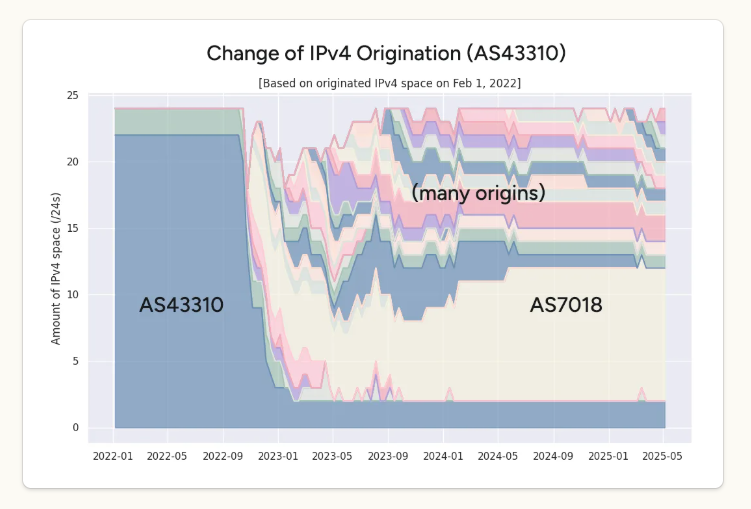
IP addresses routed over time by Ukrainian provider LVS (AS43310) shows a large chunk of it being routed by AT&T (AS7018). Image: Kentik.

Ditto for the Ukrainian ISP TVCOM, which currently routes nearly 15,000 fewer IPv4 addresses than it did at the start of the war. Madory said most of those addresses have been scattered to 37 other networks outside of Eastern Europe, including Amazon, AT&T, and Microsoft.

The Ukrainian ISP Trinity (AS43554) went offline in early March 2022 during the bloody siege of Mariupol, but its address space eventually began showing up in more than 50 different networks worldwide. Madory found more than 1,000 of Trinity’s IPv4 addresses suddenly appeared on AT&T’s network.

Why are all these former Ukrainian IP addresses being routed by U.S.-based networks like AT&T? According to spur.us, a company that tracks VPN and proxy services, nearly all of the address ranges identified by Kentik now map to commercial proxy services that allow customers to anonymously route their Internet traffic through someone else’s computer.
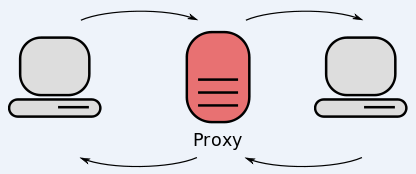
From a website’s perspective, the traffic from a proxy network user appears to originate from the rented IP address, not from the proxy service customer. These services can be used for several business purposes, such as price comparisons, sales intelligence, web crawlers and content-scraping bots. However, proxy services also are massively abused for hiding cybercrime activity because they can make it difficult to trace malicious traffic to its original source.

IPv4 address ranges are always in high demand, which means they are also quite valuable. There are now multiple companies that will pay ISPs to lease out their unwanted or unused IPv4 address space. Madory said these IPv4 brokers will pay between $100-$500 per month to lease a block of 256 IPv4 addresses, and very often the entities most willing to pay those rental rates are proxy and VPN providers.

A cursory review of all Internet address blocks currently routed through AT&T — as seen in public records maintained by the Internet backbone provider Hurricane Electric — shows a preponderance of country flags other than the United States, including networks originating in Hungary, Lithuania, Moldova, Mauritius, Palestine, Seychelles, Slovenia, and Ukraine.
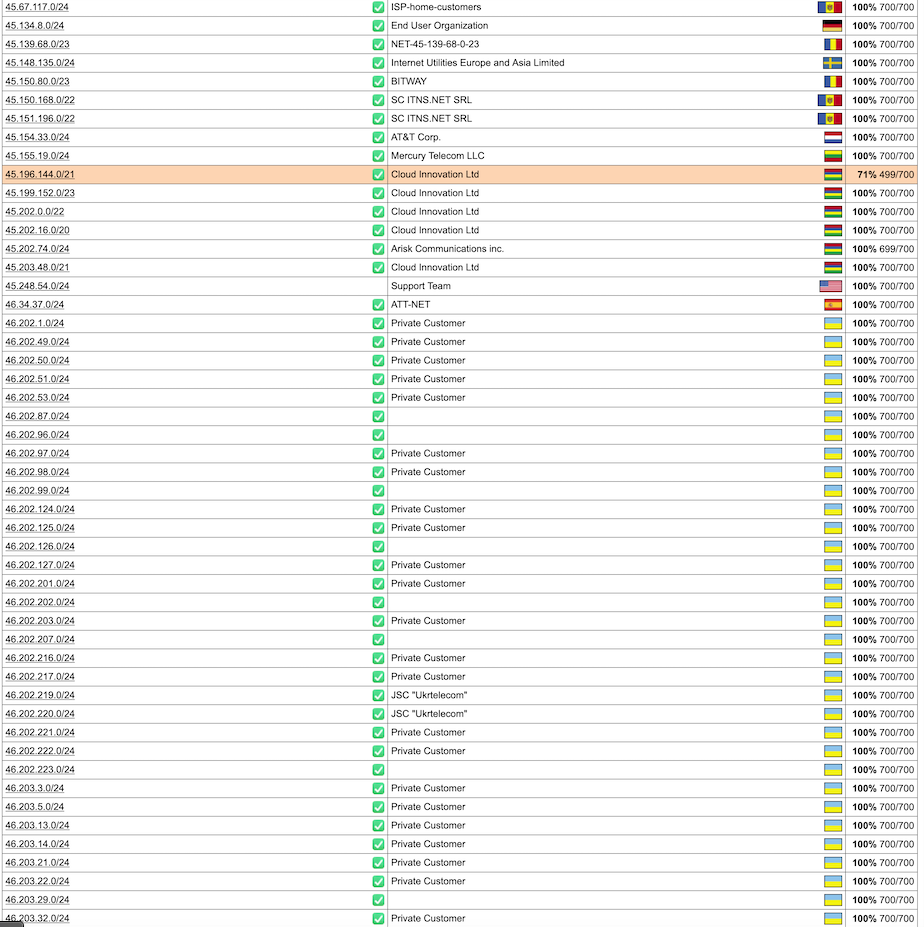
AT&T’s IPv4 address space seems to be routing a great deal of proxy traffic, including a large number of IP address ranges that were until recently routed by ISPs in Ukraine.

Asked about the apparent high incidence of proxy services routing foreign address blocks through AT&T, the telecommunications giant said it recently changed its policy about originating routes for network blocks that are not owned and managed by AT&T. That new policy, spelled out in a February 2025 update to AT&T’s terms of service, gives those customers until Sept. 1, 2025 to originate their own IP space from their own autonomous system number (ASN), a unique number assigned to each ISP (AT&T’s is AS7018).

“To ensure our customers receive the best quality of service, we changed our terms for dedicated internet in February 2025,” an AT&T spokesperson said in an emailed reply. “We no longer permit static routes with IP addresses that we have not provided. We have been in the process of identifying and notifying affected customers that they have 90 days to transition to Border Gateway Protocol routing using their own autonomous system number.”

Ironically, the co-mingling of Ukrainian IP address space with proxy providers has resulted in many of these addresses being used in cyberattacks against Ukraine and other enemies of Russia. Earlier this month, the European Union sanctioned Stark Industries Solutions Inc., an ISP that surfaced two weeks before the Russian invasion and quickly became the source of large-scale DDoS attacks and spear-phishing attempts by Russian state-sponsored hacking groups. A deep dive into Stark’s considerable address space showed some of it was sourced from Ukrainian ISPs, and most of it was connected to Russia-based proxy and anonymity services.
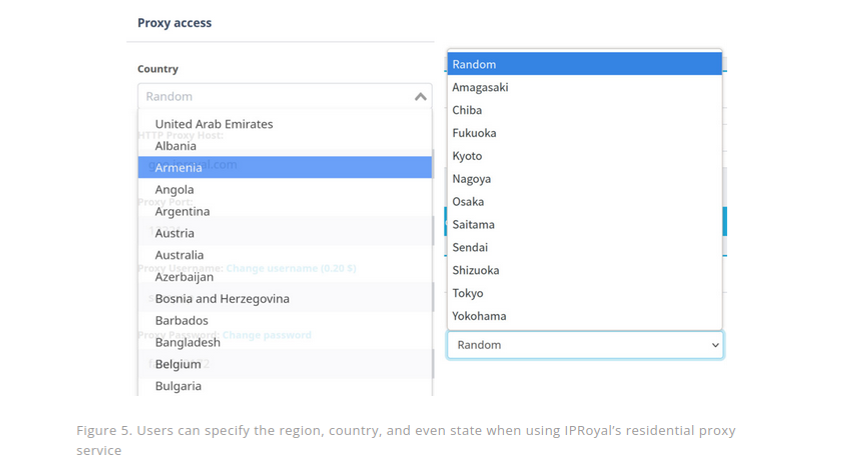
According to Spur, the proxy service IPRoyal is the current beneficiary of IP address blocks from several Ukrainian ISPs profiled in Kentik’s report. Customers can chose proxies by specifying the city and country they would to proxy their traffic through. Image: Trend Micro.

Spur’s Chief Technology Officer Riley Kilmer said AT&T’s policy change will likely force many proxy services to migrate to other U.S. providers that have less stringent policies.

“AT&T is the first one of the big ISPs that seems to be actually doing something about this,” Kilmer said. “We track several services that explicitly sell AT&T IP addresses, and it will be very interesting to see what happens to those services come September.”

Still, Kilmer said, there are several other large U.S. ISPs that continue to make it easy for proxy services to bring their own IP addresses and host them in ranges that give the appearance of residential customers. For example, Kentik’s report identified former Ukrainian IP ranges showing up as proxy services routed by Cogent Communications (AS174), a tier-one Internet backbone provider based in Washington, D.C.

Kilmer said Cogent has become an attractive home base for proxy services because it is relatively easy to get Cogent to route an address block.

“In fairness, they transit a lot of traffic,” Kilmer said of Cogent. “But there’s a reason a lot of this proxy stuff shows up as Cogent: Because it’s super easy to get something routed there.”

Cogent declined a request to comment on Kentik’s findings.

 

Read More

CISA Adds One Known Exploited Vulnerability to Catalog

 ​ CISA has added one new vulnerability to its Known Exploited Vulnerabilities (KEV) Catalog, based on evidence of active exploitation. 

CVE-2025-5419 Google Chromium V8 Out-of-Bounds Read and Write Vulnerability 

This type of vulnerability is a frequent attack vector for malicious cyber actors and poses significant risks to the federal enterprise. 

Binding Operational Directive (BOD) 22-01: Reducing the Significant Risk of Known Exploited Vulnerabilities established the KEV Catalog as a living list of known Common Vulnerabilities and Exposures (CVEs) that carry significant risk to the federal enterprise. BOD 22-01 requires Federal Civilian Executive Branch (FCEB) agencies to remediate identified vulnerabilities by the due date to protect FCEB networks against active threats. See the BOD 22-01 Fact Sheet for more information. 

Although BOD 22-01 only applies to FCEB agencies, CISA strongly urges all organizations to reduce their exposure to cyberattacks by prioritizing timely remediation of KEV Catalog vulnerabilities as part of their vulnerability management practice. CISA will continue to add vulnerabilities to the catalog that meet the specified criteria.  

 CISA has added one new vulnerability to its Known Exploited Vulnerabilities (KEV) Catalog, based on evidence of active exploitation. 

  • CVE-2025-5419 Google Chromium V8 Out-of-Bounds Read and Write Vulnerability 

This type of vulnerability is a frequent attack vector for malicious cyber actors and poses significant risks to the federal enterprise. 

Binding Operational Directive (BOD) 22-01: Reducing the Significant Risk of Known Exploited Vulnerabilities established the KEV Catalog as a living list of known Common Vulnerabilities and Exposures (CVEs) that carry significant risk to the federal enterprise. BOD 22-01 requires Federal Civilian Executive Branch (FCEB) agencies to remediate identified vulnerabilities by the due date to protect FCEB networks against active threats. See the BOD 22-01 Fact Sheet for more information. 

Although BOD 22-01 only applies to FCEB agencies, CISA strongly urges all organizations to reduce their exposure to cyberattacks by prioritizing timely remediation of KEV Catalog vulnerabilities as part of their vulnerability management practice. CISA will continue to add vulnerabilities to the catalog that meet the specified criteria

 Read More

CISA Releases Seven Industrial Control Systems Advisories

 ​CISA released seven Industrial Control Systems (ICS) advisories on June 5, 2025. These advisories provide timely information about current security issues, vulnerabilities, and exploits surrounding ICS.

ICSA-25-155-01 CyberData 011209 SIP Emergency Intercom
ICSA-25-155-02 Hitachi Energy Relion 670, 650 series and SAM600-IO Product 
ICSA-21-049-02 Mitsubishi Electric FA Engineering Software Products (Update H)
ICSA-25-133-02 Hitachi Energy Relion 670/650/SAM600-IO Series (Update A)
ICSA-23-068-05 Hitachi Energy Relion 670, 650 and SAM600-IO Series (Update A)
ICSA-21-336-05 Hitachi Energy Relion 670/650/SAM600-IO (Update A)
ICSA-23-089-01 Hitachi Energy IEC 61850 MMS-Server (Update A)

CISA encourages users and administrators to review newly released ICS advisories for technical details and mitigations. 

CISA released seven Industrial Control Systems (ICS) advisories on June 5, 2025. These advisories provide timely information about current security issues, vulnerabilities, and exploits surrounding ICS.

CISA encourages users and administrators to review newly released ICS advisories for technical details and mitigations.

 Read More

Hitachi Energy Relion 670, 650 Series and SAM600-IO Product

 ​View CSAF
1. EXECUTIVE SUMMARY

CVSS v3 9.8
ATTENTION: Exploitable remotely/low attack complexity
Vendor: Hitachi Energy
Equipment: Relion 670, Relion 650, SAM600-IO
Vulnerabilities: Integer Overflow or Wraparound

2. RISK EVALUATION
Successful exploitation of these vulnerabilities could allow an attacker to cause memory corruption on the products.
3. TECHNICAL DETAILS
3.1 AFFECTED PRODUCTS
Hitachi Energy reports that the following products are affected:

Relion 670/650/SAM600-IO series: Version 2.2.5 revisions up to 2.2.5.1
Relion 670/650 series: Version 2.2.4 revisions up to 2.2.4.2
Relion 670 series: Version 2.2.3 revisions up to 2.2.3.4
Relion 670 series: Version 2.2.2 revisions up to 2.2.2.4
Relion 670/650/SAM600-IO series: Version 2.2.1 revisions up to 2.2.1.7
Relion 670/650 series version 2.2.0: All revisions
Relion 670/650 series version 2.1: All revisions
Relion 670 series version 2.0: All revisions
Relion 670 series version 1.2: All revisions
Relion 670 series version 1.1: All revisions
Relion 650 series version 1.3: All revisions
Relion 650 series version 1.2: All revisions
Relion 650 series version 1.1: All revisions
Relion 650 series version 1.0: All revisions

3.2 VULNERABILITY OVERVIEW
3.2.1 INTEGER OVERFLOW OR WRAPAROUND CWE-190
In Wind River VxWorks, memory allocator has a possible overflow in calculating the memory block’s size to be allocated by calloc(). As a result, the actual memory allocated is smaller than the buffer size specified by the arguments, leading to memory corruption.
CVE-2020-28895 has been assigned to this vulnerability. A CVSS v3.1 base score of 7.3 has been calculated; the CVSS vector string is (CVSS:3.1/AV:N/AC:L/PR:N/UI:N/S:U/C:L/I:L/A:L).
3.2.2 INTEGER OVERFLOW OR WRAPAROUND CWE-190
An issue was discovered in Wind River VxWorks 7. The memory al-locator has a possible integer overflow in calculating a memory block’s size to be allocated by calloc(). As a result, the actual memory allocated is smaller than the buffer size specified by the arguments, leading to memory corruption.
CVE-2020-35198 has been assigned to this vulnerability. A CVSS v3.1 base score of 9.8 has been calculated; the CVSS vector string is (CVSS:3.1/AV:N/AC:L/PR:N/UI:N/S:U/C:H/I:H/A:H).
3.3 BACKGROUND

CRITICAL INFRASTRUCTURE SECTORS: Energy
COUNTRIES/AREAS DEPLOYED: Worldwide
COMPANY HEADQUARTERS LOCATION: Switzerland

3.4 RESEARCHER
Hitachi Energy reported these vulnerabilities to CISA.
4. MITIGATIONS
Hitachi Energy has identified the following specific workarounds and mitigations users may apply to reduce risk:

Relion 670 series version 2.2.5 revisions up to 2.2.5.1, Relion 650 series version 2.2.5 revisions up to 2.2.5.1, SAM-IO series version 2.2.5 revisions up to 2.2.5.1: Update to 2.2.5.2 version or latest
Relion 670 series version 2.2.4 revisions up to 2.2.4.2, Relion 650 series version 2.2.4 revisions up to 2.2.4.2: Update to 2.2.4.3 version or latest
Relion 670 series version 2.2.3 revisions up to 2.2.3.4: Update to 2.2.3.5 version or latest
Relion 670 series version 2.2.2 revisions up to 2.2.2.4: Update to 2.2.2.5 version or latest
Relion 670 series version 2.2.1 revisions up to 2.2.1.7, Relion 650 series version 2.2.1 revisions up to 2.2.1.7, SAM-IO series version 2.2.1 revisions up to 2.2.1.7: Update to 2.2.1.8 version or latest
Relion 670 series version 1.1 to 2.2.0 all revisions, Relion 650 series version 1.0 to 2.2.0 all revisions: Refer to the Mitigation Factors/Workaround Section for the current mitigation strategy.

For more information see the associated Hitachi Energy PSIRT security advisory 8DBD000070 Cybersecurity Advisory – BadAlloc – Memory Allocation Vulnerabilities in Hitachi Energy Relion 670, 650 series and SAM600-IO Product.
CISA recommends users take defensive measures to minimize the risk of exploitation of these vulnerabilities, such as:

Minimize network exposure for all control system devices and/or systems, ensuring they are not accessible from the internet.
Locate control system networks and remote devices behind firewalls and isolating them from business networks.
When remote access is required, use more secure methods, such as Virtual Private Networks (VPNs). Recognize VPNs may have vulnerabilities, should be updated to the most recent version available, and are only as secure as the connected devices.

CISA reminds organizations to perform proper impact analysis and risk assessment prior to deploying defensive measures.
CISA also provides a section for control systems security recommended practices on the ICS webpage on cisa.gov. Several CISA products detailing cyber defense best practices are available for reading and download, including Improving Industrial Control Systems Cybersecurity with Defense-in-Depth Strategies.
CISA encourages organizations to implement recommended cybersecurity strategies for proactive defense of ICS assets.
Additional mitigation guidance and recommended practices are publicly available on the ICS webpage at cisa.gov in the technical information paper, ICS-TIP-12-146-01B–Targeted Cyber Intrusion Detection and Mitigation Strategies.
Organizations observing suspected malicious activity should follow established internal procedures and report findings to CISA for tracking and correlation against other incidents.
CISA also recommends users take the following measures to protect themselves from social engineering attacks:

Do not click web links or open attachments in unsolicited email messages.
Refer to Recognizing and Avoiding Email Scams for more information on avoiding email scams.
Refer to Avoiding Social Engineering and Phishing Attacks for more information on social engineering attacks.

No known public exploitation specifically targeting these vulnerabilities has been reported to CISA at this time.
5. UPDATE HISTORY

June 5, 2025: Initial Republication of Hitachi Energy 8DBD000070 

View CSAF

1. EXECUTIVE SUMMARY

  • CVSS v3 9.8
  • ATTENTION: Exploitable remotely/low attack complexity
  • Vendor: Hitachi Energy
  • Equipment: Relion 670, Relion 650, SAM600-IO
  • Vulnerabilities: Integer Overflow or Wraparound

2. RISK EVALUATION

Successful exploitation of these vulnerabilities could allow an attacker to cause memory corruption on the products.

3. TECHNICAL DETAILS

3.1 AFFECTED PRODUCTS

Hitachi Energy reports that the following products are affected:

  • Relion 670/650/SAM600-IO series: Version 2.2.5 revisions up to 2.2.5.1
  • Relion 670/650 series: Version 2.2.4 revisions up to 2.2.4.2
  • Relion 670 series: Version 2.2.3 revisions up to 2.2.3.4
  • Relion 670 series: Version 2.2.2 revisions up to 2.2.2.4
  • Relion 670/650/SAM600-IO series: Version 2.2.1 revisions up to 2.2.1.7
  • Relion 670/650 series version 2.2.0: All revisions
  • Relion 670/650 series version 2.1: All revisions
  • Relion 670 series version 2.0: All revisions
  • Relion 670 series version 1.2: All revisions
  • Relion 670 series version 1.1: All revisions
  • Relion 650 series version 1.3: All revisions
  • Relion 650 series version 1.2: All revisions
  • Relion 650 series version 1.1: All revisions
  • Relion 650 series version 1.0: All revisions

3.2 VULNERABILITY OVERVIEW

3.2.1 INTEGER OVERFLOW OR WRAPAROUND CWE-190

In Wind River VxWorks, memory allocator has a possible overflow in calculating the memory block’s size to be allocated by calloc(). As a result, the actual memory allocated is smaller than the buffer size specified by the arguments, leading to memory corruption.

CVE-2020-28895 has been assigned to this vulnerability. A CVSS v3.1 base score of 7.3 has been calculated; the CVSS vector string is (CVSS:3.1/AV:N/AC:L/PR:N/UI:N/S:U/C:L/I:L/A:L).

3.2.2 INTEGER OVERFLOW OR WRAPAROUND CWE-190

An issue was discovered in Wind River VxWorks 7. The memory al-locator has a possible integer overflow in calculating a memory block’s size to be allocated by calloc(). As a result, the actual memory allocated is smaller than the buffer size specified by the arguments, leading to memory corruption.

CVE-2020-35198 has been assigned to this vulnerability. A CVSS v3.1 base score of 9.8 has been calculated; the CVSS vector string is (CVSS:3.1/AV:N/AC:L/PR:N/UI:N/S:U/C:H/I:H/A:H).

3.3 BACKGROUND

  • CRITICAL INFRASTRUCTURE SECTORS: Energy
  • COUNTRIES/AREAS DEPLOYED: Worldwide
  • COMPANY HEADQUARTERS LOCATION: Switzerland

3.4 RESEARCHER

Hitachi Energy reported these vulnerabilities to CISA.

4. MITIGATIONS

Hitachi Energy has identified the following specific workarounds and mitigations users may apply to reduce risk:

  • Relion 670 series version 2.2.5 revisions up to 2.2.5.1, Relion 650 series version 2.2.5 revisions up to 2.2.5.1, SAM-IO series version 2.2.5 revisions up to 2.2.5.1: Update to 2.2.5.2 version or latest
  • Relion 670 series version 2.2.4 revisions up to 2.2.4.2, Relion 650 series version 2.2.4 revisions up to 2.2.4.2: Update to 2.2.4.3 version or latest
  • Relion 670 series version 2.2.3 revisions up to 2.2.3.4: Update to 2.2.3.5 version or latest
  • Relion 670 series version 2.2.2 revisions up to 2.2.2.4: Update to 2.2.2.5 version or latest
  • Relion 670 series version 2.2.1 revisions up to 2.2.1.7, Relion 650 series version 2.2.1 revisions up to 2.2.1.7, SAM-IO series version 2.2.1 revisions up to 2.2.1.7: Update to 2.2.1.8 version or latest
  • Relion 670 series version 1.1 to 2.2.0 all revisions, Relion 650 series version 1.0 to 2.2.0 all revisions: Refer to the Mitigation Factors/Workaround Section for the current mitigation strategy.

For more information see the associated Hitachi Energy PSIRT security advisory 8DBD000070 Cybersecurity Advisory – BadAlloc – Memory Allocation Vulnerabilities in Hitachi Energy Relion 670, 650 series and SAM600-IO Product.

CISA recommends users take defensive measures to minimize the risk of exploitation of these vulnerabilities, such as:

  • Minimize network exposure for all control system devices and/or systems, ensuring they are not accessible from the internet.
  • Locate control system networks and remote devices behind firewalls and isolating them from business networks.
  • When remote access is required, use more secure methods, such as Virtual Private Networks (VPNs). Recognize VPNs may have vulnerabilities, should be updated to the most recent version available, and are only as secure as the connected devices.

CISA reminds organizations to perform proper impact analysis and risk assessment prior to deploying defensive measures.

CISA also provides a section for control systems security recommended practices on the ICS webpage on cisa.gov. Several CISA products detailing cyber defense best practices are available for reading and download, including Improving Industrial Control Systems Cybersecurity with Defense-in-Depth Strategies.

CISA encourages organizations to implement recommended cybersecurity strategies for proactive defense of ICS assets.

Additional mitigation guidance and recommended practices are publicly available on the ICS webpage at cisa.gov in the technical information paper, ICS-TIP-12-146-01B–Targeted Cyber Intrusion Detection and Mitigation Strategies.

Organizations observing suspected malicious activity should follow established internal procedures and report findings to CISA for tracking and correlation against other incidents.

CISA also recommends users take the following measures to protect themselves from social engineering attacks:

No known public exploitation specifically targeting these vulnerabilities has been reported to CISA at this time.

5. UPDATE HISTORY

  • June 5, 2025: Initial Republication of Hitachi Energy 8DBD000070

 Read More

CyberData 011209 SIP Emergency Intercom

 ​View CSAF
1. EXECUTIVE SUMMARY

CVSS v4 9.3
ATTENTION: Exploitable remotely/low attack complexity
Vendor: CyberData
Equipment: 011209 SIP Emergency Intercom
Vulnerabilities: Authentication Bypass Using an Alternate Path or Channel, Missing Authentication for Critical Function, SQL Injection, Insufficiently Protected Credentials, Path Traversal: ‘…/…//’

2. RISK EVALUATION
Successful exploitation of these vulnerabilities could allow an attacker to disclose sensitive information, cause a denial-of-service condition, or achieve code execution.
3. TECHNICAL DETAILS
3.1 AFFECTED PRODUCTS
The following CyberData products are affected:

011209 SIP Emergency Intercom: Versions prior to 22.0.1

3.2 VULNERABILITY OVERVIEW
3.2.1 Authentication Bypass Using an Alternate Path or Channel CWE-288
011209 Intercom could allow an unauthenticated user access to the Web Interface through an alternate path.
CVE-2025-30184 has been assigned to this vulnerability. A CVSS v3.1 base score of 9.8 has been calculated; the CVSS vector string is (AV:N/AC:L/PR:N/UI:N/S:U/C:H/I:H/A:H).
A CVSS v4 score has also been calculated for CVE-2025-30184. A base score of 9.3 has been calculated; the CVSS vector string is (AV:N/AC:L/AT:N/PR:N/UI:N/VC:H/VI:H/VA:H/SC:N/SI:N/SA:N).
3.2.2 Missing Authentication for Critical Function CWE-306
011209 Intercom exposes features that could allow an unauthenticated to gain access and cause a denial-of-service condition or system disruption.
CVE-2025-26468 has been assigned to this vulnerability. A CVSS v3.1 base score of 7.5 has been calculated; the CVSS vector string is (AV:N/AC:L/PR:N/UI:N/S:U/C:N/I:N/A:H).
A CVSS v4 score has also been calculated for CVE-2025-26468. A base score of 8.7 has been calculated; the CVSS vector string is (AV:N/AC:L/AT:N/PR:N/UI:N/VC:N/VI:N/VA:H/SC:N/SI:N/SA:N).
3.2.3 Improper Neutralization of Special Elements used in an SQL Command (‘SQL Injection’) CWE-89
011209 Intercom could allow an unauthenticated user to gather sensitive information through blind SQL injections.
CVE-2025-30507 has been assigned to this vulnerability. A CVSS v3.1 base score of 5.3 has been calculated; the CVSS vector string is (AV:N/AC:L/PR:N/UI:N/S:U/C:L/I:N/A:N).
A CVSS v4 score has also been calculated for CVE-2025-30507. A base score of 6.9 has been calculated; the CVSS vector string is (AV:N/AC:L/AT:N/PR:N/UI:N/VC:L/VI:N/VA:N/SC:N/SI:N/SA:N).
3.2.4 Insufficiently Protected Credentials CWE-522
011209 Intercom does not properly store or protect web server admin credentials.
CVE-2025-30183 has been assigned to this vulnerability. A CVSS v3.1 base score of 7.5 has been calculated; the CVSS vector string is (AV:N/AC:L/PR:N/UI:N/S:U/C:H/I:N/A:N).
A CVSS v4 score has also been calculated for CVE-2025-30183. A base score of 8.7 has been calculated; the CVSS vector string is (AV:N/AC:L/AT:N/PR:N/UI:N/VC:H/VI:N/VA:N/SC:N/SI:N/SA:N).
3.2.5 Path Traversal: ‘…/…//’ CWE-35
011209 Intercom could allow an authenticated attacker to upload arbitrary files to multiple locations within the system.
CVE-2025-30515 has been assigned to this vulnerability. A CVSS v3.1 base score of 9.8 has been calculated; the CVSS vector string is (AV:N/AC:L/PR:N/UI:N/S:U/C:H/I:H/A:H).
A CVSS v4 score has also been calculated for CVE-2025-30515. A base score of 9.3 has been calculated; the CVSS vector string is (AV:N/AC:L/AT:N/PR:N/UI:N/VC:H/VI:H/VA:H/SC:N/SI:N/SA:N).
3.3 BACKGROUND

CRITICAL INFRASTRUCTURE SECTORS: Communications, Emergency Services, Commercial Facilities
COUNTRIES/AREAS DEPLOYED: Worldwide
COMPANY HEADQUARTERS LOCATION: United States

3.4 RESEARCHER
Vera Mens of Claroty Team82 reported these vulnerabilities to CISA.
4. MITIGATIONS
CyberData recommends users update to v22.0.1
CISA recommends users take defensive measures to minimize the risk of exploitation of these vulnerabilities, such as:

Minimize network exposure for all control system devices and/or systems, ensuring they are not accessible from the internet.
Locate control system networks and remote devices behind firewalls and isolating them from business networks.
When remote access is required, use more secure methods, such as Virtual Private Networks (VPNs), recognizing VPNs may have vulnerabilities and should be updated to the most current version available. Also recognize VPN is only as secure as the connected devices.

CISA reminds organizations to perform proper impact analysis and risk assessment prior to deploying defensive measures.
CISA also provides a section for control systems security recommended practices on the ICS webpage on cisa.gov/ics. Several CISA products detailing cyber defense best practices are available for reading and download, including Improving Industrial Control Systems Cybersecurity with Defense-in-Depth Strategies.
CISA encourages organizations to implement recommended cybersecurity strategies for proactive defense of ICS assets.
Additional mitigation guidance and recommended practices are publicly available on the ICS webpage at cisa.gov/ics in the technical information paper, ICS-TIP-12-146-01B–Targeted Cyber Intrusion Detection and Mitigation Strategies.
Organizations observing suspected malicious activity should follow established internal procedures and report findings to CISA for tracking and correlation against other incidents.
CISA also recommends users take the following measures to protect themselves from social engineering attacks:

Do not click web links or open attachments in unsolicited email messages.
Refer to Recognizing and Avoiding Email Scams for more information on avoiding email scams.
Refer to Avoiding Social Engineering and Phishing Attacks for more information on social engineering attacks.

No known public exploitation specifically targeting these vulnerabilities has been reported to CISA at this time.
5. UPDATE HISTORY

June 5, 2025: Initial Publication 

View CSAF

1. EXECUTIVE SUMMARY

  • CVSS v4 9.3
  • ATTENTION: Exploitable remotely/low attack complexity
  • Vendor: CyberData
  • Equipment: 011209 SIP Emergency Intercom
  • Vulnerabilities: Authentication Bypass Using an Alternate Path or Channel, Missing Authentication for Critical Function, SQL Injection, Insufficiently Protected Credentials, Path Traversal: ‘…/…//’

2. RISK EVALUATION

Successful exploitation of these vulnerabilities could allow an attacker to disclose sensitive information, cause a denial-of-service condition, or achieve code execution.

3. TECHNICAL DETAILS

3.1 AFFECTED PRODUCTS

The following CyberData products are affected:

  • 011209 SIP Emergency Intercom: Versions prior to 22.0.1

3.2 VULNERABILITY OVERVIEW

3.2.1 Authentication Bypass Using an Alternate Path or Channel CWE-288

011209 Intercom could allow an unauthenticated user access to the Web Interface through an alternate path.

CVE-2025-30184 has been assigned to this vulnerability. A CVSS v3.1 base score of 9.8 has been calculated; the CVSS vector string is (AV:N/AC:L/PR:N/UI:N/S:U/C:H/I:H/A:H).

A CVSS v4 score has also been calculated for CVE-2025-30184. A base score of 9.3 has been calculated; the CVSS vector string is (AV:N/AC:L/AT:N/PR:N/UI:N/VC:H/VI:H/VA:H/SC:N/SI:N/SA:N).

3.2.2 Missing Authentication for Critical Function CWE-306

011209 Intercom exposes features that could allow an unauthenticated to gain access and cause a denial-of-service condition or system disruption.

CVE-2025-26468 has been assigned to this vulnerability. A CVSS v3.1 base score of 7.5 has been calculated; the CVSS vector string is (AV:N/AC:L/PR:N/UI:N/S:U/C:N/I:N/A:H).

A CVSS v4 score has also been calculated for CVE-2025-26468. A base score of 8.7 has been calculated; the CVSS vector string is (AV:N/AC:L/AT:N/PR:N/UI:N/VC:N/VI:N/VA:H/SC:N/SI:N/SA:N).

3.2.3 Improper Neutralization of Special Elements used in an SQL Command (‘SQL Injection’) CWE-89

011209 Intercom could allow an unauthenticated user to gather sensitive information through blind SQL injections.

CVE-2025-30507 has been assigned to this vulnerability. A CVSS v3.1 base score of 5.3 has been calculated; the CVSS vector string is (AV:N/AC:L/PR:N/UI:N/S:U/C:L/I:N/A:N).

A CVSS v4 score has also been calculated for CVE-2025-30507. A base score of 6.9 has been calculated; the CVSS vector string is (AV:N/AC:L/AT:N/PR:N/UI:N/VC:L/VI:N/VA:N/SC:N/SI:N/SA:N).

3.2.4 Insufficiently Protected Credentials CWE-522

011209 Intercom does not properly store or protect web server admin credentials.

CVE-2025-30183 has been assigned to this vulnerability. A CVSS v3.1 base score of 7.5 has been calculated; the CVSS vector string is (AV:N/AC:L/PR:N/UI:N/S:U/C:H/I:N/A:N).

A CVSS v4 score has also been calculated for CVE-2025-30183. A base score of 8.7 has been calculated; the CVSS vector string is (AV:N/AC:L/AT:N/PR:N/UI:N/VC:H/VI:N/VA:N/SC:N/SI:N/SA:N).

3.2.5 Path Traversal: ‘…/…//’ CWE-35

011209 Intercom could allow an authenticated attacker to upload arbitrary files to multiple locations within the system.

CVE-2025-30515 has been assigned to this vulnerability. A CVSS v3.1 base score of 9.8 has been calculated; the CVSS vector string is (AV:N/AC:L/PR:N/UI:N/S:U/C:H/I:H/A:H).

A CVSS v4 score has also been calculated for CVE-2025-30515. A base score of 9.3 has been calculated; the CVSS vector string is (AV:N/AC:L/AT:N/PR:N/UI:N/VC:H/VI:H/VA:H/SC:N/SI:N/SA:N).

3.3 BACKGROUND

  • CRITICAL INFRASTRUCTURE SECTORS: Communications, Emergency Services, Commercial Facilities
  • COUNTRIES/AREAS DEPLOYED: Worldwide
  • COMPANY HEADQUARTERS LOCATION: United States

3.4 RESEARCHER

Vera Mens of Claroty Team82 reported these vulnerabilities to CISA.

4. MITIGATIONS

CyberData recommends users update to v22.0.1

CISA recommends users take defensive measures to minimize the risk of exploitation of these vulnerabilities, such as:

  • Minimize network exposure for all control system devices and/or systems, ensuring they are not accessible from the internet.
  • Locate control system networks and remote devices behind firewalls and isolating them from business networks.
  • When remote access is required, use more secure methods, such as Virtual Private Networks (VPNs), recognizing VPNs may have vulnerabilities and should be updated to the most current version available. Also recognize VPN is only as secure as the connected devices.

CISA reminds organizations to perform proper impact analysis and risk assessment prior to deploying defensive measures.

CISA also provides a section for control systems security recommended practices on the ICS webpage on cisa.gov/ics. Several CISA products detailing cyber defense best practices are available for reading and download, including Improving Industrial Control Systems Cybersecurity with Defense-in-Depth Strategies.

CISA encourages organizations to implement recommended cybersecurity strategies for proactive defense of ICS assets.

Additional mitigation guidance and recommended practices are publicly available on the ICS webpage at cisa.gov/ics in the technical information paper, ICS-TIP-12-146-01B–Targeted Cyber Intrusion Detection and Mitigation Strategies.

Organizations observing suspected malicious activity should follow established internal procedures and report findings to CISA for tracking and correlation against other incidents.

CISA also recommends users take the following measures to protect themselves from social engineering attacks:

No known public exploitation specifically targeting these vulnerabilities has been reported to CISA at this time.

5. UPDATE HISTORY

  • June 5, 2025: Initial Publication

 Read More

Updated Guidance on Play Ransomware

 ​CISA, the Federal Bureau of Investigation (FBI), and the Australian Signals Directorate’s Australian Cyber Security Centre (ASD’s ACSC) have issued an updated advisory on Play ransomware, also known as Playcrypt. This advisory highlights new tactics, techniques, and procedures used by the Play ransomware group and provides updated indicators of compromise (IOCs) to enhance threat detection.
Since June 2022, Playcrypt has targeted diverse businesses and critical infrastructure across North America, South America, and Europe, becoming one of the most active ransomware groups in 2024. The FBI has identified approximately 900 entities allegedly exploited by these ransomware actors as of May 2025.
Recommended mitigations include:

Implementing multifactor authentication;
Maintaining offline data backups;
Developing and testing a recovery plan; and
Keeping all operating systems, software, and firmware updated.

Stay vigilant and take proactive measures to protect your organization.  

CISA, the Federal Bureau of Investigation (FBI), and the Australian Signals Directorate’s Australian Cyber Security Centre (ASD’s ACSC) have issued an updated advisory on Play ransomware, also known as Playcrypt. This advisory highlights new tactics, techniques, and procedures used by the Play ransomware group and provides updated indicators of compromise (IOCs) to enhance threat detection.

Since June 2022, Playcrypt has targeted diverse businesses and critical infrastructure across North America, South America, and Europe, becoming one of the most active ransomware groups in 2024. The FBI has identified approximately 900 entities allegedly exploited by these ransomware actors as of May 2025.

Recommended mitigations include:

  • Implementing multifactor authentication;
  • Maintaining offline data backups;
  • Developing and testing a recovery plan; and
  • Keeping all operating systems, software, and firmware updated.

Stay vigilant and take proactive measures to protect your organization. 

 Read More

CISA Adds Three Known Exploited Vulnerabilities to Catalog

 ​CISA has added three new vulnerabilities to its Known Exploited Vulnerabilities (KEV) Catalog, based on evidence of active exploitation.

CVE-2025-21479 Qualcomm Multiple Chipsets Incorrect Authorization Vulnerability
CVE-2025-21480 Qualcomm Multiple Chipsets Incorrect Authorization Vulnerability
CVE-2025-27038 Qualcomm Multiple Chipsets Use-After-Free Vulnerability

These types of vulnerabilities are frequent attack vectors for malicious cyber actors and pose significant risks to the federal enterprise.
Binding Operational Directive (BOD) 22-01: Reducing the Significant Risk of Known Exploited Vulnerabilities established the KEV Catalog as a living list of known Common Vulnerabilities and Exposures (CVEs) that carry significant risk to the federal enterprise. BOD 22-01 requires Federal Civilian Executive Branch (FCEB) agencies to remediate identified vulnerabilities by the due date to protect FCEB networks against active threats. See the BOD 22-01 Fact Sheet for more information.
Although BOD 22-01 only applies to FCEB agencies, CISA strongly urges all organizations to reduce their exposure to cyberattacks by prioritizing timely remediation of KEV Catalog vulnerabilities as part of their vulnerability management practice. CISA will continue to add vulnerabilities to the catalog that meet the specified criteria. 

CISA has added three new vulnerabilities to its Known Exploited Vulnerabilities (KEV) Catalog, based on evidence of active exploitation.

  • CVE-2025-21479 Qualcomm Multiple Chipsets Incorrect Authorization Vulnerability
  • CVE-2025-21480 Qualcomm Multiple Chipsets Incorrect Authorization Vulnerability
  • CVE-2025-27038 Qualcomm Multiple Chipsets Use-After-Free Vulnerability

These types of vulnerabilities are frequent attack vectors for malicious cyber actors and pose significant risks to the federal enterprise.

Binding Operational Directive (BOD) 22-01: Reducing the Significant Risk of Known Exploited Vulnerabilities established the KEV Catalog as a living list of known Common Vulnerabilities and Exposures (CVEs) that carry significant risk to the federal enterprise. BOD 22-01 requires Federal Civilian Executive Branch (FCEB) agencies to remediate identified vulnerabilities by the due date to protect FCEB networks against active threats. See the BOD 22-01 Fact Sheet for more information.

Although BOD 22-01 only applies to FCEB agencies, CISA strongly urges all organizations to reduce their exposure to cyberattacks by prioritizing timely remediation of KEV Catalog vulnerabilities as part of their vulnerability management practice. CISA will continue to add vulnerabilities to the catalog that meet the specified criteria.

 Read More

Mitsubishi Electric MELSEC iQ-F Series

 ​View CSAF
1. EXECUTIVE SUMMARY

CVSS v3 9.1
ATTENTION: Exploitable remotely/low attack complexity
Vendor: Mitsubishi Electric
Equipment: MELSEC iQ-F Series
Vulnerability: Improper Validation of Specified Index, Position, or Offset in Input

2. RISK EVALUATION
Successful exploitation of this vulnerability could allow an attacker to read confidential information, cause a denial-of-service condition, or stop operations by sending specially crafted packets.
3. TECHNICAL DETAILS
3.1 AFFECTED PRODUCTS
The following versions of Mitsubishi Electric MELSEC iQ-F Series are affected. Products with [Note *1] are sold in limited regions:

FX5U-xMy/z x=32, 64, 80, y=T, R, z=ES,DS, ESS, DSS: All versions
FX5UC-xMy/z x=32, 64, 96, y=T, z=D, DSS: All versions
FX5UC-32MT/DS-TS, FX5UC-32MT/DSS-TS, FX5UC-32MR/DS-TS: All versions
FX5UJ-xMy/z x=24, 40, 60, y=T, R, z=ES,DS,ESS,DSS: All versions
FX5UJ-xMy/ES-A[Note *1] x=24, 40, 60, y=T, R: All versions
FX5S-xMy/z x=30, 40, 60, 80[Note *1], y=T, R, z= ES,DS,ESS,DSS: All versions

3.2 VULNERABILITY OVERVIEW
3.2.1 IMPROPER VALIDATION OF SPECIFIED INDEX, POSITION, OR OFFSET IN INPUT CWE-1285
This vulnerability allows a remote attacker to read information in the product, cause a Denial-of-Service (DoS) condition in MELSOFT connection communication with Mitsubishi Electric FA products such as GX Works3 and GOT, or stop the operation of the CPU module (causing a DoS condition on the CPU module), by sending specially crafted packets. The product is needed to reset for recovery.
CVE-2025-3755 has been assigned to this vulnerability. A CVSS v3.1 base score of 9.1 has been calculated; the CVSS vector string is (AV:N/AC:L/PR:N/UI:N/S:U/C:H/I:N/A:H).
3.3 BACKGROUND

CRITICAL INFRASTRUCTURE SECTORS: Critical Manufacturing
COUNTRIES/AREAS DEPLOYED: Worldwide
COMPANY HEADQUARTERS LOCATION: Japan

3.4 RESEARCHER
Mitsubishi Electric reported this vulnerability to CISA.
4. MITIGATIONS
Mitsubishi Electric recommends users take the following mitigation measures to minimize the risk of exploiting this vulnerability:

Use a firewall or virtual private network (VPN), etc. to prevent unauthorized access when Internet access is required.
Use within a LAN and block access from untrusted networks and hosts through firewalls.
Use IP filter function to block access from untrusted hosts.
Restrict physical access to the affected products and the LAN that is connected by them.

For details on the IP filter function, please refer to the following manual for each product.”13.1 IP Filter Function” in the MELSEC iQ-F FX5 User’s Manual (Communication)Please download the manual from the following URL: https://www.mitsubishielectric.com/fa/download/index.html
For more information, see Mitsubishi Electric advisory 2025-003.
CISA reminds organizations to perform proper impact analysis and risk assessment prior to deploying defensive measures.
CISA also provides a section for control systems security recommended practices on the ICS webpage on cisa.gov/ics. Several CISA products detailing cyber defense best practices are available for reading and download, including Improving Industrial Control Systems Cybersecurity with Defense-in-Depth Strategies.
CISA encourages organizations to implement recommended cybersecurity strategies for proactive defense of ICS assets.
Additional mitigation guidance and recommended practices are publicly available on the ICS webpage at cisa.gov/ics in the technical information paper, ICS-TIP-12-146-01B–Targeted Cyber Intrusion Detection and Mitigation Strategies.
Organizations observing suspected malicious activity should follow established internal procedures and report findings to CISA for tracking and correlation against other incidents.
CISA also recommends users take the following measures to protect themselves from social engineering attacks:

Do not click web links or open attachments in unsolicited email messages.
Refer to Recognizing and Avoiding Email Scams for more information on avoiding email scams.
Refer to Avoiding Social Engineering and Phishing Attacks for more information on social engineering attacks.

No known public exploitation specifically targeting this vulnerability has been reported to CISA at this time.
5. UPDATE HISTORY

June 3, 2025: Initial Republication of Mitsubishi Electric 2025-003 

View CSAF

1. EXECUTIVE SUMMARY

  • CVSS v3 9.1
  • ATTENTION: Exploitable remotely/low attack complexity
  • Vendor: Mitsubishi Electric
  • Equipment: MELSEC iQ-F Series
  • Vulnerability: Improper Validation of Specified Index, Position, or Offset in Input

2. RISK EVALUATION

Successful exploitation of this vulnerability could allow an attacker to read confidential information, cause a denial-of-service condition, or stop operations by sending specially crafted packets.

3. TECHNICAL DETAILS

3.1 AFFECTED PRODUCTS

The following versions of Mitsubishi Electric MELSEC iQ-F Series are affected. Products with [Note *1] are sold in limited regions:

  • FX5U-xMy/z x=32, 64, 80, y=T, R, z=ES,DS, ESS, DSS: All versions
  • FX5UC-xMy/z x=32, 64, 96, y=T, z=D, DSS: All versions
  • FX5UC-32MT/DS-TS, FX5UC-32MT/DSS-TS, FX5UC-32MR/DS-TS: All versions
  • FX5UJ-xMy/z x=24, 40, 60, y=T, R, z=ES,DS,ESS,DSS: All versions
  • FX5UJ-xMy/ES-A[Note *1] x=24, 40, 60, y=T, R: All versions
  • FX5S-xMy/z x=30, 40, 60, 80[Note *1], y=T, R, z= ES,DS,ESS,DSS: All versions

3.2 VULNERABILITY OVERVIEW

3.2.1 IMPROPER VALIDATION OF SPECIFIED INDEX, POSITION, OR OFFSET IN INPUT CWE-1285

This vulnerability allows a remote attacker to read information in the product, cause a Denial-of-Service (DoS) condition in MELSOFT connection communication with Mitsubishi Electric FA products such as GX Works3 and GOT, or stop the operation of the CPU module (causing a DoS condition on the CPU module), by sending specially crafted packets. The product is needed to reset for recovery.

CVE-2025-3755 has been assigned to this vulnerability. A CVSS v3.1 base score of 9.1 has been calculated; the CVSS vector string is (AV:N/AC:L/PR:N/UI:N/S:U/C:H/I:N/A:H).

3.3 BACKGROUND

  • CRITICAL INFRASTRUCTURE SECTORS: Critical Manufacturing
  • COUNTRIES/AREAS DEPLOYED: Worldwide
  • COMPANY HEADQUARTERS LOCATION: Japan

3.4 RESEARCHER

Mitsubishi Electric reported this vulnerability to CISA.

4. MITIGATIONS

Mitsubishi Electric recommends users take the following mitigation measures to minimize the risk of exploiting this vulnerability:

  • Use a firewall or virtual private network (VPN), etc. to prevent unauthorized access when Internet access is required.
  • Use within a LAN and block access from untrusted networks and hosts through firewalls.
  • Use IP filter function to block access from untrusted hosts.
  • Restrict physical access to the affected products and the LAN that is connected by them.

For details on the IP filter function, please refer to the following manual for each product.
“13.1 IP Filter Function” in the MELSEC iQ-F FX5 User’s Manual (Communication)
Please download the manual from the following URL: https://www.mitsubishielectric.com/fa/download/index.html

For more information, see Mitsubishi Electric advisory 2025-003.

CISA reminds organizations to perform proper impact analysis and risk assessment prior to deploying defensive measures.

CISA also provides a section for control systems security recommended practices on the ICS webpage on cisa.gov/ics. Several CISA products detailing cyber defense best practices are available for reading and download, including Improving Industrial Control Systems Cybersecurity with Defense-in-Depth Strategies.

CISA encourages organizations to implement recommended cybersecurity strategies for proactive defense of ICS assets.

Additional mitigation guidance and recommended practices are publicly available on the ICS webpage at cisa.gov/ics in the technical information paper, ICS-TIP-12-146-01B–Targeted Cyber Intrusion Detection and Mitigation Strategies.

Organizations observing suspected malicious activity should follow established internal procedures and report findings to CISA for tracking and correlation against other incidents.

CISA also recommends users take the following measures to protect themselves from social engineering attacks:

No known public exploitation specifically targeting this vulnerability has been reported to CISA at this time.

5. UPDATE HISTORY

  • June 3, 2025: Initial Republication of Mitsubishi Electric 2025-003

 Read More

CISA Releases Three Industrial Control Systems Advisories

 ​CISA released three Industrial Control Systems (ICS) advisories on June 3, 2025. These advisories provide timely information about current security issues, vulnerabilities, and exploits surrounding ICS.

ICSA-25-153-01 Schneider Electric Wiser Home Automation
ICSA-25-153-02 Schneider Electric EcoStruxure Power Build Rapsody
ICSA-25-153-03 Mitsubishi Electric MELSEC iQ-F Series

CISA encourages users and administrators to review newly released ICS advisories for technical details and mitigations. 

CISA released three Industrial Control Systems (ICS) advisories on June 3, 2025. These advisories provide timely information about current security issues, vulnerabilities, and exploits surrounding ICS.

CISA encourages users and administrators to review newly released ICS advisories for technical details and mitigations.

 Read More

Scroll to Top