
Schneider Electric EcoStruxure Power Build Rapsody

 ​View CSAF
1. EXECUTIVE SUMMARY

CVSS v4 4.6
ATTENTION: Low attack complexity
Vendor: Schneider Electric
Equipment: EcoStruxure Power Build Rapsody
Vulnerability: Stack-based Buffer Overflow

2. RISK EVALUATION
Successful exploitation of this vulnerability could allow an attacker to achieve arbitrary code execution on the affected device.
3. TECHNICAL DETAILS
3.1 AFFECTED PRODUCTS
The following Schneider Electric product is affected:

EcoStruxure Power Build Rapsody: v2.7.12 FR and prior

3.2 VULNERABILITY OVERVIEW
3.2.1 STACK-BASED BUFFER OVERFLOW CWE-121
Stack-based Buffer Overflow vulnerability exists that could cause local attackers being able to exploit these issues to potentially execute arbitrary code while the end user opens a malicious project file (SSD file) provided by the attacker.
CVE-2025-3916 has been assigned to this vulnerability. A CVSS v3.1 base score of 5.3 has been calculated; the CVSS vector string is (AV:L/AC:L/PR:N/UI:R/S:U/C:L/I:L/A:L).
A CVSS v4 score has also been calculated for CVE-2025-3916. A base score of 4.6 has been calculated; the CVSS vector string is (AV:L/AC:L/AT:N/PR:N/UI:A/VC:L/VI:L/VA:L/SC:N/SI:N/SA:N).
3.3 BACKGROUND

CRITICAL INFRASTRUCTURE SECTORS: Energy
COUNTRIES/AREAS DEPLOYED: Worldwide
COMPANY HEADQUARTERS LOCATION: France

3.4 RESEARCHER
Michael Heinzl reported this vulnerability to Schneider Electric.Schneider Electric reported this vulnerability to CISA.
4. MITIGATIONS
Schneider Electric recommends users take the following actions:

Update to Version v2.8.1 FR of EcoStruxure Power Build-Rapsody, which includes a fix for this vulnerability. Reboot after installing the new version.

Additionally, Schneider Electric recommends that if users choose not to apply the remediation provided above, the following mitigations should be applied immediately to reduce the risk of exploitation:

Store the project files in a secure storage and restrict access to only trusted users.
When exchanging files over the network, use secure communication protocols.
Encrypt project files when stored.
Only open project files received from trusted sources.
Compute a hash of the project files and regularly check the consistency of this hash to verify the integrity before usage.
Harden the workstation running EcoStruxure™ Power Build Rapsody.
To ensure you are informed of all updates, including details on affected products and remediation plans, subscribe to Schneider Electric’s security notification service here: https://www.se.com/en/work/support/cybersecurity/security-notifications.jsp

CISA recommends users take defensive measures to minimize the risk of exploitation of this vulnerability, such as:

Minimize network exposure for all control system devices and/or systems, ensuring they are not accessible from the internet.
Locate control system networks and remote devices behind firewalls and isolating them from business networks.
When remote access is required, use more secure methods, such as Virtual Private Networks (VPNs), recognizing VPNs may have vulnerabilities and should be updated to the most current version available. Also recognize VPN is only as secure as the connected devices.

CISA reminds organizations to perform proper impact analysis and risk assessment prior to deploying defensive measures.
CISA also provides a section for control systems security recommended practices on the ICS webpage on cisa.gov/ics. Several CISA products detailing cyber defense best practices are available for reading and download, including Improving Industrial Control Systems Cybersecurity with Defense-in-Depth Strategies.
CISA encourages organizations to implement recommended cybersecurity strategies for proactive defense of ICS assets.
Additional mitigation guidance and recommended practices are publicly available on the ICS webpage at cisa.gov/ics in the technical information paper, ICS-TIP-12-146-01B–Targeted Cyber Intrusion Detection and Mitigation Strategies.
Organizations observing suspected malicious activity should follow established internal procedures and report findings to CISA for tracking and correlation against other incidents.
CISA also recommends users take the following measures to protect themselves from social engineering attacks:

Do not click web links or open attachments in unsolicited email messages.
Refer to Recognizing and Avoiding Email Scams for more information on avoiding email scams.
Refer to Avoiding Social Engineering and Phishing Attacks for more information on social engineering attacks.

No known public exploitation specifically targeting this vulnerability has been reported to CISA at this time. This vulnerability is not exploitable remotely.
5. UPDATE HISTORY

June 3, 2025: Initial Republication of Schneider Electric SEVD-2025-133-03 

View CSAF

1. EXECUTIVE SUMMARY

  • CVSS v4 4.6
  • ATTENTION: Low attack complexity
  • Vendor: Schneider Electric
  • Equipment: EcoStruxure Power Build Rapsody
  • Vulnerability: Stack-based Buffer Overflow

2. RISK EVALUATION

Successful exploitation of this vulnerability could allow an attacker to achieve arbitrary code execution on the affected device.

3. TECHNICAL DETAILS

3.1 AFFECTED PRODUCTS

The following Schneider Electric product is affected:

  • EcoStruxure Power Build Rapsody: v2.7.12 FR and prior

3.2 VULNERABILITY OVERVIEW

3.2.1 STACK-BASED BUFFER OVERFLOW CWE-121

Stack-based Buffer Overflow vulnerability exists that could cause local attackers being able to exploit these issues to potentially execute arbitrary code while the end user opens a malicious project file (SSD file) provided by the attacker.

CVE-2025-3916 has been assigned to this vulnerability. A CVSS v3.1 base score of 5.3 has been calculated; the CVSS vector string is (AV:L/AC:L/PR:N/UI:R/S:U/C:L/I:L/A:L).

A CVSS v4 score has also been calculated for CVE-2025-3916. A base score of 4.6 has been calculated; the CVSS vector string is (AV:L/AC:L/AT:N/PR:N/UI:A/VC:L/VI:L/VA:L/SC:N/SI:N/SA:N).

3.3 BACKGROUND

  • CRITICAL INFRASTRUCTURE SECTORS: Energy
  • COUNTRIES/AREAS DEPLOYED: Worldwide
  • COMPANY HEADQUARTERS LOCATION: France

3.4 RESEARCHER

Michael Heinzl reported this vulnerability to Schneider Electric.
Schneider Electric reported this vulnerability to CISA.

4. MITIGATIONS

Schneider Electric recommends users take the following actions:

  • Update to Version v2.8.1 FR of EcoStruxure Power Build-Rapsody, which includes a fix for this vulnerability. Reboot after installing the new version.

Additionally, Schneider Electric recommends that if users choose not to apply the remediation provided above, the following mitigations should be applied immediately to reduce the risk of exploitation:

  • Store the project files in a secure storage and restrict access to only trusted users.
  • When exchanging files over the network, use secure communication protocols.
  • Encrypt project files when stored.
  • Only open project files received from trusted sources.
  • Compute a hash of the project files and regularly check the consistency of this hash to verify the integrity before usage.
  • Harden the workstation running EcoStruxure™ Power Build Rapsody.
  • To ensure you are informed of all updates, including details on affected products and remediation plans, subscribe to Schneider Electric’s security notification service here: https://www.se.com/en/work/support/cybersecurity/security-notifications.jsp

CISA recommends users take defensive measures to minimize the risk of exploitation of this vulnerability, such as:

  • Minimize network exposure for all control system devices and/or systems, ensuring they are not accessible from the internet.
  • Locate control system networks and remote devices behind firewalls and isolating them from business networks.
  • When remote access is required, use more secure methods, such as Virtual Private Networks (VPNs), recognizing VPNs may have vulnerabilities and should be updated to the most current version available. Also recognize VPN is only as secure as the connected devices.

CISA reminds organizations to perform proper impact analysis and risk assessment prior to deploying defensive measures.

CISA also provides a section for control systems security recommended practices on the ICS webpage on cisa.gov/ics. Several CISA products detailing cyber defense best practices are available for reading and download, including Improving Industrial Control Systems Cybersecurity with Defense-in-Depth Strategies.

CISA encourages organizations to implement recommended cybersecurity strategies for proactive defense of ICS assets.

Additional mitigation guidance and recommended practices are publicly available on the ICS webpage at cisa.gov/ics in the technical information paper, ICS-TIP-12-146-01B–Targeted Cyber Intrusion Detection and Mitigation Strategies.

Organizations observing suspected malicious activity should follow established internal procedures and report findings to CISA for tracking and correlation against other incidents.

CISA also recommends users take the following measures to protect themselves from social engineering attacks:

No known public exploitation specifically targeting this vulnerability has been reported to CISA at this time. This vulnerability is not exploitable remotely.

5. UPDATE HISTORY

  • June 3, 2025: Initial Republication of Schneider Electric SEVD-2025-133-03
 Read More

Schneider Electric Wiser Home Automation

 ​View CSAF
1. EXECUTIVE SUMMARY

CVSS v4 9.3
ATTENTION: Exploitable remotely/low attack complexity
Vendor: Schneider Electric
Equipment: Wiser AvatarOn 6K Freelocate, Wiser Cuadro H 5P Socket
Vulnerability: Buffer Copy without Checking Size of Input (‘Classic Buffer Overflow’)

2. RISK EVALUATION
Successful exploitation of this vulnerability could allow an attacker to inject code or bypass authentication.
3. TECHNICAL DETAILS
3.1 AFFECTED PRODUCTS
The following Schneider Electric products are affected:

Wiser AvatarOn 6K Freelocate: All versions
Wiser Cuadro H 5P Socket: All versions

3.2 VULNERABILITY OVERVIEW
3.2.1 Buffer Copy without Checking Size of Input (‘Classic Buffer Overflow’) CWE-120
Buffer Copy without Checking Size of Input (‘Classic Buffer Overflow’), Out-of-bounds Write, Download of Code Without Integrity Check vulnerability in Silicon Labs Gecko Bootloader on ARM (Firmware Update File Parser modules) allows Code Injection, Authentication Bypass. This issue affects “Standalone” and “Application” versions of Gecko Bootloader.
CVE-2023-4041 has been assigned to this vulnerability. A CVSS v3.1 base score of 9.8 has been calculated; the CVSS vector string is (AV:N/AC:L/PR:N/UI:N/S:U/C:H/I:H/A:H).
A CVSS v4 score has also been calculated for CVE-2023-4041. A base score of 9.3 has been calculated; the CVSS vector string is (AV:N/AC:L/AT:N/PR:N/UI:N/VC:H/VI:H/VA:H/SC:N/SI:N/SA:N).
3.3 BACKGROUND

CRITICAL INFRASTRUCTURE SECTORS: Commercial Facilities, Energy
COUNTRIES/AREAS DEPLOYED: Worldwide
COMPANY HEADQUARTERS LOCATION: France

3.4 RESEARCHER
Schneider Electric reported this vulnerability to CISA.
4. MITIGATIONS
The Wiser AvatarOn 6K Freelocate and Wiser Cuadro H 5P Socket products have reached their end of life and are no longer supported. Users should immediately either disable the firmware update in the Zigbee Trust Center or remove the products from service to reduce the risk of exploitation.
To stay informed about all updates, including details on affected products and remediation plans, subscribe to Schneider Electric’s security notification service here: https://www.se.com/en/work/support/cybersecurity/securitynotifications.jsp
CISA recommends users take defensive measures to minimize the risk of exploitation of this vulnerability, such as:

Minimize network exposure for all control system devices and/or systems, ensuring they are not accessible from the Internet.
Locate control system networks and remote devices behind firewalls and isolating them from business networks.
When remote access is required, use more secure methods, such as Virtual Private Networks (VPNs), recognizing VPNs may have vulnerabilities and should be updated to the most current version available. Also recognize VPN is only as secure as the connected devices.

CISA reminds organizations to perform proper impact analysis and risk assessment prior to deploying defensive measures.
CISA also provides a section for control systems security recommended practices on the ICS webpage on cisa.gov/ics. Several CISA products detailing cyber defense best practices are available for reading and download, including Improving Industrial Control Systems Cybersecurity with Defense-in-Depth Strategies.
CISA encourages organizations to implement recommended cybersecurity strategies for proactive defense of ICS assets.
Additional mitigation guidance and recommended practices are publicly available on the ICS webpage at cisa.gov/ics in the technical information paper, ICS-TIP-12-146-01B–Targeted Cyber Intrusion Detection and Mitigation Strategies.
Organizations observing suspected malicious activity should follow established internal procedures and report findings to CISA for tracking and correlation against other incidents.
CISA also recommends users take the following measures to protect themselves from social engineering attacks:

Do not click web links or open attachments in unsolicited email messages.
Refer to Recognizing and Avoiding Email Scams for more information on avoiding email scams.
Refer to Avoiding Social Engineering and Phishing Attacks for more information on social engineering attacks.

No known public exploitation specifically targeting this vulnerability has been reported to CISA at this time.
5. UPDATE HISTORY

June 3, 2025: Initial Republication of Schneider Electric SEVD-2025-133-02 

View CSAF

1. EXECUTIVE SUMMARY

  • CVSS v4 9.3
  • ATTENTION: Exploitable remotely/low attack complexity
  • Vendor: Schneider Electric
  • Equipment: Wiser AvatarOn 6K Freelocate, Wiser Cuadro H 5P Socket
  • Vulnerability: Buffer Copy without Checking Size of Input (‘Classic Buffer Overflow’)

2. RISK EVALUATION

Successful exploitation of this vulnerability could allow an attacker to inject code or bypass authentication.

3. TECHNICAL DETAILS

3.1 AFFECTED PRODUCTS

The following Schneider Electric products are affected:

  • Wiser AvatarOn 6K Freelocate: All versions
  • Wiser Cuadro H 5P Socket: All versions

3.2 VULNERABILITY OVERVIEW

3.2.1 Buffer Copy without Checking Size of Input (‘Classic Buffer Overflow’) CWE-120

Buffer Copy without Checking Size of Input (‘Classic Buffer Overflow’), Out-of-bounds Write, Download of Code Without Integrity Check vulnerability in Silicon Labs Gecko Bootloader on ARM (Firmware Update File Parser modules) allows Code Injection, Authentication Bypass. This issue affects “Standalone” and “Application” versions of Gecko Bootloader.

CVE-2023-4041 has been assigned to this vulnerability. A CVSS v3.1 base score of 9.8 has been calculated; the CVSS vector string is (AV:N/AC:L/PR:N/UI:N/S:U/C:H/I:H/A:H).

A CVSS v4 score has also been calculated for CVE-2023-4041. A base score of 9.3 has been calculated; the CVSS vector string is (AV:N/AC:L/AT:N/PR:N/UI:N/VC:H/VI:H/VA:H/SC:N/SI:N/SA:N).

3.3 BACKGROUND

  • CRITICAL INFRASTRUCTURE SECTORS: Commercial Facilities, Energy
  • COUNTRIES/AREAS DEPLOYED: Worldwide
  • COMPANY HEADQUARTERS LOCATION: France

3.4 RESEARCHER

Schneider Electric reported this vulnerability to CISA.

4. MITIGATIONS

The Wiser AvatarOn 6K Freelocate and Wiser Cuadro H 5P Socket products have reached their end of life and are no longer supported. Users should immediately either disable the firmware update in the Zigbee Trust Center or remove the products from service to reduce the risk of exploitation.

To stay informed about all updates, including details on affected products and remediation plans, subscribe to Schneider Electric’s security notification service here: https://www.se.com/en/work/support/cybersecurity/securitynotifications.jsp

CISA recommends users take defensive measures to minimize the risk of exploitation of this vulnerability, such as:

  • Minimize network exposure for all control system devices and/or systems, ensuring they are not accessible from the Internet.
  • Locate control system networks and remote devices behind firewalls and isolating them from business networks.
  • When remote access is required, use more secure methods, such as Virtual Private Networks (VPNs), recognizing VPNs may have vulnerabilities and should be updated to the most current version available. Also recognize VPN is only as secure as the connected devices.

CISA reminds organizations to perform proper impact analysis and risk assessment prior to deploying defensive measures.

CISA also provides a section for control systems security recommended practices on the ICS webpage on cisa.gov/ics. Several CISA products detailing cyber defense best practices are available for reading and download, including Improving Industrial Control Systems Cybersecurity with Defense-in-Depth Strategies.

CISA encourages organizations to implement recommended cybersecurity strategies for proactive defense of ICS assets.

Additional mitigation guidance and recommended practices are publicly available on the ICS webpage at cisa.gov/ics in the technical information paper, ICS-TIP-12-146-01B–Targeted Cyber Intrusion Detection and Mitigation Strategies.

Organizations observing suspected malicious activity should follow established internal procedures and report findings to CISA for tracking and correlation against other incidents.

CISA also recommends users take the following measures to protect themselves from social engineering attacks:

No known public exploitation specifically targeting this vulnerability has been reported to CISA at this time.

5. UPDATE HISTORY

  • June 3, 2025: Initial Republication of Schneider Electric SEVD-2025-133-02

 Read More

CISA Adds Five Known Exploited Vulnerabilities to Catalog

 ​CISA added five new vulnerabilities to its Known Exploited Vulnerabilities (KEV) Catalog, based on evidence of active exploitation.

CVE-2021-32030 ASUS Routers Improper Authentication Vulnerability
CVE-2023-39780 ASUS RT-AX55 Routers OS Command Injection Vulnerability
CVE-2024-56145 Craft CMS Code Injection Vulnerability
CVE-2025-3935 ConnectWise ScreenConnect Improper Authentication Vulnerability
CVE-2025-35939 Craft CMS External Control of Assumed-Immutable Web Parameter Vulnerability

These types of vulnerabilities are frequent attack vectors for malicious cyber actors and pose significant risks to the federal enterprise.
Binding Operational Directive (BOD) 22-01: Reducing the Significant Risk of Known Exploited Vulnerabilities established the KEV Catalog as a living list of known Common Vulnerabilities and Exposures (CVEs) that carry significant risk to the federal enterprise. BOD 22-01 requires Federal Civilian Executive Branch (FCEB) agencies to remediate identified vulnerabilities by the due date to protect FCEB networks against active threats. See the BOD 22-01 Fact Sheet for more information.
Although BOD 22-01 only applies to FCEB agencies, CISA strongly urges all organizations to reduce their exposure to cyberattacks by prioritizing timely remediation of KEV Catalog vulnerabilities as part of their vulnerability management practice. CISA will continue to add vulnerabilities to the catalog that meet the specified criteria.
Please share your thoughts with us through our anonymous survey. We appreciate your feedback. 

CISA added five new vulnerabilities to its Known Exploited Vulnerabilities (KEV) Catalog, based on evidence of active exploitation.

  • CVE-2021-32030 ASUS Routers Improper Authentication Vulnerability
  • CVE-2023-39780 ASUS RT-AX55 Routers OS Command Injection Vulnerability
  • CVE-2024-56145 Craft CMS Code Injection Vulnerability
  • CVE-2025-3935 ConnectWise ScreenConnect Improper Authentication Vulnerability
  • CVE-2025-35939 Craft CMS External Control of Assumed-Immutable Web Parameter Vulnerability

These types of vulnerabilities are frequent attack vectors for malicious cyber actors and pose significant risks to the federal enterprise.

Binding Operational Directive (BOD) 22-01: Reducing the Significant Risk of Known Exploited Vulnerabilities established the KEV Catalog as a living list of known Common Vulnerabilities and Exposures (CVEs) that carry significant risk to the federal enterprise. BOD 22-01 requires Federal Civilian Executive Branch (FCEB) agencies to remediate identified vulnerabilities by the due date to protect FCEB networks against active threats. See the BOD 22-01 Fact Sheet for more information.

Although BOD 22-01 only applies to FCEB agencies, CISA strongly urges all organizations to reduce their exposure to cyberattacks by prioritizing timely remediation of KEV Catalog vulnerabilities as part of their vulnerability management practice. CISA will continue to add vulnerabilities to the catalog that meet the specified criteria.

Please share your thoughts with us through our anonymous survey. We appreciate your feedback.

 Read More

U.S. Sanctions Cloud Provider ‘Funnull’ as Top Source of ‘Pig Butchering’ Scams

​The U.S. government today imposed economic sanctions on Funnull Technology Inc., a Philippines-based company that provides computer infrastructure for hundreds of thousands of websites involved in virtual currency investment scams, commonly known as “pig butchering.” In January 2025, KrebsOnSecurity detailed how Funnull was being used as a content delivery network that catered to cybercriminals seeking to route their traffic through U.S.-based cloud providers. 

Image: Shutterstock, ArtHead.

The U.S. government today imposed economic sanctions on Funnull Technology Inc., a Philippines-based company that provides computer infrastructure for hundreds of thousands of websites involved in virtual currency investment scams known as “pig butchering.” In January 2025, KrebsOnSecurity detailed how Funnull was being used as a content delivery network that catered to cybercriminals seeking to route their traffic through U.S.-based cloud providers.

“Americans lose billions of dollars annually to these cyber scams, with revenues generated from these crimes rising to record levels in 2024,” reads a statement from the U.S. Department of the Treasury, which sanctioned Funnull and its 40-year-old Chinese administrator Liu Lizhi. “Funnull has directly facilitated several of these schemes, resulting in over $200 million in U.S. victim-reported losses.”

The Treasury Department said Funnull’s operations are linked to the majority of virtual currency investment scam websites reported to the FBI. The agency said Funnull directly facilitated pig butchering and other schemes that resulted in more than $200 million in financial losses by Americans.

Pig butchering is a rampant form of fraud wherein people are lured by flirtatious strangers online into investing in fraudulent cryptocurrency trading platforms. Victims are coached to invest more and more money into what appears to be an extremely profitable trading platform, only to find their money is gone when they wish to cash out.

The scammers often insist that investors pay additional “taxes” on their crypto “earnings” before they can see their invested funds again (spoiler: they never do), and a shocking number of people have lost six figures or more through these pig butchering scams.

KrebsOnSecurity’s January story on Funnull was based on research from the security firm Silent Push, which discovered in October 2024 that a vast number of domains hosted via Funnull were promoting gambling sites that bore the logo of the Suncity Group, a Chinese entity named in a 2024 UN report (PDF) for laundering millions of dollars for the North Korean state-sponsored hacking group Lazarus.

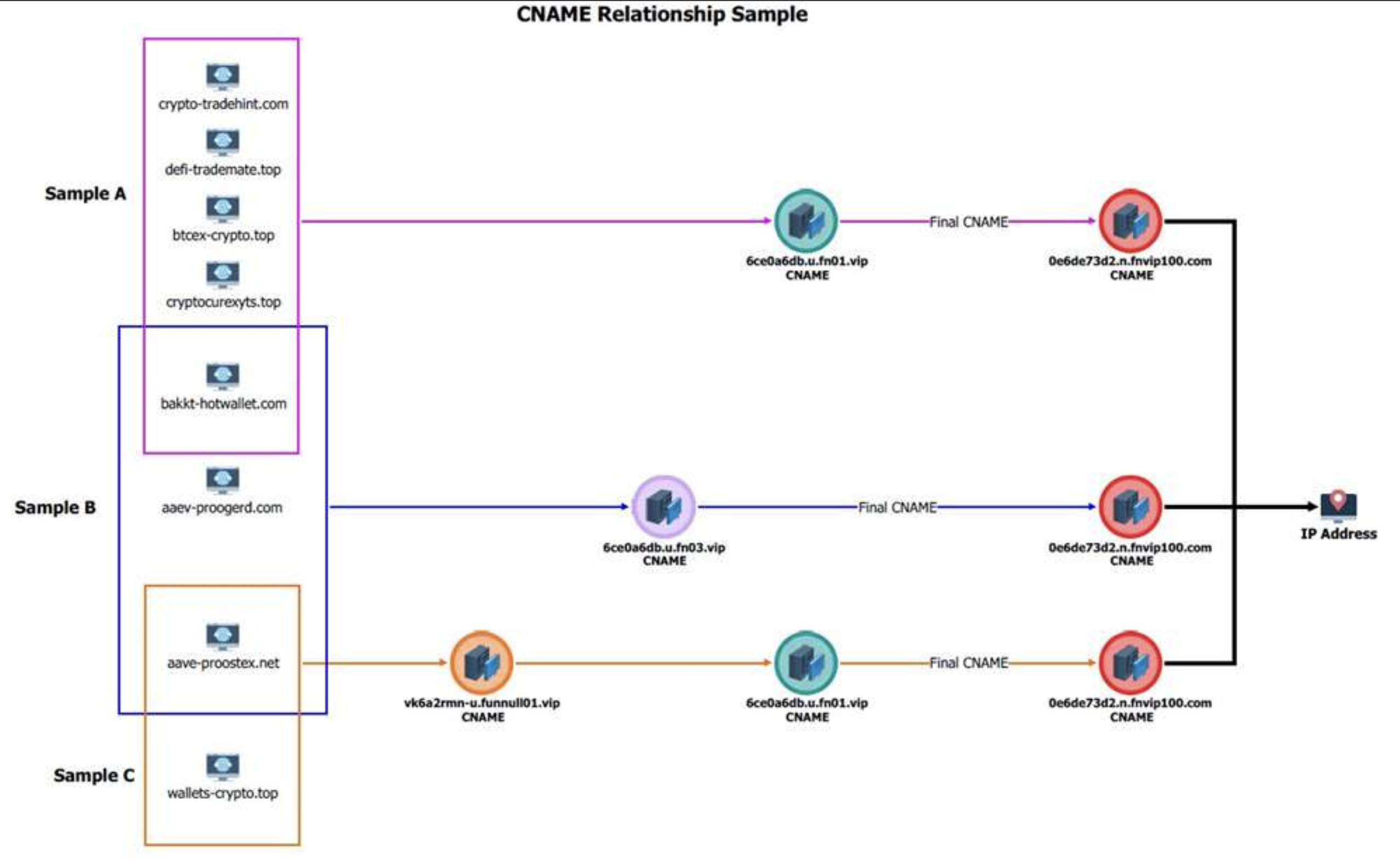
Silent Push found Funnull was a criminal content delivery network (CDN) that carried a great deal of traffic tied to scam websites, funneling the traffic through a dizzying chain of auto-generated domain names and U.S.-based cloud providers before redirecting to malicious or phishous websites. The FBI has released a technical writeup (PDF) of the infrastructure used to manage the malicious Funnull domains between October 2023 and April 2025.

A graphic from the FBI explaining how Funnull generated a slew of new domains on a regular basis and mapped them to Internet addresses on U.S. cloud providers.

Silent Push revisited Funnull’s infrastructure in January 2025 and found Funnull was still using many of the same Amazon and Microsoft cloud Internet addresses identified as malicious in its October report. Both Amazon and Microsoft pledged to rid their networks of Funnull’s presence following that story, but according to Silent Push’s Zach Edwards only one of those companies has followed through.

Edwards said Silent Push no longer sees Microsoft Internet addresses showing up in Funnull’s infrastructure, while Amazon continues to struggle with removing Funnull servers, including one that appears to have first materialized in 2023.

“Amazon is doing a terrible job — every day since they made those claims to you and us in our public blog they have had IPs still mapped to Funnull, including some that have stayed mapped for inexplicable periods of time,” Edwards said.

Amazon said its Amazon Web Services (AWS) hosting platform actively counters abuse attempts.

“We have stopped hundreds of attempts this year related to this group and we are looking into the information you shared earlier today,” reads a statement shared by Amazon. “If anyone suspects that AWS resources are being used for abusive activity, they can report it to AWS Trust & Safety using the report abuse form here.”

U.S. based cloud providers remain an attractive home base for cybercriminal organizations because many organizations will not be overly aggressive in blocking traffic from U.S.-based cloud networks, as doing so can result in blocking access to many legitimate web destinations that are also on that same shared network segment or host.

What’s more, funneling their bad traffic so that it appears to be coming out of U.S. cloud Internet providers allows cybercriminals to connect to websites from web addresses that are geographically close(r) to their targets and victims (to sidestep location-based security controls by your bank, for example).

Funnull is not the only cybercriminal infrastructure-as-a-service provider that was sanctioned this month: On May 20, 2025, the European Union imposed sanctions on Stark Industries Solutions, an ISP that materialized at the start of Russia’s invasion of Ukraine and has been used as a global proxy network that conceals the true source of cyberattacks and disinformation campaigns against enemies of Russia.

In May 2024, KrebsOnSecurity published a deep dive on Stark Industries Solutions that found much of the malicious traffic traversing Stark’s network (e.g. vulnerability scanning and password brute force attacks) was being bounced through U.S.-based cloud providers. My reporting showed how deeply Stark had penetrated U.S. ISPs, and that Ivan Neculiti for many years sold “bulletproof” hosting services that told Russian cybercrime forum customers they would proudly ignore any abuse complaints or police inquiries.

The homepage of Stark Industries Solutions.

That story examined the history of Stark’s co-founders, Moldovan brothers Ivan and Yuri Neculiti, who each denied past involvement in cybercrime or any current involvement in assisting Russian disinformation efforts or cyberattacks. Nevertheless, the EU sanctioned both brothers as well.

The EU said Stark and the Neculti brothers “enabled various Russian state-sponsored and state-affiliated actors to conduct destabilising activities including coordinated information manipulation and interference and cyber-attacks against the Union and third countries by providing services intended to hide these activities from European law enforcement and security agencies.”


Read More

Siemens SiPass Integrated

 ​As of January 10, 2023, CISA will no longer be updating ICS security advisories for Siemens product vulnerabilities beyond the initial advisory. For the most up-to-date information on vulnerabilities in this advisory, please see Siemens’ ProductCERT Security Advisories (CERT Services | Services | Siemens Global).
View CSAF
1. EXECUTIVE SUMMARY

CVSS v4 8.7
ATTENTION: Exploitable remotely/low attack complexity
Vendor: Siemens
Equipment: SiPass integrated
Vulnerability: Out-of-bounds Read

2. RISK EVALUATION
Successful exploitation of this vulnerability could allow an unauthenticated remote attacker to cause a denial-of-service condition.
3. TECHNICAL DETAILS
3.1 AFFECTED PRODUCTS
Siemens reports that the following products are affected:

SiPass integrated: Versions prior to V2.95.3.18

3.2 VULNERABILITY OVERVIEW
3.2.1 OUT-OF-BOUNDS READ CWE-125
Affected server applications contain an out of bounds read past the end of an allocated buffer while checking the integrity of incoming packets. This could allow an unauthenticated remote attacker to create a denial of service condition.
CVE-2022-31812 has been assigned to this vulnerability. A CVSS v3.1 base score of 7.5 has been calculated; the CVSS vector string is (CVSS:3.1/AV:N/AC:L/PR:N/UI:N/S:U/C:N/I:N/A:H).
A CVSS v4 score has also been calculated for CVE-2022-31812. A base score of 8.7 has been calculated; the CVSS vector string is (CVSS:4.0/AV:N/AC:L/AT:N/PR:N/UI:N/VC:N/VI:N/VA:H/SC:N/SI:N/SA:N).
3.3 BACKGROUND

CRITICAL INFRASTRUCTURE SECTORS: Commercial Facilities
COUNTRIES/AREAS DEPLOYED: Worldwide
COMPANY HEADQUARTERS LOCATION: Germany

3.4 RESEARCHER
Airbus Security reported this vulnerability to Siemens.Siemens reported this vulnerability to CISA.
4. MITIGATIONS
Siemens has identified the following specific workarounds and mitigations users can apply to reduce risk:

SiPass integrated: Update to V2.95.3.18 or later version

As a general security measure, Siemens recommends protecting network access to devices with appropriate mechanisms. To operate the devices in a protected IT environment, Siemens recommends configuring the environment according to Siemens’ operational guidelines for industrial security and following recommendations in the product manuals.
Additional information on industrial security by Siemens can be found on the Siemens industrial security webpage
For more information see the associated Siemens security advisory SSA-041082 in HTML and CSAF.
CISA recommends users take defensive measures to minimize the risk of exploitation of this vulnerability, such as:

Minimize network exposure for all control system devices and/or systems, ensuring they are not accessible from the internet.
Locate control system networks and remote devices behind firewalls and isolating them from business networks.
When remote access is required, use more secure methods, such as Virtual Private Networks (VPNs). Recognize VPNs may have vulnerabilities, should be updated to the most recent version available, and are only as secure as the connected devices.

CISA reminds organizations to perform proper impact analysis and risk assessment prior to deploying defensive measures.
CISA also provides a section for control systems security recommended practices on the ICS webpage on cisa.gov. Several CISA products detailing cyber defense best practices are available for reading and download, including Improving Industrial Control Systems Cybersecurity with Defense-in-Depth Strategies.
CISA encourages organizations to implement recommended cybersecurity strategies for proactive defense of ICS assets.
Additional mitigation guidance and recommended practices are publicly available on the ICS webpage at cisa.gov in the technical information paper, ICS-TIP-12-146-01B–Targeted Cyber Intrusion Detection and Mitigation Strategies.
Organizations observing suspected malicious activity should follow established internal procedures and report findings to CISA for tracking and correlation against other incidents.
CISA also recommends users take the following measures to protect themselves from social engineering attacks:

Do not click web links or open attachments in unsolicited email messages.
Refer to Recognizing and Avoiding Email Scams for more information on avoiding email scams.
Refer to Avoiding Social Engineering and Phishing Attacks for more information on social engineering attacks.

No known public exploitation specifically targeting this vulnerability has been reported to CISA at this time.
5. UPDATE HISTORY

May 29, 2025: Initial Republication of Siemens Security Advisory SSA-041082 

As of January 10, 2023, CISA will no longer be updating ICS security advisories for Siemens product vulnerabilities beyond the initial advisory. For the most up-to-date information on vulnerabilities in this advisory, please see Siemens’ ProductCERT Security Advisories (CERT Services | Services | Siemens Global).

View CSAF

1. EXECUTIVE SUMMARY

  • CVSS v4 8.7
  • ATTENTION: Exploitable remotely/low attack complexity
  • Vendor: Siemens
  • Equipment: SiPass integrated
  • Vulnerability: Out-of-bounds Read

2. RISK EVALUATION

Successful exploitation of this vulnerability could allow an unauthenticated remote attacker to cause a denial-of-service condition.

3. TECHNICAL DETAILS

3.1 AFFECTED PRODUCTS

Siemens reports that the following products are affected:

  • SiPass integrated: Versions prior to V2.95.3.18

3.2 VULNERABILITY OVERVIEW

3.2.1 OUT-OF-BOUNDS READ CWE-125

Affected server applications contain an out of bounds read past the end of an allocated buffer while checking the integrity of incoming packets. This could allow an unauthenticated remote attacker to create a denial of service condition.

CVE-2022-31812 has been assigned to this vulnerability. A CVSS v3.1 base score of 7.5 has been calculated; the CVSS vector string is (CVSS:3.1/AV:N/AC:L/PR:N/UI:N/S:U/C:N/I:N/A:H).

A CVSS v4 score has also been calculated for CVE-2022-31812. A base score of 8.7 has been calculated; the CVSS vector string is (CVSS:4.0/AV:N/AC:L/AT:N/PR:N/UI:N/VC:N/VI:N/VA:H/SC:N/SI:N/SA:N).

3.3 BACKGROUND

  • CRITICAL INFRASTRUCTURE SECTORS: Commercial Facilities
  • COUNTRIES/AREAS DEPLOYED: Worldwide
  • COMPANY HEADQUARTERS LOCATION: Germany

3.4 RESEARCHER

Airbus Security reported this vulnerability to Siemens.
Siemens reported this vulnerability to CISA.

4. MITIGATIONS

Siemens has identified the following specific workarounds and mitigations users can apply to reduce risk:

As a general security measure, Siemens recommends protecting network access to devices with appropriate mechanisms. To operate the devices in a protected IT environment, Siemens recommends configuring the environment according to Siemens’ operational guidelines for industrial security and following recommendations in the product manuals.

Additional information on industrial security by Siemens can be found on the Siemens industrial security webpage

For more information see the associated Siemens security advisory SSA-041082 in HTML and CSAF.

CISA recommends users take defensive measures to minimize the risk of exploitation of this vulnerability, such as:

  • Minimize network exposure for all control system devices and/or systems, ensuring they are not accessible from the internet.
  • Locate control system networks and remote devices behind firewalls and isolating them from business networks.
  • When remote access is required, use more secure methods, such as Virtual Private Networks (VPNs). Recognize VPNs may have vulnerabilities, should be updated to the most recent version available, and are only as secure as the connected devices.

CISA reminds organizations to perform proper impact analysis and risk assessment prior to deploying defensive measures.

CISA also provides a section for control systems security recommended practices on the ICS webpage on cisa.gov. Several CISA products detailing cyber defense best practices are available for reading and download, including Improving Industrial Control Systems Cybersecurity with Defense-in-Depth Strategies.

CISA encourages organizations to implement recommended cybersecurity strategies for proactive defense of ICS assets.

Additional mitigation guidance and recommended practices are publicly available on the ICS webpage at cisa.gov in the technical information paper, ICS-TIP-12-146-01B–Targeted Cyber Intrusion Detection and Mitigation Strategies.

Organizations observing suspected malicious activity should follow established internal procedures and report findings to CISA for tracking and correlation against other incidents.

CISA also recommends users take the following measures to protect themselves from social engineering attacks:

No known public exploitation specifically targeting this vulnerability has been reported to CISA at this time.

5. UPDATE HISTORY

  • May 29, 2025: Initial Republication of Siemens Security Advisory SSA-041082

 Read More

Consilium Safety CS5000 Fire Panel

 ​View CSAF
1. EXECUTIVE SUMMARY

CVSS v4 9.3
ATTENTION: Exploitable remotely/low attack complexity
Vendor: Consilium Safety
Equipment: CS5000 Fire Panel
Vulnerabilities: Initialization of a Resource with an Insecure Default, Use of Hard-coded Credentials

2. RISK EVALUATION
Successful exploitation of these vulnerabilities could allow an attacker to gain high-level access to and remotely operate the device, potentially putting it into a non-functional state.
3. TECHNICAL DETAILS
3.1 AFFECTED PRODUCTS
The following Consilium Safety product is affected:

CS5000 Fire Panel: All versions

3.2 VULNERABILITY OVERVIEW
3.2.1 INITIALIZATION OF A RESOURCE WITH AN INSECURE DEFAULT CWE-1188
The CS5000 Fire Panel is vulnerable due to a default account that exists on the panel. Even though it is possible to change this by SSHing into the device, it has remained unchanged on every installed system observed. This account is not root but holds high-level permissions that could severely impact the device’s operation if exploited.
CVE-2025-41438 has been assigned to this vulnerability. A CVSS v3.1 base score of 9.8 has been calculated; the CVSS vector string is (AV:N/AC:L/PR:N/UI:N/S:U/C:H/I:H/A:H).
A CVSS v4 score has also been calculated for CVE-2025-41438. A base score of 9.3 has been calculated; the CVSS vector string is (AV:N/AC:L/AT:N/PR:N/UI:N/VC:H/VI:H/VA:H/SC:N/SI:N/SA:N).
3.2.2 USE OF HARD-CODED CREDENTIALS CWE-798
The CS5000 Fire Panel is vulnerable due to a hard-coded password that runs on a VNC server and is visible as a string in the binary responsible for running VNC. This password cannot be altered, allowing anyone with knowledge of it to gain remote access to the panel. Such access could enable an attacker to operate the panel remotely, potentially putting the fire panel into a non-functional state and causing serious safety issues.
CVE-2025-46352 has been assigned to this vulnerability. A CVSS v3.1 base score of 9.8 has been calculated; the CVSS vector string is (AV:N/AC:L/PR:N/UI:N/S:U/C:H/I:H/A:H).
A CVSS v4 score has also been calculated for CVE-2025-46352. A base score of 9.3 has been calculated; the CVSS vector string is (AV:N/AC:L/AT:N/PR:N/UI:N/VC:H/VI:H/VA:H/SC:N/SI:N/SA:N).
3.3 BACKGROUND

CRITICAL INFRASTRUCTURE SECTORS: Commercial Facilities, Energy, Government Services and Facilities, Healthcare and Public Health, Transportation Systems
COUNTRIES/AREAS DEPLOYED: Worldwide
COMPANY HEADQUARTERS LOCATION: Sweden

3.4 RESEARCHER
Andrew Tierney of Pen Test Partners reported these vulnerabilities to CISA.
4. MITIGATIONS
Consilium Safety is aware of these vulnerabilities. Currently, no fixes are planned for the CS5000 Fire Panel.
Users wanting enhanced security features are advised to upgrade to Consilium Safety’s newer line of fire panels. Specifically, products manufactured after July 1, 2024, incorporate more secure-by-design principles.
Users of the CS5000 Fire Panel are recommended to implement compensating countermeasures, such as physical security and access control restrictions for dedicated personnel.
More product safety information can be found on Consilium Safety’s support webpage.
CISA recommends users take defensive measures to minimize the risk of exploitation of these vulnerabilities, such as:

Minimize network exposure for all control system devices and/or systems, ensuring they are not accessible from the internet.
Locate control system networks and remote devices behind firewalls and isolating them from business networks.
When remote access is required, use more secure methods, such as Virtual Private Networks (VPNs), recognizing VPNs may have vulnerabilities and should be updated to the most current version available. Also recognize VPN is only as secure as the connected devices.

CISA reminds organizations to perform proper impact analysis and risk assessment prior to deploying defensive measures.
CISA also provides a section for control systems security recommended practices on the ICS webpage on cisa.gov/ics. Several CISA products detailing cyber defense best practices are available for reading and download, including Improving Industrial Control Systems Cybersecurity with Defense-in-Depth Strategies.
CISA encourages organizations to implement recommended cybersecurity strategies for proactive defense of ICS assets.
Additional mitigation guidance and recommended practices are publicly available on the ICS webpage at cisa.gov/ics in the technical information paper, ICS-TIP-12-146-01B–Targeted Cyber Intrusion Detection and Mitigation Strategies.
Organizations observing suspected malicious activity should follow established internal procedures and report findings to CISA for tracking and correlation against other incidents.
No known public exploitation specifically targeting these vulnerabilities has been reported to CISA at this time.
5. UPDATE HISTORY

May 29, 2025: Initial Publication 

View CSAF

1. EXECUTIVE SUMMARY

  • CVSS v4 9.3
  • ATTENTION: Exploitable remotely/low attack complexity
  • Vendor: Consilium Safety
  • Equipment: CS5000 Fire Panel
  • Vulnerabilities: Initialization of a Resource with an Insecure Default, Use of Hard-coded Credentials

2. RISK EVALUATION

Successful exploitation of these vulnerabilities could allow an attacker to gain high-level access to and remotely operate the device, potentially putting it into a non-functional state.

3. TECHNICAL DETAILS

3.1 AFFECTED PRODUCTS

The following Consilium Safety product is affected:

  • CS5000 Fire Panel: All versions

3.2 VULNERABILITY OVERVIEW

3.2.1 INITIALIZATION OF A RESOURCE WITH AN INSECURE DEFAULT CWE-1188

The CS5000 Fire Panel is vulnerable due to a default account that exists on the panel. Even though it is possible to change this by SSHing into the device, it has remained unchanged on every installed system observed. This account is not root but holds high-level permissions that could severely impact the device’s operation if exploited.

CVE-2025-41438 has been assigned to this vulnerability. A CVSS v3.1 base score of 9.8 has been calculated; the CVSS vector string is (AV:N/AC:L/PR:N/UI:N/S:U/C:H/I:H/A:H).

A CVSS v4 score has also been calculated for CVE-2025-41438. A base score of 9.3 has been calculated; the CVSS vector string is (AV:N/AC:L/AT:N/PR:N/UI:N/VC:H/VI:H/VA:H/SC:N/SI:N/SA:N).

3.2.2 USE OF HARD-CODED CREDENTIALS CWE-798

The CS5000 Fire Panel is vulnerable due to a hard-coded password that runs on a VNC server and is visible as a string in the binary responsible for running VNC. This password cannot be altered, allowing anyone with knowledge of it to gain remote access to the panel. Such access could enable an attacker to operate the panel remotely, potentially putting the fire panel into a non-functional state and causing serious safety issues.

CVE-2025-46352 has been assigned to this vulnerability. A CVSS v3.1 base score of 9.8 has been calculated; the CVSS vector string is (AV:N/AC:L/PR:N/UI:N/S:U/C:H/I:H/A:H).

A CVSS v4 score has also been calculated for CVE-2025-46352. A base score of 9.3 has been calculated; the CVSS vector string is (AV:N/AC:L/AT:N/PR:N/UI:N/VC:H/VI:H/VA:H/SC:N/SI:N/SA:N).

3.3 BACKGROUND

  • CRITICAL INFRASTRUCTURE SECTORS: Commercial Facilities, Energy, Government Services and Facilities, Healthcare and Public Health, Transportation Systems
  • COUNTRIES/AREAS DEPLOYED: Worldwide
  • COMPANY HEADQUARTERS LOCATION: Sweden

3.4 RESEARCHER

Andrew Tierney of Pen Test Partners reported these vulnerabilities to CISA.

4. MITIGATIONS

Consilium Safety is aware of these vulnerabilities. Currently, no fixes are planned for the CS5000 Fire Panel.

Users wanting enhanced security features are advised to upgrade to Consilium Safety’s newer line of fire panels. Specifically, products manufactured after July 1, 2024, incorporate more secure-by-design principles.

Users of the CS5000 Fire Panel are recommended to implement compensating countermeasures, such as physical security and access control restrictions for dedicated personnel.

More product safety information can be found on Consilium Safety’s support webpage.

CISA recommends users take defensive measures to minimize the risk of exploitation of these vulnerabilities, such as:

  • Minimize network exposure for all control system devices and/or systems, ensuring they are not accessible from the internet.
  • Locate control system networks and remote devices behind firewalls and isolating them from business networks.
  • When remote access is required, use more secure methods, such as Virtual Private Networks (VPNs), recognizing VPNs may have vulnerabilities and should be updated to the most current version available. Also recognize VPN is only as secure as the connected devices.

CISA reminds organizations to perform proper impact analysis and risk assessment prior to deploying defensive measures.

CISA also provides a section for control systems security recommended practices on the ICS webpage on cisa.gov/ics. Several CISA products detailing cyber defense best practices are available for reading and download, including Improving Industrial Control Systems Cybersecurity with Defense-in-Depth Strategies.

CISA encourages organizations to implement recommended cybersecurity strategies for proactive defense of ICS assets.

Additional mitigation guidance and recommended practices are publicly available on the ICS webpage at cisa.gov/ics in the technical information paper, ICS-TIP-12-146-01B–Targeted Cyber Intrusion Detection and Mitigation Strategies.

Organizations observing suspected malicious activity should follow established internal procedures and report findings to CISA for tracking and correlation against other incidents.

No known public exploitation specifically targeting these vulnerabilities has been reported to CISA at this time.

5. UPDATE HISTORY

  • May 29, 2025: Initial Publication

 Read More

Instantel Micromate

 ​View CSAF
1. EXECUTIVE SUMMARY

CVSS v4 9.3
ATTENTION: Exploitable remotely/low attack complexity
Vendor: Instantel
Equipment: Micromate
Vulnerability: Missing Authentication for Critical Function

2. RISK EVALUATION
Successful exploitation of this vulnerability could allow an unauthenticated attacker to access the device’s configuration port and execute commands.
3. TECHNICAL DETAILS
3.1 AFFECTED PRODUCTS
The following versions of Micromate are affected:

Micromate: All versions

3.2 VULNERABILITY OVERVIEW
3.2.1 MISSING AUTHENTICATION FOR CRITICAL FUNCTION CWE-306
Instantel Micromate lacks authentication on a configuration port which could allow an attacker to execute commands if connected.
CVE-2025-1907 has been assigned to this vulnerability. A CVSS v3.1 base score of 9.8 has been calculated; the CVSS vector string is (AV:N/AC:L/PR:N/UI:N/S:U/C:H/I:H/A:H).
A CVSS v4 score has also been calculated for CVE-2025-1907. A base score of 9.3 has been calculated; the CVSS vector string is (AV:N/AC:L/AT:N/PR:N/UI:N/VC:H/VI:H/VA:H/SC:N/SI:N/SA:N).
3.3 BACKGROUND

CRITICAL INFRASTRUCTURE SECTORS: Critical Manufacturing
COUNTRIES/AREAS DEPLOYED: Worldwide
COMPANY HEADQUARTERS LOCATION: Canada

3.4 RESEARCHER
Souvik Kandar of MicroSec (microsec.io) reported this vulnerability to CISA.
4. MITIGATIONS
Instantel is actively working on a firmware update to address this vulnerability. In the meantime, Micromate users are advised to implement the following workaround measures:

Establish and maintain a list of approved IP addresses that are allowed to access the modem. This measure will help prevent unauthorized access.

For more information, please contact Instantel technical support.
CISA recommends users take defensive measures to minimize the risk of exploitation of this vulnerability, such as:

Minimize network exposure for all control system devices and/or systems, ensuring they are not accessible from the internet.
Locate control system networks and remote devices behind firewalls and isolating them from business networks.
When remote access is required, use more secure methods, such as Virtual Private Networks (VPNs), recognizing VPNs may have vulnerabilities and should be updated to the most current version available. Also recognize VPN is only as secure as the connected devices.

CISA reminds organizations to perform proper impact analysis and risk assessment prior to deploying defensive measures.
CISA also provides a section for control systems security recommended practices on the ICS webpage on cisa.gov/ics. Several CISA products detailing cyber defense best practices are available for reading and download, including Improving Industrial Control Systems Cybersecurity with Defense-in-Depth Strategies.
CISA encourages organizations to implement recommended cybersecurity strategies for proactive defense of ICS assets.
Additional mitigation guidance and recommended practices are publicly available on the ICS webpage at cisa.gov/ics in the technical information paper, ICS-TIP-12-146-01B–Targeted Cyber Intrusion Detection and Mitigation Strategies.
Organizations observing suspected malicious activity should follow established internal procedures and report findings to CISA for tracking and correlation against other incidents.
No known public exploitation specifically targeting this vulnerability has been reported to CISA at this time.
5. UPDATE HISTORY

May 29, 2025: Initial Publication 

View CSAF

1. EXECUTIVE SUMMARY

  • CVSS v4 9.3
  • ATTENTION: Exploitable remotely/low attack complexity
  • Vendor: Instantel
  • Equipment: Micromate
  • Vulnerability: Missing Authentication for Critical Function

2. RISK EVALUATION

Successful exploitation of this vulnerability could allow an unauthenticated attacker to access the device’s configuration port and execute commands.

3. TECHNICAL DETAILS

3.1 AFFECTED PRODUCTS

The following versions of Micromate are affected:

  • Micromate: All versions

3.2 VULNERABILITY OVERVIEW

3.2.1 MISSING AUTHENTICATION FOR CRITICAL FUNCTION CWE-306

Instantel Micromate lacks authentication on a configuration port which could allow an attacker to execute commands if connected.

CVE-2025-1907 has been assigned to this vulnerability. A CVSS v3.1 base score of 9.8 has been calculated; the CVSS vector string is (AV:N/AC:L/PR:N/UI:N/S:U/C:H/I:H/A:H).

A CVSS v4 score has also been calculated for CVE-2025-1907. A base score of 9.3 has been calculated; the CVSS vector string is (AV:N/AC:L/AT:N/PR:N/UI:N/VC:H/VI:H/VA:H/SC:N/SI:N/SA:N).

3.3 BACKGROUND

  • CRITICAL INFRASTRUCTURE SECTORS: Critical Manufacturing
  • COUNTRIES/AREAS DEPLOYED: Worldwide
  • COMPANY HEADQUARTERS LOCATION: Canada

3.4 RESEARCHER

Souvik Kandar of MicroSec (microsec.io) reported this vulnerability to CISA.

4. MITIGATIONS

Instantel is actively working on a firmware update to address this vulnerability. In the meantime, Micromate users are advised to implement the following workaround measures:

  • Establish and maintain a list of approved IP addresses that are allowed to access the modem. This measure will help prevent unauthorized access.

For more information, please contact Instantel technical support.

CISA recommends users take defensive measures to minimize the risk of exploitation of this vulnerability, such as:

  • Minimize network exposure for all control system devices and/or systems, ensuring they are not accessible from the internet.
  • Locate control system networks and remote devices behind firewalls and isolating them from business networks.
  • When remote access is required, use more secure methods, such as Virtual Private Networks (VPNs), recognizing VPNs may have vulnerabilities and should be updated to the most current version available. Also recognize VPN is only as secure as the connected devices.

CISA reminds organizations to perform proper impact analysis and risk assessment prior to deploying defensive measures.

CISA also provides a section for control systems security recommended practices on the ICS webpage on cisa.gov/ics. Several CISA products detailing cyber defense best practices are available for reading and download, including Improving Industrial Control Systems Cybersecurity with Defense-in-Depth Strategies.

CISA encourages organizations to implement recommended cybersecurity strategies for proactive defense of ICS assets.

Additional mitigation guidance and recommended practices are publicly available on the ICS webpage at cisa.gov/ics in the technical information paper, ICS-TIP-12-146-01B–Targeted Cyber Intrusion Detection and Mitigation Strategies.

Organizations observing suspected malicious activity should follow established internal procedures and report findings to CISA for tracking and correlation against other incidents.

No known public exploitation specifically targeting this vulnerability has been reported to CISA at this time.

5. UPDATE HISTORY

  • May 29, 2025: Initial Publication

 Read More

CISA Releases Five Industrial Control Systems Advisories

 ​CISA released five Industrial Control Systems (ICS) advisories on May 29, 2025. These advisories provide timely information about current security issues, vulnerabilities, and exploits surrounding ICS.

ICSA-25-148-01 Siemens SiPass
ICSA-25-148-02 Siemens SiPass Integrated
ICSA-25-148-03 Consilium Safety CS5000 Fire Panel
ICSA-25-148-04 Instantel Micromate 
ICSMA-25-148-01 Santesoft Sante DICOM Viewer Pro

CISA encourages users and administrators to review newly released ICS advisories for technical details and mitigations. 

CISA released five Industrial Control Systems (ICS) advisories on May 29, 2025. These advisories provide timely information about current security issues, vulnerabilities, and exploits surrounding ICS.

CISA encourages users and administrators to review newly released ICS advisories for technical details and mitigations.

 Read More

Siemens SiPass

 ​As of January 10, 2023, CISA will no longer be updating ICS security advisories for Siemens product vulnerabilities beyond the initial advisory. For the most up-to-date information on vulnerabilities in this advisory, please see Siemens’ ProductCERT Security Advisories (CERT Services | Services | Siemens Global).
View CSAF
1. EXECUTIVE SUMMARY

CVSS v4 8.2
ATTENTION: Exploitable remotely/low attack complexity
Vendor: Siemens
Equipment: SiPass
Vulnerability: Improper Verification of Cryptographic Signature

2. RISK EVALUATION
Successful exploitation of this vulnerability could allow an attacker to upload a maliciously modified firmware onto the device.
3. TECHNICAL DETAILS
3.1 AFFECTED PRODUCTS
Siemens reports that the following products are affected:

Siemens SiPass integrated AC5102 (ACC-G2): All versions
Siemens SiPass integrated ACC-AP: All versions

3.2 VULNERABILITY OVERVIEW
3.2.1 IMPROPER VERIFICATION OF CRYPTOGRAPHIC SIGNATURE CWE-347
Affected devices do not properly check the integrity of firmware updates. This could allow a local attacker to upload a maliciously modified firmware onto the device. In a second scenario, a remote attacker who is able to intercept the transfer of a valid firmware from the server to the device could modify the firmware “on the fly”.
CVE-2022-31807 has been assigned to this vulnerability. A CVSS v3.1 base score of 6.2 has been calculated; the CVSS vector string is (CVSS:3.1/AV:L/AC:L/PR:N/UI:N/S:U/C:N/I:H/A:N).
A CVSS v4 score has also been calculated for CVE-2022-31807. A base score of 8.2 has been calculated; the CVSS vector string is (CVSS:4.0/AV:N/AC:L/AT:P/PR:N/UI:N/VC:N/VI:H/VA:N/SC:N/SI:N/SA:N).
3.3 BACKGROUND

CRITICAL INFRASTRUCTURE SECTORS: Critical Manufacturing
COUNTRIES/AREAS DEPLOYED: Worldwide
COMPANY HEADQUARTERS LOCATION: Germany

3.4 RESEARCHER
Siemens reported this vulnerability to CISA.
4. MITIGATIONS
Siemens has identified the following specific workarounds and mitigations users can apply to reduce risk:

All affected products: Enable TLS for communication between servers and affected devices; this mitigates the risk of on-path attackers that intercept and modify the firmware during transmission
All affected products: Currently no fix is available

As a general security measure, Siemens recommends protecting network access to devices with appropriate mechanisms. To operate the devices in a protected IT environment, Siemens recommends configuring the environment according to Siemens’ operational guidelines for industrial security and following recommendations in the product manuals.
Additional information on industrial security by Siemens can be found on the Siemens industrial security webpage
For more information see the associated Siemens security advisory SSA-367714 in HTML and CSAF.
CISA recommends users take defensive measures to minimize the risk of exploitation of this vulnerability, such as:

Minimize network exposure for all control system devices and/or systems, ensuring they are not accessible from the internet.
Locate control system networks and remote devices behind firewalls and isolating them from business networks.
When remote access is required, use more secure methods, such as Virtual Private Networks (VPNs). Recognize VPNs may have vulnerabilities, should be updated to the most recent version available, and are only as secure as the connected devices.

CISA reminds organizations to perform proper impact analysis and risk assessment prior to deploying defensive measures.
CISA also provides a section for control systems security recommended practices on the ICS webpage on cisa.gov. Several CISA products detailing cyber defense best practices are available for reading and download, including Improving Industrial Control Systems Cybersecurity with Defense-in-Depth Strategies.
CISA encourages organizations to implement recommended cybersecurity strategies for proactive defense of ICS assets.
Additional mitigation guidance and recommended practices are publicly available on the ICS webpage at cisa.gov in the technical information paper, ICS-TIP-12-146-01B–Targeted Cyber Intrusion Detection and Mitigation Strategies.
Organizations observing suspected malicious activity should follow established internal procedures and report findings to CISA for tracking and correlation against other incidents.
CISA also recommends users take the following measures to protect themselves from social engineering attacks:

Do not click web links or open attachments in unsolicited email messages.
Refer to Recognizing and Avoiding Email Scams for more information on avoiding email scams.
Refer to Avoiding Social Engineering and Phishing Attacks for more information on social engineering attacks.

No known public exploitation specifically targeting this vulnerability has been reported to CISA at this time.
5. UPDATE HISTORY

May 29, 2025: Initial Republishing of Siemens SSA-367714 

As of January 10, 2023, CISA will no longer be updating ICS security advisories for Siemens product vulnerabilities beyond the initial advisory. For the most up-to-date information on vulnerabilities in this advisory, please see Siemens’ ProductCERT Security Advisories (CERT Services | Services | Siemens Global).

View CSAF

1. EXECUTIVE SUMMARY

  • CVSS v4 8.2
  • ATTENTION: Exploitable remotely/low attack complexity
  • Vendor: Siemens
  • Equipment: SiPass
  • Vulnerability: Improper Verification of Cryptographic Signature

2. RISK EVALUATION

Successful exploitation of this vulnerability could allow an attacker to upload a maliciously modified firmware onto the device.

3. TECHNICAL DETAILS

3.1 AFFECTED PRODUCTS

Siemens reports that the following products are affected:

  • Siemens SiPass integrated AC5102 (ACC-G2): All versions
  • Siemens SiPass integrated ACC-AP: All versions

3.2 VULNERABILITY OVERVIEW

3.2.1 IMPROPER VERIFICATION OF CRYPTOGRAPHIC SIGNATURE CWE-347

Affected devices do not properly check the integrity of firmware updates. This could allow a local attacker to upload a maliciously modified firmware onto the device. In a second scenario, a remote attacker who is able to intercept the transfer of a valid firmware from the server to the device could modify the firmware “on the fly”.

CVE-2022-31807 has been assigned to this vulnerability. A CVSS v3.1 base score of 6.2 has been calculated; the CVSS vector string is (CVSS:3.1/AV:L/AC:L/PR:N/UI:N/S:U/C:N/I:H/A:N).

A CVSS v4 score has also been calculated for CVE-2022-31807. A base score of 8.2 has been calculated; the CVSS vector string is (CVSS:4.0/AV:N/AC:L/AT:P/PR:N/UI:N/VC:N/VI:H/VA:N/SC:N/SI:N/SA:N).

3.3 BACKGROUND

  • CRITICAL INFRASTRUCTURE SECTORS: Critical Manufacturing
  • COUNTRIES/AREAS DEPLOYED: Worldwide
  • COMPANY HEADQUARTERS LOCATION: Germany

3.4 RESEARCHER

Siemens reported this vulnerability to CISA.

4. MITIGATIONS

Siemens has identified the following specific workarounds and mitigations users can apply to reduce risk:

  • All affected products: Enable TLS for communication between servers and affected devices; this mitigates the risk of on-path attackers that intercept and modify the firmware during transmission
  • All affected products: Currently no fix is available

As a general security measure, Siemens recommends protecting network access to devices with appropriate mechanisms. To operate the devices in a protected IT environment, Siemens recommends configuring the environment according to Siemens’ operational guidelines for industrial security and following recommendations in the product manuals.

Additional information on industrial security by Siemens can be found on the Siemens industrial security webpage

For more information see the associated Siemens security advisory SSA-367714 in HTML and CSAF.

CISA recommends users take defensive measures to minimize the risk of exploitation of this vulnerability, such as:

  • Minimize network exposure for all control system devices and/or systems, ensuring they are not accessible from the internet.
  • Locate control system networks and remote devices behind firewalls and isolating them from business networks.
  • When remote access is required, use more secure methods, such as Virtual Private Networks (VPNs). Recognize VPNs may have vulnerabilities, should be updated to the most recent version available, and are only as secure as the connected devices.

CISA reminds organizations to perform proper impact analysis and risk assessment prior to deploying defensive measures.

CISA also provides a section for control systems security recommended practices on the ICS webpage on cisa.gov. Several CISA products detailing cyber defense best practices are available for reading and download, including Improving Industrial Control Systems Cybersecurity with Defense-in-Depth Strategies.

CISA encourages organizations to implement recommended cybersecurity strategies for proactive defense of ICS assets.

Additional mitigation guidance and recommended practices are publicly available on the ICS webpage at cisa.gov in the technical information paper, ICS-TIP-12-146-01B–Targeted Cyber Intrusion Detection and Mitigation Strategies.

Organizations observing suspected malicious activity should follow established internal procedures and report findings to CISA for tracking and correlation against other incidents.

CISA also recommends users take the following measures to protect themselves from social engineering attacks:

No known public exploitation specifically targeting this vulnerability has been reported to CISA at this time.

5. UPDATE HISTORY

  • May 29, 2025: Initial Republishing of Siemens SSA-367714

 Read More

Santesoft Sante DICOM Viewer Pro

 ​View CSAF
1. EXECUTIVE SUMMARY

CVSS v4 8.4
ATTENTION: Low attack complexity
Vendor: Santesoft
Equipment: Sante DICOM Viewer Pro
Vulnerability: Out-of-bounds Read

2. RISK EVALUATION
Successful exploitation of this vulnerability could allow an attacker to disclose information or execute arbitrary code.
3. TECHNICAL DETAILS
3.1 AFFECTED PRODUCTS
The following Santesoft products are affected:

Sante DICOM Viewer Pro: Versions 14.2.1 and prior

3.2 VULNERABILITY OVERVIEW
3.2.1 OUT-OF-BOUNDS READ CWE-125
The affected product contains a memory corruption vulnerability. A local attacker could exploit this issue to potentially disclose information and to execute arbitrary code on affected installations of Sante DICOM Viewer Pro.
CVE-2025-5307 has been assigned to this vulnerability. A CVSS v3.1 base score of 7.8 has been calculated; the CVSS vector string is (AV:L/AC:L/PR:N/UI:R/S:U/C:H/I:H/A:H).
A CVSS v4 score has also been calculated for CVE-2025-5307. A base score of 8.4 has been calculated; the CVSS vector string is (AV:L/AC:L/AT:N/PR:N/UI:A/VC:H/VI:H/VA:H/SC:N/SI:N/SA:N).
3.3 BACKGROUND

CRITICAL INFRASTRUCTURE SECTORS: Healthcare and Public Health
COUNTRIES/AREAS DEPLOYED: Worldwide
COMPANY HEADQUARTERS LOCATION: Cyprus

3.4 RESEARCHER
Michael Heinzl reported this vulnerability to CISA.
4. MITIGATIONS
Santesoft recommends users upgrade Sante DICOM Viewer Pro to version v14.2.2.
CISA recommends users take defensive measures to minimize the risk of exploitation of this vulnerability, such as:

Minimize network exposure for all control system devices and/or systems, ensuring they are not accessible from the Internet.
Locate control system networks and remote devices behind firewalls and isolating them from business networks.
When remote access is required, use more secure methods, such as Virtual Private Networks (VPNs), recognizing VPNs may have vulnerabilities and should be updated to the most current version available. Also recognize VPN is only as secure as the connected devices.

CISA reminds organizations to perform proper impact analysis and risk assessment prior to deploying defensive measures.
CISA also provides a section for control systems security recommended practices on the ICS webpage on cisa.gov/ics. Several CISA products detailing cyber defense best practices are available for reading and download, including Improving Industrial Control Systems Cybersecurity with Defense-in-Depth Strategies.
CISA encourages organizations to implement recommended cybersecurity strategies for proactive defense of ICS assets.
Additional mitigation guidance and recommended practices are publicly available on the ICS webpage at cisa.gov/ics in the technical information paper, ICS-TIP-12-146-01B–Targeted Cyber Intrusion Detection and Mitigation Strategies.
Organizations observing suspected malicious activity should follow established internal procedures and report findings to CISA for tracking and correlation against other incidents.
CISA also recommends users take the following measures to protect themselves from social engineering attacks:

Do not click web links or open attachments in unsolicited email messages.
Refer to Recognizing and Avoiding Email Scams for more information on avoiding email scams.
Refer to Avoiding Social Engineering and Phishing Attacks for more information on social engineering attacks.

No known public exploitation specifically targeting this vulnerability has been reported to CISA at this time. This vulnerability is not exploitable remotely.
5. UPDATE HISTORY

May 29, 2025: Initial Publication 

View CSAF

1. EXECUTIVE SUMMARY

  • CVSS v4 8.4
  • ATTENTION: Low attack complexity
  • Vendor: Santesoft
  • Equipment: Sante DICOM Viewer Pro
  • Vulnerability: Out-of-bounds Read

2. RISK EVALUATION

Successful exploitation of this vulnerability could allow an attacker to disclose information or execute arbitrary code.

3. TECHNICAL DETAILS

3.1 AFFECTED PRODUCTS

The following Santesoft products are affected:

  • Sante DICOM Viewer Pro: Versions 14.2.1 and prior

3.2 VULNERABILITY OVERVIEW

3.2.1 OUT-OF-BOUNDS READ CWE-125

The affected product contains a memory corruption vulnerability. A local attacker could exploit this issue to potentially disclose information and to execute arbitrary code on affected installations of Sante DICOM Viewer Pro.

CVE-2025-5307 has been assigned to this vulnerability. A CVSS v3.1 base score of 7.8 has been calculated; the CVSS vector string is (AV:L/AC:L/PR:N/UI:R/S:U/C:H/I:H/A:H).

A CVSS v4 score has also been calculated for CVE-2025-5307. A base score of 8.4 has been calculated; the CVSS vector string is (AV:L/AC:L/AT:N/PR:N/UI:A/VC:H/VI:H/VA:H/SC:N/SI:N/SA:N).

3.3 BACKGROUND

  • CRITICAL INFRASTRUCTURE SECTORS: Healthcare and Public Health
  • COUNTRIES/AREAS DEPLOYED: Worldwide
  • COMPANY HEADQUARTERS LOCATION: Cyprus

3.4 RESEARCHER

Michael Heinzl reported this vulnerability to CISA.

4. MITIGATIONS

Santesoft recommends users upgrade Sante DICOM Viewer Pro to version v14.2.2.

CISA recommends users take defensive measures to minimize the risk of exploitation of this vulnerability, such as:

  • Minimize network exposure for all control system devices and/or systems, ensuring they are not accessible from the Internet.
  • Locate control system networks and remote devices behind firewalls and isolating them from business networks.
  • When remote access is required, use more secure methods, such as Virtual Private Networks (VPNs), recognizing VPNs may have vulnerabilities and should be updated to the most current version available. Also recognize VPN is only as secure as the connected devices.

CISA reminds organizations to perform proper impact analysis and risk assessment prior to deploying defensive measures.

CISA also provides a section for control systems security recommended practices on the ICS webpage on cisa.gov/ics. Several CISA products detailing cyber defense best practices are available for reading and download, including Improving Industrial Control Systems Cybersecurity with Defense-in-Depth Strategies.

CISA encourages organizations to implement recommended cybersecurity strategies for proactive defense of ICS assets.

Additional mitigation guidance and recommended practices are publicly available on the ICS webpage at cisa.gov/ics in the technical information paper, ICS-TIP-12-146-01B–Targeted Cyber Intrusion Detection and Mitigation Strategies.

Organizations observing suspected malicious activity should follow established internal procedures and report findings to CISA for tracking and correlation against other incidents.

CISA also recommends users take the following measures to protect themselves from social engineering attacks:

No known public exploitation specifically targeting this vulnerability has been reported to CISA at this time. This vulnerability is not exploitable remotely.

5. UPDATE HISTORY

  • May 29, 2025: Initial Publication

 Read More

Scroll to Top