
Pakistan Arrests 21 in ‘Heartsender’ Malware Service

​Authorities in Pakistan have arrested 21 individuals accused of operating “Heartsender,” a once popular spam and malware dissemination service that operated for more than a decade. The main clientele for HeartSender were organized crime groups that tried to trick victim companies into making payments to a third party, and its alleged proprietors were publicly identified by KrebsOnSecurity in 2021 after they inadvertently infected their computers with malware. 

Authorities in Pakistan have arrested 21 individuals accused of operating “Heartsender,” a once popular spam and malware dissemination service that operated for more than a decade. The main clientele for HeartSender were organized crime groups that tried to trick victim companies into making payments to a third party, and its alleged proprietors were publicly identified by KrebsOnSecurity in 2021 after they inadvertently infected their computers with malware.

Some of the core developers and sellers of Heartsender posing at a work outing in 2021. WeCodeSolutions boss Rameez Shahzad (in sunglasses) is in the center of this group photo, which was posted by employee Burhan Ul Haq, pictured just to the right of Shahzad.

A report from the Pakistani media outlet Dawn states that authorities there arrested 21 people alleged to have operated Heartsender, a spam delivery service whose homepage openly advertised phishing kits targeting users of various Internet companies, including Microsoft 365, Yahoo, AOL, Intuit, iCloud and ID.me. Pakistan’s National Cyber Crime Investigation Agency (NCCIA) reportedly conducted raids in Lahore’s Bahria Town and Multan on May 15 and 16.

The NCCIA told reporters the group’s tools were connected to more than $50m in losses in the United States alone, with European authorities investigating 63 additional cases.

“This wasn’t just a scam operation – it was essentially a cybercrime university that empowered fraudsters globally,” NCCIA Director Abdul Ghaffar said at a press briefing.

In January 2025, the FBI and the Dutch Police seized the technical infrastructure for the cybercrime service, which was marketed under the brands Heartsender, Fudpage and Fudtools (and many other “fud” variations). The “fud” bit stands for “Fully Un-Detectable,” and it refers to cybercrime resources that will evade detection by security tools like antivirus software or anti-spam appliances.

The FBI says transnational organized crime groups that purchased these services primarily used them to run business email compromise (BEC) schemes, wherein the cybercrime actors tricked victim companies into making payments to a third party.

Dawn reported that those arrested included Rameez Shahzad, the alleged ringleader of the Heartsender cybercrime business, which most recently operated under the Pakistani front company WeCodeSolutions. Mr. Shahzad was named and pictured in a 2021 KrebsOnSecurity story about a series of remarkable operational security mistakes that exposed their identities and Facebook pages showing employees posing for group photos and socializing at work-related outings.

Prior to folding their operations behind WeCodeSolutions, Shahzad and others arrested this month operated as a web hosting group calling itself The Manipulaters. KrebsOnSecurity first wrote about The Manipulaters in May 2015, mainly because their ads at the time were blanketing a number of popular cybercrime forums, and because they were fairly open and brazen about what they were doing — even who they were in real life.

Sometime in 2019, The Manipulaters failed to renew their core domain name — manipulaters[.]com — the same one tied to so many of the company’s business operations. That domain was quickly scooped up by Scylla Intel, a cyber intelligence firm that specializes in connecting cybercriminals to their real-life identities. Soon after, Scylla started receiving large amounts of email correspondence intended for the group’s owners.

In 2024, DomainTools.com found the web-hosted version of Heartsender leaked an extraordinary amount of user information to unauthenticated users, including customer credentials and email records from Heartsender employees. DomainTools says the malware infections on Manipulaters PCs exposed “vast swaths of account-related data along with an outline of the group’s membership, operations, and position in the broader underground economy.”

Shahzad allegedly used the alias “Saim Raza,” an identity which has contacted KrebsOnSecurity multiple times over the past decade with demands to remove stories published about the group. The Saim Raza identity most recently contacted this author in November 2024, asserting they had quit the cybercrime industry and turned over a new leaf after a brush with the Pakistani police.

The arrested suspects include Rameez Shahzad, Muhammad Aslam (Rameez’s father), Atif Hussain, Muhammad Umar Irshad, Yasir Ali, Syed Saim Ali Shah, Muhammad Nowsherwan, Burhanul Haq, Adnan Munawar, Abdul Moiz, Hussnain Haider, Bilal Ahmad, Dilbar Hussain, Muhammad Adeel Akram, Awais Rasool, Usama Farooq, Usama Mehmood and Hamad Nawaz.
 

Read More

CISA Releases One Industrial Control Systems Advisory

 ​CISA released one Industrial Control Systems (ICS) advisory on May 27, 2025. These advisories provide timely information about current security issues, vulnerabilities, and exploits surrounding ICS.

ICSA-25-146-01 Johnson Controls iSTAR Configuration Utility (ICU) Tool

CISA encourages users and administrators to review newly released ICS advisories for technical details and mitigations. 

CISA released one Industrial Control Systems (ICS) advisory on May 27, 2025. These advisories provide timely information about current security issues, vulnerabilities, and exploits surrounding ICS.

CISA encourages users and administrators to review newly released ICS advisories for technical details and mitigations.

 Read More

Johnson Controls iSTAR Configuration Utility (ICU) Tool

 ​View CSAF
1. EXECUTIVE SUMMARY

CVSS v4 6.3
ATTENTION: Low attack complexity
Vendor: Johnson Controls Inc.
Equipment: iSTAR Configuration Utility (ICU) tool
Vulnerability: Use of Uninitialized Variable

2. RISK EVALUATION
Successful exploitation of this vulnerability may allow an attacker to gain access to memory leaked from the ICU.
3. TECHNICAL DETAILS
3.1 AFFECTED PRODUCTS
Johnson Controls reports the following versions of ICU are affected:

ICU: All versions prior to 6.9.5

3.2 VULNERABILITY OVERVIEW
3.2.1 USE OF UNINITIALIZED VARIABLE CWE-457
The iSTAR Configuration Utility (ICU) tool leaks memory, which could result in unintended exposure of unauthorized data.
CVE-2025-26383 has been assigned to this vulnerability. A CVSS v3.1 base score of 7.4 has been calculated; the CVSS vector string is (CVSS:3.1/AV:A/AC:L/PR:N/UI:N/S:C/C:H/I:N/A:N).
A CVSS v4 score has also been calculated for CVE-2025-26383. A base score of 6.3 has been calculated; the CVSS vector string is (CVSS:4.0/AV:A/AC:L/AT:N/PR:N/UI:N/VC:L/VI:N/VA:N/SC:H/SI:N/SA:N).
3.3 BACKGROUND

CRITICAL INFRASTRUCTURE SECTORS: Commercial Facilities, Critical Manufacturing, Energy, Government Services and Facilities, Transportation Systems
COUNTRIES/AREAS DEPLOYED: Worldwide
COMPANY HEADQUARTERS LOCATION: Ireland

3.4 RESEARCHER
Reid Wightman of Dragos reported this vulnerability to Johnson Controls Inc.
4. MITIGATIONS
Johnson Controls recommends users update ICU to Version 6.9.5 or greater.
For more detailed mitigation instructions, please see Johnson Controls Product Security Advisory JCI-PSA-2025-06
For assistance and additional information, please contact Johnson Controls Trust Centertrustcenter@jci.com
CISA recommends users take defensive measures to minimize the risk of exploitation of this vulnerability, such as:

Minimize network exposure for all control system devices and/or systems, ensuring they are not accessible from the Internet.
Locate control system networks and remote devices behind firewalls and isolating them from business networks.
When remote access is required, use more secure methods, such as virtual private networks (VPNs), recognizing VPNs may have vulnerabilities and should be updated to the most current version available. Also recognize VPN is only as secure as the connected devices.

CISA reminds organizations to perform proper impact analysis and risk assessment prior to deploying defensive measures.
CISA also provides a section for control systems security recommended practices on the ICS webpage on cisa.gov/ics. Several CISA products detailing cyber defense best practices are available for reading and download, including Improving Industrial Control Systems Cybersecurity with Defense-in-Depth Strategies.
CISA encourages organizations to implement recommended cybersecurity strategies for proactive defense of ICS assets.
Additional mitigation guidance and recommended practices are publicly available on the ICS webpage at cisa.gov/ics in the technical information paper, ICS-TIP-12-146-01B–Targeted Cyber Intrusion Detection and Mitigation Strategies.
No known public exploitation specifically targeting this vulnerability has been reported to CISA at this time.
5. UPDATE HISTORY

May 27, 2025: Initial Republication of Johnson Controls security advisory 

View CSAF

1. EXECUTIVE SUMMARY

  • CVSS v4 6.3
  • ATTENTION: Low attack complexity
  • Vendor: Johnson Controls Inc.
  • Equipment: iSTAR Configuration Utility (ICU) tool
  • Vulnerability: Use of Uninitialized Variable

2. RISK EVALUATION

Successful exploitation of this vulnerability may allow an attacker to gain access to memory leaked from the ICU.

3. TECHNICAL DETAILS

3.1 AFFECTED PRODUCTS

Johnson Controls reports the following versions of ICU are affected:

  • ICU: All versions prior to 6.9.5

3.2 VULNERABILITY OVERVIEW

3.2.1 USE OF UNINITIALIZED VARIABLE CWE-457

The iSTAR Configuration Utility (ICU) tool leaks memory, which could result in unintended exposure of unauthorized data.

CVE-2025-26383 has been assigned to this vulnerability. A CVSS v3.1 base score of 7.4 has been calculated; the CVSS vector string is (CVSS:3.1/AV:A/AC:L/PR:N/UI:N/S:C/C:H/I:N/A:N).

A CVSS v4 score has also been calculated for CVE-2025-26383. A base score of 6.3 has been calculated; the CVSS vector string is (CVSS:4.0/AV:A/AC:L/AT:N/PR:N/UI:N/VC:L/VI:N/VA:N/SC:H/SI:N/SA:N).

3.3 BACKGROUND

  • CRITICAL INFRASTRUCTURE SECTORS: Commercial Facilities, Critical Manufacturing, Energy, Government Services and Facilities, Transportation Systems
  • COUNTRIES/AREAS DEPLOYED: Worldwide
  • COMPANY HEADQUARTERS LOCATION: Ireland

3.4 RESEARCHER

Reid Wightman of Dragos reported this vulnerability to Johnson Controls Inc.

4. MITIGATIONS

Johnson Controls recommends users update ICU to Version 6.9.5 or greater.

For more detailed mitigation instructions, please see Johnson Controls Product Security Advisory JCI-PSA-2025-06

For assistance and additional information, please contact Johnson Controls Trust Center
trustcenter@jci.com

CISA recommends users take defensive measures to minimize the risk of exploitation of this vulnerability, such as:

  • Minimize network exposure for all control system devices and/or systems, ensuring they are not accessible from the Internet.
  • Locate control system networks and remote devices behind firewalls and isolating them from business networks.
  • When remote access is required, use more secure methods, such as virtual private networks (VPNs), recognizing VPNs may have vulnerabilities and should be updated to the most current version available. Also recognize VPN is only as secure as the connected devices.

CISA reminds organizations to perform proper impact analysis and risk assessment prior to deploying defensive measures.

CISA also provides a section for control systems security recommended practices on the ICS webpage on cisa.gov/ics. Several CISA products detailing cyber defense best practices are available for reading and download, including Improving Industrial Control Systems Cybersecurity with Defense-in-Depth Strategies.

CISA encourages organizations to implement recommended cybersecurity strategies for proactive defense of ICS assets.

Additional mitigation guidance and recommended practices are publicly available on the ICS webpage at cisa.gov/ics in the technical information paper, ICS-TIP-12-146-01B–Targeted Cyber Intrusion Detection and Mitigation Strategies.

No known public exploitation specifically targeting this vulnerability has been reported to CISA at this time.

5. UPDATE HISTORY

  • May 27, 2025: Initial Republication of Johnson Controls security advisory

 Read More

New Guidance for SIEM and SOAR Implementation

 ​Today, CISA, in collaboration with the Australian Signals Directorate’s Australian Cyber Security Centre (ASD’s ACSC) and other international and U.S. partners, released new guidance for organizations seeking to procure Security Information and Event Management (SIEM) and Security Orchestration, Automation, and Response (SOAR) platforms.
This guidance includes the following three resources:

Implementing SIEM and SOAR Platforms – Executive Guidance outlines how executives can enhance their organization’s cybersecurity framework by implementing these technologies to improve visibility into network activities, enabling swift detection and response to cyber threats.
Implementing SIEM and SOAR Platforms – Practitioner Guidance focuses on how practitioners can quickly identify and respond to potential cybersecurity threats and leverage these technologies to streamline incident response processes by automating predefined actions based on detected anomalies.
Priority Logs for SIEM Ingestion – Practitioner Guidance offers insights for prioritizing log ingestion into a SIEM, ensuring that critical data sources are effectively collected and analyzed to enhance threat detection and incident response capabilities tailored for organizations.

CISA encourages organizations to review this guidance and implement the recommended best practices to strengthen their cybersecurity. For access to the guidance documents, please visit CISA’s SIEM and SOAR Resource page. 

Today, CISA, in collaboration with the Australian Signals Directorate’s Australian Cyber Security Centre (ASD’s ACSC) and other international and U.S. partners, released new guidance for organizations seeking to procure Security Information and Event Management (SIEM) and Security Orchestration, Automation, and Response (SOAR) platforms.

This guidance includes the following three resources:

  • Implementing SIEM and SOAR Platforms – Executive Guidance outlines how executives can enhance their organization’s cybersecurity framework by implementing these technologies to improve visibility into network activities, enabling swift detection and response to cyber threats.
  • Implementing SIEM and SOAR Platforms – Practitioner Guidance focuses on how practitioners can quickly identify and respond to potential cybersecurity threats and leverage these technologies to streamline incident response processes by automating predefined actions based on detected anomalies.
  • Priority Logs for SIEM Ingestion – Practitioner Guidance offers insights for prioritizing log ingestion into a SIEM, ensuring that critical data sources are effectively collected and analyzed to enhance threat detection and incident response capabilities tailored for organizations.

CISA encourages organizations to review this guidance and implement the recommended best practices to strengthen their cybersecurity. For access to the guidance documents, please visit CISA’s SIEM and SOAR Resource page.

 Read More

Oops: DanaBot Malware Devs Infected Their Own PCs

​The U.S. government today unsealed criminal charges against 16 individuals accused of operating and selling DanaBot, a prolific strain of information-stealing malware that has been sold on Russian cybercrime forums since 2018. The FBI says a newer version of DanaBot was used for espionage, and that many of the defendants exposed their real-life identities after accidentally infecting their own systems with the malware. 

The U.S. government today unsealed criminal charges against 16 individuals accused of operating and selling DanaBot, a prolific strain of information-stealing malware that has been sold on Russian cybercrime forums since 2018. The FBI says a newer version of DanaBot was used for espionage, and that many of the defendants exposed their real-life identities after accidentally infecting their own systems with the malware.

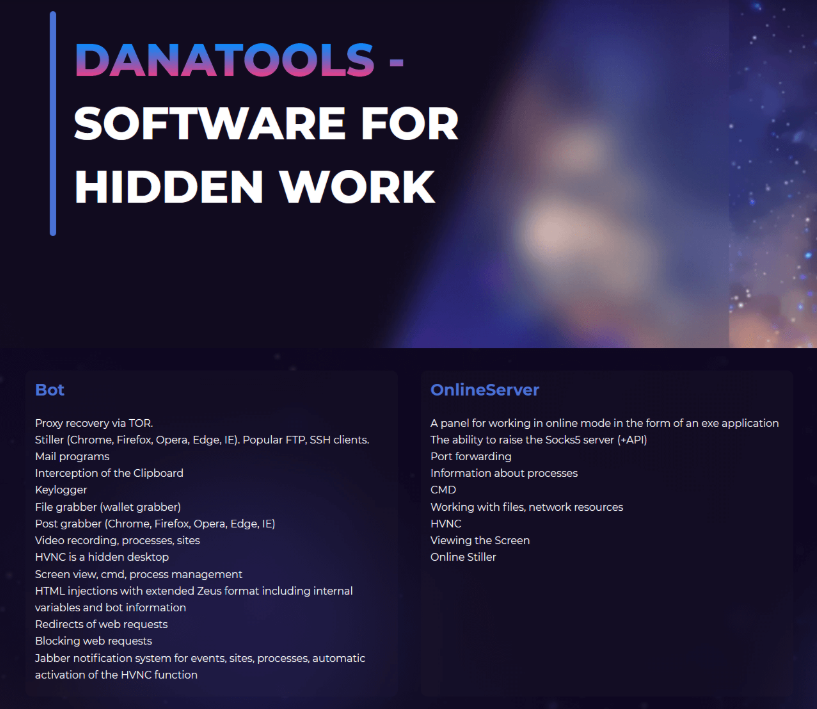
DanaBot’s features, as promoted on its support site. Image: welivesecurity.com.

Initially spotted in May 2018 by researchers at the email security firm Proofpoint, DanaBot is a malware-as-a-service platform that specializes in credential theft and banking fraud.

Today, the U.S. Department of Justice unsealed a criminal complaint and indictment from 2022, which said the FBI identified at least 40 affiliates who were paying between $3,000 and $4,000 a month for access to the information stealer platform.

The government says the malware infected more than 300,000 systems globally, causing estimated losses of more than $50 million. The ringleaders of the DanaBot conspiracy are named as Aleksandr Stepanov, 39, a.k.a. “JimmBee,” and Artem Aleksandrovich Kalinkin, 34, a.k.a. “Onix”, both of Novosibirsk, Russia. Kalinkin is an IT engineer for the Russian state-owned energy giant Gazprom. His Facebook profile name is “Maffiozi.”

According to the FBI, there were at least two major versions of DanaBot; the first was sold between 2018 and June 2020, when the malware stopped being offered on Russian cybercrime forums. The government alleges that the second version of DanaBot — emerging in January 2021 — was provided to co-conspirators for use in targeting military, diplomatic and non-governmental organization computers in several countries, including the United States, Belarus, the United Kingdom, Germany, and Russia.

“Unindicted co-conspirators would use the Espionage Variant to compromise computers around the world and steal sensitive diplomatic communications, credentials, and other data from these targeted victims,” reads a grand jury indictment dated Sept. 20, 2022. “This stolen data included financial transactions by diplomatic staff, correspondence concerning day-to-day diplomatic activity, as well as summaries of a particular country’s interactions with the United States.”

The indictment says the FBI in 2022 seized servers used by the DanaBot authors to control their malware, as well as the servers that stored stolen victim data. The government said the server data also show numerous instances in which the DanaBot defendants infected their own PCs, resulting in their credential data being uploaded to stolen data repositories that were seized by the feds.

“In some cases, such self-infections appeared to be deliberately done in order to test, analyze, or improve the malware,” the criminal complaint reads. “In other cases, the infections seemed to be inadvertent – one of the hazards of committing cybercrime is that criminals will sometimes infect themselves with their own malware by mistake.”

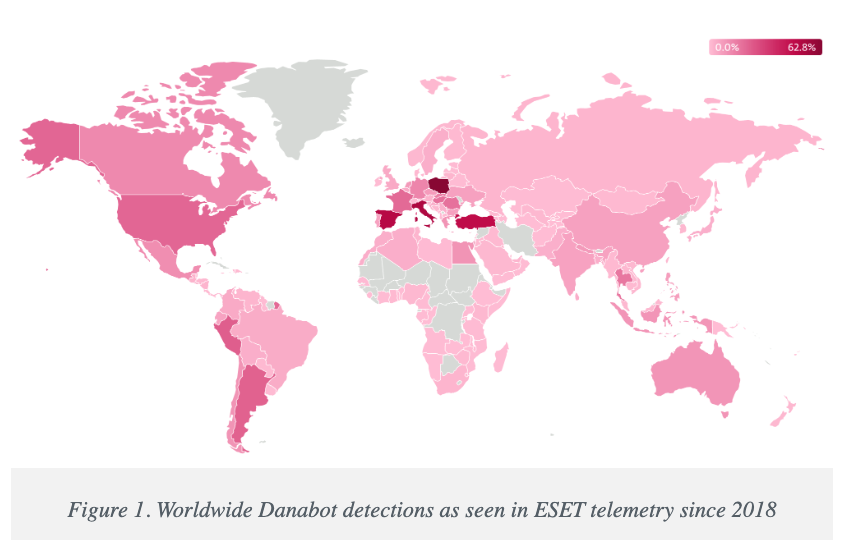
Image: welivesecurity.com

A statement from the DOJ says that as part of today’s operation, agents with the Defense Criminal Investigative Service (DCIS) seized the DanaBot control servers, including dozens of virtual servers hosted in the United States. The government says it is now working with industry partners to notify DanaBot victims and help remediate infections. The statement credits a number of security firms with providing assistance to the government, including ESET, Flashpoint, Google, Intel 471, Lumen, PayPal, Proofpoint, Team CYRMU, and ZScaler.

It’s not unheard of for financially-oriented malicious software to be repurposed for espionage. A variant of the ZeuS Trojan, which was used in countless online banking attacks against companies in the United States and Europe between 2007 and at least 2015, was for a time diverted to espionage tasks by its author.

As detailed in this 2015 story, the author of the ZeuS trojan created a custom version of the malware to serve purely as a spying machine, which scoured infected systems in Ukraine for specific keywords in emails and documents that would likely only be found in classified documents.

The public charging of the 16 DanaBot defendants comes a day after Microsoft joined a slew of tech companies in disrupting the IT infrastructure for another malware-as-a-service offering — Lumma Stealer, which is likewise offered to affiliates under tiered subscription prices ranging from $250 to $1,000 per month. Separately, Microsoft filed a civil lawsuit to seize control over 2,300 domain names used by Lumma Stealer and its affiliates.

Further reading:

Danabot: Analyzing a Fallen Empire

ZScaler blog: DanaBot Launches DDoS Attack Against the Ukrainian Ministry of Defense

Flashpoint: Operation Endgame DanaBot Malware

March 2022 criminal complaint v. Artem Aleksandrovich Kalinkin

September 2022 grand jury indictment naming the 16 defendants


Read More

Advisory Update on Cyber Threat Activity Targeting Commvault’s SaaS Cloud Application (Metallic)

 ​Commvault is monitoring cyber threat activity targeting their applications hosted in their Microsoft Azure cloud environment. Threat actors may have accessed client secrets for Commvault’s (Metallic) Microsoft 365 (M365) backup software-as-a-service (SaaS) solution, hosted in Azure. This provided the threat actors with unauthorized access to Commvault’s customers’ M365 environments that have application secrets stored by Commvault.
See the following resource for more information: Notice: Security Advisory (Update).
CISA believes the threat activity may be part of a larger campaign targeting various SaaS companies’ cloud applications with default configurations and elevated permissions.
CISA urges users and administrators to review the following mitigations and apply necessary patches and updates for all systems:

Monitor Entra audit logs for unauthorized modifications or additions of credentials to service principals initiated by Commvault applications/service principals.

Handle deviations from regular login schedules as suspicious.
For more information, see NSA and CISA’s Identity Management guidance, as well as CISA’s guidance on Identity, Credential, and Access Management (ICAM) Reference Architecture.

Review Microsoft logs (Entra audit, Entra sign-in, unified audit logs) and conduct internal threat hunting in alignment with documented organizational incident response polices.
(Applies to single tenant apps only) Implement a conditional access policy that limits authentication of an application service principal to an approved IP address that is listed within Commvault’s allowlisted range of IP addresses.

Note: A Microsoft Entra Workload ID Premium License is required to apply conditional access policies to an application service principal and is available to customers at an additional cost.[1]

For certain Commvault customers, rotate their application secrets, rotate those credentials on Commvault Metallic applications and service principles available between February and May 2025.[2] Note: This mitigation only applies to a limited number of customers who themselves have control over Commvault’s application secrets.

Customers who have the ability to, if applicable, should establish a policy to regularly rotate credentials at least every 30 days.

Review the list of Application Registrations and Service Principals in Entra with administrative consent for higher privileges than the business need.
Implement general M365 security recommendations outlined in CISA’s Secure Cloud Business Applications (SCuBA) Project.

Precautionary Recommendations for On-premises Software Versions

Where technically feasible, restrict access to Commvault management interfaces to trusted networks and administrative systems.
Detect and block path-traversal attempts and suspicious file uploads by deploying a Web Application Firewall and removing external access to Commvault applications [CSA-250502].
Apply the patches provided [3] and follow these best practices [4].

Especially monitor activity from unexpected directories, particularly web-accessible paths.

CISA added CVE-2025-3928 to the Known Exploited Vulnerabilities Catalog and is continuing to investigate the malicious activity in collaboration with partner organizations.
References
[1] Workload identities – Microsoft Entra Workload ID | Microsoft Learn
[2] Change a Client Secret for the Azure App for OneDrive for Business
[3] CV_2025_03_1: Critical Webserver Vulnerability
[4] Best Practice Guide: Enhancing Security with Conditional Access and Sign-In Monitoring
Additional Resources

Get servicePrincipal – Microsoft Graph v1.0 | Microsoft Learn
Updated Best Practices in Security for Azure Apps Configuration to Protect M365, D365 or EntraID Workload | Commvault

Organizations should report incidents and anomalous activity to CISA’s 24/7 Operations Center at Report@cisa.gov or (888) 282-0870. 

Commvault is monitoring cyber threat activity targeting their applications hosted in their Microsoft Azure cloud environment. Threat actors may have accessed client secrets for Commvault’s (Metallic) Microsoft 365 (M365) backup software-as-a-service (SaaS) solution, hosted in Azure. This provided the threat actors with unauthorized access to Commvault’s customers’ M365 environments that have application secrets stored by Commvault.

See the following resource for more information: Notice: Security Advisory (Update).

CISA believes the threat activity may be part of a larger campaign targeting various SaaS companies’ cloud applications with default configurations and elevated permissions.

CISA urges users and administrators to review the following mitigations and apply necessary patches and updates for all systems:

  1. Monitor Entra audit logs for unauthorized modifications or additions of credentials to service principals initiated by Commvault applications/service principals.
    1. Handle deviations from regular login schedules as suspicious.
    2. For more information, see NSA and CISA’s Identity Management guidance, as well as CISA’s guidance on Identity, Credential, and Access Management (ICAM) Reference Architecture.
  2. Review Microsoft logs (Entra audit, Entra sign-in, unified audit logs) and conduct internal threat hunting in alignment with documented organizational incident response polices.
  3. (Applies to single tenant apps only) Implement a conditional access policy that limits authentication of an application service principal to an approved IP address that is listed within Commvault’s allowlisted range of IP addresses.
    1. Note: A Microsoft Entra Workload ID Premium License is required to apply conditional access policies to an application service principal and is available to customers at an additional cost.[1]
  4. For certain Commvault customers, rotate their application secrets, rotate those credentials on Commvault Metallic applications and service principles available between February and May 2025.[2] Note: This mitigation only applies to a limited number of customers who themselves have control over Commvault’s application secrets.
    1. Customers who have the ability to, if applicable, should establish a policy to regularly rotate credentials at least every 30 days.
  5. Review the list of Application Registrations and Service Principals in Entra with administrative consent for higher privileges than the business need.
  6. Implement general M365 security recommendations outlined in CISA’s Secure Cloud Business Applications (SCuBA) Project.
Precautionary Recommendations for On-premises Software Versions
  1. Where technically feasible, restrict access to Commvault management interfaces to trusted networks and administrative systems.
  2. Detect and block path-traversal attempts and suspicious file uploads by deploying a Web Application Firewall and removing external access to Commvault applications [CSA-250502].
  3. Apply the patches provided [3] and follow these best practices [4].
    1. Especially monitor activity from unexpected directories, particularly web-accessible paths.

CISA added CVE-2025-3928 to the Known Exploited Vulnerabilities Catalog and is continuing to investigate the malicious activity in collaboration with partner organizations.

References

[1] Workload identities – Microsoft Entra Workload ID | Microsoft Learn

[2] Change a Client Secret for the Azure App for OneDrive for Business

[3] CV_2025_03_1: Critical Webserver Vulnerability

[4] Best Practice Guide: Enhancing Security with Conditional Access and Sign-In Monitoring

Additional Resources

Organizations should report incidents and anomalous activity to CISA’s 24/7 Operations Center at Report@cisa.gov or (888) 282-0870.

 Read More

CISA Adds One Known Exploited Vulnerability to Catalog

 ​CISA has added one new vulnerability to its Known Exploited Vulnerabilities Catalog, based on evidence of active exploitation. 

CVE-2025-4632 Samsung MagicINFO 9 Server Path Traversal Vulnerability 

These types of vulnerabilities are frequent attack vectors for malicious cyber actors and pose significant risks to the federal enterprise. 

Binding Operational Directive (BOD) 22-01: Reducing the Significant Risk of Known Exploited Vulnerabilities established the Known Exploited Vulnerabilities Catalog as a living list of known Common Vulnerabilities and Exposures (CVEs) that carry significant risk to the federal enterprise. BOD 22-01 requires Federal Civilian Executive Branch (FCEB) agencies to remediate identified vulnerabilities by the due date to protect FCEB networks against active threats. See the BOD 22-01 Fact Sheet for more information. 

Although BOD 22-01 only applies to FCEB agencies, CISA strongly urges all organizations to reduce their exposure to cyberattacks by prioritizing timely remediation of Catalog vulnerabilities as part of their vulnerability management practice. CISA will continue to add vulnerabilities to the catalog that meet the specified criteria.  

CISA has added one new vulnerability to its Known Exploited Vulnerabilities Catalog, based on evidence of active exploitation. 

  • CVE-2025-4632 Samsung MagicINFO 9 Server Path Traversal Vulnerability 

These types of vulnerabilities are frequent attack vectors for malicious cyber actors and pose significant risks to the federal enterprise. 

Binding Operational Directive (BOD) 22-01: Reducing the Significant Risk of Known Exploited Vulnerabilities established the Known Exploited Vulnerabilities Catalog as a living list of known Common Vulnerabilities and Exposures (CVEs) that carry significant risk to the federal enterprise. BOD 22-01 requires Federal Civilian Executive Branch (FCEB) agencies to remediate identified vulnerabilities by the due date to protect FCEB networks against active threats. See the BOD 22-01 Fact Sheet for more information. 

Although BOD 22-01 only applies to FCEB agencies, CISA strongly urges all organizations to reduce their exposure to cyberattacks by prioritizing timely remediation of Catalog vulnerabilities as part of their vulnerability management practice. CISA will continue to add vulnerabilities to the catalog that meet the specified criteria

 Read More

Lantronix Device Installer

 ​View CSAF
1. EXECUTIVE SUMMARY

CVSS v4 6.9
ATTENTION: Low attack complexity
Vendor: Lantronix
Equipment: Device Installer
Vulnerability: Improper Restriction of XML External Entity Reference

2. RISK EVALUATION
Successful exploitation of this vulnerability could allow an attacker to gain access to the host machine running the Device Installer software.
3. TECHNICAL DETAILS
3.1 AFFECTED PRODUCTS
The following Lantronix products are affected:

Device Installer: Versions 4.4.0.7 and prior

3.2 VULNERABILITY OVERVIEW
3.2.1 IMPROPER RESTRICTION OF XML EXTERNAL ENTITY REFERENCE CWE-611
Lantronix Device installer is vulnerable to XML External Entity (XXE) attacks in configuration files read from the network device. An attacker could obtain credentials, access these network devices, and modify their configurations. An attacker may also gain access to the host running the Device Installer software or the password hash of the user running the application.
CVE-2025-4338 has been assigned to this vulnerability. A CVSS v3.1 base score of 6.8 has been calculated; the CVSS vector string is (AV:A/AC:L/PR:N/UI:R/S:U/C:H/I:L/A:L).
A CVSS v4 score has also been calculated for CVE-2025-4338. A base score of 6.9 has been calculated; the CVSS vector string is (AV:A/AC:L/AT:N/PR:N/UI:A/VC:H/VI:L/VA:L/SC:N/SI:N/SA:N).
3.3 BACKGROUND

CRITICAL INFRASTRUCTURE SECTORS: Information Technology
COUNTRIES/AREAS DEPLOYED: Worldwide
COMPANY HEADQUARTERS LOCATION: United States

3.4 RESEARCHER
Robert McLellan reported this vulnerability to CISA.
4. MITIGATIONS
Lantronix indicates its Device Installer product has reached its end of support lifecycle in 2018. It will not receive any additional updates or security enhancements. For your security, Lantronix advises migrating to a supported solution Lantronix Provisioning Manager as soon as possible. Using unsupported software is at user’s own discretion and may leave user systems vulnerable to security issues.
CISA recommends users take defensive measures to minimize the risk of exploitation of this vulnerability such as:

Minimize network exposure for all control system devices and/or systems, ensuring they are not accessible from the internet.
Locate control system networks and remote devices behind firewalls and isolating them from business networks.
When remote access is required, use more secure methods, such as Virtual Private Networks (VPNs), recognizing VPNs may have vulnerabilities and should be updated to the most current version available. Also recognize VPN is only as secure as the connected devices.

CISA reminds organizations to perform proper impact analysis and risk assessment prior to deploying defensive measures.
CISA also provides a section for control systems security recommended practices on the ICS webpage on cisa.gov/ics. Several CISA products detailing cyber defense best practices are available for reading and download, including Improving Industrial Control Systems Cybersecurity with Defense-in-Depth Strategies.
CISA encourages organizations to implement recommended cybersecurity strategies for proactive defense of ICS assets.
Additional mitigation guidance and recommended practices are publicly available on the ICS webpage at cisa.gov/ics in the technical information paper, ICS-TIP-12-146-01B–Targeted Cyber Intrusion Detection and Mitigation Strategies.
Organizations observing suspected malicious activity should follow established internal procedures and report findings to CISA for tracking and correlation against other incidents.
CISA also recommends users take the following measures to protect themselves from social engineering attacks:

Do not click web links or open attachments in unsolicited email messages.
Refer to Recognizing and Avoiding Email Scams for more information on avoiding email scams.
Refer to Avoiding Social Engineering and Phishing Attacks for more information on social engineering attacks.

No known public exploitation specifically targeting this vulnerability has been reported to CISA at this time. This vulnerability is not exploitable remotely.
5. UPDATE HISTORY

May 22, 2025: Initial Publication 

View CSAF

1. EXECUTIVE SUMMARY

  • CVSS v4 6.9
  • ATTENTION: Low attack complexity
  • Vendor: Lantronix
  • Equipment: Device Installer
  • Vulnerability: Improper Restriction of XML External Entity Reference

2. RISK EVALUATION

Successful exploitation of this vulnerability could allow an attacker to gain access to the host machine running the Device Installer software.

3. TECHNICAL DETAILS

3.1 AFFECTED PRODUCTS

The following Lantronix products are affected:

  • Device Installer: Versions 4.4.0.7 and prior

3.2 VULNERABILITY OVERVIEW

3.2.1 IMPROPER RESTRICTION OF XML EXTERNAL ENTITY REFERENCE CWE-611

Lantronix Device installer is vulnerable to XML External Entity (XXE) attacks in configuration files read from the network device. An attacker could obtain credentials, access these network devices, and modify their configurations. An attacker may also gain access to the host running the Device Installer software or the password hash of the user running the application.

CVE-2025-4338 has been assigned to this vulnerability. A CVSS v3.1 base score of 6.8 has been calculated; the CVSS vector string is (AV:A/AC:L/PR:N/UI:R/S:U/C:H/I:L/A:L).

A CVSS v4 score has also been calculated for CVE-2025-4338. A base score of 6.9 has been calculated; the CVSS vector string is (AV:A/AC:L/AT:N/PR:N/UI:A/VC:H/VI:L/VA:L/SC:N/SI:N/SA:N).

3.3 BACKGROUND

  • CRITICAL INFRASTRUCTURE SECTORS: Information Technology
  • COUNTRIES/AREAS DEPLOYED: Worldwide
  • COMPANY HEADQUARTERS LOCATION: United States

3.4 RESEARCHER

Robert McLellan reported this vulnerability to CISA.

4. MITIGATIONS

Lantronix indicates its Device Installer product has reached its end of support lifecycle in 2018. It will not receive any additional updates or security enhancements. For your security, Lantronix advises migrating to a supported solution Lantronix Provisioning Manager as soon as possible. Using unsupported software is at user’s own discretion and may leave user systems vulnerable to security issues.

CISA recommends users take defensive measures to minimize the risk of exploitation of this vulnerability such as:

  • Minimize network exposure for all control system devices and/or systems, ensuring they are not accessible from the internet.
  • Locate control system networks and remote devices behind firewalls and isolating them from business networks.
  • When remote access is required, use more secure methods, such as Virtual Private Networks (VPNs), recognizing VPNs may have vulnerabilities and should be updated to the most current version available. Also recognize VPN is only as secure as the connected devices.

CISA reminds organizations to perform proper impact analysis and risk assessment prior to deploying defensive measures.

CISA also provides a section for control systems security recommended practices on the ICS webpage on cisa.gov/ics. Several CISA products detailing cyber defense best practices are available for reading and download, including Improving Industrial Control Systems Cybersecurity with Defense-in-Depth Strategies.

CISA encourages organizations to implement recommended cybersecurity strategies for proactive defense of ICS assets.

Additional mitigation guidance and recommended practices are publicly available on the ICS webpage at cisa.gov/ics in the technical information paper, ICS-TIP-12-146-01B–Targeted Cyber Intrusion Detection and Mitigation Strategies.

Organizations observing suspected malicious activity should follow established internal procedures and report findings to CISA for tracking and correlation against other incidents.

CISA also recommends users take the following measures to protect themselves from social engineering attacks:

No known public exploitation specifically targeting this vulnerability has been reported to CISA at this time. This vulnerability is not exploitable remotely.

5. UPDATE HISTORY

  • May 22, 2025: Initial Publication

 Read More

Rockwell Automation FactoryTalk Historian ThingWorx

 ​View CSAF
1. EXECUTIVE SUMMARY

CVSS v4 9.3
ATTENTION: Exploitable remotely/low attack complexity
Vendor: Rockwell Automation
Equipment: 95057C-FTHTWXCT11
Vulnerability: Improper Restriction of XML External Entity Reference

2. RISK EVALUATION
Successful exploitation of this vulnerability could allow an attacker to launch XXE-based attacks on applications that accept malicious log4net configuration files.
3. TECHNICAL DETAILS
3.1 AFFECTED PRODUCTS
The following versions of Rockwell Automation FactoryTalk Historian ThingWorx are affected:

95057C-FTHTWXCT11: Versions v4.02.00 and prior

3.2 VULNERABILITY OVERVIEW
3.2.1 IMPROPER RESTRICTION OF XML EXTERNAL ENTITY REFERENCE CWE-611
Apache log4net versions before 2.0.10 do not disable XML external entities when parsing log4net configuration files. This allows for XXE-based attacks in applications that accept attacker-controlled log4net configuration files.
CVE-2018-1285 has been assigned to this vulnerability. A CVSS v3.1 base score of 9.8 has been calculated; the CVSS vector string is (AV:N/AC:L/PR:N/UI:N/S:U/C:H/I:H/A:H).
A CVSS v4 score has also been calculated for CVE-2018-1285. A base score of 9.3 has been calculated; the CVSS vector string is (AV:N/AC:L/AT:N/PR:N/UI:N/VC:H/VI:H/VA:H/SC:N/SI:N/SA:N).
3.3 BACKGROUND

CRITICAL INFRASTRUCTURE SECTORS: Critical Manufacturing
COUNTRIES/AREAS DEPLOYED: Worldwide
COMPANY HEADQUARTERS LOCATION: United States

3.4 RESEARCHER
Rockwell Automation reported this vulnerability to CISA.
4. MITIGATIONS
Rockwell Automation released a product update addressing this vulnerability:

95057C-FTHTWXCT11: Versions v5.00.00 and later

For information on how to mitigate security risks on industrial automation control systems, Rockwell Automation encourages users to implement their suggested security best practices to minimize the risk of the vulnerability.
For more information, see Rockwell Automation Security Advisory SD1728.
CISA recommends users take defensive measures to minimize the risk of exploitation of this vulnerability, such as:

Minimize network exposure for all control system devices and/or systems, ensuring they are not accessible from the Internet.
Locate control system networks and remote devices behind firewalls and isolating them from business networks.
When remote access is required, use more secure methods, such as Virtual Private Networks (VPNs), recognizing VPNs may have vulnerabilities and should be updated to the most current version available. Also recognize VPN is only as secure as the connected devices.

CISA reminds organizations to perform proper impact analysis and risk assessment prior to deploying defensive measures.
CISA also provides a section for control systems security recommended practices on the ICS webpage on cisa.gov/ics. Several CISA products detailing cyber defense best practices are available for reading and download, including Improving Industrial Control Systems Cybersecurity with Defense-in-Depth Strategies.
CISA encourages organizations to implement recommended cybersecurity strategies for proactive defense of ICS assets.
Additional mitigation guidance and recommended practices are publicly available on the ICS webpage at cisa.gov/ics in the technical information paper, ICS-TIP-12-146-01B–Targeted Cyber Intrusion Detection and Mitigation Strategies.
Organizations observing suspected malicious activity should follow established internal procedures and report findings to CISA for tracking and correlation against other incidents.
CISA also recommends users take the following measures to protect themselves from social engineering attacks:

Do not click web links or open attachments in unsolicited email messages.
Refer to Recognizing and Avoiding Email Scams for more information on avoiding email scams.
Refer to Avoiding Social Engineering and Phishing Attacks for more information on social engineering attacks.

No known public exploitation specifically targeting this vulnerability has been reported to CISA at this time.
5. UPDATE HISTORY

May 22, 2025: Initial Republication of Rockwell Automation SD1728 

View CSAF

1. EXECUTIVE SUMMARY

  • CVSS v4 9.3
  • ATTENTION: Exploitable remotely/low attack complexity
  • Vendor: Rockwell Automation
  • Equipment: 95057C-FTHTWXCT11
  • Vulnerability: Improper Restriction of XML External Entity Reference

2. RISK EVALUATION

Successful exploitation of this vulnerability could allow an attacker to launch XXE-based attacks on applications that accept malicious log4net configuration files.

3. TECHNICAL DETAILS

3.1 AFFECTED PRODUCTS

The following versions of Rockwell Automation FactoryTalk Historian ThingWorx are affected:

  • 95057C-FTHTWXCT11: Versions v4.02.00 and prior

3.2 VULNERABILITY OVERVIEW

3.2.1 IMPROPER RESTRICTION OF XML EXTERNAL ENTITY REFERENCE CWE-611

Apache log4net versions before 2.0.10 do not disable XML external entities when parsing log4net configuration files. This allows for XXE-based attacks in applications that accept attacker-controlled log4net configuration files.

CVE-2018-1285 has been assigned to this vulnerability. A CVSS v3.1 base score of 9.8 has been calculated; the CVSS vector string is (AV:N/AC:L/PR:N/UI:N/S:U/C:H/I:H/A:H).

A CVSS v4 score has also been calculated for CVE-2018-1285. A base score of 9.3 has been calculated; the CVSS vector string is (AV:N/AC:L/AT:N/PR:N/UI:N/VC:H/VI:H/VA:H/SC:N/SI:N/SA:N).

3.3 BACKGROUND

  • CRITICAL INFRASTRUCTURE SECTORS: Critical Manufacturing
  • COUNTRIES/AREAS DEPLOYED: Worldwide
  • COMPANY HEADQUARTERS LOCATION: United States

3.4 RESEARCHER

Rockwell Automation reported this vulnerability to CISA.

4. MITIGATIONS

Rockwell Automation released a product update addressing this vulnerability:

  • 95057C-FTHTWXCT11: Versions v5.00.00 and later

For information on how to mitigate security risks on industrial automation control systems, Rockwell Automation encourages users to implement their suggested security best practices to minimize the risk of the vulnerability.

For more information, see Rockwell Automation Security Advisory SD1728.

CISA recommends users take defensive measures to minimize the risk of exploitation of this vulnerability, such as:

  • Minimize network exposure for all control system devices and/or systems, ensuring they are not accessible from the Internet.
  • Locate control system networks and remote devices behind firewalls and isolating them from business networks.
  • When remote access is required, use more secure methods, such as Virtual Private Networks (VPNs), recognizing VPNs may have vulnerabilities and should be updated to the most current version available. Also recognize VPN is only as secure as the connected devices.

CISA reminds organizations to perform proper impact analysis and risk assessment prior to deploying defensive measures.

CISA also provides a section for control systems security recommended practices on the ICS webpage on cisa.gov/ics. Several CISA products detailing cyber defense best practices are available for reading and download, including Improving Industrial Control Systems Cybersecurity with Defense-in-Depth Strategies.

CISA encourages organizations to implement recommended cybersecurity strategies for proactive defense of ICS assets.

Additional mitigation guidance and recommended practices are publicly available on the ICS webpage at cisa.gov/ics in the technical information paper, ICS-TIP-12-146-01B–Targeted Cyber Intrusion Detection and Mitigation Strategies.

Organizations observing suspected malicious activity should follow established internal procedures and report findings to CISA for tracking and correlation against other incidents.

CISA also recommends users take the following measures to protect themselves from social engineering attacks:

No known public exploitation specifically targeting this vulnerability has been reported to CISA at this time.

5. UPDATE HISTORY

  • May 22, 2025: Initial Republication of Rockwell Automation SD1728

 Read More

CISA Releases Two Industrial Control Systems Advisories

 ​CISA released two Industrial Control Systems (ICS) advisories on May 22, 2025. These advisories provide timely information about current security issues, vulnerabilities, and exploits surrounding ICS.

ICSA-25-142-01 Lantronix Device Installer
ICSA-25-142-02 Rockwell Automation FactoryTalk Historian ThingWorx

CISA encourages users and administrators to review newly released ICS advisories for technical details and mitigations. 

CISA released two Industrial Control Systems (ICS) advisories on May 22, 2025. These advisories provide timely information about current security issues, vulnerabilities, and exploits surrounding ICS.

CISA encourages users and administrators to review newly released ICS advisories for technical details and mitigations.

 Read More

Scroll to Top