Schneider Electric ConneXium Network Manager

 ​View CSAF
1. EXECUTIVE SUMMARY

CVSS v4 8.4
ATTENTION: Exploitable remotely/low attack complexity
Vendor: Schneider Electric
Equipment: ConneXium Network Manager
Vulnerabilities: Files or Directories Accessible to External Parties, Improper Input Validation

2. RISK EVALUATION
Successful exploitation of these vulnerabilities could allow an attacker to access sensitive data, escalate privileges, or perform remote code execution.
3. TECHNICAL DETAILS
3.1 AFFECTED PRODUCTS
Schneider Electric reports that the following products are affected:

Schneider Electric ConneXium Network Manager: Version 2.0.01 (CVE-2025-2222)
Schneider Electric ConneXium Network Manager: All versions (CVE-2025-2223)

3.2 VULNERABILITY OVERVIEW
3.2.1 FILES OR DIRECTORIES ACCESSIBLE TO EXTERNAL PARTIES CWE-552
CWE-552: Files or Directories Accessible to External Parties vulnerability over https exists that could leak information and potential privilege escalation following a Man-In-The-Middle attack.
CVE-2025-2222 has been assigned to this vulnerability. A CVSS v3.1 base score of 7.5 has been calculated; the CVSS vector string is (CVSS:3.1/AV:N/AC:L/PR:N/UI:N/S:U/C:H/I:N/A:N).
A CVSS v4 score has also been calculated for CVE-2025-2222. A base score of 8.2 has been calculated; the CVSS vector string is (CVSS:4.0/AV:N/AC:L/AT:P/PR:N/UI:N/VC:H/VI:N/VA:N/SC:N/SI:N/SA:N).
3.2.2 IMPROPER INPUT VALIDATION CWE-20
CWE-20: Improper Input Validation vulnerability exists that could cause a loss of confidentiality, integrity, and availability of the engineering workstation when a malicious project file is loaded by a user from the local system.
CVE-2025-2223 has been assigned to this vulnerability. A CVSS v3.1 base score of 7.8 has been calculated; the CVSS vector string is (CVSS:3.1/AV:L/AC:L/PR:N/UI:R/S:U/C:H/I:H/A:H).
A CVSS v4 score has also been calculated for CVE-2025-2223. A base score of 8.4 has been calculated; the CVSS vector string is (CVSS:4.0/AV:L/AC:L/AT:N/PR:N/UI:A/VC:H/VI:H/VA:H/SC:N/SI:N/SA:N).
3.3 BACKGROUND

CRITICAL INFRASTRUCTURE SECTORS: Commercial Facilities, Critical Manufacturing, Energy
COUNTRIES/AREAS DEPLOYED: Worldwide
COMPANY HEADQUARTERS LOCATION: France

3.4 RESEARCHER
Schneider Electric CPCERT reported these vulnerabilities to CISA.
4. MITIGATIONS
Schneider Electric has identified the following specific workarounds and mitigations users can apply to reduce risk:
Schneider Electric ConneXium Network Manager v2.0.01: Please note that the ConneXium Network Manager product has reached the end of its life and is no longer supported. Customers should immediately apply the following mitigations to reduce the risk of exploit:

Disable the webserver (disabled by default)
Follow workstation, network and site-hardening guidelines in the Recommended Cybersecurity Best Practices available for download here: https://www.se.com/ww/en/download/document/7EN52-0390/

Schneider Electric ConneXium Network Manager All versions: Please note that the ConneXium Network Manager product has reached the end of its life and is no longer supported. Customers should immediately apply the following mitigations to reduce the risk of exploit:

Only open project files received from a trusted source.
Compute a hash of the project files and regularly check the consistency of this hash to verify the integrity before usage.
Encrypt project files when stored and restrict the access to only trusted users.
When exchanging files over the network, use secure communication protocols.
Follow workstation, network and site-hardening guidelines in the Recommended Cybersecurity Best Practices available for download here: https://www.se.com/ww/en/download/document/7EN52-0390/

For more information see the associated Schneider Electric CPCERT security advisory SEVD-2025-098-01 ConneXium Network Manager Software – SEVD-2025-098-01 PDF Version, ConneXium Network Manager Software – SEVD-2025-098-01 CSAF Version.
CISA recommends users take defensive measures to minimize the risk of exploitation of these vulnerabilities, such as:

Minimize network exposure for all control system devices and/or systems, ensuring they are not accessible from the internet.
Locate control system networks and remote devices behind firewalls and isolating them from business networks.
When remote access is required, use more secure methods, such as Virtual Private Networks (VPNs). Recognize VPNs may have vulnerabilities, should be updated to the most recent version available, and are only as secure as the connected devices.

CISA reminds organizations to perform proper impact analysis and risk assessment prior to deploying defensive measures.
CISA also provides a section for control systems security recommended practices on the ICS webpage on cisa.gov. Several CISA products detailing cyber defense best practices are available for reading and download, including Improving Industrial Control Systems Cybersecurity with Defense-in-Depth Strategies.
CISA encourages organizations to implement recommended cybersecurity strategies for proactive defense of ICS assets.
Additional mitigation guidance and recommended practices are publicly available on the ICS webpage at cisa.gov in the technical information paper, ICS-TIP-12-146-01B–Targeted Cyber Intrusion Detection and Mitigation Strategies.
Organizations observing suspected malicious activity should follow established internal procedures and report findings to CISA for tracking and correlation against other incidents.
CISA also recommends users take the following measures to protect themselves from social engineering attacks:

Do not click web links or open attachments in unsolicited email messages.
Refer to Recognizing and Avoiding Email Scams for more information on avoiding email scams.
Refer to Avoiding Social Engineering and Phishing Attacks for more information on social engineering attacks.

No known public exploitation specifically targeting these vulnerabilities has been reported to CISA at this time.
5. UPDATE HISTORY

April 17, 2025: Initial Republication of Schneider Electric CPCERT SEVD-2025-098-01 

View CSAF

1. EXECUTIVE SUMMARY

  • CVSS v4 8.4
  • ATTENTION: Exploitable remotely/low attack complexity
  • Vendor: Schneider Electric
  • Equipment: ConneXium Network Manager
  • Vulnerabilities: Files or Directories Accessible to External Parties, Improper Input Validation

2. RISK EVALUATION

Successful exploitation of these vulnerabilities could allow an attacker to access sensitive data, escalate privileges, or perform remote code execution.

3. TECHNICAL DETAILS

3.1 AFFECTED PRODUCTS

Schneider Electric reports that the following products are affected:

  • Schneider Electric ConneXium Network Manager: Version 2.0.01 (CVE-2025-2222)
  • Schneider Electric ConneXium Network Manager: All versions (CVE-2025-2223)

3.2 VULNERABILITY OVERVIEW

3.2.1 FILES OR DIRECTORIES ACCESSIBLE TO EXTERNAL PARTIES CWE-552

CWE-552: Files or Directories Accessible to External Parties vulnerability over https exists that could leak information and potential privilege escalation following a Man-In-The-Middle attack.

CVE-2025-2222 has been assigned to this vulnerability. A CVSS v3.1 base score of 7.5 has been calculated; the CVSS vector string is (CVSS:3.1/AV:N/AC:L/PR:N/UI:N/S:U/C:H/I:N/A:N).

A CVSS v4 score has also been calculated for CVE-2025-2222. A base score of 8.2 has been calculated; the CVSS vector string is (CVSS:4.0/AV:N/AC:L/AT:P/PR:N/UI:N/VC:H/VI:N/VA:N/SC:N/SI:N/SA:N).

3.2.2 IMPROPER INPUT VALIDATION CWE-20

CWE-20: Improper Input Validation vulnerability exists that could cause a loss of confidentiality, integrity, and availability of the engineering workstation when a malicious project file is loaded by a user from the local system.

CVE-2025-2223 has been assigned to this vulnerability. A CVSS v3.1 base score of 7.8 has been calculated; the CVSS vector string is (CVSS:3.1/AV:L/AC:L/PR:N/UI:R/S:U/C:H/I:H/A:H).

A CVSS v4 score has also been calculated for CVE-2025-2223. A base score of 8.4 has been calculated; the CVSS vector string is (CVSS:4.0/AV:L/AC:L/AT:N/PR:N/UI:A/VC:H/VI:H/VA:H/SC:N/SI:N/SA:N).

3.3 BACKGROUND

  • CRITICAL INFRASTRUCTURE SECTORS: Commercial Facilities, Critical Manufacturing, Energy
  • COUNTRIES/AREAS DEPLOYED: Worldwide
  • COMPANY HEADQUARTERS LOCATION: France

3.4 RESEARCHER

Schneider Electric CPCERT reported these vulnerabilities to CISA.

4. MITIGATIONS

Schneider Electric has identified the following specific workarounds and mitigations users can apply to reduce risk:

Schneider Electric ConneXium Network Manager v2.0.01: Please note that the ConneXium Network Manager product has reached the end of its life and is no longer supported. Customers should immediately apply the following mitigations to reduce the risk of exploit:

Schneider Electric ConneXium Network Manager All versions: Please note that the ConneXium Network Manager product has reached the end of its life and is no longer supported. Customers should immediately apply the following mitigations to reduce the risk of exploit:

  • Only open project files received from a trusted source.
  • Compute a hash of the project files and regularly check the consistency of this hash to verify the integrity before usage.
  • Encrypt project files when stored and restrict the access to only trusted users.
  • When exchanging files over the network, use secure communication protocols.
  • Follow workstation, network and site-hardening guidelines in the Recommended Cybersecurity Best Practices available for download here: https://www.se.com/ww/en/download/document/7EN52-0390/

For more information see the associated Schneider Electric CPCERT security advisory SEVD-2025-098-01 ConneXium Network Manager Software – SEVD-2025-098-01 PDF Version, ConneXium Network Manager Software – SEVD-2025-098-01 CSAF Version.

CISA recommends users take defensive measures to minimize the risk of exploitation of these vulnerabilities, such as:

  • Minimize network exposure for all control system devices and/or systems, ensuring they are not accessible from the internet.
  • Locate control system networks and remote devices behind firewalls and isolating them from business networks.
  • When remote access is required, use more secure methods, such as Virtual Private Networks (VPNs). Recognize VPNs may have vulnerabilities, should be updated to the most recent version available, and are only as secure as the connected devices.

CISA reminds organizations to perform proper impact analysis and risk assessment prior to deploying defensive measures.

CISA also provides a section for control systems security recommended practices on the ICS webpage on cisa.gov. Several CISA products detailing cyber defense best practices are available for reading and download, including Improving Industrial Control Systems Cybersecurity with Defense-in-Depth Strategies.

CISA encourages organizations to implement recommended cybersecurity strategies for proactive defense of ICS assets.

Additional mitigation guidance and recommended practices are publicly available on the ICS webpage at cisa.gov in the technical information paper, ICS-TIP-12-146-01B–Targeted Cyber Intrusion Detection and Mitigation Strategies.

Organizations observing suspected malicious activity should follow established internal procedures and report findings to CISA for tracking and correlation against other incidents.

CISA also recommends users take the following measures to protect themselves from social engineering attacks:

No known public exploitation specifically targeting these vulnerabilities has been reported to CISA at this time.

5. UPDATE HISTORY

  • April 17, 2025: Initial Republication of Schneider Electric CPCERT SEVD-2025-098-01

 Read More

Yokogawa Recorder Products

 ​View CSAF
1. EXECUTIVE SUMMARY

CVSS v4 9.3
ATTENTION: Exploitable remotely/low attack complexity
Vendor: Yokogawa
Equipment: GX10, GX20, GP10, GP20, GM Data Acquisition System, DX1000, DX2000, DX1000N, FX1000, μR10000, μR20000, MW100, DX1000T, DX2000T, CX1000, CX2000
Vulnerability: Missing Authentication for Critical Function

2. RISK EVALUATION
Successful exploitation of this vulnerability could allow an attacker to manipulate information on the affected products.
3. TECHNICAL DETAILS
3.1 AFFECTED PRODUCTS
The following versions of Yokogawa recorder products are affected:

GX10 / GX20 / GP10 / GP20 Paperless Recorders: Versions R5.04.01 and earlier
GM Data Acquisition System: Versions R5.05.01 and earlier
DX1000 / DX2000 / DX1000N Paperless Recorders: Versions R4.21 and earlier
FX1000 Paperless Recorders: Versions R1.31 and earlier
μR10000 / μR20000 Chart Recorders: Versions R1.51 and earlier
MW100 Data Acquisition Units: All versions
DX1000T / DX2000T Paperless Recorders: All versions
CX1000 / CX2000 Paperless Recorders: All versions

3.2 VULNERABILITY OVERVIEW
3.2.1 MISSING AUTHENTICATION FOR CRITICAL FUNCTION CWE-306
Authentication is disabled by default on the affected products. When connected to a network with default settings, this could allow anyone to access all functions related to settings and operations. As a result, an attacker can illegally manipulate and configure important data such as measured values and settings.
CVE-2025-1863 has been assigned to this vulnerability. A CVSS v3.1 base score of 9.8 has been calculated; the CVSS vector string is (AV:N/AC:L/PR:N/UI:N/S:U/C:H/I:H/A:H).
A CVSS v4 score has also been calculated for CVE-2025-1863. A base score of 9.3 has been calculated; the CVSS vector string is (CVSS4.0/AV:N/AC:L/AT:N/PR:N/UI:N/VC:H/VI:H/VA:H/SC:N/SI:N/SA:N).
3.3 BACKGROUND

CRITICAL INFRASTRUCTURE SECTORS: Critical Manufacturing, Energy, Food and Agriculture
COUNTRIES/AREAS DEPLOYED: Worldwide
COMPANY HEADQUARTERS LOCATION: Japan

3.4 RESEARCHER
Souvik Kandar of MicroSec (microsec.io) reported this vulnerability to CISA.
4. MITIGATIONS
Yokogawa has provided the following countermeasures for this vulnerability:

Yokogawa urges users to enable the authentication function when connecting the affected products to the network (login function).
Be sure to change the password from the default setting after enabling the authentication function.

Yokogawa strongly recommends all users to establish and maintain a full security program. Security program components are patch updates, anti-virus, backup and recovery, zoning, hardening, whitelisting, firewall, etc. Yokogawa can assist in setting up and running the security program continuously. For considering the most effective risk mitigation plan, as a starting point, Yokogawa can perform a security risk assessment.
For more information, contact Yokogawa.
For more information and details on implementing these mitigations, users should see the Yokogawa advisory.
CISA recommends users take defensive measures to minimize the risk of exploitation of this vulnerability, such as:

Minimize network exposure for all control system devices and/or systems, ensuring they are not accessible from the internet.
Locate control system networks and remote devices behind firewalls and isolating them from business networks.
When remote access is required, use more secure methods, such as Virtual Private Networks (VPNs), recognizing VPNs may have vulnerabilities and should be updated to the most current version available. Also recognize VPN is only as secure as the connected devices.

CISA reminds organizations to perform proper impact analysis and risk assessment prior to deploying defensive measures.
CISA also provides a section for control systems security recommended practices on the ICS webpage on cisa.gov/ics. Several CISA products detailing cyber defense best practices are available for reading and download, including Improving Industrial Control Systems Cybersecurity with Defense-in-Depth Strategies.
CISA encourages organizations to implement recommended cybersecurity strategies for proactive defense of ICS assets.
Additional mitigation guidance and recommended practices are publicly available on the ICS webpage at cisa.gov/ics in the technical information paper, ICS-TIP-12-146-01B–Targeted Cyber Intrusion Detection and Mitigation Strategies.
Organizations observing suspected malicious activity should follow established internal procedures and report findings to CISA for tracking and correlation against other incidents.
No known public exploitation specifically targeting this vulnerability has been reported to CISA at this time.
5. UPDATE HISTORY

April 17, 2025: Initial Publication 

View CSAF

1. EXECUTIVE SUMMARY

  • CVSS v4 9.3
  • ATTENTION: Exploitable remotely/low attack complexity
  • Vendor: Yokogawa
  • Equipment: GX10, GX20, GP10, GP20, GM Data Acquisition System, DX1000, DX2000, DX1000N, FX1000, μR10000, μR20000, MW100, DX1000T, DX2000T, CX1000, CX2000
  • Vulnerability: Missing Authentication for Critical Function

2. RISK EVALUATION

Successful exploitation of this vulnerability could allow an attacker to manipulate information on the affected products.

3. TECHNICAL DETAILS

3.1 AFFECTED PRODUCTS

The following versions of Yokogawa recorder products are affected:

  • GX10 / GX20 / GP10 / GP20 Paperless Recorders: Versions R5.04.01 and earlier
  • GM Data Acquisition System: Versions R5.05.01 and earlier
  • DX1000 / DX2000 / DX1000N Paperless Recorders: Versions R4.21 and earlier
  • FX1000 Paperless Recorders: Versions R1.31 and earlier
  • μR10000 / μR20000 Chart Recorders: Versions R1.51 and earlier
  • MW100 Data Acquisition Units: All versions
  • DX1000T / DX2000T Paperless Recorders: All versions
  • CX1000 / CX2000 Paperless Recorders: All versions

3.2 VULNERABILITY OVERVIEW

3.2.1 MISSING AUTHENTICATION FOR CRITICAL FUNCTION CWE-306

Authentication is disabled by default on the affected products. When connected to a network with default settings, this could allow anyone to access all functions related to settings and operations. As a result, an attacker can illegally manipulate and configure important data such as measured values and settings.

CVE-2025-1863 has been assigned to this vulnerability. A CVSS v3.1 base score of 9.8 has been calculated; the CVSS vector string is (AV:N/AC:L/PR:N/UI:N/S:U/C:H/I:H/A:H).

A CVSS v4 score has also been calculated for CVE-2025-1863. A base score of 9.3 has been calculated; the CVSS vector string is (CVSS4.0/AV:N/AC:L/AT:N/PR:N/UI:N/VC:H/VI:H/VA:H/SC:N/SI:N/SA:N).

3.3 BACKGROUND

  • CRITICAL INFRASTRUCTURE SECTORS: Critical Manufacturing, Energy, Food and Agriculture
  • COUNTRIES/AREAS DEPLOYED: Worldwide
  • COMPANY HEADQUARTERS LOCATION: Japan

3.4 RESEARCHER

Souvik Kandar of MicroSec (microsec.io) reported this vulnerability to CISA.

4. MITIGATIONS

Yokogawa has provided the following countermeasures for this vulnerability:

  • Yokogawa urges users to enable the authentication function when connecting the affected products to the network (login function).
  • Be sure to change the password from the default setting after enabling the authentication function.

Yokogawa strongly recommends all users to establish and maintain a full security program. Security program components are patch updates, anti-virus, backup and recovery, zoning, hardening, whitelisting, firewall, etc. Yokogawa can assist in setting up and running the security program continuously. For considering the most effective risk mitigation plan, as a starting point, Yokogawa can perform a security risk assessment.

For more information, contact Yokogawa.

For more information and details on implementing these mitigations, users should see the Yokogawa advisory.

CISA recommends users take defensive measures to minimize the risk of exploitation of this vulnerability, such as:

  • Minimize network exposure for all control system devices and/or systems, ensuring they are not accessible from the internet.
  • Locate control system networks and remote devices behind firewalls and isolating them from business networks.
  • When remote access is required, use more secure methods, such as Virtual Private Networks (VPNs), recognizing VPNs may have vulnerabilities and should be updated to the most current version available. Also recognize VPN is only as secure as the connected devices.

CISA reminds organizations to perform proper impact analysis and risk assessment prior to deploying defensive measures.

CISA also provides a section for control systems security recommended practices on the ICS webpage on cisa.gov/ics. Several CISA products detailing cyber defense best practices are available for reading and download, including Improving Industrial Control Systems Cybersecurity with Defense-in-Depth Strategies.

CISA encourages organizations to implement recommended cybersecurity strategies for proactive defense of ICS assets.

Additional mitigation guidance and recommended practices are publicly available on the ICS webpage at cisa.gov/ics in the technical information paper, ICS-TIP-12-146-01B–Targeted Cyber Intrusion Detection and Mitigation Strategies.

Organizations observing suspected malicious activity should follow established internal procedures and report findings to CISA for tracking and correlation against other incidents.

No known public exploitation specifically targeting this vulnerability has been reported to CISA at this time.

5. UPDATE HISTORY

  • April 17, 2025: Initial Publication

 Read More

CISA Adds Three Known Exploited Vulnerabilities to Catalog

 ​CISA has added three new vulnerabilities to its Known Exploited Vulnerabilities Catalog, based on evidence of active exploitation.

CVE-2025-31200 Apple Multiple Products Memory Corruption Vulnerability
CVE-2025-31201 Apple Multiple Products Arbitrary Read and Write Vulnerability
CVE-2025-24054 Microsoft Windows NTLM Hash Disclosure Spoofing Vulnerability

These types of vulnerabilities are frequent attack vectors for malicious cyber actors and pose significant risks to the federal enterprise.
Binding Operational Directive (BOD) 22-01: Reducing the Significant Risk of Known Exploited Vulnerabilities established the Known Exploited Vulnerabilities Catalog as a living list of known Common Vulnerabilities and Exposures (CVEs) that carry significant risk to the federal enterprise. BOD 22-01 requires Federal Civilian Executive Branch (FCEB) agencies to remediate identified vulnerabilities by the due date to protect FCEB networks against active threats. See the BOD 22-01 Fact Sheet for more information.
Although BOD 22-01 only applies to FCEB agencies, CISA strongly urges all organizations to reduce their exposure to cyberattacks by prioritizing timely remediation of Catalog vulnerabilities as part of their vulnerability management practice. CISA will continue to add vulnerabilities to the catalog that meet the specified criteria. 

CISA has added three new vulnerabilities to its Known Exploited Vulnerabilities Catalog, based on evidence of active exploitation.

  • CVE-2025-31200 Apple Multiple Products Memory Corruption Vulnerability
  • CVE-2025-31201 Apple Multiple Products Arbitrary Read and Write Vulnerability
  • CVE-2025-24054 Microsoft Windows NTLM Hash Disclosure Spoofing Vulnerability

These types of vulnerabilities are frequent attack vectors for malicious cyber actors and pose significant risks to the federal enterprise.

Binding Operational Directive (BOD) 22-01: Reducing the Significant Risk of Known Exploited Vulnerabilities established the Known Exploited Vulnerabilities Catalog as a living list of known Common Vulnerabilities and Exposures (CVEs) that carry significant risk to the federal enterprise. BOD 22-01 requires Federal Civilian Executive Branch (FCEB) agencies to remediate identified vulnerabilities by the due date to protect FCEB networks against active threats. See the BOD 22-01 Fact Sheet for more information.

Although BOD 22-01 only applies to FCEB agencies, CISA strongly urges all organizations to reduce their exposure to cyberattacks by prioritizing timely remediation of Catalog vulnerabilities as part of their vulnerability management practice. CISA will continue to add vulnerabilities to the catalog that meet the specified criteria.

 Read More

CISA Releases Six Industrial Control Systems Advisories

 ​CISA released six Industrial Control Systems (ICS) advisories on April 17, 2025. These advisories provide timely information about current security issues, vulnerabilities, and exploits surrounding ICS.

ICSA-25-107-01 Schneider Electric Trio Q Licensed Data Radio
ICSA-25-107-02 Schneider Electric Sage Series
ICSA-25-107-03 Schneider Electric ConneXium Network Manager
ICSA-25-107-04 Yokogawa Recorder Products
ICSA-24-326-04 Schneider Electric Modicon M340, MC80, and Momentum Unity M1E (Update A)
ICSA-25-058-01 Schneider Electric Communication Modules for Modicon M580 and Quantum Controllers (Update A) 

CISA encourages users and administrators to review newly released ICS advisories for technical details and mitigations. 

CISA released six Industrial Control Systems (ICS) advisories on April 17, 2025. These advisories provide timely information about current security issues, vulnerabilities, and exploits surrounding ICS.

CISA encourages users and administrators to review newly released ICS advisories for technical details and mitigations.

 Read More

Schneider Electric Trio Q Licensed Data Radio

 ​View CSAF
1. EXECUTIVE SUMMARY

CVSS v4 5.4
ATTENTION: Low attack complexity
Vendor: Schneider Electric
Equipment: Trio Q Licensed Data Radio
Vulnerabilities: Insecure Storage of Sensitive Information, Initialization of a Resource with an Insecure Default

2. RISK EVALUATION
Successful exploitation of these vulnerabilities could allow an attacker to access confidential information, compromise the integrity, or affect the availability of the affected product.
3. TECHNICAL DETAILS
3.1 AFFECTED PRODUCTS
Schneider Electric reports that the following products are affected:

Schneider Electric Trio Q Licensed Data Radio: Versions prior to 2.7.2

3.2 VULNERABILITY OVERVIEW
3.2.1 INSECURE STORAGE OF SENSITIVE INFORMATION CWE-922
An insecure storage of sensitive information vulnerability exists that could potentially lead to unauthorized access to confidential data when a malicious user with physical access and advanced knowledge of the filesystem sets the radio to factory default mode.
CVE-2025-2440 has been assigned to this vulnerability. A CVSS v3.1 base score of 4.2 has been calculated; the CVSS vector string is (CVSS:3.1/AV:P/AC:H/PR:N/UI:N/S:U/C:H/I:N/A:N).
A CVSS v4 score has also been calculated for CVE-2025-2440. A base score of 4.1 has been calculated; the CVSS vector string is (CVSS:4.0/AV:P/AC:H/AT:N/PR:N/UI:N/VC:H/VI:N/VA:N/SC:N/SI:N/SA:N).
3.2.2 INITIALIZATION OF A RESOURCE WITH AN INSECURE DEFAULT CWE-1188
An incorrect initialization of resource vulnerability exists that could lead to a loss of confidentiality when a malicious user with physical access sets the radio to factory default mode, causing the product to not correctly initialize all data.
CVE-2025-2441 has been assigned to this vulnerability. A CVSS v3.1 base score of 4.6 has been calculated; the CVSS vector string is (CVSS:3.1/AV:P/AC:L/PR:N/UI:N/S:U/C:H/I:N/A:N).
A CVSS v4 score has also been calculated for CVE-2025-2441. A base score of 4.1 has been calculated; the CVSS vector string is (CVSS:4.0/AV:P/AC:L/AT:P/PR:N/UI:N/VC:H/VI:N/VA:N/SC:N/SI:N/SA:N).
3.2.3 INITIALIZATION OF A RESOURCE WITH AN INSECURE DEFAULT CWE-1188
An initialization of a resource with an insecure default vulnerability exists that could potentially lead to unauthorized access, resulting in the loss of confidentiality, integrity, and availability when a malicious user with physical access sets the radio to factory default mode.
CVE-2025-2442 has been assigned to this vulnerability. A CVSS v3.1 base score of 6.8 has been calculated; the CVSS vector string is (CVSS:3.1/AV:P/AC:L/PR:N/UI:N/S:U/C:H/I:H/A:H).
A CVSS v4 score has also been calculated for CVE-2025-2442. A base score of 5.4 has been calculated; the CVSS vector string is (CVSS:4.0/AV:P/AC:L/AT:P/PR:N/UI:N/VC:H/VI:H/VA:H/SC:N/SI:N/SA:N).
3.3 BACKGROUND

CRITICAL INFRASTRUCTURE SECTORS: Commercial Facilities, Critical Manufacturing, Energy
COUNTRIES/AREAS DEPLOYED: Worldwide
COMPANY HEADQUARTERS LOCATION: France

3.4 RESEARCHER
Schneider Electric CPCERT reported these vulnerabilities to CISA.
4. MITIGATIONS
Schneider Electric has identified the following specific workarounds and mitigations users can apply to reduce risk:

Version v2.7.2 of the TRIO Q Data Radio firmware includes fixes for the identified vulnerabilities and is available for download.
Follow the instructions in Section 10 Part J – Firmware Updating and Maintenance in the Trio Q Series Data Radio User Manual. This section provides information on how to download, install, and verify the new firmware version.

If users choose not to apply the remediation provided above, they should immediately apply the following mitigations to reduce the risk of exploitation:

Install Trio Data Radios in a secure location to prevent physical access by unauthorized personnel, and ensure they are securely disposed of when decommissioned.
Confirm the firmware loaded in Trio Data Radios using the hash published with the release notes, and follow the instructions in Section 10 Part J – Firmware Updating and Maintenance in the Trio Q Series Data Radio User Manual. This section provides information on how to download, install, and verify the new firmware version.

For more information see the associated Schneider Electric CPCERT security advisory SEVD-2025-098-02 Trio Q Licensed Data Radios – SEVD-2025-098-02 PDF Version, Trio Q Licensed Data Radios – SEVD-2025-098-02 CSAF Version.
CISA recommends users take defensive measures to minimize the risk of exploitation of these vulnerabilities. CISA reminds organizations to perform proper impact analysis and risk assessment prior to deploying defensive measures.
CISA also provides a section for control systems security recommended practices on the ICS webpage on cisa.gov. Several CISA products detailing cyber defense best practices are available for reading and download, including Improving Industrial Control Systems Cybersecurity with Defense-in-Depth Strategies.
CISA encourages organizations to implement recommended cybersecurity strategies for proactive defense of ICS assets.
Additional mitigation guidance and recommended practices are publicly available on the ICS webpage at cisa.gov in the technical information paper, ICS-TIP-12-146-01B–Targeted Cyber Intrusion Detection and Mitigation Strategies.
Organizations observing suspected malicious activity should follow established internal procedures and report findings to CISA for tracking and correlation against other incidents.
No known public exploitation specifically targeting these vulnerabilities has been reported to CISA at this time. These vulnerabilities are not exploitable remotely.
5. UPDATE HISTORY

April 17, 2025: Initial Republication of Schneider Electric SEVD-2025-098-02 

View CSAF

1. EXECUTIVE SUMMARY

  • CVSS v4 5.4
  • ATTENTION: Low attack complexity
  • Vendor: Schneider Electric
  • Equipment: Trio Q Licensed Data Radio
  • Vulnerabilities: Insecure Storage of Sensitive Information, Initialization of a Resource with an Insecure Default

2. RISK EVALUATION

Successful exploitation of these vulnerabilities could allow an attacker to access confidential information, compromise the integrity, or affect the availability of the affected product.

3. TECHNICAL DETAILS

3.1 AFFECTED PRODUCTS

Schneider Electric reports that the following products are affected:

  • Schneider Electric Trio Q Licensed Data Radio: Versions prior to 2.7.2

3.2 VULNERABILITY OVERVIEW

3.2.1 INSECURE STORAGE OF SENSITIVE INFORMATION CWE-922

An insecure storage of sensitive information vulnerability exists that could potentially lead to unauthorized access to confidential data when a malicious user with physical access and advanced knowledge of the filesystem sets the radio to factory default mode.

CVE-2025-2440 has been assigned to this vulnerability. A CVSS v3.1 base score of 4.2 has been calculated; the CVSS vector string is (CVSS:3.1/AV:P/AC:H/PR:N/UI:N/S:U/C:H/I:N/A:N).

A CVSS v4 score has also been calculated for CVE-2025-2440. A base score of 4.1 has been calculated; the CVSS vector string is (CVSS:4.0/AV:P/AC:H/AT:N/PR:N/UI:N/VC:H/VI:N/VA:N/SC:N/SI:N/SA:N).

3.2.2 INITIALIZATION OF A RESOURCE WITH AN INSECURE DEFAULT CWE-1188

An incorrect initialization of resource vulnerability exists that could lead to a loss of confidentiality when a malicious user with physical access sets the radio to factory default mode, causing the product to not correctly initialize all data.

CVE-2025-2441 has been assigned to this vulnerability. A CVSS v3.1 base score of 4.6 has been calculated; the CVSS vector string is (CVSS:3.1/AV:P/AC:L/PR:N/UI:N/S:U/C:H/I:N/A:N).

A CVSS v4 score has also been calculated for CVE-2025-2441. A base score of 4.1 has been calculated; the CVSS vector string is (CVSS:4.0/AV:P/AC:L/AT:P/PR:N/UI:N/VC:H/VI:N/VA:N/SC:N/SI:N/SA:N).

3.2.3 INITIALIZATION OF A RESOURCE WITH AN INSECURE DEFAULT CWE-1188

An initialization of a resource with an insecure default vulnerability exists that could potentially lead to unauthorized access, resulting in the loss of confidentiality, integrity, and availability when a malicious user with physical access sets the radio to factory default mode.

CVE-2025-2442 has been assigned to this vulnerability. A CVSS v3.1 base score of 6.8 has been calculated; the CVSS vector string is (CVSS:3.1/AV:P/AC:L/PR:N/UI:N/S:U/C:H/I:H/A:H).

A CVSS v4 score has also been calculated for CVE-2025-2442. A base score of 5.4 has been calculated; the CVSS vector string is (CVSS:4.0/AV:P/AC:L/AT:P/PR:N/UI:N/VC:H/VI:H/VA:H/SC:N/SI:N/SA:N).

3.3 BACKGROUND

  • CRITICAL INFRASTRUCTURE SECTORS: Commercial Facilities, Critical Manufacturing, Energy
  • COUNTRIES/AREAS DEPLOYED: Worldwide
  • COMPANY HEADQUARTERS LOCATION: France

3.4 RESEARCHER

Schneider Electric CPCERT reported these vulnerabilities to CISA.

4. MITIGATIONS

Schneider Electric has identified the following specific workarounds and mitigations users can apply to reduce risk:

  • Version v2.7.2 of the TRIO Q Data Radio firmware includes fixes for the identified vulnerabilities and is available for download.
  • Follow the instructions in Section 10 Part J – Firmware Updating and Maintenance in the Trio Q Series Data Radio User Manual. This section provides information on how to download, install, and verify the new firmware version.

If users choose not to apply the remediation provided above, they should immediately apply the following mitigations to reduce the risk of exploitation:

  • Install Trio Data Radios in a secure location to prevent physical access by unauthorized personnel, and ensure they are securely disposed of when decommissioned.
  • Confirm the firmware loaded in Trio Data Radios using the hash published with the release notes, and follow the instructions in Section 10 Part J – Firmware Updating and Maintenance in the Trio Q Series Data Radio User Manual. This section provides information on how to download, install, and verify the new firmware version.

For more information see the associated Schneider Electric CPCERT security advisory SEVD-2025-098-02 Trio Q Licensed Data Radios – SEVD-2025-098-02 PDF Version, Trio Q Licensed Data Radios – SEVD-2025-098-02 CSAF Version.

CISA recommends users take defensive measures to minimize the risk of exploitation of these vulnerabilities. CISA reminds organizations to perform proper impact analysis and risk assessment prior to deploying defensive measures.

CISA also provides a section for control systems security recommended practices on the ICS webpage on cisa.gov. Several CISA products detailing cyber defense best practices are available for reading and download, including Improving Industrial Control Systems Cybersecurity with Defense-in-Depth Strategies.

CISA encourages organizations to implement recommended cybersecurity strategies for proactive defense of ICS assets.

Additional mitigation guidance and recommended practices are publicly available on the ICS webpage at cisa.gov in the technical information paper, ICS-TIP-12-146-01B–Targeted Cyber Intrusion Detection and Mitigation Strategies.

Organizations observing suspected malicious activity should follow established internal procedures and report findings to CISA for tracking and correlation against other incidents.

No known public exploitation specifically targeting these vulnerabilities has been reported to CISA at this time. These vulnerabilities are not exploitable remotely.

5. UPDATE HISTORY

  • April 17, 2025: Initial Republication of Schneider Electric SEVD-2025-098-02

 Read More

CISA Releases Guidance on Credential Risks Associated with Potential Legacy Oracle Cloud Compromise

 ​CISA is aware of public reporting regarding potential unauthorized access to a legacy Oracle cloud environment. While the scope and impact remains unconfirmed, the nature of the reported activity presents potential risk to organizations and individuals, particularly where credential material may be exposed, reused across separate, unaffiliated systems, or embedded (i.e., hardcoded into scripts, applications, infrastructure templates, or automation tools). When credential material is embedded, it is difficult to discover and can enable long-term unauthorized access if exposed.
The compromise of credential material, including usernames, emails, passwords, authentication tokens, and encryption keys, can pose significant risk to enterprise environments. Threat actors routinely harvest and weaponize such credentials to: 

Escalate privileges and move laterally within networks.
Access cloud and identity management systems.
Conduct phishing, credential-based, or business email compromise (BEC) campaigns.  
Resell or exchange access to stolen credentials on criminal marketplaces.
Enrich stolen data with prior breach information for resale and/or targeted intrusion. 

CISA recommends the following actions to reduce the risks associated with potential credential compromise: 

For Organizations:

Reset passwords for any known affected users across enterprise services, particularly where local credentials may not be federated through enterprise identity solutions.  
Review source code, infrastructure-as-code templates, automation scripts, and configuration files for hardcoded or embedded credentials and replace them with secure authentication methods supported by centralized secret management.
Monitor authentication logs for anomalous activity, especially involving privileged, service, or federated identity accounts, and assess whether additional credentials (such as API keys and shared accounts) may be associated with any known impacted identities.
Enforce phishing-resistant multi-factor authentication (MFA) for all user and administrator accounts wherever technically feasible.
For additional information for or on Cloud security best practices please review the following Cybersecurity Information Sheets: CISA and NSA Release Cybersecurity Information Sheets on Cloud Security Best Practices.

For Users:

Immediately update any potentially affected passwords that may have been reused across other platforms or services.
Use strong, unique passwords for each account and enable phishing-resistant multifactor authentication (MFA) on services and applications that support it. For more information on using strong passwords, see CISA’s Use Strong Passwords web page. For more information on phishing-resistant MFA see CISA’s Implementing Phishing-Resistant MFA Fact Sheet.
Remain alert against phishing attempts (e.g., referencing login issues, password resets, or suspicious activity notifications) and reference Phishing Guidance: Stopping the Attack Cycle at Phase One.

Organizations should report incidents and anomalous activity to CISA’s 24/7 Operations Center at Report@cisa.gov or (888) 282-0870.  

 Disclaimer:  

The information in this report is being provided “as is” for informational purposes only. CISA does not endorse any commercial entity, product, company, or service, including any entities, products, or services linked within this document. Any reference to specific commercial entities, products, processes, or services by service mark, trademark, manufacturer, or otherwise, does not constitute or imply endorsement, recommendation, or favoring by CISA.  

CISA is aware of public reporting regarding potential unauthorized access to a legacy Oracle cloud environment. While the scope and impact remains unconfirmed, the nature of the reported activity presents potential risk to organizations and individuals, particularly where credential material may be exposed, reused across separate, unaffiliated systems, or embedded (i.e., hardcoded into scripts, applications, infrastructure templates, or automation tools). When credential material is embedded, it is difficult to discover and can enable long-term unauthorized access if exposed.

The compromise of credential material, including usernames, emails, passwords, authentication tokens, and encryption keys, can pose significant risk to enterprise environments. Threat actors routinely harvest and weaponize such credentials to: 

  • Escalate privileges and move laterally within networks.
  • Access cloud and identity management systems.
  • Conduct phishing, credential-based, or business email compromise (BEC) campaigns.  
  • Resell or exchange access to stolen credentials on criminal marketplaces.
  • Enrich stolen data with prior breach information for resale and/or targeted intrusion. 

CISA recommends the following actions to reduce the risks associated with potential credential compromise: 

  • For Organizations:
    • Reset passwords for any known affected users across enterprise services, particularly where local credentials may not be federated through enterprise identity solutions.  
    • Review source code, infrastructure-as-code templates, automation scripts, and configuration files for hardcoded or embedded credentials and replace them with secure authentication methods supported by centralized secret management.
    • Monitor authentication logs for anomalous activity, especially involving privileged, service, or federated identity accounts, and assess whether additional credentials (such as API keys and shared accounts) may be associated with any known impacted identities.
    • Enforce phishing-resistant multi-factor authentication (MFA) for all user and administrator accounts wherever technically feasible.
    • For additional information for or on Cloud security best practices please review the following Cybersecurity Information Sheets: CISA and NSA Release Cybersecurity Information Sheets on Cloud Security Best Practices.
  • For Users:
    • Immediately update any potentially affected passwords that may have been reused across other platforms or services.
    • Use strong, unique passwords for each account and enable phishing-resistant multifactor authentication (MFA) on services and applications that support it. For more information on using strong passwords, see CISA’s Use Strong Passwords web page. For more information on phishing-resistant MFA see CISA’s Implementing Phishing-Resistant MFA Fact Sheet.
    • Remain alert against phishing attempts (e.g., referencing login issues, password resets, or suspicious activity notifications) and reference Phishing Guidance: Stopping the Attack Cycle at Phase One.

Organizations should report incidents and anomalous activity to CISA’s 24/7 Operations Center at Report@cisa.gov or (888) 282-0870.  

 Disclaimer:  

The information in this report is being provided “as is” for informational purposes only. CISA does not endorse any commercial entity, product, company, or service, including any entities, products, or services linked within this document. Any reference to specific commercial entities, products, processes, or services by service mark, trademark, manufacturer, or otherwise, does not constitute or imply endorsement, recommendation, or favoring by CISA. 

 Read More

CISA Adds One Known Exploited Vulnerability to Catalog

 ​CISA has added one new vulnerability to its Known Exploited Vulnerabilities Catalog, based on evidence of active exploitation.

CVE-2021-20035 SonicWall SMA100 Appliances OS Command Injection Vulnerability

These types of vulnerabilities are frequent attack vectors for malicious cyber actors and pose significant risks to the federal enterprise.
Binding Operational Directive (BOD) 22-01: Reducing the Significant Risk of Known Exploited Vulnerabilities established the Known Exploited Vulnerabilities Catalog as a living list of known Common Vulnerabilities and Exposures (CVEs) that carry significant risk to the federal enterprise. BOD 22-01 requires Federal Civilian Executive Branch (FCEB) agencies to remediate identified vulnerabilities by the due date to protect FCEB networks against active threats. See the BOD 22-01 Fact Sheet for more information.
Although BOD 22-01 only applies to FCEB agencies, CISA strongly urges all organizations to reduce their exposure to cyberattacks by prioritizing timely remediation of Catalog vulnerabilities as part of their vulnerability management practice. CISA will continue to add vulnerabilities to the catalog that meet the specified criteria. 

CISA has added one new vulnerability to its Known Exploited Vulnerabilities Catalog, based on evidence of active exploitation.

  • CVE-2021-20035 SonicWall SMA100 Appliances OS Command Injection Vulnerability

These types of vulnerabilities are frequent attack vectors for malicious cyber actors and pose significant risks to the federal enterprise.

Binding Operational Directive (BOD) 22-01: Reducing the Significant Risk of Known Exploited Vulnerabilities established the Known Exploited Vulnerabilities Catalog as a living list of known Common Vulnerabilities and Exposures (CVEs) that carry significant risk to the federal enterprise. BOD 22-01 requires Federal Civilian Executive Branch (FCEB) agencies to remediate identified vulnerabilities by the due date to protect FCEB networks against active threats. See the BOD 22-01 Fact Sheet for more information.

Although BOD 22-01 only applies to FCEB agencies, CISA strongly urges all organizations to reduce their exposure to cyberattacks by prioritizing timely remediation of Catalog vulnerabilities as part of their vulnerability management practice. CISA will continue to add vulnerabilities to the catalog that meet the specified criteria.

 Read More

Funding Expires for Key Cyber Vulnerability Database

​A critical resource that cybersecurity professionals worldwide rely on to identify, mitigate and fix security vulnerabilities in software and hardware is in danger of breaking down. The federally funded, non-profit research and development organization MITRE warned today that its contract to maintain the Common Vulnerabilities and Exposures (CVE) program — which is traditionally funded each year by the Department of Homeland Security — expires on April 16. 

A critical resource that cybersecurity professionals worldwide rely on to identify, mitigate and fix security vulnerabilities in software and hardware is in danger of breaking down. The federally funded, non-profit research and development organization MITRE warned today that its contract to maintain the Common Vulnerabilities and Exposures (CVE) program — which is traditionally funded each year by the Department of Homeland Security — expires on April 16.

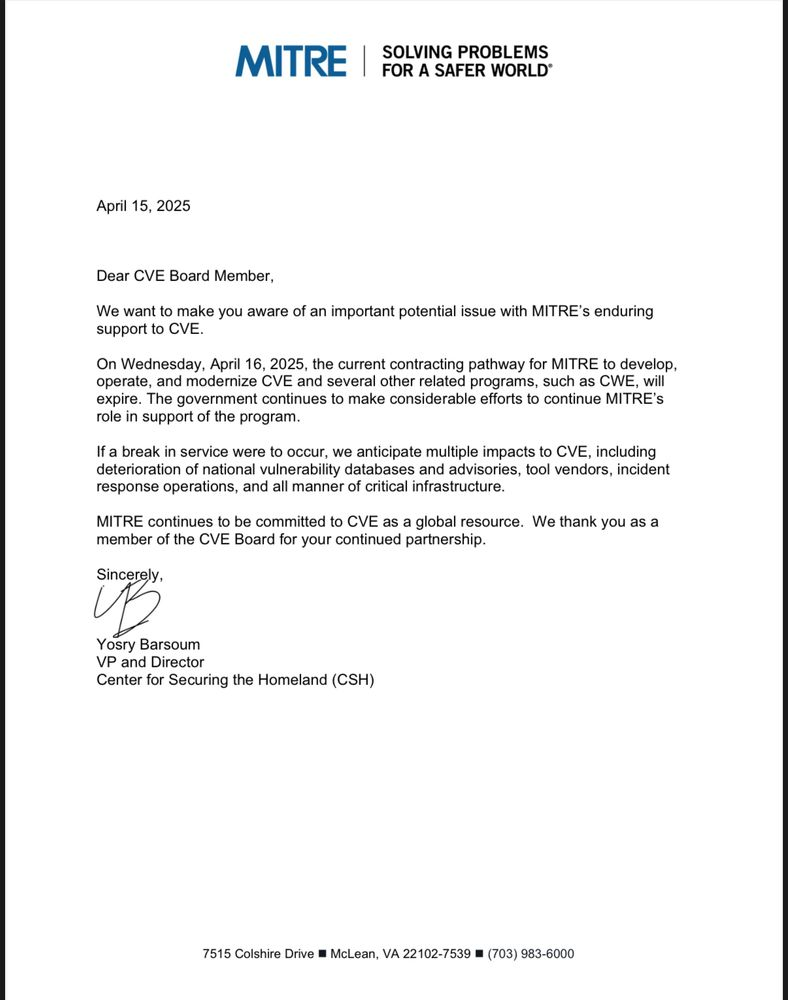
A letter from MITRE vice president Yosry Barsoum, warning that the funding for the CVE program will expire on April 16, 2025.

Tens of thousands of security flaws in software are found and reported every year, and these vulnerabilities are eventually assigned their own unique CVE tracking number (e.g. CVE-2024-43573, which is a Microsoft Windows bug that Redmond patched last year).

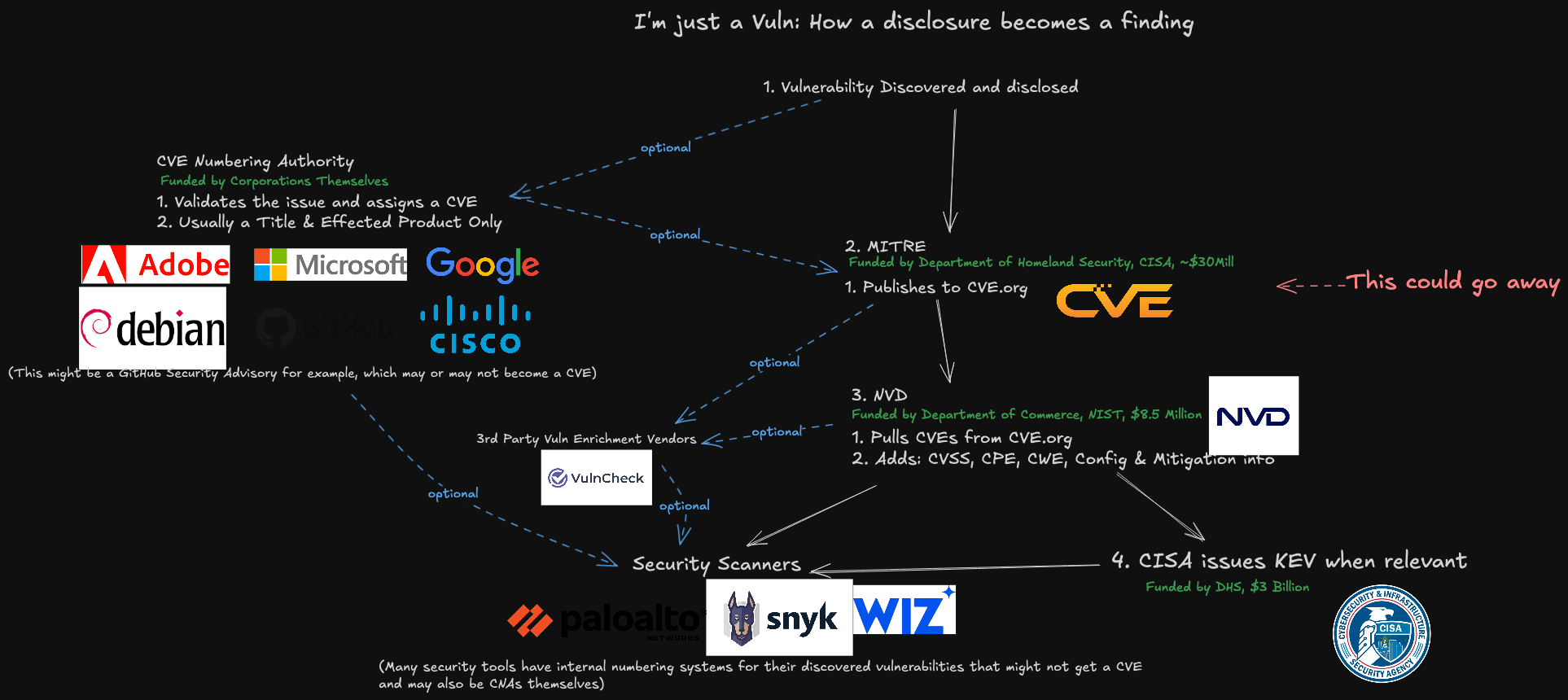
There are hundreds of organizations — known as CVE Numbering Authorities (CNAs) — that are authorized by MITRE to bestow these CVE numbers on newly reported flaws. Many of these CNAs are country and government-specific, or tied to individual software vendors or vulnerability disclosure platforms (a.k.a. bug bounty programs).

Put simply, MITRE is a critical, widely-used resource for centralizing and standardizing information on software vulnerabilities. That means the pipeline of information it supplies is plugged into an array of cybersecurity tools and services that help organizations identify and patch security holes — ideally before malware or malcontents can wriggle through them.

“What the CVE lists really provide is a standardized way to describe the severity of that defect, and a centralized repository listing which versions of which products are defective and need to be updated,” said Matt Tait, chief operating officer of Corellium, a cybersecurity firm that sells phone-virtualization software for finding security flaws.

In a letter sent today to the CVE board, MITRE Vice President Yosry Barsoum warned that on April 16, 2025, “the current contracting pathway for MITRE to develop, operate and modernize CVE and several other related programs will expire.”

“If a break in service were to occur, we anticipate multiple impacts to CVE, including deterioration of national vulnerability databases and advisories, tool vendors, incident response operations, and all manner of critical infrastructure,” Barsoum wrote.

MITRE told KrebsOnSecurity the CVE website listing vulnerabilities will remain up after the funding expires, but that new CVEs won’t be added after April 16.

A representation of how a vulnerability becomes a CVE, and how that information is consumed. Image: James Berthoty, Latio Tech, via LinkedIn.

DHS officials did not immediately respond to a request for comment. The program is funded through DHS’s Cybersecurity & Infrastructure Security Agency (CISA), which is currently facing deep budget and staffing cuts by the Trump administration.

Former CISA Director Jen Easterly said the CVE program is a bit like the Dewey Decimal System, but for cybersecurity.

“It’s the global catalog that helps everyone—security teams, software vendors, researchers, governments—organize and talk about vulnerabilities using the same reference system,” Easterly said in a post on LinkedIn. “Without it, everyone is using a different catalog or no catalog at all, no one knows if they’re talking about the same problem, defenders waste precious time figuring out what’s wrong, and worst of all, threat actors take advantage of the confusion.”

John Hammond, principal security researcher at the managed security firm Huntress, told Reuters he swore out loud when he heard the news that CVE’s funding was in jeopardy, and that losing the CVE program would be like losing “the language and lingo we used to address problems in cybersecurity.”

“I really can’t help but think this is just going to hurt,” said Hammond, who posted a Youtube video to vent about the situation and alert others.

Several people close to the matter told KrebsOnSecurity this is not the first time the CVE program’s budget has been left in funding limbo until the last minute. Barsoum’s letter, which was apparently leaked, sounded a hopeful note, saying the government is making “considerable efforts to continue MITRE’s role in support of the program.”

Tait said that without the CVE program, risk managers inside companies would need to continuously monitor many other places for information about new vulnerabilities that may jeopardize the security of their IT networks. Meaning, it may become more common that software updates get mis-prioritized, with companies having hackable software deployed for longer than they otherwise would, he said.

“Hopefully they will resolve this, but otherwise the list will rapidly fall out of date and stop being useful,” he said.


Read More

Growatt Cloud Applications

 ​View CSAF
1. EXECUTIVE SUMMARY

CVSS v4 9.3
ATTENTION: Exploitable remotely/low attack complexity
Vendor: Growatt
Equipment: Cloud Applications
Vulnerabilities: Cross-site Scripting, Authorization Bypass Through User-Controlled Key, Insufficient Type Distinction, External Control of System or Configuration Setting

2. RISK EVALUATION
Successful exploitation of these vulnerabilities could allow an attacker to compromise confidentiality, achieve cross-site scripting, or code execution on affected devices.
3. TECHNICAL DETAILS
3.1 AFFECTED PRODUCTS
The following Growatt products are affected:

Growatt cloud portal: Versions prior to 3.6.0

3.2 VULNERABILITY OVERVIEW
3.2.1 Improper Neutralization of Input During Web Page Generation (‘Cross-site Scripting’) CWE-79
An authenticated attacker can achieve stored XSS by exploiting improper sanitization of the plant name value while adding or editing a plant.
CVE-2025-30511 has been assigned to this vulnerability. A CVSS v3.1 base score of 8.8 has been calculated; the CVSS vector string is (AV:N/AC:L/PR:N/UI:N/S:U/C:N/I:N/A:H).
A CVSS v4 score has also been calculated for CVE-2025-30511. A base score of 8.7 has been calculated; the CVSS vector string is (AV:N/AC:L/AT:N/PR:L/UI:N/VC:H/VI:H/VA:H/SC:N/SI:N/SA:N).
3.2.2 Authorization Bypass Through User-Controlled Key CWE-639
An unauthenticated attacker can check the existence of usernames in the system by querying an API.
CVE-2025-31933 has been assigned to this vulnerability. A CVSS v3.1 base score of 5.3 has been calculated; the CVSS vector string is (AV:N/AC:L/PR:N/UI:N/S:U/C:L/I:N/A:N).
A CVSS v4 score has also been calculated for CVE-CVE-2025-31933. A base score of 6.9 has been calculated; the CVSS vector string is (AV:N/AC:L/AT:N/PR:N/UI:N/VC:L/VI:N/VA:N/SC:N/SI:N/SA:N).
3.2.3 Authorization Bypass Through User-Controlled Key CWE-639
An authenticated attacker can obtain any plant name by knowing the plant ID.
CVE-2025-31949 has been assigned to this vulnerability. A CVSS v3.1 base score of 5.3 has been calculated; the CVSS vector string is (AV:N/AC:L/PR:N/UI:N/S:U/C:L/I:N/A:N).
A CVSS v4 score has also been calculated for CVE-2025-31949. A base score of 6.9 has been calculated; the CVSS vector string is (AV:N/AC:L/AT:N/PR:N/UI:N/VC:L/VI:N/VA:N/SC:N/SI:N/SA:N).
3.2.4 Authorization Bypass Through User-Controlled Key CWE-639
An unauthenticated attacker can obtain a user’s plant list by knowing the username.
CVE-2025-31357 has been assigned to this vulnerability. A CVSS v3.1 base score of 5.3 has been calculated; the CVSS vector string is (AV:N/AC:L/PR:N/UI:N/S:U/C:L/I:N/A:N).
A CVSS v4 score has also been calculated for CVE-2025-31357. A base score of 6.9 has been calculated; the CVSS vector string is (AV:N/AC:L/AT:N/PR:N/UI:N/VC:L/VI:N/VA:N/SC:N/SI:N/SA:N).
3.2.5 Authorization Bypass Through User-Controlled Key CWE-639
An unauthenticated attacker can obtain a list of smart devices by knowing a valid username.
CVE-2025-31941 has been assigned to this vulnerability. A CVSS v3.1 base score of 5.3 has been calculated; the CVSS vector string is (AV:N/AC:L/PR:N/UI:N/S:U/C:L/I:N/A:N).
A CVSS v4 score has also been calculated for CVE-2025-31941. A base score of 6.9 has been calculated; the CVSS vector string is (AV:N/AC:L/AT:N/PR:N/UI:N/VC:L/VI:N/VA:N/SC:N/SI:N/SA:N).
3.2.6 Authorization Bypass Through User-Controlled Key CWE-639
An unauthenticated attacker can infer the existence of usernames in the system by querying an API.
CVE-2025-24487 has been assigned to this vulnerability. A CVSS v3.1 base score of 5.3 has been calculated; the CVSS vector string is (AV:N/AC:L/PR:N/UI:N/S:U/C:L/I:N/A:N).
A CVSS v4 score has also been calculated for CVE-2025-24487. A base score of 6.9 has been calculated; the CVSS vector string is (AV:N/AC:L/AT:N/PR:N/UI:N/VC:L/VI:N/VA:N/SC:N/SI:N/SA:N).
3.2.7 Authorization Bypass Through User-Controlled Key CWE-639
An unauthenticated attacker can get users’ emails by knowing usernames. A password reset email will be sent in response to this unsolicited request.
CVE-2025-27568 has been assigned to this vulnerability. A CVSS v3.1 base score of 5.3 has been calculated; the CVSS vector string is (AV:N/AC:L/PR:N/UI:N/S:U/C:L/I:N/A:N).
A CVSS v4 score has also been calculated for CVE-2025-27568. A base score of 6.9 has been calculated; the CVSS vector string is (AV:N/AC:L/AT:N/PR:N/UI:N/VC:L/VI:N/VA:N/SC:N/SI:N/SA:N).
3.2.8 Authorization Bypass Through User-Controlled Key CWE-639
An unauthenticated attacker can obtain a serial number of a smart meter(s) using its owner’s username.
CVE-2025-30254 has been assigned to this vulnerability. A CVSS v3.1 base score of 5.3 has been calculated; the CVSS vector string is (AV:N/AC:L/PR:N/UI:N/S:U/C:L/I:N/A:N).
A CVSS v4 score has also been calculated for CVE-2025-30254. A base score of 6.9 has been calculated; the CVSS vector string is (AV:N/AC:L/AT:N/PR:N/UI:N/VC:L/VI:N/VA:N/SC:N/SI:N/SA:N).
3.2.9 Authorization Bypass Through User-Controlled Key CWE-639
An attacker can change registered email addresses of other users and take over arbitrary accounts.
CVE-2025-27939 has been assigned to this vulnerability. A CVSS v3.1 base score of 7.5 has been calculated; the CVSS vector string is (AV:N/AC:L/PR:N/UI:N/S:U/C:N/I:H/A:N).
A CVSS v4 score has also been calculated for CVE-2025-27939. A base score of 8.7 has been calculated; the CVSS vector string is (AV:N/AC:L/AT:N/PR:N/UI:N/VC:N/VI:H/VA:N/SC:N/SI:N/SA:N).
3.2.10 Authorization Bypass Through User-Controlled Key CWE-639
Unauthenticated attackers can obtain restricted information about a user’s smart device collections (i.e., “rooms”).
CVE-2025-27938 has been assigned to this vulnerability. A CVSS v3.1 base score of 5.3 has been calculated; the CVSS vector string is (AV:N/AC:L/PR:N/UI:N/S:U/C:L/I:N/A:N).
A CVSS v4 score has also been calculated for CVE-2025-27938. A base score of 6.9 has been calculated; the CVSS vector string is (AV:N/AC:L/AT:N/PR:N/UI:N/VC:L/VI:N/VA:N/SC:N/SI:N/SA:N).
3.2.11 Authorization Bypass Through User-Controlled Key CWE-639
Unauthenticated attackers can obtain restricted information about a user’s smart device collections (i.e., “scenes”).
CVE-2025-30514 has been assigned to this vulnerability. A CVSS v3.1 base score of 5.3 has been calculated; the CVSS vector string is (AV:N/AC:L/PR:N/UI:N/S:U/C:L/I:N/A:N).
A CVSS v4 score has also been calculated for CVE-2025-30514. A base score of 6.9 has been calculated; the CVSS vector string is (AV:N/AC:L/AT:N/PR:N/UI:N/VC:L/VI:N/VA:N/SC:N/SI:N/SA:N).
3.2.12 Authorization Bypass Through User-Controlled Key CWE-639
An attacker can get information about the groups of the smart home devices for arbitrary users (i.e., “rooms”).
CVE-2025-31654 has been assigned to this vulnerability. A CVSS v3.1 base score of 5.3 has been calculated; the CVSS vector string is (AV:N/AC:L/PR:N/UI:N/S:U/C:L/I:N/A:N).
A CVSS v4 score has also been calculated for CVE-2025-31654. A base score of 6.9 has been calculated; the CVSS vector string is (AV:N/AC:L/AT:N/PR:N/UI:N/VC:L/VI:N/VA:N/SC:N/SI:N/SA:N).
3.2.13 Authorization Bypass Through User-Controlled Key CWE-639
Unauthenticated attackers can query an API endpoint and get device details.
CVE-2025-27719 has been assigned to this vulnerability. A CVSS v3.1 base score of 5.3 has been calculated; the CVSS vector string is (AV:N/AC:L/PR:N/UI:N/S:U/C:L/I:N/A:N).
A CVSS v4 score has also been calculated for CVE-2025-27719. A base score of 6.9 has been calculated; the CVSS vector string is (AV:N/AC:L/AT:N/PR:N/UI:N/VC:L/VI:N/VA:N/SC:N/SI:N/SA:N).
3.2.14 Authorization Bypass Through User-Controlled Key CWE-639
Unauthenticated attackers can rename arbitrary devices of arbitrary users (i.e., EV chargers).
CVE-2025-26857 has been assigned to this vulnerability. A CVSS v3.1 base score of 5.3 has been calculated; the CVSS vector string is (AV:N/AC:L/PR:N/UI:N/S:U/C:L/I:N/A:N).
A CVSS v4 score has also been calculated for CVE-2025-26857. A base score of 6.9 has been calculated; the CVSS vector string is (AV:N/AC:L/AT:N/PR:N/UI:N/VC:L/VI:N/VA:N/SC:N/SI:N/SA:N).
3.2.15 Authorization Bypass Through User-Controlled Key CWE-639
An unauthenticated attacker can obtain other users’ charger information.
CVE-2025-31945 has been assigned to this vulnerability. A CVSS v3.1 base score of 5.3 has been calculated; the CVSS vector string is (AV:N/AC:L/PR:N/UI:N/S:U/C:L/I:N/A:N).
A CVSS v4 score has also been calculated for CVE-2025-31945. A base score of 6.9 has been calculated; the CVSS vector string is (AV:N/AC:L/AT:N/PR:N/UI:N/VC:L/VI:N/VA:N/SC:N/SI:N/SA:N).
3.2.16 Authorization Bypass Through User-Controlled Key CWE-639
An unauthenticated attacker can obtain EV charger energy consumption information of other users.
CVE-2025-31950 has been assigned to this vulnerability. A CVSS v3.1 base score of 5.3 has been calculated; the CVSS vector string is (AV:N/AC:L/PR:N/UI:N/S:U/C:L/I:N/A:N).
A CVSS v4 score has also been calculated for CVE-2025-31950. A base score of 6.9 has been calculated; the CVSS vector string is (AV:N/AC:L/AT:N/PR:N/UI:N/VC:L/VI:N/VA:N/SC:N/SI:N/SA:N).
3.2.17 Authorization Bypass Through User-Controlled Key CWE-639
An unauthenticated attacker can obtain EV charger version and firmware upgrading history by knowing the charger ID.
CVE-2025-27575 has been assigned to this vulnerability. A CVSS v3.1 base score of 5.3 has been calculated; the CVSS vector string is (AV:AV:N/AC:L/PR:N/UI:N/S:U/C:L/I:N/A:N).
A CVSS v4 score has also been calculated for CVE-2025-27575. A base score of 6.9 has been calculated; the CVSS vector string is (AV:N/AC:L/AT:N/PR:N/UI:N/VC:L/VI:N/VA:N/SC:N/SI:N/SA:N).
3.2.18 Authorization Bypass Through User-Controlled Key CWE-639
An unauthenticated attacker can delete any user’s “rooms” by knowing the user’s and room IDs.
CVE-2025-27565 has been assigned to this vulnerability. A CVSS v3.1 base score of 5.3 has been calculated; the CVSS vector string is (AV:N/AC:L/PR:N/UI:N/S:U/C:N/I:L/A:N).
A CVSS v4 score has also been calculated for CVE-2025-27565. A base score of 6.9 has been calculated; the CVSS vector string is (AV:N/AC:L/AT:N/PR:N/UI:N/VC:N/VI:L/VA:N/SC:N/SI:N/SA:N).
3.2.19 Authorization Bypass Through User-Controlled Key CWE-639
An unauthenticated attacker can hijack other users’ devices and potentially control them.
CVE-2025-25276 has been assigned to this vulnerability. A CVSS v3.1 base score of 5.3 has been calculated; the CVSS vector string is (AV:N/AC:L/PR:N/UI:N/S:U/C:N/I:L/A:N).
A CVSS v4 score has also been calculated for CVE-2025-25276. A base score of 6.9 has been calculated; the CVSS vector string is (AV:N/AC:L/AT:N/PR:N/UI:N/VC:N/VI:L/VA:N/SC:N/SI:N/SA:N).
3.2.20 Authorization Bypass Through User-Controlled Key CWE-639
An attacker can export other users’ plant information.
CVE-2025-24850 has been assigned to this vulnerability. A CVSS v3.1 base score of 5.3 has been calculated; the CVSS vector string is (AV:N/AC:L/PR:N/UI:N/S:U/C:L/I:N/A:N).
A CVSS v4 score has also been calculated for CVE-2025-24850. A base score of 6.9 has been calculated; the CVSS vector string is (AV:N/AC:L/AT:N/PR:N/UI:N/VC:L/VI:N/VA:N/SC:N/SI:N/SA:N).
3.2.21 Insufficient Type Distinction CWE-351
An attacker can upload an arbitrary file instead of a plant image.
CVE-2025-30510 has been assigned to this vulnerability. A CVSS v3.1 base score of 9.8 has been calculated; the CVSS vector string is (AV:N/AC:L/PR:N/UI:N/S:U/C:H/I:H/A:H).
A CVSS v4 score has also been calculated for CVE-2025-30510. A base score of 9.3 has been calculated; the CVSS vector string is (AV:N/AC:L/AT:N/PR:N/UI:N/VC:H/VI:H/VA:H/SC:N/SI:N/SA:N).
3.2.22 Improper Neutralization of Input During Web Page Generation (‘Cross-site Scripting’) CWE-79
Due to lack of server-side input validation, attackers can inject malicious JavaScript code into users personal spaces of the web portal.
CVE-2025-24297 has been assigned to this vulnerability. A CVSS v3.1 base score of 9.8 has been calculated; the CVSS vector string is (AV:N/AC:L/PR:N/UI:N/S:U/C:H/I:H/A:H).
A CVSS v4 score has also been calculated for CVE-2025-24297. A base score of 9.3 has been calculated; the CVSS vector string is (AV:N/AC:L/AT:N/PR:N/UI:N/VC:H/VI:H/VA:H/SC:N/SI:N/SA:N).
3.2.23 Authorization Bypass Through User-Controlled Key CWE-639
An unauthenticated attackers can obtain a list of smart devices by knowing a valid username through an unprotected API.
CVE-2025-27927 has been assigned to this vulnerability. A CVSS v3.1 base score of 5.3 has been calculated; the CVSS vector string is (AV:N/AC:L/PR:N/UI:N/S:U/C:L/I:N/A:N).
A CVSS v4 score has also been calculated for CVE-2025-27927. A base score of 6.9 has been calculated; the CVSS vector string is (AV:N/AC:L/AT:N/PR:N/UI:N/VC:L/VI:N/VA:N/SC:N/SI:N/SA:N).
3.2.24 External Control of System or Configuration Setting CWE-15
Unauthenticated attackers can send configuration settings to device and possible perform physical actions remotely (e.g., on/off).
CVE-2025-30512 has been assigned to this vulnerability. A CVSS v3.1 base score of 6.5 has been calculated; the CVSS vector string is (AV:N/AC:L/PR:N/UI:N/S:U/C:N/I:L/A:L).
A CVSS v4 score has also been calculated for CVE-2025-30512. A base score of 6.9 has been calculated; the CVSS vector string is (AV:N/AC:L/AT:N/PR:N/UI:N/VC:N/VI:L/VA:L/SC:N/SI:N/SA:N).
3.2.25 Authorization Bypass Through User-Controlled Key CWE-639
Unauthenticated attackers can trigger device actions associated with specific “scenes” of arbitrary users.
CVE-2025-31360 has been assigned to this vulnerability. A CVSS v3.1 base score of 6.5 has been calculated; the CVSS vector string is (AV:N/AC:L/PR:N/UI:N/S:U/C:N/I:L/A:L).
A CVSS v4 score has also been calculated for CVE-2025-31360. A base score of 6.9 has been calculated; the CVSS vector string is (AV:N/AC:L/AT:N/PR:N/UI:N/VC:N/VI:L/VA:L/SC:N/SI:N/SA:N).
3.2.26 Authorization Bypass Through User-Controlled Key CWE-639
Unauthenticated attackers can query information about total energy consumed by EV chargers of arbitrary users.
CVE-2025-31147 has been assigned to this vulnerability. A CVSS v3.1 base score of 5.3 has been calculated; the CVSS vector string is (AV:N/AC:L/PR:N/UI:N/S:U/C:L/I:N/A:N).
A CVSS v4 score has also been calculated for CVE-2025-31147. A base score of 6.9 has been calculated; the CVSS vector string is (AV:N/AC:L/AT:N/PR:N/UI:N/VC:L/VI:N/VA:N/SC:N/SI:N/SA:N).
3.2.27 Authorization Bypass Through User-Controlled Key CWE-639
Unauthenticated attackers can retrieve serial number of smart meters associated to a specific user account.
CVE-2025-30257 has been assigned to this vulnerability. A CVSS v3.1 base score of 5.3 has been calculated; the CVSS vector string is (AV:N/AC:L/PR:N/UI:N/S:U/C:L/I:N/A:N).
A CVSS v4 score has also been calculated for CVE-2025-30257. A base score of 6.9 has been calculated; the CVSS vector string is (AV:N/AC:L/AT:N/PR:N/UI:N/VC:L/VI:N/VA:N/SC:N/SI:N/SA:N).
3.2.28 Authorization Bypass Through User-Controlled Key CWE-639
Unauthenticated attackers can rename “rooms” of arbitrary users.
CVE-2025-27561 has been assigned to this vulnerability. A CVSS v3.1 base score of 5.3 has been calculated; the CVSS vector string is (AV:N/AC:L/PR:N/UI:N/S:U/C:N/I:L/A:N).
A CVSS v4 score has also been calculated for CVE-2025-27561. A base score of 6.9 has been calculated; the CVSS vector string is (AV:N/AC:L/AT:N/PR:N/UI:N/VC:N/VI:L/VA:N/SC:N/SI:N/SA:N).
3.2.29 Authorization Bypass Through User-Controlled Key CWE-639
Unauthenticated attackers can add devices of other users to their scenes (or arbitrary scenes of other arbitrary users).
CVE-2025-24315 has been assigned to this vulnerability. A CVSS v3.1 base score of 5.3 has been calculated; the CVSS vector string is (AV:N/AC:L/PR:N/UI:N/S:U/C:N/I:L/A:N).
A CVSS v4 score has also been calculated for CVE-2025-24315. A base score of 6.9 has been calculated; the CVSS vector string is (AV:N/AC:L/AT:N/PR:N/UI:N/VC:N/VI:L/VA:N/SC:N/SI:N/SA:N).
3.2.30 Authorization Bypass Through User-Controlled Key CWE-639
Unauthenticated attackers can retrieve full list of users associated with arbitrary accounts.
CVE-2025-27929 has been assigned to this vulnerability. A CVSS v3.1 base score of 5.3 has been calculated; the CVSS vector string is (AV:N/AC:L/PR:N/UI:N/S:U/C:N/I:L/A:N).
A CVSS v4 score has also been calculated for CVE-2025-27929. A base score of 6.9 has been calculated; the CVSS vector string is (AV:N/AC:L/AT:N/PR:N/UI:N/VC:N/VI:L/VA:N/SC:N/SI:N/SA:N).
3.3 BACKGROUND

CRITICAL INFRASTRUCTURE SECTORS: Energy
COUNTRIES/AREAS DEPLOYED: Worldwide
COMPANY HEADQUARTERS LOCATION: China

3.4 RESEARCHER
Forescout Technologies reported these vulnerabilities to CISA.
4. MITIGATIONS
Growatt reports the cloud-based vulnerabilities were patched and no user action is needed. Additionally, Growatt strongly recommends that their users take proactive steps in securing their devices and take the following actions:

Update all devices to the latest firmware version when available. (Updates are automatic, no user action needed.)
Use strong passwords and enable multi-factor authentication where applicable.
Report any security concerns to Service@Growatt.com.
Stay vigilant. Users and installers should regularly review security settings, follow best practices, and report any unusual activity.

CISA recommends users take defensive measures to minimize the risk of exploitation of these vulnerabilities, such as:

Minimize network exposure for all control system devices and/or systems, ensuring they are not accessible from the internet.
Locate control system networks and remote devices behind firewalls and isolating them from business networks.
When remote access is required, use more secure methods, such as Virtual Private Networks (VPNs), recognizing VPNs may have vulnerabilities and should be updated to the most current version available. Also recognize VPN is only as secure as the connected devices.

CISA reminds organizations to perform proper impact analysis and risk assessment prior to deploying defensive measures.
CISA also provides a section for control systems security recommended practices on the ICS webpage on cisa.gov/ics. Several CISA products detailing cyber defense best practices are available for reading and download, including Improving Industrial Control Systems Cybersecurity with Defense-in-Depth Strategies.
CISA encourages organizations to implement recommended cybersecurity strategies for proactive defense of ICS assets.
Additional mitigation guidance and recommended practices are publicly available on the ICS webpage at cisa.gov/ics in the technical information paper, ICS-TIP-12-146-01B–Targeted Cyber Intrusion Detection and Mitigation Strategies.
Organizations observing suspected malicious activity should follow established internal procedures and report findings to CISA for tracking and correlation against other incidents.
CISA also recommends users take the following measures to protect themselves from social engineering attacks:

Do not click web links or open attachments in unsolicited email messages.
Refer to Recognizing and Avoiding Email Scams for more information on avoiding email scams.
Refer to Avoiding Social Engineering and Phishing Attacks for more information on social engineering attacks.

No known public exploitation specifically targeting these vulnerabilities has been reported to CISA at this time.
5. UPDATE HISTORY

April 15, 2025: Initial Publication 

View CSAF

1. EXECUTIVE SUMMARY

  • CVSS v4 9.3
  • ATTENTION: Exploitable remotely/low attack complexity
  • Vendor: Growatt
  • Equipment: Cloud Applications
  • Vulnerabilities: Cross-site Scripting, Authorization Bypass Through User-Controlled Key, Insufficient Type Distinction, External Control of System or Configuration Setting

2. RISK EVALUATION

Successful exploitation of these vulnerabilities could allow an attacker to compromise confidentiality, achieve cross-site scripting, or code execution on affected devices.

3. TECHNICAL DETAILS

3.1 AFFECTED PRODUCTS

The following Growatt products are affected:

  • Growatt cloud portal: Versions prior to 3.6.0

3.2 VULNERABILITY OVERVIEW

3.2.1 Improper Neutralization of Input During Web Page Generation (‘Cross-site Scripting’) CWE-79

An authenticated attacker can achieve stored XSS by exploiting improper sanitization of the plant name value while adding or editing a plant.

CVE-2025-30511 has been assigned to this vulnerability. A CVSS v3.1 base score of 8.8 has been calculated; the CVSS vector string is (AV:N/AC:L/PR:N/UI:N/S:U/C:N/I:N/A:H).

A CVSS v4 score has also been calculated for CVE-2025-30511. A base score of 8.7 has been calculated; the CVSS vector string is (AV:N/AC:L/AT:N/PR:L/UI:N/VC:H/VI:H/VA:H/SC:N/SI:N/SA:N).

3.2.2 Authorization Bypass Through User-Controlled Key CWE-639

An unauthenticated attacker can check the existence of usernames in the system by querying an API.

CVE-2025-31933 has been assigned to this vulnerability. A CVSS v3.1 base score of 5.3 has been calculated; the CVSS vector string is (AV:N/AC:L/PR:N/UI:N/S:U/C:L/I:N/A:N).

A CVSS v4 score has also been calculated for CVE-CVE-2025-31933. A base score of 6.9 has been calculated; the CVSS vector string is (AV:N/AC:L/AT:N/PR:N/UI:N/VC:L/VI:N/VA:N/SC:N/SI:N/SA:N).

3.2.3 Authorization Bypass Through User-Controlled Key CWE-639

An authenticated attacker can obtain any plant name by knowing the plant ID.

CVE-2025-31949 has been assigned to this vulnerability. A CVSS v3.1 base score of 5.3 has been calculated; the CVSS vector string is (AV:N/AC:L/PR:N/UI:N/S:U/C:L/I:N/A:N).

A CVSS v4 score has also been calculated for CVE-2025-31949. A base score of 6.9 has been calculated; the CVSS vector string is (AV:N/AC:L/AT:N/PR:N/UI:N/VC:L/VI:N/VA:N/SC:N/SI:N/SA:N).

3.2.4 Authorization Bypass Through User-Controlled Key CWE-639

An unauthenticated attacker can obtain a user’s plant list by knowing the username.

CVE-2025-31357 has been assigned to this vulnerability. A CVSS v3.1 base score of 5.3 has been calculated; the CVSS vector string is (AV:N/AC:L/PR:N/UI:N/S:U/C:L/I:N/A:N).

A CVSS v4 score has also been calculated for CVE-2025-31357. A base score of 6.9 has been calculated; the CVSS vector string is (AV:N/AC:L/AT:N/PR:N/UI:N/VC:L/VI:N/VA:N/SC:N/SI:N/SA:N).

3.2.5 Authorization Bypass Through User-Controlled Key CWE-639

An unauthenticated attacker can obtain a list of smart devices by knowing a valid username.

CVE-2025-31941 has been assigned to this vulnerability. A CVSS v3.1 base score of 5.3 has been calculated; the CVSS vector string is (AV:N/AC:L/PR:N/UI:N/S:U/C:L/I:N/A:N).

A CVSS v4 score has also been calculated for CVE-2025-31941. A base score of 6.9 has been calculated; the CVSS vector string is (AV:N/AC:L/AT:N/PR:N/UI:N/VC:L/VI:N/VA:N/SC:N/SI:N/SA:N).

3.2.6 Authorization Bypass Through User-Controlled Key CWE-639

An unauthenticated attacker can infer the existence of usernames in the system by querying an API.

CVE-2025-24487 has been assigned to this vulnerability. A CVSS v3.1 base score of 5.3 has been calculated; the CVSS vector string is (AV:N/AC:L/PR:N/UI:N/S:U/C:L/I:N/A:N).

A CVSS v4 score has also been calculated for CVE-2025-24487. A base score of 6.9 has been calculated; the CVSS vector string is (AV:N/AC:L/AT:N/PR:N/UI:N/VC:L/VI:N/VA:N/SC:N/SI:N/SA:N).

3.2.7 Authorization Bypass Through User-Controlled Key CWE-639

An unauthenticated attacker can get users’ emails by knowing usernames. A password reset email will be sent in response to this unsolicited request.

CVE-2025-27568 has been assigned to this vulnerability. A CVSS v3.1 base score of 5.3 has been calculated; the CVSS vector string is (AV:N/AC:L/PR:N/UI:N/S:U/C:L/I:N/A:N).

A CVSS v4 score has also been calculated for CVE-2025-27568. A base score of 6.9 has been calculated; the CVSS vector string is (AV:N/AC:L/AT:N/PR:N/UI:N/VC:L/VI:N/VA:N/SC:N/SI:N/SA:N).

3.2.8 Authorization Bypass Through User-Controlled Key CWE-639

An unauthenticated attacker can obtain a serial number of a smart meter(s) using its owner’s username.

CVE-2025-30254 has been assigned to this vulnerability. A CVSS v3.1 base score of 5.3 has been calculated; the CVSS vector string is (AV:N/AC:L/PR:N/UI:N/S:U/C:L/I:N/A:N).

A CVSS v4 score has also been calculated for CVE-2025-30254. A base score of 6.9 has been calculated; the CVSS vector string is (AV:N/AC:L/AT:N/PR:N/UI:N/VC:L/VI:N/VA:N/SC:N/SI:N/SA:N).

3.2.9 Authorization Bypass Through User-Controlled Key CWE-639

An attacker can change registered email addresses of other users and take over arbitrary accounts.

CVE-2025-27939 has been assigned to this vulnerability. A CVSS v3.1 base score of 7.5 has been calculated; the CVSS vector string is (AV:N/AC:L/PR:N/UI:N/S:U/C:N/I:H/A:N).

A CVSS v4 score has also been calculated for CVE-2025-27939. A base score of 8.7 has been calculated; the CVSS vector string is (AV:N/AC:L/AT:N/PR:N/UI:N/VC:N/VI:H/VA:N/SC:N/SI:N/SA:N).

3.2.10 Authorization Bypass Through User-Controlled Key CWE-639

Unauthenticated attackers can obtain restricted information about a user’s smart device collections (i.e., “rooms”).

CVE-2025-27938 has been assigned to this vulnerability. A CVSS v3.1 base score of 5.3 has been calculated; the CVSS vector string is (AV:N/AC:L/PR:N/UI:N/S:U/C:L/I:N/A:N).

A CVSS v4 score has also been calculated for CVE-2025-27938. A base score of 6.9 has been calculated; the CVSS vector string is (AV:N/AC:L/AT:N/PR:N/UI:N/VC:L/VI:N/VA:N/SC:N/SI:N/SA:N).

3.2.11 Authorization Bypass Through User-Controlled Key CWE-639

Unauthenticated attackers can obtain restricted information about a user’s smart device collections (i.e., “scenes”).

CVE-2025-30514 has been assigned to this vulnerability. A CVSS v3.1 base score of 5.3 has been calculated; the CVSS vector string is (AV:N/AC:L/PR:N/UI:N/S:U/C:L/I:N/A:N).

A CVSS v4 score has also been calculated for CVE-2025-30514. A base score of 6.9 has been calculated; the CVSS vector string is (AV:N/AC:L/AT:N/PR:N/UI:N/VC:L/VI:N/VA:N/SC:N/SI:N/SA:N).

3.2.12 Authorization Bypass Through User-Controlled Key CWE-639

An attacker can get information about the groups of the smart home devices for arbitrary users (i.e., “rooms”).

CVE-2025-31654 has been assigned to this vulnerability. A CVSS v3.1 base score of 5.3 has been calculated; the CVSS vector string is (AV:N/AC:L/PR:N/UI:N/S:U/C:L/I:N/A:N).

A CVSS v4 score has also been calculated for CVE-2025-31654. A base score of 6.9 has been calculated; the CVSS vector string is (AV:N/AC:L/AT:N/PR:N/UI:N/VC:L/VI:N/VA:N/SC:N/SI:N/SA:N).

3.2.13 Authorization Bypass Through User-Controlled Key CWE-639

Unauthenticated attackers can query an API endpoint and get device details.

CVE-2025-27719 has been assigned to this vulnerability. A CVSS v3.1 base score of 5.3 has been calculated; the CVSS vector string is (AV:N/AC:L/PR:N/UI:N/S:U/C:L/I:N/A:N).

A CVSS v4 score has also been calculated for CVE-2025-27719. A base score of 6.9 has been calculated; the CVSS vector string is (AV:N/AC:L/AT:N/PR:N/UI:N/VC:L/VI:N/VA:N/SC:N/SI:N/SA:N).

3.2.14 Authorization Bypass Through User-Controlled Key CWE-639

Unauthenticated attackers can rename arbitrary devices of arbitrary users (i.e., EV chargers).

CVE-2025-26857 has been assigned to this vulnerability. A CVSS v3.1 base score of 5.3 has been calculated; the CVSS vector string is (AV:N/AC:L/PR:N/UI:N/S:U/C:L/I:N/A:N).

A CVSS v4 score has also been calculated for CVE-2025-26857. A base score of 6.9 has been calculated; the CVSS vector string is (AV:N/AC:L/AT:N/PR:N/UI:N/VC:L/VI:N/VA:N/SC:N/SI:N/SA:N).

3.2.15 Authorization Bypass Through User-Controlled Key CWE-639

An unauthenticated attacker can obtain other users’ charger information.

CVE-2025-31945 has been assigned to this vulnerability. A CVSS v3.1 base score of 5.3 has been calculated; the CVSS vector string is (AV:N/AC:L/PR:N/UI:N/S:U/C:L/I:N/A:N).

A CVSS v4 score has also been calculated for CVE-2025-31945. A base score of 6.9 has been calculated; the CVSS vector string is (AV:N/AC:L/AT:N/PR:N/UI:N/VC:L/VI:N/VA:N/SC:N/SI:N/SA:N).

3.2.16 Authorization Bypass Through User-Controlled Key CWE-639

An unauthenticated attacker can obtain EV charger energy consumption information of other users.

CVE-2025-31950 has been assigned to this vulnerability. A CVSS v3.1 base score of 5.3 has been calculated; the CVSS vector string is (AV:N/AC:L/PR:N/UI:N/S:U/C:L/I:N/A:N).

A CVSS v4 score has also been calculated for CVE-2025-31950. A base score of 6.9 has been calculated; the CVSS vector string is (AV:N/AC:L/AT:N/PR:N/UI:N/VC:L/VI:N/VA:N/SC:N/SI:N/SA:N).

3.2.17 Authorization Bypass Through User-Controlled Key CWE-639

An unauthenticated attacker can obtain EV charger version and firmware upgrading history by knowing the charger ID.

CVE-2025-27575 has been assigned to this vulnerability. A CVSS v3.1 base score of 5.3 has been calculated; the CVSS vector string is (AV:AV:N/AC:L/PR:N/UI:N/S:U/C:L/I:N/A:N).

A CVSS v4 score has also been calculated for CVE-2025-27575. A base score of 6.9 has been calculated; the CVSS vector string is (AV:N/AC:L/AT:N/PR:N/UI:N/VC:L/VI:N/VA:N/SC:N/SI:N/SA:N).

3.2.18 Authorization Bypass Through User-Controlled Key CWE-639

An unauthenticated attacker can delete any user’s “rooms” by knowing the user’s and room IDs.

CVE-2025-27565 has been assigned to this vulnerability. A CVSS v3.1 base score of 5.3 has been calculated; the CVSS vector string is (AV:N/AC:L/PR:N/UI:N/S:U/C:N/I:L/A:N).

A CVSS v4 score has also been calculated for CVE-2025-27565. A base score of 6.9 has been calculated; the CVSS vector string is (AV:N/AC:L/AT:N/PR:N/UI:N/VC:N/VI:L/VA:N/SC:N/SI:N/SA:N).

3.2.19 Authorization Bypass Through User-Controlled Key CWE-639

An unauthenticated attacker can hijack other users’ devices and potentially control them.

CVE-2025-25276 has been assigned to this vulnerability. A CVSS v3.1 base score of 5.3 has been calculated; the CVSS vector string is (AV:N/AC:L/PR:N/UI:N/S:U/C:N/I:L/A:N).

A CVSS v4 score has also been calculated for CVE-2025-25276. A base score of 6.9 has been calculated; the CVSS vector string is (AV:N/AC:L/AT:N/PR:N/UI:N/VC:N/VI:L/VA:N/SC:N/SI:N/SA:N).

3.2.20 Authorization Bypass Through User-Controlled Key CWE-639

An attacker can export other users’ plant information.

CVE-2025-24850 has been assigned to this vulnerability. A CVSS v3.1 base score of 5.3 has been calculated; the CVSS vector string is (AV:N/AC:L/PR:N/UI:N/S:U/C:L/I:N/A:N).

A CVSS v4 score has also been calculated for CVE-2025-24850. A base score of 6.9 has been calculated; the CVSS vector string is (AV:N/AC:L/AT:N/PR:N/UI:N/VC:L/VI:N/VA:N/SC:N/SI:N/SA:N).

3.2.21 Insufficient Type Distinction CWE-351

An attacker can upload an arbitrary file instead of a plant image.

CVE-2025-30510 has been assigned to this vulnerability. A CVSS v3.1 base score of 9.8 has been calculated; the CVSS vector string is (AV:N/AC:L/PR:N/UI:N/S:U/C:H/I:H/A:H).

A CVSS v4 score has also been calculated for CVE-2025-30510. A base score of 9.3 has been calculated; the CVSS vector string is (AV:N/AC:L/AT:N/PR:N/UI:N/VC:H/VI:H/VA:H/SC:N/SI:N/SA:N).

3.2.22 Improper Neutralization of Input During Web Page Generation (‘Cross-site Scripting’) CWE-79

Due to lack of server-side input validation, attackers can inject malicious JavaScript code into users personal spaces of the web portal.

CVE-2025-24297 has been assigned to this vulnerability. A CVSS v3.1 base score of 9.8 has been calculated; the CVSS vector string is (AV:N/AC:L/PR:N/UI:N/S:U/C:H/I:H/A:H).

A CVSS v4 score has also been calculated for CVE-2025-24297. A base score of 9.3 has been calculated; the CVSS vector string is (AV:N/AC:L/AT:N/PR:N/UI:N/VC:H/VI:H/VA:H/SC:N/SI:N/SA:N).

3.2.23 Authorization Bypass Through User-Controlled Key CWE-639

An unauthenticated attackers can obtain a list of smart devices by knowing a valid username through an unprotected API.

CVE-2025-27927 has been assigned to this vulnerability. A CVSS v3.1 base score of 5.3 has been calculated; the CVSS vector string is (AV:N/AC:L/PR:N/UI:N/S:U/C:L/I:N/A:N).

A CVSS v4 score has also been calculated for CVE-2025-27927. A base score of 6.9 has been calculated; the CVSS vector string is (AV:N/AC:L/AT:N/PR:N/UI:N/VC:L/VI:N/VA:N/SC:N/SI:N/SA:N).

3.2.24 External Control of System or Configuration Setting CWE-15

Unauthenticated attackers can send configuration settings to device and possible perform physical actions remotely (e.g., on/off).

CVE-2025-30512 has been assigned to this vulnerability. A CVSS v3.1 base score of 6.5 has been calculated; the CVSS vector string is (AV:N/AC:L/PR:N/UI:N/S:U/C:N/I:L/A:L).

A CVSS v4 score has also been calculated for CVE-2025-30512. A base score of 6.9 has been calculated; the CVSS vector string is (AV:N/AC:L/AT:N/PR:N/UI:N/VC:N/VI:L/VA:L/SC:N/SI:N/SA:N).

3.2.25 Authorization Bypass Through User-Controlled Key CWE-639

Unauthenticated attackers can trigger device actions associated with specific “scenes” of arbitrary users.

CVE-2025-31360 has been assigned to this vulnerability. A CVSS v3.1 base score of 6.5 has been calculated; the CVSS vector string is (AV:N/AC:L/PR:N/UI:N/S:U/C:N/I:L/A:L).

A CVSS v4 score has also been calculated for CVE-2025-31360. A base score of 6.9 has been calculated; the CVSS vector string is (AV:N/AC:L/AT:N/PR:N/UI:N/VC:N/VI:L/VA:L/SC:N/SI:N/SA:N).

3.2.26 Authorization Bypass Through User-Controlled Key CWE-639

Unauthenticated attackers can query information about total energy consumed by EV chargers of arbitrary users.

CVE-2025-31147 has been assigned to this vulnerability. A CVSS v3.1 base score of 5.3 has been calculated; the CVSS vector string is (AV:N/AC:L/PR:N/UI:N/S:U/C:L/I:N/A:N).

A CVSS v4 score has also been calculated for CVE-2025-31147. A base score of 6.9 has been calculated; the CVSS vector string is (AV:N/AC:L/AT:N/PR:N/UI:N/VC:L/VI:N/VA:N/SC:N/SI:N/SA:N).

3.2.27 Authorization Bypass Through User-Controlled Key CWE-639

Unauthenticated attackers can retrieve serial number of smart meters associated to a specific user account.

CVE-2025-30257 has been assigned to this vulnerability. A CVSS v3.1 base score of 5.3 has been calculated; the CVSS vector string is (AV:N/AC:L/PR:N/UI:N/S:U/C:L/I:N/A:N).

A CVSS v4 score has also been calculated for CVE-2025-30257. A base score of 6.9 has been calculated; the CVSS vector string is (AV:N/AC:L/AT:N/PR:N/UI:N/VC:L/VI:N/VA:N/SC:N/SI:N/SA:N).

3.2.28 Authorization Bypass Through User-Controlled Key CWE-639

Unauthenticated attackers can rename “rooms” of arbitrary users.

CVE-2025-27561 has been assigned to this vulnerability. A CVSS v3.1 base score of 5.3 has been calculated; the CVSS vector string is (AV:N/AC:L/PR:N/UI:N/S:U/C:N/I:L/A:N).

A CVSS v4 score has also been calculated for CVE-2025-27561. A base score of 6.9 has been calculated; the CVSS vector string is (AV:N/AC:L/AT:N/PR:N/UI:N/VC:N/VI:L/VA:N/SC:N/SI:N/SA:N).

3.2.29 Authorization Bypass Through User-Controlled Key CWE-639

Unauthenticated attackers can add devices of other users to their scenes (or arbitrary scenes of other arbitrary users).

CVE-2025-24315 has been assigned to this vulnerability. A CVSS v3.1 base score of 5.3 has been calculated; the CVSS vector string is (AV:N/AC:L/PR:N/UI:N/S:U/C:N/I:L/A:N).

A CVSS v4 score has also been calculated for CVE-2025-24315. A base score of 6.9 has been calculated; the CVSS vector string is (AV:N/AC:L/AT:N/PR:N/UI:N/VC:N/VI:L/VA:N/SC:N/SI:N/SA:N).

3.2.30 Authorization Bypass Through User-Controlled Key CWE-639

Unauthenticated attackers can retrieve full list of users associated with arbitrary accounts.

CVE-2025-27929 has been assigned to this vulnerability. A CVSS v3.1 base score of 5.3 has been calculated; the CVSS vector string is (AV:N/AC:L/PR:N/UI:N/S:U/C:N/I:L/A:N).

A CVSS v4 score has also been calculated for CVE-2025-27929. A base score of 6.9 has been calculated; the CVSS vector string is (AV:N/AC:L/AT:N/PR:N/UI:N/VC:N/VI:L/VA:N/SC:N/SI:N/SA:N).

3.3 BACKGROUND

  • CRITICAL INFRASTRUCTURE SECTORS: Energy
  • COUNTRIES/AREAS DEPLOYED: Worldwide
  • COMPANY HEADQUARTERS LOCATION: China

3.4 RESEARCHER

Forescout Technologies reported these vulnerabilities to CISA.

4. MITIGATIONS

Growatt reports the cloud-based vulnerabilities were patched and no user action is needed. Additionally, Growatt strongly recommends that their users take proactive steps in securing their devices and take the following actions:

  • Update all devices to the latest firmware version when available. (Updates are automatic, no user action needed.)
  • Use strong passwords and enable multi-factor authentication where applicable.
  • Report any security concerns to Service@Growatt.com.
  • Stay vigilant. Users and installers should regularly review security settings, follow best practices, and report any unusual activity.

CISA recommends users take defensive measures to minimize the risk of exploitation of these vulnerabilities, such as:

  • Minimize network exposure for all control system devices and/or systems, ensuring they are not accessible from the internet.
  • Locate control system networks and remote devices behind firewalls and isolating them from business networks.
  • When remote access is required, use more secure methods, such as Virtual Private Networks (VPNs), recognizing VPNs may have vulnerabilities and should be updated to the most current version available. Also recognize VPN is only as secure as the connected devices.

CISA reminds organizations to perform proper impact analysis and risk assessment prior to deploying defensive measures.

CISA also provides a section for control systems security recommended practices on the ICS webpage on cisa.gov/ics. Several CISA products detailing cyber defense best practices are available for reading and download, including Improving Industrial Control Systems Cybersecurity with Defense-in-Depth Strategies.

CISA encourages organizations to implement recommended cybersecurity strategies for proactive defense of ICS assets.

Additional mitigation guidance and recommended practices are publicly available on the ICS webpage at cisa.gov/ics in the technical information paper, ICS-TIP-12-146-01B–Targeted Cyber Intrusion Detection and Mitigation Strategies.

Organizations observing suspected malicious activity should follow established internal procedures and report findings to CISA for tracking and correlation against other incidents.

CISA also recommends users take the following measures to protect themselves from social engineering attacks:

No known public exploitation specifically targeting these vulnerabilities has been reported to CISA at this time.

5. UPDATE HISTORY

  • April 15, 2025: Initial Publication

 Read More

Delta Electronics COMMGR

 ​View CSAF
1. EXECUTIVE SUMMARY

CVSS v4 9.3
ATTENTION: Exploitable remotely/low attack complexity
Vendor: Delta Electronics
Equipment: COMMGR
Vulnerability: Use of Cryptographically Weak Pseudo-Random Number Generator (PRNG)

2. RISK EVALUATION
Successful exploitation of this vulnerability could allow for an attacker to remotely access the AS3000Simulator family in the COMMGR software and execute arbitrary code.
3. TECHNICAL DETAILS
3.1 AFFECTED PRODUCTS
The following versions of COMMGR, a software management platform that contain virtual PLCs, are affected:

COMMGR (Version 1): All versions
COMMGR (Version 2): All versions

3.2 VULNERABILITY OVERVIEW
3.2.1 USE OF CRYPTOGRAPHICALLY WEAK PSEUDO-RANDOM NUMBER GENERATOR (PRNG) CWE-338
The software uses insufficiently randomized values to generate session IDs. An attacker could easily brute force a session ID and load and execute arbitrary code.
CVE-2025-3495 has been assigned to this vulnerability. A CVSS v3.1 base score of 9.8 has been calculated; the CVSS vector string is (CVSS:3.1/AV:N/AC:L/PR:N/UI:N/S:U/C:H/I:H/A:H).
A CVSS v4 score has also been calculated for CVE-2025-3495. A base score of 9.3 has been calculated; the CVSS vector string is (CVSS:4.0/AV:N/AC:L/AT:N/PR:N/UI:N/VC:H/VI:H/VA:H/SC:N/SI:N/SA:N).
3.3 BACKGROUND

CRITICAL INFRASTRUCTURE SECTORS: Commercial Facilities, Communications, Critical Manufacturing, Energy, Healthcare and Public Health
COUNTRIES/AREAS DEPLOYED: Worldwide
COMPANY HEADQUARTERS LOCATION: Taiwan

3.4 RESEARCHER
Trend Micro’s Zero Day Initiative (ZDI) reported this vulnerability to CISA.
4. MITIGATIONS
COMMGR software Version 1 has reached end of life (EOL). Delta Electronics will release a fix for COMMGR software Version 2.
Delta Electronics recommends users of COMMGR software Version 1 to take the following precautions:

Minimize network exposure for all control system devices and software, ensuring they are not accessible from the Internet.
When remote access is required, use secure methods such as Virtual Private Networks (VPNs).
Place control system networks and remote devices behind firewalls and isolate them from the business network.
Never connect programming software to any network other than the one intended for that device.

CISA recommends users take defensive measures to minimize the risk of exploitation of this vulnerability.
CISA reminds organizations to perform proper impact analysis and risk assessment prior to deploying defensive measures.
CISA also provides a section for control systems security recommended practices on the ICS webpage on cisa.gov/ics. Several CISA products detailing cyber defense best practices are available for reading and download, including Improving Industrial Control Systems Cybersecurity with Defense-in-Depth Strategies.
CISA encourages organizations to implement recommended cybersecurity strategies for proactive defense of ICS assets.
Additional mitigation guidance and recommended practices are publicly available on the ICS webpage at cisa.gov/ics in the technical information paper, ICS-TIP-12-146-01B–Targeted Cyber Intrusion Detection and Mitigation Strategies.
Organizations observing suspected malicious activity should follow established internal procedures and report findings to CISA for tracking and correlation against other incidents.
No known public exploitation specifically targeting this vulnerability has been reported to CISA at this time.
5. UPDATE HISTORY

April 15, 2025: Initial Publication 

View CSAF

1. EXECUTIVE SUMMARY

  • CVSS v4 9.3
  • ATTENTION: Exploitable remotely/low attack complexity
  • Vendor: Delta Electronics
  • Equipment: COMMGR
  • Vulnerability: Use of Cryptographically Weak Pseudo-Random Number Generator (PRNG)

2. RISK EVALUATION

Successful exploitation of this vulnerability could allow for an attacker to remotely access the AS3000Simulator family in the COMMGR software and execute arbitrary code.

3. TECHNICAL DETAILS

3.1 AFFECTED PRODUCTS

The following versions of COMMGR, a software management platform that contain virtual PLCs, are affected:

  • COMMGR (Version 1): All versions
  • COMMGR (Version 2): All versions

3.2 VULNERABILITY OVERVIEW

3.2.1 USE OF CRYPTOGRAPHICALLY WEAK PSEUDO-RANDOM NUMBER GENERATOR (PRNG) CWE-338

The software uses insufficiently randomized values to generate session IDs. An attacker could easily brute force a session ID and load and execute arbitrary code.

CVE-2025-3495 has been assigned to this vulnerability. A CVSS v3.1 base score of 9.8 has been calculated; the CVSS vector string is (CVSS:3.1/AV:N/AC:L/PR:N/UI:N/S:U/C:H/I:H/A:H).

A CVSS v4 score has also been calculated for CVE-2025-3495. A base score of 9.3 has been calculated; the CVSS vector string is (CVSS:4.0/AV:N/AC:L/AT:N/PR:N/UI:N/VC:H/VI:H/VA:H/SC:N/SI:N/SA:N).

3.3 BACKGROUND

  • CRITICAL INFRASTRUCTURE SECTORS: Commercial Facilities, Communications, Critical Manufacturing, Energy, Healthcare and Public Health
  • COUNTRIES/AREAS DEPLOYED: Worldwide
  • COMPANY HEADQUARTERS LOCATION: Taiwan

3.4 RESEARCHER

Trend Micro’s Zero Day Initiative (ZDI) reported this vulnerability to CISA.

4. MITIGATIONS

COMMGR software Version 1 has reached end of life (EOL). Delta Electronics will release a fix for COMMGR software Version 2.

Delta Electronics recommends users of COMMGR software Version 1 to take the following precautions:

  • Minimize network exposure for all control system devices and software, ensuring they are not accessible from the Internet.
  • When remote access is required, use secure methods such as Virtual Private Networks (VPNs).
  • Place control system networks and remote devices behind firewalls and isolate them from the business network.
  • Never connect programming software to any network other than the one intended for that device.

CISA recommends users take defensive measures to minimize the risk of exploitation of this vulnerability.

CISA reminds organizations to perform proper impact analysis and risk assessment prior to deploying defensive measures.

CISA also provides a section for control systems security recommended practices on the ICS webpage on cisa.gov/ics. Several CISA products detailing cyber defense best practices are available for reading and download, including Improving Industrial Control Systems Cybersecurity with Defense-in-Depth Strategies.

CISA encourages organizations to implement recommended cybersecurity strategies for proactive defense of ICS assets.

Additional mitigation guidance and recommended practices are publicly available on the ICS webpage at cisa.gov/ics in the technical information paper, ICS-TIP-12-146-01B–Targeted Cyber Intrusion Detection and Mitigation Strategies.

Organizations observing suspected malicious activity should follow established internal procedures and report findings to CISA for tracking and correlation against other incidents.

No known public exploitation specifically targeting this vulnerability has been reported to CISA at this time.

5. UPDATE HISTORY

  • April 15, 2025: Initial Publication

 Read More

Scroll to Top