Siemens Insights Hub Private Cloud

 ​As of January 10, 2023, CISA will no longer be updating ICS security advisories for Siemens product vulnerabilities beyond the initial advisory. For the most up-to-date information on vulnerabilities in this advisory, please see Siemens’ ProductCERT Security Advisories (CERT Services | Services | Siemens Global).
View CSAF
1. EXECUTIVE SUMMARY

CVSS v3 9.8
ATTENTION: Exploitable remotely/low attack complexity
Vendor: Siemens
Equipment: Insights Hub Private Cloud
Vulnerabilities: Improper Input Validation, Improper Isolation or Compartmentalization

2. RISK EVALUATION
Successful exploitation of these vulnerabilities could allow an attacker to perform arbitrary code execution, disclose information, or lead to a denial-of-service condition.
3. TECHNICAL DETAILS
3.1 AFFECTED PRODUCTS
Siemens reports that the following products are affected:

Siemens Insights Hub Private Cloud: All versions

3.2 VULNERABILITY OVERVIEW
3.2.1 IMPROPER INPUT VALIDATION CWE-20
A security issue was discovered in ingress-nginx https://github.com/kubernetes/ingress-nginx where the auth-tls-match-cn Ingress annotation can be used to inject configuration into nginx. This can lead to arbitrary code execution in the context of the ingress-nginx controller and disclosure of Secrets accessible to the controller. (Note that in the default installation, the controller can access all Secrets cluster-wide.)
CVE-2025-1097 has been assigned to this vulnerability. A CVSS v3 base score of 8.8 has been calculated; the CVSS vector string is (CVSS:3.1/AV:N/AC:L/PR:L/UI:N/S:U/C:H/I:H/A:H).
3.2.2 IMPROPER INPUT VALIDATION CWE-20
A security issue was discovered in ingress-nginx https://github.com/kubernetes/ingress-nginx where the mirror-target and mirror-host Ingress annotations can be used to inject arbitrary configuration into nginx. This can lead to arbitrary code execution in the context of the ingress-nginx controller, and disclosure of Secrets accessible to the controller. (Note that in the default installation, the controller can access all Secrets cluster-wide.)
CVE-2025-1098 has been assigned to this vulnerability. A CVSS v3 base score of 8.8 has been calculated; the CVSS vector string is (CVSS:3.1/AV:N/AC:L/PR:L/UI:N/S:U/C:H/I:H/A:H).
3.2.3 IMPROPER ISOLATION OR COMPARTMENTALIZATION CWE-653
A security issue was discovered in Kubernetes where under certain conditions, an unauthenticated attacker with access to the pod network can achieve arbitrary code execution in the context of the ingress-nginx controller. This can lead to disclosure of Secrets accessible to the controller. (Note that in the default installation, the controller can access all Secrets cluster-wide.)
CVE-2025-1974 has been assigned to this vulnerability. A CVSS v3 base score of 9.8 has been calculated; the CVSS vector string is (CVSS:3.1/AV:N/AC:L/PR:N/UI:N/S:U/C:H/I:H/A:H).
3.2.4 IMPROPER INPUT VALIDATION CWE-20
A security issue was discovered in ingress-nginx https://github.com/kubernetes/ingress-nginx where attacker-provided data are included in a filename by the ingress-nginx Admission Controller feature, resulting in directory traversal within the container. This could result in denial-of-service, or when combined with other vulnerabilities, limited disclosure of Secret objects from the cluster.
CVE-2025-24513 has been assigned to this vulnerability. A CVSS v3 base score of 4.8 has been calculated; the CVSS vector string is (CVSS:3.1/AV:N/AC:H/PR:N/UI:N/S:U/C:L/I:N/A:L).
3.2.5 IMPROPER INPUT VALIDATION CWE-20
A security issue was discovered in ingress-nginx https://github.com/kubernetes/ingress-nginx where the auth-url Ingress annotation can be used to inject configuration into nginx. This can lead to arbitrary code execution in the context of the ingress-nginx controller, and disclosure of Secrets accessible to the controller. (Note that in the default installation, the controller can access all Secrets cluster-wide.)
CVE-2025-24514 has been assigned to this vulnerability. A CVSS v3 base score of 8.8 has been calculated; the CVSS vector string is (CVSS:3.1/AV:N/AC:L/PR:L/UI:N/S:U/C:H/I:H/A:H).
3.3 BACKGROUND

CRITICAL INFRASTRUCTURE SECTORS: Critical Manufacturing
COUNTRIES/AREAS DEPLOYED: Worldwide
COMPANY HEADQUARTERS LOCATION: Germany

3.4 RESEARCHER
Siemens reported these vulnerabilities to CISA.
4. MITIGATIONS
Siemens has identified the following specific workarounds and mitigations users can apply to reduce risk:

Insights Hub Private Cloud: Contact customer support to receive patch and update information

As a general security measure, Siemens recommends protecting network access to devices with appropriate mechanisms. To operate the devices in a protected IT environment, Siemens recommends configuring the environment according to Siemens’ operational guidelines for industrial security and following recommendations in the product manuals.
Additional information on industrial security by Siemens can be found on the Siemens industrial security webpage
For more information see the associated Siemens security advisory SSA-817234 in HTML and CSAF.
CISA recommends users take defensive measures to minimize the risk of exploitation of these vulnerabilities, such as:

Minimize network exposure for all control system devices and/or systems, ensuring they are not accessible from the internet.
Locate control system networks and remote devices behind firewalls and isolating them from business networks.
When remote access is required, use more secure methods, such as Virtual Private Networks (VPNs). Recognize VPNs may have vulnerabilities, should be updated to the most recent version available, and are only as secure as the connected devices.

CISA reminds organizations to perform proper impact analysis and risk assessment prior to deploying defensive measures.
CISA also provides a section for control systems security recommended practices on the ICS webpage on cisa.gov. Several CISA products detailing cyber defense best practices are available for reading and download, including Improving Industrial Control Systems Cybersecurity with Defense-in-Depth Strategies.
CISA encourages organizations to implement recommended cybersecurity strategies for proactive defense of ICS assets.
Additional mitigation guidance and recommended practices are publicly available on the ICS webpage at cisa.gov in the technical information paper, ICS-TIP-12-146-01B–Targeted Cyber Intrusion Detection and Mitigation Strategies.
Organizations observing suspected malicious activity should follow established internal procedures and report findings to CISA for tracking and correlation against other incidents.
CISA also recommends users take the following measures to protect themselves from social engineering attacks:

Do not click web links or open attachments in unsolicited email messages.
Refer to Recognizing and Avoiding Email Scams for more information on avoiding email scams.
Refer to Avoiding Social Engineering and Phishing Attacks for more information on social engineering attacks.

No known public exploitation specifically targeting these vulnerabilities has been reported to CISA at this time.
5. UPDATE HISTORY

April 10, 2025: Initial Publication of Siemens Advisory SSA-817234 

As of January 10, 2023, CISA will no longer be updating ICS security advisories for Siemens product vulnerabilities beyond the initial advisory. For the most up-to-date information on vulnerabilities in this advisory, please see Siemens’ ProductCERT Security Advisories (CERT Services | Services | Siemens Global).

View CSAF

1. EXECUTIVE SUMMARY

  • CVSS v3 9.8
  • ATTENTION: Exploitable remotely/low attack complexity
  • Vendor: Siemens
  • Equipment: Insights Hub Private Cloud
  • Vulnerabilities: Improper Input Validation, Improper Isolation or Compartmentalization

2. RISK EVALUATION

Successful exploitation of these vulnerabilities could allow an attacker to perform arbitrary code execution, disclose information, or lead to a denial-of-service condition.

3. TECHNICAL DETAILS

3.1 AFFECTED PRODUCTS

Siemens reports that the following products are affected:

  • Siemens Insights Hub Private Cloud: All versions

3.2 VULNERABILITY OVERVIEW

3.2.1 IMPROPER INPUT VALIDATION CWE-20

A security issue was discovered in ingress-nginx https://github.com/kubernetes/ingress-nginx where the auth-tls-match-cn Ingress annotation can be used to inject configuration into nginx. This can lead to arbitrary code execution in the context of the ingress-nginx controller and disclosure of Secrets accessible to the controller. (Note that in the default installation, the controller can access all Secrets cluster-wide.)

CVE-2025-1097 has been assigned to this vulnerability. A CVSS v3 base score of 8.8 has been calculated; the CVSS vector string is (CVSS:3.1/AV:N/AC:L/PR:L/UI:N/S:U/C:H/I:H/A:H).

3.2.2 IMPROPER INPUT VALIDATION CWE-20

A security issue was discovered in ingress-nginx https://github.com/kubernetes/ingress-nginx where the mirror-target and mirror-host Ingress annotations can be used to inject arbitrary configuration into nginx. This can lead to arbitrary code execution in the context of the ingress-nginx controller, and disclosure of Secrets accessible to the controller. (Note that in the default installation, the controller can access all Secrets cluster-wide.)

CVE-2025-1098 has been assigned to this vulnerability. A CVSS v3 base score of 8.8 has been calculated; the CVSS vector string is (CVSS:3.1/AV:N/AC:L/PR:L/UI:N/S:U/C:H/I:H/A:H).

3.2.3 IMPROPER ISOLATION OR COMPARTMENTALIZATION CWE-653

A security issue was discovered in Kubernetes where under certain conditions, an unauthenticated attacker with access to the pod network can achieve arbitrary code execution in the context of the ingress-nginx controller. This can lead to disclosure of Secrets accessible to the controller. (Note that in the default installation, the controller can access all Secrets cluster-wide.)

CVE-2025-1974 has been assigned to this vulnerability. A CVSS v3 base score of 9.8 has been calculated; the CVSS vector string is (CVSS:3.1/AV:N/AC:L/PR:N/UI:N/S:U/C:H/I:H/A:H).

3.2.4 IMPROPER INPUT VALIDATION CWE-20

A security issue was discovered in ingress-nginx https://github.com/kubernetes/ingress-nginx where attacker-provided data are included in a filename by the ingress-nginx Admission Controller feature, resulting in directory traversal within the container. This could result in denial-of-service, or when combined with other vulnerabilities, limited disclosure of Secret objects from the cluster.

CVE-2025-24513 has been assigned to this vulnerability. A CVSS v3 base score of 4.8 has been calculated; the CVSS vector string is (CVSS:3.1/AV:N/AC:H/PR:N/UI:N/S:U/C:L/I:N/A:L).

3.2.5 IMPROPER INPUT VALIDATION CWE-20

A security issue was discovered in ingress-nginx https://github.com/kubernetes/ingress-nginx where the auth-url Ingress annotation can be used to inject configuration into nginx. This can lead to arbitrary code execution in the context of the ingress-nginx controller, and disclosure of Secrets accessible to the controller. (Note that in the default installation, the controller can access all Secrets cluster-wide.)

CVE-2025-24514 has been assigned to this vulnerability. A CVSS v3 base score of 8.8 has been calculated; the CVSS vector string is (CVSS:3.1/AV:N/AC:L/PR:L/UI:N/S:U/C:H/I:H/A:H).

3.3 BACKGROUND

  • CRITICAL INFRASTRUCTURE SECTORS: Critical Manufacturing
  • COUNTRIES/AREAS DEPLOYED: Worldwide
  • COMPANY HEADQUARTERS LOCATION: Germany

3.4 RESEARCHER

Siemens reported these vulnerabilities to CISA.

4. MITIGATIONS

Siemens has identified the following specific workarounds and mitigations users can apply to reduce risk:

  • Insights Hub Private Cloud: Contact customer support to receive patch and update information

As a general security measure, Siemens recommends protecting network access to devices with appropriate mechanisms. To operate the devices in a protected IT environment, Siemens recommends configuring the environment according to Siemens’ operational guidelines for industrial security and following recommendations in the product manuals.

Additional information on industrial security by Siemens can be found on the Siemens industrial security webpage

For more information see the associated Siemens security advisory SSA-817234 in HTML and CSAF.

CISA recommends users take defensive measures to minimize the risk of exploitation of these vulnerabilities, such as:

  • Minimize network exposure for all control system devices and/or systems, ensuring they are not accessible from the internet.
  • Locate control system networks and remote devices behind firewalls and isolating them from business networks.
  • When remote access is required, use more secure methods, such as Virtual Private Networks (VPNs). Recognize VPNs may have vulnerabilities, should be updated to the most recent version available, and are only as secure as the connected devices.

CISA reminds organizations to perform proper impact analysis and risk assessment prior to deploying defensive measures.

CISA also provides a section for control systems security recommended practices on the ICS webpage on cisa.gov. Several CISA products detailing cyber defense best practices are available for reading and download, including Improving Industrial Control Systems Cybersecurity with Defense-in-Depth Strategies.

CISA encourages organizations to implement recommended cybersecurity strategies for proactive defense of ICS assets.

Additional mitigation guidance and recommended practices are publicly available on the ICS webpage at cisa.gov in the technical information paper, ICS-TIP-12-146-01B–Targeted Cyber Intrusion Detection and Mitigation Strategies.

Organizations observing suspected malicious activity should follow established internal procedures and report findings to CISA for tracking and correlation against other incidents.

CISA also recommends users take the following measures to protect themselves from social engineering attacks:

No known public exploitation specifically targeting these vulnerabilities has been reported to CISA at this time.

5. UPDATE HISTORY

  • April 10, 2025: Initial Publication of Siemens Advisory SSA-817234

 Read More

China-based SMS Phishing Triad Pivots to Banks

​China-based purveyors of SMS phishing kits are enjoying remarkable success converting phished payment card data into mobile wallets from Apple and Google. Until recently, the so-called “Smishing Triad” mainly impersonated toll road operators and shipping companies. But experts say these groups are now directly targeting customers of international financial institutions, while dramatically expanding their cybercrime infrastructure and support staff. 

China-based purveyors of SMS phishing kits are enjoying remarkable success converting phished payment card data into mobile wallets from Apple and Google. Until recently, the so-called “Smishing Triad” mainly impersonated toll road operators and shipping companies. But experts say these groups are now directly targeting customers of international financial institutions, while dramatically expanding their cybercrime infrastructure and support staff.

An image of an iPhone device farm shared on Telegram by one of the Smishing Triad members. Image: Prodaft.

If you own a mobile device, the chances are excellent that at some point in the past two years you’ve received at least one instant message that warns of a delinquent toll road fee, or a wayward package from the U.S. Postal Service (USPS). Those who click the promoted link are brought to a website that spoofs the USPS or a local toll road operator and asks for payment card information.

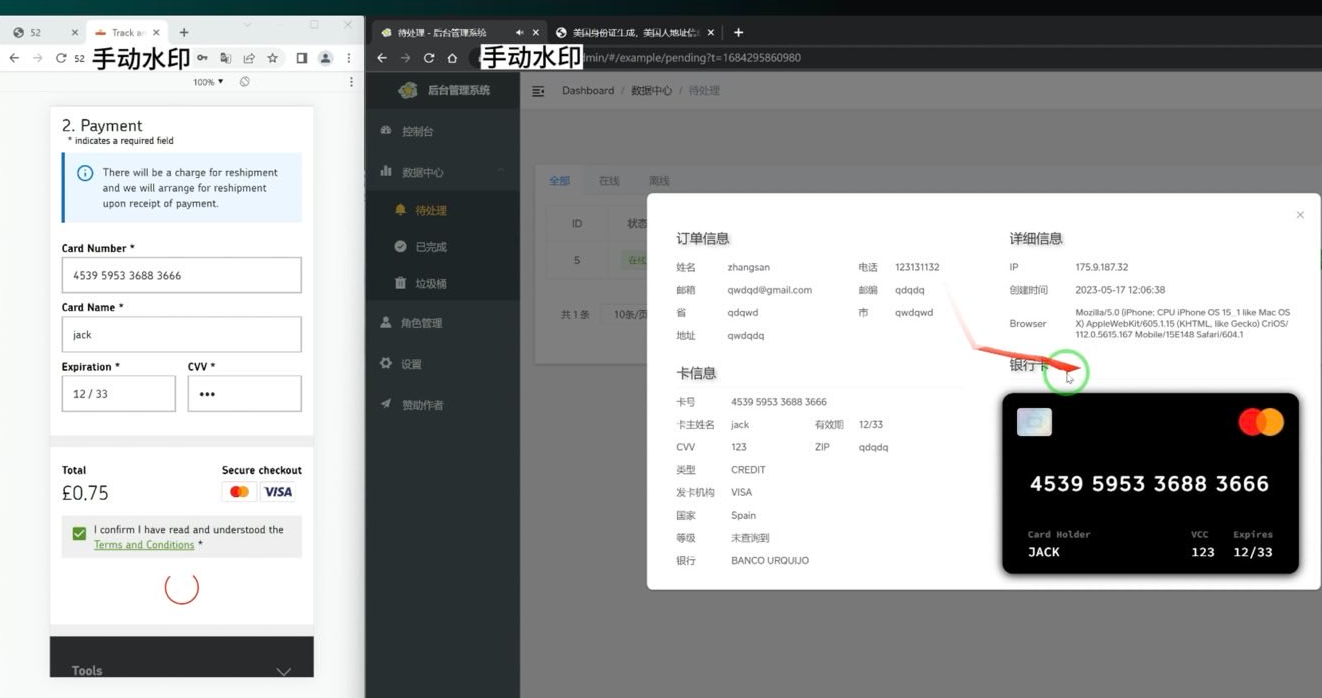
The site will then complain that the visitor’s bank needs to “verify” the transaction by sending a one-time code via SMS. In reality, the bank is sending that code to the mobile number on file for their customer because the fraudsters have just attempted to enroll that victim’s card details into a mobile wallet.

If the visitor supplies that one-time code, their payment card is then added to a new mobile wallet on an Apple or Google device that is physically controlled by the phishers. The phishing gangs typically load multiple stolen cards to digital wallets on a single Apple or Android device, and then sell those phones in bulk to scammers who use them for fraudulent e-commerce and tap-to-pay transactions.

A screenshot of the administrative panel for a smishing kit. On the left is the (test) data entered at the phishing site. On the right we can see the phishing kit has superimposed the supplied card number onto an image of a payment card. When the phishing kit scans that created card image into Apple or Google Pay, it triggers the victim’s bank to send a one-time code. Image: Ford Merrill.

The moniker “Smishing Triad” comes from Resecurity, which was among the first to report in August 2023 on the emergence of three distinct mobile phishing groups based in China that appeared to share some infrastructure and innovative phishing techniques. But it is a bit of a misnomer because the phishing lures blasted out by these groups are not SMS or text messages in the conventional sense.

Rather, they are sent via iMessage to Apple device users, and via RCS on Google Android devices. Thus, the missives bypass the mobile phone networks entirely and enjoy near 100 percent delivery rate (at least until Apple and Google suspend the spammy accounts).

In a report published on March 24, the Swiss threat intelligence firm Prodaft detailed the rapid pace of innovation coming from the Smishing Triad, which it characterizes as a loosely federated group of Chinese phishing-as-a-service operators with names like Darcula, Lighthouse, and the Xinxin Group.

Prodaft said they’re seeing a significant shift in the underground economy, particularly among Chinese-speaking threat actors who have historically operated in the shadows compared to their Russian-speaking counterparts.

“Chinese-speaking actors are introducing innovative and cost-effective systems, enabling them to target larger user bases with sophisticated services,” Prodaft wrote. “Their approach marks a new era in underground business practices, emphasizing scalability and efficiency in cybercriminal operations.”

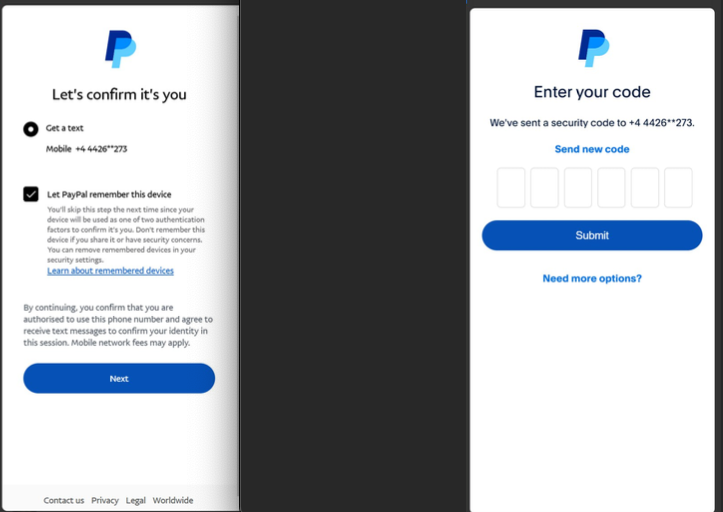
A new report from researchers at the security firm SilentPush finds the Smishing Triad members have expanded into selling mobile phishing kits targeting customers of global financial institutions like CitiGroup, MasterCard, PayPal, Stripe, and Visa, as well as banks in Canada, Latin America, Australia and the broader Asia-Pacific region.

Phishing lures from the Smishing Triad spoofing PayPal. Image: SilentPush.

SilentPush found the Smishing Triad now spoofs recognizable brands in a variety of industry verticals across at least 121 countries and a vast number of industries, including the postal, logistics, telecommunications, transportation, finance, retail and public sectors.

According to SilentPush, the domains used by the Smishing Triad are rotated frequently, with approximately 25,000 phishing domains active during any 8-day period and a majority of them sitting at two Chinese hosting companies: Tencent (AS132203) and Alibaba (AS45102).

“With nearly two-thirds of all countries in the world targeted by [the] Smishing Triad, it’s safe to say they are essentially targeting every country with modern infrastructure outside of Iran, North Korea, and Russia,” SilentPush wrote. “Our team has observed some potential targeting in Russia (such as domains that mentioned their country codes), but nothing definitive enough to indicate Russia is a persistent target. Interestingly, even though these are Chinese threat actors, we have seen instances of targeting aimed at Macau and Hong Kong, both special administrative regions of China.”

SilentPush’s Zach Edwards said his team found a vulnerability that exposed data from one of the Smishing Triad’s phishing pages, which revealed the number of visits each site received each day across thousands of phishing domains that were active at the time. Based on that data, SilentPush estimates those phishing pages received well more than a million visits within a 20-day time span.

The report notes the Smishing Triad boasts it has “300+ front desk staff worldwide” involved in one of their more popular phishing kits — Lighthouse — staff that is mainly used to support various aspects of the group’s fraud and cash-out schemes.

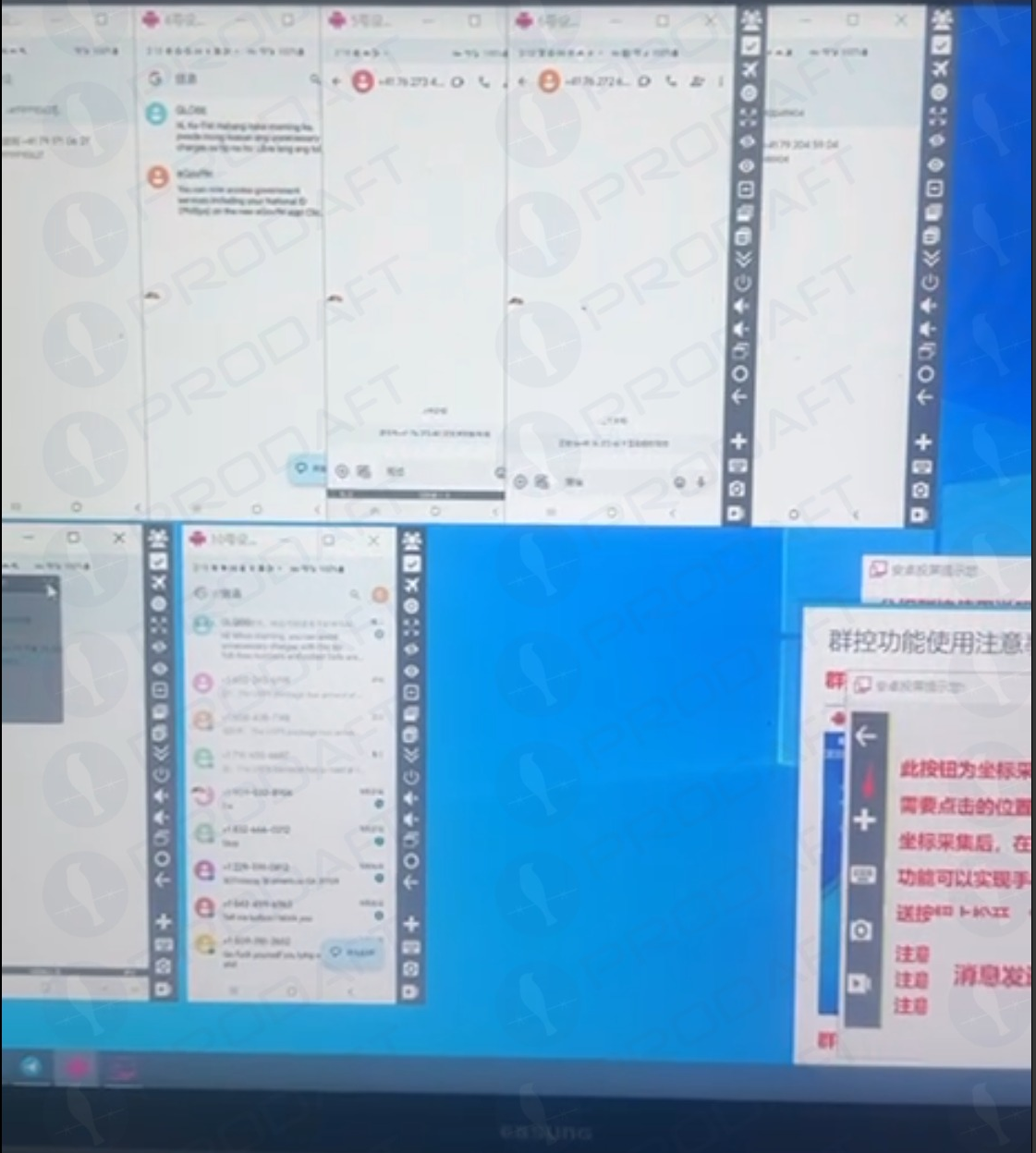
The Smishing Triad members maintain their own Chinese-language sales channels on Telegram, which frequently offer videos and photos of their staff hard at work. Some of those images include massive walls of phones used to send phishing messages, with human operators seated directly in front of them ready to receive any time-sensitive one-time codes.

As noted in February’s story How Phished Data Turns Into Apple and Google Wallets, one of those cash-out schemes involves an Android app called Z-NFC, which can relay a valid NFC transaction from one of these compromised digital wallets to anywhere in the world. For a $500 month subscription, the customer can wave their phone at any payment terminal that accepts Apple or Google pay, and the app will relay an NFC transaction over the Internet from a stolen wallet on a phone in China.

Chinese nationals were recently busted trying to use these NFC apps to buy high-end electronics in Singapore. And in the United States, authorities in California and Tennessee arrested Chinese nationals accused of using NFC apps to fraudulently purchase gift cards from retailers.

The Prodaft researchers said they were able to find a previously undocumented backend management panel for Lucid, a smishing-as-a-service operation tied to the XinXin Group. The panel included victim figures that suggest the smishing campaigns maintain an average success rate of approximately five percent, with some domains receiving over 500 visits per week.

“In one observed instance, a single phishing website captured 30 credit card records from 550 victim interactions over a 7-day period,” Prodaft wrote.

Prodaft’s report details how the Smishing Triad has achieved such success in sending their spam messages. For example, one phishing vendor appears to send out messages using dozens of Android device emulators running in parallel on a single machine.

Phishers using multiple virtualized Android devices to orchestrate and distribute RCS-based scam campaigns. Image: Prodaft.

According to Prodaft, the threat actors first acquire phone numbers through various means including data breaches, open-source intelligence, or purchased lists from underground markets. They then exploit technical gaps in sender ID validation within both messaging platforms.

“For iMessage, this involves creating temporary Apple IDs with impersonated display names, while RCS exploitation leverages carrier implementation inconsistencies in sender verification,” Prodaft wrote. “Message delivery occurs through automated platforms using VoIP numbers or compromised credentials, often deployed in precisely timed multi-wave campaigns to maximize effectiveness.

In addition, the phishing links embedded in these messages use time-limited single-use URLs that expire or redirect based on device fingerprinting to evade security analysis, they found.

“The economics strongly favor the attackers, as neither RCS nor iMessage messages incur per-message costs like traditional SMS, enabling high-volume campaigns at minimal operational expense,” Prodaft continued. “The overlap in templates, target pools, and tactics among these platforms underscores a unified threat landscape, with Chinese-speaking actors driving innovation in the underground economy. Their ability to scale operations globally and evasion techniques pose significant challenges to cybersecurity defenses.”

Ford Merrill works in security research at SecAlliance, a CSIS Security Group company. Merrill said he’s observed at least one video of a Windows binary that wraps a Chrome executable and can be used to load in target phone numbers and blast messages via RCS, iMessage, Amazon, Instagram, Facebook, and WhatsApp.

“The evidence we’ve observed suggests the ability for a single device to send approximately 100 messages per second,” Merrill said. “We also believe that there is capability to source country specific SIM cards in volume that allow them to register different online accounts that require validation with specific country codes, and even make those SIM cards available to the physical devices long-term so that services that rely on checks of the validity of the phone number or SIM card presence on a mobile network are thwarted.”

Experts say this fast-growing wave of card fraud persists because far too many financial institutions still default to sending one-time codes via SMS for validating card enrollment in mobile wallets from Apple or Google. KrebsOnSecurity interviewed multiple security executives at non-U.S. financial institutions who spoke on condition of anonymity because they were not authorized to speak to the press. Those banks have since done away with SMS-based one-time codes and are now requiring customers to log in to the bank’s mobile app before they can link their card to a digital wallet.


Read More

CISA Adds Two Known Exploited Vulnerabilities to Catalog

 ​CISA has added two new vulnerabilities to its Known Exploited Vulnerabilities Catalog, based on evidence of active exploitation.

CVE-2024-53197 Linux Kernel Out-of-Bounds Access Vulnerability
CVE-2024-53150 Linux Kernel Out-of-Bounds Read Vulnerability

These types of vulnerabilities are frequent attack vectors for malicious cyber actors and pose significant risks to the federal enterprise.
Binding Operational Directive (BOD) 22-01: Reducing the Significant Risk of Known Exploited Vulnerabilities established the Known Exploited Vulnerabilities Catalog as a living list of known Common Vulnerabilities and Exposures (CVEs) that carry significant risk to the federal enterprise. BOD 22-01 requires Federal Civilian Executive Branch (FCEB) agencies to remediate identified vulnerabilities by the due date to protect FCEB networks against active threats. See the BOD 22-01 Fact Sheet for more information.
Although BOD 22-01 only applies to FCEB agencies, CISA strongly urges all organizations to reduce their exposure to cyberattacks by prioritizing timely remediation of Catalog vulnerabilities as part of their vulnerability management practice. CISA will continue to add vulnerabilities to the catalog that meet the specified criteria. 

CISA has added two new vulnerabilities to its Known Exploited Vulnerabilities Catalog, based on evidence of active exploitation.

These types of vulnerabilities are frequent attack vectors for malicious cyber actors and pose significant risks to the federal enterprise.

Binding Operational Directive (BOD) 22-01: Reducing the Significant Risk of Known Exploited Vulnerabilities established the Known Exploited Vulnerabilities Catalog as a living list of known Common Vulnerabilities and Exposures (CVEs) that carry significant risk to the federal enterprise. BOD 22-01 requires Federal Civilian Executive Branch (FCEB) agencies to remediate identified vulnerabilities by the due date to protect FCEB networks against active threats. See the BOD 22-01 Fact Sheet for more information.

Although BOD 22-01 only applies to FCEB agencies, CISA strongly urges all organizations to reduce their exposure to cyberattacks by prioritizing timely remediation of Catalog vulnerabilities as part of their vulnerability management practice. CISA will continue to add vulnerabilities to the catalog that meet the specified criteria.

 Read More

Patch Tuesday, April 2025 Edition

​Microsoft today released updates to plug at least 121 security holes in its Windows operating systems and software, including one vulnerability that is already being exploited in the wild. Eleven of those flaws earned Microsoft’s most-dire “critical” rating, meaning malware or malcontents could exploit them with little to no interaction from Windows users. 

Microsoft today released updates to plug at least 121 security holes in its Windows operating systems and software, including one vulnerability that is already being exploited in the wild. Eleven of those flaws earned Microsoft’s most-dire “critical” rating, meaning malware or malcontents could exploit them with little to no interaction from Windows users.

The zero-day flaw already seeing exploitation is CVE-2025-29824, a local elevation of privilege bug in the Windows Common Log File System (CLFS) driver.  Microsoft rates it as “important,” but as Chris Goettl from Ivanti points out, risk-based prioritization warrants treating it as critical.

This CLFS component of Windows is no stranger to Patch Tuesday: According to Tenable’s Satnam Narang, since 2022 Microsoft has patched 32 CLFS vulnerabilities — averaging 10 per year — with six of them exploited in the wild. The last CLFS zero-day was patched in December 2024.

Narang notes that while flaws allowing attackers to install arbitrary code are consistently top overall Patch Tuesday features, the data is reversed for zero-day exploitation.

“For the past two years, elevation of privilege flaws have led the pack and, so far in 2025, account for over half of all zero-days exploited,” Narang wrote.

Rapid7’s Adam Barnett warns that any Windows defenders responsible for an LDAP server — which means almost any organization with a non-trivial Microsoft footprint — should add patching for the critical flaw CVE-2025-26663 to their to-do list.

“With no privileges required, no need for user interaction, and code execution presumably in the context of the LDAP server itself, successful exploitation would be an attractive shortcut to any attacker,” Barnett said. “Anyone wondering if today is a re-run of December 2024 Patch Tuesday can take some small solace in the fact that the worst of the trio of LDAP critical RCEs published at the end of last year was likely easier to exploit than today’s example, since today’s CVE-2025-26663 requires that an attacker win a race condition. Despite that, Microsoft still expects that exploitation is more likely.”

Among the critical updates Microsoft patched this month are remote code execution flaws in Windows Remote Desktop services (RDP), including CVE-2025-26671, CVE-2025-27480 and CVE-2025-27482; only the latter two are rated “critical,” and Microsoft marked both of them as “Exploitation More Likely.”

Perhaps the most widespread vulnerabilities fixed this month were in web browsers. Google Chrome updated to fix 13 flaws this week, and Mozilla Firefox fixed eight bugs, with possibly more updates coming later this week for Microsoft Edge.

As it tends to do on Patch Tuesdays, Adobe has released 12 updates resolving 54 security holes across a range of products, including ColdFusion, Adobe Commerce, Experience Manager Forms, After Effects, Media Encoder, BridgePremiere Pro, Photoshop, Animate, AEM Screens, and FrameMaker.

Apple users may need to patch as well. On March 31, Apple released a huge security update (more than three gigabytes in size) to fix issues in a range of their products, including at least one zero-day flaw.

And in case you missed it, on March 31, 2025 Apple released a rather large batch of security updates for a wide range of their products, from macOS to the iOS operating systems on iPhones and iPads.

Earlier today, Microsoft included a note saying Windows 10 security updates weren’t available but would be released as soon as possible. It appears from browsing askwoody.com that this snafu has since been rectified. Either way, if you run into complications applying any of these updates please leave a note about it in the comments below, because the chances are good that someone else had the same problem.

As ever, please consider backing up your data and or devices prior to updating, which makes it far less complicated to undo a software update gone awry. For more granular details on today’s Patch Tuesday, check out the SANS Internet Storm Center’s roundup. Microsoft’s update guide for April 2025 is here.

For more details on Patch Tuesday, check out the write-ups from Action1 and Automox.


Read More

CISA Adds Two Known Exploited Vulnerabilities to Catalog

 ​CISA has added two new vulnerabilities to its Known Exploited Vulnerabilities Catalog, based on evidence of active exploitation.

CVE-2025-30406 Gladinet CentreStack Use of Hard-coded Cryptographic Key Vulnerability
CVE-2025-29824 Microsoft Windows Common Log File System (CLFS) Driver Use-After-Free Vulnerability

These types of vulnerabilities are frequent attack vectors for malicious cyber actors and pose significant risks to the federal enterprise.
Binding Operational Directive (BOD) 22-01: Reducing the Significant Risk of Known Exploited Vulnerabilities established the Known Exploited Vulnerabilities Catalog as a living list of known Common Vulnerabilities and Exposures (CVEs) that carry significant risk to the federal enterprise. BOD 22-01 requires Federal Civilian Executive Branch (FCEB) agencies to remediate identified vulnerabilities by the due date to protect FCEB networks against active threats. See the BOD 22-01 Fact Sheet for more information.
Although BOD 22-01 only applies to FCEB agencies, CISA strongly urges all organizations to reduce their exposure to cyberattacks by prioritizing timely remediation of Catalog vulnerabilities as part of their vulnerability management practice. CISA will continue to add vulnerabilities to the catalog that meet the specified criteria. 

CISA has added two new vulnerabilities to its Known Exploited Vulnerabilities Catalog, based on evidence of active exploitation.

  • CVE-2025-30406 Gladinet CentreStack Use of Hard-coded Cryptographic Key Vulnerability
  • CVE-2025-29824 Microsoft Windows Common Log File System (CLFS) Driver Use-After-Free Vulnerability

These types of vulnerabilities are frequent attack vectors for malicious cyber actors and pose significant risks to the federal enterprise.

Binding Operational Directive (BOD) 22-01: Reducing the Significant Risk of Known Exploited Vulnerabilities established the Known Exploited Vulnerabilities Catalog as a living list of known Common Vulnerabilities and Exposures (CVEs) that carry significant risk to the federal enterprise. BOD 22-01 requires Federal Civilian Executive Branch (FCEB) agencies to remediate identified vulnerabilities by the due date to protect FCEB networks against active threats. See the BOD 22-01 Fact Sheet for more information.

Although BOD 22-01 only applies to FCEB agencies, CISA strongly urges all organizations to reduce their exposure to cyberattacks by prioritizing timely remediation of Catalog vulnerabilities as part of their vulnerability management practice. CISA will continue to add vulnerabilities to the catalog that meet the specified criteria.

 Read More

CISA Adds One Known Exploited Vulnerability to Catalog

 ​CISA has added one new vulnerability to its Known Exploited Vulnerabilities Catalog, based on evidence of active exploitation.

CVE-2025-31161 CrushFTP Authentication Bypass Vulnerability

These types of vulnerabilities are frequent attack vectors for malicious cyber actors and pose significant risks to the federal enterprise.
Binding Operational Directive (BOD) 22-01: Reducing the Significant Risk of Known Exploited Vulnerabilities established the Known Exploited Vulnerabilities Catalog as a living list of known Common Vulnerabilities and Exposures (CVEs) that carry significant risk to the federal enterprise. BOD 22-01 requires Federal Civilian Executive Branch (FCEB) agencies to remediate identified vulnerabilities by the due date to protect FCEB networks against active threats. See the BOD 22-01 Fact Sheet for more information.
Although BOD 22-01 only applies to FCEB agencies, CISA strongly urges all organizations to reduce their exposure to cyberattacks by prioritizing timely remediation of Catalog vulnerabilities as part of their vulnerability management practice. CISA will continue to add vulnerabilities to the catalog that meet the specified criteria. 

CISA has added one new vulnerability to its Known Exploited Vulnerabilities Catalog, based on evidence of active exploitation.

These types of vulnerabilities are frequent attack vectors for malicious cyber actors and pose significant risks to the federal enterprise.

Binding Operational Directive (BOD) 22-01: Reducing the Significant Risk of Known Exploited Vulnerabilities established the Known Exploited Vulnerabilities Catalog as a living list of known Common Vulnerabilities and Exposures (CVEs) that carry significant risk to the federal enterprise. BOD 22-01 requires Federal Civilian Executive Branch (FCEB) agencies to remediate identified vulnerabilities by the due date to protect FCEB networks against active threats. See the BOD 22-01 Fact Sheet for more information.

Although BOD 22-01 only applies to FCEB agencies, CISA strongly urges all organizations to reduce their exposure to cyberattacks by prioritizing timely remediation of Catalog vulnerabilities as part of their vulnerability management practice. CISA will continue to add vulnerabilities to the catalog that meet the specified criteria.

 Read More

CISA Adds One Vulnerability to the KEV Catalog

 ​CISA has added one new vulnerability to its Known Exploited Vulnerabilities Catalog, based on evidence of active exploitation.

CVE-2025-22457 Ivanti Connect Secure, Policy Secure and ZTA Gateways Stack-Based Buffer Overflow Vulnerability

These types of vulnerabilities are frequent attack vectors for malicious cyber actors and pose significant risks to the federal enterprise.
CISA urges organizations to apply mitigations as set forth in the CISA instructions linked below to include conducting hunt activities, taking remediation actions if applicable, and applying updates prior to returning a device to service.

Security Update: Pulse Connect Secure, Ivanti Connect Secure, Policy Secure and Neurons for ZTA Gateway
CISA Mitigation Instructions for CVE-2025-22457

Organizations should report incidents and anomalous activity to CISA’s 24/7 Operations Center at Report@cisa.gov or (888) 282-0870. When available, please include the following information regarding the incident: date, time, and location of the incident; type of activity; number of people affected; type of equipment used for the activity; the name of the submitting company or organization; and a designated point of contact.
Binding Operational Directive (BOD) 22-01: Reducing the Significant Risk of Known Exploited Vulnerabilities established the Known Exploited Vulnerabilities Catalog as a living list of known Common Vulnerabilities and Exposures (CVEs) that carry significant risk to the federal enterprise. BOD 22-01 requires Federal Civilian Executive Branch (FCEB) agencies to remediate identified vulnerabilities by the due date to protect FCEB networks against active threats. See the BOD 22-01 Fact Sheet for more information.
Although BOD 22-01 only applies to FCEB agencies, CISA strongly urges all organizations to reduce their exposure to cyberattacks by prioritizing timely remediation of Catalog vulnerabilities as part of their vulnerability management practice. CISA will continue to add vulnerabilities to the catalog that meet the specified criteria. 

CISA has added one new vulnerability to its Known Exploited Vulnerabilities Catalog, based on evidence of active exploitation.

  • CVE-2025-22457 Ivanti Connect Secure, Policy Secure and ZTA Gateways Stack-Based Buffer Overflow Vulnerability

These types of vulnerabilities are frequent attack vectors for malicious cyber actors and pose significant risks to the federal enterprise.

CISA urges organizations to apply mitigations as set forth in the CISA instructions linked below to include conducting hunt activities, taking remediation actions if applicable, and applying updates prior to returning a device to service.

Organizations should report incidents and anomalous activity to CISA’s 24/7 Operations Center at Report@cisa.gov or (888) 282-0870. When available, please include the following information regarding the incident: date, time, and location of the incident; type of activity; number of people affected; type of equipment used for the activity; the name of the submitting company or organization; and a designated point of contact.

Binding Operational Directive (BOD) 22-01: Reducing the Significant Risk of Known Exploited Vulnerabilities established the Known Exploited Vulnerabilities Catalog as a living list of known Common Vulnerabilities and Exposures (CVEs) that carry significant risk to the federal enterprise. BOD 22-01 requires Federal Civilian Executive Branch (FCEB) agencies to remediate identified vulnerabilities by the due date to protect FCEB networks against active threats. See the BOD 22-01 Fact Sheet for more information.

Although BOD 22-01 only applies to FCEB agencies, CISA strongly urges all organizations to reduce their exposure to cyberattacks by prioritizing timely remediation of Catalog vulnerabilities as part of their vulnerability management practice. CISA will continue to add vulnerabilities to the catalog that meet the specified criteria.

 Read More

Ivanti Releases Security Updates for Connect Secure, Policy Secure & ZTA Gateways Vulnerability (CVE-2025-22457)

 ​Ivanti released security updates to address vulnerabilities (CVE-2025-22457) in Ivanti Connect Secure, Policy Secure & ZTA Gateways. A cyber threat actor could exploit CVE-2025-22457 to take control of an affected system.
CISA has added CVE-2025-22457 to its Known Exploited Vulnerabilities Catalog.
See the following resources for more guidance:

April Security Update | Ivanti
April Security Advisory Ivanti Connect Secure, Policy Secure & ZTA Gateways (CVE-2025-22457)
Suspected China-Nexus Threat Actor Actively Exploiting Critical Ivanti Connect Secure Vulnerability (CVE-2025-22457) | Google Cloud Blog

For any instances of Ivanti Connect Secure that were not updated by Feb. 28, 2025, to the latest Ivanti patch (22.7R2.6) and all instances of Pulse Connect Secure (EoS), Policy Secure, and ZTA Gateways, CISA urges users and administrators to implement the following actions:

Conduct threat hunting actions:

Run an external Integrity Checker Tool (ICT). For more guidance, see Ivanti’s instructions.
Conduct threat hunt actions on any systems connected to—or recently connected to—the affected Ivanti device.

If threat hunting actions determine no compromise:

For the highest level of confidence, conduct a factory reset.

For Cloud and Virtual systems, conduct a factory reset using an external known clean image of the device.

Apply the patch described in Security Advisory Ivanti Connect Secure, Policy Secure & ZTA Gateways (CVE-2025-22457). Please note that patches for Ivanti ZTA Gateways and Ivanti Policy Secure will be available April 19 and 21, respectively. Consider disconnecting vulnerable devices until patches are available.
Monitor the authentication or identity management services that could be exposed.
Continue to audit privilege level access accounts.

If threat hunting actions determine compromise:

For devices that are confirmed compromised, isolate all affected instances from the network. Keep impacted devices isolated until the below guidance is completed and patches are applied.
Take a forensic image (including memory capture) or work with Ivanti to get a copy of the image.
Disconnect all compromised instances.  
For the highest level of confidence, conduct a factory reset.

For Cloud and Virtual systems, conduct a factory reset using an external known clean image of the device.

Revoke and reissue any connected or exposed certificates, keys, and passwords, to include the following:

Reset the admin enable password.
Reset stored application programming interface (API) keys.
Reset the password of any local user defined on the gateway, including service accounts used for auth server configuration(s).

If domain accounts associated with the affected products have been compromised:

Reset passwords twice for on premise accounts, revoke Kerberos tickets, and then revoke tokens for cloud accounts in hybrid deployments.
For cloud joined/registered devices, disable devices in the cloud to revoke the device tokens.

Apply the patch described in Security Advisory Ivanti Connect Secure, Policy Secure & ZTA Gateways (CVE-2025-22457). Please note that patches for Ivanti ZTA Gateways and Ivanti Policy Secure will be available April 19 and 21, respectively.
Report to CISA and Ivanti immediately.

Organizations should report incidents and anomalous activity to CISA’s 24/7 Operations Center at Report@cisa.gov or (888) 282-0870. 
Disclaimer:
The information in this report is being provided “as is” for informational purposes only. CISA does not endorse any commercial entity, product, company, or service, including any entities, products, or services linked within this document. Any reference to specific commercial entities, products, processes, or services by service mark, trademark, manufacturer, or otherwise, does not constitute or imply endorsement, recommendation, or favoring by CISA. 

Ivanti released security updates to address vulnerabilities (CVE-2025-22457) in Ivanti Connect Secure, Policy Secure & ZTA Gateways. A cyber threat actor could exploit CVE-2025-22457 to take control of an affected system.

CISA has added CVE-2025-22457 to its Known Exploited Vulnerabilities Catalog.

See the following resources for more guidance:

For any instances of Ivanti Connect Secure that were not updated by Feb. 28, 2025, to the latest Ivanti patch (22.7R2.6) and all instances of Pulse Connect Secure (EoS), Policy Secure, and ZTA Gateways, CISA urges users and administrators to implement the following actions:

  1. Conduct threat hunting actions:
    1. Run an external Integrity Checker Tool (ICT). For more guidance, see Ivanti’s instructions.
    2. Conduct threat hunt actions on any systems connected to—or recently connected to—the affected Ivanti device.
  2. If threat hunting actions determine no compromise:
    1. For the highest level of confidence, conduct a factory reset.
      1. For Cloud and Virtual systems, conduct a factory reset using an external known clean image of the device.
    2. Apply the patch described in Security Advisory Ivanti Connect Secure, Policy Secure & ZTA Gateways (CVE-2025-22457). Please note that patches for Ivanti ZTA Gateways and Ivanti Policy Secure will be available April 19 and 21, respectively. Consider disconnecting vulnerable devices until patches are available.
    3. Monitor the authentication or identity management services that could be exposed.
    4. Continue to audit privilege level access accounts.
  3. If threat hunting actions determine compromise:
    1. For devices that are confirmed compromised, isolate all affected instances from the network. Keep impacted devices isolated until the below guidance is completed and patches are applied.
    2. Take a forensic image (including memory capture) or work with Ivanti to get a copy of the image.
    3. Disconnect all compromised instances.  
    4. For the highest level of confidence, conduct a factory reset.
      1. For Cloud and Virtual systems, conduct a factory reset using an external known clean image of the device.
    5. Revoke and reissue any connected or exposed certificates, keys, and passwords, to include the following:
      1. Reset the admin enable password.
      2. Reset stored application programming interface (API) keys.
      3. Reset the password of any local user defined on the gateway, including service accounts used for auth server configuration(s).
    6. If domain accounts associated with the affected products have been compromised:
      1. Reset passwords twice for on premise accounts, revoke Kerberos tickets, and then revoke tokens for cloud accounts in hybrid deployments.
      2. For cloud joined/registered devices, disable devices in the cloud to revoke the device tokens.
    7. Apply the patch described in Security Advisory Ivanti Connect Secure, Policy Secure & ZTA Gateways (CVE-2025-22457). Please note that patches for Ivanti ZTA Gateways and Ivanti Policy Secure will be available April 19 and 21, respectively.
    8. Report to CISA and Ivanti immediately.

Organizations should report incidents and anomalous activity to CISA’s 24/7 Operations Center at Report@cisa.gov or (888) 282-0870. 

Disclaimer:

The information in this report is being provided “as is” for informational purposes only. CISA does not endorse any commercial entity, product, company, or service, including any entities, products, or services linked within this document. Any reference to specific commercial entities, products, processes, or services by service mark, trademark, manufacturer, or otherwise, does not constitute or imply endorsement, recommendation, or favoring by CISA.

 Read More

Cyber Forensic Expert in 2,000+ Cases Faces FBI Probe

​A Minnesota cybersecurity and computer forensics expert whose testimony has featured in thousands of courtroom trials over the past 30 years is facing questions about his credentials and an inquiry from the Federal Bureau of Investigation (FBI). Legal experts say the inquiry could be grounds to reopen a number of adjudicated cases in which the expert’s testimony may have been pivotal. 

A Minnesota cybersecurity and computer forensics expert whose testimony has featured in thousands of courtroom trials over the past 30 years is facing questions about his credentials and an inquiry from the Federal Bureau of Investigation (FBI). Legal experts say the inquiry could be grounds to reopen a number of adjudicated cases in which the expert’s testimony may have been pivotal.

One might conclude from reading Mr. Lanterman’s LinkedIn profile that has a degree from Harvard University.

Mark Lanterman is a former investigator for the U.S. Secret Service Electronics Crimes Task Force who founded the Minneapolis consulting firm Computer Forensic Services (CFS). The CFS website says Lanterman’s 30-year career has seen him testify as an expert in more than 2,000 cases, with experience in cases involving sexual harassment and workplace claims, theft of intellectual property and trade secrets, white-collar crime, and class action lawsuits.

Or at least it did until last month, when Lanterman’s profile and work history were quietly removed from the CFS website. The removal came after Hennepin County Attorney’s Office said it was notifying parties to ten pending cases that they were unable to verify Lanterman’s educational and employment background. The county attorney also said the FBI is now investigating the allegations.

Those allegations were raised by Sean Harrington, an attorney and forensics examiner based in Prescott, Wisconsin. Harrington alleged that Lanterman lied under oath in court on multiple occasions when he testified that he has a Bachelor of Science and a Master’s degree in computer science from the now-defunct Upsala College, and that he completed his postgraduate work in cybersecurity at Harvard University.

Harrington’s claims gained steam thanks to digging by the law firm Perkins Coie LLP, which is defending a case wherein a client’s laptop was forensically reviewed by Lanterman. On March 14, Perkins Coie attorneys asked the judge (PDF) to strike Lanterman’s testimony because neither he nor they could substantiate claims about his educational background.

Upsala College, located in East Orange, N.J., operated for 102 years until it closed in 1995 after a period of declining enrollment and financial difficulties. Perkins Coie told the court that they’d visited Felician University, which holds the transcripts for Upsala College during the years Lanterman claimed to have earned undergraduate and graduate degrees. The law firm said Felician had no record of transcripts for Lanterman (PDF), and that his name was absent from all of the Upsala College student yearbooks and commencement programs during that period.

Reached for comment, Lanterman acknowledged he had no way to prove he attended Upsala College, and that his “postgraduate work” at Harvard was in fact an eight-week online cybersecurity class called HarvardX, which cautions that its certificates should not be considered equivalent to a Harvard degree or a certificate earned through traditional, in-person programs at Harvard University.

Lanterman has testified that his first job after college was serving as a police officer in Springfield Township, Pennsylvania, although the Perkins Coie attorneys noted that this role was omitted from his resume. The attorneys said when they tried to verify Lanterman’s work history, “the police department responded with a story that would be almost impossible to believe if it was not corroborated by Lanterman’s own email communications.”

As recounted in the March 14 filing, Lanterman was deposed on Feb. 11, and the following day he emailed the Springfield Township Police Department to see if he could have a peek at his old personnel file. On Feb. 14, Lanterman visited the Springfield Township PD and asked to borrow his employment record. He told the officer he spoke with on the phone that he’d recently been instructed to “get his affairs in order” after being diagnosed with a grave heart condition, and that he wanted his old file to show his family about his early career.

According to Perkins Coie, Lanterman left the Springfield Township PD with his personnel file, and has not returned it as promised.

“It is shocking that an expert from Minnesota would travel to suburban Philadelphia and abscond with his decades-old personnel file to obscure his background,” the law firm wrote. “That appears to be the worst and most egregious form of spoliation, and the deception alone is reason enough to exclude Lanterman and consider sanctions.”

Harrington initially contacted KrebsOnSecurity about his concerns in late 2023, fuming after sitting through a conference speech in which Lanterman shared documents from a ransomware victim and told attendees it was because they’d refused to hire his company to perform a forensic investigation on a recent breach.

“He claims he was involved in the Martha Stewart investigation, the Bernie Madoff trial, Paul McCartney’s divorce, the Tom Petters investigation, the Denny Hecker investigation, and many others,” Harrington said. “He claims to have been invited to speak to the Supreme Court, claims to train the ‘entire federal judiciary’ on cybersecurity annually, and is a faculty member of the United States Judicial Conference and the Judicial College — positions which he obtained, in part, on a house of fraudulent cards.”

In an interview this week, Harrington said court documents reveal that at least two of Lanterman’s previous clients complained CFS had held their data for ransom over billing disputes. In a declaration (PDF) dated August 2022, the co-founder of the law firm MoreLaw Minneapolis LLC said she hired Lanterman in 2014 to examine several electronic devices after learning that one of their paralegals had a criminal fraud history.

But the law firm said when it pushed back on a consulting bill that was far higher than expected, Lanterman told them CFS would “escalate” its collection efforts if they didn’t pay, including “a claim and lien against the data which will result in a public auction of your data.”

“All of us were flabbergasted by Mr. Lanterman’s email,” wrote MoreLaw co-founder Kimberly Hanlon. “I had never heard of any legitimate forensic company threatening to ‘auction’ off an attorney’s data, particularly knowing that the data is comprised of confidential client data, much of which is sensitive in nature.”

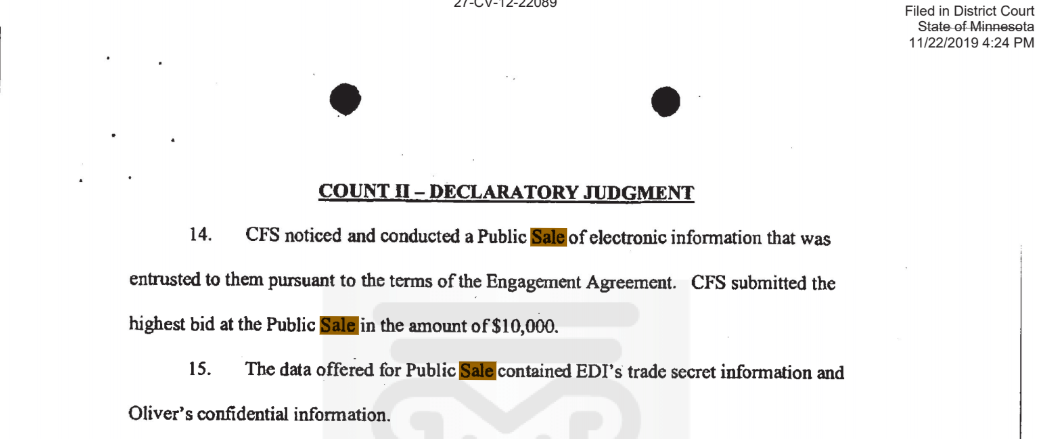
In 2009, a Wisconsin-based manufacturing company that had hired Lanterman for computer forensics balked at paying an $86,000 invoice from CFS, calling it “excessive and unsubstantiated.” The company told a Hennepin County court that on April 15, 2009, CFS conducted an auction of its trade secret information in violation of their confidentiality agreement.

“CFS noticed and conducted a Public Sale of electronic information that was entrusted to them pursuant to the terms of the engagement agreement,” the company wrote. “CFS submitted the highest bid at the Public Sale in the amount of $10,000.”

Lanterman briefly responded to a list of questions about his background (and recent heart diagnosis) on March 24, saying he would send detailed replies the following day. Those replies never materialized. Instead, Lanterman forwarded a recent memo he wrote to the court that attacked Harrington and said his accuser was only trying to take out a competitor. He has not responded to further requests for comment.

“When I attended Upsala, I was a commuter student who lived with my grandparents in Morristown, New Jersey approximately 30 minutes away from Upsala College,” Lanterman explained to the judge (PDF) overseeing a separate ongoing case (PDF) in which he has testified. “With limited resources, I did not participate in campus social events, nor did I attend graduation ceremonies. In 2023, I confirmed with Felician University — which maintains Upsala College’s records — that they could not locate my transcripts or diploma, a situation that they indicated was possibly due to unresolved money-related issues.”

Lanterman was ordered to appear in court on April 3 in the case defended by Perkins Coie, but he did not show up. Instead, he sent a message to the judge withdrawing from the case.

“I am 60 years old,” Lanterman told the judge. “I created my business from nothing. I am done dealing with the likes of individuals like Sean Harrington. And quite frankly, I have been planning at turning over my business to my children for years. That time has arrived.”

Lanterman’s letter leaves the impression that it was his decision to retire. But according to an affidavit (PDF) filed in a Florida case on March 28, Mark Lanterman’s son Sean said he’d made the difficult decision to ask his dad to step down given all the negative media attention.

Mark Rasch, a former federal cybercrime prosecutor who now serves as counsel to the New York cybersecurity intelligence firm Unit 221B, said that if an expert witness is discredited, any defendants who lost cases that were strongly influenced by that expert’s conclusions at trial could have grounds for appeal.

Rasch said law firms who propose an expert witness have a duty in good faith to vet that expert’s qualifications, knowing that those credentials will be subject to cross-examination.

“Federal rules of civil procedure and evidence both require experts to list every case they have testified in as an expert for the past few years,” Rasch said. “Part of that due diligence is pulling up the results of those cases and seeing what the nature of their testimony has been.”

Perhaps the most well-publicized case involving significant forensic findings from Lanterman was the 2018 conviction of Stephen Allwine, who was found guilty of killing his wife two years earlier after attempts at hiring a hitman on the dark net fell through. Allwine is serving a sentence of life in prison, and continues to maintain that he was framed, casting doubt on computer forensic evidence found on 64 electronic devices taken from his home.

On March 24, Allwine petitioned a Minnesota court (PDF) to revisit his case, citing the accusations against Lanterman and his role as a key witness for the prosecution.


Read More

ABB ACS880 Drives Containing CODESYS RTS

 ​View CSAF
1. EXECUTIVE SUMMARY

CVSS v3 8.8
ATTENTION: Exploitable remotely/low attack complexity
Vendor: ABB
Equipment: ACS880 Drives with IEC 61131-3 license
Vulnerabilities: Improper Input Validation, Out-of-bounds Write, Improper Restriction of Operations within the Bounds of a Memory Buffer

2. RISK EVALUATION
Successful exploitation of these vulnerabilities could allow an attacker to gain full access to the device or cause a denial-of-service condition.
3. TECHNICAL DETAILS
3.1 AFFECTED PRODUCTS
ABB reports that the following low-voltage DC drive and power controller products contain a vulnerable version of CODESYS Runtime:

ABB ACS880 Drives ACS880 Primary Control Program AINLX: Versions prior to v3.47
ABB ACS880 Drives ACS880 Primary Control Program YINLX: Versions prior to v1.30
ABB ACS880 Drives ACS880 IGBT Supply Control Program AISLX: Versions prior to v3.43
ABB ACS880 Drives ACS880 IGBT Supply Control Program ALHLX: Versions prior to v3.43
ABB ACS880 Drives ACS880 IGBT Supply Control Program YISLX: Versions prior v1.30
ABB ACS880 Drives ACS880 IGBT Supply Control Program YLHLX: Versions prior v1.30
ABB ACS880 Drives ACS880 Position Control Program APCLX: Versions up to and including v1.04.0.5
ABB ACS880 Drives ACS880 Test Bench Control Program ATBLX: Versions up to and including v3.44.0.0

3.2 VULNERABILITY OVERVIEW
3.2.1 IMPROPER INPUT VALIDATION CWE-20
After successful authentication as a user in multiple CODESYS products in multiple versions, specific crafted network communication requests with inconsistent content can cause the CmpAppForce component to read internally from an invalid address, potentially leading to a denial-of-service condition.
CVE-2023-37559 has been assigned to this vulnerability. A CVSS v3 base score of 6.5 has been calculated; the CVSS vector string is (CVSS:3.1/AV:N/AC:L/PR:L/UI:N/S:U/C:N/I:N/A:H).
3.2.2 IMPROPER INPUT VALIDATION CWE-20
After successful authentication as a user in multiple CODESYS products in multiple versions, specific crafted network communication requests with inconsistent content can cause the CmpAppForce component to read internally from an invalid address, potentially leading to a denial-of-service condition.
CVE-2023-37558 has been assigned to this vulnerability. A CVSS v3 base score of 6.5 has been calculated; the CVSS vector string is (CVSS:3.1/AV:N/AC:L/PR:L/UI:N/S:U/C:N/I:N/A:H).
3.2.3 OUT-OF-BOUNDS WRITE CWE-787
After successful authentication as a user in multiple CODESYS products in multiple versions, specific crafted remote communication requests can cause the CmpAppBP component to overwrite a heap-based buffer which can lead to a denial-of-service condition
CVE-2023-37557 has been assigned to this vulnerability. A CVSS v3 base score of 6.5 has been calculated; the CVSS vector string is (CVSS:3.1/AV:N/AC:L/PR:L/UI:N/S:U/C:N/I:N/A:H).
3.2.4 IMPROPER INPUT VALIDATION CWE-20
In multiple versions of multiple CODESYS products, after successful authentication as a user, specific crafted network communication requests with inconsistent content can cause the CmpAppBP component to read internally from an invalid address, potentially leading to a denial-of-service condition.
CVE-2023-37556 has been assigned to this vulnerability. A CVSS v3 base score of 6.5 has been calculated; the CVSS vector string is (CVSS:3.1/AV:N/AC:L/PR:L/UI:N/S:U/C:N/I:N/A:H).
3.2.5 IMPROPER INPUT VALIDATION CWE-20
In multiple versions of multiple CODESYS products, after successful authentication as a user, specific crafted network communication requests with inconsistent content can cause the CmpAppBP component to read internally from an invalid address, potentially leading to a denial-of-service condition.
CVE-2023-37555 has been assigned to this vulnerability. A CVSS v3 base score of 6.5 has been calculated; the CVSS vector string is (CVSS:3.1/AV:N/AC:L/PR:L/UI:N/S:U/C:N/I:N/A:H).
3.2.6 IMPROPER INPUT VALIDATION CWE-20
In multiple versions of multiple CODESYS products, after successful authentication as a user, specific crafted network communication requests with inconsistent content can cause the CmpAppBP component to read internally from an invalid address, potentially leading to a denial-of-service condition.
CVE-2023-37554 has been assigned to this vulnerability. A CVSS v3 base score of 6.5 has been calculated; the CVSS vector string is (CVSS:3.1/AV:N/AC:L/PR:L/UI:N/S:U/C:N/I:N/A:H).
3.2.7 IMPROPER INPUT VALIDATION CWE-20
In multiple versions of multiple CODESYS products, after successful authentication as a user, specific crafted network communication requests with inconsistent content can cause the CmpAppBP component to read internally from an invalid address, potentially leading to a denial-of-service condition.
CVE-2023-37553 has been assigned to this vulnerability. A CVSS v3 base score of 6.5 has been calculated; the CVSS vector string is (CVSS:3.1/AV:N/AC:L/PR:L/UI:N/S:U/C:N/I:N/A:H).
3.2.8 IMPROPER INPUT VALIDATION CWE-20
In multiple versions of multiple CODESYS products, after successful authentication as a user, specific crafted network communication requests with inconsistent content can cause the CmpAppBP component to read internally from an invalid address, potentially leading to a denial-of-service condition.
CVE-2023-37552 has been assigned to this vulnerability. A CVSS v3 base score of 6.5 has been calculated; the CVSS vector string is (CVSS:3.1/AV:N/AC:L/PR:L/UI:N/S:U/C:N/I:N/A:H).
3.2.9 IMPROPER INPUT VALIDATION CWE-20
In multiple CODESYS products in multiple versions, after successful authentication as a user, specific crafted network communication requests with inconsistent content can cause the CmpApp component to read internally from an invalid address, potentially leading to a denial-of-service condition.
CVE-2023-37550 has been assigned to this vulnerability. A CVSS v3 base score of 6.5 has been calculated; the CVSS vector string is (CVSS:3.1/AV:N/AC:L/PR:L/UI:N/S:U/C:N/I:N/A:H).
3.2.10 IMPROPER INPUT VALIDATION CWE-20
In multiple CODESYS products in multiple versions, after successful authentication as a user, specific crafted network communication requests with inconsistent content can cause the CmpApp component to read internally from an invalid address, potentially leading to a denial-of-service condition.
CVE-2023-37549 has been assigned to this vulnerability. A CVSS v3 base score of 6.5 has been calculated; the CVSS vector string is (CVSS:3.1/AV:N/AC:L/PR:L/UI:N/S:U/C:N/I:N/A:H).
3.2.11 IMPROPER INPUT VALIDATION CWE-20
In multiple CODESYS products in multiple versions, after successful authentication as a user, specific crafted network communication requests with inconsistent content can cause the CmpApp component to read internally from an invalid address, potentially leading to a denial-of-service condition.
CVE-2023-37548 has been assigned to this vulnerability. A CVSS v3 base score of 6.5 has been calculated; the CVSS vector string is (CVSS:3.1/AV:N/AC:L/PR:L/UI:N/S:U/C:N/I:N/A:H).
3.2.12 IMPROPER INPUT VALIDATION CWE-20
In multiple CODESYS products in multiple versions, after successful authentication as a user, specific crafted network communication requests with inconsistent content can cause the CmpApp component to read internally from an invalid address, potentially leading to a denial-of-service condition.
CVE-2023-37547 has been assigned to this vulnerability. A CVSS v3 base score of 6.5 has been calculated; the CVSS vector string is (CVSS:3.1/AV:N/AC:L/PR:L/UI:N/S:U/C:N/I:N/A:H).
3.2.13 IMPROPER INPUT VALIDATION CWE-20
In multiple CODESYS products in multiple versions, after successful authentication as a user, specific crafted network communication requests with inconsistent content can cause the CmpApp component to read internally from an invalid address, potentially leading to a denial-of-service condition.
CVE-2023-37546 has been assigned to this vulnerability. A CVSS v3 base score of 6.5 has been calculated; the CVSS vector string is (CVSS:3.1/AV:N/AC:L/PR:L/UI:N/S:U/C:N/I:N/A:H).
3.2.14 IMPROPER INPUT VALIDATION CWE-20
In multiple CODESYS products in multiple versions, after successful authentication as a user, specific crafted network communication requests with inconsistent content can cause the CmpApp component to read internally from an invalid address, potentially leading to a denial-of-service condition.
CVE-2023-37545 has been assigned to this vulnerability. A CVSS v3 base score of 6.5 has been calculated; the CVSS vector string is (CVSS:3.1/AV:N/AC:L/PR:L/UI:N/S:U/C:N/I:N/A:H).
3.2.15 IMPROPER RESTRICTION OF OPERATIONS WITHIN THE BOUNDS OF A MEMORY BUFFER CWE-119
In CODESYS Control in multiple versions a improper restriction of operations within the bounds of a memory buffer allow an remote attacker with user privileges to gain full access of the device.
CVE-2022-4046 has been assigned to this vulnerability. A CVSS v3 base score of 8.8 has been calculated; the CVSS vector string is (CVSS:3.1/AV:N/AC:L/PR:L/UI:N/S:U/C:H/I:H/A:H).
3.3 BACKGROUND

CRITICAL INFRASTRUCTURE SECTORS: Critical Manufacturing
COUNTRIES/AREAS DEPLOYED: Worldwide
COMPANY HEADQUARTERS LOCATION: Switzerland

3.4 RESEARCHER
ABB PSIRT reported these vulnerabilities to CISA.
4. MITIGATIONS
ABB has identified the following specific workarounds and mitigations users can apply to reduce risk:

ACS880 Primary Control Program AINLX, ACS880 Primary Control Program YINLX, ACS880 IGBT Supply Control Program AISLX, ACS880 IGBT Supply Control Program ALHLX, ACS880 IGBT Supply Control Program YISLX, ACS880 IGBT Supply Control Program YLHLX: In latest firmware versions for the affected products, ABB has mitigated the CODESYS Runtime System vulnerabilities. IEC online programming communication is disabled by default. As a result, CODESYS tools communication with the drive is disabled. ABB recommends that users apply the firmware update at earliest convenience. For situations where firmware update is not feasible, please set parameter 196.102 to bit 2 to disable file download for further bit description, please refer to drivefirmware manual.
ACS880 Position Control Program APCLX, ACS880 Test Bench Control Program ATBLX: For situations where firmware update is not feasible, please set parameter 196.102 to bit 2 to disable file download, for further bit description, please refer to drivefirmware manual.

The following product versions have been fixed:

ACS880 Primary Control Program AINLX: Versions v3.47 and later are fixed versions for CVE-2023-37559, CVE-2022-4046, CVE-2023-37558, CVE-2023-37557, CVE-2023-37556, CVE-2023-37555, CVE-2023-37554, CVE-2023-37553, CVE-2023-37552, CVE-2023-37549, CVE-2023-37550, CVE-2023-37548, CVE-2023-37547, CVE-2023-37546, CVE-2023-37545.
ACS880 Primary Control Program YINLX: Versions v1.30 and later are fixed versions for CVE-2023-37559, CVE-2023-37558, CVE-2023-37557, CVE-2023-37556, CVE-2022-4046, CVE-2023-37545, CVE-2023-37546, CVE-2023-37547, CVE-2023-37548, CVE-2023-37549, CVE-2023-37550, CVE-2023-37552, CVE-2023-37553, CVE-2023-37554, CVE-2023-37555.
ACS880 IGBT Supply Control Program AISLX: Versions v3.43 and later are fixed versions for CVE-2023-37559, CVE-2023-37558, CVE-2023-37557, CVE-2023-37556, CVE-2023-37555, CVE-2023-37554, CVE-2023-37553, CVE-2023-37552, CVE-2023-37550, CVE-2023-37549, CVE-2023-37548, CVE-2023-37547, CVE-2023-37546, CVE-2023-37545, CVE-2022-4046.
ACS880 IGBT Supply Control Program ALHLX: Versions v3.43 and later are fixed versions for CVE-2023-37559, CVE-2023-37558, CVE-2023-37557, CVE-2023-37556, CVE-2023-37555, CVE-2023-37554, CVE-2023-37553, CVE-2023-37552, CVE-2023-37550, CVE-2023-37549, CVE-2023-37548, CVE-2023-37547, CVE-2023-37546, CVE-2023-37545, CVE-2022-4046.
ACS880 IGBT Supply Control Program YISLX: Versions v1.30 and later are fixed versions for CVE-2023-37559, CVE-2023-37558, CVE-2023-37557, CVE-2023-37556, CVE-2023-37555, CVE-2023-37554, CVE-2023-37553, CVE-2023-37552, CVE-2023-37550, CVE-2023-37549, CVE-2023-37548, CVE-2023-37547, CVE-2023-37546, CVE-2023-37545, CVE-2022-4046.
ACS880 IGBT Supply Control Program YLHLX: Versions v1.30 and later are fixed versions for CVE-2023-37559, CVE-2023-37558, CVE-2023-37557, CVE-2023-37556, CVE-2023-37555, CVE-2023-37554, CVE-2023-37553, CVE-2023-37552, CVE-2023-37550, CVE-2023-37549, CVE-2023-37548, CVE-2023-37547, CVE-2023-37546, CVE-2023-37545, CVE-2022-4046.

For more information, see ABB’s security advisory.
ABB strongly recommends the following (non-exhaustive) list of general cyber security practices for any installation of software-related products:

Isolate special-purpose networks (e.g., for automation systems) and remote devices behind firewalls, and separate them from any general-purpose network (e.g., office or home networks).
Install physical controls so only authorized personnel can access your devices, components, peripheral equipment, and networks.
Never connect programming software tools or computers containing programming software to any network other than the network where run the devices that it is intended for.
Scan all data imported into your environment before use to detect potential malware infections.
Minimize network exposure for all applications and endpoints to ensure that they are not accessible from the Internet unless they are designed for such exposure and the intended use requires it.
Ensure all nodes are always up to date in terms of installed software, operating system, and firmware patches as well as anti-virus and firewall.
When remote access is required, use secure methods, such as virtual private networks (VPNs). Recognize that VPNs may have vulnerabilities and should be updated to the most current version available. Also, understand that VPNs are only as secure as the connected devices.

CISA recommends users take defensive measures to minimize the risk of exploitation of these vulnerabilities. CISA reminds organizations to perform proper impact analysis and risk assessment prior to deploying defensive measures.
CISA also provides a section for control systems security recommended practices on the ICS webpage on cisa.gov. Several CISA products detailing cyber defense best practices are available for reading and download, including Improving Industrial Control Systems Cybersecurity with Defense-in-Depth Strategies.
CISA encourages organizations to implement recommended cybersecurity strategies for proactive defense of ICS assets.
Additional mitigation guidance and recommended practices are publicly available on the ICS webpage at cisa.gov in the technical information paper, ICS-TIP-12-146-01B–Targeted Cyber Intrusion Detection and Mitigation Strategies.
Organizations observing suspected malicious activity should follow established internal procedures and report findings to CISA for tracking and correlation against other incidents.
CISA also recommends users take the following measures to protect themselves from social engineering attacks:

Do not click web links or open attachments in unsolicited email messages.
Refer to Recognizing and Avoiding Email Scams for more information on avoiding email scams.
Refer to Avoiding Social Engineering and Phishing Attacks for more information on social engineering attacks.

No known public exploitation specifically targeting these vulnerabilities has been reported to CISA at this time.
5. UPDATE HISTORY

April 3, 2025: Initial Republication of ABB 9AKK108470A9491 

View CSAF

1. EXECUTIVE SUMMARY

  • CVSS v3 8.8
  • ATTENTION: Exploitable remotely/low attack complexity
  • Vendor: ABB
  • Equipment: ACS880 Drives with IEC 61131-3 license
  • Vulnerabilities: Improper Input Validation, Out-of-bounds Write, Improper Restriction of Operations within the Bounds of a Memory Buffer

2. RISK EVALUATION

Successful exploitation of these vulnerabilities could allow an attacker to gain full access to the device or cause a denial-of-service condition.

3. TECHNICAL DETAILS

3.1 AFFECTED PRODUCTS

ABB reports that the following low-voltage DC drive and power controller products contain a vulnerable version of CODESYS Runtime:

  • ABB ACS880 Drives ACS880 Primary Control Program AINLX: Versions prior to v3.47
  • ABB ACS880 Drives ACS880 Primary Control Program YINLX: Versions prior to v1.30
  • ABB ACS880 Drives ACS880 IGBT Supply Control Program AISLX: Versions prior to v3.43
  • ABB ACS880 Drives ACS880 IGBT Supply Control Program ALHLX: Versions prior to v3.43
  • ABB ACS880 Drives ACS880 IGBT Supply Control Program YISLX: Versions prior v1.30
  • ABB ACS880 Drives ACS880 IGBT Supply Control Program YLHLX: Versions prior v1.30
  • ABB ACS880 Drives ACS880 Position Control Program APCLX: Versions up to and including v1.04.0.5
  • ABB ACS880 Drives ACS880 Test Bench Control Program ATBLX: Versions up to and including v3.44.0.0

3.2 VULNERABILITY OVERVIEW

3.2.1 IMPROPER INPUT VALIDATION CWE-20

After successful authentication as a user in multiple CODESYS products in multiple versions, specific crafted network communication requests with inconsistent content can cause the CmpAppForce component to read internally from an invalid address, potentially leading to a denial-of-service condition.

CVE-2023-37559 has been assigned to this vulnerability. A CVSS v3 base score of 6.5 has been calculated; the CVSS vector string is (CVSS:3.1/AV:N/AC:L/PR:L/UI:N/S:U/C:N/I:N/A:H).

3.2.2 IMPROPER INPUT VALIDATION CWE-20

After successful authentication as a user in multiple CODESYS products in multiple versions, specific crafted network communication requests with inconsistent content can cause the CmpAppForce component to read internally from an invalid address, potentially leading to a denial-of-service condition.

CVE-2023-37558 has been assigned to this vulnerability. A CVSS v3 base score of 6.5 has been calculated; the CVSS vector string is (CVSS:3.1/AV:N/AC:L/PR:L/UI:N/S:U/C:N/I:N/A:H).

3.2.3 OUT-OF-BOUNDS WRITE CWE-787

After successful authentication as a user in multiple CODESYS products in multiple versions, specific crafted remote communication requests can cause the CmpAppBP component to overwrite a heap-based buffer which can lead to a denial-of-service condition

CVE-2023-37557 has been assigned to this vulnerability. A CVSS v3 base score of 6.5 has been calculated; the CVSS vector string is (CVSS:3.1/AV:N/AC:L/PR:L/UI:N/S:U/C:N/I:N/A:H).

3.2.4 IMPROPER INPUT VALIDATION CWE-20

In multiple versions of multiple CODESYS products, after successful authentication as a user, specific crafted network communication requests with inconsistent content can cause the CmpAppBP component to read internally from an invalid address, potentially leading to a denial-of-service condition.

CVE-2023-37556 has been assigned to this vulnerability. A CVSS v3 base score of 6.5 has been calculated; the CVSS vector string is (CVSS:3.1/AV:N/AC:L/PR:L/UI:N/S:U/C:N/I:N/A:H).

3.2.5 IMPROPER INPUT VALIDATION CWE-20

In multiple versions of multiple CODESYS products, after successful authentication as a user, specific crafted network communication requests with inconsistent content can cause the CmpAppBP component to read internally from an invalid address, potentially leading to a denial-of-service condition.

CVE-2023-37555 has been assigned to this vulnerability. A CVSS v3 base score of 6.5 has been calculated; the CVSS vector string is (CVSS:3.1/AV:N/AC:L/PR:L/UI:N/S:U/C:N/I:N/A:H).

3.2.6 IMPROPER INPUT VALIDATION CWE-20

In multiple versions of multiple CODESYS products, after successful authentication as a user, specific crafted network communication requests with inconsistent content can cause the CmpAppBP component to read internally from an invalid address, potentially leading to a denial-of-service condition.

CVE-2023-37554 has been assigned to this vulnerability. A CVSS v3 base score of 6.5 has been calculated; the CVSS vector string is (CVSS:3.1/AV:N/AC:L/PR:L/UI:N/S:U/C:N/I:N/A:H).

3.2.7 IMPROPER INPUT VALIDATION CWE-20

In multiple versions of multiple CODESYS products, after successful authentication as a user, specific crafted network communication requests with inconsistent content can cause the CmpAppBP component to read internally from an invalid address, potentially leading to a denial-of-service condition.

CVE-2023-37553 has been assigned to this vulnerability. A CVSS v3 base score of 6.5 has been calculated; the CVSS vector string is (CVSS:3.1/AV:N/AC:L/PR:L/UI:N/S:U/C:N/I:N/A:H).

3.2.8 IMPROPER INPUT VALIDATION CWE-20

In multiple versions of multiple CODESYS products, after successful authentication as a user, specific crafted network communication requests with inconsistent content can cause the CmpAppBP component to read internally from an invalid address, potentially leading to a denial-of-service condition.

CVE-2023-37552 has been assigned to this vulnerability. A CVSS v3 base score of 6.5 has been calculated; the CVSS vector string is (CVSS:3.1/AV:N/AC:L/PR:L/UI:N/S:U/C:N/I:N/A:H).

3.2.9 IMPROPER INPUT VALIDATION CWE-20

In multiple CODESYS products in multiple versions, after successful authentication as a user, specific crafted network communication requests with inconsistent content can cause the CmpApp component to read internally from an invalid address, potentially leading to a denial-of-service condition.

CVE-2023-37550 has been assigned to this vulnerability. A CVSS v3 base score of 6.5 has been calculated; the CVSS vector string is (CVSS:3.1/AV:N/AC:L/PR:L/UI:N/S:U/C:N/I:N/A:H).

3.2.10 IMPROPER INPUT VALIDATION CWE-20

In multiple CODESYS products in multiple versions, after successful authentication as a user, specific crafted network communication requests with inconsistent content can cause the CmpApp component to read internally from an invalid address, potentially leading to a denial-of-service condition.

CVE-2023-37549 has been assigned to this vulnerability. A CVSS v3 base score of 6.5 has been calculated; the CVSS vector string is (CVSS:3.1/AV:N/AC:L/PR:L/UI:N/S:U/C:N/I:N/A:H).

3.2.11 IMPROPER INPUT VALIDATION CWE-20

In multiple CODESYS products in multiple versions, after successful authentication as a user, specific crafted network communication requests with inconsistent content can cause the CmpApp component to read internally from an invalid address, potentially leading to a denial-of-service condition.

CVE-2023-37548 has been assigned to this vulnerability. A CVSS v3 base score of 6.5 has been calculated; the CVSS vector string is (CVSS:3.1/AV:N/AC:L/PR:L/UI:N/S:U/C:N/I:N/A:H).

3.2.12 IMPROPER INPUT VALIDATION CWE-20

In multiple CODESYS products in multiple versions, after successful authentication as a user, specific crafted network communication requests with inconsistent content can cause the CmpApp component to read internally from an invalid address, potentially leading to a denial-of-service condition.

CVE-2023-37547 has been assigned to this vulnerability. A CVSS v3 base score of 6.5 has been calculated; the CVSS vector string is (CVSS:3.1/AV:N/AC:L/PR:L/UI:N/S:U/C:N/I:N/A:H).

3.2.13 IMPROPER INPUT VALIDATION CWE-20

In multiple CODESYS products in multiple versions, after successful authentication as a user, specific crafted network communication requests with inconsistent content can cause the CmpApp component to read internally from an invalid address, potentially leading to a denial-of-service condition.

CVE-2023-37546 has been assigned to this vulnerability. A CVSS v3 base score of 6.5 has been calculated; the CVSS vector string is (CVSS:3.1/AV:N/AC:L/PR:L/UI:N/S:U/C:N/I:N/A:H).

3.2.14 IMPROPER INPUT VALIDATION CWE-20

In multiple CODESYS products in multiple versions, after successful authentication as a user, specific crafted network communication requests with inconsistent content can cause the CmpApp component to read internally from an invalid address, potentially leading to a denial-of-service condition.

CVE-2023-37545 has been assigned to this vulnerability. A CVSS v3 base score of 6.5 has been calculated; the CVSS vector string is (CVSS:3.1/AV:N/AC:L/PR:L/UI:N/S:U/C:N/I:N/A:H).

3.2.15 IMPROPER RESTRICTION OF OPERATIONS WITHIN THE BOUNDS OF A MEMORY BUFFER CWE-119

In CODESYS Control in multiple versions a improper restriction of operations within the bounds of a memory buffer allow an remote attacker with user privileges to gain full access of the device.

CVE-2022-4046 has been assigned to this vulnerability. A CVSS v3 base score of 8.8 has been calculated; the CVSS vector string is (CVSS:3.1/AV:N/AC:L/PR:L/UI:N/S:U/C:H/I:H/A:H).

3.3 BACKGROUND

  • CRITICAL INFRASTRUCTURE SECTORS: Critical Manufacturing
  • COUNTRIES/AREAS DEPLOYED: Worldwide
  • COMPANY HEADQUARTERS LOCATION: Switzerland

3.4 RESEARCHER

ABB PSIRT reported these vulnerabilities to CISA.

4. MITIGATIONS

ABB has identified the following specific workarounds and mitigations users can apply to reduce risk:

  • ACS880 Primary Control Program AINLX, ACS880 Primary Control Program YINLX, ACS880 IGBT Supply Control Program AISLX, ACS880 IGBT Supply Control Program ALHLX, ACS880 IGBT Supply Control Program YISLX, ACS880 IGBT Supply Control Program YLHLX: In latest firmware versions for the affected products, ABB has mitigated the CODESYS Runtime System vulnerabilities. IEC online programming communication is disabled by default. As a result, CODESYS tools communication with the drive is disabled. ABB recommends that users apply the firmware update at earliest convenience. For situations where firmware update is not feasible, please set parameter 196.102 to bit 2 to disable file download for further bit description, please refer to drive
    firmware manual.
  • ACS880 Position Control Program APCLX, ACS880 Test Bench Control Program ATBLX: For situations where firmware update is not feasible, please set parameter 196.102 to bit 2 to disable file download, for further bit description, please refer to drive
    firmware manual.

The following product versions have been fixed:

  • ACS880 Primary Control Program AINLX: Versions v3.47 and later are fixed versions for CVE-2023-37559, CVE-2022-4046, CVE-2023-37558, CVE-2023-37557, CVE-2023-37556, CVE-2023-37555, CVE-2023-37554, CVE-2023-37553, CVE-2023-37552, CVE-2023-37549, CVE-2023-37550, CVE-2023-37548, CVE-2023-37547, CVE-2023-37546, CVE-2023-37545.
  • ACS880 Primary Control Program YINLX: Versions v1.30 and later are fixed versions for CVE-2023-37559, CVE-2023-37558, CVE-2023-37557, CVE-2023-37556, CVE-2022-4046, CVE-2023-37545, CVE-2023-37546, CVE-2023-37547, CVE-2023-37548, CVE-2023-37549, CVE-2023-37550, CVE-2023-37552, CVE-2023-37553, CVE-2023-37554, CVE-2023-37555.
  • ACS880 IGBT Supply Control Program AISLX: Versions v3.43 and later are fixed versions for CVE-2023-37559, CVE-2023-37558, CVE-2023-37557, CVE-2023-37556, CVE-2023-37555, CVE-2023-37554, CVE-2023-37553, CVE-2023-37552, CVE-2023-37550, CVE-2023-37549, CVE-2023-37548, CVE-2023-37547, CVE-2023-37546, CVE-2023-37545, CVE-2022-4046.
  • ACS880 IGBT Supply Control Program ALHLX: Versions v3.43 and later are fixed versions for CVE-2023-37559, CVE-2023-37558, CVE-2023-37557, CVE-2023-37556, CVE-2023-37555, CVE-2023-37554, CVE-2023-37553, CVE-2023-37552, CVE-2023-37550, CVE-2023-37549, CVE-2023-37548, CVE-2023-37547, CVE-2023-37546, CVE-2023-37545, CVE-2022-4046.
  • ACS880 IGBT Supply Control Program YISLX: Versions v1.30 and later are fixed versions for CVE-2023-37559, CVE-2023-37558, CVE-2023-37557, CVE-2023-37556, CVE-2023-37555, CVE-2023-37554, CVE-2023-37553, CVE-2023-37552, CVE-2023-37550, CVE-2023-37549, CVE-2023-37548, CVE-2023-37547, CVE-2023-37546, CVE-2023-37545, CVE-2022-4046.
  • ACS880 IGBT Supply Control Program YLHLX: Versions v1.30 and later are fixed versions for CVE-2023-37559, CVE-2023-37558, CVE-2023-37557, CVE-2023-37556, CVE-2023-37555, CVE-2023-37554, CVE-2023-37553, CVE-2023-37552, CVE-2023-37550, CVE-2023-37549, CVE-2023-37548, CVE-2023-37547, CVE-2023-37546, CVE-2023-37545, CVE-2022-4046.

For more information, see ABB’s security advisory.

ABB strongly recommends the following (non-exhaustive) list of general cyber security practices for any installation of software-related products:

  • Isolate special-purpose networks (e.g., for automation systems) and remote devices behind firewalls, and separate them from any general-purpose network (e.g., office or home networks).
  • Install physical controls so only authorized personnel can access your devices, components, peripheral equipment, and networks.
  • Never connect programming software tools or computers containing programming software to any network other than the network where run the devices that it is intended for.
  • Scan all data imported into your environment before use to detect potential malware infections.
  • Minimize network exposure for all applications and endpoints to ensure that they are not accessible from the Internet unless they are designed for such exposure and the intended use requires it.
  • Ensure all nodes are always up to date in terms of installed software, operating system, and firmware patches as well as anti-virus and firewall.
  • When remote access is required, use secure methods, such as virtual private networks (VPNs). Recognize that VPNs may have vulnerabilities and should be updated to the most current version available. Also, understand that VPNs are only as secure as the connected devices.

CISA recommends users take defensive measures to minimize the risk of exploitation of these vulnerabilities. CISA reminds organizations to perform proper impact analysis and risk assessment prior to deploying defensive measures.

CISA also provides a section for control systems security recommended practices on the ICS webpage on cisa.gov. Several CISA products detailing cyber defense best practices are available for reading and download, including Improving Industrial Control Systems Cybersecurity with Defense-in-Depth Strategies.

CISA encourages organizations to implement recommended cybersecurity strategies for proactive defense of ICS assets.

Additional mitigation guidance and recommended practices are publicly available on the ICS webpage at cisa.gov in the technical information paper, ICS-TIP-12-146-01B–Targeted Cyber Intrusion Detection and Mitigation Strategies.

Organizations observing suspected malicious activity should follow established internal procedures and report findings to CISA for tracking and correlation against other incidents.

CISA also recommends users take the following measures to protect themselves from social engineering attacks:

No known public exploitation specifically targeting these vulnerabilities has been reported to CISA at this time.

5. UPDATE HISTORY

  • April 3, 2025: Initial Republication of ABB 9AKK108470A9491
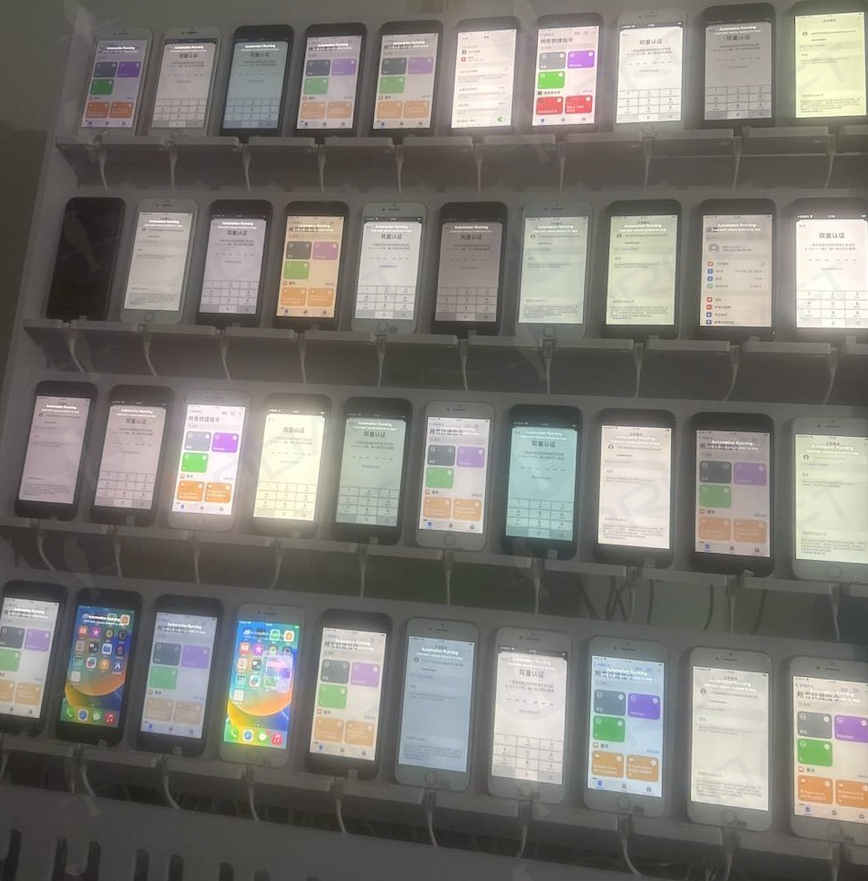
 Read More

Scroll to Top