Schneider Electric Uni-Telway Driver

 ​View CSAF
1. EXECUTIVE SUMMARY

CVSS v4 6.8
ATTENTION: Low attack complexity
Vendor: Schneider Electric
Equipment: Uni-Telway Driver
Vulnerability: Improper Input Validation

2. RISK EVALUATION
Successful exploitation of this vulnerability could allow an attacker to perform a denial of service.
3. TECHNICAL DETAILS
3.1 AFFECTED PRODUCTS
Schneider Electric reports the following products are affected:

Schneider Electric Uni-Telway Driver: All versions
Schneider Electric Uni-Telway Driver installed on Control Expert: All versions
Schneider Electric Uni-Telway Driver installed on Process Expert: All versions
Schneider Electric Uni-Telway Driver installed on Process Expert for AVEVA System Platform: All versions
Schneider Electric Uni-Telway Driver installed on OPC Factory Server: All versions

3.2 VULNERABILITY OVERVIEW
3.2.1 IMPROPER INPUT VALIDATION CWE-20
Schneider Electric Uni-Telway Driver is vulnerable to an improper input validation vulnerability that could cause denial-of-service of engineering workstations when a specific driver interface is invoked locally by an authenticated user with crafted input.
CVE-2024-10083 has been assigned to this vulnerability. A CVSS v3 base score of 5.5 has been calculated; the CVSS vector string is (CVSS:3.1/AV:L/AC:L/PR:L/UI:N/S:U/C:N/I:N/A:H).
A CVSS v4 score has also been calculated for CVE-2024-10083. A base score of 6.8 has been calculated; the CVSS vector string is (AV:L/AC:L/AT:N/PR:N/UI:A/VC:H/VI:H/VA:H/SC:N/SI:N/SA:N).
3.3 BACKGROUND

CRITICAL INFRASTRUCTURE SECTORS: Commercial Facilities, Critical Manufacturing, Energy
COUNTRIES/AREAS DEPLOYED: Worldwide
COMPANY HEADQUARTERS LOCATION: France

3.4 RESEARCHER
Sangjun Park, Jongseoung Kim, Byunghyun Kang, Yunjin Park, Albert Einstein, Kwon Yul, Seungchan Kim of today-0day reported this vulnerability to Schneider Electric.
4. MITIGATIONS
Schneider Electric has identified the following specific workarounds and mitigations users can apply to reduce risk:
For users requiring the use of Uni-Telway Driver, Schneider Electric recommends using following mitigations to reduce the risk of exploit:

McAfee Application and Change Control software for application control. Refer to the Cybersecurity Application Note available https://www.se.com/ww/en/download/document/EIO0000004778/.
Follow workstation, network, and site-hardening guidelines in the Schneider Electric Recommended Cybersecurity Best Practices document. For users not requiring the use of Uni-Telway driver, Schneider Electric recommends uninstalling the driver. Version 16.1 of EcoStruxure Control Expert does not include Uni-Telway driver by default anymore. This vulnerability is only affecting users who have installed Uni-Telway driver. To ensure users are informed of all updates, including details on affected products and remediation plans, subscribe to Schneider Electric’s security notification service here: https://www.se.com/ww/en/work/support/cybersecurity/security-notifications.jsp

For more information see the associated Schneider Electric CPCERT security advisory SEVD-2025-042-02 Uni-Telway driver used in EcoStruxureTM Control Expert, EcoStruxureTM Process – SEVD-2025-042-02 PDF Version, Uni-Telway driver used in EcoStruxureTM Control Expert, EcoStruxureTM Process – SEVD-2025-042-02 CSAF Version.
CISA recommends users take defensive measures to minimize the risk of exploitation of this vulnerability, such as:

Minimize network exposure for all control system devices and/or systems, ensuring they are not accessible from the Internet.
Locate control system networks and remote devices behind firewalls and isolating them from business networks.
When remote access is required, use more secure methods, such as Virtual Private Networks (VPNs). Recognize VPNs may have vulnerabilities, should be updated to the most recent version available, and are only as secure as the connected devices.

CISA reminds organizations to perform proper impact analysis and risk assessment prior to deploying defensive measures.
CISA also provides a section for control systems security recommended practices on the ICS webpage on cisa.gov. Several CISA products detailing cyber defense best practices are available for reading and download, including Improving Industrial Control Systems Cybersecurity with Defense-in-Depth Strategies.
CISA encourages organizations to implement recommended cybersecurity strategies for proactive defense of ICS assets.
Additional mitigation guidance and recommended practices are publicly available on the ICS webpage at cisa.gov in the technical information paper, ICS-TIP-12-146-01B–Targeted Cyber Intrusion Detection and Mitigation Strategies.
Organizations observing suspected malicious activity should follow established internal procedures and report findings to CISA for tracking and correlation against other incidents.
No known public exploitation specifically targeting this vulnerability has been reported to CISA at this time. This vulnerability is not exploitable remotely.
5. UPDATE HISTORY

March 11, 2025: Initial Publication 

View CSAF

1. EXECUTIVE SUMMARY

  • CVSS v4 6.8
  • ATTENTION: Low attack complexity
  • Vendor: Schneider Electric
  • Equipment: Uni-Telway Driver
  • Vulnerability: Improper Input Validation

2. RISK EVALUATION

Successful exploitation of this vulnerability could allow an attacker to perform a denial of service.

3. TECHNICAL DETAILS

3.1 AFFECTED PRODUCTS

Schneider Electric reports the following products are affected:

  • Schneider Electric Uni-Telway Driver: All versions
  • Schneider Electric Uni-Telway Driver installed on Control Expert: All versions
  • Schneider Electric Uni-Telway Driver installed on Process Expert: All versions
  • Schneider Electric Uni-Telway Driver installed on Process Expert for AVEVA System Platform: All versions
  • Schneider Electric Uni-Telway Driver installed on OPC Factory Server: All versions

3.2 VULNERABILITY OVERVIEW

3.2.1 IMPROPER INPUT VALIDATION CWE-20

Schneider Electric Uni-Telway Driver is vulnerable to an improper input validation vulnerability that could cause denial-of-service of engineering workstations when a specific driver interface is invoked locally by an authenticated user with crafted input.

CVE-2024-10083 has been assigned to this vulnerability. A CVSS v3 base score of 5.5 has been calculated; the CVSS vector string is (CVSS:3.1/AV:L/AC:L/PR:L/UI:N/S:U/C:N/I:N/A:H).

A CVSS v4 score has also been calculated for CVE-2024-10083. A base score of 6.8 has been calculated; the CVSS vector string is (AV:L/AC:L/AT:N/PR:N/UI:A/VC:H/VI:H/VA:H/SC:N/SI:N/SA:N).

3.3 BACKGROUND

  • CRITICAL INFRASTRUCTURE SECTORS: Commercial Facilities, Critical Manufacturing, Energy
  • COUNTRIES/AREAS DEPLOYED: Worldwide
  • COMPANY HEADQUARTERS LOCATION: France

3.4 RESEARCHER

Sangjun Park, Jongseoung Kim, Byunghyun Kang, Yunjin Park, Albert Einstein, Kwon Yul, Seungchan Kim of today-0day reported this vulnerability to Schneider Electric.

4. MITIGATIONS

Schneider Electric has identified the following specific workarounds and mitigations users can apply to reduce risk:

For users requiring the use of Uni-Telway Driver, Schneider Electric recommends using following mitigations to reduce the risk of exploit:

  • McAfee Application and Change Control software for application control. Refer to the Cybersecurity Application Note available https://www.se.com/ww/en/download/document/EIO0000004778/.
  • Follow workstation, network, and site-hardening guidelines in the Schneider Electric Recommended Cybersecurity Best Practices document. For users not requiring the use of Uni-Telway driver, Schneider Electric recommends uninstalling the driver. Version 16.1 of EcoStruxure Control Expert does not include Uni-Telway driver by default anymore. This vulnerability is only affecting users who have installed Uni-Telway driver. To ensure users are informed of all updates, including details on affected products and remediation plans, subscribe to Schneider Electric’s security notification service here: https://www.se.com/ww/en/work/support/cybersecurity/security-notifications.jsp

For more information see the associated Schneider Electric CPCERT security advisory SEVD-2025-042-02 Uni-Telway driver used in EcoStruxureTM Control Expert, EcoStruxureTM Process – SEVD-2025-042-02 PDF Version, Uni-Telway driver used in EcoStruxureTM Control Expert, EcoStruxureTM Process – SEVD-2025-042-02 CSAF Version.

CISA recommends users take defensive measures to minimize the risk of exploitation of this vulnerability, such as:

  • Minimize network exposure for all control system devices and/or systems, ensuring they are not accessible from the Internet.
  • Locate control system networks and remote devices behind firewalls and isolating them from business networks.
  • When remote access is required, use more secure methods, such as Virtual Private Networks (VPNs). Recognize VPNs may have vulnerabilities, should be updated to the most recent version available, and are only as secure as the connected devices.

CISA reminds organizations to perform proper impact analysis and risk assessment prior to deploying defensive measures.

CISA also provides a section for control systems security recommended practices on the ICS webpage on cisa.gov. Several CISA products detailing cyber defense best practices are available for reading and download, including Improving Industrial Control Systems Cybersecurity with Defense-in-Depth Strategies.

CISA encourages organizations to implement recommended cybersecurity strategies for proactive defense of ICS assets.

Additional mitigation guidance and recommended practices are publicly available on the ICS webpage at cisa.gov in the technical information paper, ICS-TIP-12-146-01B–Targeted Cyber Intrusion Detection and Mitigation Strategies.

Organizations observing suspected malicious activity should follow established internal procedures and report findings to CISA for tracking and correlation against other incidents.

No known public exploitation specifically targeting this vulnerability has been reported to CISA at this time. This vulnerability is not exploitable remotely.

5. UPDATE HISTORY

  • March 11, 2025: Initial Publication

 Read More

Optigo Networks Visual BACnet Capture Tool/Optigo Visual Networks Capture Tool

 ​View CSAF
1. EXECUTIVE SUMMARY

CVSS v4 9.3
ATTENTION: Exploitable remotely/low attack complexity
Vendor: Optigo Networks
Equipment: Visual BACnet Capture Tool, Optigo Visual Networks Capture Tool
Vulnerabilities: Use of Hard-coded, Security-relevant Constants, Authentication Bypass Using an Alternate Path or Channel

2. RISK EVALUATION
Successful exploitation of these vulnerabilities could allow an attacker to bypass authentication, gain control over the products, or impersonate the web applications.
3. TECHNICAL DETAILS
3.1 AFFECTED PRODUCTS
The following versions of Optigo Networks Visual BACnet Capture Tool and Optigo Visual Networks Capture Tool are affected:

Visual BACnet Capture Tool: Version 3.1.2rc11
Optigo Visual Networks Capture Tool: Version 3.1.2rc11

3.2 VULNERABILITY OVERVIEW
3.2.1 USE OF HARD-CODED, SECURITY-RELEVANT CONSTANTS CWE-547
Optigo Networks Visual BACnet Capture Tool and Optigo Visual Networks Capture Tool version 3.1.2rc11 contain a hard coded secret key. This could allow an attacker to generate valid JWT (JSON Web Token) sessions.
CVE-2025-2079 has been assigned to this vulnerability. A CVSS v3.1 base score of 7.5 has been calculated; the CVSS vector string is (AV:N/AC:L/PR:N/UI:N/S:U/C:H/I:N/A:N).
A CVSS v4 score has also been calculated for CVE-2025-2079. A base score of 8.7 has been calculated; the CVSS vector string is (AV:N/AC:L/AT:N/PR:N/UI:N/VC:H/VI:N/VA:N/SC:N/SI:N/SA:N).
3.2.2 AUTHENTICATION BYPASS USING AN ALTERNATE PATH OR CHANNEL CWE-288
Optigo Networks Visual BACnet Capture Tool and Optigo Visual Networks Capture Tool version 3.1.2rc11 contain an exposed web management service that could allow an attacker to bypass authentication measures and gain controls over utilities within the products.
CVE-2025-2080 has been assigned to this vulnerability. A CVSS v3.1 base score of 9.8 has been calculated; the CVSS vector string is (AV:N/AC:L/PR:N/UI:N/S:U/C:H/I:H/A:H).
A CVSS v4 score has also been calculated for CVE-2025-2080. A base score of 9.3 has been calculated; the CVSS vector string is (AV:N/AC:L/AT:N/PR:N/UI:N/VC:H/VI:H/VA:H/SC:N/SI:N/SA:N).
3.2.3 USE OF HARD-CODED, SECURITY-RELEVANT CONSTANTS CWE-547
Optigo Networks Visual BACnet Capture Tool and Optigo Visual Networks Capture Tool version 3.1.2rc11 are vulnerable to an attacker impersonating the web application service and mislead victim clients.
CVE-2025-2081 has been assigned to this vulnerability. A CVSS v3.1 base score of 7.5 has been calculated; the CVSS vector string is (AV:N/AC:L/PR:N/UI:N/S:U/C:N/I:N/A:H).
A CVSS v4 score has also been calculated for CVE-2025-2081. A base score of 8.7 has been calculated; the CVSS vector string is (AV:N/AC:L/AT:N/PR:N/UI:N/VC:N/VI:N/VA:H/SC:N/SI:N/SA:N).
3.3 BACKGROUND

CRITICAL INFRASTRUCTURE SECTORS: Information Technology
COUNTRIES/AREAS DEPLOYED: Worldwide
COMPANY HEADQUARTERS LOCATION: Canada

3.4 RESEARCHER
Tomer Goldschmidt of Claroty Team82 reported these vulnerabilities to CISA.
4. MITIGATIONS
Optigo Networks recommends users to upgrade to the following:

Visual BACnet Capture Tool: Version v3.1.3rc8
Optigo Visual Networks Capture Tool: Version v3.1.3rc8

CISA recommends users take defensive measures to minimize the risk of exploitation of these vulnerabilities, such as:

Minimize network exposure for all control system devices and/or systems, ensuring they are not accessible from the Internet.
Locate control system networks and remote devices behind firewalls and isolating them from business networks.
When remote access is required, use more secure methods, such as Virtual Private Networks (VPNs), recognizing VPNs may have vulnerabilities and should be updated to the most current version available. Also recognize VPN is only as secure as the connected devices.

CISA reminds organizations to perform proper impact analysis and risk assessment prior to deploying defensive measures.
CISA also provides a section for control systems security recommended practices on the ICS webpage on cisa.gov/ics. Several CISA products detailing cyber defense best practices are available for reading and download, including Improving Industrial Control Systems Cybersecurity with Defense-in-Depth Strategies.
CISA encourages organizations to implement recommended cybersecurity strategies for proactive defense of ICS assets.
Additional mitigation guidance and recommended practices are publicly available on the ICS webpage at cisa.gov/ics in the technical information paper, ICS-TIP-12-146-01B–Targeted Cyber Intrusion Detection and Mitigation Strategies.
Organizations observing suspected malicious activity should follow established internal procedures and report findings to CISA for tracking and correlation against other incidents.
No known public exploitation specifically targeting these vulnerabilities has been reported to CISA at this time.
5. UPDATE HISTORY

March 11, 2025: Initial Publication 

View CSAF

1. EXECUTIVE SUMMARY

  • CVSS v4 9.3
  • ATTENTION: Exploitable remotely/low attack complexity
  • Vendor: Optigo Networks
  • Equipment: Visual BACnet Capture Tool, Optigo Visual Networks Capture Tool
  • Vulnerabilities: Use of Hard-coded, Security-relevant Constants, Authentication Bypass Using an Alternate Path or Channel

2. RISK EVALUATION

Successful exploitation of these vulnerabilities could allow an attacker to bypass authentication, gain control over the products, or impersonate the web applications.

3. TECHNICAL DETAILS

3.1 AFFECTED PRODUCTS

The following versions of Optigo Networks Visual BACnet Capture Tool and Optigo Visual Networks Capture Tool are affected:

  • Visual BACnet Capture Tool: Version 3.1.2rc11
  • Optigo Visual Networks Capture Tool: Version 3.1.2rc11

3.2 VULNERABILITY OVERVIEW

3.2.1 USE OF HARD-CODED, SECURITY-RELEVANT CONSTANTS CWE-547

Optigo Networks Visual BACnet Capture Tool and Optigo Visual Networks Capture Tool version 3.1.2rc11 contain a hard coded secret key. This could allow an attacker to generate valid JWT (JSON Web Token) sessions.

CVE-2025-2079 has been assigned to this vulnerability. A CVSS v3.1 base score of 7.5 has been calculated; the CVSS vector string is (AV:N/AC:L/PR:N/UI:N/S:U/C:H/I:N/A:N).

A CVSS v4 score has also been calculated for CVE-2025-2079. A base score of 8.7 has been calculated; the CVSS vector string is (AV:N/AC:L/AT:N/PR:N/UI:N/VC:H/VI:N/VA:N/SC:N/SI:N/SA:N).

3.2.2 AUTHENTICATION BYPASS USING AN ALTERNATE PATH OR CHANNEL CWE-288

Optigo Networks Visual BACnet Capture Tool and Optigo Visual Networks Capture Tool version 3.1.2rc11 contain an exposed web management service that could allow an attacker to bypass authentication measures and gain controls over utilities within the products.

CVE-2025-2080 has been assigned to this vulnerability. A CVSS v3.1 base score of 9.8 has been calculated; the CVSS vector string is (AV:N/AC:L/PR:N/UI:N/S:U/C:H/I:H/A:H).

A CVSS v4 score has also been calculated for CVE-2025-2080. A base score of 9.3 has been calculated; the CVSS vector string is (AV:N/AC:L/AT:N/PR:N/UI:N/VC:H/VI:H/VA:H/SC:N/SI:N/SA:N).

3.2.3 USE OF HARD-CODED, SECURITY-RELEVANT CONSTANTS CWE-547

Optigo Networks Visual BACnet Capture Tool and Optigo Visual Networks Capture Tool version 3.1.2rc11 are vulnerable to an attacker impersonating the web application service and mislead victim clients.

CVE-2025-2081 has been assigned to this vulnerability. A CVSS v3.1 base score of 7.5 has been calculated; the CVSS vector string is (AV:N/AC:L/PR:N/UI:N/S:U/C:N/I:N/A:H).

A CVSS v4 score has also been calculated for CVE-2025-2081. A base score of 8.7 has been calculated; the CVSS vector string is (AV:N/AC:L/AT:N/PR:N/UI:N/VC:N/VI:N/VA:H/SC:N/SI:N/SA:N).

3.3 BACKGROUND

  • CRITICAL INFRASTRUCTURE SECTORS: Information Technology
  • COUNTRIES/AREAS DEPLOYED: Worldwide
  • COMPANY HEADQUARTERS LOCATION: Canada

3.4 RESEARCHER

Tomer Goldschmidt of Claroty Team82 reported these vulnerabilities to CISA.

4. MITIGATIONS

Optigo Networks recommends users to upgrade to the following:

CISA recommends users take defensive measures to minimize the risk of exploitation of these vulnerabilities, such as:

  • Minimize network exposure for all control system devices and/or systems, ensuring they are not accessible from the Internet.
  • Locate control system networks and remote devices behind firewalls and isolating them from business networks.
  • When remote access is required, use more secure methods, such as Virtual Private Networks (VPNs), recognizing VPNs may have vulnerabilities and should be updated to the most current version available. Also recognize VPN is only as secure as the connected devices.

CISA reminds organizations to perform proper impact analysis and risk assessment prior to deploying defensive measures.

CISA also provides a section for control systems security recommended practices on the ICS webpage on cisa.gov/ics. Several CISA products detailing cyber defense best practices are available for reading and download, including Improving Industrial Control Systems Cybersecurity with Defense-in-Depth Strategies.

CISA encourages organizations to implement recommended cybersecurity strategies for proactive defense of ICS assets.

Additional mitigation guidance and recommended practices are publicly available on the ICS webpage at cisa.gov/ics in the technical information paper, ICS-TIP-12-146-01B–Targeted Cyber Intrusion Detection and Mitigation Strategies.

Organizations observing suspected malicious activity should follow established internal procedures and report findings to CISA for tracking and correlation against other incidents.

No known public exploitation specifically targeting these vulnerabilities has been reported to CISA at this time.

5. UPDATE HISTORY

  • March 11, 2025: Initial Publication

 Read More

CISA Releases Two Industrial Control Systems Advisories

 ​CISA released two Industrial Control Systems (ICS) advisories on March 11, 2025. These advisories provide timely information about current security issues, vulnerabilities, and exploits surrounding ICS.

ICSA-25-070-01 Schneider Electric Uni-Telway Driver
ICSA-25-070-02 Optigo Networks Visual BACnet Capture Tool/Optigo Visual Networks Capture Tool

CISA encourages users and administrators to review newly released ICS advisories for technical details and mitigations. 

CISA released two Industrial Control Systems (ICS) advisories on March 11, 2025. These advisories provide timely information about current security issues, vulnerabilities, and exploits surrounding ICS.

CISA encourages users and administrators to review newly released ICS advisories for technical details and mitigations.

 Read More

CISA Adds Five Known Exploited Vulnerabilities to Catalog

 ​CISA has added five new vulnerabilities to its Known Exploited Vulnerabilities Catalog, based on evidence of active exploitation.

CVE-2025-25181 Advantive VeraCore SQL Injection Vulnerability
CVE-2024-57968 Advantive VeraCore Unrestricted File Upload Vulnerability
CVE-2024-13159 Ivanti Endpoint Manager (EPM) Absolute Path Traversal Vulnerability
CVE-2024-13160 Ivanti Endpoint Manager (EPM) Absolute Path Traversal Vulnerability
CVE-2024-13161 Ivanti Endpoint Manager (EPM) Absolute Path Traversal Vulnerability

These types of vulnerabilities are frequent attack vectors for malicious cyber actors and pose significant risks to the federal enterprise.
Binding Operational Directive (BOD) 22-01: Reducing the Significant Risk of Known Exploited Vulnerabilities established the Known Exploited Vulnerabilities Catalog as a living list of known Common Vulnerabilities and Exposures (CVEs) that carry significant risk to the federal enterprise. BOD 22-01 requires Federal Civilian Executive Branch (FCEB) agencies to remediate identified vulnerabilities by the due date to protect FCEB networks against active threats. See the BOD 22-01 Fact Sheet for more information.
Although BOD 22-01 only applies to FCEB agencies, CISA strongly urges all organizations to reduce their exposure to cyberattacks by prioritizing timely remediation of Catalog vulnerabilities as part of their vulnerability management practice. CISA will continue to add vulnerabilities to the catalog that meet the specified criteria. 

CISA has added five new vulnerabilities to its Known Exploited Vulnerabilities Catalog, based on evidence of active exploitation.

  • CVE-2025-25181 Advantive VeraCore SQL Injection Vulnerability
  • CVE-2024-57968 Advantive VeraCore Unrestricted File Upload Vulnerability
  • CVE-2024-13159 Ivanti Endpoint Manager (EPM) Absolute Path Traversal Vulnerability
  • CVE-2024-13160 Ivanti Endpoint Manager (EPM) Absolute Path Traversal Vulnerability
  • CVE-2024-13161 Ivanti Endpoint Manager (EPM) Absolute Path Traversal Vulnerability

These types of vulnerabilities are frequent attack vectors for malicious cyber actors and pose significant risks to the federal enterprise.

Binding Operational Directive (BOD) 22-01: Reducing the Significant Risk of Known Exploited Vulnerabilities established the Known Exploited Vulnerabilities Catalog as a living list of known Common Vulnerabilities and Exposures (CVEs) that carry significant risk to the federal enterprise. BOD 22-01 requires Federal Civilian Executive Branch (FCEB) agencies to remediate identified vulnerabilities by the due date to protect FCEB networks against active threats. See the BOD 22-01 Fact Sheet for more information.

Although BOD 22-01 only applies to FCEB agencies, CISA strongly urges all organizations to reduce their exposure to cyberattacks by prioritizing timely remediation of Catalog vulnerabilities as part of their vulnerability management practice. CISA will continue to add vulnerabilities to the catalog that meet the specified criteria.

 Read More

Feds Link $150M Cyberheist to 2022 LastPass Hacks

​In September 2023, KrebsOnSecurity published findings from security researchers who concluded that a series of six-figure cyberheists across dozens of victims resulted from thieves cracking master passwords stolen from the password manager service LastPass in 2022. In a court filing this week, U.S. federal agents investigating a spectacular $150 million cryptocurrency heist said they had reached the same conclusion. 

In September 2023, KrebsOnSecurity published findings from security researchers who concluded that a series of six-figure cyberheists across dozens of victims resulted from thieves cracking master passwords stolen from the password manager service LastPass in 2022. In a court filing this week, U.S. federal agents investigating a spectacular $150 million cryptocurrency heist said they had reached the same conclusion.

On March 6, federal prosecutors in northern California said they seized approximately $24 million worth of cryptocurrencies that were clawed back following a $150 million cyberheist on Jan. 30, 2024. The complaint refers to the person robbed only as “Victim-1,” but according to blockchain security research ZachXBT the theft was perpetrated against Chris Larsen, the co-founder of the cryptocurrency platform Ripple.

ZachXBT was the first to report on the heist, of which approximately $24 million was frozen by the feds before it could be withdrawn. This week’s action by the government merely allows investigators to officially seize the frozen funds.

But there is an important conclusion in this seizure document: It basically says the U.S. Secret Service and the FBI agree with the findings of the LastPass breach story published here in September 2023. That piece quoted security researchers who said they were witnessing six-figure crypto heists several times each month that they believed all appeared to be the result of crooks cracking master passwords for the password vaults stolen from LastPass in 2022.

“The Federal Bureau of Investigation has been investigating these data breaches, and law enforcement agents investigating the instant case have spoken with FBI agents about their investigation,” reads the seizure complaint, which was written by a U.S. Secret Service agent. “From those conversations, law enforcement agents in this case learned that the stolen data and passwords that were stored in several victims’ online password manager accounts were used to illegally, and without authorization, access the victims’ electronic accounts and steal information, cryptocurrency, and other data.”

The document continues:

“Based on this investigation, law enforcement had probable cause to believe the same attackers behind the above-described commercial online password manager attack used a stolen password held in Victim 1’s online password manager account and, without authorization, accessed his cryptocurrency wallet/account.”

Working with dozens of victims, security researchers Nick Bax and Taylor Monahan found that none of the six-figure cyberheist victims appeared to have suffered the sorts of attacks that typically preface a high-dollar crypto theft, such as the compromise of one’s email and/or mobile phone accounts, or SIM-swapping attacks.

They discovered the victims all had something else in common: Each had at one point stored their cryptocurrency seed phrase — the secret code that lets anyone gain access to your cryptocurrency holdings — in the “Secure Notes” area of their LastPass account prior to the 2022 breaches at the company.

Bax and Monahan found another common theme with these robberies: They all followed a similar pattern of cashing out, rapidly moving stolen funds to a dizzying number of drop accounts scattered across various cryptocurrency exchanges.

According to the government, a similar level of complexity was present in the $150 million heist against the Ripple co-founder last year.

“The scale of a theft and rapid dissipation of funds would have required the efforts of multiple malicious actors, and was consistent with the online password manager breaches and attack on other victims whose cryptocurrency was stolen,” the government wrote. “For these reasons, law enforcement agents believe the cryptocurrency stolen from Victim 1 was committed by the same attackers who conducted the attack on the online password manager, and cryptocurrency thefts from other similarly situated victims.”

Reached for comment, LastPass said it has seen no definitive proof — from federal investigators or others — that the cyberheists in question were linked to the LastPass breaches.

“Since we initially disclosed this incident back in 2022, LastPass has worked in close cooperation with multiple representatives from law enforcement,” LastPass said in a written statement. “To date, our law enforcement partners have not made us aware of any conclusive evidence that connects any crypto thefts to our incident. In the meantime, we have been investing heavily in enhancing our security measures and will continue to do so.”

On August 25, 2022, LastPass CEO Karim Toubba told users the company had detected unusual activity in its software development environment, and that the intruders stole some source code and proprietary LastPass technical information. On Sept. 15, 2022, LastPass said an investigation into the August breach determined the attacker did not access any customer data or password vaults.

But on Nov. 30, 2022, LastPass notified customers about another, far more serious security incident that the company said leveraged data stolen in the August breach. LastPass disclosed that criminal hackers had compromised encrypted copies of some password vaults, as well as other personal information.

Experts say the breach would have given thieves “offline” access to encrypted password vaults, theoretically allowing them all the time in the world to try to crack some of the weaker master passwords using powerful systems that can attempt millions of password guesses per second.

Researchers found that many of the cyberheist victims had chosen master passwords with relatively low complexity, and were among LastPass’s oldest customers. That’s because legacy LastPass users were more likely to have master passwords that were protected with far fewer “iterations,” which refers to the number of times your password is run through the company’s encryption routines. In general, the more iterations, the longer it takes an offline attacker to crack your master password.

Over the years, LastPass forced new users to pick longer and more complex master passwords, and they increased the number of iterations on multiple occasions by several orders of magnitude. But researchers found strong indications that LastPass never succeeded in upgrading many of its older customers to the newer password requirements and protections.

Asked about LastPass’s continuing denials, Bax said that after the initial warning in our 2023 story, he naively hoped people would migrate their funds to new cryptocurrency wallets.

“While some did, the continued thefts underscore how much more needs to be done,” Bax told KrebsOnSecurity. “It’s validating to see the Secret Service and FBI corroborate our findings, but I’d much rather see fewer of these hacks in the first place. ZachXBT and SEAL 911 reported yet another wave of thefts as recently as December, showing the threat is still very real.”

Monahan said LastPass still hasn’t alerted their customers that their secrets—especially those stored in “Secure Notes”—may be at risk.

“Its been two and a half years since LastPass was first breached [and] hundreds of millions of dollars has been stolen from individuals and companies around the globe,” Monahan said. “They could have encouraged users to rotate their credentials. They could’ve prevented millions and millions of dollars from being stolen by these threat actors. But  instead they chose to deny that their customers were are risk and blame the victims instead.”


Read More

Who is the DOGE and X Technician Branden Spikes?

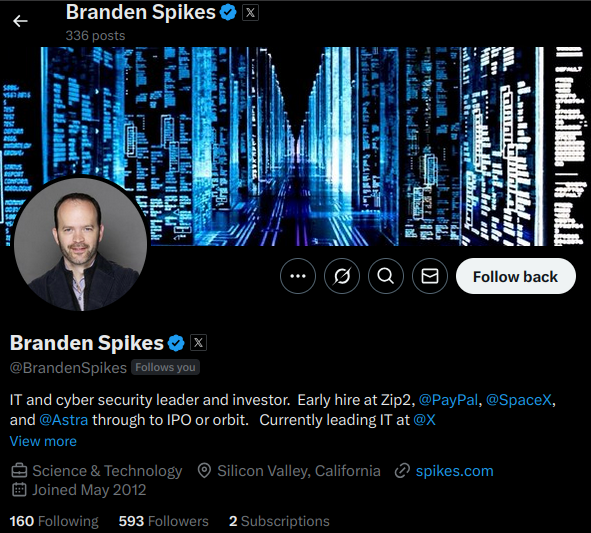
​At 49, Branden Spikes isn’t just one of the oldest technologists who has been involved in Elon Musk’s Department of Government Efficiency (DOGE). As the current director of information technology at X/Twitter and an early hire at PayPal, Zip2, Tesla and SpaceX, Spikes is also among Musk’s most loyal employees. Here’s a closer look at this trusted Musk lieutenant, whose Russian ex-wife was once married to Elon’s cousin. 

At 49, Branden Spikes isn’t just one of the oldest technologists who has been involved in Elon Musk’s Department of Government Efficiency (DOGE). As the current director of information technology at X/Twitter and an early hire at PayPal, Zip2, Tesla and SpaceX, Spikes is also among Musk’s most loyal employees. Here’s a closer look at this trusted Musk lieutenant, whose Russian ex-wife was once married to Elon’s cousin.

The profile of Branden Spikes on X.

When President Trump took office again in January, he put the world’s richest man — Elon Musk — in charge of the U.S. Digital Service, and renamed the organization as DOGE. The group is reportedly staffed by at least 50 technologists, many of whom have ties to Musk’s companies.

DOGE has been enabling the president’s ongoing mass layoffs and firings of federal workers, largely by seizing control over computer systems and government data for a multitude of federal agencies, including the Social Security Administration, the Department of Homeland Security, the Office of Personnel Management, and the Treasury Department.

It is difficult to find another person connected to DOGE who has stronger ties to Musk than Branden Spikes. A native of California, Spikes initially teamed up with Musk in 1997 as a lead systems engineer for the software company Zip2, the first major venture for Musk. In 1999, Spikes was hired as director of IT at PayPal, and in 2002 he became just the fourth person hired at SpaceX.

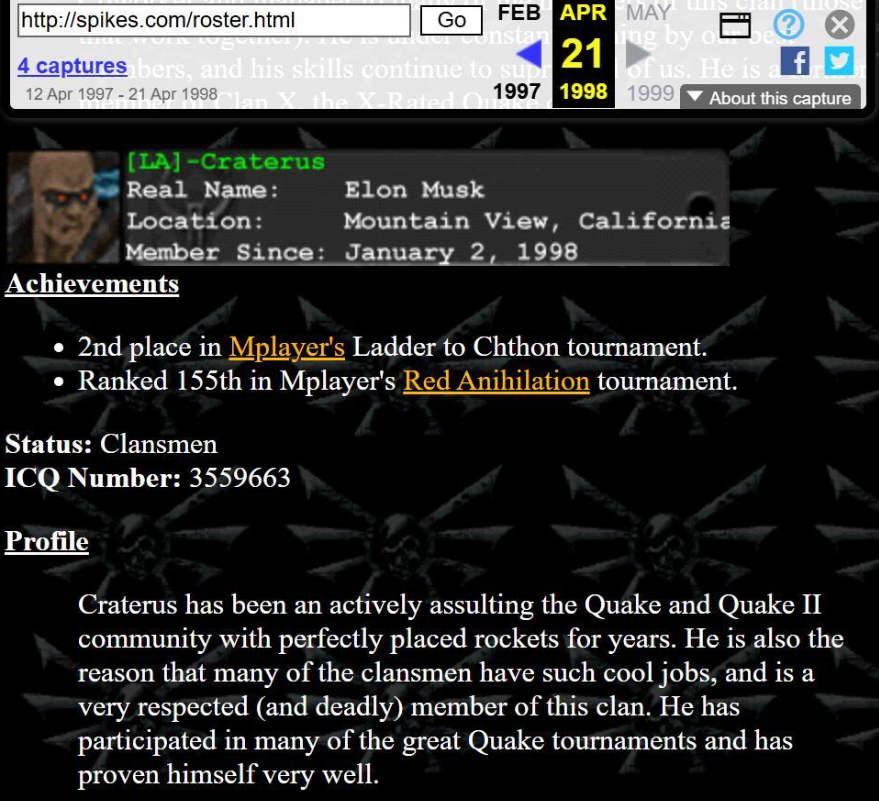
In 2012, Spikes launched Spikes Security, a software product that sought to create a compartmentalized or “sandboxed” web browser that could insulate the user from malware attacks. A review of spikes.com in the Wayback Machine shows that as far back as 1998, Musk could be seen joining Spikes for team matches in the online games Quake and Quake II. In 2016, Spikes Security was merged with another security suite called Aurionpro, with the combined company renamed Cyberinc.

A snapshot of spikes.com from 1998 shows Elon Musk’s profile in Spike’s clan for the games Quake and Quake II.

Spikes’s LinkedIn profile says he was appointed head of IT at X in February 2025. And although his name shows up on none of the lists of DOGE employees circulated by various media outlets, multiple sources told KrebsOnSecurity that Spikes was working with DOGE and operates within Musk’s inner circle of trust.

In a conversation with KrebsOnSecurity, Spikes said he is dedicated to his country and to saving it from what he sees as certain ruin.

“Myself, I was raised by a southern conservative family in California and I strongly believe in America and her future,” Spikes said. “This is why I volunteered for two months in DC recently to help DOGE save us from certain bankruptcy.”

Spikes told KrebsOnSecurity that he recently decided to head back home and focus on his job as director of IT at X.

“I loved it, but ultimately I did not want to leave my hometown and family back in California,” Spikes said of his tenure at DOGE. “After a couple of months it became clear that to continue helping I would need to move to DC and commit a lot more time, so I politely bowed out.”

Prior to founding Spikes Security, Branden Spikes was married to a native Russian woman named Natalia whom he’d met at a destination wedding in South America in 2003.

Branden and Natalia’s names are both on the registration records for the domain name orangetearoom[.]com. This domain, which DomainTools.com says was originally registered by Branden in 2009, is the home of a tax-exempt charity in Los Angeles called the California Russian Association.

Here is a photo from a 2011 event organized by the California Russian Association, showing Branden and Natalia at one of its “White Nights” charity fundraisers:

Branden and Natalia Spikes, on left, in 2011. The man on the far right is Ivan Y. Podvalov, a board member of the Kremlin-aligned Congress of Russian Americans (CRA). The man in the center is Feodor Yakimoff, director of operations at the Transib Global Sourcing Group, and chairman of the Russian Imperial Charity Balls, which works in concert with the Russian Heritage Foundation.

In 2011, the Spikes couple got divorced, and Natalia changed her last name to Haldeman. That is not her maiden name, which appears to be “Libina.” Rather, Natalia acquired the surname Haldeman in 1998, when she married Elon Musk’s cousin.

Reeve Haldeman is the son of Scott Haldeman, who is the brother of Elon Musk’s mother, Maye Musk. Divorce records show Reeve and Natalia officially terminated their marriage in 2007. Reeve Haldeman did not respond to a request for comment.

A review of other domain names connected to Natalia Haldeman’s email address show she has registered more than a dozen domains over the years that are tied to the California Russian Association, and an apparently related entity called the Russian Heritage Foundation, Inc.:

russianamericans.org
russianamericanstoday.com
russianamericanstoday.org
russiancalifornia.org
russianheritagefoundation.com
russianheritagefoundation.org
russianwhitenights.com
russianwhitenights.org
theforafoundation.org
thegoldentearoom.com
therussianheritagefoundation.org
tsarinahome.com

Ms. Haldeman did not respond to requests for comment. Her name and contact information appears in the registration records for these domains dating back to 2010, and a document published by ProPublica show that by 2016 Natalia Haldeman was appointed CEO of the California Russian Foundation.

A photo from Natalia Haldeman’s Facebook page shows her mother (left) pictured with Maye Musk, Elon Musk’s mother, in 2022.

The domain name that bears both Branden’s and Natalia’s names — orangeteamroom.com — features photos of Ms. Haldeman at fundraising events for the Russian foundation through 2014. Additional photos of her and many of the same people can be seen through 2023 at another domain she registered in 2010 — russianheritagefoundation.com.

The photo of Branden and Natalia above is from one such event in 2011 (tied to russianwhitenights.org, another Haldeman domain). The person on the right in that image — Ivan Y. Podvalov — appears in many fundraising event photos published by the foundation over the past decade. Podvalov is a board member of the Congress of Russian Americans (CRA), a nonprofit group that is known for vehemently opposing U.S. financial and legal sanctions against Russia.

Writing for The Insider in 2022, journalist Diana Fishman described how the CRA has engaged in outright political lobbying, noting that the organization in June 2014 sent a letter to President Obama and the secretary of the United Nations, calling for an end to the “large-scale US intervention in Ukraine and the campaign to isolate Russia.”

“The US military contingents must be withdrawn immediately from the Eastern European region, and NATO’s enlargement efforts and provocative actions against Russia must cease,” the message read.

The Insider said the CRA director sent another two letters, this time to President Donald Trump, in 2017 and 2018.

“One was a request not to sign a law expanding sanctions against Russia,” Fishman wrote. “The other regretted the expulsion of 60 Russian diplomats from the United States and urged not to jump to conclusions on Moscow’s involvement in the poisoning of Sergei Skripal.”

The nonprofit tracking website CauseIQ.com reports that The Russian Heritage Foundation, Inc. is now known as Constellation of Humanity.

The Russian Heritage Foundation and the California Russian Association both promote the interests of the Russian Orthodox Church. This page indexed by Archive.org from russiancalifornia.org shows The California Russian Foundation organized a community effort to establish an Orthodox church in Orange County, Calif.

A press release from the Russian Orthodox Church Outside of Russia (ROCOR) shows that in 2021 the Russian Heritage Foundation donated money to organize a conference for the Russian Orthodox Church in Serbia.

A review of the “Partners” listed on the Spikes’ jointly registered domain — orangetearoom.com — shows the organization worked with a marketing company called Russian American Media. Reporting by KrebsOnSecurity last year showed that Russian American Media also partners with the problematic people-search service Radaris, which was formed by two native Russian brothers in Massachusetts who have built a fleet of consumer data brokers and Russian affiliate programs.

When asked about his ex-wife’s history, Spikes said she has a good heart and bears no ill-will toward anyone.

“I attended several of Natalia’s social events over the years we were together and can assure you that she’s got the best intentions with those,” Spikes told KrebsOnSecurity. “There’s no funny business going on. It is just a way for those friendly immigrants to find resources amongst each other to help get settled in and chase the American dream. I mean, they’re not unlike the immigrants from other countries who come to America and try to find each other and help each other find others who speak the language and share in the building of their businesses here in America.”

Spikes said his own family roots go back deeply into American history, sharing that his 6th great grandfather was Alexander Hamilton on his mom’s side, and Jessie James on his dad’s side.

“My family roots are about as American as you can get,” he said. “I’ve also been entrusted with building and safeguarding Elon’s companies since 1999 and have a keen eye (as you do) for bad actors, so have enough perspective to tell you that Natalia has no bad blood and that she loves America.”

Of course, this perspective comes from someone who has the utmost regard for the interests of the “special government employee” Mr. Musk, who has been bragging about tossing entire federal agencies into the “wood chipper,” and who recently wielded an actual chainsaw on stage while referring to it as the “chainsaw for bureaucracy.”

“Elon’s intentions are good and you can trust him,” Spikes assured.

A special note of thanks for research assistance goes to Jacqueline Sweet, an independent investigative journalist whose work has been published in The Guardian, Rolling Stone, POLITICO and The Intercept.


Read More

FBI Warns of Data Extortion Scam Targeting Corporate Executives

 ​The Federal Bureau of Investigation (FBI) Internet Crime Complaint Center (IC3) has released an alert warning of a scam involving criminal actors masquerading as the “BianLian Group.” The cyber criminals target corporate executives by sending extortion letters threatening to release victims’ sensitive information unless payment is received. 
CISA encourages organizations to review the following FBI Public Service Announcement for more information:

Mail Scam Targeting Corporate Executives Claims Ties to Ransomware

Organizations should report incidents and anomalous activity to CISA’s 24/7 Operations Center at Report@cisa.gov or (888) 282-0870.  

The Federal Bureau of Investigation (FBI) Internet Crime Complaint Center (IC3) has released an alert warning of a scam involving criminal actors masquerading as the “BianLian Group.” The cyber criminals target corporate executives by sending extortion letters threatening to release victims’ sensitive information unless payment is received. 

CISA encourages organizations to review the following FBI Public Service Announcement for more information:

Organizations should report incidents and anomalous activity to CISA’s 24/7 Operations Center at Report@cisa.gov or (888) 282-0870. 

 Read More

Hitachi Energy PCU400

 ​View CSAF
1. EXECUTIVE SUMMARY

CVSS v3 7.5
ATTENTION: Exploitable remotely/low attack complexity
Vendor: Hitachi Energy
Equipment: PCU400, PCULogger
Vulnerabilities: Access of Resource Using Incompatible Type (‘Type Confusion’), NULL Pointer Dereference, Use After Free, Double Free, Observable Discrepancy, Out-of-bounds Read

2. RISK EVALUATION
Exploitation of these vulnerabilities could allow an attacker to access or decrypt sensitive data, crash the device application, or cause a denial-of-service condition.
3. TECHNICAL DETAILS
3.1 AFFECTED PRODUCTS
Hitachi Energy reports that the following products are affected:

PCU400: Version 6.5 K and prior
PCU400: Version 9.4.1 and prior
PCULogger: Version 1.1.0 and prior

3.2 VULNERABILITY OVERVIEW
3.2.1 ACCESS OF RESOURCE USING INCOMPATIBLE TYPE (‘TYPE CONFUSION’) CWE-843
There is a type confusion vulnerability relating to X.400 address processing inside an X.509 GeneralName. X.400 addresses were parsed as an ASN1_STRING but the public structure definition for GENERAL_NAME incorrectly specified the type of the x400Address field as ASN1_TYPE. This field is subsequently interpreted by the OpenSSL function GENERAL_NAME_cmp as an ASN1_TYPE rather than an ASN1_STRING. When CRL checking is enabled (i.e. the application sets the X509_V_FLAG_CRL_CHECK flag), this vulnerability may allow an attacker to pass arbitrary pointers to a memcmp call, enabling them to read memory contents or enact a denial-of-service. In most cases, the attack requires the attacker to provide both the certificate chain and CRL, neither of which need to have a valid signature. If the attacker only controls one of these inputs, the other input must already contain an X.400 address as a CRL distribution point, which is uncommon. As such, this vulnerability is most likely to only affect applications which have implemented their own functionality for retrieving CRLs over a network.
CVE-2023-0286 has been assigned to this vulnerability. A CVSS v3 base score of 7.4 has been calculated; the CVSS vector string is (CVSS:3.1/AV:N/AC:H/PR:N/UI:N/S:U/C:H/I:N/A:H).
3.2.2 NULL POINTER DEREFERENCE CWE-476
An invalid pointer dereference on read can be triggered when an application tries to check a malformed DSA public key by the EVP_PKEY_public_check() function. This will most likely lead to an application crash. This function can be called on public keys supplied from untrusted sources which could allow an attacker to cause a denial-of-service attack. The TLS implementation in OpenSSL does not call this function but applications might call the function if there are additional security requirements imposed by standards such as FIPS 140-3.
CVE-2023-0217 has been assigned to this vulnerability. A CVSS v3 base score of 7.5 has been calculated; the CVSS vector string is (CVSS:3.1/AV:N/AC:L/PR:N/UI:N/S:U/C:N/I:N/A:H).
3.2.3 NULL POINTER DEREFERENCE CWE-476
An invalid pointer dereference on read can be triggered when an application tries to load malformed PKCS7 data with the d2i_PKCS7(), d2i_PKCS7_bio() or d2i_PKCS7_fp() functions. The result of the dereference is an application crash which could lead to a denial-of-service attack. The TLS implementation in OpenSSL does not call this function however third party applications might call these functions on untrusted data.
CVE-2023-0216 has been assigned to this vulnerability. A CVSS v3 base score of 7.5 has been calculated; the CVSS vector string is (CVSS:3.1/AV:N/AC:L/PR:N/UI:N/S:U/C:N/I:N/A:H).
3.2.4 NULL POINTER DEREFERENCE CWE-476
A NULL pointer can be dereferenced when signatures are being verified on PKCS7 signed or signedAndEnveloped data. In case the hash algorithm used for the signature is known to the OpenSSL library but the implementation of the hash algorithm is not available, the digest initialization will fail. There is a missing check for the return value from the initialization function which later leads to invalid usage of the digest API most likely leading to a crash. The unavailability of an algorithm can be caused by using FIPS enabled configuration of providers or more commonly by not loading the legacy provider. PKCS7 data is processed by the SMIME library calls and also by the time stamp (TS) library calls. The TLS implementation in OpenSSL does not call these functions, however third party applications would be affected if they call these functions to verify signatures on untrusted data.
CVE-2023-0401 has been assigned to this vulnerability. A CVSS v3 base score of 7.5 has been calculated; the CVSS vector string is (CVSS:3.1/AV:N/AC:L/PR:N/UI:N/S:U/C:N/I:N/A:H).
3.2.5 USE AFTER FREE CWE-416
The public API function BIO_new_NDEF is a helper function used for streaming ASN.1 data via a BIO. It is primarily used internally to OpenSSL to support the SMIME, CMS and PKCS7 streaming capabilities, but may also be called directly by end user applications. The function receives a BIO from the caller, prepends a new BIO_f_asn1 filter BIO onto the front of it to form a BIO chain, and then returns the new head of the BIO chain to the caller. Under certain conditions, for example if a CMS recipient public key is invalid, the new filter BIO is freed and the function returns a NULL result indicating a failure. However, in this case, the BIO chain is not properly cleaned up and the BIO passed by the caller still retains internal pointers to the previously freed filter BIO. If the caller then goes on to call BIO_pop() on the BIO then a use-after-free will occur. This will most likely result in a crash. This scenario occurs directly in the internal function B64_write_ASN1() which may cause BIO_new_NDEF() to be called and will subsequently call BIO_pop() on the BIO. This internal function is in turn called by the public API functions PEM_write_bio_ASN1_stream, PEM_write_bio_CMS_stream, PEM_write_bio_PKCS7_stream, SMIME_write_ASN1, SMIME_write_CMS and SMIME_write_PKCS7. Other public API functions that may be impacted by this include i2d_ASN1_bio_stream, BIO_new_CMS, BIO_new_PKCS7, i2d_CMS_bio_stream and i2d_PKCS7_bio_stream. The OpenSSL cms and smime command line applications are similarly affected.
CVE-2023-0215 has been assigned to this vulnerability. A CVSS v3 base score of 7.5 has been calculated; the CVSS vector string is (CVSS:3.1/AV:N/AC:L/PR:N/UI:N/S:U/C:N/I:N/A:H).
3.2.6 DOUBLE FREE CWE-415
The function PEM_read_bio_ex() reads a PEM file from a BIO and parses and decodes the “name” (e.g. CERTIFICATE”), any header data and the payload data. If the function succeeds then the “name_out”, “header” and “data” arguments are populated with pointers to buffers containing the relevant decoded data. The caller is responsible for freeing those buffers. It is possible to construct a PEM file that results in 0 bytes of payload data. In this case PEM_read_bio_ex() will return a failure code but will populate the header argument with a pointer to a buffer that has already been freed. If the caller also frees this buffer then a double free will occur. This will most likely lead to a crash. This could be exploited by an attacker who has the ability to supply malicious PEM files for parsing to achieve a denial-of-service attack. The functions PEM_read_bio() and PEM_read() are simple wrappers around PEM_read_bio_ex() and therefore these functions are also directly affected. These functions are also called indirectly by a number of other OpenSSL functions including PEM_X509_INFO_read_bio_ex() and SSL_CTX_use_serverinfo_file() which are also vulnerable. Some OpenSSL internal uses of these functions are not vulnerable because the caller does not free the header argument if PEM_read_bio_ex() returns a failure code. These locations include the PEM_read_bio_TYPE() functions as well as the decoders introduced in OpenSSL 3.0. The OpenSSL asn1parse command line application is also impacted by this issue.
CVE-2022-4450 has been assigned to this vulnerability. A CVSS v3 base score of 7.5 has been calculated; the CVSS vector string is (CVSS:3.1/AV:N/AC:L/PR:N/UI:N/S:U/C:N/I:N/A:H).
3.2.7 OBSERVABLE DISCREPANCY CWE-203
A timing-based side channel exists in the OpenSSL RSA decryption implementation which could be sufficient to recover plaintext across a network in a Bleichenbacher style attack. To achieve a successful decryption, an attacker would have to be able to send a very large number of trial messages for decryption. The vulnerability affects all RSA padding modes: PKCS#1 v1.5, RSA-OEAP and RSASVE. For example, in a TLS connection, RSA is commonly used by a client to send an encrypted pre-master secret to the server. An attacker that had observed a genuine connection between a client and a server could use this flaw to send trial messages to the server and record the time taken to process them. After a sufficiently large number of messages the attacker could recover the pre-master secret used for the original connection and thus be able to decrypt the application data sent over that connection.
CVE-2022-4304 has been assigned to this vulnerability. A CVSS v3 base score of 5.9 has been calculated; the CVSS vector string is (CVSS:3.1/AV:N/AC:H/PR:N/UI:N/S:U/C:H/I:N/A:N).
3.2.8 OUT-OF-BOUNDS READ CWE-125
A read buffer overrun can be triggered in X.509 certificate verification, specifically in name constraint checking. Note that this occurs after certificate chain signature verification and requires either a CA to have signed the malicious certificate or for the application to continue certificate verification despite failure to construct a path to a trusted issuer. The read buffer overrun might result in a crash which could lead to a denial-of-service attack. In theory it could also result in the disclosure of private memory contents (such as private keys, or sensitive plaintext) although we are not aware of any working exploit leading to memory contents disclosure as of the time of release of this advisory. In a TLS client, this can be triggered by connecting to a malicious server. In a TLS server, this can be triggered if the server requests client authentication and a malicious client connects.
CVE-2022-4203 has been assigned to this vulnerability. A CVSS v3 base score of 4.9 has been calculated; the CVSS vector string is (CVSS:3.1/AV:N/AC:L/PR:H/UI:N/S:U/C:N/I:N/A:H).
3.3 BACKGROUND

CRITICAL INFRASTRUCTURE SECTORS: Critical Manufacturing
COUNTRIES/AREAS DEPLOYED: Worldwide
COMPANY HEADQUARTERS LOCATION: Switzerland

3.4 RESEARCHER
A researcher from Dragos reported these vulnerabilities to Hitachi Energy.
4. MITIGATIONS
Hitachi Energy has identified the following specific workarounds and mitigations users can apply to reduce risk:

PCU400 versions 6.5 K and below: If IEC62351-3 secure for IEC104/DNP3 is used, then update to version 6.6.0 or later.
PCU400 versions 9.4.1 and below: If IEC62351-3 secure for IEC104/DNP3 is used, then update to version 9.4.2 or later.
PCULogger versions 1.1.0 and below: If the PCULogger program is used, then update to version 1.2.0* when available. This version is compatible with PCU400 9.4.2 and later.

For more information see the associated Hitachi Energy PSIRT security advisory 8dbd000213 CYBERSECURITY ADVISORY – OpenSSL Vulnerabilities in Hitachi Energy PCU400 Product.
Hitachi Energy recommends users implement recommended security practices and firewall configurations to help protect the process control network from attacks originating from outside the network. Process control systems should be physically protected from direct access by unauthorized personnel, have no direct connections to the Internet, and be separated from other networks by means of a firewall system with a minimal number of ports exposed. Process control systems should not be used for Internet surfing, instant messaging, or receiving e-mails. Portable computers and removable storage media should be carefully scanned for viruses before they are connected to a control system.
CISA recommends users take defensive measures to minimize the risk of exploitation of these vulnerabilities. CISA reminds organizations to perform proper impact analysis and risk assessment prior to deploying defensive measures.
CISA also provides a section for control systems security recommended practices on the ICS webpage on cisa.gov. Several CISA products detailing cyber defense best practices are available for reading and download, including Improving Industrial Control Systems Cybersecurity with Defense-in-Depth Strategies.
CISA encourages organizations to implement recommended cybersecurity strategies for proactive defense of ICS assets.
Additional mitigation guidance and recommended practices are publicly available on the ICS webpage at cisa.gov in the technical information paper, ICS-TIP-12-146-01B–Targeted Cyber Intrusion Detection and Mitigation Strategies.
Organizations observing suspected malicious activity should follow established internal procedures and report findings to CISA for tracking and correlation against other incidents.
No known public exploitation specifically targeting these vulnerabilities has been reported to CISA at this time.
5. UPDATE HISTORY

March 6, 2025: Initial Publication 

View CSAF

1. EXECUTIVE SUMMARY

  • CVSS v3 7.5
  • ATTENTION: Exploitable remotely/low attack complexity
  • Vendor: Hitachi Energy
  • Equipment: PCU400, PCULogger
  • Vulnerabilities: Access of Resource Using Incompatible Type (‘Type Confusion’), NULL Pointer Dereference, Use After Free, Double Free, Observable Discrepancy, Out-of-bounds Read

2. RISK EVALUATION

Exploitation of these vulnerabilities could allow an attacker to access or decrypt sensitive data, crash the device application, or cause a denial-of-service condition.

3. TECHNICAL DETAILS

3.1 AFFECTED PRODUCTS

Hitachi Energy reports that the following products are affected:

  • PCU400: Version 6.5 K and prior
  • PCU400: Version 9.4.1 and prior
  • PCULogger: Version 1.1.0 and prior

3.2 VULNERABILITY OVERVIEW

3.2.1 ACCESS OF RESOURCE USING INCOMPATIBLE TYPE (‘TYPE CONFUSION’) CWE-843

There is a type confusion vulnerability relating to X.400 address processing inside an X.509 GeneralName. X.400 addresses were parsed as an ASN1_STRING but the public structure definition for GENERAL_NAME incorrectly specified the type of the x400Address field as ASN1_TYPE. This field is subsequently interpreted by the OpenSSL function GENERAL_NAME_cmp as an ASN1_TYPE rather than an ASN1_STRING. When CRL checking is enabled (i.e. the application sets the X509_V_FLAG_CRL_CHECK flag), this vulnerability may allow an attacker to pass arbitrary pointers to a memcmp call, enabling them to read memory contents or enact a denial-of-service. In most cases, the attack requires the attacker to provide both the certificate chain and CRL, neither of which need to have a valid signature. If the attacker only controls one of these inputs, the other input must already contain an X.400 address as a CRL distribution point, which is uncommon. As such, this vulnerability is most likely to only affect applications which have implemented their own functionality for retrieving CRLs over a network.

CVE-2023-0286 has been assigned to this vulnerability. A CVSS v3 base score of 7.4 has been calculated; the CVSS vector string is (CVSS:3.1/AV:N/AC:H/PR:N/UI:N/S:U/C:H/I:N/A:H).

3.2.2 NULL POINTER DEREFERENCE CWE-476

An invalid pointer dereference on read can be triggered when an application tries to check a malformed DSA public key by the EVP_PKEY_public_check() function. This will most likely lead to an application crash. This function can be called on public keys supplied from untrusted sources which could allow an attacker to cause a denial-of-service attack. The TLS implementation in OpenSSL does not call this function but applications might call the function if there are additional security requirements imposed by standards such as FIPS 140-3.

CVE-2023-0217 has been assigned to this vulnerability. A CVSS v3 base score of 7.5 has been calculated; the CVSS vector string is (CVSS:3.1/AV:N/AC:L/PR:N/UI:N/S:U/C:N/I:N/A:H).

3.2.3 NULL POINTER DEREFERENCE CWE-476

An invalid pointer dereference on read can be triggered when an application tries to load malformed PKCS7 data with the d2i_PKCS7(), d2i_PKCS7_bio() or d2i_PKCS7_fp() functions. The result of the dereference is an application crash which could lead to a denial-of-service attack. The TLS implementation in OpenSSL does not call this function however third party applications might call these functions on untrusted data.

CVE-2023-0216 has been assigned to this vulnerability. A CVSS v3 base score of 7.5 has been calculated; the CVSS vector string is (CVSS:3.1/AV:N/AC:L/PR:N/UI:N/S:U/C:N/I:N/A:H).

3.2.4 NULL POINTER DEREFERENCE CWE-476

A NULL pointer can be dereferenced when signatures are being verified on PKCS7 signed or signedAndEnveloped data. In case the hash algorithm used for the signature is known to the OpenSSL library but the implementation of the hash algorithm is not available, the digest initialization will fail. There is a missing check for the return value from the initialization function which later leads to invalid usage of the digest API most likely leading to a crash. The unavailability of an algorithm can be caused by using FIPS enabled configuration of providers or more commonly by not loading the legacy provider. PKCS7 data is processed by the SMIME library calls and also by the time stamp (TS) library calls. The TLS implementation in OpenSSL does not call these functions, however third party applications would be affected if they call these functions to verify signatures on untrusted data.

CVE-2023-0401 has been assigned to this vulnerability. A CVSS v3 base score of 7.5 has been calculated; the CVSS vector string is (CVSS:3.1/AV:N/AC:L/PR:N/UI:N/S:U/C:N/I:N/A:H).

3.2.5 USE AFTER FREE CWE-416

The public API function BIO_new_NDEF is a helper function used for streaming ASN.1 data via a BIO. It is primarily used internally to OpenSSL to support the SMIME, CMS and PKCS7 streaming capabilities, but may also be called directly by end user applications. The function receives a BIO from the caller, prepends a new BIO_f_asn1 filter BIO onto the front of it to form a BIO chain, and then returns the new head of the BIO chain to the caller. Under certain conditions, for example if a CMS recipient public key is invalid, the new filter BIO is freed and the function returns a NULL result indicating a failure. However, in this case, the BIO chain is not properly cleaned up and the BIO passed by the caller still retains internal pointers to the previously freed filter BIO. If the caller then goes on to call BIO_pop() on the BIO then a use-after-free will occur. This will most likely result in a crash. This scenario occurs directly in the internal function B64_write_ASN1() which may cause BIO_new_NDEF() to be called and will subsequently call BIO_pop() on the BIO. This internal function is in turn called by the public API functions PEM_write_bio_ASN1_stream, PEM_write_bio_CMS_stream, PEM_write_bio_PKCS7_stream, SMIME_write_ASN1, SMIME_write_CMS and SMIME_write_PKCS7. Other public API functions that may be impacted by this include i2d_ASN1_bio_stream, BIO_new_CMS, BIO_new_PKCS7, i2d_CMS_bio_stream and i2d_PKCS7_bio_stream. The OpenSSL cms and smime command line applications are similarly affected.

CVE-2023-0215 has been assigned to this vulnerability. A CVSS v3 base score of 7.5 has been calculated; the CVSS vector string is (CVSS:3.1/AV:N/AC:L/PR:N/UI:N/S:U/C:N/I:N/A:H).

3.2.6 DOUBLE FREE CWE-415

The function PEM_read_bio_ex() reads a PEM file from a BIO and parses and decodes the “name” (e.g. CERTIFICATE”), any header data and the payload data. If the function succeeds then the “name_out”, “header” and “data” arguments are populated with pointers to buffers containing the relevant decoded data. The caller is responsible for freeing those buffers. It is possible to construct a PEM file that results in 0 bytes of payload data. In this case PEM_read_bio_ex() will return a failure code but will populate the header argument with a pointer to a buffer that has already been freed. If the caller also frees this buffer then a double free will occur. This will most likely lead to a crash. This could be exploited by an attacker who has the ability to supply malicious PEM files for parsing to achieve a denial-of-service attack. The functions PEM_read_bio() and PEM_read() are simple wrappers around PEM_read_bio_ex() and therefore these functions are also directly affected. These functions are also called indirectly by a number of other OpenSSL functions including PEM_X509_INFO_read_bio_ex() and SSL_CTX_use_serverinfo_file() which are also vulnerable. Some OpenSSL internal uses of these functions are not vulnerable because the caller does not free the header argument if PEM_read_bio_ex() returns a failure code. These locations include the PEM_read_bio_TYPE() functions as well as the decoders introduced in OpenSSL 3.0. The OpenSSL asn1parse command line application is also impacted by this issue.

CVE-2022-4450 has been assigned to this vulnerability. A CVSS v3 base score of 7.5 has been calculated; the CVSS vector string is (CVSS:3.1/AV:N/AC:L/PR:N/UI:N/S:U/C:N/I:N/A:H).

3.2.7 OBSERVABLE DISCREPANCY CWE-203

A timing-based side channel exists in the OpenSSL RSA decryption implementation which could be sufficient to recover plaintext across a network in a Bleichenbacher style attack. To achieve a successful decryption, an attacker would have to be able to send a very large number of trial messages for decryption. The vulnerability affects all RSA padding modes: PKCS#1 v1.5, RSA-OEAP and RSASVE. For example, in a TLS connection, RSA is commonly used by a client to send an encrypted pre-master secret to the server. An attacker that had observed a genuine connection between a client and a server could use this flaw to send trial messages to the server and record the time taken to process them. After a sufficiently large number of messages the attacker could recover the pre-master secret used for the original connection and thus be able to decrypt the application data sent over that connection.

CVE-2022-4304 has been assigned to this vulnerability. A CVSS v3 base score of 5.9 has been calculated; the CVSS vector string is (CVSS:3.1/AV:N/AC:H/PR:N/UI:N/S:U/C:H/I:N/A:N).

3.2.8 OUT-OF-BOUNDS READ CWE-125

A read buffer overrun can be triggered in X.509 certificate verification, specifically in name constraint checking. Note that this occurs after certificate chain signature verification and requires either a CA to have signed the malicious certificate or for the application to continue certificate verification despite failure to construct a path to a trusted issuer. The read buffer overrun might result in a crash which could lead to a denial-of-service attack. In theory it could also result in the disclosure of private memory contents (such as private keys, or sensitive plaintext) although we are not aware of any working exploit leading to memory contents disclosure as of the time of release of this advisory. In a TLS client, this can be triggered by connecting to a malicious server. In a TLS server, this can be triggered if the server requests client authentication and a malicious client connects.

CVE-2022-4203 has been assigned to this vulnerability. A CVSS v3 base score of 4.9 has been calculated; the CVSS vector string is (CVSS:3.1/AV:N/AC:L/PR:H/UI:N/S:U/C:N/I:N/A:H).

3.3 BACKGROUND

  • CRITICAL INFRASTRUCTURE SECTORS: Critical Manufacturing
  • COUNTRIES/AREAS DEPLOYED: Worldwide
  • COMPANY HEADQUARTERS LOCATION: Switzerland

3.4 RESEARCHER

A researcher from Dragos reported these vulnerabilities to Hitachi Energy.

4. MITIGATIONS

Hitachi Energy has identified the following specific workarounds and mitigations users can apply to reduce risk:

  • PCU400 versions 6.5 K and below: If IEC62351-3 secure for IEC104/DNP3 is used, then update to version 6.6.0 or later.
  • PCU400 versions 9.4.1 and below: If IEC62351-3 secure for IEC104/DNP3 is used, then update to version 9.4.2 or later.
  • PCULogger versions 1.1.0 and below: If the PCULogger program is used, then update to version 1.2.0* when available. This version is compatible with PCU400 9.4.2 and later.

For more information see the associated Hitachi Energy PSIRT security advisory 8dbd000213 CYBERSECURITY ADVISORY – OpenSSL Vulnerabilities in Hitachi Energy PCU400 Product.

Hitachi Energy recommends users implement recommended security practices and firewall configurations to help protect the process control network from attacks originating from outside the network. Process control systems should be physically protected from direct access by unauthorized personnel, have no direct connections to the Internet, and be separated from other networks by means of a firewall system with a minimal number of ports exposed. Process control systems should not be used for Internet surfing, instant messaging, or receiving e-mails. Portable computers and removable storage media should be carefully scanned for viruses before they are connected to a control system.

CISA recommends users take defensive measures to minimize the risk of exploitation of these vulnerabilities. CISA reminds organizations to perform proper impact analysis and risk assessment prior to deploying defensive measures.

CISA also provides a section for control systems security recommended practices on the ICS webpage on cisa.gov. Several CISA products detailing cyber defense best practices are available for reading and download, including Improving Industrial Control Systems Cybersecurity with Defense-in-Depth Strategies.

CISA encourages organizations to implement recommended cybersecurity strategies for proactive defense of ICS assets.

Additional mitigation guidance and recommended practices are publicly available on the ICS webpage at cisa.gov in the technical information paper, ICS-TIP-12-146-01B–Targeted Cyber Intrusion Detection and Mitigation Strategies.

Organizations observing suspected malicious activity should follow established internal procedures and report findings to CISA for tracking and correlation against other incidents.

No known public exploitation specifically targeting these vulnerabilities has been reported to CISA at this time.

5. UPDATE HISTORY

  • March 6, 2025: Initial Publication

 Read More

Hitachi Energy Relion 670/650/SAM600-IO

 ​View CSAF
1. EXECUTIVE SUMMARY

CVSS v4 8.6
ATTENTION: Exploitable remotely/low attack complexity
Vendor: Hitachi Energy
Equipment: Relion 670/650/SAM600-IO
Vulnerability: Improper Handling of Insufficient Privileges

2. RISK EVALUATION
Successful exploitation of this vulnerability could allow anyone with user credentials to bypass the security controls enforced by the product.
3. TECHNICAL DETAILS
3.1 AFFECTED PRODUCTS
Hitachi Energy reports the following products are affected:

Relion 670/650 series: Version 2.2.0 all revisions
Relion 670/650/SAM600-IO series: Version 2.2.1 all revisions up to but not including version 2.2.1.8.
Relion 670 series: Version 2.2.2 all revisions up to but not including 2.2.2.5
Relion 670 series: Version 2.2.3 revisions up to 2.2.3.4
Relion 670/650 series Version 2.2.4 all revisions up to but not including version 2.2.4.3.
Relion 670/650/SAM600-IO series: Version 2.2.5 up to revision 2.2.5.1
Relion 670/650 series: Version 2.1 all revisions up to but not including version 2.1.0.5
Relion 670 series: Version 2.0 all revisions up to but not including version 2.0.0.14.
Relion 650 series: Version 1.3 all revisions up to but not including version 1.3.0.8.
Relion 650 series: Version 1.2 all revisions
Relion 650 series: Version 1.1 all revisions
Relion 650 series: Version 1.0 all revisions

3.2 VULNERABILITY OVERVIEW
3.2.1 IMPROPER HANDLING OF INSUFFICIENT PRIVILEGES CWE-274
A vulnerability exists in the database schema inside the product. An attacker could exploit the vulnerability by gaining access to credentials of any account or to have access to a session ticket issued for an account. Then, through the configuration tool that accesses the proprietary Open Database Connectivity (ODBC) protocol (TCP 2102), the database table can be manipulated for privilege escalation, which then allows unauthorized modification or to permanently disabling of the device.
CVE-2021-35534 has been assigned to this vulnerability. A CVSS v3 base score of 7.2 has been calculated; the CVSS vector string is (CVSS:3.1/AV:N/AC:L/PR:H/UI:N/S:U/C:H/I:H/A:H).
A CVSS v4 score has also been calculated for CVE-2021-35534. A base score of 8.6 has been calculated; the CVSS vector string is (AV:N/AC:L/AT:N/PR:H/UI:N/VC:H/VI:H/VA:H/SC:N/SI:N/SA:N).
3.3 BACKGROUND

CRITICAL INFRASTRUCTURE SECTORS: Energy
COUNTRIES/AREAS DEPLOYED: Worldwide
COMPANY HEADQUARTERS LOCATION: Switzerland

3.4 RESEARCHER
Hitachi Energy PSIRT reported this vulnerability to CISA.
4. MITIGATIONS
Hitachi Energy has identified the following recommended immediate actions for each affected version:

Relion 650 series Version 2.2.1, Relion 670 series Version 2.2.1, SAM600-IO series Version 2.2.1: Update to Relion 670/650/SAM600-IO series Version 2.2.1.8.
Relion 670 series Version 2.2.2: Update to Relion 670 series Version 2.2.2.5.
Relion 670 series Version 2.2.3: Update to Relion 670 series Version 2.2.3.5.
Relion 670 series Version 2.2.4, Relion 650 series Version 2.2.4: Update to Relion 670/650 series Version 2.2.4.3.
Relion 670 series Version 2.2.5, Relion 670 series Version 2.2.5, SAM600-IO series Version 2.2.5: Update to Relion 670/650/SAM600-IO series Version 2.2.5.2.
Relion 650 series Version 2.1.0, Relion 670 series Version 2.1.0: Update to Relion 670/650 series Version 2.1.0.5.
Relion 670 series Version 2.0.0: Update to Relion 670/650 series Version 2.0.0.14.
Relion 650 series Version 1.3.0.8: Update to Relion 650 series Version 1.3.0.8.
Relion 670 series Version 2.2.0, Relion 650 series Version 1.1.0, Relion 650 series Version 1.0.0: Refer to the general mitigation factors below.
Relion 650 series Version 1.2.0: Refer to the general mitigation factors below for the current mitigation strategy or upgrade to Relion 650 series Version 1.3.

For more information see the associated Hitachi Energy PSIRT security advisory 8DBD000058 Cybersecurity Advisory – Insufficient Security Control Vulnerability in Hitachi Energy Relion 670/650/SAM600-IO series Products.
Hitachi Energy recommends users implement recommended security practices and firewall configurations to help protect the process control network from attacks originating from outside the network. Process control systems should be physically protected from direct access by unauthorized personnel, have no direct connections to the Internet, and be separated from other networks by means of a firewall system with a minimal number of ports exposed. Open Database Connectivity (ODBC) protocol that is used for device configuration should be limited within the substation only. Process control systems should not be used for Internet surfing, instant messaging, or receiving e-mails. Portable computers and removable storage media should be carefully scanned for viruses before they are connected to a control system.
CISA recommends users take defensive measures to minimize the risk of exploitation of this vulnerability. CISA reminds organizations to perform proper impact analysis and risk assessment prior to deploying defensive measures.
CISA also provides a section for control systems security recommended practices on the ICS webpage on cisa.gov. Several CISA products detailing cyber defense best practices are available for reading and download, including Improving Industrial Control Systems Cybersecurity with Defense-in-Depth Strategies.
CISA encourages organizations to implement recommended cybersecurity strategies for proactive defense of ICS assets.
Additional mitigation guidance and recommended practices are publicly available on the ICS webpage at cisa.gov in the technical information paper, ICS-TIP-12-146-01B–Targeted Cyber Intrusion Detection and Mitigation Strategies.
Organizations observing suspected malicious activity should follow established internal procedures and report findings to CISA for tracking and correlation against other incidents.
No known public exploitation specifically targeting this vulnerability has been reported to CISA at this time.
5. UPDATE HISTORY

March 06, 2025: Initial Publication 

View CSAF

1. EXECUTIVE SUMMARY

  • CVSS v4 8.6
  • ATTENTION: Exploitable remotely/low attack complexity
  • Vendor: Hitachi Energy
  • Equipment: Relion 670/650/SAM600-IO
  • Vulnerability: Improper Handling of Insufficient Privileges

2. RISK EVALUATION

Successful exploitation of this vulnerability could allow anyone with user credentials to bypass the security controls enforced by the product.

3. TECHNICAL DETAILS

3.1 AFFECTED PRODUCTS

Hitachi Energy reports the following products are affected:

  • Relion 670/650 series: Version 2.2.0 all revisions
  • Relion 670/650/SAM600-IO series: Version 2.2.1 all revisions up to but not including version 2.2.1.8.
  • Relion 670 series: Version 2.2.2 all revisions up to but not including 2.2.2.5
  • Relion 670 series: Version 2.2.3 revisions up to 2.2.3.4
  • Relion 670/650 series Version 2.2.4 all revisions up to but not including version 2.2.4.3.
  • Relion 670/650/SAM600-IO series: Version 2.2.5 up to revision 2.2.5.1
  • Relion 670/650 series: Version 2.1 all revisions up to but not including version 2.1.0.5
  • Relion 670 series: Version 2.0 all revisions up to but not including version 2.0.0.14.
  • Relion 650 series: Version 1.3 all revisions up to but not including version 1.3.0.8.
  • Relion 650 series: Version 1.2 all revisions
  • Relion 650 series: Version 1.1 all revisions
  • Relion 650 series: Version 1.0 all revisions

3.2 VULNERABILITY OVERVIEW

3.2.1 IMPROPER HANDLING OF INSUFFICIENT PRIVILEGES CWE-274

A vulnerability exists in the database schema inside the product. An attacker could exploit the vulnerability by gaining access to credentials of any account or to have access to a session ticket issued for an account. Then, through the configuration tool that accesses the proprietary Open Database Connectivity (ODBC) protocol (TCP 2102), the database table can be manipulated for privilege escalation, which then allows unauthorized modification or to permanently disabling of the device.

CVE-2021-35534 has been assigned to this vulnerability. A CVSS v3 base score of 7.2 has been calculated; the CVSS vector string is (CVSS:3.1/AV:N/AC:L/PR:H/UI:N/S:U/C:H/I:H/A:H).

A CVSS v4 score has also been calculated for CVE-2021-35534. A base score of 8.6 has been calculated; the CVSS vector string is (AV:N/AC:L/AT:N/PR:H/UI:N/VC:H/VI:H/VA:H/SC:N/SI:N/SA:N).

3.3 BACKGROUND

  • CRITICAL INFRASTRUCTURE SECTORS: Energy
  • COUNTRIES/AREAS DEPLOYED: Worldwide
  • COMPANY HEADQUARTERS LOCATION: Switzerland

3.4 RESEARCHER

Hitachi Energy PSIRT reported this vulnerability to CISA.

4. MITIGATIONS

Hitachi Energy has identified the following recommended immediate actions for each affected version:

  • Relion 650 series Version 2.2.1, Relion 670 series Version 2.2.1, SAM600-IO series Version 2.2.1: Update to Relion 670/650/SAM600-IO series Version 2.2.1.8.
  • Relion 670 series Version 2.2.2: Update to Relion 670 series Version 2.2.2.5.
  • Relion 670 series Version 2.2.3: Update to Relion 670 series Version 2.2.3.5.
  • Relion 670 series Version 2.2.4, Relion 650 series Version 2.2.4: Update to Relion 670/650 series Version 2.2.4.3.
  • Relion 670 series Version 2.2.5, Relion 670 series Version 2.2.5, SAM600-IO series Version 2.2.5: Update to Relion 670/650/SAM600-IO series Version 2.2.5.2.
  • Relion 650 series Version 2.1.0, Relion 670 series Version 2.1.0: Update to Relion 670/650 series Version 2.1.0.5.
  • Relion 670 series Version 2.0.0: Update to Relion 670/650 series Version 2.0.0.14.
  • Relion 650 series Version 1.3.0.8: Update to Relion 650 series Version 1.3.0.8.
  • Relion 670 series Version 2.2.0, Relion 650 series Version 1.1.0, Relion 650 series Version 1.0.0: Refer to the general mitigation factors below.
  • Relion 650 series Version 1.2.0: Refer to the general mitigation factors below for the current mitigation strategy or upgrade to Relion 650 series Version 1.3.

For more information see the associated Hitachi Energy PSIRT security advisory 8DBD000058 Cybersecurity Advisory – Insufficient Security Control Vulnerability in Hitachi Energy Relion 670/650/SAM600-IO series Products.

Hitachi Energy recommends users implement recommended security practices and firewall configurations to help protect the process control network from attacks originating from outside the network. Process control systems should be physically protected from direct access by unauthorized personnel, have no direct connections to the Internet, and be separated from other networks by means of a firewall system with a minimal number of ports exposed. Open Database Connectivity (ODBC) protocol that is used for device configuration should be limited within the substation only. Process control systems should not be used for Internet surfing, instant messaging, or receiving e-mails. Portable computers and removable storage media should be carefully scanned for viruses before they are connected to a control system.

CISA recommends users take defensive measures to minimize the risk of exploitation of this vulnerability. CISA reminds organizations to perform proper impact analysis and risk assessment prior to deploying defensive measures.

CISA also provides a section for control systems security recommended practices on the ICS webpage on cisa.gov. Several CISA products detailing cyber defense best practices are available for reading and download, including Improving Industrial Control Systems Cybersecurity with Defense-in-Depth Strategies.

CISA encourages organizations to implement recommended cybersecurity strategies for proactive defense of ICS assets.

Additional mitigation guidance and recommended practices are publicly available on the ICS webpage at cisa.gov in the technical information paper, ICS-TIP-12-146-01B–Targeted Cyber Intrusion Detection and Mitigation Strategies.

Organizations observing suspected malicious activity should follow established internal procedures and report findings to CISA for tracking and correlation against other incidents.

No known public exploitation specifically targeting this vulnerability has been reported to CISA at this time.

5. UPDATE HISTORY

  • March 06, 2025: Initial Publication

 Read More

CISA Releases Three Industrial Control Systems Advisories

 ​CISA released three Industrial Control Systems (ICS) advisories on March 6, 2025. These advisories provide timely information about current security issues, vulnerabilities, and exploits surrounding ICS.

ICSA-25-065-01 Hitachi Energy PCU400
ICSA-25-065-02 Hitachi Energy Relion 670/650/SAM600-IO 
ICSA-25-037-02 Schneider Electric EcoStruxure (Update A) 

CISA encourages users and administrators to review newly released ICS advisories for technical details and mitigations. 

CISA released three Industrial Control Systems (ICS) advisories on March 6, 2025. These advisories provide timely information about current security issues, vulnerabilities, and exploits surrounding ICS.

CISA encourages users and administrators to review newly released ICS advisories for technical details and mitigations.

 Read More

Scroll to Top