
Trump 2.0 Brings Cuts to Cyber, Consumer Protections

​One month into his second term, President Trump’s actions to shrink the government through mass layoffs, firings and withholding funds allocated by Congress have thrown federal cybersecurity and consumer protection programs into disarray. At the same time, agencies are battling an ongoing effort by the world’s richest man to wrest control over their networks and data. 

One month into his second term, President Trump’s actions to shrink the government through mass layoffs, firings and withholding funds allocated by Congress have thrown federal cybersecurity and consumer protection programs into disarray. At the same time, agencies are battling an ongoing effort by the world’s richest man to wrest control over their networks and data.

Image: Shutterstock. Greg Meland.

The Trump administration has fired at least 130 employees at the federal government’s foremost cybersecurity body — the Cybersecurity and Infrastructure Security Agency (CISA). Those dismissals reportedly included CISA staff dedicated to securing U.S. elections, and fighting misinformation and foreign influence operations.

Earlier this week, technologists with Elon Musk’s Department of Government Efficiency (DOGE) arrived at CISA and gained access to the agency’s email and networked files. Those DOGE staffers include Edward “Big Balls” Coristine, a 19-year-old former denizen of the “Com,” an archipelago of Discord and Telegram chat channels that function as a kind of distributed cybercriminal social network.

The investigative journalist Jacob Silverman writes that Coristine is the grandson of Valery Martynov, a KGB double agent who spied for the United States. Silverman recounted how Martynov’s wife Natalya Martynova moved to the United States with her two children after her husband’s death.

“Her son became a Virginia police officer who sometimes posts comments on blogs about his historically famous father,” Silverman wrote. “Her daughter became a financial professional who married Charles Coristine, the proprietor of LesserEvil, a snack company. Among their children is a 19-year-old young man named Edward Coristine, who currently wields an unknown amount of power and authority over the inner-workings of our federal government.”

Another member of DOGE is Christopher Stanley, formerly senior director for security engineering at X and principal security engineer at Musk’s SpaceX. Stanley, 33, had a brush with celebrity on Twitter in 2015 when he leaked the user database for the DDoS-for-hire service LizardStresser, and soon faced threats of physical violence against his family.

My 2015 story on that leak did not name Stanley, but he exposed himself as the source by posting a video about it on his Youtube channel. A review of domain names registered by Stanley shows he went by the nickname “enKrypt,” and was the former owner of a pirated software and hacking forum called error33[.]net, as well as theC0re, a video game cheating community.

“A NATIONAL CYBERATTACK”

DOGE has been steadily gaining sensitive network access to federal agencies that hold a staggering amount of personal and financial information on Americans, including the Social Security Administration (SSA), the Department of Homeland Security, the Office of Personnel Management (OPM), and the Treasury Department.

Most recently, DOGE has sought broad access to systems at the Internal Revenue Service that contain the personal tax information on millions of Americans, including how much individuals earn and owe, property information, and even details related to child custody agreements. The New York Times reported Friday that the IRS had reached an agreement whereby a single DOGE employee — 25-year-old Gavin Kliger — will be allowed to see only anonymized taxpayer information.

The rapidity with which DOGE has rifled through one federal database after another in the name of unearthing “massive fraud” by government agencies has alarmed many security experts, who warned that DOGE’s actions bypassed essential safeguards and security measures.

“The most alarming aspect isn’t just the access being granted,” wrote Bruce Schneier and Davi Ottenheimer, referring to DOGE as a national cyberattack. “It’s the systematic dismantling of security measures that would detect and prevent misuse—including standard incident response protocols, auditing, and change-tracking mechanisms—by removing the career officials in charge of those security measures and replacing them with inexperienced operators.”

Jacob Williams is a former hacker with the U.S. National Security Agency who now works as managing director of the cybersecurity firm Hunter Labs. Williams kicked a virtual hornet’s nest last week when he posted on LinkedIn that the network incursions by DOGE were “a bigger threat to U.S. federal government information systems than China.”

Williams said while he doesn’t believe anyone at DOGE would intentionally harm the integrity and availability of these systems, it’s widely reported (and not denied) that DOGE introduced code changes into multiple federal IT systems. These code changes, he maintained, are not following the normal process for vetting and review given to federal government IT systems.

“For those thinking ‘I’m glad they aren’t following the normal federal government IT processes, those are too burdensome’ I get where you’re coming from,” Williams wrote. “But another name for ‘red tape’ are ‘controls.’ If you’re comfortable bypassing controls for the advancement of your agenda, I have questions – mostly about whether you do this in your day job too. Please tag your employer letting them know your position when you comment that controls aren’t important (doubly so if you work in cybersecurity). All satire aside, if you’re comfortable abandoning controls for expediency, I implore you to decide where the line is that you won’t cross in that regard.”

The DOGE website’s “wall of receipts” boasts that Musk and his team have saved the federal government more than $55 billion through staff reductions, lease cancellations and terminated contracts. But a team of reporters at The New York Times found the math that could back up those checks is marred with accounting errors, incorrect assumptions, outdated data and other mistakes.

For example, DOGE claimed it saved $8 billion in one contract, when the total amount was actually $8 million, The Times found.

“Some contracts the group claims credit for were double- or triple-counted,” reads a Times story with six bylines. “Another initially contained an error that inflated the totals by billions of dollars. While the DOGE team has surely cut some number of billions of dollars, its slapdash accounting adds to a pattern of recklessness by the group, which has recently gained access to sensitive government payment systems.”

So far, the DOGE website does not inspire confidence: We learned last week that the doge.gov administrators somehow left their database wide open, allowing someone to publish messages that ridiculed the site’s insecurity.
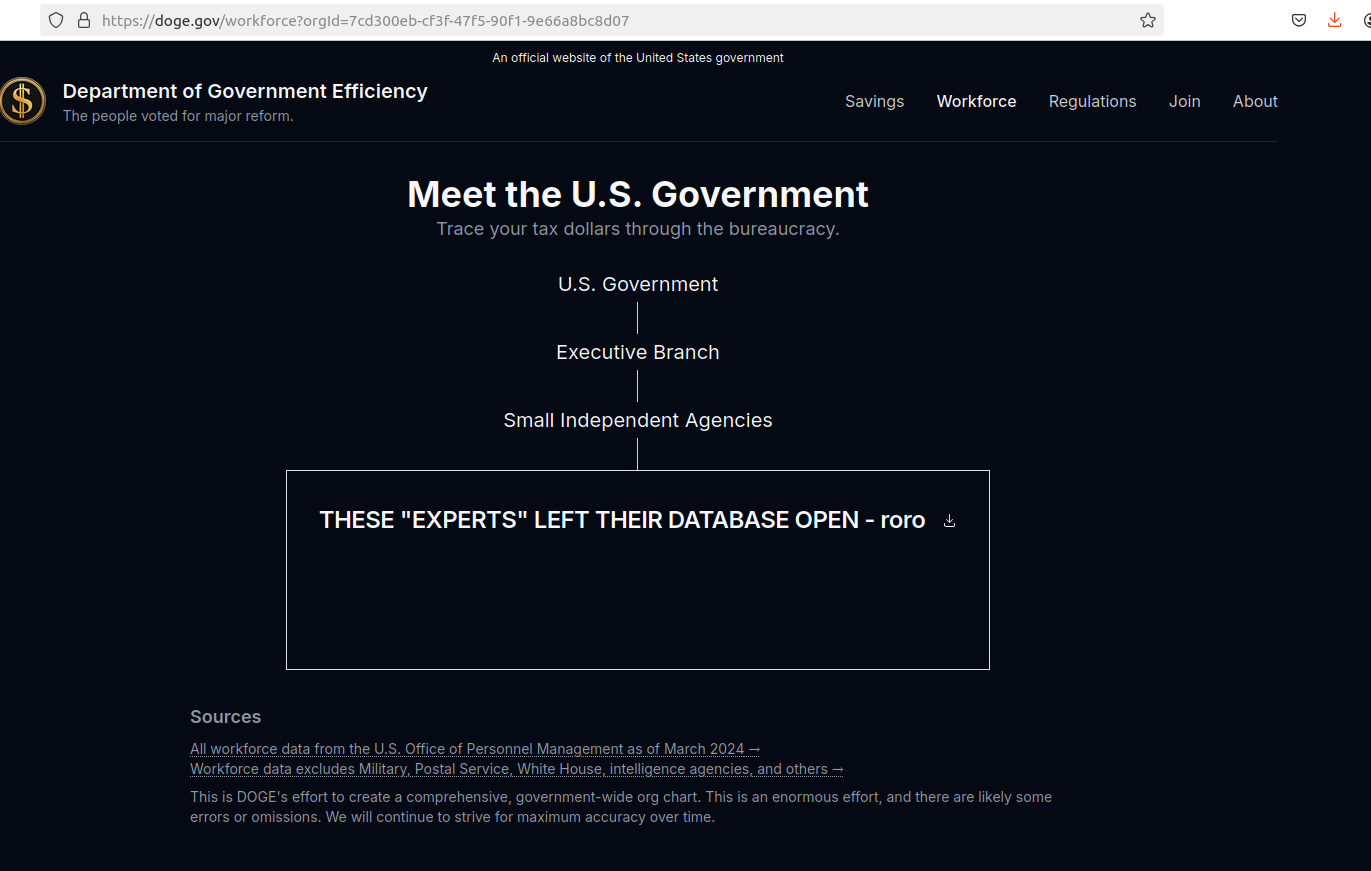
A screenshot of the DOGE website after it was defaced with the message: “These ‘experts’ left their database open – roro”

APPOINTMENTS

Trump’s efforts to grab federal agencies by their data has seen him replace career civil servants who refused to allow DOGE access to agency networks. CNN reports that Michelle King, acting commissioner of the Social Security Administration for more than 30 years, was shown the door after she denied DOGE access to sensitive information.

King was replaced by Leland Dudek, formerly a senior advisor in the SSA’s Office of Program Integrity. This week, Dudek posted a now-deleted message on LinkedIn acknowledging he had been placed on administrative leave for cooperating with DOGE.

“I confess,” Dudek wrote. “I bullied agency executives, shared executive contact information, and circumvented the chain of command to connect DOGE with the people who get stuff done. I confess. I asked where the fact was and is in our contracts so we can make the right tough choices.”
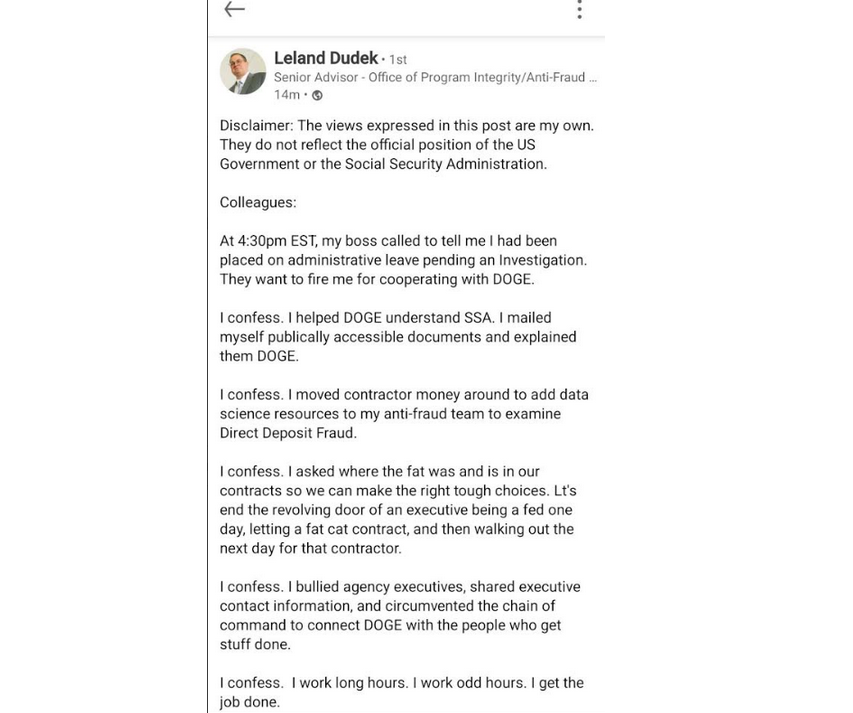
Dudek’s message on LinkedIn.

According to Wired, the National Institute of Standards and Technology (NIST) was also bracing this week for roughly 500 staffers to be fired, which could have serious impacts on NIST’s cybersecurity standards and software vulnerability tracking work.

“And cuts last week at the US Digital Service included the cybersecurity lead for the central Veterans Affairs portal, VA.gov, potentially leaving VA systems and data more vulnerable without someone in his role,” Wired’s Andy Greenberg and Lily Hay Newman wrote.

NextGov reports that Trump named the Department of Defense’s new chief information security officer: Katie Arrington, a former South Carolina state lawmaker who helped steer Pentagon cybersecurity contracting policy before being put on leave amid accusations that she disclosed classified data from a military intelligence agency.

NextGov notes that the National Security Agency suspended her clearance in 2021, although the exact reasons that led to the suspension and her subsequent leave were classified. Arrington argued that the suspension was a politically motivated effort to silence her.

Trump also appointed the former chief operating officer of the Republican National Committee as the new head of the Office of National Cyber Director. Sean Cairncross, who has no formal experience in technology or security, will be responsible for coordinating national cybersecurity policy, advising the president on cyber threats, and ensuring a unified federal response to emerging cyber-risks, Politico writes.

DarkReading reports that Cairncross would share responsibility for advising the president on cyber matters, along with the director of cyber at the White House National Security Council (NSC) — a group that advises the president on all matters security related, and not just cyber.

CONSUMER PROTECTION?

The president also ordered staffers at the Consumer Financial Protection Bureau (CFPB) to stop most work. Created by Congress in 2011 to be a clearinghouse of consumer complaints, the CFPB has sued some of the nation’s largest financial institutions for violating consumer protection laws.

The CFPB says its actions have put nearly $18 billion back in Americans’ pockets in the form of monetary compensation or canceled debts, and imposed $4 billion in civil money penalties against violators. The CFPB’s homepage has featured a “404: Page not found” error for weeks now.

Trump has appointed Russell Vought, the architect of the conservative policy playbook Project 2025, to be the CFPB’s acting director. Vought has publicly favored abolishing the agency, as has Elon Musk, whose efforts to remake X into a payments platform would otherwise be regulated by the CFPB.

The New York Times recently published a useful graphic showing all of the government staffing changes, including the firing of several top officials, affecting agencies with federal investigations into or regulatory battles with Musk’s companies. Democrats on the House Judiciary Committee also have released a comprehensive account (PDF) of Musk’s various conflicts of interest.
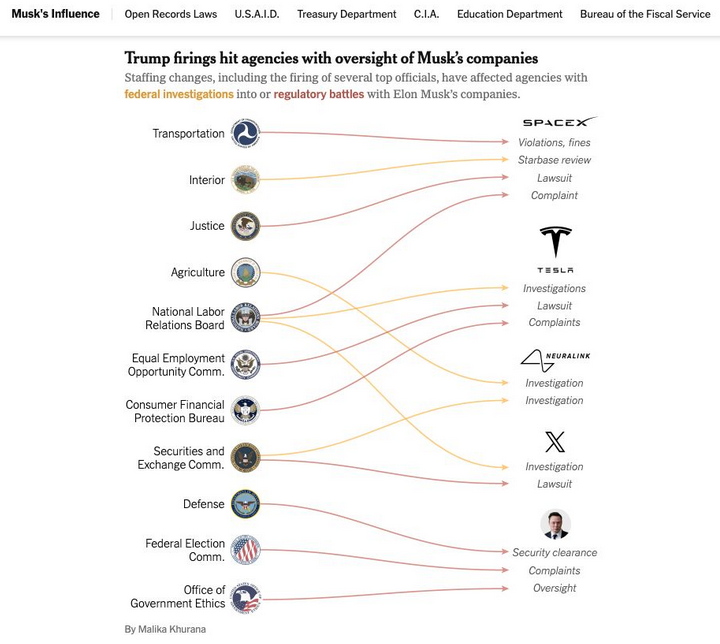
Image: nytimes.com

As the Times notes, Musk and his companies have repeatedly failed to comply with federal reporting protocols aimed at protecting state secrets, and these failures have prompted at least three federal reviews. Those include an inquiry launched last year by the Defense Department’s Office of Inspector General. Four days after taking office, Trump fired the DoD inspector general along with 17 other inspectors general.

The Trump administration also shifted the enforcement priorities of the U.S. Securities and Exchange Commission (SEC) away from prosecuting misconduct in the cryptocurrency sector, reassigning lawyers and renaming the unit to focus more on “cyber and emerging technologies.”

Reuters reports that the former SEC chair Gary Gensler made fighting misconduct in a sector he termed the “wild west” a priority for the agency, targeting not only cryptocurrency fraudsters but also the large firms that facilitate trading such as Coinbase.

On Friday, Coinbase said the SEC planned to withdraw its lawsuit against the crypto exchange. Also on Friday, the cryptocurrency exchange Bybit announced on X that a cybersecurity breach led to the theft of more than $1.4 billion worth of cryptocurrencies — making it the largest crypto heist ever.

ORGANIZED CRIME AND CORRUPTION

On Feb. 10, Trump ordered executive branch agencies to stop enforcing the U.S. Foreign Corrupt Practices Act, which froze foreign bribery investigations, and even allows for “remedial actions” of past enforcement actions deemed “inappropriate.”

Trump’s action also disbanded the Kleptocracy Asset Recovery Initiative and KleptoCapture Task Force — units which proved their value in corruption cases and in seizing the assets of sanctioned Russian oligarchs — and diverted resources away from investigating white-collar crime.

That’s according to the independent Organized Crime and Corruption Reporting Project (OCCRP), an investigative journalism outlet that until very recently was funded in part by the U.S. Agency for International Development (USAID).

The OCCRP lost nearly a third of its funding and was forced to lay off 43 reporters and staff after Trump moved to shutter USAID and freeze its spending. NBC News reports the Trump administration plans to gut the agency and leave fewer than 300 staffers on the job out of the current 8,000 direct hires and contractors.

The Global Investigative Journalism Network wrote this week that the sudden hold on USAID foreign assistance funding has frozen an estimated $268 million in agreed grants for independent media and the free flow of information in more than 30 countries — including several under repressive regimes.

Elon Musk has called USAID “a criminal organization” without evidence, and promoted fringe theories on his social media platform X that the agency operated without oversight and was rife with fraud. Just months before the election, USAID’s Office of Inspector General announced an investigation into USAID’s oversight of Starlink satellite terminals provided to the government of Ukraine.

KrebsOnSecurity this week heard from a trusted source that all outgoing email from USAID now carries a notation of “sensitive but unclassified,” a designation that experts say could make it more difficult for journalists and others to obtain USAID email records under the Freedom of Information Act (FOIA). On Feb. 20, Fedscoop reported also hearing the same thing from multiple sources, noting that the added message cannot be seen by senders until after the email is sent.

FIVE BULLETS

On Feb. 18, Trump issued an executive order declaring that only the U.S. attorney general and the president can provide authoritative interpretations of the law for the executive branch, and that this authority extends to independent agencies operating under the executive branch.

Trump is arguing that Article II, Clause 1 of the Constitution vests this power with the president. However, jurist.org writes that Article II does not expressly state the president or any other person in the executive branch has the power to interpret laws.

“The article states that the president is required to ‘take care that the laws be faithfully executed,’” Juris noted. “Jurisdiction to interpret laws and determine constitutionality belongs to the judicial branch under Article III. The framers of the Constitution designed the separation of duties to prevent any single branch of government from becoming too powerful.”

The executive order requires all agencies to submit to “performance standards and management objectives” to be established by the White House Office of Management and Budget, and to report periodically to the president.

Those performance metrics are already being requested: Employees at multiple federal agencies on Saturday reported receiving an email from the Office of Personnel Management ordering them to reply with a set of bullet points justifying their work for the past week.

“Please reply to this email with approx. 5 bullets of what you accomplished last week and cc your manager,” the notice read. “Please do not send any classified information, links, or attachments. Deadline is this Monday at 11:59 p.m. EST.”
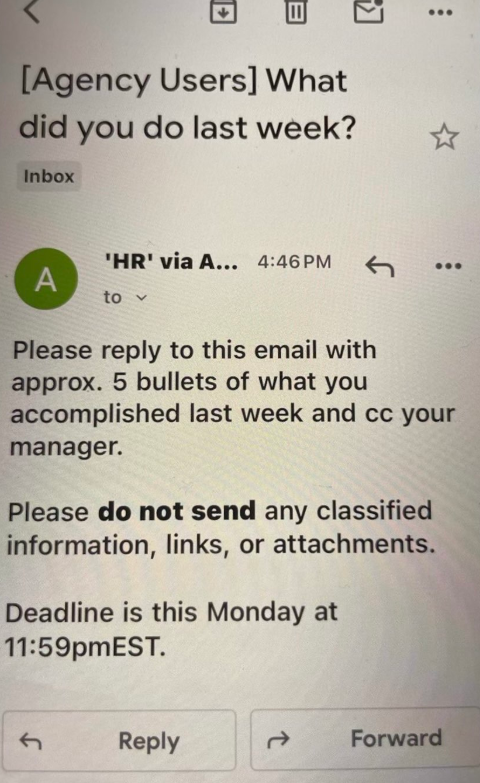
An email sent by the OPM to more than two million federal employees late in the afternoon EST on Saturday, Feb. 22.

In a social media post Saturday, Musk said the directive came at the behest of President Trump, and that failure to respond would be taken as a resignation. Meanwhile, Bloomberg writes the Department of Justice has been urging employees to hold off replying out of concern doing so could trigger ethics violations. The National Treasury Employees Union also is advising its employees not to respond.

A legal battle over Trump’s latest executive order is bound to join more than 70 other lawsuits currently underway to halt the administration’s efforts to massively reduce the size of the federal workforce through layoffs, firings and attrition.

KING TRUMP?

On Feb. 15, the president posted on social media, “He who saves his Country does not violate any Law,” citing a quote often attributed to the French dictator Napoleon Bonaparte. Four days later, Trump referred to himself as “the king” on social media, while the White House nonchalantly posted an illustration of him wearing a crown.

Trump has been publicly musing about running for an unconstitutional third-term in office, a statement that some of his supporters dismiss as Trump just trying to rile his liberal critics. However, just days after Trump began his second term, Rep. Andy Ogles (R-Tenn.) introduced a bill to amend the Constitution so that Trump — and any other future president — can be elected to serve a third term.

This week at the Conservative Political Action Conference (CPAC), Rep. Ogles reportedly led a group of Trump supporters calling itself the “Third Term Project,” which is trying to gain support for the bill from GOP lawmakers. The event featured images of Trump depicted as Caesar.

A banner at the CPAC conference this week in support of The Third Term Project, a group of conservatives trying to gain support for a bill to amend the Constitution and allow Trump to run for a third term.

Russia continues to be among the world’s top exporters of cybercrime, narcotics, money laundering, human trafficking, disinformation, war and death, and yet the Trump administration has suddenly broken with the Western world in normalizing relations with Moscow.

This week President Trump stunned U.S. allies by repeating Kremlin talking points that Ukraine is somehow responsible for Russia’s invasion, and that Ukrainian President Volodymyr Zelensky is a “dictator.” The president repeated these lies even as his administration is demanding that Zelensky give the United States half of his country’s mineral wealth in exchange for a promise that Russia will cease its territorial aggression there.

President Trump’s servility toward an actual dictatorRussian President Vladimir Putin — does not bode well for efforts to improve the cybersecurity of U.S. federal IT networks, or the private sector systems on which the government is largely reliant. In addition, this administration’s baffling moves to alienate, antagonize and sideline our closest allies could make it more difficult for the United States to secure their ongoing cooperation in cybercrime investigations.

It’s also startling how closely DOGE’s approach so far hews to tactics typically employed by ransomware gangs: A group of 20-somethings with names like “Big Balls” shows up on a weekend and gains access to your servers, deletes data, locks out key staff, takes your website down, and prevents you from serving customers.

When the federal executive starts imitating ransomware playbooks against its own agencies while Congress largely gazes on in either bewilderment or amusement, we’re in four-alarm fire territory. At least in theory, one can negotiate with ransomware purveyors.


Read More

CISA Adds One Known Exploited Vulnerability to Catalog

 ​CISA has added one new vulnerability to its Known Exploited Vulnerabilities Catalog, based on evidence of active exploitation.

CVE-2025-24989 Microsoft Power Pages Improper Access Control Vulnerability

These types of vulnerabilities are frequent attack vectors for malicious cyber actors and pose significant risks to the federal enterprise.
Binding Operational Directive (BOD) 22-01: Reducing the Significant Risk of Known Exploited Vulnerabilities established the Known Exploited Vulnerabilities Catalog as a living list of known Common Vulnerabilities and Exposures (CVEs) that carry significant risk to the federal enterprise. BOD 22-01 requires Federal Civilian Executive Branch (FCEB) agencies to remediate identified vulnerabilities by the due date to protect FCEB networks against active threats. See the BOD 22-01 Fact Sheet for more information.
Although BOD 22-01 only applies to FCEB agencies, CISA strongly urges all organizations to reduce their exposure to cyberattacks by prioritizing timely remediation of Catalog vulnerabilities as part of their vulnerability management practice. CISA will continue to add vulnerabilities to the catalog that meet the specified criteria. 

CISA has added one new vulnerability to its Known Exploited Vulnerabilities Catalog, based on evidence of active exploitation.

  • CVE-2025-24989 Microsoft Power Pages Improper Access Control Vulnerability

These types of vulnerabilities are frequent attack vectors for malicious cyber actors and pose significant risks to the federal enterprise.

Binding Operational Directive (BOD) 22-01: Reducing the Significant Risk of Known Exploited Vulnerabilities established the Known Exploited Vulnerabilities Catalog as a living list of known Common Vulnerabilities and Exposures (CVEs) that carry significant risk to the federal enterprise. BOD 22-01 requires Federal Civilian Executive Branch (FCEB) agencies to remediate identified vulnerabilities by the due date to protect FCEB networks against active threats. See the BOD 22-01 Fact Sheet for more information.

Although BOD 22-01 only applies to FCEB agencies, CISA strongly urges all organizations to reduce their exposure to cyberattacks by prioritizing timely remediation of Catalog vulnerabilities as part of their vulnerability management practice. CISA will continue to add vulnerabilities to the catalog that meet the specified criteria.

 Read More

CISA Releases Eight Industrial Control Systems Advisories

 ​CISA released eight Industrial Control Systems (ICS) advisories on February 20, 2025. These advisories provide timely information about current security issues, vulnerabilities, and exploits surrounding ICS.

ICSA-25-051-01 ABB ASPECT-Enterprise, NEXUS, and MATRIX Series
ICSA-25-051-02 ABB FLXEON Controllers
ICSA-25-051-03 Carrier Block Load
ICSA-25-051-04 Siemens SiPass Integrated
ICSA-25-051-05 Rapid Response Monitoring My Security Account App
ICSA-25-051-06 Elseta Vinci Protocol Analyzer 
ICSA-24-291-03 Mitsubishi Electric CNC Series (Update A) 
ICSMA-25-051-01 Medixant RadiAnt DICOM Viewer

CISA encourages users and administrators to review newly released ICS advisories for technical details and mitigations. 

CISA released eight Industrial Control Systems (ICS) advisories on February 20, 2025. These advisories provide timely information about current security issues, vulnerabilities, and exploits surrounding ICS.

CISA encourages users and administrators to review newly released ICS advisories for technical details and mitigations.

 Read More

CISA Adds Two Known Exploited Vulnerabilities to Catalog

 ​CISA has added two new vulnerabilities to its Known Exploited Vulnerabilities Catalog, based on evidence of active exploitation.

CVE-2025-23209 Craft CMS Code Injection Vulnerability
CVE-2025-0111 Palo Alto Networks PAN-OS File Read Vulnerability

These types of vulnerabilities are frequent attack vectors for malicious cyber actors and pose significant risks to the federal enterprise.
Binding Operational Directive (BOD) 22-01: Reducing the Significant Risk of Known Exploited Vulnerabilities established the Known Exploited Vulnerabilities Catalog as a living list of known Common Vulnerabilities and Exposures (CVEs) that carry significant risk to the federal enterprise. BOD 22-01 requires Federal Civilian Executive Branch (FCEB) agencies to remediate identified vulnerabilities by the due date to protect FCEB networks against active threats. See the BOD 22-01 Fact Sheet for more information.
Although BOD 22-01 only applies to FCEB agencies, CISA strongly urges all organizations to reduce their exposure to cyberattacks by prioritizing timely remediation of Catalog vulnerabilities as part of their vulnerability management practice. CISA will continue to add vulnerabilities to the catalog that meet the specified criteria. 

CISA has added two new vulnerabilities to its Known Exploited Vulnerabilities Catalog, based on evidence of active exploitation.

These types of vulnerabilities are frequent attack vectors for malicious cyber actors and pose significant risks to the federal enterprise.

Binding Operational Directive (BOD) 22-01: Reducing the Significant Risk of Known Exploited Vulnerabilities established the Known Exploited Vulnerabilities Catalog as a living list of known Common Vulnerabilities and Exposures (CVEs) that carry significant risk to the federal enterprise. BOD 22-01 requires Federal Civilian Executive Branch (FCEB) agencies to remediate identified vulnerabilities by the due date to protect FCEB networks against active threats. See the BOD 22-01 Fact Sheet for more information.

Although BOD 22-01 only applies to FCEB agencies, CISA strongly urges all organizations to reduce their exposure to cyberattacks by prioritizing timely remediation of Catalog vulnerabilities as part of their vulnerability management practice. CISA will continue to add vulnerabilities to the catalog that meet the specified criteria.

 Read More

Medixant RadiAnt DICOM Viewer

 ​View CSAF
1. EXECUTIVE SUMMARY

CVSS v4 5.7
ATTENTION: Low attack complexity
Vendor: Medixant
Equipment: RadiAnt DICOM Viewer
Vulnerability: Improper Certificate Validation

2. RISK EVALUATION
Successful exploitation of this vulnerability could allow an attacker to perform a machine-in-the-middle attack (MITM), resulting in malicious updates being delivered to the user.
3. TECHNICAL DETAILS
3.1 AFFECTED PRODUCTS
The following Medixant products are affected:

RadiAnt DICOM Viewer: Version 2024.02

3.2 VULNERABILITY OVERVIEW
3.2.1 IMPROPER CERTIFICATE VALIDATION CWE-295
The affected product is vulnerable due to failure of the update mechanism to verify the update server’s certificate which could allow an attacker to alter network traffic and carry out a machine-in-the-middle attack (MITM). An attacker could modify the server’s response and deliver a malicious update to the user.
CVE-2025-1001 has been assigned to this vulnerability. A CVSS v3.1 base score of 5.7 has been calculated; the CVSS vector string is (AV:A/AC:L/PR:N/UI:R/S:U/C:N/I:H/A:N).
A CVSS v4 score has also been calculated for CVE-2025-1001. A base score of 5.7 has been calculated; the CVSS vector string is (AV:A/AC:L/AT:P/PR:N/UI:A/VC:N/VI:H/VA:N/SC:N/SI:N/SA:N).
3.3 BACKGROUND

CRITICAL INFRASTRUCTURE SECTORS: Healthcare and Public Health
COUNTRIES/AREAS DEPLOYED: Worldwide
COMPANY HEADQUARTERS LOCATION: Poland

3.4 RESEARCHER
Sharon Brizinov of Claroty Team82 reported this vulnerability to CISA.
4. MITIGATIONS
Medixant recommends users download the v2025.1 or later version of their software.
If users are unable to update to the new version, Medixant recommends the following:

Disable the display of available updates via this command reg add “HKCUSoftwareRadiAnt Viewer” /t REG_DWORD /v CheckUpdate /d 0 /f.
Do not check manually for updates (“Check for updates now” from the toolbar menu).
Ignore any update notifications coming from RadiAnt DICOM Viewer, download the latest version directly in the web browser from https://www.radiantviewer.com.
Check the downloaded RadiAnt DICOM Viewer installation package with antivirus software before running it.

CISA recommends users take defensive measures to minimize the risk of exploitation of this vulnerability, such as:

Minimize network exposure for all control system devices and/or systems, ensuring they are not accessible from the internet.
Locate control system networks and remote devices behind firewalls and isolating them from business networks.
When remote access is required, use more secure methods, such as Virtual Private Networks (VPNs), recognizing VPNs may have vulnerabilities and should be updated to the most current version available. Also recognize VPN is only as secure as the connected devices.

CISA reminds organizations to perform proper impact analysis and risk assessment prior to deploying defensive measures.
CISA also provides a section for control systems security recommended practices on the ICS webpage on cisa.gov/ics. Several CISA products detailing cyber defense best practices are available for reading and download, including Improving Industrial Control Systems Cybersecurity with Defense-in-Depth Strategies.
CISA encourages organizations to implement recommended cybersecurity strategies for proactive defense of ICS assets.
Additional mitigation guidance and recommended practices are publicly available on the ICS webpage at cisa.gov/ics in the technical information paper, ICS-TIP-12-146-01B–Targeted Cyber Intrusion Detection and Mitigation Strategies.
Organizations observing suspected malicious activity should follow established internal procedures and report findings to CISA for tracking and correlation against other incidents.
CISA also recommends users take the following measures to protect themselves from social engineering attacks:

Do not click web links or open attachments in unsolicited email messages.
Refer to Recognizing and Avoiding Email Scams for more information on avoiding email scams.
Refer to Avoiding Social Engineering and Phishing Attacks for more information on social engineering attacks.

No known public exploitation specifically targeting this vulnerability has been reported to CISA at this time. This vulnerability is not exploitable remotely.
5. UPDATE HISTORY

February 20, 2025: Initial Publication 

View CSAF

1. EXECUTIVE SUMMARY

  • CVSS v4 5.7
  • ATTENTION: Low attack complexity
  • Vendor: Medixant
  • Equipment: RadiAnt DICOM Viewer
  • Vulnerability: Improper Certificate Validation

2. RISK EVALUATION

Successful exploitation of this vulnerability could allow an attacker to perform a machine-in-the-middle attack (MITM), resulting in malicious updates being delivered to the user.

3. TECHNICAL DETAILS

3.1 AFFECTED PRODUCTS

The following Medixant products are affected:

  • RadiAnt DICOM Viewer: Version 2024.02

3.2 VULNERABILITY OVERVIEW

3.2.1 IMPROPER CERTIFICATE VALIDATION CWE-295

The affected product is vulnerable due to failure of the update mechanism to verify the update server’s certificate which could allow an attacker to alter network traffic and carry out a machine-in-the-middle attack (MITM). An attacker could modify the server’s response and deliver a malicious update to the user.

CVE-2025-1001 has been assigned to this vulnerability. A CVSS v3.1 base score of 5.7 has been calculated; the CVSS vector string is (AV:A/AC:L/PR:N/UI:R/S:U/C:N/I:H/A:N).

A CVSS v4 score has also been calculated for CVE-2025-1001. A base score of 5.7 has been calculated; the CVSS vector string is (AV:A/AC:L/AT:P/PR:N/UI:A/VC:N/VI:H/VA:N/SC:N/SI:N/SA:N).

3.3 BACKGROUND

  • CRITICAL INFRASTRUCTURE SECTORS: Healthcare and Public Health
  • COUNTRIES/AREAS DEPLOYED: Worldwide
  • COMPANY HEADQUARTERS LOCATION: Poland

3.4 RESEARCHER

Sharon Brizinov of Claroty Team82 reported this vulnerability to CISA.

4. MITIGATIONS

Medixant recommends users download the v2025.1 or later version of their software.

If users are unable to update to the new version, Medixant recommends the following:

  • Disable the display of available updates via this command reg add “HKCUSoftwareRadiAnt Viewer” /t REG_DWORD /v CheckUpdate /d 0 /f.
  • Do not check manually for updates (“Check for updates now” from the toolbar menu).
  • Ignore any update notifications coming from RadiAnt DICOM Viewer, download the latest version directly in the web browser from https://www.radiantviewer.com.
  • Check the downloaded RadiAnt DICOM Viewer installation package with antivirus software before running it.

CISA recommends users take defensive measures to minimize the risk of exploitation of this vulnerability, such as:

  • Minimize network exposure for all control system devices and/or systems, ensuring they are not accessible from the internet.
  • Locate control system networks and remote devices behind firewalls and isolating them from business networks.
  • When remote access is required, use more secure methods, such as Virtual Private Networks (VPNs), recognizing VPNs may have vulnerabilities and should be updated to the most current version available. Also recognize VPN is only as secure as the connected devices.

CISA reminds organizations to perform proper impact analysis and risk assessment prior to deploying defensive measures.

CISA also provides a section for control systems security recommended practices on the ICS webpage on cisa.gov/ics. Several CISA products detailing cyber defense best practices are available for reading and download, including Improving Industrial Control Systems Cybersecurity with Defense-in-Depth Strategies.

CISA encourages organizations to implement recommended cybersecurity strategies for proactive defense of ICS assets.

Additional mitigation guidance and recommended practices are publicly available on the ICS webpage at cisa.gov/ics in the technical information paper, ICS-TIP-12-146-01B–Targeted Cyber Intrusion Detection and Mitigation Strategies.

Organizations observing suspected malicious activity should follow established internal procedures and report findings to CISA for tracking and correlation against other incidents.

CISA also recommends users take the following measures to protect themselves from social engineering attacks:

No known public exploitation specifically targeting this vulnerability has been reported to CISA at this time. This vulnerability is not exploitable remotely.

5. UPDATE HISTORY

  • February 20, 2025: Initial Publication

 Read More

ABB FLXEON Controllers

 ​View CSAF
1. EXECUTIVE SUMMARY

CVSS v4 10.0
ATTENTION: Exploitable remotely/low attack complexity
Vendor: ABB
Equipment: FLXEON Controllers
Vulnerabilities: Improper Control of Filename for Include/Require Statement in PHP Program (‘PHP Remote File Inclusion’), Missing Origin Validation in WebSockets, Insertion of Sensitive Information into Log File

2. RISK EVALUATION
Successful exploitation of these vulnerabilities could allow an attacker to send unauthorized HTTPS requests, access sensitive information from HTTPS responses, or use network access to execute remote code.
3. TECHNICAL DETAILS
3.1 AFFECTED PRODUCTS
ABB reports that the following products are affected:

FLXEON Controllers FBXi: Version 9.3.4 and prior
FLXEON Controllers FBVi: Version 9.3.4 and prior
FLXEON Controllers FBTi: Version 9.3.4 and prior
FLXEON Controllers CBXi: Version 9.3.4 and prior

3.2 VULNERABILITY OVERVIEW
3.2.1 IMPROPER NEUTRALIZATION OF SPECIAL ELEMENTS USED IN A COMMAND (‘COMMAND INJECTION’) CWE-77
Network access can be used to execute arbitrary code with elevated privileges. This issue affects FLXEON version 9.3.4 and prior.
CVE-2024-48841 has been assigned to this vulnerability. A CVSS v3 base score of 10.0 has been calculated; the CVSS vector string is (CVSS:3.1/AV:N/AC:L/PR:N/UI:N/S:C/C:H/I:H/A:H).
A CVSS v4 score has also been calculated for CVE-2024-48841. A base score of 10.0 has been calculated; the CVSS vector string is (CVSS:4.0/AV:N/AC:L/AT:N/PR:N/UI:N/VC:H/VI:H/VA:H/SC:H/SI:H/SA:H).
3.2.2 MISSING ORIGIN VALIDATION IN WEBSOCKETS CWE-1385
Session management is not sufficient to prevent unauthorized HTTPS requests. This issue affects FLXEON version 9.3.4 and prior.
CVE-2024-48849 has been assigned to this vulnerability. A CVSS v3 base score of 9.4 has been calculated; the CVSS vector string is (CVSS:3.1/AV:N/AC:L/PR:N/UI:N/S:U/C:L/I:H/A:H).
A CVSS v4 score has also been calculated for CVE-2024-48849. A base score of 8.8 has been calculated; the CVSS vector string is (CVSS:4.0/AV:N/AC:L/AT:N/PR:N/UI:N/VC:L/VI:H/VA:H/SC:N/SI:N/SA:N).
3.2.3 INSERTION OF SENSITIVE INFORMATION INTO LOG FILE CWE-532
Some information may be improperly disclosed through HTTPS access. This issue affects FLXEON version 9.3.4 and prior.
CVE-2024-48852 has been assigned to this vulnerability. A CVSS v3 base score of 9.4 has been calculated; the CVSS vector string is (CVSS:3.1/AV:N/AC:L/PR:N/UI:N/S:U/C:L/I:H/A:H).
A CVSS v4 score has also been calculated for CVE-2024-48852. A base score of 8.8 has been calculated; the CVSS vector string is (CVSS:4.0/AV:N/AC:L/AT:N/PR:N/UI:N/VC:L/VI:H/VA:H/SC:N/SI:N/SA:N).
3.3 BACKGROUND

CRITICAL INFRASTRUCTURE SECTORS: Critical Manufacturing
COUNTRIES/AREAS DEPLOYED: Worldwide
COMPANY HEADQUARTERS LOCATION: Switzerland

3.4 RESEARCHER
Gjoko Krstikj of Zero Science Lab reported these vulnerabilities through responsible disclosure.
4. MITIGATIONS
ABB recommends that users update to firmware version 9.3.5.
ABB recommends that users immediately do the following actions on any released version of FLXEON:

Stop and disconnect any FLXEON products that are exposed directly to the Internet, either via a direct ISP connection or via NAT port forwarding.
Ensure that physical controls are in place, so no unauthorized personnel can access your devices, components, peripheral equipment, and networks.
Ensure that all FLXEON products are upgraded to the latest firmware version (9.3.5 or above). Please find the latest version of FLXEON firmware on the respective product homepage.
When remote access is required, only use secure methods. If a virtual private network (VPN) is used, ensure that the chosen VPN is secure i.e. updated to the most current version available and configured for secure access.

For more information, please refer to ABB’s cybersecurity advisory 9AKK108470A5684.
ABB states that these vulnerabilities are only exploitable if attackers can access the network segment where FLXEON is installed and exposed directly to the internet. ABB therefore recommends the following guidelines in order to protect users networks:

FLXEON devices should never be exposed directly to the Internet either via a direct ISP connection nor via NAT port forwarding. If remote access to a FLXEON system is a user requirement, the system shall operate behind a firewall. Users accessing FLXEON remotely shall do this using a VPN gateway allowing access to the particular network segment where FLXEON is in stalled and configured.
It is crucial that the VPN gateway and network are set up in accordance with best industry standards and maintained in terms of security patches for all related components.
Change default passwords if they are still in use.
Ensure that all FLXEON products are upgraded to the latest firmware version. Please find the latest version of FLXEON firmware on the respective product homepage.

CISA recommends users take defensive measures to minimize the risk of exploitation of these vulnerabilities. CISA reminds organizations to perform proper impact analysis and risk assessment prior to deploying defensive measures.
CISA also provides a section for control systems security recommended practices on the ICS webpage on cisa.gov. Several CISA products detailing cyber defense best practices are available for reading and download, including Improving Industrial Control Systems Cybersecurity with Defense-in-Depth Strategies.
CISA encourages organizations to implement recommended cybersecurity strategies for proactive defense of ICS assets.
Additional mitigation guidance and recommended practices are publicly available on the ICS webpage at cisa.gov in the technical information paper, ICS-TIP-12-146-01B–Targeted Cyber Intrusion Detection and Mitigation Strategies.
Organizations observing suspected malicious activity should follow established internal procedures and report findings to CISA for tracking and correlation against other incidents.
No known public exploitation specifically targeting these vulnerabilities has been reported to CISA at this time.
5. UPDATE HISTORY

February 20, 2025: Initial Publication 

View CSAF

1. EXECUTIVE SUMMARY

  • CVSS v4 10.0
  • ATTENTION: Exploitable remotely/low attack complexity
  • Vendor: ABB
  • Equipment: FLXEON Controllers
  • Vulnerabilities: Improper Control of Filename for Include/Require Statement in PHP Program (‘PHP Remote File Inclusion’), Missing Origin Validation in WebSockets, Insertion of Sensitive Information into Log File

2. RISK EVALUATION

Successful exploitation of these vulnerabilities could allow an attacker to send unauthorized HTTPS requests, access sensitive information from HTTPS responses, or use network access to execute remote code.

3. TECHNICAL DETAILS

3.1 AFFECTED PRODUCTS

ABB reports that the following products are affected:

  • FLXEON Controllers FBXi: Version 9.3.4 and prior
  • FLXEON Controllers FBVi: Version 9.3.4 and prior
  • FLXEON Controllers FBTi: Version 9.3.4 and prior
  • FLXEON Controllers CBXi: Version 9.3.4 and prior

3.2 VULNERABILITY OVERVIEW

3.2.1 IMPROPER NEUTRALIZATION OF SPECIAL ELEMENTS USED IN A COMMAND (‘COMMAND INJECTION’) CWE-77

Network access can be used to execute arbitrary code with elevated privileges. This issue affects FLXEON version 9.3.4 and prior.

CVE-2024-48841 has been assigned to this vulnerability. A CVSS v3 base score of 10.0 has been calculated; the CVSS vector string is (CVSS:3.1/AV:N/AC:L/PR:N/UI:N/S:C/C:H/I:H/A:H).

A CVSS v4 score has also been calculated for CVE-2024-48841. A base score of 10.0 has been calculated; the CVSS vector string is (CVSS:4.0/AV:N/AC:L/AT:N/PR:N/UI:N/VC:H/VI:H/VA:H/SC:H/SI:H/SA:H).

3.2.2 MISSING ORIGIN VALIDATION IN WEBSOCKETS CWE-1385

Session management is not sufficient to prevent unauthorized HTTPS requests. This issue affects FLXEON version 9.3.4 and prior.

CVE-2024-48849 has been assigned to this vulnerability. A CVSS v3 base score of 9.4 has been calculated; the CVSS vector string is (CVSS:3.1/AV:N/AC:L/PR:N/UI:N/S:U/C:L/I:H/A:H).

A CVSS v4 score has also been calculated for CVE-2024-48849. A base score of 8.8 has been calculated; the CVSS vector string is (CVSS:4.0/AV:N/AC:L/AT:N/PR:N/UI:N/VC:L/VI:H/VA:H/SC:N/SI:N/SA:N).

3.2.3 INSERTION OF SENSITIVE INFORMATION INTO LOG FILE CWE-532

Some information may be improperly disclosed through HTTPS access. This issue affects FLXEON version 9.3.4 and prior.

CVE-2024-48852 has been assigned to this vulnerability. A CVSS v3 base score of 9.4 has been calculated; the CVSS vector string is (CVSS:3.1/AV:N/AC:L/PR:N/UI:N/S:U/C:L/I:H/A:H).

A CVSS v4 score has also been calculated for CVE-2024-48852. A base score of 8.8 has been calculated; the CVSS vector string is (CVSS:4.0/AV:N/AC:L/AT:N/PR:N/UI:N/VC:L/VI:H/VA:H/SC:N/SI:N/SA:N).

3.3 BACKGROUND

  • CRITICAL INFRASTRUCTURE SECTORS: Critical Manufacturing
  • COUNTRIES/AREAS DEPLOYED: Worldwide
  • COMPANY HEADQUARTERS LOCATION: Switzerland

3.4 RESEARCHER

Gjoko Krstikj of Zero Science Lab reported these vulnerabilities through responsible disclosure.

4. MITIGATIONS

ABB recommends that users update to firmware version 9.3.5.

ABB recommends that users immediately do the following actions on any released version of FLXEON:

  • Stop and disconnect any FLXEON products that are exposed directly to the Internet, either via a direct ISP connection or via NAT port forwarding.
  • Ensure that physical controls are in place, so no unauthorized personnel can access your devices, components, peripheral equipment, and networks.
  • Ensure that all FLXEON products are upgraded to the latest firmware version (9.3.5 or above). Please find the latest version of FLXEON firmware on the respective product homepage.
  • When remote access is required, only use secure methods. If a virtual private network (VPN) is used, ensure that the chosen VPN is secure i.e. updated to the most current version available and configured for secure access.

For more information, please refer to ABB’s cybersecurity advisory 9AKK108470A5684.

ABB states that these vulnerabilities are only exploitable if attackers can access the network segment where FLXEON is installed and exposed directly to the internet. ABB therefore recommends the following guidelines in order to protect users networks:

  • FLXEON devices should never be exposed directly to the Internet either via a direct ISP connection nor via NAT port forwarding. If remote access to a FLXEON system is a user requirement, the system shall operate behind a firewall. Users accessing FLXEON remotely shall do this using a VPN gateway allowing access to the particular network segment where FLXEON is in stalled and configured.
  • It is crucial that the VPN gateway and network are set up in accordance with best industry standards and maintained in terms of security patches for all related components.
  • Change default passwords if they are still in use.
  • Ensure that all FLXEON products are upgraded to the latest firmware version. Please find the latest version of FLXEON firmware on the respective product homepage.

CISA recommends users take defensive measures to minimize the risk of exploitation of these vulnerabilities. CISA reminds organizations to perform proper impact analysis and risk assessment prior to deploying defensive measures.

CISA also provides a section for control systems security recommended practices on the ICS webpage on cisa.gov. Several CISA products detailing cyber defense best practices are available for reading and download, including Improving Industrial Control Systems Cybersecurity with Defense-in-Depth Strategies.

CISA encourages organizations to implement recommended cybersecurity strategies for proactive defense of ICS assets.

Additional mitigation guidance and recommended practices are publicly available on the ICS webpage at cisa.gov in the technical information paper, ICS-TIP-12-146-01B–Targeted Cyber Intrusion Detection and Mitigation Strategies.

Organizations observing suspected malicious activity should follow established internal procedures and report findings to CISA for tracking and correlation against other incidents.

No known public exploitation specifically targeting these vulnerabilities has been reported to CISA at this time.

5. UPDATE HISTORY

  • February 20, 2025: Initial Publication

 Read More

Carrier Block Load

 ​View CSAF
1. EXECUTIVE SUMMARY

CVSS v4 7.1
ATTENTION: Exploitable remotely/low attack complexity
Vendor: Carrier
Equipment: Block Load
Vulnerability: Uncontrolled Search Path Element

2. RISK EVALUATION
Successful exploitation of this vulnerability could allow a malicious actor to execute arbitrary code with escalated privileges .
3. TECHNICAL DETAILS
3.1 AFFECTED PRODUCTS
The following Carrier product, which is a HVAC load calculation program, are affected:

Block Load: Version 4.16

3.2 VULNERABILITY OVERVIEW
3.2.1 UNCONTROLLED SEARCH PATH ELEMENT CWE-427
The vulnerability could allow a malicious actor to perform DLL hijacking and execute arbitrary code with escalated privileges.
CVE-2024-10930 has been assigned to this vulnerability. A CVSS v3.1 base score of 7.8 has been calculated; the CVSS vector string is (AV:L/AC:L/PR:N/UI:R/S:U/C:H/I:H/A:H).
A CVSS v4 score has also been calculated for CVE-2024-10930. A base score of 7.1 has been calculated; the CVSS vector string is (AV:L/AC:L/AT:P/PR:N/UI:A/VC:H/VI:H/VA:H/SC:N/SI:N/SA:N).
3.3 BACKGROUND

CRITICAL INFRASTRUCTURE SECTORS: Commercial Facilities
COUNTRIES/AREAS DEPLOYED: United States
COMPANY HEADQUARTERS LOCATION: United States

3.4 RESEARCHER
An anonymous researcher reported this vulnerability to Carrier.
4. MITIGATIONS
Carrier recommends users to upgrade the product to v4.2 or later. If any issues arise, users are encouraged to contact Carrier directly. For more information refer to Carrier’s security advisory.
CISA recommends users take defensive measures to minimize the risk of exploitation of this vulnerability, such as:

Minimize network exposure for all control system devices and/or systems, ensuring they are not accessible from the internet.
Locate control system networks and remote devices behind firewalls and isolating them from business networks.
When remote access is required, use more secure methods, such as Virtual Private Networks (VPNs), recognizing VPNs may have vulnerabilities and should be updated to the most current version available. Also recognize VPN is only as secure as the connected devices.

CISA reminds organizations to perform proper impact analysis and risk assessment prior to deploying defensive measures.
CISA also provides a section for control systems security recommended practices on the ICS webpage on cisa.gov/ics. Several CISA products detailing cyber defense best practices are available for reading and download, including Improving Industrial Control Systems Cybersecurity with Defense-in-Depth Strategies.
CISA encourages organizations to implement recommended cybersecurity strategies for proactive defense of ICS assets.
Additional mitigation guidance and recommended practices are publicly available on the ICS webpage at cisa.gov/ics in the technical information paper, ICS-TIP-12-146-01B–Targeted Cyber Intrusion Detection and Mitigation Strategies.
Organizations observing suspected malicious activity should follow established internal procedures and report findings to CISA for tracking and correlation against other incidents.
No known public exploitation specifically targeting this vulnerability has been reported to CISA at this time.
5. UPDATE HISTORY

February 20, 2025: Initial Publication 

View CSAF

1. EXECUTIVE SUMMARY

  • CVSS v4 7.1
  • ATTENTION: Exploitable remotely/low attack complexity
  • Vendor: Carrier
  • Equipment: Block Load
  • Vulnerability: Uncontrolled Search Path Element

2. RISK EVALUATION

Successful exploitation of this vulnerability could allow a malicious actor to execute arbitrary code with escalated privileges .

3. TECHNICAL DETAILS

3.1 AFFECTED PRODUCTS

The following Carrier product, which is a HVAC load calculation program, are affected:

  • Block Load: Version 4.16

3.2 VULNERABILITY OVERVIEW

3.2.1 UNCONTROLLED SEARCH PATH ELEMENT CWE-427

The vulnerability could allow a malicious actor to perform DLL hijacking and execute arbitrary code with escalated privileges.

CVE-2024-10930 has been assigned to this vulnerability. A CVSS v3.1 base score of 7.8 has been calculated; the CVSS vector string is (AV:L/AC:L/PR:N/UI:R/S:U/C:H/I:H/A:H).

A CVSS v4 score has also been calculated for CVE-2024-10930. A base score of 7.1 has been calculated; the CVSS vector string is (AV:L/AC:L/AT:P/PR:N/UI:A/VC:H/VI:H/VA:H/SC:N/SI:N/SA:N).

3.3 BACKGROUND

  • CRITICAL INFRASTRUCTURE SECTORS: Commercial Facilities
  • COUNTRIES/AREAS DEPLOYED: United States
  • COMPANY HEADQUARTERS LOCATION: United States

3.4 RESEARCHER

An anonymous researcher reported this vulnerability to Carrier.

4. MITIGATIONS

Carrier recommends users to upgrade the product to v4.2 or later. If any issues arise, users are encouraged to contact Carrier directly. For more information refer to Carrier’s security advisory.

CISA recommends users take defensive measures to minimize the risk of exploitation of this vulnerability, such as:

  • Minimize network exposure for all control system devices and/or systems, ensuring they are not accessible from the internet.
  • Locate control system networks and remote devices behind firewalls and isolating them from business networks.
  • When remote access is required, use more secure methods, such as Virtual Private Networks (VPNs), recognizing VPNs may have vulnerabilities and should be updated to the most current version available. Also recognize VPN is only as secure as the connected devices.

CISA reminds organizations to perform proper impact analysis and risk assessment prior to deploying defensive measures.

CISA also provides a section for control systems security recommended practices on the ICS webpage on cisa.gov/ics. Several CISA products detailing cyber defense best practices are available for reading and download, including Improving Industrial Control Systems Cybersecurity with Defense-in-Depth Strategies.

CISA encourages organizations to implement recommended cybersecurity strategies for proactive defense of ICS assets.

Additional mitigation guidance and recommended practices are publicly available on the ICS webpage at cisa.gov/ics in the technical information paper, ICS-TIP-12-146-01B–Targeted Cyber Intrusion Detection and Mitigation Strategies.

Organizations observing suspected malicious activity should follow established internal procedures and report findings to CISA for tracking and correlation against other incidents.

No known public exploitation specifically targeting this vulnerability has been reported to CISA at this time.

5. UPDATE HISTORY

  • February 20, 2025: Initial Publication

 Read More

Elseta Vinci Protocol Analyzer

 ​View CSAF
1. EXECUTIVE SUMMARY

CVSS v4 9.4
ATTENTION: Exploitable remotely/low attack complexity
Vendor: Elseta
Equipment: Vinci Protocol Analyzer
Vulnerability: Improper Neutralization of Special Elements used in an OS Command (‘OS Command Injection’)

2. RISK EVALUATION
Successful exploitation of this vulnerability could allow an attacker to escalate privileges and perform code execution on the affected system.
3. TECHNICAL DETAILS
3.1 AFFECTED PRODUCTS
The following Elseta products are affected:
Vinci Protocol Analyzer: Versions prior to 3.2.3.19
3.2 VULNERABILITY OVERVIEW
3.2.1 IMPROPER NEUTRALIZATION OF SPECIAL ELEMENTS USED IN AN OS COMMAND (‘OS COMMAND INJECTION’) CWE-78
An OS command injection vulnerability exists in Vinci Protocol Analyzer that could allow an attacker to escalate privileges and perform code execution on affected system.
CVE-2025-1265 has been assigned to this vulnerability. A CVSS v3.1 base score of 9.9 has been calculated; the CVSS vector string is (AV:N/AC:L/PR:L/UI:N/S:C/C:H/I:H/A:H).
A CVSS v4 score has also been calculated for CVE-2025-1265. A base score of 9.4 has been calculated; the CVSS vector string is (CVSS:4.0/AV:N/AC:L/AT:N/PR:L/UI:N/VC:H/VI:H/VA:H/SC:H/SI:H/SA:H).
3.3 BACKGROUND

CRITICAL INFRASTRUCTURE SECTORS: Critical Manufacturing, Communications
COUNTRIES/AREAS DEPLOYED: Worldwide
COMPANY HEADQUARTERS LOCATION: Lithuania

3.4 RESEARCHER
Nguyen Huu Thien Duc reported this vulnerability to CISA.
4. MITIGATIONS
Elseta recommends affected users update to version 3.2.3.19 or later. Contact Elseta for more information.
CISA recommends users take defensive measures to minimize the risk of exploitation of this vulnerability, such as:

Minimize network exposure for all control system devices and/or systems, ensuring they are not accessible from the internet.
Locate control system networks and remote devices behind firewalls and isolating them from business networks.
When remote access is required, use more secure methods, such as Virtual Private Networks (VPNs), recognizing VPNs may have vulnerabilities and should be updated to the most current version available. Also recognize VPN is only as secure as the connected devices.

CISA reminds organizations to perform proper impact analysis and risk assessment prior to deploying defensive measures.
CISA also provides a section for control systems security recommended practices on the ICS webpage on cisa.gov/ics. Several CISA products detailing cyber defense best practices are available for reading and download, including Improving Industrial Control Systems Cybersecurity with Defense-in-Depth Strategies.
CISA encourages organizations to implement recommended cybersecurity strategies for proactive defense of ICS assets.
Additional mitigation guidance and recommended practices are publicly available on the ICS webpage at cisa.gov/ics in the technical information paper, ICS-TIP-12-146-01B–Targeted Cyber Intrusion Detection and Mitigation Strategies.
Organizations observing suspected malicious activity should follow established internal procedures and report findings to CISA for tracking and correlation against other incidents.
No known public exploitation specifically targeting this vulnerability has been reported to CISA at this time.
5. UPDATE HISTORY

February 20, 2025: Initial Publication 

View CSAF

1. EXECUTIVE SUMMARY

  • CVSS v4 9.4
  • ATTENTION: Exploitable remotely/low attack complexity
  • Vendor: Elseta
  • Equipment: Vinci Protocol Analyzer
  • Vulnerability: Improper Neutralization of Special Elements used in an OS Command (‘OS Command Injection’)

2. RISK EVALUATION

Successful exploitation of this vulnerability could allow an attacker to escalate privileges and perform code execution on the affected system.

3. TECHNICAL DETAILS

3.1 AFFECTED PRODUCTS

The following Elseta products are affected:

Vinci Protocol Analyzer: Versions prior to 3.2.3.19

3.2 VULNERABILITY OVERVIEW

3.2.1 IMPROPER NEUTRALIZATION OF SPECIAL ELEMENTS USED IN AN OS COMMAND (‘OS COMMAND INJECTION’) CWE-78

An OS command injection vulnerability exists in Vinci Protocol Analyzer that could allow an attacker to escalate privileges and perform code execution on affected system.

CVE-2025-1265 has been assigned to this vulnerability. A CVSS v3.1 base score of 9.9 has been calculated; the CVSS vector string is (AV:N/AC:L/PR:L/UI:N/S:C/C:H/I:H/A:H).

A CVSS v4 score has also been calculated for CVE-2025-1265. A base score of 9.4 has been calculated; the CVSS vector string is (CVSS:4.0/AV:N/AC:L/AT:N/PR:L/UI:N/VC:H/VI:H/VA:H/SC:H/SI:H/SA:H).

3.3 BACKGROUND

  • CRITICAL INFRASTRUCTURE SECTORS: Critical Manufacturing, Communications
  • COUNTRIES/AREAS DEPLOYED: Worldwide
  • COMPANY HEADQUARTERS LOCATION: Lithuania

3.4 RESEARCHER

Nguyen Huu Thien Duc reported this vulnerability to CISA.

4. MITIGATIONS

Elseta recommends affected users update to version 3.2.3.19 or later. Contact Elseta for more information.

CISA recommends users take defensive measures to minimize the risk of exploitation of this vulnerability, such as:

  • Minimize network exposure for all control system devices and/or systems, ensuring they are not accessible from the internet.
  • Locate control system networks and remote devices behind firewalls and isolating them from business networks.
  • When remote access is required, use more secure methods, such as Virtual Private Networks (VPNs), recognizing VPNs may have vulnerabilities and should be updated to the most current version available. Also recognize VPN is only as secure as the connected devices.

CISA reminds organizations to perform proper impact analysis and risk assessment prior to deploying defensive measures.

CISA also provides a section for control systems security recommended practices on the ICS webpage on cisa.gov/ics. Several CISA products detailing cyber defense best practices are available for reading and download, including Improving Industrial Control Systems Cybersecurity with Defense-in-Depth Strategies.

CISA encourages organizations to implement recommended cybersecurity strategies for proactive defense of ICS assets.

Additional mitigation guidance and recommended practices are publicly available on the ICS webpage at cisa.gov/ics in the technical information paper, ICS-TIP-12-146-01B–Targeted Cyber Intrusion Detection and Mitigation Strategies.

Organizations observing suspected malicious activity should follow established internal procedures and report findings to CISA for tracking and correlation against other incidents.

No known public exploitation specifically targeting this vulnerability has been reported to CISA at this time.

5. UPDATE HISTORY

  • February 20, 2025: Initial Publication

 Read More

Rapid Response Monitoring My Security Account App

 ​View CSAF
1. EXECUTIVE SUMMARY

CVSS v4 8.7
ATTENTION: Exploitable remotely/low attack complexity
Vendor: Rapid Response Monitoring
Equipment: My Security Account App
Vulnerability: Authorization Bypass Through User-Controlled Key

2. RISK EVALUATION
Successful exploitation of this vulnerability could allow attacker to access sensitive information of other users.
3. TECHNICAL DETAILS
3.1 AFFECTED PRODUCTS
The following Rapid Response Monitoring products are affected:

My Security Account App API: Versions prior to 7/29/24

3.2 VULNERABILITY OVERVIEW
3.2.1 Authorization Bypass Through User-Controlled Key CWE-639
Rapid Response Monitoring My Security Account App utilizes an API that could be exploited by an attacker to modify request data, potentially causing the API to return information about other users.
CVE-2025-0352 has been assigned to this vulnerability. A CVSS v3.1 base score of 7.5 has been calculated; the CVSS vector string is (AV:N/AC:L/PR:N/UI:N/S:U/C:H/I:N/A:N).
A CVSS v4 score has also been calculated for CVE-2025-0352. A base score of 8.7 has been calculated; the CVSS vector string is (AV:N/AC:L/AT:N/PR:N/UI:N/VC:H/VI:N/VA:N/SC:N/SI:N/SA:N).
3.3 BACKGROUND

CRITICAL INFRASTRUCTURE SECTORS: Emergency Services
COUNTRIES/AREAS DEPLOYED: Worldwide
COMPANY HEADQUARTERS LOCATION: United States

3.4 RESEARCHER
kbots reported this vulnerability to CISA.
4. MITIGATIONS
Rapid Response Monitoring reports that this issue was patched on their end and no action is required by users. For further information, contact Rapid Response Monitoring.
CISA recommends users take defensive measures to minimize the risk of exploitation of this vulnerability, such as:

Minimize network exposure for all control system devices and/or systems, ensuring they are not accessible from the internet.
Locate control system networks and remote devices behind firewalls and isolating them from business networks.
When remote access is required, use more secure methods, such as Virtual Private Networks (VPNs), recognizing VPNs may have vulnerabilities and should be updated to the most current version available. Also recognize VPN is only as secure as the connected devices.

CISA reminds organizations to perform proper impact analysis and risk assessment prior to deploying defensive measures.
CISA also provides a section for control systems security recommended practices on the ICS webpage on cisa.gov/ics. Several CISA products detailing cyber defense best practices are available for reading and download, including Improving Industrial Control Systems Cybersecurity with Defense-in-Depth Strategies.
CISA encourages organizations to implement recommended cybersecurity strategies for proactive defense of ICS assets.
Additional mitigation guidance and recommended practices are publicly available on the ICS webpage at cisa.gov/ics in the technical information paper, ICS-TIP-12-146-01B–Targeted Cyber Intrusion Detection and Mitigation Strategies.
Organizations observing suspected malicious activity should follow established internal procedures and report findings to CISA for tracking and correlation against other incidents.
CISA also recommends users take the following measures to protect themselves from social engineering attacks:

Do not click web links or open attachments in unsolicited email messages.
Refer to Recognizing and Avoiding Email Scams for more information on avoiding email scams.
Refer to Avoiding Social Engineering and Phishing Attacks for more information on social engineering attacks.

No known public exploitation specifically targeting this vulnerability has been reported to CISA at this time.
5. UPDATE HISTORY

February 20, 2025: Initial Publication 

View CSAF

1. EXECUTIVE SUMMARY

  • CVSS v4 8.7
  • ATTENTION: Exploitable remotely/low attack complexity
  • Vendor: Rapid Response Monitoring
  • Equipment: My Security Account App
  • Vulnerability: Authorization Bypass Through User-Controlled Key

2. RISK EVALUATION

Successful exploitation of this vulnerability could allow attacker to access sensitive information of other users.

3. TECHNICAL DETAILS

3.1 AFFECTED PRODUCTS

The following Rapid Response Monitoring products are affected:

  • My Security Account App API: Versions prior to 7/29/24

3.2 VULNERABILITY OVERVIEW

3.2.1 Authorization Bypass Through User-Controlled Key CWE-639

Rapid Response Monitoring My Security Account App utilizes an API that could be exploited by an attacker to modify request data, potentially causing the API to return information about other users.

CVE-2025-0352 has been assigned to this vulnerability. A CVSS v3.1 base score of 7.5 has been calculated; the CVSS vector string is (AV:N/AC:L/PR:N/UI:N/S:U/C:H/I:N/A:N).

A CVSS v4 score has also been calculated for CVE-2025-0352. A base score of 8.7 has been calculated; the CVSS vector string is (AV:N/AC:L/AT:N/PR:N/UI:N/VC:H/VI:N/VA:N/SC:N/SI:N/SA:N).

3.3 BACKGROUND

  • CRITICAL INFRASTRUCTURE SECTORS: Emergency Services
  • COUNTRIES/AREAS DEPLOYED: Worldwide
  • COMPANY HEADQUARTERS LOCATION: United States

3.4 RESEARCHER

kbots reported this vulnerability to CISA.

4. MITIGATIONS

Rapid Response Monitoring reports that this issue was patched on their end and no action is required by users. For further information, contact Rapid Response Monitoring.

CISA recommends users take defensive measures to minimize the risk of exploitation of this vulnerability, such as:

  • Minimize network exposure for all control system devices and/or systems, ensuring they are not accessible from the internet.
  • Locate control system networks and remote devices behind firewalls and isolating them from business networks.
  • When remote access is required, use more secure methods, such as Virtual Private Networks (VPNs), recognizing VPNs may have vulnerabilities and should be updated to the most current version available. Also recognize VPN is only as secure as the connected devices.

CISA reminds organizations to perform proper impact analysis and risk assessment prior to deploying defensive measures.

CISA also provides a section for control systems security recommended practices on the ICS webpage on cisa.gov/ics. Several CISA products detailing cyber defense best practices are available for reading and download, including Improving Industrial Control Systems Cybersecurity with Defense-in-Depth Strategies.

CISA encourages organizations to implement recommended cybersecurity strategies for proactive defense of ICS assets.

Additional mitigation guidance and recommended practices are publicly available on the ICS webpage at cisa.gov/ics in the technical information paper, ICS-TIP-12-146-01B–Targeted Cyber Intrusion Detection and Mitigation Strategies.

Organizations observing suspected malicious activity should follow established internal procedures and report findings to CISA for tracking and correlation against other incidents.

CISA also recommends users take the following measures to protect themselves from social engineering attacks:

No known public exploitation specifically targeting this vulnerability has been reported to CISA at this time.

5. UPDATE HISTORY

  • February 20, 2025: Initial Publication

 Read More

Siemens SiPass Integrated

 ​As of January 10, 2023, CISA will no longer be updating ICS security advisories for Siemens product vulnerabilities beyond the initial advisory. For the most up-to-date information on vulnerabilities in this advisory, please see Siemens’ ProductCERT Security Advisories (CERT Services | Services | Siemens Global).
View CSAF
1. EXECUTIVE SUMMARY

CVSS v4 9.3
ATTENTION: Exploitable remotely/low attack complexity
Vendor: Siemens
Equipment: SiPass integrated
Vulnerability: Improper Limitation of a Pathname to a Restricted Directory (‘Path Traversal’)

2. RISK EVALUATION
Successful exploitation of this vulnerability could allow an attacker to execute arbitrary code on the application server, if a specially crafted backup set is used for a restore.
3. TECHNICAL DETAILS
3.1 AFFECTED PRODUCTS
Siemens reports that the following products are affected:

SiPass integrated V2.90: Versions prior to V2.90.3.19
SiPass integrated V2.95: Versions prior to V2.95.3.15

3.2 VULNERABILITY OVERVIEW
3.2.1 IMPROPER LIMITATION OF A PATHNAME TO A RESTRICTED DIRECTORY (‘PATH TRAVERSAL’) CWE-22
Directory traversal vulnerability in DotNetZip versions v.1.16.0 and prior which allows a remote attacker to execute arbitrary code via the src/Zip.Shared/ZipEntry.Extract.cs component. This vulnerability only affects products that are no longer supported by the maintainer. For SiPass integrated V2.90 and V2.95: The product could only be exploitable in situations where a specially crafted backup set is used for a restore.
CVE-2024-48510 has been assigned to this vulnerability. A CVSS v3 base score of 9.1 has been calculated; the CVSS vector string is (CVSS:3.1/AV:N/AC:L/PR:H/UI:N/S:C/C:H/I:H/A:H).
A CVSS v4 score has also been calculated for CVE-2024-48510. A base score of 9.3 has been calculated; the CVSS vector string is (CVSS:4.0/AV:N/AC:L/AT:N/PR:N/UI:N/VC:H/VI:H/VA:N/SC:N/SI:N/SA:N).
3.3 BACKGROUND

CRITICAL INFRASTRUCTURE SECTORS: Critical Manufacturing, Transportation Systems, Energy, Healthcare and Public Health, Financial Services, Government Services and Facilities
COUNTRIES/AREAS DEPLOYED: Worldwide
COMPANY HEADQUARTERS LOCATION: Germany

3.4 RESEARCHER
Siemens ProductCERT reported this vulnerability to CISA.
4. MITIGATIONS
Siemens has released a new version for SiPass integrated and recommends updating to the latest version:

SiPass integrated V2.90: Update to V2.90.3.19 or later version
SiPass integrated V2.95: Update to V2.95.3.15 or later version

Siemens has identified the following specific workarounds and mitigations users can apply to reduce risk:

Ensure that only trusted persons are permitted to initiate a restore via the Configuration Client
Do not use untrusted backup files for a restore

As a general security measure, Siemens recommends protecting network access to devices with appropriate mechanisms. To operate the devices in a protected IT environment, Siemens recommends configuring the environment according to Siemens’ operational guidelines for industrial security and following recommendations in the product manuals.
Additional information on industrial security by Siemens can be found on the Siemens industrial security webpage
For more information see the associated Siemens security advisory SSA-992434 in HTML and CSAF.
CISA recommends users take defensive measures to minimize the risk of exploitation of this vulnerability, such as:

Minimize network exposure for all control system devices and/or systems, ensuring they are not accessible from the internet.
Locate control system networks and remote devices behind firewalls and isolating them from business networks.
When remote access is required, use more secure methods, such as Virtual Private Networks (VPNs). Recognize VPNs may have vulnerabilities, should be updated to the most recent version available, and are only as secure as the connected devices.

CISA reminds organizations to perform proper impact analysis and risk assessment prior to deploying defensive measures.
CISA also provides a section for control systems security recommended practices on the ICS webpage on cisa.gov. Several CISA products detailing cyber defense best practices are available for reading and download, including Improving Industrial Control Systems Cybersecurity with Defense-in-Depth Strategies.
CISA encourages organizations to implement recommended cybersecurity strategies for proactive defense of ICS assets.
Additional mitigation guidance and recommended practices are publicly available on the ICS webpage at cisa.gov in the technical information paper, ICS-TIP-12-146-01B–Targeted Cyber Intrusion Detection and Mitigation Strategies.
Organizations observing suspected malicious activity should follow established internal procedures and report findings to CISA for tracking and correlation against other incidents.
No known public exploitation specifically targeting this vulnerability has been reported to CISA at this time.
5. UPDATE HISTORY

February 20, 2025: Initial Publication 

As of January 10, 2023, CISA will no longer be updating ICS security advisories for Siemens product vulnerabilities beyond the initial advisory. For the most up-to-date information on vulnerabilities in this advisory, please see Siemens’ ProductCERT Security Advisories (CERT Services | Services | Siemens Global).

View CSAF

1. EXECUTIVE SUMMARY

  • CVSS v4 9.3
  • ATTENTION: Exploitable remotely/low attack complexity
  • Vendor: Siemens
  • Equipment: SiPass integrated
  • Vulnerability: Improper Limitation of a Pathname to a Restricted Directory (‘Path Traversal’)

2. RISK EVALUATION

Successful exploitation of this vulnerability could allow an attacker to execute arbitrary code on the application server, if a specially crafted backup set is used for a restore.

3. TECHNICAL DETAILS

3.1 AFFECTED PRODUCTS

Siemens reports that the following products are affected:

  • SiPass integrated V2.90: Versions prior to V2.90.3.19
  • SiPass integrated V2.95: Versions prior to V2.95.3.15

3.2 VULNERABILITY OVERVIEW

3.2.1 IMPROPER LIMITATION OF A PATHNAME TO A RESTRICTED DIRECTORY (‘PATH TRAVERSAL’) CWE-22

Directory traversal vulnerability in DotNetZip versions v.1.16.0 and prior which allows a remote attacker to execute arbitrary code via the src/Zip.Shared/ZipEntry.Extract.cs component. This vulnerability only affects products that are no longer supported by the maintainer. For SiPass integrated V2.90 and V2.95: The product could only be exploitable in situations where a specially crafted backup set is used for a restore.

CVE-2024-48510 has been assigned to this vulnerability. A CVSS v3 base score of 9.1 has been calculated; the CVSS vector string is (CVSS:3.1/AV:N/AC:L/PR:H/UI:N/S:C/C:H/I:H/A:H).

A CVSS v4 score has also been calculated for CVE-2024-48510. A base score of 9.3 has been calculated; the CVSS vector string is (CVSS:4.0/AV:N/AC:L/AT:N/PR:N/UI:N/VC:H/VI:H/VA:N/SC:N/SI:N/SA:N).

3.3 BACKGROUND

  • CRITICAL INFRASTRUCTURE SECTORS: Critical Manufacturing, Transportation Systems, Energy, Healthcare and Public Health, Financial Services, Government Services and Facilities
  • COUNTRIES/AREAS DEPLOYED: Worldwide
  • COMPANY HEADQUARTERS LOCATION: Germany

3.4 RESEARCHER

Siemens ProductCERT reported this vulnerability to CISA.

4. MITIGATIONS

Siemens has released a new version for SiPass integrated and recommends updating to the latest version:

  • SiPass integrated V2.90: Update to V2.90.3.19 or later version
  • SiPass integrated V2.95: Update to V2.95.3.15 or later version

Siemens has identified the following specific workarounds and mitigations users can apply to reduce risk:

  • Ensure that only trusted persons are permitted to initiate a restore via the Configuration Client
  • Do not use untrusted backup files for a restore

As a general security measure, Siemens recommends protecting network access to devices with appropriate mechanisms. To operate the devices in a protected IT environment, Siemens recommends configuring the environment according to Siemens’ operational guidelines for industrial security and following recommendations in the product manuals.

Additional information on industrial security by Siemens can be found on the Siemens industrial security webpage

For more information see the associated Siemens security advisory SSA-992434 in HTML and CSAF.

CISA recommends users take defensive measures to minimize the risk of exploitation of this vulnerability, such as:

  • Minimize network exposure for all control system devices and/or systems, ensuring they are not accessible from the internet.
  • Locate control system networks and remote devices behind firewalls and isolating them from business networks.
  • When remote access is required, use more secure methods, such as Virtual Private Networks (VPNs). Recognize VPNs may have vulnerabilities, should be updated to the most recent version available, and are only as secure as the connected devices.

CISA reminds organizations to perform proper impact analysis and risk assessment prior to deploying defensive measures.

CISA also provides a section for control systems security recommended practices on the ICS webpage on cisa.gov. Several CISA products detailing cyber defense best practices are available for reading and download, including Improving Industrial Control Systems Cybersecurity with Defense-in-Depth Strategies.

CISA encourages organizations to implement recommended cybersecurity strategies for proactive defense of ICS assets.

Additional mitigation guidance and recommended practices are publicly available on the ICS webpage at cisa.gov in the technical information paper, ICS-TIP-12-146-01B–Targeted Cyber Intrusion Detection and Mitigation Strategies.

Organizations observing suspected malicious activity should follow established internal procedures and report findings to CISA for tracking and correlation against other incidents.

No known public exploitation specifically targeting this vulnerability has been reported to CISA at this time.

5. UPDATE HISTORY

  • February 20, 2025: Initial Publication

 Read More

Scroll to Top