ABB ASPECT-Enterprise, NEXUS, and MATRIX Series

 ​View CSAF
1. EXECUTIVE SUMMARY

CVSS v4 9.3
ATTENTION: Exploitable remotely/low attack complexity
Vendor: ABB
Equipment: ASPECT-Enterprise, NEXUS, and MATRIX series
Vulnerability: Use of Hard-coded Credentials

2. RISK EVALUATION
Successful exploitation of this vulnerability could allow an attacker to obtain access to devices without proper authentication.
3. TECHNICAL DETAILS
3.1 AFFECTED PRODUCTS
ABB reports the following products are affected:

ABB ASPECT®-Enterprise ASP-ENT-x: Versions 3.08.03 and prior
ABB NEXUS Series NEX-2x: Versions 3.08.03 and prior
ABB NEXUS Series: Versions 3.08.03 and prior
ABB MATRIX Series MAT-x: Versions 3.08.03 and prior

3.2 VULNERABILITY OVERVIEW
3.2.1 USE OF HARD-CODED CREDENTIALS CWE-798
Several hard-coded credentials for the products internal use are contained in the firmware as plain text information.
CVE-2024-51547 has been assigned to this vulnerability. A CVSS v3 base score of 9.8 has been assigned; the CVSS vector string is (CVSS:3.1/AV:N/AC:L/PR:N/UI:N/S:U/C:H/I:H/A:H).
A CVSS v4 score has also been calculated for CVE-2024-51547. A base score of 9.3 has been calculated; the CVSS vector string is (AV:N/AC:L/AT:N/PR:N/UI:N/VC:H/VI:H/VA:H/SC:N/SI:N/SA:N).
3.3 BACKGROUND

CRITICAL INFRASTRUCTURE SECTORS: Critical Manufacturing
COUNTRIES/AREAS DEPLOYED: Worldwide
COMPANY HEADQUARTERS LOCATION: Switzerland

3.4 RESEARCHER
Gjoko Krstikj of Zero Science Lab reported this vulnerability to CISA.
4. MITIGATIONS
ABB has identified specific workarounds and mitigations users can apply to reduce risk and recommends users to perform the following actions on any released SW version of ASPECT:

Stop and disconnect any ASPECT products that are exposed directly to the Internet, either via a direct ISP connection or via NAT port forwarding.
Ensure that physical controls are in place, so no unauthorized personnel can access your devices, components, peripheral equipment, and networks.
Ensure log-files, downloaded from the equipment is protected against unauthorized access.
Ensure that all ASPECT products are upgraded to the latest firmware version. Please find the latest version of ASPECT firmware on the respective product homepage.
When remote access is required, only use secure methods. If a Virtual Private Network (VPN) is used, ensure that the chosen VPN is secure i.e. updated to the most current version available and configured for secure access.

For more information, please refer to ABB’s cybersecurity advisory 9AKK108470A6775.
CISA recommends users take defensive measures to minimize the risk of exploitation of this vulnerability, such as:

Minimize network exposure for all control system devices and/or systems, ensuring they are not accessible from the Internet.
Locate control system networks and remote devices behind firewalls and isolating them from business networks.
When remote access is required, use more secure methods, such as Virtual Private Networks (VPNs). Recognize VPNs may have vulnerabilities, should be updated to the most recent version available, and are only as secure as the connected devices.

CISA reminds organizations to perform proper impact analysis and risk assessment prior to deploying defensive measures.
CISA also provides a section for control systems security recommended practices on the ICS webpage on cisa.gov. Several CISA products detailing cyber defense best practices are available for reading and download, including Improving Industrial Control Systems Cybersecurity with Defense-in-Depth Strategies.
CISA encourages organizations to implement recommended cybersecurity strategies for proactive defense of ICS assets.
Additional mitigation guidance and recommended practices are publicly available on the ICS webpage at cisa.gov in the technical information paper, ICS-TIP-12-146-01B–Targeted Cyber Intrusion Detection and Mitigation Strategies.
Organizations observing suspected malicious activity should follow established internal procedures and report findings to CISA for tracking and correlation against other incidents.
No known public exploitation specifically targeting this vulnerability has been reported to CISA at this time.
5. UPDATE HISTORY

February 20, 2025: Initial Publication 

View CSAF

1. EXECUTIVE SUMMARY

  • CVSS v4 9.3
  • ATTENTION: Exploitable remotely/low attack complexity
  • Vendor: ABB
  • Equipment: ASPECT-Enterprise, NEXUS, and MATRIX series
  • Vulnerability: Use of Hard-coded Credentials

2. RISK EVALUATION

Successful exploitation of this vulnerability could allow an attacker to obtain access to devices without proper authentication.

3. TECHNICAL DETAILS

3.1 AFFECTED PRODUCTS

ABB reports the following products are affected:

  • ABB ASPECT®-Enterprise ASP-ENT-x: Versions 3.08.03 and prior
  • ABB NEXUS Series NEX-2x: Versions 3.08.03 and prior
  • ABB NEXUS Series: Versions 3.08.03 and prior
  • ABB MATRIX Series MAT-x: Versions 3.08.03 and prior

3.2 VULNERABILITY OVERVIEW

3.2.1 USE OF HARD-CODED CREDENTIALS CWE-798

Several hard-coded credentials for the products internal use are contained in the firmware as plain text information.

CVE-2024-51547 has been assigned to this vulnerability. A CVSS v3 base score of 9.8 has been assigned; the CVSS vector string is (CVSS:3.1/AV:N/AC:L/PR:N/UI:N/S:U/C:H/I:H/A:H).

A CVSS v4 score has also been calculated for CVE-2024-51547. A base score of 9.3 has been calculated; the CVSS vector string is (AV:N/AC:L/AT:N/PR:N/UI:N/VC:H/VI:H/VA:H/SC:N/SI:N/SA:N).

3.3 BACKGROUND

  • CRITICAL INFRASTRUCTURE SECTORS: Critical Manufacturing
  • COUNTRIES/AREAS DEPLOYED: Worldwide
  • COMPANY HEADQUARTERS LOCATION: Switzerland

3.4 RESEARCHER

Gjoko Krstikj of Zero Science Lab reported this vulnerability to CISA.

4. MITIGATIONS

ABB has identified specific workarounds and mitigations users can apply to reduce risk and recommends users to perform the following actions on any released SW version of ASPECT:

  • Stop and disconnect any ASPECT products that are exposed directly to the Internet, either via a direct ISP connection or via NAT port forwarding.
  • Ensure that physical controls are in place, so no unauthorized personnel can access your devices, components, peripheral equipment, and networks.
  • Ensure log-files, downloaded from the equipment is protected against unauthorized access.
  • Ensure that all ASPECT products are upgraded to the latest firmware version. Please find the latest version of ASPECT firmware on the respective product homepage.
  • When remote access is required, only use secure methods. If a Virtual Private Network (VPN) is used, ensure that the chosen VPN is secure i.e. updated to the most current version available and configured for secure access.

For more information, please refer to ABB’s cybersecurity advisory 9AKK108470A6775.

CISA recommends users take defensive measures to minimize the risk of exploitation of this vulnerability, such as:

  • Minimize network exposure for all control system devices and/or systems, ensuring they are not accessible from the Internet.
  • Locate control system networks and remote devices behind firewalls and isolating them from business networks.
  • When remote access is required, use more secure methods, such as Virtual Private Networks (VPNs). Recognize VPNs may have vulnerabilities, should be updated to the most recent version available, and are only as secure as the connected devices.

CISA reminds organizations to perform proper impact analysis and risk assessment prior to deploying defensive measures.

CISA also provides a section for control systems security recommended practices on the ICS webpage on cisa.gov. Several CISA products detailing cyber defense best practices are available for reading and download, including Improving Industrial Control Systems Cybersecurity with Defense-in-Depth Strategies.

CISA encourages organizations to implement recommended cybersecurity strategies for proactive defense of ICS assets.

Additional mitigation guidance and recommended practices are publicly available on the ICS webpage at cisa.gov in the technical information paper, ICS-TIP-12-146-01B–Targeted Cyber Intrusion Detection and Mitigation Strategies.

Organizations observing suspected malicious activity should follow established internal procedures and report findings to CISA for tracking and correlation against other incidents.

No known public exploitation specifically targeting this vulnerability has been reported to CISA at this time.

5. UPDATE HISTORY

  • February 20, 2025: Initial Publication

 Read More

CISA and Partners Release Advisory on Ghost (Cring) Ransomware

 ​Today, CISA—in partnership with the Federal Bureau of Investigation (FBI) and Multi-State Information Sharing and Analysis Center (MS-ISAC)—released a joint Cybersecurity Advisory, #StopRansomware: Ghost (Cring) Ransomware. This advisory provides network defenders with indicators of compromise (IOCs), tactics, techniques, and procedures (TTPs), and detection methods associated with Ghost ransomware activity identified through FBI investigations.
Ghost actors conduct these widespread attacks targeting and compromising organizations with outdated versions of software and firmware on their internet facing services. These malicious ransomware actors are known to use publicly available code to exploit Common Vulnerabilities and Exposures (CVEs) where available patches have not been applied to gain access to internet facing servers. The known CVEs are CVE-2018-13379, CVE-2010-2861, CVE-2009-3960, CVE-2021-34473, CVE-2021-34523, CVE-2021-31207.
CISA encourages network defenders to review this advisory and apply the recommended mitigations. See #StopRansomware and the #StopRansomware Guide for additional guidance on ransomware protection, detection, and response. Visit CISA’s Cross-Sector Cybersecurity Performance Goals for more information on the CPGs, including added recommended baseline protections. 

Today, CISA—in partnership with the Federal Bureau of Investigation (FBI) and Multi-State Information Sharing and Analysis Center (MS-ISAC)—released a joint Cybersecurity Advisory, #StopRansomware: Ghost (Cring) Ransomware. This advisory provides network defenders with indicators of compromise (IOCs), tactics, techniques, and procedures (TTPs), and detection methods associated with Ghost ransomware activity identified through FBI investigations.

Ghost actors conduct these widespread attacks targeting and compromising organizations with outdated versions of software and firmware on their internet facing services. These malicious ransomware actors are known to use publicly available code to exploit Common Vulnerabilities and Exposures (CVEs) where available patches have not been applied to gain access to internet facing servers. The known CVEs are CVE-2018-13379CVE-2010-2861CVE-2009-3960CVE-2021-34473CVE-2021-34523CVE-2021-31207.

CISA encourages network defenders to review this advisory and apply the recommended mitigations. See #StopRansomware and the #StopRansomware Guide for additional guidance on ransomware protection, detection, and response. Visit CISA’s Cross-Sector Cybersecurity Performance Goals for more information on the CPGs, including added recommended baseline protections.

 Read More

#StopRansomware: Ghost (Cring) Ransomware

 ​Summary
Note: This joint Cybersecurity Advisory is part of an ongoing #StopRansomware effort to publish advisories for network defenders that detail various ransomware variants and ransomware threat actors. These #StopRansomware advisories include recently and historically observed tactics, techniques, and procedures (TTPs) and indicators of compromise (IOCs) to help organizations protect against ransomware. Visit stopransomware.gov to see all #StopRansomware advisories and to learn more about other ransomware threats and no-cost resources.
The Federal Bureau of Investigation (FBI), Cybersecurity and Infrastructure Security Agency (CISA), and the Multi-State Information Sharing and Analysis Center (MS-ISAC) are releasing this joint advisory to disseminate known Ghost (Cring)—(“Ghost”)—ransomware IOCs and TTPs identified through FBI investigation as recently as January 2025.
Beginning early 2021, Ghost actors began attacking victims whose internet facing services ran outdated versions of software and firmware. This indiscriminate targeting of networks containing vulnerabilities has led to the compromise of organizations across more than 70 countries, including organizations in China. Ghost actors, located in China, conduct these widespread attacks for financial gain. Affected victims include critical infrastructure, schools and universities, healthcare, government networks, religious institutions, technology and manufacturing companies, and numerous small- and medium-sized businesses.
Ghost actors rotate their ransomware executable payloads, switch file extensions for encrypted files, modify ransom note text, and use numerous ransom email addresses, which has led to variable attribution of this group over time. Names associated with this group include Ghost, Cring, Crypt3r, Phantom, Strike, Hello, Wickrme, HsHarada, and Rapture. Samples of ransomware files Ghost used during attacks are: Cring.exe, Ghost.exe, ElysiumO.exe, and Locker.exe.
Ghost actors use publicly available code to exploit Common Vulnerabilities and Exposures (CVEs) and gain access to internet facing servers. Ghost actors exploit well known vulnerabilities and target networks where available patches have not been applied.
The FBI, CISA, and MS-ISAC encourage organizations to implement the recommendations in the Mitigations section of this advisory to reduce the likelihood and impact of Ghost ransomware incidents.
Download the PDF version of this report:

AA25-050A #StopRansomware: Ghost (Cring) Ransomware
(PDF, 735.18 KB
)

For a downloadable copy of IOCs, see:

AA25-050A STIX XML
(XML, 78.67 KB
)

AA25-050A STIX XML (Additional IOCs)
(XML, 74.01 KB
)

AA25-050A STIX JSON
(JSON, 68.47 KB
)

Technical Details
Note: This advisory uses the MITRE ATT&CK® Matrix for Enterprise framework, version 16.1. See the MITRE ATT&CK Tactics and Techniques section of this advisory for a table of the threat actors’ activity mapped to MITRE ATT&CK tactics and techniques.
Initial Access
The FBI has observed Ghost actors obtaining initial access to networks by exploiting public facing applications that are associated with multiple CVEs [T1190]. Their methodology includes leveraging vulnerabilities in Fortinet FortiOS appliances (CVE-2018-13379), servers running Adobe ColdFusion (CVE-2010-2861 and CVE-2009-3960), Microsoft SharePoint (CVE-2019-0604), and Microsoft Exchange (CVE-2021-34473, CVE-2021-34523, and CVE-2021-31207— commonly referred to as the ProxyShell attack chain).
Execution
Ghost actors have been observed uploading a web shell [T1505.003] to a compromised server and leveraging Windows Command Prompt [T1059.003] and/or PowerShell [T1059.001] to download and execute Cobalt Strike Beacon malware [T1105] that is then implanted on victim systems. Despite Ghost actors’ malicious implementation, Cobalt Strike is a commercially available adversary simulation tool often used for the purposes of testing an organization’s security controls.
Persistence
Persistence is not a major focus for Ghost actors, as they typically only spend a few days on victim networks. In multiple instances, they have been observed proceeding from initial compromise to the deployment of ransomware within the same day. However, Ghost actors sporadically create new local [T1136.001] and domain accounts [T1136.002] and change passwords for existing accounts [T1098]. In 2024, Ghost actors were observed deploying web shells [T1505.003] on victim web servers.
Privilege Escalation
Ghost actors often rely on built in Cobalt Strike functions to steal process tokens running under the SYSTEM user context to impersonate the SYSTEM user, often for the purpose of running Beacon a second time with elevated privileges [T1134.001].
Ghost actors have been observed using multiple open-source tools in an attempt at privilege escalation through exploitation [T1068] such as “SharpZeroLogon,” “SharpGPPPass,” “BadPotato,” and “GodPotato.” These privilege escalation tools would not generally be used by individuals with legitimate access and credentials. 
See Table 1 for a descriptive listing of tools.
Credential Access
Ghost actors use the built in Cobalt Strike function “hashdump” or Mimikatz [T1003] to collect passwords and/or password hashes to aid them with unauthorized logins and privilege escalation or to pivot to other victim devices.
Defense Evasion
Ghost actors used their access through Cobalt Strike to display a list of running processes [T1057] to determine which antivirus software [T1518.001] is running so that it can be disabled [T1562.001]. Ghost frequently runs a command to disable Windows Defender on network connected devices. Options used in this command are: Set-MpPreference -DisableRealtimeMonitoring 1 -DisableIntrusionPreventionSystem 1 -DisableBehaviorMonitoring 1 -DisableScriptScanning 1 -DisableIOAVProtection 1 -EnableControlledFolderAccess Disabled -MAPSReporting Disabled -SubmitSamplesConsent NeverSend.
Discovery
Ghost actors have been observed using other built-in Cobalt Strike commands for domain account discovery [T1087.002], open-source tools such as “SharpShares” for network share discovery [T1135], and “Ladon 911” and “SharpNBTScan” for remote systems discovery [T1018]. Network administrators would be unlikely to use these tools for network share or remote systems discovery.
Lateral Movement
Ghost actors used elevated access and Windows Management Instrumentation Command-Line (WMIC) [T1047] to run PowerShell commands on additional systems on the victim network— often for the purpose of initiating additional Cobalt Strike Beacon infections. The associated encoded string is a base 64 PowerShell command that always begins with: powershell -nop -w hidden -encodedcommand JABzAD0ATgBlAHcALQBPAGIAagBlAGMAdAAgAEkATwAuAE0AZQBtAG8AcgB5AFMAdAByAGUAYQBtACgALABbAEMAbwBuAHYAZQByAHQAXQA6ADoARgByAG8AbQBCAGEAcwBlADYANABTAHQAcgBpAG4AZwAoACIA… [T1132.001][T1564.003].
This string decodes to “$s=New-Object IO.MemoryStream(,[Convert]::FromBase64String(“” and is involved with the execution of Cobalt Strike in memory on the target machine.
In cases where lateral movement attempts are unsuccessful, Ghost actors have been observed abandoning an attack on a victim.
Exfiltration
Ghost ransom notes often claim exfiltrated data will be sold if a ransom is not paid. However, Ghost actors do not frequently exfiltrate a significant amount of information or files, such as intellectual property or personally identifiable information (PII), that would cause significant harm to victims if leaked. The FBI has observed limited downloading of data to Cobalt Strike Team Servers [T1041]. Victims and other trusted third parties have reported limited uses of Mega.nz [T1567.002] and installed web shells for similar limited data exfiltration. Note: The typical data exfiltration is less than hundreds of gigabytes of data.
Command and Control
Ghost actors rely heavily on Cobalt Strike Beacon malware and Cobalt Strike Team Servers for command and control (C2) operations, which function using hypertext transfer protocol (HTTP) and hypertext transfer protocol secure (HTTPS) [T1071.001]. Ghost rarely registers domains associated with their C2 servers. Instead, connections made to a uniform resource identifier (URI) of a C2 server, for the purpose of downloading and executing Beacon malware, directly reference the C2 server’s IP address. For example, http://xxx.xxx.xxx.xxx:80/Google.com where xxx.xxx.xxx.xxx represents the C2 server’s IP address.
For email communication with victims, Ghost actors use legitimate email services that include traffic encryption features. [T1573] Some examples of emails services that Ghost actors have been observed using are Tutanota, Skiff, ProtonMail, Onionmail, and Mailfence.
Note: Table 2 contains a list of Ghost ransom email addresses.
Impact and Encryption
Ghost actors use Cring.exe, Ghost.exe, ElysiumO.exe, and Locker.exe, which are all ransomware executables that share similar functionality. Ghost variants can be used to encrypt specific directories or the entire system’s storage [T1486]. The nature of executables’ operability is based on command line arguments used when executing the ransomware file. Various file extensions and system folders are excluded during the encryption process to avoid encrypting files that would render targeted devices inoperable.
These ransomware payloads clear Windows Event Logs [T1070.001], disable the Volume Shadow Copy Service, and delete shadow copies to inhibit system recovery attempts [T1490]. Data encrypted with Ghost ransomware variants cannot be recovered without the decryption key. Ghost actors hold the encrypted data for ransom and typically demand anywhere from tens to hundreds of thousands of dollars in cryptocurrency in exchange for decryption software [T1486].
The impact of Ghost ransomware activity varies widely on a victim-to-victim basis. Ghost actors tend to move to other targets when confronted with hardened systems, such as those where proper network segmentation prevents lateral moment to other devices.
Indicators of Compromise (IOC)
Table 1 lists several tools and applications Ghost actors have used for their operations. The use of these tools and applications on a network should be investigated further.
Note: Authors of these tools generally state that they should not be used in illegal activity.

Table 1: Tools Leveraged by Ghost Actors

Name
Description
Source

Cobalt Strike
Cobalt Strike is penetration testing software. Ghost actors  use an unauthorized version of Cobalt Strike.
N/A

IOX
Open-source proxy, used to establish a reverse proxy to a Ghost C2 server from an internal victim device.
github[.]com/EddieIvan01/iox

SharpShares.exe
SharpShares.exe is used to enumerate accessible network shares in a domain. Ghost actors use this primarily for host discovery.
github[.]com/mitchmoser/SharpShares

SharpZeroLogon.exe
SharpZeroLogon.exe attempts to exploit CVE-2020-1472 and is run against a target Domain Controller.
github[.]com/leitosama/SharpZeroLogon

SharpGPPPass.exe
SharpGPPPass.exe attempts to exploit CVE-2014-1812 and targets XML files created through Group Policy Preferences that may contain passwords.
N/A

SpnDump.exe
SpnDump.exe is used to list service principal name identifiers, which Ghost actors use for service and hostname enumeration.
N/A

NBT.exe
A compiled version of SharpNBTScan, a NetBIOS scanner. Ghost actors use this tool for hostname and IP address enumeration.
github[.]com/BronzeTicket/SharpNBTScan

BadPotato.exe
BadPotato.exe is an exploitation tool used for privilege escalation.
github[.]com/BeichenDream/BadPotato

God.exe
God.exe is a compiled version of GodPotato and is used for privilege escalation.
github[.]com/BeichenDream/GodPotato

HFS (HTTP File Server)
A portable web server program that Ghost actors use to host files for remote access and exfiltration.
rejitto[.]com/hfs

Ladon 911
A multifunctional scanning and exploitation tool, often used by Ghost actors with the MS17010 option to scan for SMB vulnerabilities associated with CVE-2017-0143 and CVE-2017-0144.
github[.]com/k8gege/Ladon

Web Shell
A backdoor installed on a web server that allows for the execution of commands and facilitates persistent access.
Slight variation of github[.]com/BeichenDream/Chunk-Proxy/blob/main/proxy.aspx

Table 2: MD5 File Hashes Associated with Ghost Ransomware Activity

File name
MD5 File Hash

Cring.exe
c5d712f82d5d37bb284acd4468ab3533

Ghost.exe

34b3009590ec2d361f07cac320671410
d9c019182d88290e5489cdf3b607f982

ElysiumO.exe

29e44e8994197bdb0c2be6fc5dfc15c2
c9e35b5c1dc8856da25965b385a26ec4
d1c5e7b8e937625891707f8b4b594314

Locker.exe
ef6a213f59f3fbee2894bd6734bbaed2

iex.txt, pro.txt (IOX)
ac58a214ce7deb3a578c10b97f93d9c3

x86.log (IOX)

c3b8f6d102393b4542e9f951c9435255
0a5c4ad3ec240fbfd00bdc1d36bd54eb

sp.txt (IOX)
ff52fdf84448277b1bc121f592f753c5

main.txt (IOX)
a2fd181f57548c215ac6891d000ec6b9

isx.txt (IOX)
625bd7275e1892eac50a22f8b4a6355d

sock.txt (IOX)
db38ef2e3d4d8cb785df48f458b35090

Ransom Email Addresses
Table 3 is a subset of ransom email addresses that have been included in Ghost ransom notes.

Table 3: Ransom Email Addresses

Email Addresses

asauribe@tutanota.com
ghostbackup@skiff.com
rainbowforever@tutanota.com

cringghost@skiff.com
ghosts1337@skiff.com
retryit1998@mailfence.com

crptbackup@skiff.com
ghosts1337@tuta.io
retryit1998@tutamail.com

d3crypt@onionmail.org
ghostsbackup@skiff.com
rsacrpthelp@skiff.com

d3svc@tuta.io
hsharada@skiff.com
rsahelp@protonmail.com

eternalnightmare@tutanota.com
just4money@tutanota.com
sdghost@onionmail.org

evilcorp@skiff.com
kellyreiff@tutanota.com
shadowghost@skiff.com

fileunlock@onionmail.org
kev1npt@tuta.io
shadowghosts@tutanota.com

fortihooks@protonmail.com
lockhelp1998@skiff.com
summerkiller@mailfence.com

genesis1337@tutanota.com
r.heisler@skiff.com
summerkiller@tutanota.com

ghost1998@tutamail.com
rainbowforever@skiff.com
webroothooks@tutanota.com

Ransom Notes
Starting approximately in August 2024, Ghost actors began using TOX IDs in ransom notes as an alternative method for communicating with victims. For example: EFE31926F41889DBF6588F27A2EC3A2D7DEF7D2E9E0A1DEFD39B976A49C11F0E19E03998DBDA and E83CD54EAAB0F31040D855E1ED993E2AC92652FF8E8742D3901580339D135C6EBCD71002885B.
MITRE ATT&CK Tactics and Techniques
See Table 4 to Table 13 for all referenced threat actor tactics and techniques in this advisory. For assistance with mapping malicious cyber activity to the MITRE ATT&CK framework, version 16.1, see CISA and MITRE ATT&CK’s Best Practices for MITRE ATT&CK Mapping and CISA’s Decider Tool.

Table 4: Initial Access

Technique Title 
ID
Use

Exploit Public-Facing Application
T1190
Ghost actors exploit multiple vulnerabilities in public-facing systems to gain initial access to servers.

Table 5: Execution

Technique Title 
ID
Use

Windows Management Instrumentation
T1047
Ghost actors abuse WMI to run PowerShell scripts on other devices, resulting in their infection with Cobalt Strike Beacon malware.

PowerShell
T1059.001
Ghost actors use PowerShell for various functions including to deploy Cobalt Strike.

Windows Command Shell
T1059.003
Ghost actors use the Windows Command Shell to download malicious content on to victim servers.

Table 6: Persistence

Technique Title 
ID
Use

Account Manipulation
T1098
Ghost actors change passwords for already established accounts.

Local Account
T1136.001
Ghost actors create new accounts or makes modifications to local accounts.

Domain Account
T1136.002
Ghost actors create new accounts or makes modifications to domain accounts.

Web Shell
T1505.003
Ghost actors upload web shells to victim servers to gain access and for persistence.

Table 7: Privilege Escalation

Technique Title 
ID
Use

Exploitation for Privilege Escalation
T1068
Ghost actors use a suite of open source tools in an attempt to gain elevated privileges through exploitation of vulnerabilities.

Token Impersonation/Theft
T1134.001
Ghost actors use Cobalt Strike to steal process tokens of processes running at a higher privilege.

Table 8: Defense Evasion

Technique Title 
ID
Use

Application Layer Protocol: Web Protocols
T1071.001
Ghost actors use HTTP and HTTPS protocols while conducting C2 operations. 

Impair Defenses: Disable or Modify Tools
T1562.001
Ghost actors disable antivirus products.

Hidden Window
T1564.003
Ghost actors use PowerShell to conceal malicious content within legitimate appearing command windows.

Table 9: Credential Access

Technique Title 
ID
Use

OS Credential Dumping
T1003
Ghost actors use Mimikatz and the Cobalt Strike “hashdump” command to collect passwords and password hashes.

Table 10: Discovery

Technique Title 
ID
Use

Remote System Discovery
T1018
Ghost actors use tools like Ladon 911 and ShapNBTScan for remote systems discovery.

Process Discovery
T1057
Ghost actors run a ps command to list running processes on an infected device.

Domain Account Discovery
T1087.002
Ghost actors run commands such as net group “Domain Admins” /domain to discover a list of domain administrator accounts.

Network Share Discovery
T1135
Ghost actors use various tools for network share discovery for the purpose of host enumeration.

Software Discovery
T1518
Ghost actors use their access to determine which antivirus software is running.

Security Software Discovery
T1518.001
Ghost actors run Cobalt Strike to enumerate running antivirus software.

Table 11: Exfiltration

Technique Title 
ID
Use

Exfiltration Over C2 Channel
T1041
Ghost actors use both web shells and Cobalt Strike to exfiltrate limited data.

Exfiltration to Cloud Storage
T1567.002
Ghost actors sometimes use legitimate cloud storage providers such as Mega.nz for malicious exfiltration operations.

Table 12: Command and Control

Technique Title 
ID
Use

Web Protocols
T1071.001
Ghost actors use Cobalt Strike Beacon malware and Cobalt Strike Team Servers which communicate over HTTP and HTTPS.

Ingress Tool Transfer
T1105
Ghost actors use Cobalt Strike Beacon malware to deliver ransomware payloads to victim servers.

Standard Encoding
T1132.001
Ghost actors use PowerShell commands to encode network traffic which reduces their likelihood of being detected during lateral movement.

Encrypted Channel
T1573
Ghost actors use encrypted email platforms to facilitate communications. 

Table 13: Impact

Technique Title 
ID
Use

Data Encrypted for Impact
T1486
Ghost actors use ransomware variants Cring.exe, Ghost.exe, ElysiumO.exe, and Locker.exe to encrypt victim files for ransom.

Inhibit System Recovery
T1490
Ghost actors delete volume shadow copies.

Mitigations
The FBI, CISA, and MS-ISAC recommend organizations reference their #StopRansomware Guide and implement the mitigations below to improve cybersecurity posture on the basis of the Ghost ransomware activity. These mitigations align with the Cross-Sector Cybersecurity Performance Goals (CPGs) developed by CISA and the National Institute of Standards and Technology (NIST). The CPGs provide a minimum set of practices and protections that CISA and NIST recommend all organizations implement. CISA and NIST based the CPGs on existing cybersecurity frameworks and guidance to protect against the most common and impactful threats, tactics, techniques, and procedures. Visit CISA’s CPGs webpage for more information on the CPGs, including additional recommended baseline protections.

Maintain regular system backups that are known-good and stored offline or are segmented from source systems [CPG 2.R]. Ghost ransomware victims whose backups were unaffected by the ransomware attack were often able to restore operations without needing to contact Ghost actors or pay a ransom.
Patch known vulnerabilities by applying timely security updates to operating systems, software, and firmware within a risk-informed timeframe [CPG 1.E].
Segment networks to restrict lateral movement from initial infected devices and other devices in the same organization [CPG 2.F].
Require Phishing-Resistant MFA for access to all privileged accounts and email services accounts.
Train users to recognize phishing attempts.
Monitor for unauthorized use of PowerShell. Ghost actors leverage PowerShell for malicious purposes, although it is often a helpful tool that is used by administrators and defenders to manage system resources. For more information, visit NSA and CISA’s joint guidance on PowerShell best practices.

Implement the principle of least privilege when granting permissions so that employees who require access to PowerShell are aligned with organizational business requirements.

Implement allowlisting for applications, scripts, and network traffic to prevent unauthorized execution and access [CPG 3.A].
Identify, alert on, and investigate abnormal network activity. Ransomware activity generates unusual network traffic across all phases of the attack chain. This includes running scans to discover other network connected devices, running commands to list, add, or alter administrator accounts, using PowerShell to download and execute remote programs, and running scripts not usually seen on a network. Organizations that can successfully identify and investigate this activity are better able to interrupt malicious activity before ransomware is executed [CPG 3.A].

Ghost actors run a significant number of commands, scripts, and programs that IT administrators would have no legitimate reason for running. Victims who have identified and responded to this unusual behavior have successfully prevented Ghost ransomware attacks.

Limit exposure of services by disabling unused ports such as, RDP 3398, FTP 21, and SMB 445, and restricting access to essential services through securely configured VPNs or firewalls.
Enhance email security by implementing advanced filtering, blocking malicious attachments, and enabling DMARC, DKIM, and SPF to prevent spoofing [CPG 2.M].

Validate Security Controls
In addition to applying mitigations, the FBI, CISA, and MS-ISAC recommend exercising, testing, and validating your organization’s security program against the threat behaviors mapped to the MITRE ATT&CK for Enterprise framework in this advisory.
To get started:

Select an ATT&CK technique described in this advisory (see Table 3 to Table 13).
Align your security technologies against the technique.
Test your technologies against the technique.
Analyze your detection and prevention technologies’ performance.
Repeat the process for all security technologies to obtain a set of comprehensive performance data.
Tune your security program, including people, processes, and technologies, based on the data generated by this process.

Reporting
Your organization has no obligation to respond or provide information back to the FBI in response to this joint advisory. If, after reviewing the information provided, your organization decides to provide information to the FBI, reporting must be consistent with applicable state and federal laws.
The FBI is interested in any information that can be shared, to include logs showing communication to and from foreign IP addresses, a sample ransom note, communications with threat actors, Bitcoin wallet information, and/or decryptor files.
Additional details of interest include a targeted company point of contact, status and scope of infection, estimated loss, operational impact, date of infection, date detected, initial attack vector, and host and network-based indicators.
The FBI, CISA, and MS-ISAC do not encourage paying ransom as payment does not guarantee victim files will be recovered. Furthermore, payment may also embolden adversaries to target additional organizations, encourage other criminal actors to engage in the distribution of ransomware, and/or fund illicit activities. Regardless of whether you or your organization have decided to pay the ransom, the FBI and CISA urge you to promptly report ransomware incidents to FBI’s Internet Crime Complain Center (IC3), a local FBI Field Office, or CISA via the agency’s Incident Reporting System or its 24/7 Operations Center (report@cisa.gov) or by calling 1-844-Say-CISA (1-844-729-2472).
Disclaimer
The information in this report is being provided “as is” for informational purposes only. The FBI, CISA, and MS-ISAC do not endorse any commercial entity, product, company, or service, including any entities, products, or services linked within this document. Any reference to specific commercial entities, products, processes, or services by service mark, trademark, manufacturer, or otherwise, does not constitute or imply endorsement, recommendation, or favoring by the FBI, CISA, and the MS-ISAC.
Version History
February 19, 2025: Initial version. 

Summary

Note: This joint Cybersecurity Advisory is part of an ongoing #StopRansomware effort to publish advisories for network defenders that detail various ransomware variants and ransomware threat actors. These #StopRansomware advisories include recently and historically observed tactics, techniques, and procedures (TTPs) and indicators of compromise (IOCs) to help organizations protect against ransomware. Visit stopransomware.gov to see all #StopRansomware advisories and to learn more about other ransomware threats and no-cost resources.

The Federal Bureau of Investigation (FBI), Cybersecurity and Infrastructure Security Agency (CISA), and the Multi-State Information Sharing and Analysis Center (MS-ISAC) are releasing this joint advisory to disseminate known Ghost (Cring)—(“Ghost”)—ransomware IOCs and TTPs identified through FBI investigation as recently as January 2025.

Beginning early 2021, Ghost actors began attacking victims whose internet facing services ran outdated versions of software and firmware. This indiscriminate targeting of networks containing vulnerabilities has led to the compromise of organizations across more than 70 countries, including organizations in China. Ghost actors, located in China, conduct these widespread attacks for financial gain. Affected victims include critical infrastructure, schools and universities, healthcare, government networks, religious institutions, technology and manufacturing companies, and numerous small- and medium-sized businesses.

Ghost actors rotate their ransomware executable payloads, switch file extensions for encrypted files, modify ransom note text, and use numerous ransom email addresses, which has led to variable attribution of this group over time. Names associated with this group include Ghost, Cring, Crypt3r, Phantom, Strike, Hello, Wickrme, HsHarada, and Rapture. Samples of ransomware files Ghost used during attacks are: Cring.exe, Ghost.exe, ElysiumO.exe, and Locker.exe.

Ghost actors use publicly available code to exploit Common Vulnerabilities and Exposures (CVEs) and gain access to internet facing servers. Ghost actors exploit well known vulnerabilities and target networks where available patches have not been applied.

The FBI, CISA, and MS-ISAC encourage organizations to implement the recommendations in the Mitigations section of this advisory to reduce the likelihood and impact of Ghost ransomware incidents.

Download the PDF version of this report:

AA25-050A #StopRansomware: Ghost (Cring) Ransomware
(PDF, 735.18 KB
)

For a downloadable copy of IOCs, see:

AA25-050A STIX XML
(XML, 78.67 KB
)

AA25-050A STIX XML (Additional IOCs)
(XML, 74.01 KB
)

AA25-050A STIX JSON
(JSON, 68.47 KB
)

Technical Details

Note: This advisory uses the MITRE ATT&CK® Matrix for Enterprise framework, version 16.1. See the MITRE ATT&CK Tactics and Techniques section of this advisory for a table of the threat actors’ activity mapped to MITRE ATT&CK tactics and techniques.

Initial Access

The FBI has observed Ghost actors obtaining initial access to networks by exploiting public facing applications that are associated with multiple CVEs [T1190]. Their methodology includes leveraging vulnerabilities in Fortinet FortiOS appliances (CVE-2018-13379), servers running Adobe ColdFusion (CVE-2010-2861 and CVE-2009-3960), Microsoft SharePoint (CVE-2019-0604), and Microsoft Exchange (CVE-2021-34473CVE-2021-34523, and CVE-2021-31207— commonly referred to as the ProxyShell attack chain).

Execution

Ghost actors have been observed uploading a web shell [T1505.003] to a compromised server and leveraging Windows Command Prompt [T1059.003] and/or PowerShell [T1059.001] to download and execute Cobalt Strike Beacon malware [T1105] that is then implanted on victim systems. Despite Ghost actors’ malicious implementation, Cobalt Strike is a commercially available adversary simulation tool often used for the purposes of testing an organization’s security controls.

Persistence

Persistence is not a major focus for Ghost actors, as they typically only spend a few days on victim networks. In multiple instances, they have been observed proceeding from initial compromise to the deployment of ransomware within the same day. However, Ghost actors sporadically create new local [T1136.001] and domain accounts [T1136.002] and change passwords for existing accounts [T1098]. In 2024, Ghost actors were observed deploying web shells [T1505.003] on victim web servers.

Privilege Escalation

Ghost actors often rely on built in Cobalt Strike functions to steal process tokens running under the SYSTEM user context to impersonate the SYSTEM user, often for the purpose of running Beacon a second time with elevated privileges [T1134.001].

Ghost actors have been observed using multiple open-source tools in an attempt at privilege escalation through exploitation [T1068] such as “SharpZeroLogon,” “SharpGPPPass,” “BadPotato,” and “GodPotato.” These privilege escalation tools would not generally be used by individuals with legitimate access and credentials. 

See Table 1 for a descriptive listing of tools.

Credential Access

Ghost actors use the built in Cobalt Strike function “hashdump” or Mimikatz [T1003] to collect passwords and/or password hashes to aid them with unauthorized logins and privilege escalation or to pivot to other victim devices.

Defense Evasion

Ghost actors used their access through Cobalt Strike to display a list of running processes [T1057] to determine which antivirus software [T1518.001] is running so that it can be disabled [T1562.001]. Ghost frequently runs a command to disable Windows Defender on network connected devices. Options used in this command are: Set-MpPreference -DisableRealtimeMonitoring 1 -DisableIntrusionPreventionSystem 1 -DisableBehaviorMonitoring 1 -DisableScriptScanning 1 -DisableIOAVProtection 1 -EnableControlledFolderAccess Disabled -MAPSReporting Disabled -SubmitSamplesConsent NeverSend.

Discovery

Ghost actors have been observed using other built-in Cobalt Strike commands for domain account discovery [T1087.002], open-source tools such as “SharpShares” for network share discovery [T1135], and “Ladon 911” and “SharpNBTScan” for remote systems discovery [T1018]. Network administrators would be unlikely to use these tools for network share or remote systems discovery.

Lateral Movement

Ghost actors used elevated access and Windows Management Instrumentation Command-Line (WMIC) [T1047] to run PowerShell commands on additional systems on the victim network— often for the purpose of initiating additional Cobalt Strike Beacon infections. The associated encoded string is a base 64 PowerShell command that always begins with: powershell -nop -w hidden -encodedcommand JABzAD0ATgBlAHcALQBPAGIAagBlAGMAdAAgAEkATwAuAE0AZQBtAG8AcgB5AFMAdAByAGUAYQBtACgALABbAEMAbwBuAHYAZQByAHQAXQA6ADoARgByAG8AbQBCAGEAcwBlADYANABTAHQAcgBpAG4AZwAoACIA… [T1132.001][T1564.003].

This string decodes to “$s=New-Object IO.MemoryStream(,[Convert]::FromBase64String(“” and is involved with the execution of Cobalt Strike in memory on the target machine.

In cases where lateral movement attempts are unsuccessful, Ghost actors have been observed abandoning an attack on a victim.

Exfiltration

Ghost ransom notes often claim exfiltrated data will be sold if a ransom is not paid. However, Ghost actors do not frequently exfiltrate a significant amount of information or files, such as intellectual property or personally identifiable information (PII), that would cause significant harm to victims if leaked. The FBI has observed limited downloading of data to Cobalt Strike Team Servers [T1041]. Victims and other trusted third parties have reported limited uses of Mega.nz [T1567.002] and installed web shells for similar limited data exfiltration. Note: The typical data exfiltration is less than hundreds of gigabytes of data.

Command and Control

Ghost actors rely heavily on Cobalt Strike Beacon malware and Cobalt Strike Team Servers for command and control (C2) operations, which function using hypertext transfer protocol (HTTP) and hypertext transfer protocol secure (HTTPS) [T1071.001]. Ghost rarely registers domains associated with their C2 servers. Instead, connections made to a uniform resource identifier (URI) of a C2 server, for the purpose of downloading and executing Beacon malware, directly reference the C2 server’s IP address. For example, http://xxx.xxx.xxx.xxx:80/Google.com where xxx.xxx.xxx.xxx represents the C2 server’s IP address.

For email communication with victims, Ghost actors use legitimate email services that include traffic encryption features. [T1573] Some examples of emails services that Ghost actors have been observed using are Tutanota, Skiff, ProtonMail, Onionmail, and Mailfence.

Note: Table 2 contains a list of Ghost ransom email addresses.

Impact and Encryption

Ghost actors use Cring.exe, Ghost.exe, ElysiumO.exe, and Locker.exe, which are all ransomware executables that share similar functionality. Ghost variants can be used to encrypt specific directories or the entire system’s storage [T1486]. The nature of executables’ operability is based on command line arguments used when executing the ransomware file. Various file extensions and system folders are excluded during the encryption process to avoid encrypting files that would render targeted devices inoperable.

These ransomware payloads clear Windows Event Logs [T1070.001], disable the Volume Shadow Copy Service, and delete shadow copies to inhibit system recovery attempts [T1490]. Data encrypted with Ghost ransomware variants cannot be recovered without the decryption key. Ghost actors hold the encrypted data for ransom and typically demand anywhere from tens to hundreds of thousands of dollars in cryptocurrency in exchange for decryption software [T1486].

The impact of Ghost ransomware activity varies widely on a victim-to-victim basis. Ghost actors tend to move to other targets when confronted with hardened systems, such as those where proper network segmentation prevents lateral moment to other devices.

Indicators of Compromise (IOC)

Table 1 lists several tools and applications Ghost actors have used for their operations. The use of these tools and applications on a network should be investigated further.

Note: Authors of these tools generally state that they should not be used in illegal activity.

Table 1: Tools Leveraged by Ghost Actors
Name Description Source
Cobalt Strike Cobalt Strike is penetration testing software. Ghost actors  use an unauthorized version of Cobalt Strike. N/A
IOX Open-source proxy, used to establish a reverse proxy to a Ghost C2 server from an internal victim device. github[.]com/EddieIvan01/iox
SharpShares.exe SharpShares.exe is used to enumerate accessible network shares in a domain. Ghost actors use this primarily for host discovery. github[.]com/mitchmoser/SharpShares
SharpZeroLogon.exe SharpZeroLogon.exe attempts to exploit CVE-2020-1472 and is run against a target Domain Controller. github[.]com/leitosama/SharpZeroLogon
SharpGPPPass.exe SharpGPPPass.exe attempts to exploit CVE-2014-1812 and targets XML files created through Group Policy Preferences that may contain passwords. N/A
SpnDump.exe SpnDump.exe is used to list service principal name identifiers, which Ghost actors use for service and hostname enumeration. N/A
NBT.exe A compiled version of SharpNBTScan, a NetBIOS scanner. Ghost actors use this tool for hostname and IP address enumeration. github[.]com/BronzeTicket/SharpNBTScan
BadPotato.exe BadPotato.exe is an exploitation tool used for privilege escalation. github[.]com/BeichenDream/BadPotato
God.exe God.exe is a compiled version of GodPotato and is used for privilege escalation. github[.]com/BeichenDream/GodPotato
HFS (HTTP File Server) A portable web server program that Ghost actors use to host files for remote access and exfiltration. rejitto[.]com/hfs
Ladon 911 A multifunctional scanning and exploitation tool, often used by Ghost actors with the MS17010 option to scan for SMB vulnerabilities associated with CVE-2017-0143 and CVE-2017-0144. github[.]com/k8gege/Ladon
Web Shell A backdoor installed on a web server that allows for the execution of commands and facilitates persistent access. Slight variation of github[.]com/BeichenDream/Chunk-Proxy/blob/main/proxy.aspx
Table 2: MD5 File Hashes Associated with Ghost Ransomware Activity
File name MD5 File Hash
Cring.exe c5d712f82d5d37bb284acd4468ab3533
Ghost.exe

34b3009590ec2d361f07cac320671410

d9c019182d88290e5489cdf3b607f982

ElysiumO.exe

29e44e8994197bdb0c2be6fc5dfc15c2

c9e35b5c1dc8856da25965b385a26ec4

d1c5e7b8e937625891707f8b4b594314

Locker.exe ef6a213f59f3fbee2894bd6734bbaed2
iex.txt, pro.txt (IOX) ac58a214ce7deb3a578c10b97f93d9c3
x86.log (IOX)

c3b8f6d102393b4542e9f951c9435255

0a5c4ad3ec240fbfd00bdc1d36bd54eb

sp.txt (IOX) ff52fdf84448277b1bc121f592f753c5
main.txt (IOX) a2fd181f57548c215ac6891d000ec6b9
isx.txt (IOX) 625bd7275e1892eac50a22f8b4a6355d
sock.txt (IOX) db38ef2e3d4d8cb785df48f458b35090

Ransom Email Addresses

Table 3 is a subset of ransom email addresses that have been included in Ghost ransom notes.

Table 3: Ransom Email Addresses
Email Addresses
asauribe@tutanota.com ghostbackup@skiff.com rainbowforever@tutanota.com
cringghost@skiff.com ghosts1337@skiff.com retryit1998@mailfence.com
crptbackup@skiff.com ghosts1337@tuta.io retryit1998@tutamail.com
d3crypt@onionmail.org ghostsbackup@skiff.com rsacrpthelp@skiff.com
d3svc@tuta.io hsharada@skiff.com rsahelp@protonmail.com
eternalnightmare@tutanota.com just4money@tutanota.com sdghost@onionmail.org
evilcorp@skiff.com kellyreiff@tutanota.com shadowghost@skiff.com
fileunlock@onionmail.org kev1npt@tuta.io shadowghosts@tutanota.com
fortihooks@protonmail.com lockhelp1998@skiff.com summerkiller@mailfence.com
genesis1337@tutanota.com r.heisler@skiff.com summerkiller@tutanota.com
ghost1998@tutamail.com rainbowforever@skiff.com webroothooks@tutanota.com

Ransom Notes

Starting approximately in August 2024, Ghost actors began using TOX IDs in ransom notes as an alternative method for communicating with victims. For example: EFE31926F41889DBF6588F27A2EC3A2D7DEF7D2E9E0A1DEFD39B976A49C11F0E19E03998DBDA and E83CD54EAAB0F31040D855E1ED993E2AC92652FF8E8742D3901580339D135C6EBCD71002885B.

MITRE ATT&CK Tactics and Techniques

See Table 4 to Table 13 for all referenced threat actor tactics and techniques in this advisory. For assistance with mapping malicious cyber activity to the MITRE ATT&CK framework, version 16.1, see CISA and MITRE ATT&CK’s Best Practices for MITRE ATT&CK Mapping and CISA’s Decider Tool.

Table 4: Initial Access
Technique Title  ID Use
Exploit Public-Facing Application T1190 Ghost actors exploit multiple vulnerabilities in public-facing systems to gain initial access to servers.
Table 5: Execution
Technique Title  ID Use
Windows Management Instrumentation T1047 Ghost actors abuse WMI to run PowerShell scripts on other devices, resulting in their infection with Cobalt Strike Beacon malware.
PowerShell T1059.001 Ghost actors use PowerShell for various functions including to deploy Cobalt Strike.
Windows Command Shell T1059.003 Ghost actors use the Windows Command Shell to download malicious content on to victim servers.
Table 6: Persistence
Technique Title  ID Use
Account Manipulation T1098 Ghost actors change passwords for already established accounts.
Local Account T1136.001 Ghost actors create new accounts or makes modifications to local accounts.
Domain Account T1136.002 Ghost actors create new accounts or makes modifications to domain accounts.
Web Shell T1505.003 Ghost actors upload web shells to victim servers to gain access and for persistence.
Table 7: Privilege Escalation
Technique Title  ID Use
Exploitation for Privilege Escalation T1068 Ghost actors use a suite of open source tools in an attempt to gain elevated privileges through exploitation of vulnerabilities.
Token Impersonation/Theft T1134.001 Ghost actors use Cobalt Strike to steal process tokens of processes running at a higher privilege.
Table 8: Defense Evasion
Technique Title  ID Use
Application Layer Protocol: Web Protocols T1071.001 Ghost actors use HTTP and HTTPS protocols while conducting C2 operations. 
Impair Defenses: Disable or Modify Tools T1562.001 Ghost actors disable antivirus products.
Hidden Window T1564.003 Ghost actors use PowerShell to conceal malicious content within legitimate appearing command windows.
Table 9: Credential Access
Technique Title  ID Use
OS Credential Dumping T1003 Ghost actors use Mimikatz and the Cobalt Strike “hashdump” command to collect passwords and password hashes.
Table 10: Discovery
Technique Title  ID Use
Remote System Discovery T1018 Ghost actors use tools like Ladon 911 and ShapNBTScan for remote systems discovery.
Process Discovery T1057 Ghost actors run a ps command to list running processes on an infected device.
Domain Account Discovery T1087.002 Ghost actors run commands such as net group “Domain Admins” /domain to discover a list of domain administrator accounts.
Network Share Discovery T1135 Ghost actors use various tools for network share discovery for the purpose of host enumeration.
Software Discovery T1518 Ghost actors use their access to determine which antivirus software is running.
Security Software Discovery T1518.001 Ghost actors run Cobalt Strike to enumerate running antivirus software.
Table 11: Exfiltration
Technique Title  ID Use
Exfiltration Over C2 Channel T1041 Ghost actors use both web shells and Cobalt Strike to exfiltrate limited data.
Exfiltration to Cloud Storage T1567.002 Ghost actors sometimes use legitimate cloud storage providers such as Mega.nz for malicious exfiltration operations.
Table 12: Command and Control
Technique Title  ID Use
Web Protocols T1071.001 Ghost actors use Cobalt Strike Beacon malware and Cobalt Strike Team Servers which communicate over HTTP and HTTPS.
Ingress Tool Transfer T1105 Ghost actors use Cobalt Strike Beacon malware to deliver ransomware payloads to victim servers.
Standard Encoding T1132.001 Ghost actors use PowerShell commands to encode network traffic which reduces their likelihood of being detected during lateral movement.
Encrypted Channel T1573 Ghost actors use encrypted email platforms to facilitate communications. 
Table 13: Impact
Technique Title  ID Use
Data Encrypted for Impact T1486 Ghost actors use ransomware variants Cring.exe, Ghost.exe, ElysiumO.exe, and Locker.exe to encrypt victim files for ransom.
Inhibit System Recovery T1490 Ghost actors delete volume shadow copies.

Mitigations

The FBI, CISA, and MS-ISAC recommend organizations reference their #StopRansomware Guide and implement the mitigations below to improve cybersecurity posture on the basis of the Ghost ransomware activity. These mitigations align with the Cross-Sector Cybersecurity Performance Goals (CPGs) developed by CISA and the National Institute of Standards and Technology (NIST). The CPGs provide a minimum set of practices and protections that CISA and NIST recommend all organizations implement. CISA and NIST based the CPGs on existing cybersecurity frameworks and guidance to protect against the most common and impactful threats, tactics, techniques, and procedures. Visit CISA’s CPGs webpage for more information on the CPGs, including additional recommended baseline protections.

  • Maintain regular system backups that are known-good and stored offline or are segmented from source systems [CPG 2.R]. Ghost ransomware victims whose backups were unaffected by the ransomware attack were often able to restore operations without needing to contact Ghost actors or pay a ransom.
  • Patch known vulnerabilities by applying timely security updates to operating systems, software, and firmware within a risk-informed timeframe [CPG 1.E].
  • Segment networks to restrict lateral movement from initial infected devices and other devices in the same organization [CPG 2.F].
  • Require Phishing-Resistant MFA for access to all privileged accounts and email services accounts.
  • Train users to recognize phishing attempts.
  • Monitor for unauthorized use of PowerShell. Ghost actors leverage PowerShell for malicious purposes, although it is often a helpful tool that is used by administrators and defenders to manage system resources. For more information, visit NSA and CISA’s joint guidance on PowerShell best practices.
    • Implement the principle of least privilege when granting permissions so that employees who require access to PowerShell are aligned with organizational business requirements.
  • Implement allowlisting for applications, scripts, and network traffic to prevent unauthorized execution and access [CPG 3.A].
  • Identify, alert on, and investigate abnormal network activity. Ransomware activity generates unusual network traffic across all phases of the attack chain. This includes running scans to discover other network connected devices, running commands to list, add, or alter administrator accounts, using PowerShell to download and execute remote programs, and running scripts not usually seen on a network. Organizations that can successfully identify and investigate this activity are better able to interrupt malicious activity before ransomware is executed [CPG 3.A].
    • Ghost actors run a significant number of commands, scripts, and programs that IT administrators would have no legitimate reason for running. Victims who have identified and responded to this unusual behavior have successfully prevented Ghost ransomware attacks.
  • Limit exposure of services by disabling unused ports such as, RDP 3398, FTP 21, and SMB 445, and restricting access to essential services through securely configured VPNs or firewalls.
  • Enhance email security by implementing advanced filtering, blocking malicious attachments, and enabling DMARC, DKIM, and SPF to prevent spoofing [CPG 2.M].

Validate Security Controls

In addition to applying mitigations, the FBI, CISA, and MS-ISAC recommend exercising, testing, and validating your organization’s security program against the threat behaviors mapped to the MITRE ATT&CK for Enterprise framework in this advisory.

To get started:

  1. Select an ATT&CK technique described in this advisory (see Table 3 to Table 13).
  2. Align your security technologies against the technique.
  3. Test your technologies against the technique.
  4. Analyze your detection and prevention technologies’ performance.
  5. Repeat the process for all security technologies to obtain a set of comprehensive performance data.
  6. Tune your security program, including people, processes, and technologies, based on the data generated by this process.

Reporting

Your organization has no obligation to respond or provide information back to the FBI in response to this joint advisory. If, after reviewing the information provided, your organization decides to provide information to the FBI, reporting must be consistent with applicable state and federal laws.

The FBI is interested in any information that can be shared, to include logs showing communication to and from foreign IP addresses, a sample ransom note, communications with threat actors, Bitcoin wallet information, and/or decryptor files.

Additional details of interest include a targeted company point of contact, status and scope of infection, estimated loss, operational impact, date of infection, date detected, initial attack vector, and host and network-based indicators.

The FBI, CISA, and MS-ISAC do not encourage paying ransom as payment does not guarantee victim files will be recovered. Furthermore, payment may also embolden adversaries to target additional organizations, encourage other criminal actors to engage in the distribution of ransomware, and/or fund illicit activities. Regardless of whether you or your organization have decided to pay the ransom, the FBI and CISA urge you to promptly report ransomware incidents to FBI’s Internet Crime Complain Center (IC3), a local FBI Field Office, or CISA via the agency’s Incident Reporting System or its 24/7 Operations Center (report@cisa.gov) or by calling 1-844-Say-CISA (1-844-729-2472).

Disclaimer

The information in this report is being provided “as is” for informational purposes only. The FBI, CISA, and MS-ISAC do not endorse any commercial entity, product, company, or service, including any entities, products, or services linked within this document. Any reference to specific commercial entities, products, processes, or services by service mark, trademark, manufacturer, or otherwise, does not constitute or imply endorsement, recommendation, or favoring by the FBI, CISA, and the MS-ISAC.

Version History

February 19, 2025: Initial version.
 Read More

How Phished Data Turns into Apple & Google Wallets

​Carding — the underground business of stealing, selling and swiping stolen payment card data — has long been the dominion of Russia-based hackers. Happily, the broad deployment of more secure chip-based payment cards in the United States has weakened the carding market. But a flurry of innovation from cybercrime groups in China is breathing new life into the carding industry, by turning phished card data into mobile wallets that can be used online and at main street stores. 

Carding — the underground business of stealing, selling and swiping stolen payment card data — has long been the dominion of Russia-based hackers. Happily, the broad deployment of more secure chip-based payment cards in the United States has weakened the carding market. But a flurry of innovation from cybercrime groups in China is breathing new life into the carding industry, by turning phished card data into mobile wallets that can be used online and at main street stores.

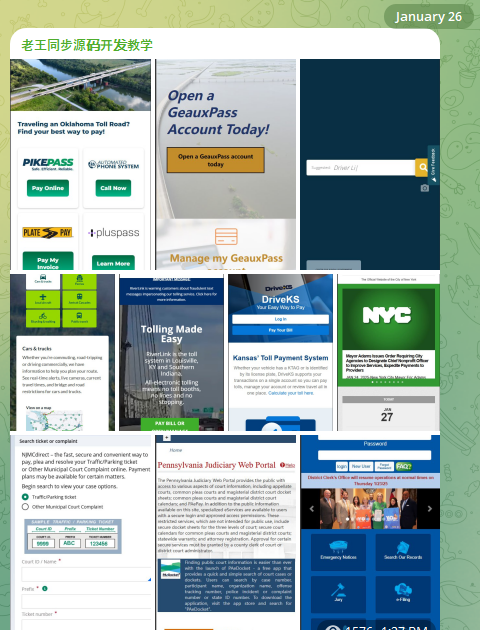
An image from one Chinese phishing group’s Telegram channel shows various toll road phish kits available.

If you own a mobile phone, the chances are excellent that at some point in the past two years it has received at least one phishing message that spoofs the U.S. Postal Service to supposedly collect some outstanding delivery fee, or an SMS that pretends to be a local toll road operator warning of a delinquent toll fee.

These messages are being sent through sophisticated phishing kits sold by several cybercriminals based in mainland China. And they are not traditional SMS phishing or “smishing” messages, as they bypass the mobile networks entirely. Rather, the missives are sent through the Apple iMessage service and through RCS, the functionally equivalent technology on Google phones.

People who enter their payment card data at one of these sites will be told their financial institution needs to verify the small transaction by sending a one-time passcode to the customer’s mobile device. In reality, that code will be sent by the victim’s financial institution to verify that the user indeed wishes to link their card information to a mobile wallet.

If the victim then provides that one-time code, the phishers will link the card data to a new mobile wallet from Apple or Google, loading the wallet onto a mobile phone that the scammers control.

CARDING REINVENTED

Ford Merrill works in security research at SecAlliance, a CSIS Security Group company. Merrill has been studying the evolution of several China-based smishing gangs, and found that most of them feature helpful and informative video tutorials in their sales accounts on Telegram. Those videos show the thieves are loading multiple stolen digital wallets on a single mobile device, and then selling those phones in bulk for hundreds of dollars apiece.

“Who says carding is dead?,” said Merrill, who presented about his findings at the M3AAWG security conference in Lisbon earlier today. “This is the best mag stripe cloning device ever. This threat actor is saying you need to buy at least 10 phones, and they’ll air ship them to you.”

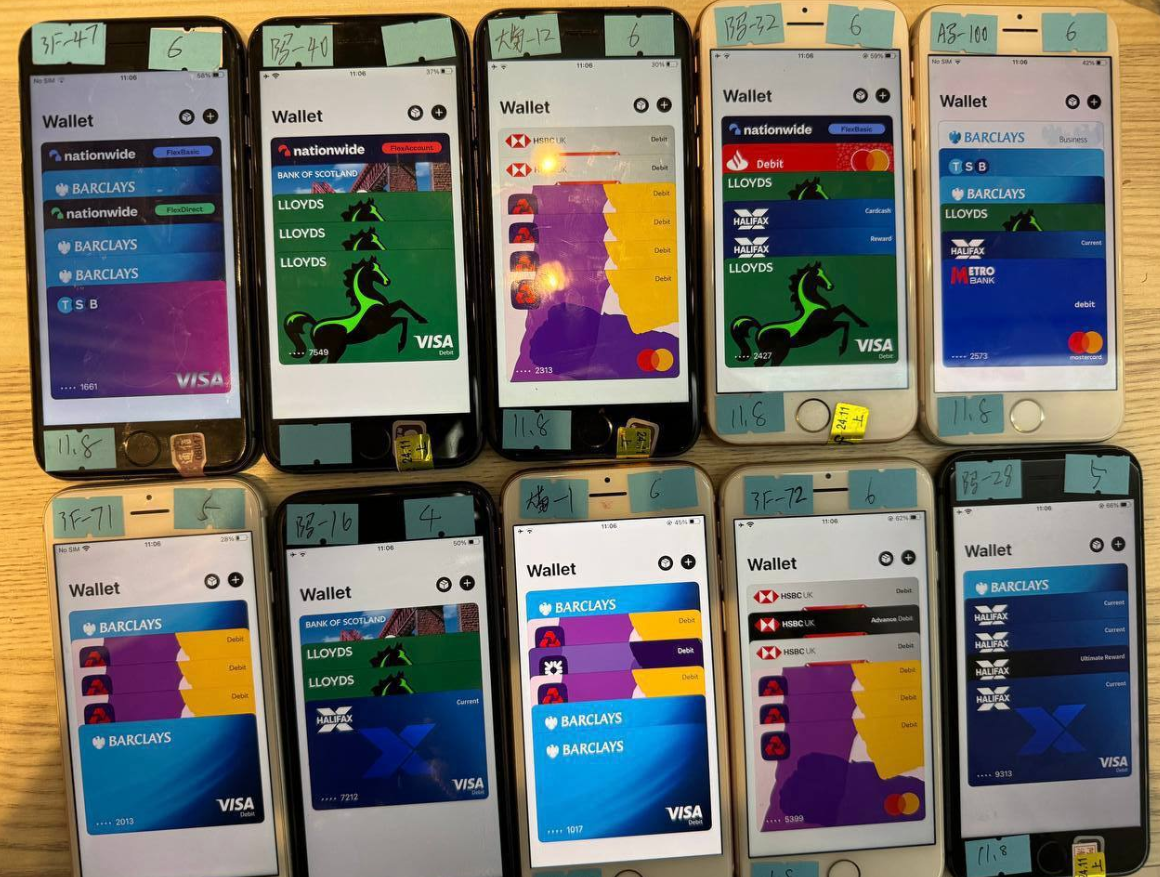
One promotional video shows stacks of milk crates stuffed full of phones for sale. A closer inspection reveals that each phone is affixed with a handwritten notation that typically references the date its mobile wallets were added, the number of wallets on the device, and the initials of the seller.

An image from the Telegram channel for a popular Chinese smishing kit vendor shows 10 mobile phones for sale, each loaded with 4-6 digital wallets from different UK financial institutions.

Merrill said one common way criminal groups in China are cashing out with these stolen mobile wallets involves setting up fake e-commerce businesses on Stripe or Zelle and running transactions through those entities — often for amounts totaling between $100 and $500.

Merrill said that when these phishing groups first began operating in earnest two years ago, they would wait between 60 to 90 days before selling the phones or using them for fraud. But these days that waiting period is more like just seven to ten days, he said.

“When they first installed this, the actors were very patient,” he said. “Nowadays, they only wait like 10 days before [the wallets] are hit hard and fast.”

GHOST TAP

Criminals also can cash out mobile wallets by obtaining real point-of-sale terminals and using tap-to-pay on phone after phone. But they also offer a more cutting-edge mobile fraud technology: Merrill found that at least one of the Chinese phishing groups sells an Android app called “ZNFC” that can relay a valid NFC transaction to anywhere in the world. The user simply waves their phone at a local payment terminal that accepts Apple or Google pay, and the app relays an NFC transaction over the Internet from a phone in China.

“The software can work from anywhere in the world,” Merrill said. “These guys provide the software for $500 a month, and it can relay both NFC enabled tap-to-pay as well as any digital wallet. The even have 24-hour support.”

The rise of so-called “ghost tap” mobile software was first documented in November 2024 by security experts at ThreatFabric. Andy Chandler, the company’s chief commercial officer, said their researchers have since identified a number of criminal groups from different regions of the world latching on to this scheme.

Chandler said those include organized crime gangs in Europe that are using similar mobile wallet and NFC attacks to take money out of ATMs made to work with smartphones.

“No one is talking about it, but we’re now seeing ten different methodologies using the same modus operandi, and none of them are doing it the same,” Chandler said. “This is much bigger than the banks are prepared to say.”

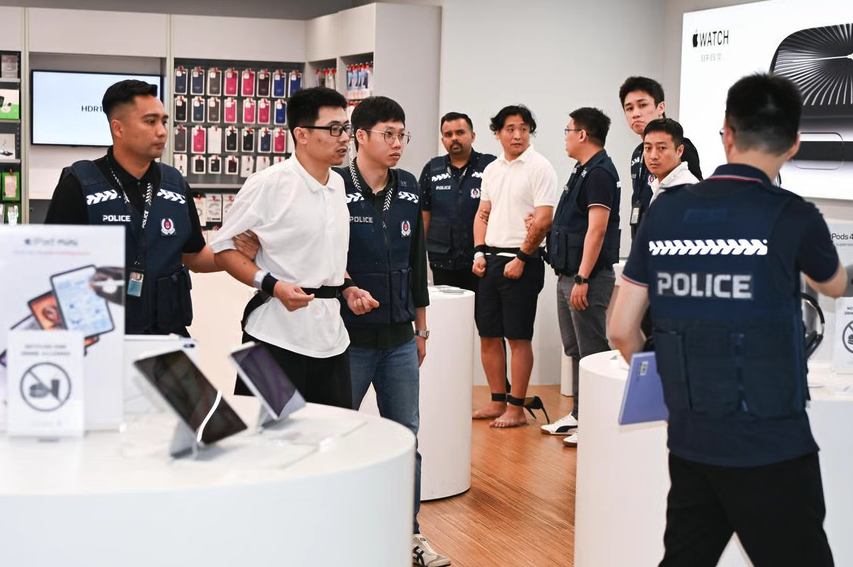
A November 2024 story in the Singapore daily The Straits Times reported authorities there arrested three foreign men who were recruited in their home countries via social messaging platforms, and given ghost tap apps with which to purchase expensive items from retailers, including mobile phones, jewelry, and gold bars.

“Since Nov 4, at least 10 victims who had fallen for e-commerce scams have reported unauthorised transactions totaling more than $100,000 on their credit cards for purchases such as electronic products, like iPhones and chargers, and jewelry in Singapore,” The Straits Times wrote, noting that in another case with a similar modus operandi, the police arrested a Malaysian man and woman on Nov 8.

Three individuals charged with using ghost tap software at an electronics store in Singapore. Image: The Straits Times.

ADVANCED PHISHING TECHNIQUES

According to Merrill, the phishing pages that spoof the USPS and various toll road operators are powered by several innovations designed to maximize the extraction of victim data.

For example, a would-be smishing victim might enter their personal and financial information, but then decide the whole thing is scam before actually submitting the data. In this case, anything typed into the data fields of the phishing page will be captured in real time, regardless of whether the visitor actually clicks the “submit” button.

Merrill said people who submit payment card data to these phishing sites often are then told their card can’t be processed, and urged to use a different card. This technique, he said, sometimes allows the phishers to steal more than one mobile wallet per victim.

Many phishing websites expose victim data by storing the stolen information directly on the phishing domain. But Merrill said these Chinese phishing kits will forward all victim data to a back-end database operated by the phishing kit vendors. That way, even when the smishing sites get taken down for fraud, the stolen data is still safe and secure.

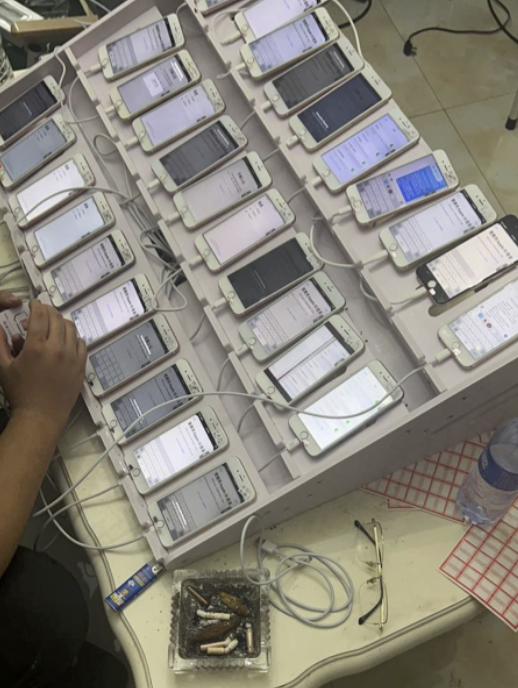
Another important innovation is the use of mass-created Apple and Google user accounts through which these phishers send their spam messages. One of the Chinese phishing groups posted images on their Telegram sales channels showing how these robot Apple and Google accounts are loaded onto Apple and Google phones, and arranged snugly next to each other in an expansive, multi-tiered rack that sits directly in front of the phishing service operator.

The ashtray says: You’ve been phishing all night.

In other words, the smishing websites are powered by real human operators as long as new messages are being sent. Merrill said the criminals appear to send only a few dozen messages at a time, likely because completing the scam takes manual work by the human operators in China. After all, most one-time codes used for mobile wallet provisioning are generally only good for a few minutes before they expire.

Notably, none of the phishing sites spoofing the toll operators or postal services will load in a regular Web browser; they will only render if they detect that a visitor is coming from a mobile device.

“One of the reasons they want you to be on a mobile device is they want you to be on the same device that is going to receive the one-time code,” Merrill said. “They also want to minimize the chances you will leave. And if they want to get that mobile tokenization and grab your one-time code, they need a live operator.”

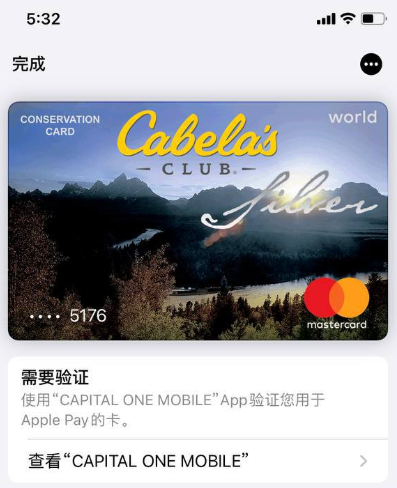
Merrill found the Chinese phishing kits feature another innovation that makes it simple for customers to turn stolen card details into a mobile wallet: They programmatically take the card data supplied by the phishing victim and convert it into a digital image of a real payment card that matches that victim’s financial institution. That way, attempting to enroll a stolen card into Apple Pay, for example, becomes as easy as scanning the fabricated card image with an iPhone.

An ad from a Chinese SMS phishing group’s Telegram channel showing how the service converts stolen card data into an image of the stolen card.

“The phone isn’t smart enough to know whether it’s a real card or just an image,” Merrill said. “So it scans the card into Apple Pay, which says okay we need to verify that you’re the owner of the card by sending a one-time code.”

PROFITS

How profitable are these mobile phishing kits? The best guess so far comes from data gathered by other security researchers who’ve been tracking these advanced Chinese phishing vendors.

In August 2023, the security firm Resecurity discovered a vulnerability in one popular Chinese phish kit vendor’s platform that exposed the personal and financial data of phishing victims. Resecurity dubbed the group the Smishing Triad, and found the gang had harvested 108,044 payment cards across 31 phishing domains (3,485 cards per domain).

In August 2024, security researcher Grant Smith gave a presentation at the DEFCON security conference about tracking down the Smishing Triad after scammers spoofing the U.S. Postal Service duped his wife. By identifying a different vulnerability in the gang’s phishing kit, Smith said he was able to see that people entered 438,669 unique credit cards in 1,133 phishing domains (387 cards per domain).

Based on his research, Merrill said it’s reasonable to expect between $100 and $500 in losses on each card that is turned into a mobile wallet. Merrill said they observed nearly 33,000 unique domains tied to these Chinese smishing groups during the year between the publication of Resecurity’s research and Smith’s DEFCON talk.

Using a median number of 1,935 cards per domain and a conservative loss of $250 per card, that comes out to about $15 billion in fraudulent charges over a year.

Merrill was reluctant to say whether he’d identified additional security vulnerabilities in any of the phishing kits sold by the Chinese groups, noting that the phishers quickly fixed the vulnerabilities that were detailed publicly by Resecurity and Smith.

FIGHTING BACK

Adoption of touchless payments took off in the United States after the Coronavirus pandemic emerged, and many financial institutions in the United States were eager to make it simple for customers to link payment cards to mobile wallets. Thus, the authentication requirement for doing so defaulted to sending the customer a one-time code via SMS.

Experts say the continued reliance on one-time codes for onboarding mobile wallets has fostered this new wave of carding. KrebsOnSecurity interviewed a security executive from a large European financial institution who spoke on condition of anonymity because they were not authorized to speak to the press.

That expert said the lag between the phishing of victim card data and its eventual use for fraud has left many financial institutions struggling to correlate the causes of their losses.

“That’s part of why the industry as a whole has been caught by surprise,” the expert said. “A lot of people are asking, how this is possible now that we’ve tokenized a plaintext process. We’ve never seen the volume of sending and people responding that we’re seeing with these phishers.”

To improve the security of digital wallet provisioning, some banks in Europe and Asia require customers to log in to the bank’s mobile app before they can link a digital wallet to their device.

Addressing the ghost tap threat may require updates to contactless payment terminals, to better identify NFC transactions that are being relayed from another device. But experts say it’s unrealistic to expect retailers will be eager to replace existing payment terminals before their expected lifespans expire.

And of course Apple and Google have an increased role to play as well, given that their accounts are being created en masse and used to blast out these smishing messages. Both companies could easily tell which of their devices suddenly have 7-10 different mobile wallets added from 7-10 different people around the world. They could also recommend that financial institutions use more secure authentication methods for mobile wallet provisioning.

Neither Apple nor Google responded to requests for comment on this story.


Read More

CISA Adds Two Known Exploited Vulnerabilities to Catalog

 ​CISA has added two vulnerabilities to its Known Exploited Vulnerabilities Catalog, based on evidence of active exploitation.

CVE-2025-0108 Palo Alto PAN-OS Authentication Bypass Vulnerability
CVE-2024-53704 SonicWall SonicOS SSLVPN Improper Authentication Vulnerability

These types of vulnerabilities are frequent attack vectors for malicious cyber actors and pose significant risks to the federal enterprise.
Binding Operational Directive (BOD) 22-01: Reducing the Significant Risk of Known Exploited Vulnerabilities established the Known Exploited Vulnerabilities Catalog as a living list of known Common Vulnerabilities and Exposures (CVEs) that carry significant risk to the federal enterprise. BOD 22-01 requires Federal Civilian Executive Branch (FCEB) agencies to remediate identified vulnerabilities by the due date to protect FCEB networks against active threats. See the BOD 22-01 Fact Sheet for more information.
Although BOD 22-01 only applies to FCEB agencies, CISA strongly urges all organizations to reduce their exposure to cyberattacks by prioritizing timely remediation of Catalog vulnerabilities as part of their vulnerability management practice. CISA will continue to add vulnerabilities to the catalog that meet the specified criteria. 

CISA has added two vulnerabilities to its Known Exploited Vulnerabilities Catalog, based on evidence of active exploitation.

  • CVE-2025-0108 Palo Alto PAN-OS Authentication Bypass Vulnerability
  • CVE-2024-53704 SonicWall SonicOS SSLVPN Improper Authentication Vulnerability

These types of vulnerabilities are frequent attack vectors for malicious cyber actors and pose significant risks to the federal enterprise.

Binding Operational Directive (BOD) 22-01: Reducing the Significant Risk of Known Exploited Vulnerabilities established the Known Exploited Vulnerabilities Catalog as a living list of known Common Vulnerabilities and Exposures (CVEs) that carry significant risk to the federal enterprise. BOD 22-01 requires Federal Civilian Executive Branch (FCEB) agencies to remediate identified vulnerabilities by the due date to protect FCEB networks against active threats. See the BOD 22-01 Fact Sheet for more information.

Although BOD 22-01 only applies to FCEB agencies, CISA strongly urges all organizations to reduce their exposure to cyberattacks by prioritizing timely remediation of Catalog vulnerabilities as part of their vulnerability management practice. CISA will continue to add vulnerabilities to the catalog that meet the specified criteria.

 Read More

CISA Releases Two Industrial Control Systems Advisories

 ​CISA released two Industrial Control Systems (ICS) advisories on February 18, 2025. These advisories provide timely information about current security issues, vulnerabilities, and exploits surrounding ICS.

ICSA-24-191-01 Delta Electronics CNCSoft-G2 (Update A)
ICSA-25-035-02 Rockwell Automation GuardLogix 5380 and 5580 (Update A)

CISA encourages users and administrators to review newly released ICS advisories for technical details and mitigations. 

CISA released two Industrial Control Systems (ICS) advisories on February 18, 2025. These advisories provide timely information about current security issues, vulnerabilities, and exploits surrounding ICS.

CISA encourages users and administrators to review newly released ICS advisories for technical details and mitigations.

 Read More

Nearly a Year Later, Mozilla is Still Promoting OneRep

​In mid-March 2024, KrebsOnSecurity revealed that the founder of the personal data removal service Onerep also founded dozens of people-search companies. Shortly after that investigation was published, Mozilla said it would stop bundling Onerep with the Firefox browser and wind down its partnership. But nearly a year later, Mozilla is still promoting it to Firefox users. 

In mid-March 2024, KrebsOnSecurity revealed that the founder of the personal data removal service Onerep also founded dozens of people-search companies. Shortly after that investigation was published, Mozilla said it would stop bundling Onerep with the Firefox browser and wind down its partnership with the company. But nearly a year later, Mozilla is still promoting it to Firefox users.

Mozilla offers Onerep to Firefox users on a subscription basis as part of Mozilla Monitor Plus. Launched in 2018 under the name Firefox Monitor, Mozilla Monitor also checks data from the website Have I Been Pwned? to let users know when their email addresses or password are leaked in data breaches.

The ink on that partnership agreement had barely dried before KrebsOnSecurity published a story showing that Onerep’s Belarusian CEO and founder Dimitiri Shelest launched dozens of people-search services since 2010, including a still-active data broker called Nuwber that sells background reports on people. This seemed to contradict Onerep’s stated motto, “We believe that no one should compromise personal online security and get a profit from it.”

Shelest released a lengthy statement (PDF) wherein he acknowledged maintaining an ownership stake in Nuwber, a consumer data broker he founded in 2015 — around the same time he started Onerep.

Onerep.com CEO and founder Dimitri Shelest, as pictured on the “about” page of onerep.com.

Shelest maintained that Nuwber has “zero cross-over or information-sharing with Onerep,” and said any other old domains that may be found and associated with his name are no longer being operated by him.

“I get it,” Shelest wrote. “My affiliation with a people search business may look odd from the outside. In truth, if I hadn’t taken that initial path with a deep dive into how people search sites work, Onerep wouldn’t have the best tech and team in the space. Still, I now appreciate that we did not make this more clear in the past and I’m aiming to do better in the future.”

When asked to comment on the findings, Mozilla said then that although customer data was never at risk, the outside financial interests and activities of Onerep’s CEO did not align with their values.

“We’re working now to solidify a transition plan that will provide customers with a seamless experience and will continue to put their interests first,” Mozilla said.

In October 2024, Mozilla published a statement saying the search for a different provider was taking longer than anticipated.

“While we continue to evaluate vendors, finding a technically excellent and values-aligned partner takes time,” Mozilla wrote. “While we continue this search, Onerep will remain the backend provider, ensuring that we can maintain uninterrupted services while we continue evaluating new potential partners that align more closely with Mozilla’s values and user expectations. We are conducting thorough diligence to find the right vendor.”

Asked for an update, Mozilla said the search for a replacement partner continues.

“The work’s ongoing but we haven’t found the right alternative yet,” Mozilla said in an emailed statement. “Our customers’ data remains safe, and since the product provides a lot of value to our subscribers, we’ll continue to offer it during this process.”

It’s a win-win for Mozilla that they’ve received accolades for their principled response while continuing to partner with Onerep almost a year later. But if it takes so long to find a suitable replacement, what does that say about the personal data removal industry itself?

Onerep appears to be working in partnership with another problematic people-search service: Radaris, which has a history of ignoring opt-out requests or failing to honor them. A week before breaking the story about Onerep, KrebsOnSecurity published research showing the co-founders of Radaris were two native Russian brothers who’d built a vast network of affiliate marketing programs and consumer data broker services.

Lawyers for the Radaris co-founders threatened to sue KrebsOnSecurity unless that story was retracted in full, claiming the founders were in fact Ukrainian and that our reporting had defamed the brothers by associating them with the actions of Radaris. Instead, we published a follow-up investigation which showed that not only did the brothers from Russia create Radaris, for many years they issued press releases quoting a fictitious CEO seeking money from investors.

Several readers have shared emails they received from Radaris after attempting to remove their personal data, and those messages show Radaris has been promoting Onerep.

An email from Radaris promoting Onerep.


Read More

Siemens SIMATIC PCS neo and TIA Administrator

 ​As of January 10, 2023, CISA will no longer be updating ICS security advisories for Siemens product vulnerabilities beyond the initial advisory. For the most up-to-date information on vulnerabilities in this advisory, please see Siemens’ ProductCERT Security Advisories (CERT Services | Services | Siemens Global).
View CSAF
1. EXECUTIVE SUMMARY

CVSS v4 8.7
ATTENTION: Exploitable remotely/low attack complexity
Vendor: Siemens
Equipment: SIMATIC PCS neo and TIA Administrator
Vulnerability: Insufficient Session Expiration

2. RISK EVALUATION
Successful exploitation of this vulnerability could allow a remote unauthenticated attacker, who has obtained the session token by other means, to re-use a legitimate user’s session even after logout.
3. TECHNICAL DETAILS
3.1 AFFECTED PRODUCTS
Siemens reports that the following products are affected:

SIMOCODE ES V19: Versions prior to V19 Update 1
TIA Administrator: Versions 3.0.4 and prior
SIMATIC PCS neo V4.1: Versions prior to V4.1 Update 2
SIMATIC PCS neo V4.0: All versions
SIRIUS Safety ES V19 (TIA Portal): Versions prior to V19 Update 1
SIRIUS Soft Starter ES V19 (TIA Portal): Versions prior to V19 Update 1
SIMATIC PCS neo V5.0: Versions prior to V5.0 Update 1

3.2 VULNERABILITY OVERVIEW
3.2.1 INSUFFICIENT SESSION EXPIRATION CWE-613
Affected products do not correctly invalidate user sessions upon user logout. This could allow a remote unauthenticated attacker, who has obtained the session token by other means, to re-use a legitimate user’s session even after logout.
CVE-2024-45386 has been assigned to this vulnerability. A CVSS v3 base score of 8.8 has been calculated; the CVSS vector string is (CVSS:3.1/AV:N/AC:L/PR:N/UI:R/S:U/C:H/I:H/A:H).
A CVSS v4 score has also been calculated for CVE-2024-45386. A base score of 8.7 has been calculated; the CVSS vector string is (CVSS:4.0/AV:N/AC:L/AT:N/PR:N/UI:P/VC:H/VI:H/VA:H/SC:N/SI:N/SA:N).
3.3 BACKGROUND

CRITICAL INFRASTRUCTURE SECTORS: Critical Manufacturing
COUNTRIES/AREAS DEPLOYED: Worldwide
COMPANY HEADQUARTERS LOCATION: Germany

3.4 RESEARCHER
Siemens reported this vulnerability to CISA.
4. MITIGATIONS
Siemens has identified the following specific workarounds and mitigations users can apply to reduce risk:

Close browser and client after logout and remove all locally stored session tokens
SIMATIC PCS neo V4.0: Currently no fix is planned
SIMOCODE ES V19: Update to V19 Update 1 or later version
SIRIUS Soft Starter ES V19 (TIA Portal): Update to V19 Update 1 or later version
SIRIUS Safety ES V19 (TIA Portal): Update to V19 Update 1 or later version
TIA Administrator: Update to V3.0.4 or later version
SIMATIC PCS neo V4.1: Update to V4.1 Update 2 or later version
SIMATIC PCS neo V5.0: Update to V5.0 Update 1 or later version

As a general security measure, Siemens recommends protecting network access to devices with appropriate mechanisms. To operate the devices in a protected IT environment, Siemens recommends configuring the environment according to Siemens’ operational guidelines for industrial security and following recommendations in the product manuals.
Additional information on industrial security by Siemens can be found on the Siemens industrial security webpage
For more information see the associated Siemens security advisory SSA-342348 in HTML and CSAF.
CISA recommends users take defensive measures to minimize the risk of exploitation of this vulnerability, such as:

Minimize network exposure for all control system devices and/or systems, ensuring they are not accessible from the internet.
Locate control system networks and remote devices behind firewalls and isolating them from business networks.
When remote access is required, use more secure methods, such as Virtual Private Networks (VPNs). Recognize VPNs may have vulnerabilities, should be updated to the most recent version available, and are only as secure as the connected devices.

CISA reminds organizations to perform proper impact analysis and risk assessment prior to deploying defensive measures.
CISA also provides a section for control systems security recommended practices on the ICS webpage on cisa.gov. Several CISA products detailing cyber defense best practices are available for reading and download, including Improving Industrial Control Systems Cybersecurity with Defense-in-Depth Strategies.
CISA encourages organizations to implement recommended cybersecurity strategies for proactive defense of ICS assets.
Additional mitigation guidance and recommended practices are publicly available on the ICS webpage at cisa.gov in the technical information paper, ICS-TIP-12-146-01B–Targeted Cyber Intrusion Detection and Mitigation Strategies.
Organizations observing suspected malicious activity should follow established internal procedures and report findings to CISA for tracking and correlation against other incidents.
CISA also recommends users take the following measures to protect themselves from social engineering attacks:

Do not click web links or open attachments in unsolicited email messages.
Refer to Recognizing and Avoiding Email Scams for more information on avoiding email scams.
Refer to Avoiding Social Engineering and Phishing Attacks for more information on social engineering attacks.

No known public exploitation specifically targeting this vulnerability has been reported to CISA at this time.
5. UPDATE HISTORY

February 13, 2025: Initial Publication 

As of January 10, 2023, CISA will no longer be updating ICS security advisories for Siemens product vulnerabilities beyond the initial advisory. For the most up-to-date information on vulnerabilities in this advisory, please see Siemens’ ProductCERT Security Advisories (CERT Services | Services | Siemens Global).

View CSAF

1. EXECUTIVE SUMMARY

  • CVSS v4 8.7
  • ATTENTION: Exploitable remotely/low attack complexity
  • Vendor: Siemens
  • Equipment: SIMATIC PCS neo and TIA Administrator
  • Vulnerability: Insufficient Session Expiration

2. RISK EVALUATION

Successful exploitation of this vulnerability could allow a remote unauthenticated attacker, who has obtained the session token by other means, to re-use a legitimate user’s session even after logout.

3. TECHNICAL DETAILS

3.1 AFFECTED PRODUCTS

Siemens reports that the following products are affected:

  • SIMOCODE ES V19: Versions prior to V19 Update 1
  • TIA Administrator: Versions 3.0.4 and prior
  • SIMATIC PCS neo V4.1: Versions prior to V4.1 Update 2
  • SIMATIC PCS neo V4.0: All versions
  • SIRIUS Safety ES V19 (TIA Portal): Versions prior to V19 Update 1
  • SIRIUS Soft Starter ES V19 (TIA Portal): Versions prior to V19 Update 1
  • SIMATIC PCS neo V5.0: Versions prior to V5.0 Update 1

3.2 VULNERABILITY OVERVIEW

3.2.1 INSUFFICIENT SESSION EXPIRATION CWE-613

Affected products do not correctly invalidate user sessions upon user logout. This could allow a remote unauthenticated attacker, who has obtained the session token by other means, to re-use a legitimate user’s session even after logout.

CVE-2024-45386 has been assigned to this vulnerability. A CVSS v3 base score of 8.8 has been calculated; the CVSS vector string is (CVSS:3.1/AV:N/AC:L/PR:N/UI:R/S:U/C:H/I:H/A:H).

A CVSS v4 score has also been calculated for CVE-2024-45386. A base score of 8.7 has been calculated; the CVSS vector string is (CVSS:4.0/AV:N/AC:L/AT:N/PR:N/UI:P/VC:H/VI:H/VA:H/SC:N/SI:N/SA:N).

3.3 BACKGROUND

  • CRITICAL INFRASTRUCTURE SECTORS: Critical Manufacturing
  • COUNTRIES/AREAS DEPLOYED: Worldwide
  • COMPANY HEADQUARTERS LOCATION: Germany

3.4 RESEARCHER

Siemens reported this vulnerability to CISA.

4. MITIGATIONS

Siemens has identified the following specific workarounds and mitigations users can apply to reduce risk:

  • Close browser and client after logout and remove all locally stored session tokens
  • SIMATIC PCS neo V4.0: Currently no fix is planned
  • SIMOCODE ES V19: Update to V19 Update 1 or later version
  • SIRIUS Soft Starter ES V19 (TIA Portal): Update to V19 Update 1 or later version
  • SIRIUS Safety ES V19 (TIA Portal): Update to V19 Update 1 or later version
  • TIA Administrator: Update to V3.0.4 or later version
  • SIMATIC PCS neo V4.1: Update to V4.1 Update 2 or later version
  • SIMATIC PCS neo V5.0: Update to V5.0 Update 1 or later version

As a general security measure, Siemens recommends protecting network access to devices with appropriate mechanisms. To operate the devices in a protected IT environment, Siemens recommends configuring the environment according to Siemens’ operational guidelines for industrial security and following recommendations in the product manuals.

Additional information on industrial security by Siemens can be found on the Siemens industrial security webpage

For more information see the associated Siemens security advisory SSA-342348 in HTML and CSAF.

CISA recommends users take defensive measures to minimize the risk of exploitation of this vulnerability, such as:

  • Minimize network exposure for all control system devices and/or systems, ensuring they are not accessible from the internet.
  • Locate control system networks and remote devices behind firewalls and isolating them from business networks.
  • When remote access is required, use more secure methods, such as Virtual Private Networks (VPNs). Recognize VPNs may have vulnerabilities, should be updated to the most recent version available, and are only as secure as the connected devices.

CISA reminds organizations to perform proper impact analysis and risk assessment prior to deploying defensive measures.

CISA also provides a section for control systems security recommended practices on the ICS webpage on cisa.gov. Several CISA products detailing cyber defense best practices are available for reading and download, including Improving Industrial Control Systems Cybersecurity with Defense-in-Depth Strategies.

CISA encourages organizations to implement recommended cybersecurity strategies for proactive defense of ICS assets.

Additional mitigation guidance and recommended practices are publicly available on the ICS webpage at cisa.gov in the technical information paper, ICS-TIP-12-146-01B–Targeted Cyber Intrusion Detection and Mitigation Strategies.

Organizations observing suspected malicious activity should follow established internal procedures and report findings to CISA for tracking and correlation against other incidents.

CISA also recommends users take the following measures to protect themselves from social engineering attacks:

No known public exploitation specifically targeting this vulnerability has been reported to CISA at this time.

5. UPDATE HISTORY

  • February 13, 2025: Initial Publication

 Read More

Siemens APOGEE PXC and TALON TC Series

 ​As of January 10, 2023, CISA will no longer be updating ICS security advisories for Siemens product vulnerabilities beyond the initial advisory. For the most up-to-date information on vulnerabilities in this advisory, please see Siemens’ ProductCERT Security Advisories (CERT Services | Services | Siemens Global).
View CSAF
1. EXECUTIVE SUMMARY

CVSS v4 8.7
ATTENTION: Exploitable remotely/low attack complexity
Vendor: Siemens
Equipment: APOGEE PXC and TALON TC Series
Vulnerabilities: Inadequate Encryption Strength, Out-of-bounds Read

2. RISK EVALUATION
Successful exploitation of these vulnerabilities could allow an attacker to perform a denial of service using a out-of-bounds read forcing the device to enter a cold state and a vulnerability that would allow an attacker to decrypt the passwords of the device.
3. TECHNICAL DETAILS
3.1 AFFECTED PRODUCTS
Siemens reports that the following products are affected:

APOGEE PXC Series (P2 Ethernet): All versions
APOGEE PXC Series (BACnet): All versions
TALON TC Series (BACnet): All versions

3.2 VULNERABILITY OVERVIEW
3.2.1 INADEQUATE ENCRYPTION STRENGTH CWE-326
Affected devices contain a weak encryption mechanism with a hard-coded key allowing an attacker to guess or reverse engineer the password from the cyphertext.
CVE-2024-54089 has been assigned to this vulnerability. A CVSS v3 base score of 7.5 has been calculated; the CVSS vector string is (CVSS:3.1/AV:N/AC:L/PR:N/UI:N/S:U/C:H/I:N/A:N).
A CVSS v4 score has also been calculated for CVE-2024-54089. A base score of 8.7 has been calculated; the CVSS vector string is (CVSS:4.0/AV:N/AC:L/AT:N/PR:N/UI:N/VC:H/VI:N/VA:N/SC:N/SI:N/SA:N).
3.2.2 OUT-OF-BOUNDS READ CWE-125
An authenticated user with a Medium(MED) account could connect to the device and perform an out-of-bound read using memory dump functionality. An attacker could use this to cause the device to enter an insecure cold start state.
CVE-2024-54090 has been assigned to this vulnerability. A CVSS v3 base score of 5.9 has been calculated; the CVSS vector string is (CVSS:3.1/AV:N/AC:H/PR:N/UI:N/S:U/C:N/I:N/A:H).
A CVSS v4 score has also been calculated for CVE-2024-54090. A base score of 6.0 has been calculated; the CVSS vector string is (CVSS:4.0/AV:N/AC:H/AT:P/PR:L/UI:N/VC:N/VI:N/VA:H/SC:N/SI:N/SA:N).
3.3 BACKGROUND

CRITICAL INFRASTRUCTURE SECTORS: Critical Manufacturing
COUNTRIES/AREAS DEPLOYED: Worldwide
COMPANY HEADQUARTERS LOCATION: Germany

3.4 RESEARCHER
Siemens reported these vulnerabilities to CISA.
4. MITIGATIONS
Siemens has identified the following specific workarounds and mitigations users can apply to reduce risk:
For CVE-2024-54089:

Use strong, hard to guess passwords

For CVE-2024-54090:

Ensure all three default passwords are changed even if not in use.
Disable telnet (Telnet is disabled by default).

As a general security measure, Siemens recommends protecting network access to devices with appropriate mechanisms. To operate the devices in a protected IT environment, Siemens recommends configuring the environment according to Siemens’ operational guidelines for industrial security and following recommendations in the product manuals.
Additional information on industrial security by Siemens can be found on the Siemens industrial security webpage
For more information see the associated Siemens security advisory SSA-615116 in HTML and CSAF.
CISA recommends users take defensive measures to minimize the risk of exploitation of these vulnerabilities, such as:

Minimize network exposure for all control system devices and/or systems, ensuring they are not accessible from the internet.
Locate control system networks and remote devices behind firewalls and isolating them from business networks.
When remote access is required, use more secure methods, such as Virtual Private Networks (VPNs). Recognize VPNs may have vulnerabilities, should be updated to the most recent version available, and are only as secure as the connected devices.

CISA reminds organizations to perform proper impact analysis and risk assessment prior to deploying defensive measures.
CISA also provides a section for control systems security recommended practices on the ICS webpage on cisa.gov. Several CISA products detailing cyber defense best practices are available for reading and download, including Improving Industrial Control Systems Cybersecurity with Defense-in-Depth Strategies.
CISA encourages organizations to implement recommended cybersecurity strategies for proactive defense of ICS assets.
Additional mitigation guidance and recommended practices are publicly available on the ICS webpage at cisa.gov in the technical information paper, ICS-TIP-12-146-01B–Targeted Cyber Intrusion Detection and Mitigation Strategies.
Organizations observing suspected malicious activity should follow established internal procedures and report findings to CISA for tracking and correlation against other incidents.
CISA also recommends users take the following measures to protect themselves from social engineering attacks:

Do not click web links or open attachments in unsolicited email messages.
Refer to Recognizing and Avoiding Email Scams for more information on avoiding email scams.
Refer to Avoiding Social Engineering and Phishing Attacks for more information on social engineering attacks.

No known public exploitation specifically targeting these vulnerabilities has been reported to CISA at this time.
5. UPDATE HISTORY

February 13, 2025: Initial Publication 

As of January 10, 2023, CISA will no longer be updating ICS security advisories for Siemens product vulnerabilities beyond the initial advisory. For the most up-to-date information on vulnerabilities in this advisory, please see Siemens’ ProductCERT Security Advisories (CERT Services | Services | Siemens Global).

View CSAF

1. EXECUTIVE SUMMARY

  • CVSS v4 8.7
  • ATTENTION: Exploitable remotely/low attack complexity
  • Vendor: Siemens
  • Equipment: APOGEE PXC and TALON TC Series
  • Vulnerabilities: Inadequate Encryption Strength, Out-of-bounds Read

2. RISK EVALUATION

Successful exploitation of these vulnerabilities could allow an attacker to perform a denial of service using a out-of-bounds read forcing the device to enter a cold state and a vulnerability that would allow an attacker to decrypt the passwords of the device.

3. TECHNICAL DETAILS

3.1 AFFECTED PRODUCTS

Siemens reports that the following products are affected:

  • APOGEE PXC Series (P2 Ethernet): All versions
  • APOGEE PXC Series (BACnet): All versions
  • TALON TC Series (BACnet): All versions

3.2 VULNERABILITY OVERVIEW

3.2.1 INADEQUATE ENCRYPTION STRENGTH CWE-326

Affected devices contain a weak encryption mechanism with a hard-coded key allowing an attacker to guess or reverse engineer the password from the cyphertext.

CVE-2024-54089 has been assigned to this vulnerability. A CVSS v3 base score of 7.5 has been calculated; the CVSS vector string is (CVSS:3.1/AV:N/AC:L/PR:N/UI:N/S:U/C:H/I:N/A:N).

A CVSS v4 score has also been calculated for CVE-2024-54089. A base score of 8.7 has been calculated; the CVSS vector string is (CVSS:4.0/AV:N/AC:L/AT:N/PR:N/UI:N/VC:H/VI:N/VA:N/SC:N/SI:N/SA:N).

3.2.2 OUT-OF-BOUNDS READ CWE-125

An authenticated user with a Medium(MED) account could connect to the device and perform an out-of-bound read using memory dump functionality. An attacker could use this to cause the device to enter an insecure cold start state.

CVE-2024-54090 has been assigned to this vulnerability. A CVSS v3 base score of 5.9 has been calculated; the CVSS vector string is (CVSS:3.1/AV:N/AC:H/PR:N/UI:N/S:U/C:N/I:N/A:H).

A CVSS v4 score has also been calculated for CVE-2024-54090. A base score of 6.0 has been calculated; the CVSS vector string is (CVSS:4.0/AV:N/AC:H/AT:P/PR:L/UI:N/VC:N/VI:N/VA:H/SC:N/SI:N/SA:N).

3.3 BACKGROUND

  • CRITICAL INFRASTRUCTURE SECTORS: Critical Manufacturing
  • COUNTRIES/AREAS DEPLOYED: Worldwide
  • COMPANY HEADQUARTERS LOCATION: Germany

3.4 RESEARCHER

Siemens reported these vulnerabilities to CISA.

4. MITIGATIONS

Siemens has identified the following specific workarounds and mitigations users can apply to reduce risk:

For CVE-2024-54089:

  • Use strong, hard to guess passwords

For CVE-2024-54090:

  • Ensure all three default passwords are changed even if not in use.
  • Disable telnet (Telnet is disabled by default).

As a general security measure, Siemens recommends protecting network access to devices with appropriate mechanisms. To operate the devices in a protected IT environment, Siemens recommends configuring the environment according to Siemens’ operational guidelines for industrial security and following recommendations in the product manuals.

Additional information on industrial security by Siemens can be found on the Siemens industrial security webpage

For more information see the associated Siemens security advisory SSA-615116 in HTML and CSAF.

CISA recommends users take defensive measures to minimize the risk of exploitation of these vulnerabilities, such as:

  • Minimize network exposure for all control system devices and/or systems, ensuring they are not accessible from the internet.
  • Locate control system networks and remote devices behind firewalls and isolating them from business networks.
  • When remote access is required, use more secure methods, such as Virtual Private Networks (VPNs). Recognize VPNs may have vulnerabilities, should be updated to the most recent version available, and are only as secure as the connected devices.

CISA reminds organizations to perform proper impact analysis and risk assessment prior to deploying defensive measures.

CISA also provides a section for control systems security recommended practices on the ICS webpage on cisa.gov. Several CISA products detailing cyber defense best practices are available for reading and download, including Improving Industrial Control Systems Cybersecurity with Defense-in-Depth Strategies.

CISA encourages organizations to implement recommended cybersecurity strategies for proactive defense of ICS assets.

Additional mitigation guidance and recommended practices are publicly available on the ICS webpage at cisa.gov in the technical information paper, ICS-TIP-12-146-01B–Targeted Cyber Intrusion Detection and Mitigation Strategies.

Organizations observing suspected malicious activity should follow established internal procedures and report findings to CISA for tracking and correlation against other incidents.

CISA also recommends users take the following measures to protect themselves from social engineering attacks:

No known public exploitation specifically targeting these vulnerabilities has been reported to CISA at this time.

5. UPDATE HISTORY

  • February 13, 2025: Initial Publication

 Read More

CISA Adds One Known Exploited Vulnerability to Catalog

 ​CISA has added one new vulnerability to its Known Exploited Vulnerabilities Catalog, based on evidence of active exploitation.

    CVE-2024-57727 SimpleHelp Path Traversal Vulnerability

These types of vulnerabilities are frequent attack vectors for malicious cyber actors and pose significant risks to the federal enterprise.
Binding Operational Directive (BOD) 22-01: Reducing the Significant Risk of Known Exploited Vulnerabilities established the Known Exploited Vulnerabilities Catalog as a living list of known Common Vulnerabilities and Exposures (CVEs) that carry significant risk to the federal enterprise. BOD 22-01 requires Federal Civilian Executive Branch (FCEB) agencies to remediate identified vulnerabilities by the due date to protect FCEB networks against active threats. See the BOD 22-01 Fact Sheet for more information.
Although BOD 22-01 only applies to FCEB agencies, CISA strongly urges all organizations to reduce their exposure to cyberattacks by prioritizing timely remediation of Catalog vulnerabilities as part of their vulnerability management practice. CISA will continue to add vulnerabilities to the catalog that meet the specified criteria. 

CISA has added one new vulnerability to its Known Exploited Vulnerabilities Catalog, based on evidence of active exploitation.

These types of vulnerabilities are frequent attack vectors for malicious cyber actors and pose significant risks to the federal enterprise.

Binding Operational Directive (BOD) 22-01: Reducing the Significant Risk of Known Exploited Vulnerabilities established the Known Exploited Vulnerabilities Catalog as a living list of known Common Vulnerabilities and Exposures (CVEs) that carry significant risk to the federal enterprise. BOD 22-01 requires Federal Civilian Executive Branch (FCEB) agencies to remediate identified vulnerabilities by the due date to protect FCEB networks against active threats. See the BOD 22-01 Fact Sheet for more information.

Although BOD 22-01 only applies to FCEB agencies, CISA strongly urges all organizations to reduce their exposure to cyberattacks by prioritizing timely remediation of Catalog vulnerabilities as part of their vulnerability management practice. CISA will continue to add vulnerabilities to the catalog that meet the specified criteria.

 Read More

Scroll to Top