Trimble Releases Security Updates to Address a Vulnerability in Cityworks Software

 ​CISA is collaborating with private industry partners to respond to reports of exploitation of a vulnerability (CVE-2025-0994) discovered by Trimble impacting its Cityworks Server AMS (Asset Management System). Trimble has released security updates and an advisory addressing a recently discovered a deserialization vulnerability enabling an external actor to potentially conduct remote code execution (RCE) against a customer’s Microsoft Internet Information Services (IIS) web server. 
CISA has added CVE-2025-0994 to its Known Exploited Vulnerabilities Catalog, based on evidence of active exploitation. 

CISA strongly encourages users and administrators to search for indicators of compromise (IOCs) and apply the necessary updates and workarounds. 

Review the following article for more information: 

Trimble Advisory and IOCs for Vulnerability Affecting Cityworks Deployments 

The Symantec Threat Hunter team, part of Broadcom, contributed to this guidance.  

CISA is collaborating with private industry partners to respond to reports of exploitation of a vulnerability (CVE-2025-0994) discovered by Trimble impacting its Cityworks Server AMS (Asset Management System). Trimble has released security updates and an advisory addressing a recently discovered a deserialization vulnerability enabling an external actor to potentially conduct remote code execution (RCE) against a customer’s Microsoft Internet Information Services (IIS) web server. 

CISA has added CVE-2025-0994 to its Known Exploited Vulnerabilities Catalog, based on evidence of active exploitation. 

CISA strongly encourages users and administrators to search for indicators of compromise (IOCs) and apply the necessary updates and workarounds. 

Review the following article for more information: 

The Symantec Threat Hunter team, part of Broadcom, contributed to this guidance. 

 Read More

CISA Adds One Known Exploited Vulnerability to Catalog

 ​CISA has added one vulnerability to its Known Exploited Vulnerabilities Catalog, based on evidence of active exploitation.

CVE-2025-0994 Trimble Cityworks Deserialization Vulnerability

These types of vulnerabilities are frequent attack vectors for malicious cyber actors and pose significant risks to the federal enterprise.
Binding Operational Directive (BOD) 22-01: Reducing the Significant Risk of Known Exploited Vulnerabilities established the Known Exploited Vulnerabilities Catalog as a living list of known Common Vulnerabilities and Exposures (CVEs) that carry significant risk to the federal enterprise. BOD 22-01 requires Federal Civilian Executive Branch (FCEB) agencies to remediate identified vulnerabilities by the due date to protect FCEB networks against active threats. See the BOD 22-01 Fact Sheet for more information.
Although BOD 22-01 only applies to FCEB agencies, CISA strongly urges all organizations to reduce their exposure to cyberattacks by prioritizing timely remediation of Catalog vulnerabilities as part of their vulnerability management practice. CISA will continue to add vulnerabilities to the catalog that meet the specified criteria. 

CISA has added one vulnerability to its Known Exploited Vulnerabilities Catalog, based on evidence of active exploitation.

These types of vulnerabilities are frequent attack vectors for malicious cyber actors and pose significant risks to the federal enterprise.

Binding Operational Directive (BOD) 22-01: Reducing the Significant Risk of Known Exploited Vulnerabilities established the Known Exploited Vulnerabilities Catalog as a living list of known Common Vulnerabilities and Exposures (CVEs) that carry significant risk to the federal enterprise. BOD 22-01 requires Federal Civilian Executive Branch (FCEB) agencies to remediate identified vulnerabilities by the due date to protect FCEB networks against active threats. See the BOD 22-01 Fact Sheet for more information.

Although BOD 22-01 only applies to FCEB agencies, CISA strongly urges all organizations to reduce their exposure to cyberattacks by prioritizing timely remediation of Catalog vulnerabilities as part of their vulnerability management practice. CISA will continue to add vulnerabilities to the catalog that meet the specified criteria.

 Read More

Experts Flag Security, Privacy Risks in DeepSeek AI App

​New mobile apps from the Chinese artificial intelligence (AI) company DeepSeek have remained among the top three “free” downloads for Apple and Google devices since their debut on Jan. 25, 2025. But experts caution that many of DeepSeek’s design choices — such as using hard-coded encryption keys, and sending unencrypted user and device data to Chinese companies — introduce a number of glaring security and privacy risks. 

New mobile apps from the Chinese artificial intelligence (AI) company DeepSeek have remained among the top three “free” downloads for Apple and Google devices since their debut on Jan. 25, 2025. But experts caution that many of DeepSeek’s design choices — such as using hard-coded encryption keys, and sending unencrypted user and device data to Chinese companies — introduce a number of glaring security and privacy risks.

Public interest in the DeepSeek AI chat apps swelled following widespread media reports that the upstart Chinese AI firm had managed to match the abilities of cutting-edge chatbots while using a fraction of the specialized computer chips that leading AI companies rely on. As of this writing, DeepSeek is the third most-downloaded “free” app on the Apple store, and #1 on Google Play.

DeepSeek’s rapid rise caught the attention of the mobile security firm NowSecure, a Chicago-based company that helps clients screen mobile apps for security and privacy threats. In a teardown of the DeepSeek app published today, NowSecure urged organizations to remove the DeepSeek iOS mobile app from their environments, citing security concerns.

NowSecure founder Andrew Hoog said they haven’t yet concluded an in-depth analysis of the DeepSeek app for Android devices, but that there is little reason to believe its basic design would be functionally much different.

Hoog told KrebsOnSecurity there were a number of qualities about the DeepSeek iOS app that suggest the presence of deep-seated security and privacy risks. For starters, he said, the app collects an awful lot of data about the user’s device.

“They are doing some very interesting things that are on the edge of advanced device fingerprinting,” Hoog said, noting that one property of the app tracks the device’s name — which for many iOS devices defaults to the customer’s name followed by the type of iOS device.

The device information shared, combined with the user’s Internet address and data gathered from mobile advertising companies, could be used to deanonymize users of the DeepSeek iOS app, NowSecure warned. The report notes that DeepSeek communicates with Volcengine, a cloud platform developed by ByteDance (the makers of TikTok), although NowSecure said it wasn’t clear if the data is just leveraging ByteDance’s digital transformation cloud service or if the declared information share extends further between the two companies.
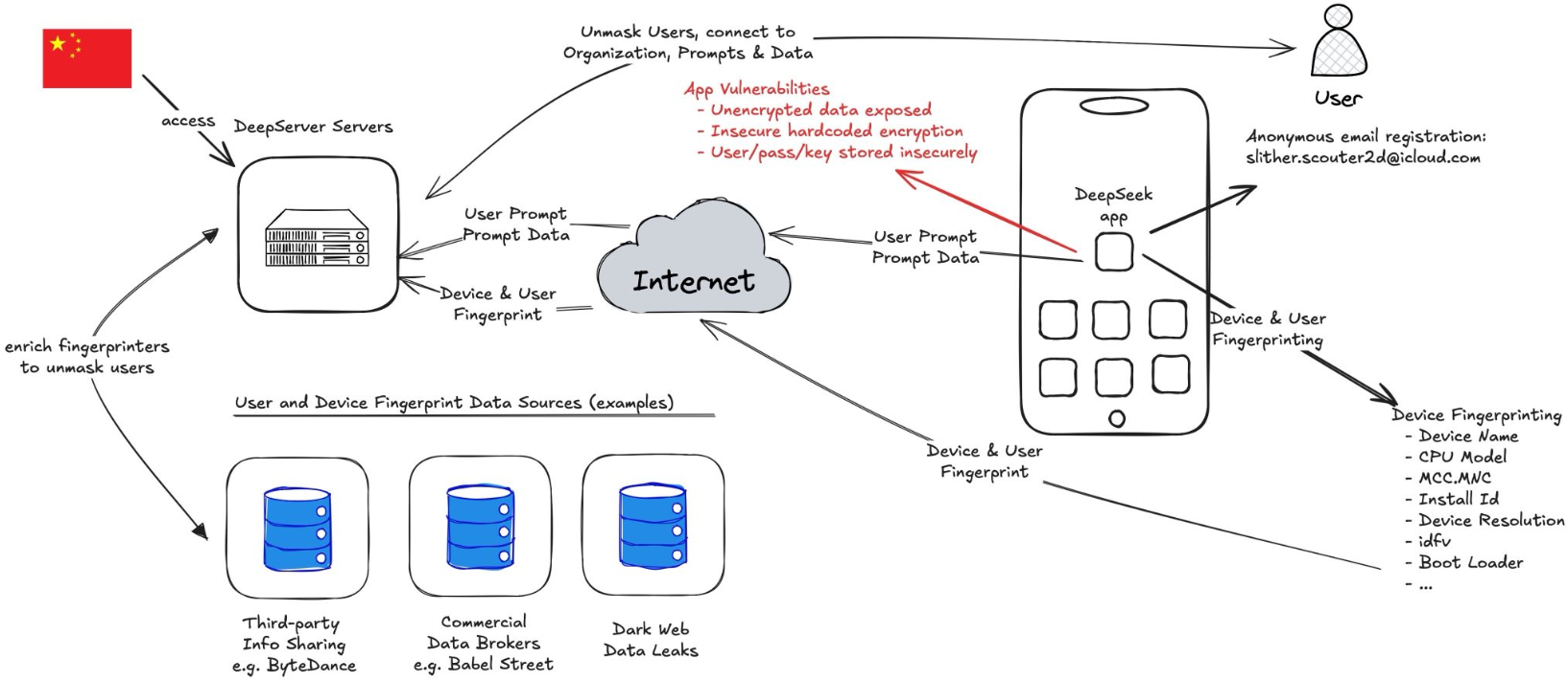
Image: NowSecure.

Perhaps more concerning, NowSecure said the iOS app transmits device information “in the clear,” without any encryption to encapsulate the data. This means the data being handled by the app could be intercepted, read, and even modified by anyone who has access to any of the networks that carry the app’s traffic.

“The DeepSeek iOS app globally disables App Transport Security (ATS) which is an iOS platform level protection that prevents sensitive data from being sent over unencrypted channels,” the report observed. “Since this protection is disabled, the app can (and does) send unencrypted data over the internet.”

Hoog said the app does selectively encrypt portions of the responses coming from DeepSeek servers. But they also found it uses an insecure and now deprecated encryption algorithm called 3DES (aka Triple DES), and that the developers had hard-coded the encryption key. That means the cryptographic key needed to decipher those data fields can be extracted from the app itself.

There were other, less alarming security and privacy issues highlighted in the report, but Hoog said he’s confident there are additional, unseen security concerns lurking within the app’s code.

“When we see people exhibit really simplistic coding errors, as you dig deeper there are usually a lot more issues,” Hoog said. “There is virtually no priority around security or privacy. Whether cultural, or mandated by China, or a witting choice, taken together they point to significant lapse in security and privacy controls, and that puts companies at risk.”

Apparently, plenty of others share this view. Axios reported on January 30 that U.S. congressional offices are being warned not to use the app.

“[T]hreat actors are already exploiting DeepSeek to deliver malicious software and infect devices,” read the notice from the chief administrative officer for the House of Representatives. “To mitigate these risks, the House has taken security measures to restrict DeepSeek’s functionality on all House-issued devices.”

TechCrunch reports that Italy and Taiwan have already moved to ban DeepSeek over security concerns. Bloomberg writes that The Pentagon has blocked access to DeepSeek. CNBC says NASA also banned employees from using the service, as did the U.S. Navy.

Beyond security concerns tied to the DeepSeek iOS app, there are indications the Chinese AI company may be playing fast and loose with the data that it collects from and about users. On January 29, researchers at Wiz said they discovered a publicly accessible database linked to DeepSeek that exposed “a significant volume of chat history, backend data and sensitive information, including log streams, API secrets, and operational details.”

“More critically, the exposure allowed for full database control and potential privilege escalation within the DeepSeek environment, without any authentication or defense mechanism to the outside world,” Wiz wrote. [Full disclosure: Wiz is currently an advertiser on this website.]

KrebsOnSecurity sought comment on the report from DeepSeek and from Apple. This story will be updated with any substantive replies.

 

Read More

CISA Adds Five Known Exploited Vulnerabilities to Catalog

 ​CISA has added five vulnerabilities to its Known Exploited Vulnerabilities Catalog, based on evidence of active exploitation.

CVE-2025-0411 7-Zip Mark of the Web Bypass Vulnerability
CVE-2022-23748 Dante Discovery Process Control Vulnerability
CVE-2024-21413 Microsoft Outlook Improper Input Validation Vulnerability
CVE-2020-29574 CyberoamOS (CROS) SQL Injection Vulnerability
CVE-2020-15069 Sophos XG Firewall Buffer Overflow Vulnerability

These types of vulnerabilities are frequent attack vectors for malicious cyber actors and pose significant risks to the federal enterprise.
Binding Operational Directive (BOD) 22-01: Reducing the Significant Risk of Known Exploited Vulnerabilities established the Known Exploited Vulnerabilities Catalog as a living list of known Common Vulnerabilities and Exposures (CVEs) that carry significant risk to the federal enterprise. BOD 22-01 requires Federal Civilian Executive Branch (FCEB) agencies to remediate identified vulnerabilities by the due date to protect FCEB networks against active threats. See the BOD 22-01 Fact Sheet for more information.
Although BOD 22-01 only applies to FCEB agencies, CISA strongly urges all organizations to reduce their exposure to cyberattacks by prioritizing timely remediation of Catalog vulnerabilities as part of their vulnerability management practice. CISA will continue to add vulnerabilities to the catalog that meet the specified criteria. 

CISA has added five vulnerabilities to its Known Exploited Vulnerabilities Catalog, based on evidence of active exploitation.

These types of vulnerabilities are frequent attack vectors for malicious cyber actors and pose significant risks to the federal enterprise.

Binding Operational Directive (BOD) 22-01: Reducing the Significant Risk of Known Exploited Vulnerabilities established the Known Exploited Vulnerabilities Catalog as a living list of known Common Vulnerabilities and Exposures (CVEs) that carry significant risk to the federal enterprise. BOD 22-01 requires Federal Civilian Executive Branch (FCEB) agencies to remediate identified vulnerabilities by the due date to protect FCEB networks against active threats. See the BOD 22-01 Fact Sheet for more information.

Although BOD 22-01 only applies to FCEB agencies, CISA strongly urges all organizations to reduce their exposure to cyberattacks by prioritizing timely remediation of Catalog vulnerabilities as part of their vulnerability management practice. CISA will continue to add vulnerabilities to the catalog that meet the specified criteria.

 Read More

Trimble Cityworks

 ​View CSAF
1. EXECUTIVE SUMMARY

CVSS v4 8.6
ATTENTION: Exploitable remotely/low attack complexity/known public exploitation
Vendor: Trimble
Equipment: Cityworks
Vulnerability: Deserialization of Untrusted Data

2. RISK EVALUATION
Successful exploitation of this vulnerability could allow an authenticated user to perform a remote code execution.
3. TECHNICAL DETAILS
3.1 AFFECTED PRODUCTS
The following versions of Trimble Cityworks, an asset and work management system, are affected:

Cityworks: All versions prior to 15.8.9
Cityworks with office companion: All versions prior to 23.10

3.2 Vulnerability Overview
3.2.1 DESERIALIZATION OF UNTRUSTED DATA CWE-502
Trimble Cityworks versions prior to 15.8.9 and Cityworks with office companion versions prior to 23.10 are vulnerable to a deserialization vulnerability. This could allow an authenticated user to perform a remote code execution attack against a customer’s Microsoft Internet Information Services (IIS) web server.
CVE-2025-0994 has been assigned to this vulnerability. A CVSS v3.1 base score of 7.2 has been calculated; the CVSS vector string is (AV:N/AC:L/PR:H/UI:N/S:U/C:H/I:H/A:H).
A CVSS v4 score has also been calculated for CVE-2025-0994. A base score of 8.6 has been calculated; the CVSS vector string is (AV:N/AC:L/AT:N/PR:H/UI:N/VC:H/VI:H/VA:H/SC:N/SI:N/SA:N).
3.3 BACKGROUND

CRITICAL INFRASTRUCTURE SECTORS: Water and Wastewater Systems
COUNTRIES/AREAS DEPLOYED: Worldwide
COMPANY HEADQUARTERS LOCATION: United States

3.4 RESEARCHER
Trimble reported this vulnerability to CISA.
4. MITIGATIONS
Cityworks has released the following update guidance for users:

Trimble will be releasing updated versions to both 15.x (15.8.9 available January 28, 2025) and Cityworks 23.x software releases (23.10 available January 29, 2025). Information on the updated versions will be available through the normal channels via the Cityworks Support Portal(Login required). On-premise customers should install the updated version immediately. These updates will be automatically applied to all Cityworks Online (CWOL) deployments.
Trimble has observed that some on-premise deployments may have overprivileged Internet Information Services (IIS) identity permissions. For avoidance of doubt, and in accordance with Trimble’s technical documentation, IIS should not be run with local or domain level administrative privileges on any site. Please refer to the direction in the latest release notes in the Cityworks Support Portal(Login required) for more information on how to update IIS identity permissions. Trimble’s CWOL customers have their IIS identity permissions set appropriately and do not need to take this action.
Trimble has observed that some deployments have inappropriate attachment directory configurations. Trimble recommends that attachment directory root configuration should be limited to folders/subfolders which only contain attachments. Please refer to the direction in the latest release notes in the Cityworks Support Portal(Login required) for more information on how to ensure proper configuration of the attachment directory.

For more information, see Trimble’s notification.
Cityworks software is incapable of controlling industrial processes, and is not directly part of an ICS.
CISA reminds organizations to perform proper impact analysis and risk assessment prior to deploying defensive measures.
CISA also provides a section for control systems security recommended practices on the ICS webpage on cisa.gov/ics. Several CISA products detailing cyber defense best practices are available for reading and download, including Improving Industrial Control Systems Cybersecurity with Defense-in-Depth Strategies.
CISA encourages organizations to implement recommended cybersecurity strategies for proactive defense of ICS assets.
Additional mitigation guidance and recommended practices are publicly available on the ICS webpage at cisa.gov/ics in the technical information paper, ICS-TIP-12-146-01B–Targeted Cyber Intrusion Detection and Mitigation Strategies.
Organizations observing suspected malicious activity should follow established internal procedures and report findings to CISA for tracking and correlation against other incidents.
CISA also recommends users take the following measures to protect themselves from social engineering attacks:

Do not click web links or open attachments in unsolicited email messages.
Refer to Recognizing and Avoiding Email Scams for more information on avoiding email scams.
Refer to Avoiding Social Engineering and Phishing Attacks for more information on social engineering attacks.

CISA has received reports of this vulnerability being actively exploited.
5. UPDATE HISTORY

February 06, 2025: Initial Publication 

View CSAF

1. EXECUTIVE SUMMARY

  • CVSS v4 8.6
  • ATTENTION: Exploitable remotely/low attack complexity/known public exploitation
  • Vendor: Trimble
  • Equipment: Cityworks
  • Vulnerability: Deserialization of Untrusted Data

2. RISK EVALUATION

Successful exploitation of this vulnerability could allow an authenticated user to perform a remote code execution.

3. TECHNICAL DETAILS

3.1 AFFECTED PRODUCTS

The following versions of Trimble Cityworks, an asset and work management system, are affected:

  • Cityworks: All versions prior to 15.8.9
  • Cityworks with office companion: All versions prior to 23.10

3.2 Vulnerability Overview

3.2.1 DESERIALIZATION OF UNTRUSTED DATA CWE-502

Trimble Cityworks versions prior to 15.8.9 and Cityworks with office companion versions prior to 23.10 are vulnerable to a deserialization vulnerability. This could allow an authenticated user to perform a remote code execution attack against a customer’s Microsoft Internet Information Services (IIS) web server.

CVE-2025-0994 has been assigned to this vulnerability. A CVSS v3.1 base score of 7.2 has been calculated; the CVSS vector string is (AV:N/AC:L/PR:H/UI:N/S:U/C:H/I:H/A:H).

A CVSS v4 score has also been calculated for CVE-2025-0994. A base score of 8.6 has been calculated; the CVSS vector string is (AV:N/AC:L/AT:N/PR:H/UI:N/VC:H/VI:H/VA:H/SC:N/SI:N/SA:N).

3.3 BACKGROUND

  • CRITICAL INFRASTRUCTURE SECTORS: Water and Wastewater Systems
  • COUNTRIES/AREAS DEPLOYED: Worldwide
  • COMPANY HEADQUARTERS LOCATION: United States

3.4 RESEARCHER

Trimble reported this vulnerability to CISA.

4. MITIGATIONS

Cityworks has released the following update guidance for users:

  • Trimble will be releasing updated versions to both 15.x (15.8.9 available January 28, 2025) and Cityworks 23.x software releases (23.10 available January 29, 2025). Information on the updated versions will be available through the normal channels via the Cityworks Support Portal(Login required). On-premise customers should install the updated version immediately. These updates will be automatically applied to all Cityworks Online (CWOL) deployments.
  • Trimble has observed that some on-premise deployments may have overprivileged Internet Information Services (IIS) identity permissions. For avoidance of doubt, and in accordance with Trimble’s technical documentation, IIS should not be run with local or domain level administrative privileges on any site. Please refer to the direction in the latest release notes in the Cityworks Support Portal(Login required) for more information on how to update IIS identity permissions. Trimble’s CWOL customers have their IIS identity permissions set appropriately and do not need to take this action.
  • Trimble has observed that some deployments have inappropriate attachment directory configurations. Trimble recommends that attachment directory root configuration should be limited to folders/subfolders which only contain attachments. Please refer to the direction in the latest release notes in the Cityworks Support Portal(Login required) for more information on how to ensure proper configuration of the attachment directory.

For more information, see Trimble’s notification.

Cityworks software is incapable of controlling industrial processes, and is not directly part of an ICS.

CISA reminds organizations to perform proper impact analysis and risk assessment prior to deploying defensive measures.

CISA also provides a section for control systems security recommended practices on the ICS webpage on cisa.gov/ics. Several CISA products detailing cyber defense best practices are available for reading and download, including Improving Industrial Control Systems Cybersecurity with Defense-in-Depth Strategies.

CISA encourages organizations to implement recommended cybersecurity strategies for proactive defense of ICS assets.

Additional mitigation guidance and recommended practices are publicly available on the ICS webpage at cisa.gov/ics in the technical information paper, ICS-TIP-12-146-01B–Targeted Cyber Intrusion Detection and Mitigation Strategies.

Organizations observing suspected malicious activity should follow established internal procedures and report findings to CISA for tracking and correlation against other incidents.

CISA also recommends users take the following measures to protect themselves from social engineering attacks:

CISA has received reports of this vulnerability being actively exploited.

5. UPDATE HISTORY

  • February 06, 2025: Initial Publication

 Read More

Schneider Electric EcoStruxure Power Monitoring Expert (PME)

 ​View CSAF
1. EXECUTIVE SUMMARY

CVSS v3 7.1
ATTENTION: Exploitable remotely
Vendor: Schneider Electric
Equipment: EcoStruxure Power Monitoring Expert (PME)
Vulnerability: Deserialization of Untrusted Data

2. RISK EVALUATION
Successful exploitation of this vulnerability could allow an attacker to remotely execute code.
3. TECHNICAL DETAILS
3.1 AFFECTED PRODUCTS
Schneider Electric reports that the following products are affected:

EcoStruxure Power Monitoring Expert (PME): Versions 2022 and prior

3.2 VULNERABILITY OVERVIEW
3.2.1 DESERIALIZATION OF UNTRUSTED DATA CWE-502
A deserialization of untrusted data vulnerability exists which could allow code to be remotely executed on the server when unsafely deserialized data is posted to the web server.
CVE-2024-9005 has been assigned to this vulnerability. A CVSS v3 base score of 7.1 has been assigned; the CVSS vector string is (CVSS:3.1/AV:N/AC:H/PR:L/UI:R/S:U/C:H/I:H/A:H).
3.3 BACKGROUND

CRITICAL INFRASTRUCTURE SECTORS: Commercial Facilities, Critical Manufacturing, Energy
COUNTRIES/AREAS DEPLOYED: Worldwide
COMPANY HEADQUARTERS LOCATION: France

3.4 RESEARCHER
Schneider Electric CPCERT reported this vulnerability to CISA.
4. MITIGATIONS
Schneider Electric has identified the following specific workarounds and mitigations users can apply to reduce risk:

EcoStruxure Power Monitoring Expert 2021 and prior have reached end-of-life support. Users should consider upgrading to the latest version offering of PME to resolve this issue. Please contact Schneider Electric Customer Care Center for more details.
EcoStruxure Power Monitoring Expert (PME) Version 2022 and prior: There is a hotfix available for EcoStruxure Power Monitoring Expert (PME) that includes a fix for this vulnerability. Contact Schneider Electric’s Customer Care Center to download this hotfix.

Schneider Electric strongly recommends the following industry cybersecurity best practices:

Locate control and safety system networks and remote devices behind firewalls and isolate them from the business network.
Install physical controls so no unauthorized personnel can access your industrial control and safety systems, components, peripheral equipment, and networks.
Place all controllers in locked cabinets and never leave them in the “Program” mode.
Never connect programming software to any network other than the network intended for that device.
Scan all methods of mobile data exchange with the isolated network such as CDs, USB drives, etc. before use in the terminals or any node connected to these networks.
Never allow mobile devices that have connected to any other network besides the intended network to connect to the safety or control networks without proper sanitation.
Minimize network exposure for all control system devices and systems and ensure that they are not accessible from the Internet.
When remote access is required, use secure methods, such as virtual private networks (VPNs). Recognize that VPNs may have vulnerabilities and should be updated to the most current version available. Also, understand that VPNs are only as secure as the connected devices.

For more information refer to the Schneider Electric recommended cybersecurity best practices document and the associated Schneider Electric security notification SEVD-2024-282-05 in PDF and CSAF.
CISA recommends users take defensive measures to minimize the risk of exploitation of this vulnerability. CISA reminds organizations to perform proper impact analysis and risk assessment prior to deploying defensive measures.
CISA also provides a section for control systems security recommended practices on the ICS webpage on cisa.gov. Several CISA products detailing cyber defense best practices are available for reading and download, including Improving Industrial Control Systems Cybersecurity with Defense-in-Depth Strategies.
CISA encourages organizations to implement recommended cybersecurity strategies for proactive defense of ICS assets.
Additional mitigation guidance and recommended practices are publicly available on the ICS webpage at cisa.gov in the technical information paper, ICS-TIP-12-146-01B–Targeted Cyber Intrusion Detection and Mitigation Strategies.
Organizations observing suspected malicious activity should follow established internal procedures and report findings to CISA for tracking and correlation against other incidents.
CISA also recommends users take the following measures to protect themselves from social engineering attacks:

Do not click web links or open attachments in unsolicited email messages.
Refer to Recognizing and Avoiding Email Scams for more information on avoiding email scams.
Refer to Avoiding Social Engineering and Phishing Attacks for more information on social engineering attacks.

No known public exploitation specifically targeting this vulnerability has been reported to CISA at this time. This vulnerability has a high attack complexity.
5. UPDATE HISTORY

February 06, 2025: Initial Publication 

View CSAF

1. EXECUTIVE SUMMARY

  • CVSS v3 7.1
  • ATTENTION: Exploitable remotely
  • Vendor: Schneider Electric
  • Equipment: EcoStruxure Power Monitoring Expert (PME)
  • Vulnerability: Deserialization of Untrusted Data

2. RISK EVALUATION

Successful exploitation of this vulnerability could allow an attacker to remotely execute code.

3. TECHNICAL DETAILS

3.1 AFFECTED PRODUCTS

Schneider Electric reports that the following products are affected:

  • EcoStruxure Power Monitoring Expert (PME): Versions 2022 and prior

3.2 VULNERABILITY OVERVIEW

3.2.1 DESERIALIZATION OF UNTRUSTED DATA CWE-502

A deserialization of untrusted data vulnerability exists which could allow code to be remotely executed on the server when unsafely deserialized data is posted to the web server.

CVE-2024-9005 has been assigned to this vulnerability. A CVSS v3 base score of 7.1 has been assigned; the CVSS vector string is (CVSS:3.1/AV:N/AC:H/PR:L/UI:R/S:U/C:H/I:H/A:H).

3.3 BACKGROUND

  • CRITICAL INFRASTRUCTURE SECTORS: Commercial Facilities, Critical Manufacturing, Energy
  • COUNTRIES/AREAS DEPLOYED: Worldwide
  • COMPANY HEADQUARTERS LOCATION: France

3.4 RESEARCHER

Schneider Electric CPCERT reported this vulnerability to CISA.

4. MITIGATIONS

Schneider Electric has identified the following specific workarounds and mitigations users can apply to reduce risk:

  • EcoStruxure Power Monitoring Expert 2021 and prior have reached end-of-life support. Users should consider upgrading to the latest version offering of PME to resolve this issue. Please contact Schneider Electric Customer Care Center for more details.
  • EcoStruxure Power Monitoring Expert (PME) Version 2022 and prior: There is a hotfix available for EcoStruxure Power Monitoring Expert (PME) that includes a fix for this vulnerability. Contact Schneider Electric’s Customer Care Center to download this hotfix.

Schneider Electric strongly recommends the following industry cybersecurity best practices:

  • Locate control and safety system networks and remote devices behind firewalls and isolate them from the business network.
  • Install physical controls so no unauthorized personnel can access your industrial control and safety systems, components, peripheral equipment, and networks.
  • Place all controllers in locked cabinets and never leave them in the “Program” mode.
  • Never connect programming software to any network other than the network intended for that device.
  • Scan all methods of mobile data exchange with the isolated network such as CDs, USB drives, etc. before use in the terminals or any node connected to these networks.
  • Never allow mobile devices that have connected to any other network besides the intended network to connect to the safety or control networks without proper sanitation.
  • Minimize network exposure for all control system devices and systems and ensure that they are not accessible from the Internet.
  • When remote access is required, use secure methods, such as virtual private networks (VPNs). Recognize that VPNs may have vulnerabilities and should be updated to the most current version available. Also, understand that VPNs are only as secure as the connected devices.

For more information refer to the Schneider Electric recommended cybersecurity best practices document and the associated Schneider Electric security notification SEVD-2024-282-05 in PDF and CSAF.

CISA recommends users take defensive measures to minimize the risk of exploitation of this vulnerability. CISA reminds organizations to perform proper impact analysis and risk assessment prior to deploying defensive measures.

CISA also provides a section for control systems security recommended practices on the ICS webpage on cisa.gov. Several CISA products detailing cyber defense best practices are available for reading and download, including Improving Industrial Control Systems Cybersecurity with Defense-in-Depth Strategies.

CISA encourages organizations to implement recommended cybersecurity strategies for proactive defense of ICS assets.

Additional mitigation guidance and recommended practices are publicly available on the ICS webpage at cisa.gov in the technical information paper, ICS-TIP-12-146-01B–Targeted Cyber Intrusion Detection and Mitigation Strategies.

Organizations observing suspected malicious activity should follow established internal procedures and report findings to CISA for tracking and correlation against other incidents.

CISA also recommends users take the following measures to protect themselves from social engineering attacks:

No known public exploitation specifically targeting this vulnerability has been reported to CISA at this time. This vulnerability has a high attack complexity.

5. UPDATE HISTORY

  • February 06, 2025: Initial Publication

 Read More

MicroDicom DICOM Viewer

 ​View CSAF
1. EXECUTIVE SUMMARY

CVSS v4 5.7
ATTENTION: Low attack complexity
Vendor: MicroDicom
Equipment: DICOM Viewer
Vulnerability: Improper Certificate Validation

2. RISK EVALUATION
Successful exploitation of this vulnerability could allow an attacker to alter network traffic and perform a machine-in-the-middle (MITM) attack.
3. TECHNICAL DETAILS
3.1 AFFECTED PRODUCTS
The following MicroDicom DICOM Viewer are affected:

MicroDicom DICOM Viewer: Version 2024.03

3.2 VULNERABILITY OVERVIEW
3.2.1 IMPROPER CERTIFICATE VALIDATION CWE-295
MicroDicom DICOM Viewer fails to adequately verify the update server’s certificate, which could make it possible for attackers in a privileged network position to alter network traffic and carry out a machine-in-the-middle (MITM) attack. This allows the attackers to modify the server’s response and deliver a malicious update to the user.
CVE-2025-1002 has been assigned to this vulnerability. A CVSS v3.1 base score of 5.7 has been calculated; the CVSS vector string is (AV:A/AC:L/PR:N/UI:R/S:U/C:N/I:H/A:N).
A CVSS v4 score has also been calculated for CVE-2025-1002. A base score of 5.7 has been calculated; the CVSS vector string is (AV:A/AC:L/AT:P/PR:N/UI:A/VC:N/VI:H/VA:N/SC:N/SI:N/SA:N).
3.3 BACKGROUND

CRITICAL INFRASTRUCTURE SECTORS: Healthcare and Public Health
COUNTRIES/AREAS DEPLOYED: Worldwide
COMPANY HEADQUARTERS LOCATION: Bulgaria

3.4 RESEARCHER
Sharon Brizinov of Claroty Team82 reported this vulnerability to CISA.
4. MITIGATIONS
MicroDicom recommends users upgrade to DICOM Viewer version 2025.1.
CISA recommends users take defensive measures to minimize the risk of exploitation of this vulnerability, such as:

Minimize network exposure for all control system devices and/or systems, ensuring they are not accessible from the internet.
Locate control system networks and remote devices behind firewalls and isolating them from business networks.
When remote access is required, use more secure methods, such as Virtual Private Networks (VPNs), recognizing VPNs may have vulnerabilities and should be updated to the most current version available. Also recognize VPN is only as secure as the connected devices.

CISA reminds organizations to perform proper impact analysis and risk assessment prior to deploying defensive measures.
CISA also provides a section for control systems security recommended practices on the ICS webpage on cisa.gov/ics. Several CISA products detailing cyber defense best practices are available for reading and download, including Improving Industrial Control Systems Cybersecurity with Defense-in-Depth Strategies.
CISA encourages organizations to implement recommended cybersecurity strategies for proactive defense of ICS assets.
Additional mitigation guidance and recommended practices are publicly available on the ICS webpage at cisa.gov/ics in the technical information paper, ICS-TIP-12-146-01B–Targeted Cyber Intrusion Detection and Mitigation Strategies.
Organizations observing suspected malicious activity should follow established internal procedures and report findings to CISA for tracking and correlation against other incidents.
No known public exploitation specifically targeting this vulnerability has been reported to CISA at this time. This vulnerability is not exploitable remotely.
5. UPDATE HISTORY

February 6, 2025: Initial Publication 

View CSAF

1. EXECUTIVE SUMMARY

  • CVSS v4 5.7
  • ATTENTION: Low attack complexity
  • Vendor: MicroDicom
  • Equipment: DICOM Viewer
  • Vulnerability: Improper Certificate Validation

2. RISK EVALUATION

Successful exploitation of this vulnerability could allow an attacker to alter network traffic and perform a machine-in-the-middle (MITM) attack.

3. TECHNICAL DETAILS

3.1 AFFECTED PRODUCTS

The following MicroDicom DICOM Viewer are affected:

  • MicroDicom DICOM Viewer: Version 2024.03

3.2 VULNERABILITY OVERVIEW

3.2.1 IMPROPER CERTIFICATE VALIDATION CWE-295

MicroDicom DICOM Viewer fails to adequately verify the update server’s certificate, which could make it possible for attackers in a privileged network position to alter network traffic and carry out a machine-in-the-middle (MITM) attack. This allows the attackers to modify the server’s response and deliver a malicious update to the user.

CVE-2025-1002 has been assigned to this vulnerability. A CVSS v3.1 base score of 5.7 has been calculated; the CVSS vector string is (AV:A/AC:L/PR:N/UI:R/S:U/C:N/I:H/A:N).

A CVSS v4 score has also been calculated for CVE-2025-1002. A base score of 5.7 has been calculated; the CVSS vector string is (AV:A/AC:L/AT:P/PR:N/UI:A/VC:N/VI:H/VA:N/SC:N/SI:N/SA:N).

3.3 BACKGROUND

  • CRITICAL INFRASTRUCTURE SECTORS: Healthcare and Public Health
  • COUNTRIES/AREAS DEPLOYED: Worldwide
  • COMPANY HEADQUARTERS LOCATION: Bulgaria

3.4 RESEARCHER

Sharon Brizinov of Claroty Team82 reported this vulnerability to CISA.

4. MITIGATIONS

MicroDicom recommends users upgrade to DICOM Viewer version 2025.1.

CISA recommends users take defensive measures to minimize the risk of exploitation of this vulnerability, such as:

  • Minimize network exposure for all control system devices and/or systems, ensuring they are not accessible from the internet.
  • Locate control system networks and remote devices behind firewalls and isolating them from business networks.
  • When remote access is required, use more secure methods, such as Virtual Private Networks (VPNs), recognizing VPNs may have vulnerabilities and should be updated to the most current version available. Also recognize VPN is only as secure as the connected devices.

CISA reminds organizations to perform proper impact analysis and risk assessment prior to deploying defensive measures.

CISA also provides a section for control systems security recommended practices on the ICS webpage on cisa.gov/ics. Several CISA products detailing cyber defense best practices are available for reading and download, including Improving Industrial Control Systems Cybersecurity with Defense-in-Depth Strategies.

CISA encourages organizations to implement recommended cybersecurity strategies for proactive defense of ICS assets.

Additional mitigation guidance and recommended practices are publicly available on the ICS webpage at cisa.gov/ics in the technical information paper, ICS-TIP-12-146-01B–Targeted Cyber Intrusion Detection and Mitigation Strategies.

Organizations observing suspected malicious activity should follow established internal procedures and report findings to CISA for tracking and correlation against other incidents.

No known public exploitation specifically targeting this vulnerability has been reported to CISA at this time. This vulnerability is not exploitable remotely.

5. UPDATE HISTORY

  • February 6, 2025: Initial Publication

 Read More

CISA Releases Six Industrial Control Systems Advisories

 ​CISA released six Industrial Control Systems (ICS) advisories on February 6, 2025. These advisories provide timely information about current security issues, vulnerabilities, and exploits surrounding ICS.

ICSA-25-037-01 Schneider Electric EcoStruxure Power Monitoring Expert (PME)
ICSA-25-037-02 Schneider Electric EcoStruxure
ICSA-25-037-03 ABB Drive Composer
ICSA-25-037-04 Trimble Cityworks
ICSMA-25-037-01 MicroDicom DICOM Viewer
ICSMA-25-037-02 Orthanc Server

CISA encourages users and administrators to review newly released ICS advisories for technical details and mitigations. 

CISA released six Industrial Control Systems (ICS) advisories on February 6, 2025. These advisories provide timely information about current security issues, vulnerabilities, and exploits surrounding ICS.

CISA encourages users and administrators to review newly released ICS advisories for technical details and mitigations.

 Read More

ABB Drive Composer

 ​View CSAF
1. EXECUTIVE SUMMARY

CVSS v4 9.3
ATTENTION: Exploitable remotely/low attack complexity
Vendor: ABB
Equipment: Drive Composer
Vulnerability: Improper Limitation of a Pathname to a Restricted Directory (‘Path Traversal’)

2. RISK EVALUATION
Successful exploitation of this vulnerability could allow attackers unauthorized access to the file system on the host machine. An attacker can exploit this flaw to run malicious code, which could lead to the compromise of the affected system.
3. TECHNICAL DETAILS
3.1 AFFECTED PRODUCTS
ABB reports that the following Drive Composer products are affected:

Drive Composer entry: Version 2.9.0.1 and prior
Drive Composer pro: Version 2.9.0.1 and prior

3.2 VULNERABILITY OVERVIEW
3.2.1 IMPROPER LIMITATION OF A PATHNAME TO A RESTRICTED DIRECTORY (‘PATH TRAVERSAL’) CWE-22
A vulnerability in drive composer can allow attackers unauthorized access to the file system on the host machine. An attacker can exploit this flaw to run malicious code, which could lead to the compromise of the affected system.
CVE-2024-48510 has been assigned to this vulnerability. A CVSS v3 base score of 9.8 has been calculated; the CVSS vector string is (CVSS:3.1/AV:N/AC:L/PR:N/UI:N/S:U/C:H/I:H/A:H).
A CVSS v4 score has also been calculated for CVE-2024-48510. A base score of 9.3 has been calculated; the CVSS vector string is (CVSS:4.0/AV:N/AC:L/AT:N/PR:N/UI:N/VC:H/VI:H/VA:H/SC:N/SI:N/SA:N).
3.3 BACKGROUND

CRITICAL INFRASTRUCTURE SECTORS: Critical Manufacturing
COUNTRIES/AREAS DEPLOYED: Worldwide
COMPANY HEADQUARTERS LOCATION: Switzerland

3.4 RESEARCHER
ABB reported this vulnerability to CISA.
4. MITIGATIONS
ABB has corrected this vulnerability in Drive Composer Version 2.9.1. Drive Composer Version 2.9.1 (both entry and pro) is downloadable from the product page. ABB recommends users apply the update at their earliest convenience.
For more information, please refer to the ABB Cybersecurity Advisory.
ABB recommends the following general security practices for any installation of software-related ABB products:

Isolate special purpose networks (e.g. for automation systems) and remote devices behind firewalls and separate them from any general-purpose network (e.g. office or home networks).
Install physical controls so no unauthorized personnel can access your devices, components, peripheral equipment, and networks.
Never connect programming software or computers containing programing software to any networkother than the network for the devices that it is intended for.
Scan all data imported into your environment before use to detect potential malware infections.
Minimize network exposure for all applications and endpoints to ensure that they are not accessible from the Internet unless they are designed for such exposure and the intended use requires such.
Ensure all nodes are always up to date in terms of installed software, operating system, and firmware patches as well as anti-virus and firewall.
When remote access is required, use secure methods, such as virtual private networks (VPNs). Recognize that VPNs may have vulnerabilities and should be updated to the most current version available. Also, understand that VPNs are only as secure as the connected devices.

More information on recommended practices can be found in the following documents:3AXD10000492137 Technical Guide – Cybersecurity for ABB Drives
CISA recommends users take defensive measures to minimize the risk of exploitation of this vulnerability. CISA reminds organizations to perform proper impact analysis and risk assessment prior to deploying defensive measures.
CISA also provides a section for control systems security recommended practices on the ICS webpage on cisa.gov. Several CISA products detailing cyber defense best practices are available for reading and download, including Improving Industrial Control Systems Cybersecurity with Defense-in-Depth Strategies.
CISA encourages organizations to implement recommended cybersecurity strategies for proactive defense of ICS assets.
Additional mitigation guidance and recommended practices are publicly available on the ICS webpage at cisa.gov in the technical information paper, ICS-TIP-12-146-01B–Targeted Cyber Intrusion Detection and Mitigation Strategies.
Organizations observing suspected malicious activity should follow established internal procedures and report findings to CISA for tracking and correlation against other incidents.
No known public exploitation specifically targeting this vulnerability has been reported to CISA at this time.
5. UPDATE HISTORY

February 6, 2025: Initial Publication 

View CSAF

1. EXECUTIVE SUMMARY

  • CVSS v4 9.3
  • ATTENTION: Exploitable remotely/low attack complexity
  • Vendor: ABB
  • Equipment: Drive Composer
  • Vulnerability: Improper Limitation of a Pathname to a Restricted Directory (‘Path Traversal’)

2. RISK EVALUATION

Successful exploitation of this vulnerability could allow attackers unauthorized access to the file system on the host machine. An attacker can exploit this flaw to run malicious code, which could lead to the compromise of the affected system.

3. TECHNICAL DETAILS

3.1 AFFECTED PRODUCTS

ABB reports that the following Drive Composer products are affected:

  • Drive Composer entry: Version 2.9.0.1 and prior
  • Drive Composer pro: Version 2.9.0.1 and prior

3.2 VULNERABILITY OVERVIEW

3.2.1 IMPROPER LIMITATION OF A PATHNAME TO A RESTRICTED DIRECTORY (‘PATH TRAVERSAL’) CWE-22

A vulnerability in drive composer can allow attackers unauthorized access to the file system on the host machine. An attacker can exploit this flaw to run malicious code, which could lead to the compromise of the affected system.

CVE-2024-48510 has been assigned to this vulnerability. A CVSS v3 base score of 9.8 has been calculated; the CVSS vector string is (CVSS:3.1/AV:N/AC:L/PR:N/UI:N/S:U/C:H/I:H/A:H).

A CVSS v4 score has also been calculated for CVE-2024-48510. A base score of 9.3 has been calculated; the CVSS vector string is (CVSS:4.0/AV:N/AC:L/AT:N/PR:N/UI:N/VC:H/VI:H/VA:H/SC:N/SI:N/SA:N).

3.3 BACKGROUND

  • CRITICAL INFRASTRUCTURE SECTORS: Critical Manufacturing
  • COUNTRIES/AREAS DEPLOYED: Worldwide
  • COMPANY HEADQUARTERS LOCATION: Switzerland

3.4 RESEARCHER

ABB reported this vulnerability to CISA.

4. MITIGATIONS

ABB has corrected this vulnerability in Drive Composer Version 2.9.1. Drive Composer Version 2.9.1 (both entry and pro) is downloadable from the product page. ABB recommends users apply the update at their earliest convenience.

For more information, please refer to the ABB Cybersecurity Advisory.

ABB recommends the following general security practices for any installation of software-related ABB products:

  • Isolate special purpose networks (e.g. for automation systems) and remote devices behind firewalls and separate them from any general-purpose network (e.g. office or home networks).
  • Install physical controls so no unauthorized personnel can access your devices, components, peripheral equipment, and networks.
  • Never connect programming software or computers containing programing software to any network
    other than the network for the devices that it is intended for.
  • Scan all data imported into your environment before use to detect potential malware infections.
  • Minimize network exposure for all applications and endpoints to ensure that they are not accessible from the Internet unless they are designed for such exposure and the intended use requires such.
  • Ensure all nodes are always up to date in terms of installed software, operating system, and firmware patches as well as anti-virus and firewall.
  • When remote access is required, use secure methods, such as virtual private networks (VPNs). Recognize that VPNs may have vulnerabilities and should be updated to the most current version available. Also, understand that VPNs are only as secure as the connected devices.

More information on recommended practices can be found in the following documents:
3AXD10000492137 Technical Guide – Cybersecurity for ABB Drives

CISA recommends users take defensive measures to minimize the risk of exploitation of this vulnerability. CISA reminds organizations to perform proper impact analysis and risk assessment prior to deploying defensive measures.

CISA also provides a section for control systems security recommended practices on the ICS webpage on cisa.gov. Several CISA products detailing cyber defense best practices are available for reading and download, including Improving Industrial Control Systems Cybersecurity with Defense-in-Depth Strategies.

CISA encourages organizations to implement recommended cybersecurity strategies for proactive defense of ICS assets.

Additional mitigation guidance and recommended practices are publicly available on the ICS webpage at cisa.gov in the technical information paper, ICS-TIP-12-146-01B–Targeted Cyber Intrusion Detection and Mitigation Strategies.

Organizations observing suspected malicious activity should follow established internal procedures and report findings to CISA for tracking and correlation against other incidents.

No known public exploitation specifically targeting this vulnerability has been reported to CISA at this time.

5. UPDATE HISTORY

  • February 6, 2025: Initial Publication

 Read More

Orthanc Server

 ​View CSAF
1. EXECUTIVE SUMMARY

CVSS v4 9.2
ATTENTION: Exploitable remotely/low attack complexity
Vendor: Orthanc
Equipment: Orthanc Server
Vulnerability: Missing Authentication for Critical Function

2. RISK EVALUATION
Successful exploitation of this vulnerability could allow an attacker to disclose sensitive information, modify records, or cause a denial-of-service condition.
3. TECHNICAL DETAILS
3.1 AFFECTED PRODUCTS
The following Orthanc products are affected:

Orthanc server: Versions prior to 1.5.8

3.2 VULNERABILITY OVERVIEW
3.2.1 MISSING AUTHENTICATION FOR CRITICAL FUNCTION CWE-306
Orthanc server prior to version 1.5.8 does not enable basic authentication by default when remote access is enabled. This could result in unauthorized access by an attacker.
CVE-2025-0896 has been assigned to this vulnerability. A CVSS v3.1 base score of 9.8 has been calculated; the CVSS vector string is (AV:N/AC:L/PR:N/UI:N/S:U/C:H/I:H/A:H).
A CVSS v4 score has also been calculated for CVE-2025-0896. A base score of 9.2 has been calculated; the CVSS vector string is (AV:N/AC:L/AT:P/PR:N/UI:N/VC:H/VI:H/VA:H/SC:N/SI:N/SA:N).
3.3 BACKGROUND

CRITICAL INFRASTRUCTURE SECTORS: Healthcare and Public Health
COUNTRIES/AREAS DEPLOYED: Worldwide
COMPANY HEADQUARTERS LOCATION: Belgium

3.4 RESEARCHER
Amitay Dan reported this vulnerability to Orthanc.Souvik Kandar reported this vulnerability to CISA.
4. MITIGATIONS
Orthanc recommends that users update to the latest version or enable the HTTP authentication by setting the configuration “AuthenticationEnabled”: true in the configuration file.
CISA recommends users take defensive measures to minimize the risk of exploitation of this vulnerability, such as:

Minimize network exposure for all control system devices and/or systems, ensuring they are not accessible from the internet.
Locate control system networks and remote devices behind firewalls and isolating them from business networks.
When remote access is required, utilize more secure methods, such as Virtual Private Networks (VPNs), recognizing VPNs may have their own vulnerabilities and should be updated to the most current version available. Also recognize VPNs are only as secure as the connected devices.

CISA reminds organizations to perform proper impact analysis and risk assessment prior to deploying defensive measures.
CISA also provides a section for control systems security recommended practices on the ICS webpage on cisa.gov/ics. Several CISA products detailing cyber defense best practices are available for reading and download, including Improving Industrial Control Systems Cybersecurity with Defense-in-Depth Strategies.
CISA encourages organizations to implement recommended cybersecurity strategies for proactive defense of ICS assets.
Additional mitigation guidance and recommended practices are publicly available on the ICS webpage at cisa.gov/ics in the technical information paper, ICS-TIP-12-146-01B–Targeted Cyber Intrusion Detection and Mitigation Strategies.
Organizations observing suspected malicious activity should follow established internal procedures and report findings to CISA for tracking and correlation against other incidents.
CISA also recommends users take the following measures to protect themselves from social engineering attacks:

Do not click web links or open attachments in unsolicited email messages.
Refer to Recognizing and Avoiding Email Scams for more information on avoiding email scams.
Refer to Avoiding Social Engineering and Phishing Attacks for more information on social engineering attacks.

No known public exploitation specifically targeting this vulnerability has been reported to CISA at this time.
5. UPDATE HISTORY

February 6, 2025: Initial Publication 

View CSAF

1. EXECUTIVE SUMMARY

  • CVSS v4 9.2
  • ATTENTION: Exploitable remotely/low attack complexity
  • Vendor: Orthanc
  • Equipment: Orthanc Server
  • Vulnerability: Missing Authentication for Critical Function

2. RISK EVALUATION

Successful exploitation of this vulnerability could allow an attacker to disclose sensitive information, modify records, or cause a denial-of-service condition.

3. TECHNICAL DETAILS

3.1 AFFECTED PRODUCTS

The following Orthanc products are affected:

  • Orthanc server: Versions prior to 1.5.8

3.2 VULNERABILITY OVERVIEW

3.2.1 MISSING AUTHENTICATION FOR CRITICAL FUNCTION CWE-306

Orthanc server prior to version 1.5.8 does not enable basic authentication by default when remote access is enabled. This could result in unauthorized access by an attacker.

CVE-2025-0896 has been assigned to this vulnerability. A CVSS v3.1 base score of 9.8 has been calculated; the CVSS vector string is (AV:N/AC:L/PR:N/UI:N/S:U/C:H/I:H/A:H).

A CVSS v4 score has also been calculated for CVE-2025-0896. A base score of 9.2 has been calculated; the CVSS vector string is (AV:N/AC:L/AT:P/PR:N/UI:N/VC:H/VI:H/VA:H/SC:N/SI:N/SA:N).

3.3 BACKGROUND

  • CRITICAL INFRASTRUCTURE SECTORS: Healthcare and Public Health
  • COUNTRIES/AREAS DEPLOYED: Worldwide
  • COMPANY HEADQUARTERS LOCATION: Belgium

3.4 RESEARCHER

Amitay Dan reported this vulnerability to Orthanc.
Souvik Kandar reported this vulnerability to CISA.

4. MITIGATIONS

Orthanc recommends that users update to the latest version or enable the HTTP authentication by setting the configuration “AuthenticationEnabled”: true in the configuration file.

CISA recommends users take defensive measures to minimize the risk of exploitation of this vulnerability, such as:

  • Minimize network exposure for all control system devices and/or systems, ensuring they are not accessible from the internet.
  • Locate control system networks and remote devices behind firewalls and isolating them from business networks.
  • When remote access is required, utilize more secure methods, such as Virtual Private Networks (VPNs), recognizing VPNs may have their own vulnerabilities and should be updated to the most current version available. Also recognize VPNs are only as secure as the connected devices.

CISA reminds organizations to perform proper impact analysis and risk assessment prior to deploying defensive measures.

CISA also provides a section for control systems security recommended practices on the ICS webpage on cisa.gov/ics. Several CISA products detailing cyber defense best practices are available for reading and download, including Improving Industrial Control Systems Cybersecurity with Defense-in-Depth Strategies.

CISA encourages organizations to implement recommended cybersecurity strategies for proactive defense of ICS assets.

Additional mitigation guidance and recommended practices are publicly available on the ICS webpage at cisa.gov/ics in the technical information paper, ICS-TIP-12-146-01B–Targeted Cyber Intrusion Detection and Mitigation Strategies.

Organizations observing suspected malicious activity should follow established internal procedures and report findings to CISA for tracking and correlation against other incidents.

CISA also recommends users take the following measures to protect themselves from social engineering attacks:

No known public exploitation specifically targeting this vulnerability has been reported to CISA at this time.

5. UPDATE HISTORY

  • February 6, 2025: Initial Publication

 Read More

Scroll to Top