
Schneider Electric System Monitor Application in Harmony and Pro-face PS5000 Legacy Industrial PCs

 ​View CSAF
1. EXECUTIVE SUMMARY

CVSS v3 9.8
ATTENTION: Exploitable remotely/low attack complexity
Vendor: Schneider Electric
Equipment: Harmony Industrial PC, Pro-face Industrial PC
Vulnerability: Exposure of Sensitive Information to an Unauthorized Actor

2. RISK EVALUATION
Successful exploitation of this vulnerability could allow an attacker to access sensitive information.
3. TECHNICAL DETAILS
3.1 AFFECTED PRODUCTS
Schneider Electric reports that the following products are affected:

System Monitor application in Harmony Industrial PC: All versions
System Monitor application in Pro-face Industrial PC: All versions

3.2 Vulnerability Overview
3.2.1 EXPOSURE OF SENSITIVE INFORMATION TO AN UNAUTHORIZED ACTOR CWE-200
An information exposure vulnerability exists that could cause exposure of credentials when attacker has access to application on network over HTTP.
CVE-2024-8884 has been assigned to this vulnerability. A CVSS v3 base score of 9.8 has been assigned; the CVSS vector string is (CVSS:3.1/AV:N/AC:L/PR:N/UI:N/S:U/C:H/I:H/A:H).
3.3 BACKGROUND

CRITICAL INFRASTRUCTURE SECTORS: Commercial Facilities, Critical Manufacturing, Energy
COUNTRIES/AREAS DEPLOYED: Worldwide
COMPANY HEADQUARTERS LOCATION: France

3.4 RESEARCHER
Schneider Electric CPCERT reported this vulnerability to CISA.
4. MITIGATIONS
Schneider Electric has identified the following specific workarounds and mitigations users can apply to reduce risk:

System Monitor application in Harmony Industrial PC: Users can uninstall System Monitor application using installer available for download.
System Monitor application in Pro-face Industrial PC: Customer can uninstall System Monitor application using installer available for download.

Schneider Electric strongly recommends the use of back-ups and evaluating the impact of these patches in a test and development environment or on an offline infrastructure. Please follow the steps described in the guideline attached as a .pdf in the downloaded uninstaller guide. Contact Schneider Electric’s Customer Care Center if you need assistance.
If users choose not to apply the remediation provided above, they should immediately apply the following mitigations to reduce the risk of exploit:

Stop the system monitor if not required by turning off the services as specified in user guide:

Harmony Industrial PC Series User Manual
Pro-face PS5000 legacy industrial PC Series User Manual

Set up network segmentation and implement a firewall to block all unauthorized access to configured HTTP/HTTPS ports.

Schneider Electric strongly recommends the following industry cybersecurity best practices:

Locate control and safety system networks and remote devices behind firewalls and isolate them from the business network.
Install physical controls so no unauthorized personnel can access your industrial control and safety systems, components, peripheral equipment, and networks.
Place all controllers in locked cabinets and never leave them in the “Program” mode.
Never connect programming software to any network other than the network intended for that device.
Scan all methods of mobile data exchange with the isolated network such as CDs, USB drives, etc. before use in the terminals or any node connected to these networks.
Never allow mobile devices that have connected to any other network besides the intended network to connect to the safety or control networks without proper sanitation.
Minimize network exposure for all control system devices and systems and ensure that they are not accessible from the Internet.
When remote access is required, use secure methods, such as virtual private networks (VPNs). Recognize that VPNs may have vulnerabilities and should be updated to the most current version available. Also, understand that VPNs are only as secure as the connected devices.

For more information refer to the Schneider Electric Recommended Cybersecurity Best Practices document.
For more information refer to the Schneider Electric recommended cybersecurity best practices document and the associated Schneider Electric security notification SEVD-2024-282-07 in PDF and CSAF.
CISA recommends users take defensive measures to minimize the risk of exploitation of this vulnerability. CISA reminds organizations to perform proper impact analysis and risk assessment prior to deploying defensive measures.
CISA also provides a section for control systems security recommended practices on the ICS webpage on cisa.gov. Several CISA products detailing cyber defense best practices are available for reading and download, including Improving Industrial Control Systems Cybersecurity with Defense-in-Depth Strategies.
CISA encourages organizations to implement recommended cybersecurity strategies for proactive defense of ICS assets.
Additional mitigation guidance and recommended practices are publicly available on the ICS webpage at cisa.gov in the technical information paper, ICS-TIP-12-146-01B–Targeted Cyber Intrusion Detection and Mitigation Strategies.
Organizations observing suspected malicious activity should follow established internal procedures and report findings to CISA for tracking and correlation against other incidents.
No known public exploitation specifically targeting this vulnerability has been reported to CISA at this time.
5. UPDATE HISTORY

January 30, 2025: Initial Publication 

View CSAF

1. EXECUTIVE SUMMARY

  • CVSS v3 9.8
  • ATTENTION: Exploitable remotely/low attack complexity
  • Vendor: Schneider Electric
  • Equipment: Harmony Industrial PC, Pro-face Industrial PC
  • Vulnerability: Exposure of Sensitive Information to an Unauthorized Actor

2. RISK EVALUATION

Successful exploitation of this vulnerability could allow an attacker to access sensitive information.

3. TECHNICAL DETAILS

3.1 AFFECTED PRODUCTS

Schneider Electric reports that the following products are affected:

  • System Monitor application in Harmony Industrial PC: All versions
  • System Monitor application in Pro-face Industrial PC: All versions

3.2 Vulnerability Overview

3.2.1 EXPOSURE OF SENSITIVE INFORMATION TO AN UNAUTHORIZED ACTOR CWE-200

An information exposure vulnerability exists that could cause exposure of credentials when attacker has access to application on network over HTTP.

CVE-2024-8884 has been assigned to this vulnerability. A CVSS v3 base score of 9.8 has been assigned; the CVSS vector string is (CVSS:3.1/AV:N/AC:L/PR:N/UI:N/S:U/C:H/I:H/A:H).

3.3 BACKGROUND

  • CRITICAL INFRASTRUCTURE SECTORS: Commercial Facilities, Critical Manufacturing, Energy
  • COUNTRIES/AREAS DEPLOYED: Worldwide
  • COMPANY HEADQUARTERS LOCATION: France

3.4 RESEARCHER

Schneider Electric CPCERT reported this vulnerability to CISA.

4. MITIGATIONS

Schneider Electric has identified the following specific workarounds and mitigations users can apply to reduce risk:

Schneider Electric strongly recommends the use of back-ups and evaluating the impact of these patches in a test and development environment or on an offline infrastructure. Please follow the steps described in the guideline attached as a .pdf in the downloaded uninstaller guide. Contact Schneider Electric’s Customer Care Center if you need assistance.

If users choose not to apply the remediation provided above, they should immediately apply the following mitigations to reduce the risk of exploit:

Schneider Electric strongly recommends the following industry cybersecurity best practices:

  • Locate control and safety system networks and remote devices behind firewalls and isolate them from the business network.
  • Install physical controls so no unauthorized personnel can access your industrial control and safety systems, components, peripheral equipment, and networks.
  • Place all controllers in locked cabinets and never leave them in the “Program” mode.
  • Never connect programming software to any network other than the network intended for that device.
  • Scan all methods of mobile data exchange with the isolated network such as CDs, USB drives, etc. before use in the terminals or any node connected to these networks.
  • Never allow mobile devices that have connected to any other network besides the intended network to connect to the safety or control networks without proper sanitation.
  • Minimize network exposure for all control system devices and systems and ensure that they are not accessible from the Internet.
  • When remote access is required, use secure methods, such as virtual private networks (VPNs). Recognize that VPNs may have vulnerabilities and should be updated to the most current version available. Also, understand that VPNs are only as secure as the connected devices.

For more information refer to the Schneider Electric Recommended Cybersecurity Best Practices document.

For more information refer to the Schneider Electric recommended cybersecurity best practices document and the associated Schneider Electric security notification SEVD-2024-282-07 in PDF and CSAF.

CISA recommends users take defensive measures to minimize the risk of exploitation of this vulnerability. CISA reminds organizations to perform proper impact analysis and risk assessment prior to deploying defensive measures.

CISA also provides a section for control systems security recommended practices on the ICS webpage on cisa.gov. Several CISA products detailing cyber defense best practices are available for reading and download, including Improving Industrial Control Systems Cybersecurity with Defense-in-Depth Strategies.

CISA encourages organizations to implement recommended cybersecurity strategies for proactive defense of ICS assets.

Additional mitigation guidance and recommended practices are publicly available on the ICS webpage at cisa.gov in the technical information paper, ICS-TIP-12-146-01B–Targeted Cyber Intrusion Detection and Mitigation Strategies.

Organizations observing suspected malicious activity should follow established internal procedures and report findings to CISA for tracking and correlation against other incidents.

No known public exploitation specifically targeting this vulnerability has been reported to CISA at this time.

5. UPDATE HISTORY

  • January 30, 2025: Initial Publication
 Read More

New Rock Technologies Cloud Connected Devices

 ​View CSAF
1. EXECUTIVE SUMMARY

CVSS v4 9.3
ATTENTION: Exploitable remotely/low attack complexity
Vendor: New Rock Technologies
Equipment: Cloud Connected Devices
Vulnerabilities: Improper Neutralization of Special Elements used in an OS Command (‘OS Command Injection’), Improper Neutralization of Wildcards or Matching Symbols

2. RISK EVALUATION
Successful exploitation of these vulnerabilities could allow an attacker full control of the device.
3. TECHNICAL DETAILS
3.1 AFFECTED PRODUCTS
The following versions of New Rock Technologies Cloud Connected Devices are affected:

OM500 IP-PBX: All versions
MX8G VoIP Gateway: All versions
NRP1302/P Desktop IP Phone: All versions

3.2 Vulnerability Overview
3.2.1 Improper Neutralization of Special Elements used in an OS Command (‘OS Command Injection’) CWE-78
Affected products contain a vulnerability in the device cloud rpc command handling process that could allow remote attackers to take control over arbitrary devices connected to the cloud.
CVE-2025-0680 has been assigned to this vulnerability. A CVSS v3.1 base score of 9.8 has been calculated; the CVSS vector string is (AV:N/AC:L/PR:N/UI:N/S:U/C:H/I:H/A:H).
A CVSS v4 score has also been calculated for CVE-2025-0680. A base score of 9.3 has been calculated; the CVSS vector string is (AV:N/AC:L/AT:N/PR:N/UI:N/VC:H/VI:H/VA:H/SC:N/SI:N/SA:N).
3.2.2 Improper Neutralization of Wildcards or Matching Symbols CWE-155
The Cloud MQTT service of the affected products supports wildcard topic subscription which could allow an attacker to obtain sensitive information from tapping the service communications.
CVE-2025-0681 has been assigned to this vulnerability. A CVSS v3.1 base score of 6.2 has been calculated; the CVSS vector string is (AV:L/AC:L/PR:N/UI:N/S:U/C:H/I:N/A:N).
A CVSS v4 score has also been calculated for CVE-2025-0681. A base score of 6.9 has been calculated; the CVSS vector string is (AV:L/AC:L/AT:N/PR:N/UI:N/VC:H/VI:N/VA:N/SC:N/SI:N/SA:N).
3.3 BACKGROUND

CRITICAL INFRASTRUCTURE SECTORS: Communications, Healthcare and Public Health
COUNTRIES/AREAS DEPLOYED: Worldwide
COMPANY HEADQUARTERS LOCATION: China

3.4 RESEARCHER
Tomer Goldschmidt of Claroty Team82 reported these vulnerabilities to CISA.
4. MITIGATIONS
New Rock Technologies has not responded to requests to work with CISA to mitigate these vulnerabilities. Users of affected versions of New Rock Technologies Cloud Connected Devices are invited to contact New Rock Technologies customer support for additional information.
CISA recommends users take defensive measures to minimize the risk of exploitation of these vulnerabilities, such as:

Minimize network exposure for all control system devices and/or systems, ensuring they are not accessible from the internet.
Locate control system networks and remote devices behind firewalls and isolating them from business networks.
When remote access is required, use more secure methods, such as Virtual Private Networks (VPNs), recognizing VPNs may have vulnerabilities and should be updated to the most current version available. Also recognize VPN is only as secure as the connected devices.

CISA reminds organizations to perform proper impact analysis and risk assessment prior to deploying defensive measures.
CISA also provides a section for control systems security recommended practices on the ICS webpage on cisa.gov/ics. Several CISA products detailing cyber defense best practices are available for reading and download, including Improving Industrial Control Systems Cybersecurity with Defense-in-Depth Strategies.
CISA encourages organizations to implement recommended cybersecurity strategies for proactive defense of ICS assets.
Additional mitigation guidance and recommended practices are publicly available on the ICS webpage at cisa.gov/ics in the technical information paper, ICS-TIP-12-146-01B–Targeted Cyber Intrusion Detection and Mitigation Strategies.
Organizations observing suspected malicious activity should follow established internal procedures and report findings to CISA for tracking and correlation against other incidents.
No known public exploitation specifically targeting these vulnerabilities has been reported to CISA at this time.
5. UPDATE HISTORY

January 30, 2025: Initial Publication 

View CSAF

1. EXECUTIVE SUMMARY

  • CVSS v4 9.3
  • ATTENTION: Exploitable remotely/low attack complexity
  • Vendor: New Rock Technologies
  • Equipment: Cloud Connected Devices
  • Vulnerabilities: Improper Neutralization of Special Elements used in an OS Command (‘OS Command Injection’), Improper Neutralization of Wildcards or Matching Symbols

2. RISK EVALUATION

Successful exploitation of these vulnerabilities could allow an attacker full control of the device.

3. TECHNICAL DETAILS

3.1 AFFECTED PRODUCTS

The following versions of New Rock Technologies Cloud Connected Devices are affected:

  • OM500 IP-PBX: All versions
  • MX8G VoIP Gateway: All versions
  • NRP1302/P Desktop IP Phone: All versions

3.2 Vulnerability Overview

3.2.1 Improper Neutralization of Special Elements used in an OS Command (‘OS Command Injection’) CWE-78

Affected products contain a vulnerability in the device cloud rpc command handling process that could allow remote attackers to take control over arbitrary devices connected to the cloud.

CVE-2025-0680 has been assigned to this vulnerability. A CVSS v3.1 base score of 9.8 has been calculated; the CVSS vector string is (AV:N/AC:L/PR:N/UI:N/S:U/C:H/I:H/A:H).

A CVSS v4 score has also been calculated for CVE-2025-0680. A base score of 9.3 has been calculated; the CVSS vector string is (AV:N/AC:L/AT:N/PR:N/UI:N/VC:H/VI:H/VA:H/SC:N/SI:N/SA:N).

3.2.2 Improper Neutralization of Wildcards or Matching Symbols CWE-155

The Cloud MQTT service of the affected products supports wildcard topic subscription which could allow an attacker to obtain sensitive information from tapping the service communications.

CVE-2025-0681 has been assigned to this vulnerability. A CVSS v3.1 base score of 6.2 has been calculated; the CVSS vector string is (AV:L/AC:L/PR:N/UI:N/S:U/C:H/I:N/A:N).

A CVSS v4 score has also been calculated for CVE-2025-0681. A base score of 6.9 has been calculated; the CVSS vector string is (AV:L/AC:L/AT:N/PR:N/UI:N/VC:H/VI:N/VA:N/SC:N/SI:N/SA:N).

3.3 BACKGROUND

  • CRITICAL INFRASTRUCTURE SECTORS: Communications, Healthcare and Public Health
  • COUNTRIES/AREAS DEPLOYED: Worldwide
  • COMPANY HEADQUARTERS LOCATION: China

3.4 RESEARCHER

Tomer Goldschmidt of Claroty Team82 reported these vulnerabilities to CISA.

4. MITIGATIONS

New Rock Technologies has not responded to requests to work with CISA to mitigate these vulnerabilities. Users of affected versions of New Rock Technologies Cloud Connected Devices are invited to contact New Rock Technologies customer support for additional information.

CISA recommends users take defensive measures to minimize the risk of exploitation of these vulnerabilities, such as:

  • Minimize network exposure for all control system devices and/or systems, ensuring they are not accessible from the internet.
  • Locate control system networks and remote devices behind firewalls and isolating them from business networks.
  • When remote access is required, use more secure methods, such as Virtual Private Networks (VPNs), recognizing VPNs may have vulnerabilities and should be updated to the most current version available. Also recognize VPN is only as secure as the connected devices.

CISA reminds organizations to perform proper impact analysis and risk assessment prior to deploying defensive measures.

CISA also provides a section for control systems security recommended practices on the ICS webpage on cisa.gov/ics. Several CISA products detailing cyber defense best practices are available for reading and download, including Improving Industrial Control Systems Cybersecurity with Defense-in-Depth Strategies.

CISA encourages organizations to implement recommended cybersecurity strategies for proactive defense of ICS assets.

Additional mitigation guidance and recommended practices are publicly available on the ICS webpage at cisa.gov/ics in the technical information paper, ICS-TIP-12-146-01B–Targeted Cyber Intrusion Detection and Mitigation Strategies.

Organizations observing suspected malicious activity should follow established internal procedures and report findings to CISA for tracking and correlation against other incidents.

No known public exploitation specifically targeting these vulnerabilities has been reported to CISA at this time.

5. UPDATE HISTORY

  • January 30, 2025: Initial Publication

 Read More

Hitachi Energy UNEM

 ​View CSAF
1. EXECUTIVE SUMMARY

CVSS v3 10.0
ATTENTION: Exploitable remotely/low attack complexity
Vendor: Hitachi Energy
Equipment: UNEM
Vulnerabilities: Authentication Bypass Using an Alternate Path or Channel, Argument Injection, Heap-based Buffer Overflow, Improper Certificate Validation, Use of Hard-coded Password, Improper Restriction of Excessive Authentication Attempts, Cleartext Storage of Sensitive Information, Incorrect User Management

2. RISK EVALUATION
Successful exploitation of these vulnerabilities could allow an attacker to cause a denial of service, execute unintended commands, access sensitive information, or execute arbitrary code.
3. TECHNICAL DETAILS
3.1 AFFECTED PRODUCTS
Hitachi Energy reports that the following products are affected:

UNEM: Versions R15A and prior
UNEM: R15B (CVE-2024-28022, CVE-2024-28024, CVE-2024-28020)
UNEM: R15B PC4 (CVE-2024-2013, CVE-2024-2012, CVE-2024-2011, CVE-2024-28021, CVE-2024-28023)
UNEM: R16A
UNEM: R16B (CVE-2024-28022, CVE-2024-28024, CVE-2024-28020)
UNEM: R16B PC2 (CVE-2024-2013, CVE-2024-2012, CVE-2024-2011, CVE-2024-28021, CVE-2024-28023)

3.2 Vulnerability Overview
3.2.1 AUTHENTICATION BYPASS USING AN ALTERNATE PATH OR CHANNEL CWE-288
An authentication bypass vulnerability exists in the UNEM server / APIGateway component that if exploited allows unauthenticated malicious users to interact with the services and the post-authentication attack surface.
CVE-2024-2013 has been assigned to this vulnerability. A CVSS v3 base score of 10.0 has been assigned; the CVSS vector string is (CVSS:3.1/AV:N/AC:L/PR:N/UI:N/S:C/C:H/I:H/A:H).
3.2.2 IMPROPER NEUTRALIZATION OF ARGUMENT DELIMITERS IN A COMMAND (‘ARGUMENT INJECTION’) CWE-88
A vulnerability exists in the UNEM server / APIGateway that if exploited could be used to allow unintended commands or code to be executed on the UNEM server.
CVE-2024-2012 has been assigned to this vulnerability. A CVSS v3 base score of 9.1 has been assigned; the CVSS vector string is (CVSS:3.1/AV:N/AC:L/PR:H/UI:N/S:C/C:H/I:H/A:H).
3.2.3 HEAP-BASED BUFFER OVERFLOW CWE-122
A heap-based buffer overflow vulnerability exists in the UNEM that if exploited will generally lead to a denial of service but can be used to execute arbitrary code which is usually outside the scope of a program’s implicit security policy.
CVE-2024-2011 has been assigned to this vulnerability. A CVSS v3 base score of 8.6 has been assigned; the CVSS vector string is (CVSS:3.1/AV:N/AC:L/PR:N/UI:N/S:U/C:L/I:L/A:H).
3.2.4 IMPROPER CERTIFICATE VALIDATION CWE-295
A vulnerability exists in the UNEM server / APIGateway that if exploited could be used to allow unintended commands or code to be executed on the UNEM server.
CVE-2024-28021 has been assigned to this vulnerability. A CVSS v3 base score of 8.0 has been assigned; the CVSS vector string is (CVSS:3.1/AV:A/AC:H/PR:N/UI:N/S:C/C:H/I:H/A:N).
3.2.5 USE OF HARD-CODED PASSWORD CWE-259
A vulnerability exists in the message queueing mechanism that if exploited can lead to the exposure of resources or functionality to unintended actors, possibly providing malicious users with sensitive information or even execute arbitrary code.
CVE-2024-28023 has been assigned to this vulnerability. A CVSS v3 base score of 5.7 has been assigned; the CVSS vector string is (CVSS:3.1/AV:L/AC:L/PR:H/UI:N/S:C/C:L/I:L/A:L).
3.2.6 IMPROPER RESTRICTION OF EXCESSIVE AUTHENTICATION ATTEMPTS CWE-307
A vulnerability exists in the UNEM server / APIGateway that if exploited allows a malicious user to perform an arbitrary number of authentication attempts using different passwords, and eventually gain access to the targeted account.
CVE-2024-28022 has been assigned to this vulnerability. A CVSS v3 base score of 6.5 has been assigned; the CVSS vector string is (CVSS:3.1/AV:N/AC:H/PR:N/UI:N/S:C/C:L/I:L/A:L).
3.2.7 CLEARTEXT STORAGE OF SENSITIVE INFORMATION CWE-312
A vulnerability exists in the UNEM in which sensitive information is stored in cleartext within a resource that might be accessible to another control sphere.
CVE-2024-28024 has been assigned to this vulnerability. A CVSS v3 base score of 1.9 has been assigned; the CVSS vector string is (CVSS:3.1/AV:L/AC:H/PR:H/UI:N/S:U/C:L/I:N/A:N).
3.2.8 INCORRECT USER MANAGEMENT CWE-286
A user/password reuse vulnerability exists in the UNEM application and server management. If exploited a malicious user could use the passwords and login information to extend access on the server and other services.
CVE-2024-28020 has been assigned to this vulnerability. A CVSS v3 base score of 8.0 has been assigned; the CVSS vector string is (CVSS:3.1/AV:N/AC:H/PR:H/UI:N/S:C/C:H/I:H/A:H).
3.3 BACKGROUND

CRITICAL INFRASTRUCTURE SECTORS: Critical Manufacturing
COUNTRIES/AREAS DEPLOYED: Worldwide
COMPANY HEADQUARTERS LOCATION: Switzerland

3.4 RESEARCHER
Hitachi Energy PSIRT reported these vulnerabilities to CISA.
4. MITIGATIONS
Hitachi Energy has identified the following specific workarounds and mitigations users can apply to reduce risk:

UNEM R16A, UNEM R15A, UNEM older than R15A: EOL versions – no remediation will be available. Recommended to update to UNEM R16B PC4 or R15B PC5 (update planned) and apply general mitigation factors.
(CVE-2024-2013, CVE-2024-2012, CVE-2024-28021, CVE-2024-28023) UNEM R16B PC2: Fixed in UNEM R16B PC3 Recommended to update to UNEM R16B PC4 and apply general mitigation factors.
(CVE-2024-2013, CVE-2024-2012, CVE-2024-2011, CVE-2024-28021, CVE-2024-28023) UNEM R15B PC4: Update to UNEM R15B PC5 (under development) and apply general mitigation factors.
(CVE-2024-2011) UNEM R16B PC2: Fixed in UNEM R16B PC3 Recommended to update to UNEM R16B PC4 and apply general mitigation factors.
(CVE-2024-28022, CVE-2024-28024) UNEM R16B, UNEM R15B: Apply general mitigation factors
(CVE-2024-28020) UNEM R16B, UNEM R15B: Deny nemadm account for ssh logins by configuring DenyUsers in /etc/ssh/sshd_config

Hitachi Energy recommends users implementing recommended security practices and firewall configurations to help protect the process control network from attacks originating from outside the network. Process control systems should be physically protected from direct access by unauthorized personnel, have no direct connections to the Internet, and be separated from other networks by means of a firewall system with a minimal number of ports exposed. Process control systems should not be used for Internet surfing, instant messaging, or receiving e-mails. Portable computers and removable storage media should be carefully scanned for viruses before they are connected to a control system.
For more information, see Hitachi Energy Cybersecurity Advisory “Multiple Vulnerabilities in Hitachi Energy’s UNEM”.
CISA recommends users take defensive measures to minimize the risk of exploitation of these vulnerabilities, such as:

When remote access is required, use more secure methods, such as virtual private networks (VPNs). Recognize VPNs may have vulnerabilities, should be updated to the most recent version available, and are only as secure as the connected devices.

CISA reminds organizations to perform proper impact analysis and risk assessment prior to deploying defensive measures.
CISA also provides a section for control systems security recommended practices on the ICS webpage on cisa.gov. Several CISA products detailing cyber defense best practices are available for reading and download, including Improving Industrial Control Systems Cybersecurity with Defense-in-Depth Strategies.
CISA encourages organizations to implement recommended cybersecurity strategies for proactive defense of ICS assets.
Additional mitigation guidance and recommended practices are publicly available on the ICS webpage at cisa.gov in the technical information paper, ICS-TIP-12-146-01B–Targeted Cyber Intrusion Detection and Mitigation Strategies.
Organizations observing suspected malicious activity should follow established internal procedures and report findings to CISA for tracking and correlation against other incidents.
CISA also recommends users take the following measures to protect themselves from social engineering attacks:

Do not click web links or open attachments in unsolicited email messages.
Refer to Recognizing and Avoiding Email Scams for more information on avoiding email scams.
Refer to Avoiding Social Engineering and Phishing Attacks for more information on social engineering attacks.

No known public exploitation specifically targeting these vulnerabilities has been reported to CISA at this time.
5. UPDATE HISTORY

January 30, 2025: Initial Publication 

View CSAF

1. EXECUTIVE SUMMARY

  • CVSS v3 10.0
  • ATTENTION: Exploitable remotely/low attack complexity
  • Vendor: Hitachi Energy
  • Equipment: UNEM
  • Vulnerabilities: Authentication Bypass Using an Alternate Path or Channel, Argument Injection, Heap-based Buffer Overflow, Improper Certificate Validation, Use of Hard-coded Password, Improper Restriction of Excessive Authentication Attempts, Cleartext Storage of Sensitive Information, Incorrect User Management

2. RISK EVALUATION

Successful exploitation of these vulnerabilities could allow an attacker to cause a denial of service, execute unintended commands, access sensitive information, or execute arbitrary code.

3. TECHNICAL DETAILS

3.1 AFFECTED PRODUCTS

Hitachi Energy reports that the following products are affected:

  • UNEM: Versions R15A and prior
  • UNEM: R15B (CVE-2024-28022, CVE-2024-28024, CVE-2024-28020)
  • UNEM: R15B PC4 (CVE-2024-2013, CVE-2024-2012, CVE-2024-2011, CVE-2024-28021, CVE-2024-28023)
  • UNEM: R16A
  • UNEM: R16B (CVE-2024-28022, CVE-2024-28024, CVE-2024-28020)
  • UNEM: R16B PC2 (CVE-2024-2013, CVE-2024-2012, CVE-2024-2011, CVE-2024-28021, CVE-2024-28023)

3.2 Vulnerability Overview

3.2.1 AUTHENTICATION BYPASS USING AN ALTERNATE PATH OR CHANNEL CWE-288

An authentication bypass vulnerability exists in the UNEM server / APIGateway component that if exploited allows unauthenticated malicious users to interact with the services and the post-authentication attack surface.

CVE-2024-2013 has been assigned to this vulnerability. A CVSS v3 base score of 10.0 has been assigned; the CVSS vector string is (CVSS:3.1/AV:N/AC:L/PR:N/UI:N/S:C/C:H/I:H/A:H).

3.2.2 IMPROPER NEUTRALIZATION OF ARGUMENT DELIMITERS IN A COMMAND (‘ARGUMENT INJECTION’) CWE-88

A vulnerability exists in the UNEM server / APIGateway that if exploited could be used to allow unintended commands or code to be executed on the UNEM server.

CVE-2024-2012 has been assigned to this vulnerability. A CVSS v3 base score of 9.1 has been assigned; the CVSS vector string is (CVSS:3.1/AV:N/AC:L/PR:H/UI:N/S:C/C:H/I:H/A:H).

3.2.3 HEAP-BASED BUFFER OVERFLOW CWE-122

A heap-based buffer overflow vulnerability exists in the UNEM that if exploited will generally lead to a denial of service but can be used to execute arbitrary code which is usually outside the scope of a program’s implicit security policy.

CVE-2024-2011 has been assigned to this vulnerability. A CVSS v3 base score of 8.6 has been assigned; the CVSS vector string is (CVSS:3.1/AV:N/AC:L/PR:N/UI:N/S:U/C:L/I:L/A:H).

3.2.4 IMPROPER CERTIFICATE VALIDATION CWE-295

A vulnerability exists in the UNEM server / APIGateway that if exploited could be used to allow unintended commands or code to be executed on the UNEM server.

CVE-2024-28021 has been assigned to this vulnerability. A CVSS v3 base score of 8.0 has been assigned; the CVSS vector string is (CVSS:3.1/AV:A/AC:H/PR:N/UI:N/S:C/C:H/I:H/A:N).

3.2.5 USE OF HARD-CODED PASSWORD CWE-259

A vulnerability exists in the message queueing mechanism that if exploited can lead to the exposure of resources or functionality to unintended actors, possibly providing malicious users with sensitive information or even execute arbitrary code.

CVE-2024-28023 has been assigned to this vulnerability. A CVSS v3 base score of 5.7 has been assigned; the CVSS vector string is (CVSS:3.1/AV:L/AC:L/PR:H/UI:N/S:C/C:L/I:L/A:L).

3.2.6 IMPROPER RESTRICTION OF EXCESSIVE AUTHENTICATION ATTEMPTS CWE-307

A vulnerability exists in the UNEM server / APIGateway that if exploited allows a malicious user to perform an arbitrary number of authentication attempts using different passwords, and eventually gain access to the targeted account.

CVE-2024-28022 has been assigned to this vulnerability. A CVSS v3 base score of 6.5 has been assigned; the CVSS vector string is (CVSS:3.1/AV:N/AC:H/PR:N/UI:N/S:C/C:L/I:L/A:L).

3.2.7 CLEARTEXT STORAGE OF SENSITIVE INFORMATION CWE-312

A vulnerability exists in the UNEM in which sensitive information is stored in cleartext within a resource that might be accessible to another control sphere.

CVE-2024-28024 has been assigned to this vulnerability. A CVSS v3 base score of 1.9 has been assigned; the CVSS vector string is (CVSS:3.1/AV:L/AC:H/PR:H/UI:N/S:U/C:L/I:N/A:N).

3.2.8 INCORRECT USER MANAGEMENT CWE-286

A user/password reuse vulnerability exists in the UNEM application and server management. If exploited a malicious user could use the passwords and login information to extend access on the server and other services.

CVE-2024-28020 has been assigned to this vulnerability. A CVSS v3 base score of 8.0 has been assigned; the CVSS vector string is (CVSS:3.1/AV:N/AC:H/PR:H/UI:N/S:C/C:H/I:H/A:H).

3.3 BACKGROUND

  • CRITICAL INFRASTRUCTURE SECTORS: Critical Manufacturing
  • COUNTRIES/AREAS DEPLOYED: Worldwide
  • COMPANY HEADQUARTERS LOCATION: Switzerland

3.4 RESEARCHER

Hitachi Energy PSIRT reported these vulnerabilities to CISA.

4. MITIGATIONS

Hitachi Energy has identified the following specific workarounds and mitigations users can apply to reduce risk:

  • UNEM R16A, UNEM R15A, UNEM older than R15A: EOL versions – no remediation will be available. Recommended to update to UNEM R16B PC4 or R15B PC5 (update planned) and apply general mitigation factors.
  • (CVE-2024-2013, CVE-2024-2012, CVE-2024-28021, CVE-2024-28023) UNEM R16B PC2: Fixed in UNEM R16B PC3 Recommended to update to UNEM R16B PC4 and apply general mitigation factors.
  • (CVE-2024-2013, CVE-2024-2012, CVE-2024-2011, CVE-2024-28021, CVE-2024-28023) UNEM R15B PC4: Update to UNEM R15B PC5 (under development) and apply general mitigation factors.
  • (CVE-2024-2011) UNEM R16B PC2: Fixed in UNEM R16B PC3 Recommended to update to UNEM R16B PC4 and apply general mitigation factors.
  • (CVE-2024-28022, CVE-2024-28024) UNEM R16B, UNEM R15B: Apply general mitigation factors
  • (CVE-2024-28020) UNEM R16B, UNEM R15B: Deny nemadm account for ssh logins by configuring DenyUsers in /etc/ssh/sshd_config

Hitachi Energy recommends users implementing recommended security practices and firewall configurations to help protect the process control network from attacks originating from outside the network. Process control systems should be physically protected from direct access by unauthorized personnel, have no direct connections to the Internet, and be separated from other networks by means of a firewall system with a minimal number of ports exposed. Process control systems should not be used for Internet surfing, instant messaging, or receiving e-mails. Portable computers and removable storage media should be carefully scanned for viruses before they are connected to a control system.

For more information, see Hitachi Energy Cybersecurity Advisory “Multiple Vulnerabilities in Hitachi Energy’s UNEM”.

CISA recommends users take defensive measures to minimize the risk of exploitation of these vulnerabilities, such as:

  • When remote access is required, use more secure methods, such as virtual private networks (VPNs). Recognize VPNs may have vulnerabilities, should be updated to the most recent version available, and are only as secure as the connected devices.

CISA reminds organizations to perform proper impact analysis and risk assessment prior to deploying defensive measures.

CISA also provides a section for control systems security recommended practices on the ICS webpage on cisa.gov. Several CISA products detailing cyber defense best practices are available for reading and download, including Improving Industrial Control Systems Cybersecurity with Defense-in-Depth Strategies.

CISA encourages organizations to implement recommended cybersecurity strategies for proactive defense of ICS assets.

Additional mitigation guidance and recommended practices are publicly available on the ICS webpage at cisa.gov in the technical information paper, ICS-TIP-12-146-01B–Targeted Cyber Intrusion Detection and Mitigation Strategies.

Organizations observing suspected malicious activity should follow established internal procedures and report findings to CISA for tracking and correlation against other incidents.

CISA also recommends users take the following measures to protect themselves from social engineering attacks:

No known public exploitation specifically targeting these vulnerabilities has been reported to CISA at this time.

5. UPDATE HISTORY

  • January 30, 2025: Initial Publication

 Read More

Infrastructure Laundering: Blending in with the Cloud

​In an effort to blend in and make their malicious traffic tougher to block, hosting firms catering to cybercriminals in China and Russia increasingly are funneling their operations through major U.S. cloud providers. Research published this week on one such outfit — a sprawling network tied to Chinese organized crime gangs and aptly named “Funnull” — highlights a persistent whac-a-mole problem facing cloud services. 

Image: Shutterstock, ArtHead.

In an effort to blend in and make their malicious traffic tougher to block, hosting firms catering to cybercriminals in China and Russia increasingly are funneling their operations through major U.S. cloud providers. Research published this week on one such outfit — a sprawling network tied to Chinese organized crime gangs and aptly named “Funnull” — highlights a persistent whac-a-mole problem facing cloud services.

In October 2024, the security firm Silent Push published a lengthy analysis of how Amazon AWS and Microsoft Azure were providing services to Funnull, a two-year-old Chinese content delivery network that hosts a wide variety of fake trading apps, pig butchering scams, gambling websites, and retail phishing pages.

Funnull made headlines last summer after it acquired the domain name polyfill[.]io, previously the home of a widely-used open source code library that allowed older browsers to handle advanced functions that weren’t natively supported. There were still tens of thousands of legitimate domains linking to the Polyfill domain at the time of its acquisition, and Funnull soon after conducted a supply-chain attack that redirected visitors to malicious sites.

Silent Push’s October 2024 report found a vast number of domains hosted via Funnull promoting gambling sites and junkets in Macau operated by the Suncity Group, a Chinese entity named in a 2024 UN report (PDF) for laundering millions of dollars for the North Korean Lazarus Group.

In 2023, Suncity’s CEO was sentenced to 18 years in prison on charges of fraud, illegal gambling, and “triad offenses,” i.e. working with Chinese transnational organized crime syndicates. Suncity is alleged to have built an underground banking system that laundered billions of dollars for criminals.

Gambling is illegal in China except in Macau, a special administrative region of China. Silent Push researchers say Funnull may be helping online gamblers in China evade the Communist party’s “Great Firewall,” which blocks access to gambling destinations.

Silent Push’s Zach Edwards said that upon revisiting Funnull’s infrastructure again this month, they found dozens of the same Amazon and Microsoft cloud Internet addresses still forwarding Funnull traffic through a dizzying chain of auto-generated domain names before redirecting malicious or phishous websites.

Edwards said Funnull is a textbook example of an increasing trend Silent Push calls “infrastructure laundering,” wherein crooks selling cybercrime services will relay some or all of their malicious traffic through U.S. cloud providers.

“It’s crucial for global hosting companies based in the West to wake up to the fact that extremely low quality and suspicious web hosts based out of China are deliberately renting IP space from multiple companies and then mapping those IPs to their criminal client websites,” Edwards told KrebsOnSecurity. “We need these major hosts to create internal policies so that if they are renting IP space to one entity, who further rents it to host numerous criminal websites, all of those IPs should be reclaimed and the CDN who purchased them should be banned from future IP rentals or purchases.”

A Suncity gambling site promoted via Funnull. The sites feature a prompt for a Tether/USDT deposit program.

Reached for comment, Amazon referred this reporter to a statement Silent Push included in a report released today. Amazon said AWS was already aware of the Funnull addresses tracked by Silent Push, and that it had suspended all known accounts linked to the activity.

Amazon said that contrary to implications in the Silent Push report, it has every reason to aggressively police its network against infrastructure laundering, noting the accounts tied to Funnull used “fraudulent methods to temporarily acquire infrastructure, for which it never pays. Thus, AWS incurs damages as a result of the abusive activity.”

“When AWS’s automated or manual systems detect potential abuse, or when we receive reports of potential abuse, we act quickly to investigate and take action to stop any prohibited activity,” Amazon’s statement continues. “In the event anyone suspects that AWS resources are being used for abusive activity, we encourage them to report it to AWS Trust & Safety using the report abuse form. In this case, the authors of the report never notified AWS of the findings of their research via our easy-to-find security and abuse reporting channels. Instead, AWS first learned of their research from a journalist to whom the researchers had provided a draft.”

Microsoft likewise said it takes such abuse seriously, and encouraged others to report suspicious activity found on its network.

“We are committed to protecting our customers against this kind of activity and actively enforce acceptable use policies when violations are detected,” Microsoft said in a written statement. “We encourage reporting suspicious activity to Microsoft so we can investigate and take appropriate actions.”

Richard Hummel is threat intelligence lead at NETSCOUT. Hummel said it used to be that “noisy” and frequently disruptive malicious traffic — such as automated application layer attacks, and “brute force” efforts to crack passwords or find vulnerabilities in websites — came mostly from botnets, or large collections of hacked devices.

But he said the vast majority of the infrastructure used to funnel this type of traffic is now proxied through major cloud providers, which can make it difficult for organizations to block at the network level.

“From a defenders point of view, you can’t wholesale block cloud providers, because a single IP can host thousands or tens of thousands of domains,” Hummel said.

In May 2024, KrebsOnSecurity published a deep dive on Stark Industries Solutions, an ISP that materialized at the start of Russia’s invasion of Ukraine and has been used as a global proxy network that conceals the true source of cyberattacks and disinformation campaigns against enemies of Russia. Experts said much of the malicious traffic  traversing Stark’s network (e.g. vulnerability scanning and password brute force attacks) was being bounced through U.S.-based cloud providers.

Stark’s network has been a favorite of the Russian hacktivist group called NoName057(16), which frequently launches huge distributed denial-of-service (DDoS) attacks against a variety of targets seen as opposed to Moscow. Hummel said NoName’s history suggests they are adept at cycling through new cloud provider accounts, making anti-abuse efforts into a game of whac-a-mole.

“It almost doesn’t matter if the cloud provider is on point and takes it down because the bad guys will just spin up a new one,” he said. “Even if they’re only able to use it for an hour, they’ve already done their damage. It’s a really difficult problem.”

Edwards said Amazon declined to specify whether the banned Funnull users were operating using compromised accounts or stolen payment card data, or something else.

“I’m surprised they wanted to lean into ‘We’ve caught this 1,200+ times and have taken these down!’ and yet didn’t connect that each of those IPs was mapped to [the same] Chinese CDN,” he said. “We’re just thankful Amazon confirmed that account mules are being used for this and it isn’t some front-door relationship. We haven’t heard the same thing from Microsoft but it’s very likely that the same thing is happening.”

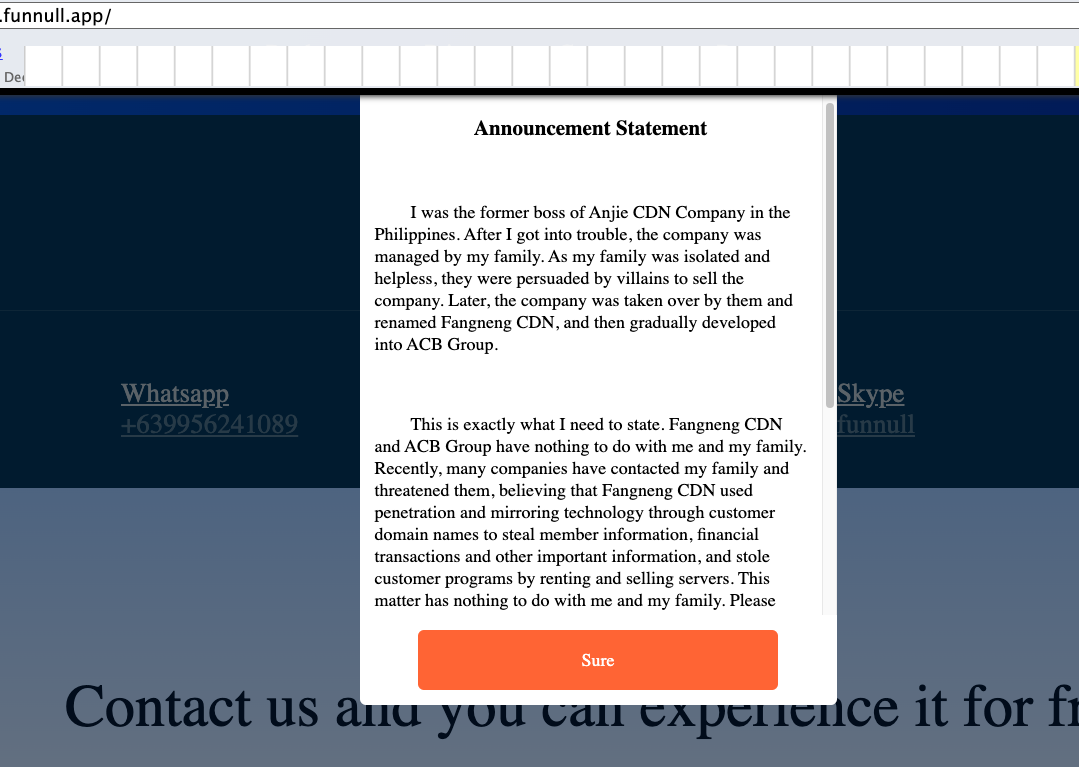
Funnull wasn’t always a bulletproof hosting network for scam sites. Prior to 2022, the network was known as Anjie CDN, based in the Philippines. One of Anjie’s properties was a website called funnull[.]app. Loading that domain reveals a pop-up message by the original Anjie CDN owner, who said their operations had been seized by an entity known as Fangneng CDN and ACB Group, the parent company of Funnull.

A machine-translated message from the former owner of Anjie CDN, a Chinese content delivery network that is now Funnull.

“After I got into trouble, the company was managed by my family,” the message explains. “Because my family was isolated and helpless, they were persuaded by villains to sell the company. Recently, many companies have contacted my family and threatened them, believing that Fangneng CDN used penetration and mirroring technology through customer domain names to steal member information and financial transactions, and stole customer programs by renting and selling servers. This matter has nothing to do with me and my family. Please contact Fangneng CDN to resolve it.”

In January 2024, the U.S. Department of Commerce issued a proposed rule that would require cloud providers to create a “Customer Identification Program” that includes procedures to collect data sufficient to determine whether each potential customer is a foreign or U.S. person.

According to the law firm Crowell & Moring LLP, the Commerce rule also would require “infrastructure as a service” (IaaS) providers to report knowledge of any transactions with foreign persons that might allow the foreign entity to train a large AI model with potential capabilities that could be used in malicious cyber-enabled activity.

“The proposed rulemaking has garnered global attention, as its cross-border data collection requirements are unprecedented in the cloud computing space,” Crowell wrote. “To the extent the U.S. alone imposes these requirements, there is concern that U.S. IaaS providers could face a competitive disadvantage, as U.S. allies have not yet announced similar foreign customer identification requirements.”

It remains unclear if the new White House administration will push forward with the requirements. The Commerce action was mandated as part of an executive order President Trump issued a day before leaving office in January 2021.


Read More

CISA Adds One Known Exploited Vulnerability to Catalog

 ​CISA has added one new vulnerability to its Known Exploited Vulnerabilities Catalog, based on evidence of active exploitation, as confirmed by Fortinet.

CVE-2025-24085 Apple Multiple Products Use-After-Free Vulnerability

These types of vulnerabilities are frequent attack vectors for malicious cyber actors and pose significant risks to the federal enterprise.
Binding Operational Directive (BOD) 22-01: Reducing the Significant Risk of Known Exploited Vulnerabilities established the Known Exploited Vulnerabilities Catalog as a living list of known Common Vulnerabilities and Exposures (CVEs) that carry significant risk to the federal enterprise. BOD 22-01 requires Federal Civilian Executive Branch (FCEB) agencies to remediate identified vulnerabilities by the due date to protect FCEB networks against active threats. See the BOD 22-01 Fact Sheet for more information.
Although BOD 22-01 only applies to FCEB agencies, CISA strongly urges all organizations to reduce their exposure to cyberattacks by prioritizing timely remediation of Catalog vulnerabilities as part of their vulnerability management practice. CISA will continue to add vulnerabilities to the catalog that meet the specified criteria. 

CISA has added one new vulnerability to its Known Exploited Vulnerabilities Catalog, based on evidence of active exploitation, as confirmed by Fortinet.

These types of vulnerabilities are frequent attack vectors for malicious cyber actors and pose significant risks to the federal enterprise.

Binding Operational Directive (BOD) 22-01: Reducing the Significant Risk of Known Exploited Vulnerabilities established the Known Exploited Vulnerabilities Catalog as a living list of known Common Vulnerabilities and Exposures (CVEs) that carry significant risk to the federal enterprise. BOD 22-01 requires Federal Civilian Executive Branch (FCEB) agencies to remediate identified vulnerabilities by the due date to protect FCEB networks against active threats. See the BOD 22-01 Fact Sheet for more information.

Although BOD 22-01 only applies to FCEB agencies, CISA strongly urges all organizations to reduce their exposure to cyberattacks by prioritizing timely remediation of Catalog vulnerabilities as part of their vulnerability management practice. CISA will continue to add vulnerabilities to the catalog that meet the specified criteria.

 Read More

CISA Releases Seven Industrial Control Systems Advisories

 ​CISA released seven Industrial Control Systems (ICS) advisories on January 28, 2025. These advisories provide timely information about current security issues, vulnerabilities, and exploits surrounding ICS.

ICSA-25-028-01 B&R Automation Runtime
ICSA-25-028-02 Schneider Electric Power Logic
ICSA-25-028-03 Rockwell Automation FactoryTalk
ICSA-25-028-04 Rockwell Automation FactoryTalk
ICSA-25-028-05 Rockwell Automation DataMosaix Private Cloud
ICSA-25-028-06 Schneider Electric RemoteConnect and SCADAPack x70 Utilities
ICSMA-24-352-01 BD Diagnostic Solutions Products (Update A)

CISA encourages users and administrators to review newly released ICS advisories for technical details and mitigations. 

CISA released seven Industrial Control Systems (ICS) advisories on January 28, 2025. These advisories provide timely information about current security issues, vulnerabilities, and exploits surrounding ICS.

CISA encourages users and administrators to review newly released ICS advisories for technical details and mitigations.

 Read More

Schneider Electric RemoteConnect and SCADAPack x70 Utilities

 ​View CSAF
1. EXECUTIVE SUMMARY

CVSS v4 8.5
ATTENTION: Low Attack Complexity
Vendor: Schneider Electric
Equipment: Electric RemoteConnect and SCADAPack x70 Utilities
Vulnerability: Deserialization of Untrusted Data

2. RISK EVALUATION
Successful exploitation of this vulnerability could lead to loss of confidentiality, integrity, and potential remote code execution on workstation when a non-admin authenticated user opens a malicious project file.
3. TECHNICAL DETAILS
3.1 AFFECTED PRODUCTS
Schneider Electric reports that the following products are affected:

RemoteConnect: All versions
SCADAPackTM x70 Utilities: All versions

3.2 VULNERABILITY OVERVIEW
3.2.1 DESERIALIZATION OF UNTRUSTED DATA CWE-502
A deserialization of untrusted data vulnerability exists that could lead to loss of confidentiality, integrity, and potential remote code execution on workstation when a non-admin authenticated user opens a malicious project file.
CVE-2024-12703 has been assigned to this vulnerability. A CVSS v3 base score of 7.8 has been assigned; the CVSS vector string is (CVSS:3.1/AV:L/AC:L/PR:N/UI:R/S:U/C:H/I:H/A:H).
A CVSS v4 score has also been calculated for CVE-2024-12703. A base score of 8.5 has been calculated; the CVSS vector string is (CVSS:4.0/AV:L/AC:L/AT:N/PR:N/UI:P/VC:H/VI:H/VA:H/SC:N/SI:N/SA:N).
3.3 BACKGROUND
CRITICAL INFRASTRUCTURE SECTORS: Energy, Critical Manufacturing.

COUNTRIES/AREAS DEPLOYED: Worldwide
COMPANY HEADQUARTERS LOCATION: France

3.4 RESEARCHER
Schneider Electric reported this vulnerability to CISA.
4. MITIGATIONS
Schneider Electric is establishing a remediation plan for all future versions of RemoteConnect and SCADAPackTM x70 Utilities that will include a fix for this vulnerability. Until then, Schneider Electric recommends that users should immediately apply the following mitigations to reduce the risk of exploit:

Only open project files received from a trusted source.
Compute a hash of the project files and regularly check the consistency of this hash to verify the integrity before usage.
Encrypt project file when stored and restrict the access to only trusted users.
When exchanging files over the network, use secure communication protocols.
Follow the SCADAPackTM Security Guidelines.

CISA recommends users take defensive measures to minimize the risk of exploitation of this vulnerability, such as:

Minimize network exposure for all control system devices and/or systems, ensuring they are not accessible from the internet.
Locate control system networks and remote devices behind firewalls and isolating them from business networks.
When remote access is required, use more secure methods, such as Virtual Private Networks (VPNs). Recognize VPNs may have vulnerabilities, should be updated to the most recent version available, and are only as secure as the connected devices.

CISA reminds organizations to perform proper impact analysis and risk assessment prior to deploying defensive measures.
CISA also provides a section for control systems security recommended practices on the ICS webpage on cisa.gov. Several CISA products detailing cyber defense best practices are available for reading and download, including Improving Industrial Control Systems Cybersecurity with Defense-in-Depth Strategies.
CISA encourages organizations to implement recommended cybersecurity strategies for proactive defense of ICS assets. Additional mitigation guidance and recommended practices are publicly available on the ICS webpage at cisa.gov in the technical information paper, ICS-TIP-12-146-01B–Targeted Cyber Intrusion Detection and Mitigation Strategies. Organizations observing suspected malicious activity should follow established internal procedures and report findings to CISA for tracking and correlation against other incidents.
CISA also recommends users take the following measures to protect themselves from social engineering attacks:

Do not click web links or open attachments in unsolicited email messages.
Refer to Recognizing and Avoiding Email Scams for more information on avoiding malicious email.
Refer to Avoiding Social Engineering and Phishing Attacks for more information on social engineering attacks.

No known public exploitation specifically targeting this vulnerability has been reported to CISA at this time. This vulnerability is not exploitable remotely.
5. UPDATE HISTORY

January 28, 2025: Initial Publication 

View CSAF

1. EXECUTIVE SUMMARY

  • CVSS v4 8.5
  • ATTENTION: Low Attack Complexity
  • Vendor: Schneider Electric
  • Equipment: Electric RemoteConnect and SCADAPack x70 Utilities
  • Vulnerability: Deserialization of Untrusted Data

2. RISK EVALUATION

Successful exploitation of this vulnerability could lead to loss of confidentiality, integrity, and potential remote code execution on workstation when a non-admin authenticated user opens a malicious project file.

3. TECHNICAL DETAILS

3.1 AFFECTED PRODUCTS

Schneider Electric reports that the following products are affected:

  • RemoteConnect: All versions
  • SCADAPackTM x70 Utilities: All versions

3.2 VULNERABILITY OVERVIEW

3.2.1 DESERIALIZATION OF UNTRUSTED DATA CWE-502

A deserialization of untrusted data vulnerability exists that could lead to loss of confidentiality, integrity, and potential remote code execution on workstation when a non-admin authenticated user opens a malicious project file.

CVE-2024-12703 has been assigned to this vulnerability. A CVSS v3 base score of 7.8 has been assigned; the CVSS vector string is (CVSS:3.1/AV:L/AC:L/PR:N/UI:R/S:U/C:H/I:H/A:H).

A CVSS v4 score has also been calculated for CVE-2024-12703. A base score of 8.5 has been calculated; the CVSS vector string is (CVSS:4.0/AV:L/AC:L/AT:N/PR:N/UI:P/VC:H/VI:H/VA:H/SC:N/SI:N/SA:N).

3.3 BACKGROUND

CRITICAL INFRASTRUCTURE SECTORS: Energy, Critical Manufacturing.

  • COUNTRIES/AREAS DEPLOYED: Worldwide
  • COMPANY HEADQUARTERS LOCATION: France

3.4 RESEARCHER

Schneider Electric reported this vulnerability to CISA.

4. MITIGATIONS

Schneider Electric is establishing a remediation plan for all future versions of RemoteConnect and SCADAPackTM x70 Utilities that will include a fix for this vulnerability. Until then, Schneider Electric recommends that users should immediately apply the following mitigations to reduce the risk of exploit:

  • Only open project files received from a trusted source.
  • Compute a hash of the project files and regularly check the consistency of this hash to verify the integrity before usage.
  • Encrypt project file when stored and restrict the access to only trusted users.
  • When exchanging files over the network, use secure communication protocols.
  • Follow the SCADAPackTM Security Guidelines.

CISA recommends users take defensive measures to minimize the risk of exploitation of this vulnerability, such as:

  • Minimize network exposure for all control system devices and/or systems, ensuring they are not accessible from the internet.
  • Locate control system networks and remote devices behind firewalls and isolating them from business networks.
  • When remote access is required, use more secure methods, such as Virtual Private Networks (VPNs). Recognize VPNs may have vulnerabilities, should be updated to the most recent version available, and are only as secure as the connected devices.

CISA reminds organizations to perform proper impact analysis and risk assessment prior to deploying defensive measures.

CISA also provides a section for control systems security recommended practices on the ICS webpage on cisa.gov. Several CISA products detailing cyber defense best practices are available for reading and download, including Improving Industrial Control Systems Cybersecurity with Defense-in-Depth Strategies.

CISA encourages organizations to implement recommended cybersecurity strategies for proactive defense of ICS assets. Additional mitigation guidance and recommended practices are publicly available on the ICS webpage at cisa.gov in the technical information paper, ICS-TIP-12-146-01B–Targeted Cyber Intrusion Detection and Mitigation Strategies. Organizations observing suspected malicious activity should follow established internal procedures and report findings to CISA for tracking and correlation against other incidents.

CISA also recommends users take the following measures to protect themselves from social engineering attacks:

No known public exploitation specifically targeting this vulnerability has been reported to CISA at this time. This vulnerability is not exploitable remotely.

5. UPDATE HISTORY

  • January 28, 2025: Initial Publication

 Read More

Rockwell Automation FactoryTalk

 ​View CSAF
1. EXECUTIVE SUMMARY

CVSS v4 9.3
ATTENTION: Low attack complexity
Vendor: Rockwell Automation
Equipment: FactoryTalk
Vulnerabilities: Incorrect Authorization, Improper Neutralization of Special Elements used in an OS Command (‘OS Command Injection’)

2. RISK EVALUATION
Successful exploitation of these vulnerabilities could allow an attacker to execute code on the device with elevated privileges.
3. TECHNICAL DETAILS
3.1 AFFECTED PRODUCTS
The following versions of Rockwell Automation FactoryTalk View ME are affected:

FactoryTalk View ME: All versions prior to 15.0

3.2 VULNERABILITY OVERVIEW
3.2.1 Incorrect Authorization CWE-863
A local code execution vulnerability exists in in Rockwell Automation FactoryTalk products on all versions prior to version 15.0. The vulnerability is due to a default setting in Windows and allows access to the command prompt as a higher privileged user.
CVE-2025-24479 has been assigned to this vulnerability. A CVSS v3.1 base score of 8.4 has been calculated; the CVSS vector string is (AV:L/AC:L/PR:N/UI:N/S:U/C:H/I:H/A:H).
A CVSS v4 score has also been calculated for CVE-2025-24479. A base score of 8.6 has been calculated; the CVSS vector string is (AV:L/AC:L/AT:N/PR:N/UI:N/VC:H/VI:H/VA:H/SC:N/SI:N/SA:N).
3.2.2 Improper Neutralization of Special Elements Used in an OS Command (‘OS Command Injection’) CWE-78
A remote code execution vulnerability exists in Rockwell Automation FactoryTalk products on all versions prior to version 15.0. The vulnerability is due to lack of input sanitation and could allow a remote attacker to run commands or code as a high privileged user.
CVE-2025-24480 has been assigned to this vulnerability. A CVSS v3.1 base score of 9.8 has been calculated; the CVSS vector string is (AV:N/AC:L/PR:N/UI:N/S:U/C:H/I:H/A:H).
A CVSS v4 score has also been calculated for CVE-2025-24480. A base score of 9.3 has been calculated; the CVSS vector string is (AV:N/AC:L/AT:N/PR:N/UI:N/VC:H/VI:H/VA:H/SC:N/SI:N/SA:N).
3.3 BACKGROUND

CRITICAL INFRASTRUCTURE SECTORS: Critical Manufacturing
COUNTRIES/AREAS DEPLOYED: Worldwide
COMPANY HEADQUARTERS LOCATION: United States

3.4 RESEARCHER
Rockwell Automation reported these vulnerabilities to CISA.
4. MITIGATIONS
Rockwell Automation encourages users of the affected software to apply the following risk mitigations, if possible:

CVE-2025-24479

Upgrade to V15.0 or apply patch in AID 1152309
Control physical access to the system

CVE-2025-24480

Upgrade to V15.0 or apply patch in AID 1152331, 1152332.
Protect network access to the device
Strictly constrain the parameters of invoked functions

For information on how to mitigate security risks on industrial automation control systems, Rockwell Automation encourages users to implement their suggested security best practices to minimize the risk of the vulnerability.
Stakeholder-Specific Vulnerability Categorization can be used to generate more environment-specific prioritization.
For more information about this issue, please see the advisory on the Rockwell Automation security page.
CISA recommends users take defensive measures to minimize the risk of exploitation of these vulnerabilities, such as:

Minimize network exposure for all control system devices and/or systems, ensuring they are not accessible from the internet.
Locate control system networks and remote devices behind firewalls and isolating them from business networks.
When remote access is required, use more secure methods, such as Virtual Private Networks (VPNs), recognizing VPNs may have vulnerabilities and should be updated to the most current version available. Also recognize VPN is only as secure as the connected devices.

CISA reminds organizations to perform proper impact analysis and risk assessment prior to deploying defensive measures.
CISA also provides a section for control systems security recommended practices on the ICS webpage on cisa.gov/ics. Several CISA products detailing cyber defense best practices are available for reading and download, including Improving Industrial Control Systems Cybersecurity with Defense-in-Depth Strategies.
CISA encourages organizations to implement recommended cybersecurity strategies for proactive defense of ICS assets.
Additional mitigation guidance and recommended practices are publicly available on the ICS webpage at cisa.gov/ics in the technical information paper, ICS-TIP-12-146-01B–Targeted Cyber Intrusion Detection and Mitigation Strategies.
Organizations observing suspected malicious activity should follow established internal procedures and report findings to CISA for tracking and correlation against other incidents.
No known public exploitation specifically targeting these vulnerabilities has been reported to CISA at this time.
5. UPDATE HISTORY

January 28, 2025: Initial Publication 

View CSAF

1. EXECUTIVE SUMMARY

  • CVSS v4 9.3
  • ATTENTION: Low attack complexity
  • Vendor: Rockwell Automation
  • Equipment: FactoryTalk
  • Vulnerabilities: Incorrect Authorization, Improper Neutralization of Special Elements used in an OS Command (‘OS Command Injection’)

2. RISK EVALUATION

Successful exploitation of these vulnerabilities could allow an attacker to execute code on the device with elevated privileges.

3. TECHNICAL DETAILS

3.1 AFFECTED PRODUCTS

The following versions of Rockwell Automation FactoryTalk View ME are affected:

  • FactoryTalk View ME: All versions prior to 15.0

3.2 VULNERABILITY OVERVIEW

3.2.1 Incorrect Authorization CWE-863

A local code execution vulnerability exists in in Rockwell Automation FactoryTalk products on all versions prior to version 15.0. The vulnerability is due to a default setting in Windows and allows access to the command prompt as a higher privileged user.

CVE-2025-24479 has been assigned to this vulnerability. A CVSS v3.1 base score of 8.4 has been calculated; the CVSS vector string is (AV:L/AC:L/PR:N/UI:N/S:U/C:H/I:H/A:H).

A CVSS v4 score has also been calculated for CVE-2025-24479. A base score of 8.6 has been calculated; the CVSS vector string is (AV:L/AC:L/AT:N/PR:N/UI:N/VC:H/VI:H/VA:H/SC:N/SI:N/SA:N).

3.2.2 Improper Neutralization of Special Elements Used in an OS Command (‘OS Command Injection’) CWE-78

A remote code execution vulnerability exists in Rockwell Automation FactoryTalk products on all versions prior to version 15.0. The vulnerability is due to lack of input sanitation and could allow a remote attacker to run commands or code as a high privileged user.

CVE-2025-24480 has been assigned to this vulnerability. A CVSS v3.1 base score of 9.8 has been calculated; the CVSS vector string is (AV:N/AC:L/PR:N/UI:N/S:U/C:H/I:H/A:H).

A CVSS v4 score has also been calculated for CVE-2025-24480. A base score of 9.3 has been calculated; the CVSS vector string is (AV:N/AC:L/AT:N/PR:N/UI:N/VC:H/VI:H/VA:H/SC:N/SI:N/SA:N).

3.3 BACKGROUND

  • CRITICAL INFRASTRUCTURE SECTORS: Critical Manufacturing
  • COUNTRIES/AREAS DEPLOYED: Worldwide
  • COMPANY HEADQUARTERS LOCATION: United States

3.4 RESEARCHER

Rockwell Automation reported these vulnerabilities to CISA.

4. MITIGATIONS

Rockwell Automation encourages users of the affected software to apply the following risk mitigations, if possible:

  • CVE-2025-24479
    • Upgrade to V15.0 or apply patch in AID 1152309
    • Control physical access to the system
  • CVE-2025-24480
    • Upgrade to V15.0 or apply patch in AID 1152331, 1152332.
    • Protect network access to the device
    • Strictly constrain the parameters of invoked functions

For information on how to mitigate security risks on industrial automation control systems, Rockwell Automation encourages users to implement their suggested security best practices to minimize the risk of the vulnerability.

Stakeholder-Specific Vulnerability Categorization can be used to generate more environment-specific prioritization.

For more information about this issue, please see the advisory on the Rockwell Automation security page.

CISA recommends users take defensive measures to minimize the risk of exploitation of these vulnerabilities, such as:

  • Minimize network exposure for all control system devices and/or systems, ensuring they are not accessible from the internet.
  • Locate control system networks and remote devices behind firewalls and isolating them from business networks.
  • When remote access is required, use more secure methods, such as Virtual Private Networks (VPNs), recognizing VPNs may have vulnerabilities and should be updated to the most current version available. Also recognize VPN is only as secure as the connected devices.

CISA reminds organizations to perform proper impact analysis and risk assessment prior to deploying defensive measures.

CISA also provides a section for control systems security recommended practices on the ICS webpage on cisa.gov/ics. Several CISA products detailing cyber defense best practices are available for reading and download, including Improving Industrial Control Systems Cybersecurity with Defense-in-Depth Strategies.

CISA encourages organizations to implement recommended cybersecurity strategies for proactive defense of ICS assets.

Additional mitigation guidance and recommended practices are publicly available on the ICS webpage at cisa.gov/ics in the technical information paper, ICS-TIP-12-146-01B–Targeted Cyber Intrusion Detection and Mitigation Strategies.

Organizations observing suspected malicious activity should follow established internal procedures and report findings to CISA for tracking and correlation against other incidents.

No known public exploitation specifically targeting these vulnerabilities has been reported to CISA at this time.

5. UPDATE HISTORY

  • January 28, 2025: Initial Publication

 Read More

Schneider Electric Power Logic

 ​View CSAF
1. EXECUTIVE SUMMARY

CVSS v3 8.8
ATTENTION: Exploitable remotely/low attack complexity
Vendor: Schneider Electric
Equipment: Power Logic
Vulnerabilities: Authorization Bypass Through User-Controlled Key, Improper Restriction of Operations within the Bounds of a Memory Buffer

2. RISK EVALUATION
Successful exploitation of these vulnerabilities could allow an attacker to modify data or cause a denial-of-service condition on web interface functionality.
3. TECHNICAL DETAILS
3.1 AFFECTED PRODUCTS
Schneider Electric reports that the following products are affected:

Schneider Electric Power Logic: v0.62.7 (CVE-2024-10497)
Schneider Electric Power Logic: v0.62.7 and prior (CVE-2024-10498)

3.2 VULNERABILITY OVERVIEW
3.2.1 AUTHORIZATION BYPASS THROUGH USER-CONTROLLED KEY CWE-639
An authorization bypass through user-controlled key vulnerability exists that could allow an authorized attacker to modify values outside those defined by their privileges (Elevation of Privileges) when the attacker sends modified HTTPS requests to the device.
CVE-2024-10497 has been assigned to this vulnerability. A CVSS v3 base score of 8.8 has been assigned; the CVSS vector string is (CVSS:3.1/AV:N/AC:L/PR:L/UI:N/S:U/C:H/I:H/A:H).
3.2.2 IMPROPER RESTRICTION OF OPERATIONS WITHIN THE BOUNDS OF A MEMORY BUFFER CWE-119
An improper restriction of operations within the bounds of a memory buffer vulnerability exists that could allow an unauthorized attacker to modify configuration values outside of the normal range when the attacker sends specific Modbus write packets to the device, which could result in invalid data or loss of web interface functionality.
CVE-2024-10498 has been assigned to this vulnerability. A CVSS v3 base score of 6.5 has been assigned; the CVSS vector string is (CVSS:3.1/AV:N/AC:L/PR:N/UI:N/S:U/C:N/I:L/A:L).
3.3 BACKGROUND

CRITICAL INFRASTRUCTURE SECTORS: Energy
COUNTRIES/AREAS DEPLOYED: Worldwide
COMPANY HEADQUARTERS LOCATION: France

3.4 RESEARCHER
Schneider Electric CPCERT reported these vulnerabilities to CISA.
4. MITIGATIONS
Schneider Electric has identified the following specific workarounds and mitigations users can apply to reduce risk:

(CVE-2024-10497) Schneider Electric Power Logic HDPM6000 Version 0.62.7 only: Version v0.62.11 and newer of HDPM6000 includes a fix for these vulnerabilities and is available for download here. A device restart will occur as part of the firmware update process if conducted through the web user interface. If the upgrade is performed using the HDPM6000 Manager software, the device will need to be restarted manually to apply the update.
(CVE-2024-10497) Schneider Electric Power Logic HDPM6000 Version 0.62.7 only: If users choose not to apply the remediation provided above, they should immediately apply the following mitigations to reduce the risk of exploit: Ensure that the device is not accessible via the HTTPS protocol outside the local network segment by applying appropriate firewalls configuration and controls, and that access to the network segment is protected and controlled.
(CVE-2024-10498) Schneider Electric Power Logic HDPM6000 Versions 0.62.7 and prior: Version v0.62.11 and newer of HDPM6000 includes a fix for these vulnerabilities and is available for download here. A device restart will occur as part of the firmware update process if conducted through the web user interface. If the upgrade is performed using the HDPM6000 Manager software, the device will need to be restarted manually to apply the update.
(CVE-2024-10498) Schneider Electric Power Logic HDPM6000 Versions 0.62.7 and prior: If users choose not to apply the remediation provided above, they should immediately apply the following mitigations to reduce the risk of exploit: Ensure that the device is not accessible via the Modbus protocol outside the local network segment by applying appropriate firewalls configuration and controls, and that access to the network segment is protected and controlled.

CISA recommends users take defensive measures to minimize the risk of exploitation of these vulnerabilities, such as:

Minimize network exposure for all control system devices and/or systems, ensuring they are not accessible from the internet.
Locate control system networks and remote devices behind firewalls and isolating them from business networks.
When remote access is required, use more secure methods, such as Virtual Private Networks (VPNs). Recognize VPNs may have vulnerabilities, should be updated to the most recent version available, and are only as secure as the connected devices.

CISA reminds organizations to perform proper impact analysis and risk assessment prior to deploying defensive measures.
CISA also provides a section for control systems security recommended practices on the ICS webpage on cisa.gov. Several CISA products detailing cyber defense best practices are available for reading and download, including Improving Industrial Control Systems Cybersecurity with Defense-in-Depth Strategies.
CISA encourages organizations to implement recommended cybersecurity strategies for proactive defense of ICS assets.
Additional mitigation guidance and recommended practices are publicly available on the ICS webpage at cisa.gov in the technical information paper, ICS-TIP-12-146-01B–Targeted Cyber Intrusion Detection and Mitigation Strategies.
Organizations observing suspected malicious activity should follow established internal procedures and report findings to CISA for tracking and correlation against other incidents.
No known public exploitation specifically targeting these vulnerabilities has been reported to CISA at this time.
5. UPDATE HISTORY

January 28, 2025: Initial Publication 

View CSAF

1. EXECUTIVE SUMMARY

  • CVSS v3 8.8
  • ATTENTION: Exploitable remotely/low attack complexity
  • Vendor: Schneider Electric
  • Equipment: Power Logic
  • Vulnerabilities: Authorization Bypass Through User-Controlled Key, Improper Restriction of Operations within the Bounds of a Memory Buffer

2. RISK EVALUATION

Successful exploitation of these vulnerabilities could allow an attacker to modify data or cause a denial-of-service condition on web interface functionality.

3. TECHNICAL DETAILS

3.1 AFFECTED PRODUCTS

Schneider Electric reports that the following products are affected:

  • Schneider Electric Power Logic: v0.62.7 (CVE-2024-10497)
  • Schneider Electric Power Logic: v0.62.7 and prior (CVE-2024-10498)

3.2 VULNERABILITY OVERVIEW

3.2.1 AUTHORIZATION BYPASS THROUGH USER-CONTROLLED KEY CWE-639

An authorization bypass through user-controlled key vulnerability exists that could allow an authorized attacker to modify values outside those defined by their privileges (Elevation of Privileges) when the attacker sends modified HTTPS requests to the device.

CVE-2024-10497 has been assigned to this vulnerability. A CVSS v3 base score of 8.8 has been assigned; the CVSS vector string is (CVSS:3.1/AV:N/AC:L/PR:L/UI:N/S:U/C:H/I:H/A:H).

3.2.2 IMPROPER RESTRICTION OF OPERATIONS WITHIN THE BOUNDS OF A MEMORY BUFFER CWE-119

An improper restriction of operations within the bounds of a memory buffer vulnerability exists that could allow an unauthorized attacker to modify configuration values outside of the normal range when the attacker sends specific Modbus write packets to the device, which could result in invalid data or loss of web interface functionality.

CVE-2024-10498 has been assigned to this vulnerability. A CVSS v3 base score of 6.5 has been assigned; the CVSS vector string is (CVSS:3.1/AV:N/AC:L/PR:N/UI:N/S:U/C:N/I:L/A:L).

3.3 BACKGROUND

  • CRITICAL INFRASTRUCTURE SECTORS: Energy
  • COUNTRIES/AREAS DEPLOYED: Worldwide
  • COMPANY HEADQUARTERS LOCATION: France

3.4 RESEARCHER

Schneider Electric CPCERT reported these vulnerabilities to CISA.

4. MITIGATIONS

Schneider Electric has identified the following specific workarounds and mitigations users can apply to reduce risk:

  • (CVE-2024-10497) Schneider Electric Power Logic HDPM6000 Version 0.62.7 only: Version v0.62.11 and newer of HDPM6000 includes a fix for these vulnerabilities and is available for download here. A device restart will occur as part of the firmware update process if conducted through the web user interface. If the upgrade is performed using the HDPM6000 Manager software, the device will need to be restarted manually to apply the update.
  • (CVE-2024-10497) Schneider Electric Power Logic HDPM6000 Version 0.62.7 only: If users choose not to apply the remediation provided above, they should immediately apply the following mitigations to reduce the risk of exploit: Ensure that the device is not accessible via the HTTPS protocol outside the local network segment by applying appropriate firewalls configuration and controls, and that access to the network segment is protected and controlled.
  • (CVE-2024-10498) Schneider Electric Power Logic HDPM6000 Versions 0.62.7 and prior: Version v0.62.11 and newer of HDPM6000 includes a fix for these vulnerabilities and is available for download here. A device restart will occur as part of the firmware update process if conducted through the web user interface. If the upgrade is performed using the HDPM6000 Manager software, the device will need to be restarted manually to apply the update.
  • (CVE-2024-10498) Schneider Electric Power Logic HDPM6000 Versions 0.62.7 and prior: If users choose not to apply the remediation provided above, they should immediately apply the following mitigations to reduce the risk of exploit: Ensure that the device is not accessible via the Modbus protocol outside the local network segment by applying appropriate firewalls configuration and controls, and that access to the network segment is protected and controlled.

CISA recommends users take defensive measures to minimize the risk of exploitation of these vulnerabilities, such as:

  • Minimize network exposure for all control system devices and/or systems, ensuring they are not accessible from the internet.
  • Locate control system networks and remote devices behind firewalls and isolating them from business networks.
  • When remote access is required, use more secure methods, such as Virtual Private Networks (VPNs). Recognize VPNs may have vulnerabilities, should be updated to the most recent version available, and are only as secure as the connected devices.

CISA reminds organizations to perform proper impact analysis and risk assessment prior to deploying defensive measures.

CISA also provides a section for control systems security recommended practices on the ICS webpage on cisa.gov. Several CISA products detailing cyber defense best practices are available for reading and download, including Improving Industrial Control Systems Cybersecurity with Defense-in-Depth Strategies.

CISA encourages organizations to implement recommended cybersecurity strategies for proactive defense of ICS assets.

Additional mitigation guidance and recommended practices are publicly available on the ICS webpage at cisa.gov in the technical information paper, ICS-TIP-12-146-01B–Targeted Cyber Intrusion Detection and Mitigation Strategies.

Organizations observing suspected malicious activity should follow established internal procedures and report findings to CISA for tracking and correlation against other incidents.

No known public exploitation specifically targeting these vulnerabilities has been reported to CISA at this time.

5. UPDATE HISTORY

  • January 28, 2025: Initial Publication

 Read More

Rockwell Automation DataMosaix Private Cloud

 ​View CSAF
1. EXECUTIVE SUMMARY

CVSS v4 9.3
ATTENTION: Exploitable remotely/low attack complexity
Vendor: Rockwell Automation
Equipment: DataMosaix Private Cloud
Vulnerabilities: Exposure of Sensitive Information to an Unauthorized Actor, Dependency on Vulnerable Third-Party Component

2. RISK EVALUATION
Successful exploitation of these vulnerabilities could overwrite reports, including user projects.
3. TECHNICAL DETAILS
3.1 AFFECTED PRODUCTS
Rockwell Automation reports the following versions of DataMosaix Private Cloud are affected:

DataEdgePlatform DataMosaix Private Cloud: Version 7.11 and prior (CVE-2025-0659)
DataEdgePlatform DataMosaix Private Cloud: Versions 7.09 and prior (CVE-2020-11656)

3.2 VULNERABILITY OVERVIEW
3.2.1 Exposure of Sensitive Information to an Unauthorized Actor CWE-200
A path traversal vulnerability exists in DataMosaix Private Cloud. By specifying the character sequence in the body of the vulnerable endpoint, it is possible to overwrite files outside of the intended directory. A threat actor with admin privileges could leverage this vulnerability to overwrite reports including user projects.
CVE-2024-11932 has been assigned to this vulnerability. A CVSS v3.1 base score of 5.5 has been calculated; the CVSS vector string is (CVSS:3.1/AV:N/AC:L/PR:H/UI:N/S:U/C:L/I:H/A:N).
A CVSS v4 score has also been calculated for CVE-2024-11932. A base score of 7.0 has been calculated; the CVSS vector string is (CVSS:4.0/AV:N/AC:L/AT:N/PR:H/UI:N/VC:L/VI:H/VA:N/SC:N/SI:N/SA:N).
3.2.2 Dependency on Vulnerable Third-Party Component CWE-1395
DataMosaix Private Cloud utilizes SQLite, which contains a use after free vulnerability in the ALTER TABLE implementation, which was demonstrated by an ORDER BY clause that belongs to a compound SELECT statement.
CVE-2020-11656 has been assigned to this vulnerability. A CVSS v3.1 base score of 9.8 has been calculated; the CVSS vector string is (CVSS:3.1/AV:N/AC:L/PR:N/UI:N/S:U/C:H/I:H/A:H).
A CVSS v4 score has also been calculated for CVE-2020-11656. A base score of 9.3 has been calculated; the CVSS vector string is (CVSS:4.0/AV:N/AC:L/AT:N/PR:N/UI:N/VC:H/VI:H/VA:H/SC:N/SI:N/SA:N).
3.3 BACKGROUND

CRITICAL INFRASTRUCTURE SECTORS: Critical Manufacturing
COUNTRIES/AREAS DEPLOYED: Worldwide
COMPANY HEADQUARTERS LOCATION: United States

3.4 RESEARCHER
Rockwell Automation reported these vulnerabilities to CISA.
4. MITIGATIONS
Rockwell Automation has addressed these issues in version v7.11.01 and encourages users to update to the newest available version. Rockwell Automation encourages users to mitigate security risks on industrial automation control systems by implement their suggested security best practices, where possible.   
For more information about this issue, please see the advisory on the Rockwell Automation security page.
CISA recommends users take defensive measures to minimize the risk of exploitation of these vulnerabilities, such as:

Minimize network exposure for all control system devices and/or systems, ensuring they are not accessible from the Internet.
Locate control system networks and remote devices behind firewalls and isolating them from business networks.
When remote access is required, use more secure methods, such as virtual private networks (VPNs), recognizing VPNs may have vulnerabilities and should be updated to the most current version available. Also recognize VPN is only as secure as the connected devices.

CISA reminds organizations to perform proper impact analysis and risk assessment prior to deploying defensive measures.
CISA also provides a section for control systems security recommended practices on the ICS webpage on cisa.gov/ics. Several CISA products detailing cyber defense best practices are available for reading and download, including Improving Industrial Control Systems Cybersecurity with Defense-in-Depth Strategies.
CISA encourages organizations to implement recommended cybersecurity strategies for proactive defense of ICS assets.
Additional mitigation guidance and recommended practices are publicly available on the ICS webpage at cisa.gov/ics in the technical information paper, ICS-TIP-12-146-01B–Targeted Cyber Intrusion Detection and Mitigation Strategies.
Organizations observing suspected malicious activity should follow established internal procedures and report findings to CISA for tracking and correlation against other incidents.
CISA also recommends users take the following measures to protect themselves from social engineering attacks:

Do not click web links or open attachments in unsolicited email messages.
Refer to Recognizing and Avoiding Email Scams for more information on avoiding email scams.
Refer to Avoiding Social Engineering and Phishing Attacks for more information on social engineering attacks.

No known public exploitation specifically targeting these vulnerabilities has been reported to CISA at this time.
5. UPDATE HISTORY

January 28, 2025: Initial Publication 

View CSAF

1. EXECUTIVE SUMMARY

  • CVSS v4 9.3
  • ATTENTION: Exploitable remotely/low attack complexity
  • Vendor: Rockwell Automation
  • Equipment: DataMosaix Private Cloud
  • Vulnerabilities: Exposure of Sensitive Information to an Unauthorized Actor, Dependency on Vulnerable Third-Party Component

2. RISK EVALUATION

Successful exploitation of these vulnerabilities could overwrite reports, including user projects.

3. TECHNICAL DETAILS

3.1 AFFECTED PRODUCTS

Rockwell Automation reports the following versions of DataMosaix Private Cloud are affected:

  • DataEdgePlatform DataMosaix Private Cloud: Version 7.11 and prior (CVE-2025-0659)
  • DataEdgePlatform DataMosaix Private Cloud: Versions 7.09 and prior (CVE-2020-11656)

3.2 VULNERABILITY OVERVIEW

3.2.1 Exposure of Sensitive Information to an Unauthorized Actor CWE-200

A path traversal vulnerability exists in DataMosaix Private Cloud. By specifying the character sequence in the body of the vulnerable endpoint, it is possible to overwrite files outside of the intended directory. A threat actor with admin privileges could leverage this vulnerability to overwrite reports including user projects.

CVE-2024-11932 has been assigned to this vulnerability. A CVSS v3.1 base score of 5.5 has been calculated; the CVSS vector string is (CVSS:3.1/AV:N/AC:L/PR:H/UI:N/S:U/C:L/I:H/A:N).

A CVSS v4 score has also been calculated for CVE-2024-11932. A base score of 7.0 has been calculated; the CVSS vector string is (CVSS:4.0/AV:N/AC:L/AT:N/PR:H/UI:N/VC:L/VI:H/VA:N/SC:N/SI:N/SA:N).

3.2.2 Dependency on Vulnerable Third-Party Component CWE-1395

DataMosaix Private Cloud utilizes SQLite, which contains a use after free vulnerability in the ALTER TABLE implementation, which was demonstrated by an ORDER BY clause that belongs to a compound SELECT statement.

CVE-2020-11656 has been assigned to this vulnerability. A CVSS v3.1 base score of 9.8 has been calculated; the CVSS vector string is (CVSS:3.1/AV:N/AC:L/PR:N/UI:N/S:U/C:H/I:H/A:H).

A CVSS v4 score has also been calculated for CVE-2020-11656. A base score of 9.3 has been calculated; the CVSS vector string is (CVSS:4.0/AV:N/AC:L/AT:N/PR:N/UI:N/VC:H/VI:H/VA:H/SC:N/SI:N/SA:N).

3.3 BACKGROUND

  • CRITICAL INFRASTRUCTURE SECTORS: Critical Manufacturing
  • COUNTRIES/AREAS DEPLOYED: Worldwide
  • COMPANY HEADQUARTERS LOCATION: United States

3.4 RESEARCHER

Rockwell Automation reported these vulnerabilities to CISA.

4. MITIGATIONS

Rockwell Automation has addressed these issues in version v7.11.01 and encourages users to update to the newest available version. Rockwell Automation encourages users to mitigate security risks on industrial automation control systems by implement their suggested security best practices, where possible.   

For more information about this issue, please see the advisory on the Rockwell Automation security page.

CISA recommends users take defensive measures to minimize the risk of exploitation of these vulnerabilities, such as:

  • Minimize network exposure for all control system devices and/or systems, ensuring they are not accessible from the Internet.
  • Locate control system networks and remote devices behind firewalls and isolating them from business networks.
  • When remote access is required, use more secure methods, such as virtual private networks (VPNs), recognizing VPNs may have vulnerabilities and should be updated to the most current version available. Also recognize VPN is only as secure as the connected devices.

CISA reminds organizations to perform proper impact analysis and risk assessment prior to deploying defensive measures.

CISA also provides a section for control systems security recommended practices on the ICS webpage on cisa.gov/ics. Several CISA products detailing cyber defense best practices are available for reading and download, including Improving Industrial Control Systems Cybersecurity with Defense-in-Depth Strategies.

CISA encourages organizations to implement recommended cybersecurity strategies for proactive defense of ICS assets.

Additional mitigation guidance and recommended practices are publicly available on the ICS webpage at cisa.gov/ics in the technical information paper, ICS-TIP-12-146-01B–Targeted Cyber Intrusion Detection and Mitigation Strategies.

Organizations observing suspected malicious activity should follow established internal procedures and report findings to CISA for tracking and correlation against other incidents.

CISA also recommends users take the following measures to protect themselves from social engineering attacks:

No known public exploitation specifically targeting these vulnerabilities has been reported to CISA at this time.

5. UPDATE HISTORY

  • January 28, 2025: Initial Publication

 Read More

Scroll to Top