
Chinese Innovations Spawn Wave of Toll Phishing Via SMS

​Residents across the United States are being inundated with text messages purporting to come from toll road operators like E-ZPass, warning that recipients face fines if a delinquent toll fee remains unpaid. Researchers say the surge in SMS spam coincides with new features added to a popular commercial phishing kit sold in China that makes it simple to set up convincing lures spoofing toll road operators in multiple U.S. states. 

Residents across the United States are being inundated with text messages purporting to come from toll road operators like E-ZPass, warning that recipients face fines if a delinquent toll fee remains unpaid. Researchers say the surge in SMS spam coincides with new features added to a popular commercial phishing kit sold in China that makes it simple to set up convincing lures spoofing toll road operators in multiple U.S. states.

Last week, the Massachusetts Department of Transportation (MassDOT) warned residents to be on the lookout for a new SMS phishing or “smishing” scam targeting users of EZDriveMA, MassDOT’s all electronic tolling program. Those who fall for the scam are asked to provide payment card data, and eventually will be asked to supply a one-time password sent via SMS or a mobile authentication app.

Reports of similar SMS phishing attacks against customers of other U.S. state-run toll facilities surfaced around the same time as the MassDOT alert. People in Florida reported receiving SMS phishing that spoofed Sunpass, Florida’s prepaid toll program.
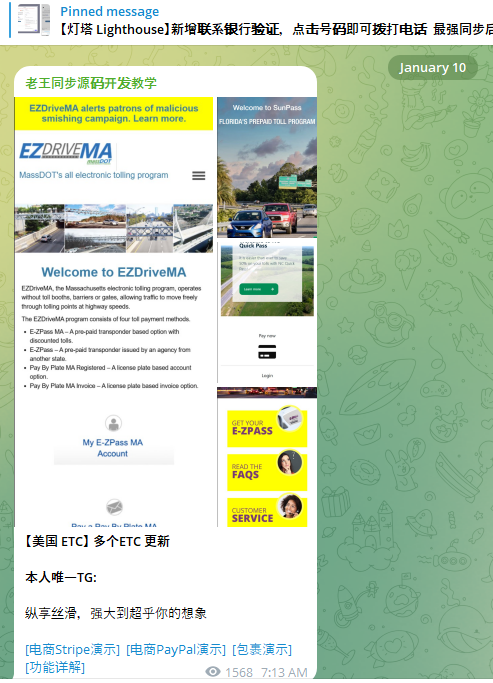
This phishing module for spoofing MassDOT’s EZDrive toll system was offered on Jan. 10, 2025 by a China-based SMS phishing service called “Lighthouse.”

In Texas, residents said they received text messages about unpaid tolls with the North Texas Toll Authority. Similar reports came from readers in California, Colorado, Connecticut, Minnesota, and Washington. This is by no means a comprehensive list.

A new module from the Lighthouse SMS phishing kit released Jan. 14 targets customers of the North Texas Toll Authority (NTTA).

In each case, the emergence of these SMS phishing attacks coincided with the release of new phishing kit capabilities that closely mimic these toll operator websites as they appear on mobile devices. Notably, none of the phishing pages will even load unless the website detects that the visitor is coming from a mobile device.

Ford Merrill works in security research at SecAlliance, a CSIS Security Group company. Merrill said the volume of SMS phishing attacks spoofing toll road operators skyrocketed after the New Year, when at least one Chinese cybercriminal group known for selling sophisticated SMS phishing kits began offering new phishing pages designed to spoof toll operators in various U.S. states.

According to Merrill, multiple China-based cybercriminals are selling distinct SMS-based phishing kits that each have hundreds or thousands of customers. The ultimate goal of these kits, he said, is to phish enough information from victims that their payment cards can be added to mobile wallets and used to buy goods at physical stores, online, or to launder money through shell companies.
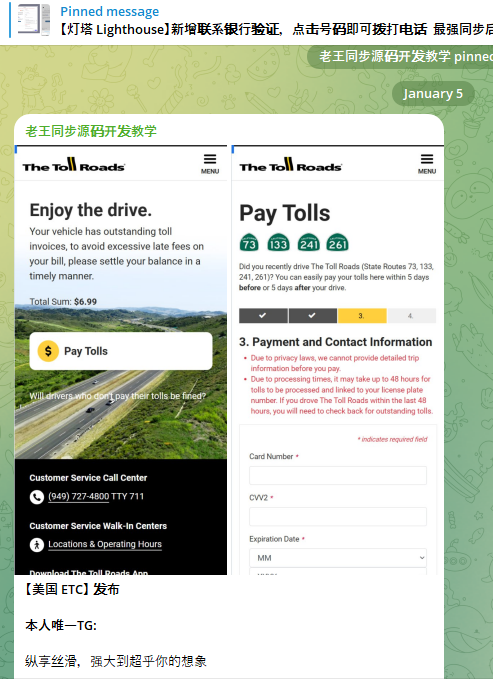
A component of the Chinese SMS phishing kit Lighthouse made to target customers of The Toll Roads, which refers to several state routes through Orange County, Calif.

Merrill said the different purveyors of these SMS phishing tools traditionally have impersonated shipping companies, customs authorities, and even governments with tax refund lures and visa or immigration renewal scams targeting people who may be living abroad or new to a country.

“What we’re seeing with these tolls scams is just a continuation of the Chinese smishing groups rotating from package redelivery schemes to toll road scams,” Merrill said. “Every one of us by now is sick and tired of receiving these package smishing attacks, so now it’s a new twist on an existing scam.”

In October 2023, KrebsOnSecurity wrote about a massive uptick in SMS phishing scams targeting U.S. Postal Service customers. That story revealed the surge was tied to innovations introduced by “Chenlun,” a mainland China-based proprietor of a popular phishing kit and service. At the time, Chenlun had just introduced new phishing pages made to impersonate postal services in the United States and at least a dozen other countries.

SMS phishing kits are hardly new, but Merrill said Chinese smishing groups recently have introduced innovations in deliverability, by more seamlessly integrating their spam messages with Apple’s iMessage technology, and with RCS, the equivalent “rich text” messaging capability built into Android devices.

“While traditional smishing kits relied heavily on SMS for delivery, nowadays the actors make heavy use of iMessage and RCS because telecom operators can’t filter them and they likely have a higher success rate with these delivery channels,” he said.

It remains unclear how the phishers have selected their targets, or from where their data may be sourced. A notice from MassDOT cautions that “the targeted phone numbers seem to be chosen at random and are not uniquely associated with an account or usage of toll roads.”

Indeed, one reader shared on Mastodon yesterday that they’d received one of these SMS phishing attacks spoofing a local toll operator, when they didn’t even own a vehicle.

Targeted or not, these phishing websites are dangerous because they are operated dynamically in real-time by criminals. If you receive one of these messages, just ignore it or delete it, but please do not visit the phishing site. The FBI asks that before you bin the missives, consider filing a complaint with the agency’s Internet Crime Complaint Center (IC3), including the phone number where the text originated, and the website listed within the text.


Read More

CISA and Partners Release Call to Action to Close the National Software Understanding Gap

 ​Today, CISA—in partnership with the Defense Advanced Research Projects Agency (DARPA), the Office of the Under Secretary of Defense for Research and Engineering (OUSD R&E), and the National Security Agency (NSA)—published Closing the Software Understanding Gap. This report urgently implores the U.S. government to take decisive and coordinated action.
 Software understanding refers to assessing software-controlled systems across all conditions. Mission owners and operators often lack adequate capabilities for software understanding because technology manufacturers build software that greatly outstrips the ability to understand it. This gap, along with the lack of secure by design software being created by technology manufacturers, can lead to the exploitation of software vulnerabilities.
 The U.S. government has engaged in activities that have paved the way toward improving software understanding, including research investments, mission agency initiatives, and policy actions. This report further explores the opportunity for enhanced coordination to strengthen technical foundations and progress towards a more vigorous understanding of software on a national scale. To learn more about development practices and principles that build cybersecurity into the design and manufacture of technology products, visit CISA’s Secure by Design webpage. 

Today, CISA—in partnership with the Defense Advanced Research Projects Agency (DARPA), the Office of the Under Secretary of Defense for Research and Engineering (OUSD R&E), and the National Security Agency (NSA)—published Closing the Software Understanding Gap. This report urgently implores the U.S. government to take decisive and coordinated action.

 Software understanding refers to assessing software-controlled systems across all conditions. Mission owners and operators often lack adequate capabilities for software understanding because technology manufacturers build software that greatly outstrips the ability to understand it. This gap, along with the lack of secure by design software being created by technology manufacturers, can lead to the exploitation of software vulnerabilities.

 The U.S. government has engaged in activities that have paved the way toward improving software understanding, including research investments, mission agency initiatives, and policy actions. This report further explores the opportunity for enhanced coordination to strengthen technical foundations and progress towards a more vigorous understanding of software on a national scale. To learn more about development practices and principles that build cybersecurity into the design and manufacture of technology products, visit CISA’s Secure by Design webpage.

 Read More

Schneider Electric Data Center Expert

 ​View CSAF
1. EXECUTIVE SUMMARY

CVSS v3 7.2
ATTENTION: Exploitable remotely/low attack complexity
Vendor: Schneider Electric
Equipment: Data Center Expert
Vulnerabilities: Improper Verification of Cryptographic Signature, Missing Authentication for Critical Function

2. RISK EVALUATION
Exploitation of these vulnerabilities could allow an attacker to expose private data or achieve remote code execution.
3. TECHNICAL DETAILS
3.1 AFFECTED PRODUCTS
Schneider Electric reports that the following products are affected:

Schneider Electric Data Center Expert: 8.1.1.3 and prior

3.2 VULNERABILITY OVERVIEW
3.2.1 IMPROPER VERIFICATION OF CRYPTOGRAPHIC SIGNATURE CWE-347
An improper verification of cryptographic signature vulnerability exists that could compromise the Data Center Expert software when an upgrade bundle is manipulated to include arbitrary bash scripts that are executed as root.
CVE-2024-8531 has been assigned to this vulnerability. A CVSS v3 base score of 7.2 has been assigned; the CVSS vector string is (CVSS:3.1/AV:N/AC:L/PR:H/UI:N/S:U/C:H/I:H/A:H).
3.2.2 MISSING AUTHENTICATION FOR CRITICAL FUNCTION CWE-306
A missing authentication for critical function vulnerability exists that could cause exposure of private data when an already generated “logcaptures” archive is accessed directly by HTTPS.
CVE-2024-8530 has been assigned to this vulnerability. A CVSS v3 base score of 5.9 has been assigned; the CVSS vector string is (CVSS:3.1/AV:N/AC:H/PR:N/UI:N/S:U/C:H/I:N/A:N).
3.3 BACKGROUND

CRITICAL INFRASTRUCTURE SECTORS: Critical Manufacturing
COUNTRIES/AREAS DEPLOYED: Worldwide
COMPANY HEADQUARTERS LOCATION: France

3.4 RESEARCHER
Schneider Electric CPCERT reported these vulnerabilities to CISA.
Trend Micro Zero Day Initiative reported these vulnerabilities to CISA.
4. MITIGATIONS
Schneider Electric has identified the following specific workarounds and mitigations users can apply to reduce risk:
Version 8.2 of EcoStruxure™ IT Data Center Expert includes fixes for these vulnerabilities and is available upon request from Schneider Electric’s Customer Care Center.
Additionally, Schneider Electric recommends that users:

Ensure the principals of least privilege are being followed so that only those with need have account access and that the level of their respective account authorization aligns with their role, including Privileged Accounts as described in the Data Center Expert Security Handbook.
Verify SHA1 checksums of upgrade bundles prior to executing upgrades as described in the Upgrades section of the Data Center Expert Security Handbook.
Delete any existing “logcapture” archives present on the system and do not create any new “logcapture” archives. Existing archives can be deleted from the https://server_ip/capturelogs web page after authenticating.

CISA recommends users take defensive measures to minimize the risk of exploitation of these vulnerabilities, such as:

Minimize network exposure for all control system devices and/or systems, ensuring they are not accessible from the Internet.
Locate control system networks and remote devices behind firewalls and isolating them from business networks.
When remote access is required, use more secure methods, such as Virtual Private Networks (VPNs). Recognize VPNs may have vulnerabilities, should be updated to the most recent version available, and are only as secure as the connected devices.

CISA reminds organizations to perform proper impact analysis and risk assessment prior to deploying defensive measures.
CISA also provides a section for control systems security recommended practices on the ICS webpage on cisa.gov. Several CISA products detailing cyber defense best practices are available for reading and download, including Improving Industrial Control Systems Cybersecurity with Defense-in-Depth Strategies.
CISA encourages organizations to implement recommended cybersecurity strategies for proactive defense of ICS assets.
Additional mitigation guidance and recommended practices are publicly available on the ICS webpage at cisa.gov in the technical information paper, ICS-TIP-12-146-01B–Targeted Cyber Intrusion Detection and Mitigation Strategies.
Organizations observing suspected malicious activity should follow established internal procedures and report findings to CISA for tracking and correlation against other incidents.
CISA also recommends users take the following measures to protect themselves from social engineering attacks:

Do not click web links or open attachments in unsolicited email messages.
Refer to Recognizing and Avoiding Email Scams for more information on avoiding email scams.
Refer to Avoiding Social Engineering and Phishing Attacks for more information on social engineering attacks.

No known public exploitation specifically targeting these vulnerabilities has been reported to CISA at this time.
5. UPDATE HISTORY

January 16, 2025: Initial Publication 

View CSAF

1. EXECUTIVE SUMMARY

  • CVSS v3 7.2
  • ATTENTION: Exploitable remotely/low attack complexity
  • Vendor: Schneider Electric
  • Equipment: Data Center Expert
  • Vulnerabilities: Improper Verification of Cryptographic Signature, Missing Authentication for Critical Function

2. RISK EVALUATION

Exploitation of these vulnerabilities could allow an attacker to expose private data or achieve remote code execution.

3. TECHNICAL DETAILS

3.1 AFFECTED PRODUCTS

Schneider Electric reports that the following products are affected:

  • Schneider Electric Data Center Expert: 8.1.1.3 and prior

3.2 VULNERABILITY OVERVIEW

3.2.1 IMPROPER VERIFICATION OF CRYPTOGRAPHIC SIGNATURE CWE-347

An improper verification of cryptographic signature vulnerability exists that could compromise the Data Center Expert software when an upgrade bundle is manipulated to include arbitrary bash scripts that are executed as root.

CVE-2024-8531 has been assigned to this vulnerability. A CVSS v3 base score of 7.2 has been assigned; the CVSS vector string is (CVSS:3.1/AV:N/AC:L/PR:H/UI:N/S:U/C:H/I:H/A:H).

3.2.2 MISSING AUTHENTICATION FOR CRITICAL FUNCTION CWE-306

A missing authentication for critical function vulnerability exists that could cause exposure of private data when an already generated “logcaptures” archive is accessed directly by HTTPS.

CVE-2024-8530 has been assigned to this vulnerability. A CVSS v3 base score of 5.9 has been assigned; the CVSS vector string is (CVSS:3.1/AV:N/AC:H/PR:N/UI:N/S:U/C:H/I:N/A:N).

3.3 BACKGROUND

  • CRITICAL INFRASTRUCTURE SECTORS: Critical Manufacturing
  • COUNTRIES/AREAS DEPLOYED: Worldwide
  • COMPANY HEADQUARTERS LOCATION: France

3.4 RESEARCHER

Schneider Electric CPCERT reported these vulnerabilities to CISA.

Trend Micro Zero Day Initiative reported these vulnerabilities to CISA.

4. MITIGATIONS

Schneider Electric has identified the following specific workarounds and mitigations users can apply to reduce risk:

Version 8.2 of EcoStruxure™ IT Data Center Expert includes fixes for these vulnerabilities and is available upon request from Schneider Electric’s Customer Care Center.

Additionally, Schneider Electric recommends that users:

  • Ensure the principals of least privilege are being followed so that only those with need have account access and that the level of their respective account authorization aligns with their role, including Privileged Accounts as described in the Data Center Expert Security Handbook.
  • Verify SHA1 checksums of upgrade bundles prior to executing upgrades as described in the Upgrades section of the Data Center Expert Security Handbook.
  • Delete any existing “logcapture” archives present on the system and do not create any new “logcapture” archives. Existing archives can be deleted from the https://server_ip/capturelogs web page after authenticating.

CISA recommends users take defensive measures to minimize the risk of exploitation of these vulnerabilities, such as:

  • Minimize network exposure for all control system devices and/or systems, ensuring they are not accessible from the Internet.
  • Locate control system networks and remote devices behind firewalls and isolating them from business networks.
  • When remote access is required, use more secure methods, such as Virtual Private Networks (VPNs). Recognize VPNs may have vulnerabilities, should be updated to the most recent version available, and are only as secure as the connected devices.

CISA reminds organizations to perform proper impact analysis and risk assessment prior to deploying defensive measures.

CISA also provides a section for control systems security recommended practices on the ICS webpage on cisa.gov. Several CISA products detailing cyber defense best practices are available for reading and download, including Improving Industrial Control Systems Cybersecurity with Defense-in-Depth Strategies.

CISA encourages organizations to implement recommended cybersecurity strategies for proactive defense of ICS assets.

Additional mitigation guidance and recommended practices are publicly available on the ICS webpage at cisa.gov in the technical information paper, ICS-TIP-12-146-01B–Targeted Cyber Intrusion Detection and Mitigation Strategies.

Organizations observing suspected malicious activity should follow established internal procedures and report findings to CISA for tracking and correlation against other incidents.

CISA also recommends users take the following measures to protect themselves from social engineering attacks:

No known public exploitation specifically targeting these vulnerabilities has been reported to CISA at this time.

5. UPDATE HISTORY

  • January 16, 2025: Initial Publication

 Read More

Fuji Electric Alpha5 SMART

 ​View CSAF
1. EXECUTIVE SUMMARY

CVSS v4 8.5
ATTENTION: Low attack complexity
Vendor: Fuji Electric
Equipment: Alpha5 SMART
Vulnerability: Stack-based Buffer Overflow

2. RISK EVALUATION
Successful exploitation of this vulnerability could allow an attacker to execute arbitrary code.
3. TECHNICAL DETAILS
3.1 AFFECTED PRODUCTS
The following versions of Fuji Electric Alpha5 SMART, a servo drive system, are affected:

Alpha5 SMART: Versions 4.5 and prior

3.2 VULNERABILITY OVERVIEW
3.2.1 STACK-BASED BUFFER OVERFLOW CWE-121
The affected product is vulnerable to a stack-based buffer overflow, which may allow an attacker to execute arbitrary code.
CVE-2024-34579 has been assigned to this vulnerability. A CVSS v3.1 base score of 7.8 has been calculated; the CVSS vector string is (AV:L/AC:L/PR:N/UI:R/S:U/C:H/I:H/A:H).
A CVSS v4 score has also been calculated for CVE-2024-34579. A base score of 8.5 has been calculated; the CVSS vector string is (CVSS4.0/AV:L/AC:L/AT:N/PR:N/UI:P/VC:H/VI:H/VA:H/SC:N/SI:N/SA:N).
3.3 BACKGROUND

CRITICAL INFRASTRUCTURE SECTORS: Critical Manufacturing
COUNTRIES/AREAS DEPLOYED: Worldwide
COMPANY HEADQUARTERS LOCATION: Japan

3.4 RESEARCHER
An anonymous researcher working with Trend Micro’s Zero Day Initiative reported this vulnerability to CISA.
4. MITIGATIONS
Fuji Electric has indicated that the vulnerabilities will not be fixed in Alpha5 SMART. Fuji Electric recommends users upgrade their systems to Alpha7.
For assistance, reach out directly to Fuji Electric’s support team.
CISA recommends users take defensive measures to minimize the risk of exploitation of this vulnerability, such as:

Minimize network exposure for all control system devices and/or systems, ensuring they are not accessible from the Internet.
Locate control system networks and remote devices behind firewalls and isolating them from business networks.
When remote access is required, use more secure methods, such as Virtual Private Networks (VPNs), recognizing VPNs may have vulnerabilities and should be updated to the most current version available. Also recognize VPN is only as secure as the connected devices.

CISA reminds organizations to perform proper impact analysis and risk assessment prior to deploying defensive measures.
CISA also provides a section for control systems security recommended practices on the ICS webpage on cisa.gov/ics. Several CISA products detailing cyber defense best practices are available for reading and download, including Improving Industrial Control Systems Cybersecurity with Defense-in-Depth Strategies.
CISA encourages organizations to implement recommended cybersecurity strategies for proactive defense of ICS assets.
Additional mitigation guidance and recommended practices are publicly available on the ICS webpage at cisa.gov/ics in the technical information paper, ICS-TIP-12-146-01B–Targeted Cyber Intrusion Detection and Mitigation Strategies.
Organizations observing suspected malicious activity should follow established internal procedures and report findings to CISA for tracking and correlation against other incidents.
No known public exploitation specifically targeting this vulnerability has been reported to CISA at this time. This vulnerability is not exploitable remotely.
5. UPDATE HISTORY

January 16, 2025: Initial Publication 

View CSAF

1. EXECUTIVE SUMMARY

  • CVSS v4 8.5
  • ATTENTION: Low attack complexity
  • Vendor: Fuji Electric
  • Equipment: Alpha5 SMART
  • Vulnerability: Stack-based Buffer Overflow

2. RISK EVALUATION

Successful exploitation of this vulnerability could allow an attacker to execute arbitrary code.

3. TECHNICAL DETAILS

3.1 AFFECTED PRODUCTS

The following versions of Fuji Electric Alpha5 SMART, a servo drive system, are affected:

  • Alpha5 SMART: Versions 4.5 and prior

3.2 VULNERABILITY OVERVIEW

3.2.1 STACK-BASED BUFFER OVERFLOW CWE-121

The affected product is vulnerable to a stack-based buffer overflow, which may allow an attacker to execute arbitrary code.

CVE-2024-34579 has been assigned to this vulnerability. A CVSS v3.1 base score of 7.8 has been calculated; the CVSS vector string is (AV:L/AC:L/PR:N/UI:R/S:U/C:H/I:H/A:H).

A CVSS v4 score has also been calculated for CVE-2024-34579. A base score of 8.5 has been calculated; the CVSS vector string is (CVSS4.0/AV:L/AC:L/AT:N/PR:N/UI:P/VC:H/VI:H/VA:H/SC:N/SI:N/SA:N).

3.3 BACKGROUND

  • CRITICAL INFRASTRUCTURE SECTORS: Critical Manufacturing
  • COUNTRIES/AREAS DEPLOYED: Worldwide
  • COMPANY HEADQUARTERS LOCATION: Japan

3.4 RESEARCHER

An anonymous researcher working with Trend Micro’s Zero Day Initiative reported this vulnerability to CISA.

4. MITIGATIONS

Fuji Electric has indicated that the vulnerabilities will not be fixed in Alpha5 SMART. Fuji Electric recommends users upgrade their systems to Alpha7.

For assistance, reach out directly to Fuji Electric’s support team.

CISA recommends users take defensive measures to minimize the risk of exploitation of this vulnerability, such as:

  • Minimize network exposure for all control system devices and/or systems, ensuring they are not accessible from the Internet.
  • Locate control system networks and remote devices behind firewalls and isolating them from business networks.
  • When remote access is required, use more secure methods, such as Virtual Private Networks (VPNs), recognizing VPNs may have vulnerabilities and should be updated to the most current version available. Also recognize VPN is only as secure as the connected devices.

CISA reminds organizations to perform proper impact analysis and risk assessment prior to deploying defensive measures.

CISA also provides a section for control systems security recommended practices on the ICS webpage on cisa.gov/ics. Several CISA products detailing cyber defense best practices are available for reading and download, including Improving Industrial Control Systems Cybersecurity with Defense-in-Depth Strategies.

CISA encourages organizations to implement recommended cybersecurity strategies for proactive defense of ICS assets.

Additional mitigation guidance and recommended practices are publicly available on the ICS webpage at cisa.gov/ics in the technical information paper, ICS-TIP-12-146-01B–Targeted Cyber Intrusion Detection and Mitigation Strategies.

Organizations observing suspected malicious activity should follow established internal procedures and report findings to CISA for tracking and correlation against other incidents.

No known public exploitation specifically targeting this vulnerability has been reported to CISA at this time. This vulnerability is not exploitable remotely.

5. UPDATE HISTORY

  • January 16, 2025: Initial Publication

 Read More

Siemens Siveillance Video Camera

 ​As of January 10, 2023, CISA will no longer be updating ICS security advisories for Siemens product vulnerabilities beyond the initial advisory. For the most up-to-date information on vulnerabilities in this advisory, please see Siemens’ ProductCERT Security Advisories (CERT Services | Services | Siemens Global).
View CSAF
1. EXECUTIVE SUMMARY

CVSS v4 5.2
ATTENTION: Exploitable locally
Vendor: Siemens
Equipment: Siveillance Video Camera Drivers
Vulnerability: Insertion of Sensitive Information into Log File

2. RISK EVALUATION
Successful exploitation of this vulnerability could allow a local attacker to read camera credentials stored in the Recording Server under specific conditions.
3. TECHNICAL DETAILS
3.1 AFFECTED PRODUCTS
Siemens reports that the following products are affected:

Siveillance Video Device Pack: Versions prior to V13.5

3.2 VULNERABILITY OVERVIEW
3.2.1 INSERTION OF SENSITIVE INFORMATION INTO LOG FILE CWE-532
Disclosure of sensitive information in HikVision camera driver’s log file in XProtect Device Pack allows an attacker to read camera credentials stored in the Recording Server under specific conditions.
CVE-2024-12569 has been assigned to this vulnerability. A CVSS v3 base score of 7.8 has been assigned; the CVSS vector string is (CVSS:3.1/AV:L/AC:H/PR:L/UI:N/S:C/C:H/I:H/A:H).
A CVSS v4 score has also been calculated for CVE-2024-12569. A base score of 5.2 has been calculated; the CVSS vector string is (CVSS:4.0/AV:L/AC:L/AT:P/PR:L/UI:N/VC:N/VI:N/VA:N/SC:H/SI:H/SA:H).
3.3 BACKGROUND

CRITICAL INFRASTRUCTURE SECTORS: Commercial Facilities, Critical Manufacturing
COUNTRIES/AREAS DEPLOYED: Worldwide
COMPANY HEADQUARTERS LOCATION: Germany

3.4 RESEARCHER
Siemens ProductCERT reported this vulnerability to CISA.
4. MITIGATIONS
Siemens has identified the following specific workarounds and mitigations users can apply to reduce risk:

Ensure that only trusted people get local access to the driver log files on the Recording Server.
Update to V13.5 or later version.

As a general security measure, Siemens recommends protecting network access to devices with appropriate mechanisms. To operate the devices in a protected IT environment, Siemens recommends configuring the environment according to Siemens’ operational guidelines for industrial security and following recommendations in the product manuals.
Additional information on industrial security by Siemens can be found on the Siemens industrial security webpage
For more information see the associated Siemens security advisory SSA-404759 in HTML and CSAF.
CISA recommends users take defensive measures to minimize the risk of exploitation of this vulnerability, such as:

Minimize network exposure for all control system devices and/or systems, ensuring they are not accessible from the internet.
Locate control system networks and remote devices behind firewalls and isolating them from business networks.
When remote access is required, use more secure methods, such as Virtual Private Networks (VPNs). Recognize VPNs may have vulnerabilities, should be updated to the most recent version available, and are only as secure as the connected devices.

CISA reminds organizations to perform proper impact analysis and risk assessment prior to deploying defensive measures.
CISA also provides a section for control systems security recommended practices on the ICS webpage on cisa.gov. Several CISA products detailing cyber defense best practices are available for reading and download, including Improving Industrial Control Systems Cybersecurity with Defense-in-Depth Strategies.
CISA encourages organizations to implement recommended cybersecurity strategies for proactive defense of ICS assets.
Additional mitigation guidance and recommended practices are publicly available on the ICS webpage at cisa.gov in the technical information paper, ICS-TIP-12-146-01B–Targeted Cyber Intrusion Detection and Mitigation Strategies.
Organizations observing suspected malicious activity should follow established internal procedures and report findings to CISA for tracking and correlation against other incidents.
No known public exploitation specifically targeting this vulnerability has been reported to CISA at this time. This vulnerability is not exploitable remotely. This vulnerability has a high attack complexity.
5. UPDATE HISTORY

January 16, 2025: Initial Publication 

As of January 10, 2023, CISA will no longer be updating ICS security advisories for Siemens product vulnerabilities beyond the initial advisory. For the most up-to-date information on vulnerabilities in this advisory, please see Siemens’ ProductCERT Security Advisories (CERT Services | Services | Siemens Global).

View CSAF

1. EXECUTIVE SUMMARY

  • CVSS v4 5.2
  • ATTENTION: Exploitable locally
  • Vendor: Siemens
  • Equipment: Siveillance Video Camera Drivers
  • Vulnerability: Insertion of Sensitive Information into Log File

2. RISK EVALUATION

Successful exploitation of this vulnerability could allow a local attacker to read camera credentials stored in the Recording Server under specific conditions.

3. TECHNICAL DETAILS

3.1 AFFECTED PRODUCTS

Siemens reports that the following products are affected:

  • Siveillance Video Device Pack: Versions prior to V13.5

3.2 VULNERABILITY OVERVIEW

3.2.1 INSERTION OF SENSITIVE INFORMATION INTO LOG FILE CWE-532

Disclosure of sensitive information in HikVision camera driver’s log file in XProtect Device Pack allows an attacker to read camera credentials stored in the Recording Server under specific conditions.

CVE-2024-12569 has been assigned to this vulnerability. A CVSS v3 base score of 7.8 has been assigned; the CVSS vector string is (CVSS:3.1/AV:L/AC:H/PR:L/UI:N/S:C/C:H/I:H/A:H).

A CVSS v4 score has also been calculated for CVE-2024-12569. A base score of 5.2 has been calculated; the CVSS vector string is (CVSS:4.0/AV:L/AC:L/AT:P/PR:L/UI:N/VC:N/VI:N/VA:N/SC:H/SI:H/SA:H).

3.3 BACKGROUND

  • CRITICAL INFRASTRUCTURE SECTORS: Commercial Facilities, Critical Manufacturing
  • COUNTRIES/AREAS DEPLOYED: Worldwide
  • COMPANY HEADQUARTERS LOCATION: Germany

3.4 RESEARCHER

Siemens ProductCERT reported this vulnerability to CISA.

4. MITIGATIONS

Siemens has identified the following specific workarounds and mitigations users can apply to reduce risk:

  • Ensure that only trusted people get local access to the driver log files on the Recording Server.
  • Update to V13.5 or later version.

As a general security measure, Siemens recommends protecting network access to devices with appropriate mechanisms. To operate the devices in a protected IT environment, Siemens recommends configuring the environment according to Siemens’ operational guidelines for industrial security and following recommendations in the product manuals.

Additional information on industrial security by Siemens can be found on the Siemens industrial security webpage

For more information see the associated Siemens security advisory SSA-404759 in HTML and CSAF.

CISA recommends users take defensive measures to minimize the risk of exploitation of this vulnerability, such as:

  • Minimize network exposure for all control system devices and/or systems, ensuring they are not accessible from the internet.
  • Locate control system networks and remote devices behind firewalls and isolating them from business networks.
  • When remote access is required, use more secure methods, such as Virtual Private Networks (VPNs). Recognize VPNs may have vulnerabilities, should be updated to the most recent version available, and are only as secure as the connected devices.

CISA reminds organizations to perform proper impact analysis and risk assessment prior to deploying defensive measures.

CISA also provides a section for control systems security recommended practices on the ICS webpage on cisa.gov. Several CISA products detailing cyber defense best practices are available for reading and download, including Improving Industrial Control Systems Cybersecurity with Defense-in-Depth Strategies.

CISA encourages organizations to implement recommended cybersecurity strategies for proactive defense of ICS assets.

Additional mitigation guidance and recommended practices are publicly available on the ICS webpage at cisa.gov in the technical information paper, ICS-TIP-12-146-01B–Targeted Cyber Intrusion Detection and Mitigation Strategies.

Organizations observing suspected malicious activity should follow established internal procedures and report findings to CISA for tracking and correlation against other incidents.

No known public exploitation specifically targeting this vulnerability has been reported to CISA at this time. This vulnerability is not exploitable remotely. This vulnerability has a high attack complexity.

5. UPDATE HISTORY

  • January 16, 2025: Initial Publication

 Read More

CISA Releases Twelve Industrial Control Systems Advisories

 ​CISA released twelve Industrial Control Systems (ICS) advisories on January 16, 2025. These advisories provide timely information about current security issues, vulnerabilities, and exploits surrounding ICS.

ICSA-25-016-01 Siemens Mendix LDAP
ICSA-25-016-02 Siemens Industrial Edge Management
ICSA-25-016-03 Siemens Siveillance Video Camera
ICSA-25-016-04 Siemens SIPROTEC 5 Products
ICSA-25-016-05 Fuji Electric Alpha5 SMART
ICSA-25-016-06 Hitachi Energy FOX61x, FOXCST, and FOXMAN-UN Products
ICSA-25-016-07 Hitachi Energy FOX61x Products
ICSA-25-016-08 Schneider Electric Data Center Expert 
ICSA-24-058-01 Mitsubishi Electric Multiple Factory Automation Products (Update A)
ICSA-25-010-03 Delta Electronics DRASimuCAD (Update A)
ICSA-24-191-05 Johnson Controls Inc. Software House C●CURE 9000 (Update A)
ICSA-24-030-02 Mitsubishi Electric FA Engineering Software Products (Update B)

CISA encourages users and administrators to review newly released ICS advisories for technical details and mitigations. 

CISA released twelve Industrial Control Systems (ICS) advisories on January 16, 2025. These advisories provide timely information about current security issues, vulnerabilities, and exploits surrounding ICS.

CISA encourages users and administrators to review newly released ICS advisories for technical details and mitigations.

 Read More

Hitachi Energy FOX61x Products

 ​View CSAF
1. EXECUTIVE SUMMARY

CVSS v3 4.9
ATTENTION: Exploitable remotely/low attack complexity
Vendor: Hitachi Energy
Equipment: FOX61x Products
Vulnerability: Relative Path Traversal

2. RISK EVALUATION
Successful exploitation of this vulnerability could allow an attacker to traverse the file system to access files or directories that would otherwise be inaccessible.
3. TECHNICAL DETAILS
3.1 AFFECTED PRODUCTS
Hitachi Energy reports the following products are affected:

Hitachi Energy FOX61x: R15A and prior
Hitachi Energy FOX61x: R15B
Hitachi Energy FOX61x: R16A
Hitachi Energy FOX61x: R16B Revision E

3.2 VULNERABILITY OVERVIEW
3.2.1 RELATIVE PATH TRAVERSAL CWE-23
Hitachi Energy is aware of a vulnerability that affects the FOX61x. If exploited an attacker could traverse the file system to access files or directories that would otherwise be inaccessible.
CVE-2024-2461 has been assigned to this vulnerability. A CVSS v3 base score of 4.9 has been assigned; the CVSS vector string is (CVSS:3.1/AV:N/AC:L/PR:H/UI:N/S:U/C:N/I:H/A:N).
3.3 BACKGROUND

CRITICAL INFRASTRUCTURE SECTORS: Critical Manufacturing
COUNTRIES/AREAS DEPLOYED: Worldwide
COMPANY HEADQUARTERS LOCATION: Switzerland

3.4 RESEARCHER
Hitachi Energy PSIRT reported this vulnerability to CISA.
4. MITIGATIONS
Hitachi Energy has identified the following specific workarounds and mitigations users can apply to reduce risk:

FOX61x R16B Revision E (cesm3_r16b04_02, cesne_r16b04_02 and f10ne_r16b04_02) and older: Update to FOX61x R16B Revision G, Version (cesm3_r16b04_07, cesne_r16b04_07, f10ne_r16b04_07) and apply general mitigation factors. (Hitachi Energy recommends that users apply the update at the earliest convenience).
FOX61x R15B: Recommended to update to FOX61X R16B Revision G, (cesm3_r16b04_07, cesne_r16b04_07, f10ne_r16b04_07) and apply general mitigation factors.
FOX61x R15A and older including all subversions, FOX61x R16A: EOL versions – no remediation will be available. Recommended to update to FOX61X R16B Revision G, (cesm3_r16b04_07, cesne_r16b04_07, f10ne_r16b04_07) and apply general mitigation factors.

CISA recommends users take defensive measures to minimize the risk of exploitation of this vulnerability, such as:

Minimize network exposure for all control system devices and/or systems, ensuring they are not accessible from the Internet.
Locate control system networks and remote devices behind firewalls and isolating them from business networks.
When remote access is required, use more secure methods, such as Virtual Private Networks (VPNs). Recognize VPNs may have vulnerabilities, should be updated to the most recent version available, and are only as secure as the connected devices.

CISA reminds organizations to perform proper impact analysis and risk assessment prior to deploying defensive measures.
CISA also provides a section for control systems security recommended practices on the ICS webpage on cisa.gov. Several CISA products detailing cyber defense best practices are available for reading and download, including Improving Industrial Control Systems Cybersecurity with Defense-in-Depth Strategies.
CISA encourages organizations to implement recommended cybersecurity strategies for proactive defense of ICS assets.
Additional mitigation guidance and recommended practices are publicly available on the ICS webpage at cisa.gov in the technical information paper, ICS-TIP-12-146-01B–Targeted Cyber Intrusion Detection and Mitigation Strategies.
Organizations observing suspected malicious activity should follow established internal procedures and report findings to CISA for tracking and correlation against other incidents.
CISA also recommends users take the following measures to protect themselves from social engineering attacks:

Do not click web links or open attachments in unsolicited email messages.
Refer to Recognizing and Avoiding Email Scams for more information on avoiding email scams.
Refer to Avoiding Social Engineering and Phishing Attacks for more information on social engineering attacks.

No known public exploitation specifically targeting this vulnerability has been reported to CISA at this time.
5. UPDATE HISTORY

January 16, 2025: Initial Publication 

View CSAF

1. EXECUTIVE SUMMARY

  • CVSS v3 4.9
  • ATTENTION: Exploitable remotely/low attack complexity
  • Vendor: Hitachi Energy
  • Equipment: FOX61x Products
  • Vulnerability: Relative Path Traversal

2. RISK EVALUATION

Successful exploitation of this vulnerability could allow an attacker to traverse the file system to access files or directories that would otherwise be inaccessible.

3. TECHNICAL DETAILS

3.1 AFFECTED PRODUCTS

Hitachi Energy reports the following products are affected:

  • Hitachi Energy FOX61x: R15A and prior
  • Hitachi Energy FOX61x: R15B
  • Hitachi Energy FOX61x: R16A
  • Hitachi Energy FOX61x: R16B Revision E

3.2 VULNERABILITY OVERVIEW

3.2.1 RELATIVE PATH TRAVERSAL CWE-23

Hitachi Energy is aware of a vulnerability that affects the FOX61x. If exploited an attacker could traverse the file system to access files or directories that would otherwise be inaccessible.

CVE-2024-2461 has been assigned to this vulnerability. A CVSS v3 base score of 4.9 has been assigned; the CVSS vector string is (CVSS:3.1/AV:N/AC:L/PR:H/UI:N/S:U/C:N/I:H/A:N).

3.3 BACKGROUND

  • CRITICAL INFRASTRUCTURE SECTORS: Critical Manufacturing
  • COUNTRIES/AREAS DEPLOYED: Worldwide
  • COMPANY HEADQUARTERS LOCATION: Switzerland

3.4 RESEARCHER

Hitachi Energy PSIRT reported this vulnerability to CISA.

4. MITIGATIONS

Hitachi Energy has identified the following specific workarounds and mitigations users can apply to reduce risk:

  • FOX61x R16B Revision E (cesm3_r16b04_02, cesne_r16b04_02 and f10ne_r16b04_02) and older: Update to FOX61x R16B Revision G, Version (cesm3_r16b04_07, cesne_r16b04_07, f10ne_r16b04_07) and apply general mitigation factors. (Hitachi Energy recommends that users apply the update at the earliest convenience).
  • FOX61x R15B: Recommended to update to FOX61X R16B Revision G, (cesm3_r16b04_07, cesne_r16b04_07, f10ne_r16b04_07) and apply general mitigation factors.
  • FOX61x R15A and older including all subversions, FOX61x R16A: EOL versions – no remediation will be available. Recommended to update to FOX61X R16B Revision G, (cesm3_r16b04_07, cesne_r16b04_07, f10ne_r16b04_07) and apply general mitigation factors.

CISA recommends users take defensive measures to minimize the risk of exploitation of this vulnerability, such as:

  • Minimize network exposure for all control system devices and/or systems, ensuring they are not accessible from the Internet.
  • Locate control system networks and remote devices behind firewalls and isolating them from business networks.
  • When remote access is required, use more secure methods, such as Virtual Private Networks (VPNs). Recognize VPNs may have vulnerabilities, should be updated to the most recent version available, and are only as secure as the connected devices.

CISA reminds organizations to perform proper impact analysis and risk assessment prior to deploying defensive measures.

CISA also provides a section for control systems security recommended practices on the ICS webpage on cisa.gov. Several CISA products detailing cyber defense best practices are available for reading and download, including Improving Industrial Control Systems Cybersecurity with Defense-in-Depth Strategies.

CISA encourages organizations to implement recommended cybersecurity strategies for proactive defense of ICS assets.

Additional mitigation guidance and recommended practices are publicly available on the ICS webpage at cisa.gov in the technical information paper, ICS-TIP-12-146-01B–Targeted Cyber Intrusion Detection and Mitigation Strategies.

Organizations observing suspected malicious activity should follow established internal procedures and report findings to CISA for tracking and correlation against other incidents.

CISA also recommends users take the following measures to protect themselves from social engineering attacks:

No known public exploitation specifically targeting this vulnerability has been reported to CISA at this time.

5. UPDATE HISTORY

  • January 16, 2025: Initial Publication

 Read More

Siemens Mendix LDAP

 ​As of January 10, 2023, CISA will no longer be updating ICS security advisories for Siemens product vulnerabilities beyond the initial advisory. For the most up-to-date information on vulnerabilities in this advisory, please see Siemens’ ProductCERT Security Advisories (CERT Services | Services | Siemens Global).
View CSAF
1. EXECUTIVE SUMMARY

CVSS v3 7.4
ATTENTION: Exploitable remotely
Vendor: Siemens
Equipment: Mendix LDAP
Vulnerability: LDAP Injection

2. RISK EVALUATION
Successful exploitation of this vulnerability could allow an unauthenticated remote attacker to bypass username verification.
3. TECHNICAL DETAILS
3.1 AFFECTED PRODUCTS
Siemens reports that the following products are affected:

Siemens Mendix LDAP: All versions prior to 1.1.2

3.2 VULNERABILITY OVERVIEW
3.2.1 IMPROPER NEUTRALIZATION OF SPECIAL ELEMENTS USED IN AN LDAP QUERY (‘LDAP INJECTION’) CWE-90
Affected versions of the module are vulnerable to LDAP injection. This could allow an unauthenticated remote attacker to bypass username verification.
CVE-2024-56841 has been assigned to this vulnerability. A CVSS v3 base score of 7.4 has been assigned; the CVSS vector string is (CVSS:3.1/AV:N/AC:H/PR:N/UI:N/S:U/C:H/I:H/A:N).
3.3 BACKGROUND

CRITICAL INFRASTRUCTURE SECTORS: Commercial Facilities, Critical Manufacturing, Energy
COUNTRIES/AREAS DEPLOYED: Worldwide
COMPANY HEADQUARTERS LOCATION: Germany

3.4 RESEARCHER
Siemens reported this vulnerability to CISA.
4. MITIGATIONS
Siemens has identified the following specific workarounds and mitigations users can apply to reduce risk:

Mendix LDAP: Update to V1.1.2 or later version

As a general security measure, Siemens recommends protecting network access to devices with appropriate mechanisms. To operate the devices in a protected IT environment, Siemens recommends configuring the environment according to Siemens’ operational guidelines for industrial security and following recommendations in the product manuals.
Additional information on industrial security by Siemens can be found on the Siemens industrial security webpage
For more information see the associated Siemens security advisory SSA-314390 in HTML and CSAF.
CISA recommends users take defensive measures to minimize the risk of exploitation of this vulnerability, such as:

Minimize network exposure for all control system devices and/or systems, ensuring they are not accessible from the internet.
Locate control system networks and remote devices behind firewalls and isolating them from business networks.
When remote access is required, use more secure methods, such as Virtual Private Networks (VPNs). Recognize VPNs may have vulnerabilities, should be updated to the most recent version available, and are only as secure as the connected devices.

CISA reminds organizations to perform proper impact analysis and risk assessment prior to deploying defensive measures.
CISA also provides a section for control systems security recommended practices on the ICS webpage on cisa.gov. Several CISA products detailing cyber defense best practices are available for reading and download, including Improving Industrial Control Systems Cybersecurity with Defense-in-Depth Strategies.
CISA encourages organizations to implement recommended cybersecurity strategies for proactive defense of ICS assets.
Additional mitigation guidance and recommended practices are publicly available on the ICS webpage at cisa.gov in the technical information paper, ICS-TIP-12-146-01B–Targeted Cyber Intrusion Detection and Mitigation Strategies.
Organizations observing suspected malicious activity should follow established internal procedures and report findings to CISA for tracking and correlation against other incidents.
CISA also recommends users take the following measures to protect themselves from social engineering attacks:

Do not click web links or open attachments in unsolicited email messages.
Refer to Recognizing and Avoiding Email Scams for more information on avoiding email scams.
Refer to Avoiding Social Engineering and Phishing Attacks for more information on social engineering attacks.

No known public exploitation specifically targeting this vulnerability has been reported to CISA at this time. This vulnerability has a high attack complexity.
5. UPDATE HISTORY

January 16, 2025: Initial Publication 

As of January 10, 2023, CISA will no longer be updating ICS security advisories for Siemens product vulnerabilities beyond the initial advisory. For the most up-to-date information on vulnerabilities in this advisory, please see Siemens’ ProductCERT Security Advisories (CERT Services | Services | Siemens Global).

View CSAF

1. EXECUTIVE SUMMARY

  • CVSS v3 7.4
  • ATTENTION: Exploitable remotely
  • Vendor: Siemens
  • Equipment: Mendix LDAP
  • Vulnerability: LDAP Injection

2. RISK EVALUATION

Successful exploitation of this vulnerability could allow an unauthenticated remote attacker to bypass username verification.

3. TECHNICAL DETAILS

3.1 AFFECTED PRODUCTS

Siemens reports that the following products are affected:

  • Siemens Mendix LDAP: All versions prior to 1.1.2

3.2 VULNERABILITY OVERVIEW

3.2.1 IMPROPER NEUTRALIZATION OF SPECIAL ELEMENTS USED IN AN LDAP QUERY (‘LDAP INJECTION’) CWE-90

Affected versions of the module are vulnerable to LDAP injection. This could allow an unauthenticated remote attacker to bypass username verification.

CVE-2024-56841 has been assigned to this vulnerability. A CVSS v3 base score of 7.4 has been assigned; the CVSS vector string is (CVSS:3.1/AV:N/AC:H/PR:N/UI:N/S:U/C:H/I:H/A:N).

3.3 BACKGROUND

  • CRITICAL INFRASTRUCTURE SECTORS: Commercial Facilities, Critical Manufacturing, Energy
  • COUNTRIES/AREAS DEPLOYED: Worldwide
  • COMPANY HEADQUARTERS LOCATION: Germany

3.4 RESEARCHER

Siemens reported this vulnerability to CISA.

4. MITIGATIONS

Siemens has identified the following specific workarounds and mitigations users can apply to reduce risk:

As a general security measure, Siemens recommends protecting network access to devices with appropriate mechanisms. To operate the devices in a protected IT environment, Siemens recommends configuring the environment according to Siemens’ operational guidelines for industrial security and following recommendations in the product manuals.

Additional information on industrial security by Siemens can be found on the Siemens industrial security webpage

For more information see the associated Siemens security advisory SSA-314390 in HTML and CSAF.

CISA recommends users take defensive measures to minimize the risk of exploitation of this vulnerability, such as:

  • Minimize network exposure for all control system devices and/or systems, ensuring they are not accessible from the internet.
  • Locate control system networks and remote devices behind firewalls and isolating them from business networks.
  • When remote access is required, use more secure methods, such as Virtual Private Networks (VPNs). Recognize VPNs may have vulnerabilities, should be updated to the most recent version available, and are only as secure as the connected devices.

CISA reminds organizations to perform proper impact analysis and risk assessment prior to deploying defensive measures.

CISA also provides a section for control systems security recommended practices on the ICS webpage on cisa.gov. Several CISA products detailing cyber defense best practices are available for reading and download, including Improving Industrial Control Systems Cybersecurity with Defense-in-Depth Strategies.

CISA encourages organizations to implement recommended cybersecurity strategies for proactive defense of ICS assets.

Additional mitigation guidance and recommended practices are publicly available on the ICS webpage at cisa.gov in the technical information paper, ICS-TIP-12-146-01B–Targeted Cyber Intrusion Detection and Mitigation Strategies.

Organizations observing suspected malicious activity should follow established internal procedures and report findings to CISA for tracking and correlation against other incidents.

CISA also recommends users take the following measures to protect themselves from social engineering attacks:

No known public exploitation specifically targeting this vulnerability has been reported to CISA at this time. This vulnerability has a high attack complexity.

5. UPDATE HISTORY

  • January 16, 2025: Initial Publication

 Read More

Siemens Industrial Edge Management

 ​As of January 10, 2023, CISA will no longer be updating ICS security advisories for Siemens product vulnerabilities beyond the initial advisory. For the most up-to-date information on vulnerabilities in this advisory, please see Siemens’ ProductCERT Security Advisories (CERT Services | Services | Siemens Global).
View CSAF
1. EXECUTIVE SUMMARY

CVSS v4 2.1
ATTENTION: Exploitable remotely
Vendor: Siemens
Equipment: Industrial Edge Management
Vulnerability: Improper Neutralization of Input During Web Page Generation (‘Cross-site Scripting’)

2. RISK EVALUATION
Successful exploitation of this vulnerability could allow an attacker to extract sensitive information by tricking users into accessing a malicious link.
3. TECHNICAL DETAILS
3.1 AFFECTED PRODUCTS
Siemens reports that the following products are affected:

Siemens Industrial Edge Management OS (IEM-OS): All versions

3.2 VULNERABILITY OVERVIEW
3.2.1 IMPROPER NEUTRALIZATION OF INPUT DURING WEB PAGE GENERATION (‘CROSS-SITE SCRIPTING’) CWE-79
Affected components are vulnerable to reflected cross-site scripting (XSS) attacks. This could allow an attacker to extract sensitive information by tricking users into accessing a malicious link.
CVE-2024-45385 has been assigned to this vulnerability. A CVSS v3 base score of 4.7 has been assigned; the CVSS vector string is (CVSS:3.1/AV:N/AC:H/PR:N/UI:R/S:C/C:L/I:L/A:N).
A CVSS v4 score has also been calculated for CVE-2024-45385. A base score of 2.1 has been calculated; the CVSS vector string is (AV:N/AC:H/AT:N/PR:N/UI:A/VC:N/VI:N/VA:N/SC:L/SI:L/SA:N).
3.3 BACKGROUND

CRITICAL INFRASTRUCTURE SECTORS: Energy
COUNTRIES/AREAS DEPLOYED: Worldwide
COMPANY HEADQUARTERS LOCATION: Germany

3.4 RESEARCHER
Siemens ProductCERT reported this vulnerability to CISA.
4. MITIGATIONS
Siemens has identified the following specific workarounds and mitigations users can apply to reduce risk:

Industrial Edge Management OS (IEM-OS): Currently no fix is planned. Migrate to Industrial Edge Management Virtual (IEM-V)

As a general security measure, Siemens recommends protecting network access to devices with appropriate mechanisms. To operate the devices in a protected IT environment, Siemens recommends configuring the environment according to Siemens’ operational guidelines for industrial security and following recommendations in the product manuals.
Additional information on industrial security by Siemens can be found on the Siemens industrial security webpage.
For more information see the associated Siemens security advisory SSA-416411 in HTML and CSAF.
CISA recommends users take defensive measures to minimize the risk of exploitation of this vulnerability, such as:

Minimize network exposure for all control system devices and/or systems, ensuring they are not accessible from the internet.
Locate control system networks and remote devices behind firewalls and isolating them from business networks.
When remote access is required, use more secure methods, such as Virtual Private Networks (VPNs). Recognize VPNs may have vulnerabilities, should be updated to the most recent version available, and are only as secure as the connected devices.

CISA reminds organizations to perform proper impact analysis and risk assessment prior to deploying defensive measures.
CISA also provides a section for control systems security recommended practices on the ICS webpage on cisa.gov. Several CISA products detailing cyber defense best practices are available for reading and download, including Improving Industrial Control Systems Cybersecurity with Defense-in-Depth Strategies.
CISA encourages organizations to implement recommended cybersecurity strategies for proactive defense of ICS assets.
Additional mitigation guidance and recommended practices are publicly available on the ICS webpage at cisa.gov in the technical information paper, ICS-TIP-12-146-01B–Targeted Cyber Intrusion Detection and Mitigation Strategies.
Organizations observing suspected malicious activity should follow established internal procedures and report findings to CISA for tracking and correlation against other incidents.
CISA also recommends users take the following measures to protect themselves from social engineering attacks:

Do not click web links or open attachments in unsolicited email messages.
Refer to Recognizing and Avoiding Email Scams for more information on avoiding email scams.
Refer to Avoiding Social Engineering and Phishing Attacks for more information on social engineering attacks.

No known public exploitation specifically targeting this vulnerability has been reported to CISA at this time. This vulnerability has a high attack complexity.
5. UPDATE HISTORY

January 16, 2025: Initial Publication 

As of January 10, 2023, CISA will no longer be updating ICS security advisories for Siemens product vulnerabilities beyond the initial advisory. For the most up-to-date information on vulnerabilities in this advisory, please see Siemens’ ProductCERT Security Advisories (CERT Services | Services | Siemens Global).

View CSAF

1. EXECUTIVE SUMMARY

  • CVSS v4 2.1
  • ATTENTION: Exploitable remotely
  • Vendor: Siemens
  • Equipment: Industrial Edge Management
  • Vulnerability: Improper Neutralization of Input During Web Page Generation (‘Cross-site Scripting’)

2. RISK EVALUATION

Successful exploitation of this vulnerability could allow an attacker to extract sensitive information by tricking users into accessing a malicious link.

3. TECHNICAL DETAILS

3.1 AFFECTED PRODUCTS

Siemens reports that the following products are affected:

  • Siemens Industrial Edge Management OS (IEM-OS): All versions

3.2 VULNERABILITY OVERVIEW

3.2.1 IMPROPER NEUTRALIZATION OF INPUT DURING WEB PAGE GENERATION (‘CROSS-SITE SCRIPTING’) CWE-79

Affected components are vulnerable to reflected cross-site scripting (XSS) attacks. This could allow an attacker to extract sensitive information by tricking users into accessing a malicious link.

CVE-2024-45385 has been assigned to this vulnerability. A CVSS v3 base score of 4.7 has been assigned; the CVSS vector string is (CVSS:3.1/AV:N/AC:H/PR:N/UI:R/S:C/C:L/I:L/A:N).

A CVSS v4 score has also been calculated for CVE-2024-45385. A base score of 2.1 has been calculated; the CVSS vector string is (AV:N/AC:H/AT:N/PR:N/UI:A/VC:N/VI:N/VA:N/SC:L/SI:L/SA:N).

3.3 BACKGROUND

  • CRITICAL INFRASTRUCTURE SECTORS: Energy
  • COUNTRIES/AREAS DEPLOYED: Worldwide
  • COMPANY HEADQUARTERS LOCATION: Germany

3.4 RESEARCHER

Siemens ProductCERT reported this vulnerability to CISA.

4. MITIGATIONS

Siemens has identified the following specific workarounds and mitigations users can apply to reduce risk:

  • Industrial Edge Management OS (IEM-OS): Currently no fix is planned. Migrate to Industrial Edge Management Virtual (IEM-V)

As a general security measure, Siemens recommends protecting network access to devices with appropriate mechanisms. To operate the devices in a protected IT environment, Siemens recommends configuring the environment according to Siemens’ operational guidelines for industrial security and following recommendations in the product manuals.

Additional information on industrial security by Siemens can be found on the Siemens industrial security webpage.

For more information see the associated Siemens security advisory SSA-416411 in HTML and CSAF.

CISA recommends users take defensive measures to minimize the risk of exploitation of this vulnerability, such as:

  • Minimize network exposure for all control system devices and/or systems, ensuring they are not accessible from the internet.
  • Locate control system networks and remote devices behind firewalls and isolating them from business networks.
  • When remote access is required, use more secure methods, such as Virtual Private Networks (VPNs). Recognize VPNs may have vulnerabilities, should be updated to the most recent version available, and are only as secure as the connected devices.

CISA reminds organizations to perform proper impact analysis and risk assessment prior to deploying defensive measures.

CISA also provides a section for control systems security recommended practices on the ICS webpage on cisa.gov. Several CISA products detailing cyber defense best practices are available for reading and download, including Improving Industrial Control Systems Cybersecurity with Defense-in-Depth Strategies.

CISA encourages organizations to implement recommended cybersecurity strategies for proactive defense of ICS assets.

Additional mitigation guidance and recommended practices are publicly available on the ICS webpage at cisa.gov in the technical information paper, ICS-TIP-12-146-01B–Targeted Cyber Intrusion Detection and Mitigation Strategies.

Organizations observing suspected malicious activity should follow established internal procedures and report findings to CISA for tracking and correlation against other incidents.

CISA also recommends users take the following measures to protect themselves from social engineering attacks:

No known public exploitation specifically targeting this vulnerability has been reported to CISA at this time. This vulnerability has a high attack complexity.

5. UPDATE HISTORY

  • January 16, 2025: Initial Publication

 Read More

CISA Adds One Known Exploited Vulnerability to Catalog

 ​CISA has added one new vulnerability to its Known Exploited Vulnerabilities Catalog, based on evidence of active exploitation.

CVE-2024-50603 Aviatrix Controllers OS Command Injection Vulnerability

These types of vulnerabilities are frequent attack vectors for malicious cyber actors and pose significant risks to the federal enterprise.
Binding Operational Directive (BOD) 22-01: Reducing the Significant Risk of Known Exploited Vulnerabilities established the Known Exploited Vulnerabilities Catalog as a living list of known Common Vulnerabilities and Exposures (CVEs) that carry significant risk to the federal enterprise. BOD 22-01 requires Federal Civilian Executive Branch (FCEB) agencies to remediate identified vulnerabilities by the due date to protect FCEB networks against active threats. See the BOD 22-01 Fact Sheet for more information.
Although BOD 22-01 only applies to FCEB agencies, CISA strongly urges all organizations to reduce their exposure to cyberattacks by prioritizing timely remediation of Catalog vulnerabilities as part of their vulnerability management practice. CISA will continue to add vulnerabilities to the catalog that meet the specified criteria. 

CISA has added one new vulnerability to its Known Exploited Vulnerabilities Catalog, based on evidence of active exploitation.

  • CVE-2024-50603 Aviatrix Controllers OS Command Injection Vulnerability

These types of vulnerabilities are frequent attack vectors for malicious cyber actors and pose significant risks to the federal enterprise.

Binding Operational Directive (BOD) 22-01: Reducing the Significant Risk of Known Exploited Vulnerabilities established the Known Exploited Vulnerabilities Catalog as a living list of known Common Vulnerabilities and Exposures (CVEs) that carry significant risk to the federal enterprise. BOD 22-01 requires Federal Civilian Executive Branch (FCEB) agencies to remediate identified vulnerabilities by the due date to protect FCEB networks against active threats. See the BOD 22-01 Fact Sheet for more information.

Although BOD 22-01 only applies to FCEB agencies, CISA strongly urges all organizations to reduce their exposure to cyberattacks by prioritizing timely remediation of Catalog vulnerabilities as part of their vulnerability management practice. CISA will continue to add vulnerabilities to the catalog that meet the specified criteria.

 Read More

Scroll to Top