
Alleged ‘Scattered Spider’ Member Extradited to U.S.

​A 23-year-old Scottish man thought to be a member of the prolific Scattered Spider cybercrime group was extradited last week from Spain to the United States, where he is facing charges of wire fraud, conspiracy and identity theft. U.S. prosecutors allege Tyler Robert Buchanan and co-conspirators hacked into dozens of companies in the United States and abroad, and that he personally controlled more than $26 million stolen from victims. 

A 23-year-old Scottish man thought to be a member of the prolific Scattered Spider cybercrime group was extradited last week from Spain to the United States, where he is facing charges of wire fraud, conspiracy and identity theft. U.S. prosecutors allege Tyler Robert Buchanan and co-conspirators hacked into dozens of companies in the United States and abroad, and that he personally controlled more than $26 million stolen from victims.

Scattered Spider is a loosely affiliated criminal hacking group whose members have broken into and stolen data from some of the world’s largest technology companies. Buchanan was arrested in Spain last year on a warrant from the FBI, which wanted him in connection with a series of SMS-based phishing attacks in the summer of 2022 that led to intrusions at Twilio, LastPass, DoorDash, Mailchimp, and many other tech firms.

Tyler Buchanan, being escorted by Spanish police at the airport in Palma de Mallorca in June 2024.

As first reported by KrebsOnSecurity, Buchanan (a.k.a. “tylerb”) fled the United Kingdom in February 2023, after a rival cybercrime gang hired thugs to invade his home, assault his mother, and threaten to burn him with a blowtorch unless he gave up the keys to his cryptocurrency wallet. Buchanan was arrested in June 2024 at the airport in Palma de Mallorca while trying to board a flight to Italy. His extradition to the United States was first reported last week by Bloomberg.

Members of Scattered Spider have been tied to the 2023 ransomware attacks against MGM and Caesars casinos in Las Vegas, but it remains unclear whether Buchanan was implicated in that incident. The Justice Department’s complaint against Buchanan makes no mention of the 2023 ransomware attack.

Rather, the investigation into Buchanan appears to center on the SMS phishing campaigns from 2022, and on SIM-swapping attacks that siphoned funds from individual cryptocurrency investors. In a SIM-swapping attack, crooks transfer the target’s phone number to a device they control and intercept any text messages or phone calls to the victim’s device — including one-time passcodes for authentication and password reset links sent via SMS.

In August 2022, KrebsOnSecurity reviewed data harvested in a months-long cybercrime campaign by Scattered Spider involving countless SMS-based phishing attacks against employees at major corporations. The security firm Group-IB called them by a different name — 0ktapus, because the group typically spoofed the identity provider Okta in their phishing messages to employees at targeted firms.
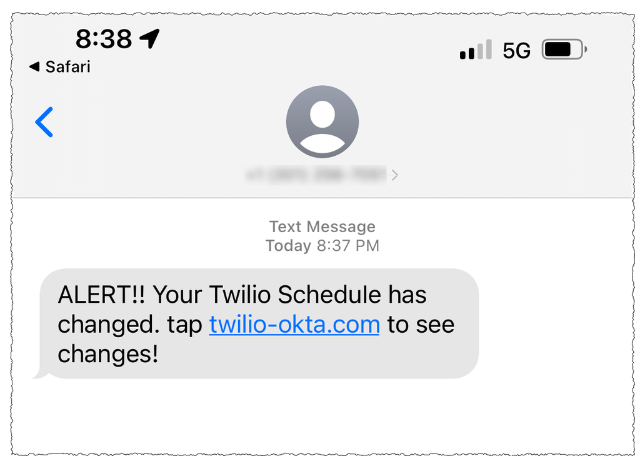
A Scattered Spider/0Ktapus SMS phishing lure sent to Twilio employees in 2022.

The complaint against Buchanan (PDF) says the FBI tied him to the 2022 SMS phishing attacks after discovering the same username and email address was used to register numerous Okta-themed phishing domains seen in the campaign. The domain registrar NameCheap found that less than a month before the phishing spree, the account that registered those domains logged in from an Internet address in the U.K. FBI investigators said the Scottish police told them the address was leased to Buchanan from January 26, 2022 to November 7, 2022.

Authorities seized at least 20 digital devices when they raided Buchanan’s residence, and on one of those devices they found usernames and passwords for employees of three different companies targeted in the phishing campaign.

“The FBI’s investigation to date has gathered evidence showing that Buchanan and his co-conspirators targeted at least 45 companies in the United States and abroad, including Canada, India, and the United Kingdom,” the FBI complaint reads. “One of Buchanan’s devices contained a screenshot of Telegram messages between an account known to be used by Buchanan and other unidentified co-conspirators discussing dividing up the proceeds of SIM swapping.”

U.S. prosecutors allege that records obtained from Discord showed the same U.K. Internet address was used to operate a Discord account that specified a cryptocurrency wallet when asking another user to send funds. The complaint says the publicly available transaction history for that payment address shows approximately 391 bitcoin was transferred in and out of this address between October 2022 and
February 2023; 391 bitcoin is presently worth more than $26 million.

In November 2024, federal prosecutors in Los Angeles unsealed criminal charges against Buchanan and four other alleged Scattered Spider members, including Ahmed Elbadawy, 23, of College Station, Texas; Joel Evans, 25, of Jacksonville, North Carolina; Evans Osiebo, 20, of Dallas; and Noah Urban, 20, of Palm Coast, Florida. KrebsOnSecurity reported last year that another suspected Scattered Spider member — a 17-year-old from the United Kingdom — was arrested as part of a joint investigation with the FBI into the MGM hack.

Mr. Buchanan’s court-appointed attorney did not respond to a request for comment. The accused faces charges of wire fraud conspiracy, conspiracy to obtain information by computer for private financial gain, and aggravated identity theft. Convictions on the latter charge carry a minimum sentence of two years in prison.

Documents from the U.S. District Court for the Central District of California indicate Buchanan is being held without bail pending trial. A preliminary hearing in the case is slated for May 6.


Read More

CISA Adds One Known Exploited Vulnerability to Catalog

 ​CISA has added one new vulnerability to its Known Exploited Vulnerabilities Catalog, based on evidence of active exploitation.

CVE-2025-31324 SAP NetWeaver Unrestricted File Upload Vulnerability

These types of vulnerabilities are frequent attack vectors for malicious cyber actors and pose significant risks to the federal enterprise.
Binding Operational Directive (BOD) 22-01: Reducing the Significant Risk of Known Exploited Vulnerabilities established the Known Exploited Vulnerabilities Catalog as a living list of known Common Vulnerabilities and Exposures (CVEs) that carry significant risk to the federal enterprise. BOD 22-01 requires Federal Civilian Executive Branch (FCEB) agencies to remediate identified vulnerabilities by the due date to protect FCEB networks against active threats. See the BOD 22-01 Fact Sheet for more information.
Although BOD 22-01 only applies to FCEB agencies, CISA strongly urges all organizations to reduce their exposure to cyberattacks by prioritizing timely remediation of Catalog vulnerabilities as part of their vulnerability management practice. CISA will continue to add vulnerabilities to the catalog that meet the specified criteria. 

CISA has added one new vulnerability to its Known Exploited Vulnerabilities Catalog, based on evidence of active exploitation.

These types of vulnerabilities are frequent attack vectors for malicious cyber actors and pose significant risks to the federal enterprise.

Binding Operational Directive (BOD) 22-01: Reducing the Significant Risk of Known Exploited Vulnerabilities established the Known Exploited Vulnerabilities Catalog as a living list of known Common Vulnerabilities and Exposures (CVEs) that carry significant risk to the federal enterprise. BOD 22-01 requires Federal Civilian Executive Branch (FCEB) agencies to remediate identified vulnerabilities by the due date to protect FCEB networks against active threats. See the BOD 22-01 Fact Sheet for more information.

Although BOD 22-01 only applies to FCEB agencies, CISA strongly urges all organizations to reduce their exposure to cyberattacks by prioritizing timely remediation of Catalog vulnerabilities as part of their vulnerability management practice. CISA will continue to add vulnerabilities to the catalog that meet the specified criteria.

 Read More

Delta Electronics ISPSoft

 ​View CSAF
1. EXECUTIVE SUMMARY

CVSS v4 8.4
ATTENTION: Low attack complexity
Vendor: Delta Electronics
Equipment: ISPSoft
Vulnerabilities: Stack-based Buffer Overflow, Out-of-bounds Write

2. RISK EVALUATION
Successful exploitation of these vulnerabilities could result in an attacker executing arbitrary code.
3. TECHNICAL DETAILS
3.1 AFFECTED PRODUCTS
The following versions of ISPSoft are affected:

ISPSoft: Versions 3.19 and prior

3.2 VULNERABILITY OVERVIEW
3.2.1 STACK-BASED BUFFER OVERFLOW CWE-121
Delta Electronics ISPSoft Versions 3.19 and prior are vulnerable to a stack-based buffer overflow vulnerability that could allow an attacker to leverage debugging logic to execute arbitrary code when parsing CBDGL files.
CVE-2025-22882 has been assigned to this vulnerability. A CVSS v3 base score of 7.8 has been calculated; the CVSS vector string is (AV:L/AC:L/PR:N/UI:R/S:U/C:H/I:H/A:H).
A CVSS v4 score has also been calculated for CVE-2025-22882. A base score of 8.4 has been calculated; the CVSS vector string is (AV:L/AC:L/AT:N/PR:N/UI:A/VC:H/VI:H/VA:H/SC:N/SI:N/SA:N).
3.2.2 OUT-OF-BOUNDS WRITE CWE-787
Delta Electronics ISPSoft Versions 3.19 and prior are vulnerable to an out-of-bounds write vulnerability that could allow an attacker to execute arbitrary code when parsing DVP files.
CVE-2025-22883 has been assigned to this vulnerability. A CVSS v3 base score of 7.8 has been calculated; the CVSS vector string is (AV:L/AC:L/PR:N/UI:R/S:U/C:H/I:H/A:H).
A CVSS v4 score has also been calculated for CVE-2025-22883. A base score of 8.4 has been calculated; the CVSS vector string is (AV:L/AC:L/AT:N/PR:N/UI:A/VC:H/VI:H/VA:H/SC:N/SI:N/SA:N).
3.2.3 STACK-BASED BUFFER OVERFLOW CWE-121
Delta Electronics ISPSoft Versions 3.19 and prior are vulnerable to a stack-based buffer overflow vulnerability that could allow an attacker to execute arbitrary code when parsing DVP files.
CVE-2025-22884 has been assigned to this vulnerability. A CVSS v3 base score of 7.8 has been calculated; the CVSS vector string is (AV:L/AC:L/PR:N/UI:R/S:U/C:H/I:H/A:H).
A CVSS v4 score has also been calculated for CVE-2025-22884. A base score of 8.4 has been calculated; the CVSS vector string is (AV:L/AC:L/AT:N/PR:N/UI:A/VC:H/VI:H/VA:H/SC:N/SI:N/SA:N).
3.3 BACKGROUND

CRITICAL INFRASTRUCTURE SECTORS: Critical Manufacturing
COUNTRIES/AREAS DEPLOYED: Worldwide
COMPANY HEADQUARTERS LOCATION: Taiwan

3.4 RESEARCHER
Zero Day Initiative reported these vulnerabilities to CISA.
4. MITIGATIONS
Delta Electronics recommends users to update to ISPSoft v 3.21 or later.
For more information, see Delta Electronics’ advisory.
CISA recommends users take defensive measures to minimize the risk of exploitation of these vulnerabilities, such as:

Minimize network exposure for all control system devices and/or systems, ensuring they are not accessible from the Internet.
Locate control system networks and remote devices behind firewalls and isolating them from business networks.
When remote access is required, use more secure methods, such as Virtual Private Networks (VPNs), recognizing VPNs may have vulnerabilities and should be updated to the most current version available. Also recognize VPN is only as secure as the connected devices.

CISA reminds organizations to perform proper impact analysis and risk assessment prior to deploying defensive measures.
CISA also provides a section for control systems security recommended practices on the ICS webpage on cisa.gov/ics. Several CISA products detailing cyber defense best practices are available for reading and download, including Improving Industrial Control Systems Cybersecurity with Defense-in-Depth Strategies.
CISA encourages organizations to implement recommended cybersecurity strategies for proactive defense of ICS assets.
Additional mitigation guidance and recommended practices are publicly available on the ICS webpage at cisa.gov/ics in the technical information paper, ICS-TIP-12-146-01B–Targeted Cyber Intrusion Detection and Mitigation Strategies.
Organizations observing suspected malicious activity should follow established internal procedures and report findings to CISA for tracking and correlation against other incidents.
No known public exploitation specifically targeting these vulnerabilities has been reported to CISA at this time. These vulnerabilities are not exploitable remotely.
5. UPDATE HISTORY

April 29, 2025: Initial Publication 

View CSAF

1. EXECUTIVE SUMMARY

  • CVSS v4 8.4
  • ATTENTION: Low attack complexity
  • Vendor: Delta Electronics
  • Equipment: ISPSoft
  • Vulnerabilities: Stack-based Buffer Overflow, Out-of-bounds Write

2. RISK EVALUATION

Successful exploitation of these vulnerabilities could result in an attacker executing arbitrary code.

3. TECHNICAL DETAILS

3.1 AFFECTED PRODUCTS

The following versions of ISPSoft are affected:

  • ISPSoft: Versions 3.19 and prior

3.2 VULNERABILITY OVERVIEW

3.2.1 STACK-BASED BUFFER OVERFLOW CWE-121

Delta Electronics ISPSoft Versions 3.19 and prior are vulnerable to a stack-based buffer overflow vulnerability that could allow an attacker to leverage debugging logic to execute arbitrary code when parsing CBDGL files.

CVE-2025-22882 has been assigned to this vulnerability. A CVSS v3 base score of 7.8 has been calculated; the CVSS vector string is (AV:L/AC:L/PR:N/UI:R/S:U/C:H/I:H/A:H).

A CVSS v4 score has also been calculated for CVE-2025-22882. A base score of 8.4 has been calculated; the CVSS vector string is (AV:L/AC:L/AT:N/PR:N/UI:A/VC:H/VI:H/VA:H/SC:N/SI:N/SA:N).

3.2.2 OUT-OF-BOUNDS WRITE CWE-787

Delta Electronics ISPSoft Versions 3.19 and prior are vulnerable to an out-of-bounds write vulnerability that could allow an attacker to execute arbitrary code when parsing DVP files.

CVE-2025-22883 has been assigned to this vulnerability. A CVSS v3 base score of 7.8 has been calculated; the CVSS vector string is (AV:L/AC:L/PR:N/UI:R/S:U/C:H/I:H/A:H).

A CVSS v4 score has also been calculated for CVE-2025-22883. A base score of 8.4 has been calculated; the CVSS vector string is (AV:L/AC:L/AT:N/PR:N/UI:A/VC:H/VI:H/VA:H/SC:N/SI:N/SA:N).

3.2.3 STACK-BASED BUFFER OVERFLOW CWE-121

Delta Electronics ISPSoft Versions 3.19 and prior are vulnerable to a stack-based buffer overflow vulnerability that could allow an attacker to execute arbitrary code when parsing DVP files.

CVE-2025-22884 has been assigned to this vulnerability. A CVSS v3 base score of 7.8 has been calculated; the CVSS vector string is (AV:L/AC:L/PR:N/UI:R/S:U/C:H/I:H/A:H).

A CVSS v4 score has also been calculated for CVE-2025-22884. A base score of 8.4 has been calculated; the CVSS vector string is (AV:L/AC:L/AT:N/PR:N/UI:A/VC:H/VI:H/VA:H/SC:N/SI:N/SA:N).

3.3 BACKGROUND

  • CRITICAL INFRASTRUCTURE SECTORS: Critical Manufacturing
  • COUNTRIES/AREAS DEPLOYED: Worldwide
  • COMPANY HEADQUARTERS LOCATION: Taiwan

3.4 RESEARCHER

Zero Day Initiative reported these vulnerabilities to CISA.

4. MITIGATIONS

Delta Electronics recommends users to update to ISPSoft v 3.21 or later.

For more information, see Delta Electronics’ advisory.

CISA recommends users take defensive measures to minimize the risk of exploitation of these vulnerabilities, such as:

  • Minimize network exposure for all control system devices and/or systems, ensuring they are not accessible from the Internet.
  • Locate control system networks and remote devices behind firewalls and isolating them from business networks.
  • When remote access is required, use more secure methods, such as Virtual Private Networks (VPNs), recognizing VPNs may have vulnerabilities and should be updated to the most current version available. Also recognize VPN is only as secure as the connected devices.

CISA reminds organizations to perform proper impact analysis and risk assessment prior to deploying defensive measures.

CISA also provides a section for control systems security recommended practices on the ICS webpage on cisa.gov/ics. Several CISA products detailing cyber defense best practices are available for reading and download, including Improving Industrial Control Systems Cybersecurity with Defense-in-Depth Strategies.

CISA encourages organizations to implement recommended cybersecurity strategies for proactive defense of ICS assets.

Additional mitigation guidance and recommended practices are publicly available on the ICS webpage at cisa.gov/ics in the technical information paper, ICS-TIP-12-146-01B–Targeted Cyber Intrusion Detection and Mitigation Strategies.

Organizations observing suspected malicious activity should follow established internal procedures and report findings to CISA for tracking and correlation against other incidents.

No known public exploitation specifically targeting these vulnerabilities has been reported to CISA at this time. These vulnerabilities are not exploitable remotely.

5. UPDATE HISTORY

  • April 29, 2025: Initial Publication

 Read More

CISA Releases Three Industrial Control Systems Advisories

 ​CISA released three Industrial Control Systems (ICS) advisories on April 29, 2025. These advisories provide timely information about current security issues, vulnerabilities, and exploits surrounding ICS.

ICSA-25-119-01 Rockwell Automation ThinManager
ICSA-25-119-02 Delta Electronics ISPSoft 
ICSA-25-105-05 Lantronix XPort (Update A)

CISA encourages users and administrators to review newly released ICS advisories for technical details and mitigations. 

CISA released three Industrial Control Systems (ICS) advisories on April 29, 2025. These advisories provide timely information about current security issues, vulnerabilities, and exploits surrounding ICS.

CISA encourages users and administrators to review newly released ICS advisories for technical details and mitigations.

 Read More

Rockwell Automation ThinManager

 ​View CSAF
1. EXECUTIVE SUMMARY

CVSS v4 8.7
ATTENTION: Exploitable remotely/low attack complexity
Vendor: Rockwell Automation
Equipment: ThinManager
Vulnerabilities: Improper Restriction of Operations within the Bounds of a Memory Buffer, Incorrect Default Permissions

2. RISK EVALUATION
Successful exploitation of these vulnerabilities could allow an attacker to escalate privileges and cause a denial-of-service condition.
3. TECHNICAL DETAILS
3.1 AFFECTED PRODUCTS
The following versions of ThinManager, a software management platform, are affected:

ThinManager: Version 14.0.0 and prior

3.2 VULNERABILITY OVERVIEW
3.2.1 IMPROPER RESTRICTION OF OPERATIONS WITHIN THE BOUNDS OF A MEMORY BUFFER CWE-119
A denial-of-service vulnerability exists in Rockwell Automation ThinManager. The software fails to adequately verify the outcome of memory allocation while processing Type 18 messages. If exploited, a threat actor could cause a denial of service on the target software.
CVE-2025-3618 has been assigned to this vulnerability. A CVSS v3.1 base score of 7.5 has been calculated; the CVSS vector string is (CVSS:3.1/AV:N/AC:L/PR:N/UI:N/S:U/C:N/I:N/A:H).
A CVSS v4 score has also been calculated for CVE-2025-3618. A base score of 8.7 has been calculated; the CVSS vector string is (CVSS:4.0/AV:N/AC:L/AT:N/PR:N/UI:N/VC:N/VI:N/VA:H/SC:N/SI:N/SA:N).
3.2.2 INCORRECT DEFAULT PERMISSIONS CWE-276
A privilege escalation vulnerability exists in Rockwell Automation ThinManager. When the software starts up, files are deleted in the temporary folder causing the Access Control Entry of the directory to inherit permissions from the parent directory. If exploited, a threat actor could inherit elevated privileges.
CVE-2025-3617 has been assigned to this vulnerability. A CVSS v3.1 base score of 7.8 has been calculated; the CVSS vector string is (CVSS:3.1/AV:L/AC:L/PR:L/UI:N/S:U/C:H/I:H/A:H).
A CVSS v4 score has also been calculated for CVE-2025-3617. A base score of 8.5 has been calculated; the CVSS vector string is (CVSS:4.0/AV:L/AC:L/AT:N/PR:L/UI:N/VC:H/VI:H/VA:H/SC:N/SI:N/SA:N).
3.3 BACKGROUND

CRITICAL INFRASTRUCTURE SECTORS: Critical Manufacturing
COUNTRIES/AREAS DEPLOYED: Worldwide
COMPANY HEADQUARTERS LOCATION: United States

3.4 RESEARCHER
An anonymous researcher working with Trend Micro’s Zero Day Initiative reported these vulnerabilities to CISA.
4. MITIGATIONS
Rockwell Automation encourages users to update ThinManager to v14.0.2 or later to mitigate CVE-2025-3617.
Rockwell Automation fixed CVE-2025-3618 in the following versions of ThinManager:

ThinManager v11.2.11
ThinManager v12.0.9
ThinManager v13.1.5
ThinManager v13.2.4
ThinManager v14.0.2
For information on how to mitigate security risks on industrial automation control systems, Rockwell Automation encourages users to implement their suggested security best practices to minimize the risk of the vulnerability.

For more information about these issues, please see the Rockwell Automation security advisory SD1727.
Stakeholder-Specific Vulnerability Categorization can be used to generate more environment-specific prioritization.
CISA recommends users take defensive measures to minimize the risk of exploitation of these vulnerabilities, such as:

Minimize network exposure for all control system devices and/or systems, ensuring they are not accessible from the internet.
Locate control system networks and remote devices behind firewalls and isolating them from business networks.
When remote access is required, use more secure methods, such as Virtual Private Networks (VPNs), recognizing VPNs may have vulnerabilities and should be updated to the most current version available. Also recognize VPN is only as secure as the connected devices.

CISA reminds organizations to perform proper impact analysis and risk assessment prior to deploying defensive measures.
CISA also provides a section for control systems security recommended practices on the ICS webpage on cisa.gov/ics. Several CISA products detailing cyber defense best practices are available for reading and download, including Improving Industrial Control Systems Cybersecurity with Defense-in-Depth Strategies.
CISA encourages organizations to implement recommended cybersecurity strategies for proactive defense of ICS assets.
Additional mitigation guidance and recommended practices are publicly available on the ICS webpage at cisa.gov/ics in the technical information paper, ICS-TIP-12-146-01B–Targeted Cyber Intrusion Detection and Mitigation Strategies.
Organizations observing suspected malicious activity should follow established internal procedures and report findings to CISA for tracking and correlation against other incidents.
No known public exploitation specifically targeting these vulnerabilities has been reported to CISA at this time.
5. UPDATE HISTORY

April 29, 2025: Initial Publication 

View CSAF

1. EXECUTIVE SUMMARY

  • CVSS v4 8.7
  • ATTENTION: Exploitable remotely/low attack complexity
  • Vendor: Rockwell Automation
  • Equipment: ThinManager
  • Vulnerabilities: Improper Restriction of Operations within the Bounds of a Memory Buffer, Incorrect Default Permissions

2. RISK EVALUATION

Successful exploitation of these vulnerabilities could allow an attacker to escalate privileges and cause a denial-of-service condition.

3. TECHNICAL DETAILS

3.1 AFFECTED PRODUCTS

The following versions of ThinManager, a software management platform, are affected:

  • ThinManager: Version 14.0.0 and prior

3.2 VULNERABILITY OVERVIEW

3.2.1 IMPROPER RESTRICTION OF OPERATIONS WITHIN THE BOUNDS OF A MEMORY BUFFER CWE-119

A denial-of-service vulnerability exists in Rockwell Automation ThinManager. The software fails to adequately verify the outcome of memory allocation while processing Type 18 messages. If exploited, a threat actor could cause a denial of service on the target software.

CVE-2025-3618 has been assigned to this vulnerability. A CVSS v3.1 base score of 7.5 has been calculated; the CVSS vector string is (CVSS:3.1/AV:N/AC:L/PR:N/UI:N/S:U/C:N/I:N/A:H).

A CVSS v4 score has also been calculated for CVE-2025-3618. A base score of 8.7 has been calculated; the CVSS vector string is (CVSS:4.0/AV:N/AC:L/AT:N/PR:N/UI:N/VC:N/VI:N/VA:H/SC:N/SI:N/SA:N).

3.2.2 INCORRECT DEFAULT PERMISSIONS CWE-276

A privilege escalation vulnerability exists in Rockwell Automation ThinManager. When the software starts up, files are deleted in the temporary folder causing the Access Control Entry of the directory to inherit permissions from the parent directory. If exploited, a threat actor could inherit elevated privileges.

CVE-2025-3617 has been assigned to this vulnerability. A CVSS v3.1 base score of 7.8 has been calculated; the CVSS vector string is (CVSS:3.1/AV:L/AC:L/PR:L/UI:N/S:U/C:H/I:H/A:H).

A CVSS v4 score has also been calculated for CVE-2025-3617. A base score of 8.5 has been calculated; the CVSS vector string is (CVSS:4.0/AV:L/AC:L/AT:N/PR:L/UI:N/VC:H/VI:H/VA:H/SC:N/SI:N/SA:N).

3.3 BACKGROUND

  • CRITICAL INFRASTRUCTURE SECTORS: Critical Manufacturing
  • COUNTRIES/AREAS DEPLOYED: Worldwide
  • COMPANY HEADQUARTERS LOCATION: United States

3.4 RESEARCHER

An anonymous researcher working with Trend Micro’s Zero Day Initiative reported these vulnerabilities to CISA.

4. MITIGATIONS

Rockwell Automation encourages users to update ThinManager to v14.0.2 or later to mitigate CVE-2025-3617.

Rockwell Automation fixed CVE-2025-3618 in the following versions of ThinManager:

  • ThinManager v11.2.11
  • ThinManager v12.0.9
  • ThinManager v13.1.5
  • ThinManager v13.2.4
  • ThinManager v14.0.2
  • For information on how to mitigate security risks on industrial automation control systems, Rockwell Automation encourages users to implement their suggested security best practices to minimize the risk of the vulnerability.

For more information about these issues, please see the Rockwell Automation security advisory SD1727.

Stakeholder-Specific Vulnerability Categorization can be used to generate more environment-specific prioritization.

CISA recommends users take defensive measures to minimize the risk of exploitation of these vulnerabilities, such as:

  • Minimize network exposure for all control system devices and/or systems, ensuring they are not accessible from the internet.
  • Locate control system networks and remote devices behind firewalls and isolating them from business networks.
  • When remote access is required, use more secure methods, such as Virtual Private Networks (VPNs), recognizing VPNs may have vulnerabilities and should be updated to the most current version available. Also recognize VPN is only as secure as the connected devices.

CISA reminds organizations to perform proper impact analysis and risk assessment prior to deploying defensive measures.

CISA also provides a section for control systems security recommended practices on the ICS webpage on cisa.gov/ics. Several CISA products detailing cyber defense best practices are available for reading and download, including Improving Industrial Control Systems Cybersecurity with Defense-in-Depth Strategies.

CISA encourages organizations to implement recommended cybersecurity strategies for proactive defense of ICS assets.

Additional mitigation guidance and recommended practices are publicly available on the ICS webpage at cisa.gov/ics in the technical information paper, ICS-TIP-12-146-01B–Targeted Cyber Intrusion Detection and Mitigation Strategies.

Organizations observing suspected malicious activity should follow established internal procedures and report findings to CISA for tracking and correlation against other incidents.

No known public exploitation specifically targeting these vulnerabilities has been reported to CISA at this time.

5. UPDATE HISTORY

  • April 29, 2025: Initial Publication

 Read More

CISA Adds Three Known Exploited Vulnerabilities to Catalog

 ​CISA has added three new vulnerabilities to its Known Exploited Vulnerabilities Catalog, based on evidence of active exploitation.

CVE-2025-1976 Broadcom Brocade Fabric OS Code Injection Vulnerability
CVE-2025-42599 Qualitia Active! Mail Stack-Based Buffer Overflow Vulnerability
CVE-2025-3928 Commvault Web Server Unspecified Vulnerability

These types of vulnerabilities are frequent attack vectors for malicious cyber actors and pose significant risks to the federal enterprise.
Binding Operational Directive (BOD) 22-01: Reducing the Significant Risk of Known Exploited Vulnerabilities established the Known Exploited Vulnerabilities Catalog as a living list of known Common Vulnerabilities and Exposures (CVEs) that carry significant risk to the federal enterprise. BOD 22-01 requires Federal Civilian Executive Branch (FCEB) agencies to remediate identified vulnerabilities by the due date to protect FCEB networks against active threats. See the BOD 22-01 Fact Sheet for more information.
Although BOD 22-01 only applies to FCEB agencies, CISA strongly urges all organizations to reduce their exposure to cyberattacks by prioritizing timely remediation of Catalog vulnerabilities as part of their vulnerability management practice. CISA will continue to add vulnerabilities to the catalog that meet the specified criteria. 

CISA has added three new vulnerabilities to its Known Exploited Vulnerabilities Catalog, based on evidence of active exploitation.

  • CVE-2025-1976 Broadcom Brocade Fabric OS Code Injection Vulnerability
  • CVE-2025-42599 Qualitia Active! Mail Stack-Based Buffer Overflow Vulnerability
  • CVE-2025-3928 Commvault Web Server Unspecified Vulnerability

These types of vulnerabilities are frequent attack vectors for malicious cyber actors and pose significant risks to the federal enterprise.

Binding Operational Directive (BOD) 22-01: Reducing the Significant Risk of Known Exploited Vulnerabilities established the Known Exploited Vulnerabilities Catalog as a living list of known Common Vulnerabilities and Exposures (CVEs) that carry significant risk to the federal enterprise. BOD 22-01 requires Federal Civilian Executive Branch (FCEB) agencies to remediate identified vulnerabilities by the due date to protect FCEB networks against active threats. See the BOD 22-01 Fact Sheet for more information.

Although BOD 22-01 only applies to FCEB agencies, CISA strongly urges all organizations to reduce their exposure to cyberattacks by prioritizing timely remediation of Catalog vulnerabilities as part of their vulnerability management practice. CISA will continue to add vulnerabilities to the catalog that meet the specified criteria.

 Read More

Nice Linear eMerge E3

 ​View CSAF
1. EXECUTIVE SUMMARY

CVSS v4 9.3
ATTENTION: Exploitable remotely/low attack complexity
Vendor: Nice
Equipment: Linear eMerge E3
Vulnerability: Improper Neutralization of Special Elements used in an OS Command (‘OS Command Injection’)

2. RISK EVALUATION
Successful exploitation of this vulnerability could allow an attacker to execute arbitrary OS commands.
3. TECHNICAL DETAILS
3.1 AFFECTED PRODUCTS
The following versions of Nice Linear eMerge E3 are affected:

Linear eMerge E3: Versions 1.00-07 and prior

3.2 VULNERABILITY OVERVIEW
3.2.1 Improper Neutralization of Special Elements used in an OS Command (‘OS Command Injection’) CWE-78
The Linear eMerge e3-Series through version 1.00-07 is vulnerable to an OS command injection vulnerability. A remote and unauthenticated attacker can execute arbitrary OS commands via the login_id parameter when invoking the forgot_password functionality over HTTP.
CVE-2024-9441 has been assigned to this vulnerability. A CVSS v3.1 base score of 9.8 has been calculated; the CVSS vector string is (AV:N/AC:L/PR:N/UI:N/S:U/C:H/I:H/A:H).
A CVSS v4 score has also been calculated for CVE-2024-9441. A base score of 9.3 has been calculated; the CVSS vector string is (AV:N/AC:L/AT:N/PR:N/UI:N/VC:H/VI:H/VA:H/SC:N/SI:N/SA:N).
3.3 BACKGROUND

CRITICAL INFRASTRUCTURE SECTORS: Commercial Facilities
COUNTRIES/AREAS DEPLOYED: Worldwide
COMPANY HEADQUARTERS LOCATION: Italy

3.4 RESEARCHER
Noam Rathaus of SSD Secure Disclosure reported this vulnerability to CISA.
4. MITIGATIONS
Nice did not indicate if/when a patch would be developed. Please see Nice’s E3-Bulletin for the latest information on product security.
Nice also recommends the following defensive measures to minimize the risk of exploitation of this vulnerability:

Minimize network exposure of devices, ensuring they are not accessible from the internet.
Place the devices behind firewalls and isolate them from other networks.
When remote access is required, use secure methods, such as Virtual Private Networks (VPNs). Keep your VPNs as up-to-date as possible.
Change default credentials on the device.
Change the default IP address of the device.

See Nice’s Telephone Entry Bulletin for additional information.
Users should contact Nice with any questions.
CISA recommends users take defensive measures to minimize the risk of exploitation of this vulnerability. CISA reminds organizations to perform proper impact analysis and risk assessment prior to deploying defensive measures.
CISA also provides a section for control systems security recommended practices on the ICS webpage on cisa.gov/ics. Several CISA products detailing cyber defense best practices are available for reading and download, including Improving Industrial Control Systems Cybersecurity with Defense-in-Depth Strategies.
CISA encourages organizations to implement recommended cybersecurity strategies for proactive defense of ICS assets.
Additional mitigation guidance and recommended practices are publicly available on the ICS webpage at cisa.gov/ics in the technical information paper, ICS-TIP-12-146-01B–Targeted Cyber Intrusion Detection and Mitigation Strategies.
Organizations observing suspected malicious activity should follow established internal procedures and report findings to CISA for tracking and correlation against other incidents.
No known public exploitation specifically targeting this vulnerability has been reported to CISA at this time.
5. UPDATE HISTORY

April 24, 2025: Initial Publication 

View CSAF

1. EXECUTIVE SUMMARY

  • CVSS v4 9.3
  • ATTENTION: Exploitable remotely/low attack complexity
  • Vendor: Nice
  • Equipment: Linear eMerge E3
  • Vulnerability: Improper Neutralization of Special Elements used in an OS Command (‘OS Command Injection’)

2. RISK EVALUATION

Successful exploitation of this vulnerability could allow an attacker to execute arbitrary OS commands.

3. TECHNICAL DETAILS

3.1 AFFECTED PRODUCTS

The following versions of Nice Linear eMerge E3 are affected:

  • Linear eMerge E3: Versions 1.00-07 and prior

3.2 VULNERABILITY OVERVIEW

3.2.1 Improper Neutralization of Special Elements used in an OS Command (‘OS Command Injection’) CWE-78

The Linear eMerge e3-Series through version 1.00-07 is vulnerable to an OS command injection vulnerability. A remote and unauthenticated attacker can execute arbitrary OS commands via the login_id parameter when invoking the forgot_password functionality over HTTP.

CVE-2024-9441 has been assigned to this vulnerability. A CVSS v3.1 base score of 9.8 has been calculated; the CVSS vector string is (AV:N/AC:L/PR:N/UI:N/S:U/C:H/I:H/A:H).

A CVSS v4 score has also been calculated for CVE-2024-9441. A base score of 9.3 has been calculated; the CVSS vector string is (AV:N/AC:L/AT:N/PR:N/UI:N/VC:H/VI:H/VA:H/SC:N/SI:N/SA:N).

3.3 BACKGROUND

  • CRITICAL INFRASTRUCTURE SECTORS: Commercial Facilities
  • COUNTRIES/AREAS DEPLOYED: Worldwide
  • COMPANY HEADQUARTERS LOCATION: Italy

3.4 RESEARCHER

Noam Rathaus of SSD Secure Disclosure reported this vulnerability to CISA.

4. MITIGATIONS

Nice did not indicate if/when a patch would be developed. Please see Nice’s E3-Bulletin for the latest information on product security.

Nice also recommends the following defensive measures to minimize the risk of exploitation of this vulnerability:

  • Minimize network exposure of devices, ensuring they are not accessible from the internet.
  • Place the devices behind firewalls and isolate them from other networks.
  • When remote access is required, use secure methods, such as Virtual Private Networks (VPNs). Keep your VPNs as up-to-date as possible.
  • Change default credentials on the device.
  • Change the default IP address of the device.

See Nice’s Telephone Entry Bulletin for additional information.

Users should contact Nice with any questions.

CISA recommends users take defensive measures to minimize the risk of exploitation of this vulnerability. CISA reminds organizations to perform proper impact analysis and risk assessment prior to deploying defensive measures.

CISA also provides a section for control systems security recommended practices on the ICS webpage on cisa.gov/ics. Several CISA products detailing cyber defense best practices are available for reading and download, including Improving Industrial Control Systems Cybersecurity with Defense-in-Depth Strategies.

CISA encourages organizations to implement recommended cybersecurity strategies for proactive defense of ICS assets.

Additional mitigation guidance and recommended practices are publicly available on the ICS webpage at cisa.gov/ics in the technical information paper, ICS-TIP-12-146-01B–Targeted Cyber Intrusion Detection and Mitigation Strategies.

Organizations observing suspected malicious activity should follow established internal procedures and report findings to CISA for tracking and correlation against other incidents.

No known public exploitation specifically targeting this vulnerability has been reported to CISA at this time.

5. UPDATE HISTORY

  • April 24, 2025: Initial Publication

 Read More

Planet Technology Network Products

 ​View CSAF
1. EXECUTIVE SUMMARY

CVSS v4 9.3
ATTENTION: Exploitable remotely/Low attack complexity
Vendor: Planet Technology
Equipment: Planet Technology Network Products
Vulnerabilities: Improper Neutralization of Special Elements used in an OS Command (‘OS Command Injection’), Use of Hard-coded Credentials, Missing Authentication for Critical Function

2. RISK EVALUATION
Successful exploitation of these vulnerabilities could allow an attacker to read or manipulate device data, gain administrative privileges, or alter database entries.
3. TECHNICAL DETAILS
3.1 AFFECTED PRODUCTS
The following versions of Planet Technology products are affected:

UNI-NMS-Lite: Versions 1.0b211018 and prior
NMS-500: All Versions
NMS-1000V: All Versions
WGS-804HPT-V2: Versions 2.305b250121 and prior
WGS-4215-8T2S: Versions 1.305b241115 and prior

3.2 VULNERABILITY OVERVIEW
3.2.1 IMPROPER NEUTRALIZATION OF SPECIAL ELEMENTS USED IN AN OS COMMAND (‘OS COMMAND INJECTION’) CWE-78
UNI-NMS-Lite is vulnerable to a command injection attack that could allow an unauthenticated attacker to read or manipulate device data.
CVE-2025-46271 has been assigned to this vulnerability. A CVSS v3 base score of 9.1 has been calculated; the CVSS vector string is (AV:N/AC:L/PR:N/UI:N/S:U/C:H/I:H/A:N).
A CVSS v4 score has also been calculated for CVE-2025-46271. A base score of 9.3 has been calculated; the CVSS vector string is (AV:N/AC:L/AT:N/PR:N/UI:N/VC:H/VI:H/VA:N/SC:N/SI:N/SA:N).
3.2.2 IMPROPER NEUTRALIZATION OF SPECIAL ELEMENTS USED IN AN OS COMMAND (‘OS COMMAND INJECTION’) CWE-78
WGS-80HPT-V2 and WGS-4215-8T2S are vulnerable to a command injection attack that could allow an unauthenticated attacker to execute OS commands on the host system.
CVE-2025-46272 has been assigned to this vulnerability. A CVSS v3 base score of 9.1 has been calculated; the CVSS vector string is (AV:N/AC:L/PR:N/UI:N/S:U/C:H/I:H/A:N).
A CVSS v4 score has also been calculated for CVE-2025-46272. A base score of 9.3 has been calculated; the CVSS vector string is (AV:N/AC:L/AT:N/PR:N/UI:N/VC:H/VI:H/VA:N/SC:N/SI:N/SA:N).
3.2.3 USE OF HARD-CODED CREDENTIALS CWE-798
UNI-NMS-Lite uses hard-coded credentials that could allow an unauthenticated attacker to gain administrative privileges to all UNI-NMS managed devices.
CVE-2025-46273 has been assigned to this vulnerability. A CVSS v3 base score of 9.8 has been calculated; the CVSS vector string is (AV:N/AC:L/PR:N/UI:N/S:U/C:H/I:H/A:H).
A CVSS v4 score has also been calculated for CVE-2025-46273. A base score of 9.3 has been calculated; the CVSS vector string is (AV:N/AC:L/AT:N/PR:N/UI:N/VC:H/VI:H/VA:H/SC:N/SI:N/SA:N).
3.2.4 USE OF HARD-CODED CREDENTIALS CWE-798
UNI-NMS-Lite uses hard-coded credentials that could allow an unauthenticated attacker to read, manipulate and create entries in the managed database.
CVE-2025-46274 has been assigned to this vulnerability. A CVSS v3 base score of 9.8 has been calculated; the CVSS vector string is (AV:N/AC:L/PR:N/UI:N/S:U/C:H/I:H/A:H).
A CVSS v4 score has also been calculated for CVE-2025-46274. A base score of 9.3 has been calculated; the CVSS vector string is (AV:N/AC:L/AT:N/PR:N/UI:N/VC:H/VI:H/VA:H/SC:N/SI:N/SA:N).
3.2.5 MISSING AUTHENTICATION FOR CRITICAL FUNCTION CWE-306
WGS-80HPT-V2 and WGS-4215-8T2S are missing authentication that could allow an attacker to create an administrator account without knowing any existing credentials.
CVE-2025-46275 has been assigned to this vulnerability. A CVSS v3 base score of 9.8 has been calculated; the CVSS vector string is (AV:N/AC:L/PR:N/UI:N/S:U/C:H/I:H/A:H).
A CVSS v4 score has also been calculated for CVE-2025-46275. A base score of 9.3 has been calculated; the CVSS vector string is (AV:N/AC:L/AT:N/PR:N/UI:N/VC:H/VI:H/VA:H/SC:N/SI:N/SA:N).
3.3 BACKGROUND

CRITICAL INFRASTRUCTURE SECTORS: Critical Manufacturing
COUNTRIES/AREAS DEPLOYED: Worldwide
COMPANY HEADQUARTERS LOCATION: Taiwan

3.4 RESEARCHER
Kev Breen of Immersive reported these vulnerabilities to CISA.
4. MITIGATIONS
Planet Technology has released patches for the following devices:

WGS-804HPT (v2)
WGS-4215-8T2S
UNI-NMS
NMS-500
NMS-1000V

CISA recommends users take defensive measures to minimize the risk of exploitation of these vulnerabilities, such as:

Minimize network exposure for all control system devices and/or systems, ensuring they are not accessible from the internet.
Locate control system networks and remote devices behind firewalls and isolating them from business networks.
When remote access is required, use more secure methods, such as Virtual Private Networks (VPNs), recognizing VPNs may have vulnerabilities and should be updated to the most current version available. Also recognize VPN is only as secure as the connected devices.

CISA reminds organizations to perform proper impact analysis and risk assessment prior to deploying defensive measures.
CISA also provides a section for control systems security recommended practices on the ICS webpage on cisa.gov/ics. Several CISA products detailing cyber defense best practices are available for reading and download, including Improving Industrial Control Systems Cybersecurity with Defense-in-Depth Strategies.
CISA encourages organizations to implement recommended cybersecurity strategies for proactive defense of ICS assets.
Additional mitigation guidance and recommended practices are publicly available on the ICS webpage at cisa.gov/ics in the technical information paper, ICS-TIP-12-146-01B–Targeted Cyber Intrusion Detection and Mitigation Strategies.
Organizations observing suspected malicious activity should follow established internal procedures and report findings to CISA for tracking and correlation against other incidents.
No known public exploitation specifically targeting these vulnerabilities has been reported to CISA at this time.
5. UPDATE HISTORY

April 24, 2025: Initial Publication 

View CSAF

1. EXECUTIVE SUMMARY

  • CVSS v4 9.3
  • ATTENTION: Exploitable remotely/Low attack complexity
  • Vendor: Planet Technology
  • Equipment: Planet Technology Network Products
  • Vulnerabilities: Improper Neutralization of Special Elements used in an OS Command (‘OS Command Injection’), Use of Hard-coded Credentials, Missing Authentication for Critical Function

2. RISK EVALUATION

Successful exploitation of these vulnerabilities could allow an attacker to read or manipulate device data, gain administrative privileges, or alter database entries.

3. TECHNICAL DETAILS

3.1 AFFECTED PRODUCTS

The following versions of Planet Technology products are affected:

  • UNI-NMS-Lite: Versions 1.0b211018 and prior
  • NMS-500: All Versions
  • NMS-1000V: All Versions
  • WGS-804HPT-V2: Versions 2.305b250121 and prior
  • WGS-4215-8T2S: Versions 1.305b241115 and prior

3.2 VULNERABILITY OVERVIEW

3.2.1 IMPROPER NEUTRALIZATION OF SPECIAL ELEMENTS USED IN AN OS COMMAND (‘OS COMMAND INJECTION’) CWE-78

UNI-NMS-Lite is vulnerable to a command injection attack that could allow an unauthenticated attacker to read or manipulate device data.

CVE-2025-46271 has been assigned to this vulnerability. A CVSS v3 base score of 9.1 has been calculated; the CVSS vector string is (AV:N/AC:L/PR:N/UI:N/S:U/C:H/I:H/A:N).

A CVSS v4 score has also been calculated for CVE-2025-46271. A base score of 9.3 has been calculated; the CVSS vector string is (AV:N/AC:L/AT:N/PR:N/UI:N/VC:H/VI:H/VA:N/SC:N/SI:N/SA:N).

3.2.2 IMPROPER NEUTRALIZATION OF SPECIAL ELEMENTS USED IN AN OS COMMAND (‘OS COMMAND INJECTION’) CWE-78

WGS-80HPT-V2 and WGS-4215-8T2S are vulnerable to a command injection attack that could allow an unauthenticated attacker to execute OS commands on the host system.

CVE-2025-46272 has been assigned to this vulnerability. A CVSS v3 base score of 9.1 has been calculated; the CVSS vector string is (AV:N/AC:L/PR:N/UI:N/S:U/C:H/I:H/A:N).

A CVSS v4 score has also been calculated for CVE-2025-46272. A base score of 9.3 has been calculated; the CVSS vector string is (AV:N/AC:L/AT:N/PR:N/UI:N/VC:H/VI:H/VA:N/SC:N/SI:N/SA:N).

3.2.3 USE OF HARD-CODED CREDENTIALS CWE-798

UNI-NMS-Lite uses hard-coded credentials that could allow an unauthenticated attacker to gain administrative privileges to all UNI-NMS managed devices.

CVE-2025-46273 has been assigned to this vulnerability. A CVSS v3 base score of 9.8 has been calculated; the CVSS vector string is (AV:N/AC:L/PR:N/UI:N/S:U/C:H/I:H/A:H).

A CVSS v4 score has also been calculated for CVE-2025-46273. A base score of 9.3 has been calculated; the CVSS vector string is (AV:N/AC:L/AT:N/PR:N/UI:N/VC:H/VI:H/VA:H/SC:N/SI:N/SA:N).

3.2.4 USE OF HARD-CODED CREDENTIALS CWE-798

UNI-NMS-Lite uses hard-coded credentials that could allow an unauthenticated attacker to read, manipulate and create entries in the managed database.

CVE-2025-46274 has been assigned to this vulnerability. A CVSS v3 base score of 9.8 has been calculated; the CVSS vector string is (AV:N/AC:L/PR:N/UI:N/S:U/C:H/I:H/A:H).

A CVSS v4 score has also been calculated for CVE-2025-46274. A base score of 9.3 has been calculated; the CVSS vector string is (AV:N/AC:L/AT:N/PR:N/UI:N/VC:H/VI:H/VA:H/SC:N/SI:N/SA:N).

3.2.5 MISSING AUTHENTICATION FOR CRITICAL FUNCTION CWE-306

WGS-80HPT-V2 and WGS-4215-8T2S are missing authentication that could allow an attacker to create an administrator account without knowing any existing credentials.

CVE-2025-46275 has been assigned to this vulnerability. A CVSS v3 base score of 9.8 has been calculated; the CVSS vector string is (AV:N/AC:L/PR:N/UI:N/S:U/C:H/I:H/A:H).

A CVSS v4 score has also been calculated for CVE-2025-46275. A base score of 9.3 has been calculated; the CVSS vector string is (AV:N/AC:L/AT:N/PR:N/UI:N/VC:H/VI:H/VA:H/SC:N/SI:N/SA:N).

3.3 BACKGROUND

  • CRITICAL INFRASTRUCTURE SECTORS: Critical Manufacturing
  • COUNTRIES/AREAS DEPLOYED: Worldwide
  • COMPANY HEADQUARTERS LOCATION: Taiwan

3.4 RESEARCHER

Kev Breen of Immersive reported these vulnerabilities to CISA.

4. MITIGATIONS

Planet Technology has released patches for the following devices:

CISA recommends users take defensive measures to minimize the risk of exploitation of these vulnerabilities, such as:

  • Minimize network exposure for all control system devices and/or systems, ensuring they are not accessible from the internet.
  • Locate control system networks and remote devices behind firewalls and isolating them from business networks.
  • When remote access is required, use more secure methods, such as Virtual Private Networks (VPNs), recognizing VPNs may have vulnerabilities and should be updated to the most current version available. Also recognize VPN is only as secure as the connected devices.

CISA reminds organizations to perform proper impact analysis and risk assessment prior to deploying defensive measures.

CISA also provides a section for control systems security recommended practices on the ICS webpage on cisa.gov/ics. Several CISA products detailing cyber defense best practices are available for reading and download, including Improving Industrial Control Systems Cybersecurity with Defense-in-Depth Strategies.

CISA encourages organizations to implement recommended cybersecurity strategies for proactive defense of ICS assets.

Additional mitigation guidance and recommended practices are publicly available on the ICS webpage at cisa.gov/ics in the technical information paper, ICS-TIP-12-146-01B–Targeted Cyber Intrusion Detection and Mitigation Strategies.

Organizations observing suspected malicious activity should follow established internal procedures and report findings to CISA for tracking and correlation against other incidents.

No known public exploitation specifically targeting these vulnerabilities has been reported to CISA at this time.

5. UPDATE HISTORY

  • April 24, 2025: Initial Publication

 Read More

Vestel AC Charger

 ​View CSAF
1. EXECUTIVE SUMMARY

CVSS v4 8.7
ATTENTION: Exploitable remotely/low attack complexity
Vendor: Vestel
Equipment: AC Charger
Vulnerability: Exposure of Sensitive System Information to an Unauthorized Control Sphere

2. RISK EVALUATION
Successful exploitation of this vulnerability could allow an attacker access to sensitive information, such as credentials which could subsequently enable them to cause a denial of service or partial loss of integrity of the charger.
3. TECHNICAL DETAILS
3.1 AFFECTED PRODUCTS
The following versions of AC Charger are affected:

AC Charger EVC04: Version 3.75.0

3.2 VULNERABILITY OVERVIEW
3.2.1 EXPOSURE OF SENSITIVE SYSTEM INFORMATION TO AN UNAUTHORIZED CONTROL SPHERE CWE-497
Affected versions of Vestel AC Charger contains a vulnerability that could enable an attacker to access files containing sensitive information, such as credentials which could be used to further compromise the device.
CVE-2025-3606 has been assigned to this vulnerability. A CVSS v3.1 base score of 7.5 has been calculated; the CVSS vector string is (AV:N/AC:L/PR:N/UI:N/S:U/C:H/I:N/A:N).
A CVSS v4 score has also been calculated for CVE-2025-3606. A base score of 8.7 has been calculated; the CVSS vector string is (AV:N/AC:L/AT:N/PR:N/UI:N/VC:H/VI:N/VA:N/SC:N/SI:N/SA:N).
3.3 BACKGROUND

CRITICAL INFRASTRUCTURE SECTORS: Transportation Systems
COUNTRIES/AREAS DEPLOYED: Worldwide
COMPANY HEADQUARTERS LOCATION: Turkey

3.4 RESEARCHER
Cumhur Kizilari reported this vulnerability to CISA.
4. MITIGATIONS
Vestel strongly suggests for users using the related AC chargers shall update to V3.187 or any higher version.
Vestel also recommends the following mitigations to reduce risk:
Avoid using open network:

Use secure methods like Virtual Private Networks (VPNs) for remote access. Regularly update VPNs to their latest versions and ensure that connected devices maintain strong security measures.
Reduce network exposure for applications and endpoints. Only make them accessible via the Internet if specifically designed for and required by their intended use.

Login Credentials Management:

Force end user to revise the factory default set username and password of webconfig page.
Remove any printed documents such as installation guide, instruction book, quick start guide from web where login credentials are featured.

Please refer to Vestel’s advisory for more information.
CISA reminds organizations to perform proper impact analysis and risk assessment prior to deploying defensive measures.
CISA also provides a section for control systems security recommended practices on the ICS webpage on cisa.gov/ics. Several CISA products detailing cyber defense best practices are available for reading and download, including Improving Industrial Control Systems Cybersecurity with Defense-in-Depth Strategies.
CISA encourages organizations to implement recommended cybersecurity strategies for proactive defense of ICS assets.
Additional mitigation guidance and recommended practices are publicly available on the ICS webpage at cisa.gov/ics in the technical information paper, ICS-TIP-12-146-01B–Targeted Cyber Intrusion Detection and Mitigation Strategies.
Organizations observing suspected malicious activity should follow established internal procedures and report findings to CISA for tracking and correlation against other incidents.
CISA also recommends users take the following measures to protect themselves from social engineering attacks:

Do not click web links or open attachments in unsolicited email messages.
Refer to Recognizing and Avoiding Email Scams for more information on avoiding email scams.
Refer to Avoiding Social Engineering and Phishing Attacks for more information on social engineering attacks.

No known public exploitation specifically targeting this vulnerability has been reported to CISA at this time.
5. UPDATE HISTORY

April 24, 2025: Initial Publication 

View CSAF

1. EXECUTIVE SUMMARY

  • CVSS v4 8.7
  • ATTENTION: Exploitable remotely/low attack complexity
  • Vendor: Vestel
  • Equipment: AC Charger
  • Vulnerability: Exposure of Sensitive System Information to an Unauthorized Control Sphere

2. RISK EVALUATION

Successful exploitation of this vulnerability could allow an attacker access to sensitive information, such as credentials which could subsequently enable them to cause a denial of service or partial loss of integrity of the charger.

3. TECHNICAL DETAILS

3.1 AFFECTED PRODUCTS

The following versions of AC Charger are affected:

  • AC Charger EVC04: Version 3.75.0

3.2 VULNERABILITY OVERVIEW

3.2.1 EXPOSURE OF SENSITIVE SYSTEM INFORMATION TO AN UNAUTHORIZED CONTROL SPHERE CWE-497

Affected versions of Vestel AC Charger contains a vulnerability that could enable an attacker to access files containing sensitive information, such as credentials which could be used to further compromise the device.

CVE-2025-3606 has been assigned to this vulnerability. A CVSS v3.1 base score of 7.5 has been calculated; the CVSS vector string is (AV:N/AC:L/PR:N/UI:N/S:U/C:H/I:N/A:N).

A CVSS v4 score has also been calculated for CVE-2025-3606. A base score of 8.7 has been calculated; the CVSS vector string is (AV:N/AC:L/AT:N/PR:N/UI:N/VC:H/VI:N/VA:N/SC:N/SI:N/SA:N).

3.3 BACKGROUND

  • CRITICAL INFRASTRUCTURE SECTORS: Transportation Systems
  • COUNTRIES/AREAS DEPLOYED: Worldwide
  • COMPANY HEADQUARTERS LOCATION: Turkey

3.4 RESEARCHER

Cumhur Kizilari reported this vulnerability to CISA.

4. MITIGATIONS

Vestel strongly suggests for users using the related AC chargers shall update to V3.187 or any higher version.

Vestel also recommends the following mitigations to reduce risk:

Avoid using open network:

  • Use secure methods like Virtual Private Networks (VPNs) for remote access. Regularly update VPNs to their latest versions and ensure that connected devices maintain strong security measures.
  • Reduce network exposure for applications and endpoints. Only make them accessible via the Internet if specifically designed for and required by their intended use.

Login Credentials Management:

  • Force end user to revise the factory default set username and password of webconfig page.
  • Remove any printed documents such as installation guide, instruction book, quick start guide from web where login credentials are featured.

Please refer to Vestel’s advisory for more information.

CISA reminds organizations to perform proper impact analysis and risk assessment prior to deploying defensive measures.

CISA also provides a section for control systems security recommended practices on the ICS webpage on cisa.gov/ics. Several CISA products detailing cyber defense best practices are available for reading and download, including Improving Industrial Control Systems Cybersecurity with Defense-in-Depth Strategies.

CISA encourages organizations to implement recommended cybersecurity strategies for proactive defense of ICS assets.

Additional mitigation guidance and recommended practices are publicly available on the ICS webpage at cisa.gov/ics in the technical information paper, ICS-TIP-12-146-01B–Targeted Cyber Intrusion Detection and Mitigation Strategies.

Organizations observing suspected malicious activity should follow established internal procedures and report findings to CISA for tracking and correlation against other incidents.

CISA also recommends users take the following measures to protect themselves from social engineering attacks:

No known public exploitation specifically targeting this vulnerability has been reported to CISA at this time.

5. UPDATE HISTORY

  • April 24, 2025: Initial Publication

 Read More

Johnson Controls ICU

 ​View CSAF
1. EXECUTIVE SUMMARY

CVSS v4 9.3
ATTENTION: Exploitable remotely/low attack complexity
Vendor: Johnson Controls Inc.
Equipment: ICU
Vulnerability: Stack-based Buffer Overflow

2. RISK EVALUATION
Successful exploitation of this vulnerability may allow an attacker to execute arbitrary code.
3. TECHNICAL DETAILS
3.1 AFFECTED PRODUCTS
Johnson Controls reports the following versions of ICU are affected:

ICU: Versions prior to 6.9.5

3.2 VULNERABILITY OVERVIEW
3.2.1 STACK-BASED BUFFER OVERFLOW CWE-121
Under certain circumstances, the ICU tool can have a buffer overflow issue.
CVE-2025-26382 has been assigned to this vulnerability. A CVSS v3.1 base score of 9.8 has been calculated; the CVSS vector string is (CVSS:3.1/AV:N/AC:L/PR:N/UI:N/S:U/C:H/I:H/A:H).
A CVSS v4 score has also been calculated for CVE-2025-26382. A base score of 9.3 has been calculated; the CVSS vector string is (CVSS:4.0/AV:N/AC:L/AT:N/PR:N/UI:N/VC:H/VI:H/VA:H/SC:N/SI:N/SA:N).
3.3 BACKGROUND

CRITICAL INFRASTRUCTURE SECTORS: Critical Manufacturing, Commercial Facilities, Government Services and Facilities, Transportation Systems, Energy
COUNTRIES/AREAS DEPLOYED: Worldwide
COMPANY HEADQUARTERS LOCATION: Ireland

3.4 RESEARCHER
Reid Wightman of Dragos reported this vulnerability to Johnson Controls, Inc.
4. MITIGATIONS
Johnson Controls recommends users upgrade ICU to Version 6.9.5.
For more detailed mitigation instructions, please see Johnson Controls Product Security Advisory JCI-PSA-2025-04.
Aligning with CISA recommendations, Johnson Controls recommends taking steps to minimize risks to all building automation systems.
CISA recommends users take defensive measures to minimize the risk of exploitation of this vulnerability, such as:

Minimize network exposure for all control system devices and/or systems, ensuring they are not accessible from the Internet.
Locate control system networks and remote devices behind firewalls and isolating them from business networks.
When remote access is required, use more secure methods, such as virtual private networks (VPNs), recognizing VPNs may have vulnerabilities and should be updated to the most current version available. Also recognize VPN is only as secure as the connected devices.

CISA reminds organizations to perform proper impact analysis and risk assessment prior to deploying defensive measures.
CISA also provides a section for control systems security recommended practices on the ICS webpage on cisa.gov/ics. Several CISA products detailing cyber defense best practices are available for reading and download, including Improving Industrial Control Systems Cybersecurity with Defense-in-Depth Strategies.
CISA encourages organizations to implement recommended cybersecurity strategies for proactive defense of ICS assets.
Additional mitigation guidance and recommended practices are publicly available on the ICS webpage at cisa.gov/ics in the technical information paper, ICS-TIP-12-146-01B–Targeted Cyber Intrusion Detection and Mitigation Strategies.
Organizations observing suspected malicious activity should follow established internal procedures and report findings to CISA for tracking and correlation against other incidents.
No known public exploitation specifically targeting this vulnerability has been reported to CISA at this time.
5. UPDATE HISTORY

April 24, 2025: Initial Republication of Johnson Controls JCI-PSA-2025-04 

View CSAF

1. EXECUTIVE SUMMARY

  • CVSS v4 9.3
  • ATTENTION: Exploitable remotely/low attack complexity
  • Vendor: Johnson Controls Inc.
  • Equipment: ICU
  • Vulnerability: Stack-based Buffer Overflow

2. RISK EVALUATION

Successful exploitation of this vulnerability may allow an attacker to execute arbitrary code.

3. TECHNICAL DETAILS

3.1 AFFECTED PRODUCTS

Johnson Controls reports the following versions of ICU are affected:

  • ICU: Versions prior to 6.9.5

3.2 VULNERABILITY OVERVIEW

3.2.1 STACK-BASED BUFFER OVERFLOW CWE-121

Under certain circumstances, the ICU tool can have a buffer overflow issue.

CVE-2025-26382 has been assigned to this vulnerability. A CVSS v3.1 base score of 9.8 has been calculated; the CVSS vector string is (CVSS:3.1/AV:N/AC:L/PR:N/UI:N/S:U/C:H/I:H/A:H).

A CVSS v4 score has also been calculated for CVE-2025-26382. A base score of 9.3 has been calculated; the CVSS vector string is (CVSS:4.0/AV:N/AC:L/AT:N/PR:N/UI:N/VC:H/VI:H/VA:H/SC:N/SI:N/SA:N).

3.3 BACKGROUND

  • CRITICAL INFRASTRUCTURE SECTORS: Critical Manufacturing, Commercial Facilities, Government Services and Facilities, Transportation Systems, Energy
  • COUNTRIES/AREAS DEPLOYED: Worldwide
  • COMPANY HEADQUARTERS LOCATION: Ireland

3.4 RESEARCHER

Reid Wightman of Dragos reported this vulnerability to Johnson Controls, Inc.

4. MITIGATIONS

Johnson Controls recommends users upgrade ICU to Version 6.9.5.

For more detailed mitigation instructions, please see Johnson Controls Product Security Advisory JCI-PSA-2025-04.

Aligning with CISA recommendations, Johnson Controls recommends taking steps to minimize risks to all building automation systems.

CISA recommends users take defensive measures to minimize the risk of exploitation of this vulnerability, such as:

  • Minimize network exposure for all control system devices and/or systems, ensuring they are not accessible from the Internet.
  • Locate control system networks and remote devices behind firewalls and isolating them from business networks.
  • When remote access is required, use more secure methods, such as virtual private networks (VPNs), recognizing VPNs may have vulnerabilities and should be updated to the most current version available. Also recognize VPN is only as secure as the connected devices.

CISA reminds organizations to perform proper impact analysis and risk assessment prior to deploying defensive measures.

CISA also provides a section for control systems security recommended practices on the ICS webpage on cisa.gov/ics. Several CISA products detailing cyber defense best practices are available for reading and download, including Improving Industrial Control Systems Cybersecurity with Defense-in-Depth Strategies.

CISA encourages organizations to implement recommended cybersecurity strategies for proactive defense of ICS assets.

Additional mitigation guidance and recommended practices are publicly available on the ICS webpage at cisa.gov/ics in the technical information paper, ICS-TIP-12-146-01B–Targeted Cyber Intrusion Detection and Mitigation Strategies.

Organizations observing suspected malicious activity should follow established internal procedures and report findings to CISA for tracking and correlation against other incidents.

No known public exploitation specifically targeting this vulnerability has been reported to CISA at this time.

5. UPDATE HISTORY

  • April 24, 2025: Initial Republication of Johnson Controls JCI-PSA-2025-04

 Read More

Scroll to Top