Fortinet Releases Security Updates for FortiManager

 ​Fortinet released a security update to address a vulnerability in FortiManager. A remote cyber threat actor could exploit this vulnerability to take control of an affected system.
Users and administrators are encouraged to review the following Fortinet Security Bulletin and apply the necessary updates:

FG-IR-24-425 

Fortinet released a security update to address a vulnerability in FortiManager. A remote cyber threat actor could exploit this vulnerability to take control of an affected system.

Users and administrators are encouraged to review the following Fortinet Security Bulletin and apply the necessary updates:

 Read More

CISA Adds One Known Exploited Vulnerability to Catalog

 ​CISA has added one new vulnerability to its Known Exploited Vulnerabilities Catalog, based on evidence of active exploitation.

CVE-2024-12356 BeyondTrust Privileged Remote Access (PRA) and Remote Support (RS) Command Injection Vulnerability

These types of vulnerabilities are frequent attack vectors for malicious cyber actors and pose significant risks to the federal enterprise.
Binding Operational Directive (BOD) 22-01: Reducing the Significant Risk of Known Exploited Vulnerabilities established the Known Exploited Vulnerabilities Catalog as a living list of known Common Vulnerabilities and Exposures (CVEs) that carry significant risk to the federal enterprise. BOD 22-01 requires Federal Civilian Executive Branch (FCEB) agencies to remediate identified vulnerabilities by the due date to protect FCEB networks against active threats. See the BOD 22-01 Fact Sheet for more information.
Although BOD 22-01 only applies to FCEB agencies, CISA strongly urges all organizations to reduce their exposure to cyberattacks by prioritizing timely remediation of Catalog vulnerabilities as part of their vulnerability management practice. CISA will continue to add vulnerabilities to the catalog that meet the specified criteria. 

CISA has added one new vulnerability to its Known Exploited Vulnerabilities Catalog, based on evidence of active exploitation.

  • CVE-2024-12356 BeyondTrust Privileged Remote Access (PRA) and Remote Support (RS) Command Injection Vulnerability

These types of vulnerabilities are frequent attack vectors for malicious cyber actors and pose significant risks to the federal enterprise.

Binding Operational Directive (BOD) 22-01: Reducing the Significant Risk of Known Exploited Vulnerabilities established the Known Exploited Vulnerabilities Catalog as a living list of known Common Vulnerabilities and Exposures (CVEs) that carry significant risk to the federal enterprise. BOD 22-01 requires Federal Civilian Executive Branch (FCEB) agencies to remediate identified vulnerabilities by the due date to protect FCEB networks against active threats. See the BOD 22-01 Fact Sheet for more information.

Although BOD 22-01 only applies to FCEB agencies, CISA strongly urges all organizations to reduce their exposure to cyberattacks by prioritizing timely remediation of Catalog vulnerabilities as part of their vulnerability management practice. CISA will continue to add vulnerabilities to the catalog that meet the specified criteria.

 Read More

Web Hacking Service ‘Araneida’ Tied to Turkish IT Firm

​Cybercriminals are selling hundreds of thousands of credential sets stolen with the help of a cracked version of Acunetix, a powerful commercial web app vulnerability scanner, new research finds. The cracked software is being resold as a cloud-based attack tool by at least two different services, one of which KrebsOnSecurity traced to an information technology firm based in Turkey. 

Cybercriminals are selling hundreds of thousands of credential sets stolen with the help of a cracked version of Acunetix, a powerful commercial web app vulnerability scanner, new research finds. The cracked software is being resold as a cloud-based attack tool by at least two different services, one of which KrebsOnSecurity traced to an information technology firm based in Turkey.

Araneida Scanner.

Cyber threat analysts at Silent Push said they recently received reports from a partner organization that identified an aggressive scanning effort against their website using an Internet address previously associated with a campaign by FIN7, a notorious Russia-based hacking group.

But on closer inspection they discovered the address contained an HTML title of “Araneida Customer Panel,” and found they could search on that text string to find dozens of unique addresses hosting the same service.

It soon became apparent that Araneida was being resold as a cloud-based service using a cracked version of Acunetix, allowing paying customers to conduct offensive reconnaissance on potential target websites, scrape user data, and find vulnerabilities for exploitation.

Silent Push also learned Araneida bundles its service with a robust proxy offering, so that customer scans appear to come from Internet addresses that are randomly selected from a large pool of available traffic relays.

The makers of Acunetix, Texas-based application security vendor Invicti Security, confirmed Silent Push’s findings, saying someone had figured out how to crack the free trial version of the software so that it runs without a valid license key.

“We have been playing cat and mouse for a while with these guys,” said Matt Sciberras, chief information security officer at Invicti.

Silent Push said Araneida is being advertised by an eponymous user on multiple cybercrime forums. The service’s Telegram channel boasts nearly 500 subscribers and explains how to use the tool for malicious purposes.

In a “Fun Facts” list posted to the channel in late September, Araneida said their service was used to take over more than 30,000 websites in just six months, and that one customer used it to buy a Porsche with the payment card data (“dumps”) they sold.

Araneida Scanner’s Telegram channel bragging about how customers are using the service for cybercrime.

“They are constantly bragging with their community about the crimes that are being committed, how it’s making criminals money,” said Zach Edwards, a senior threat researcher at Silent Push. “They are also selling bulk data and dumps which appear to have been acquired with this tool or due to vulnerabilities found with the tool.”

Silent Push also found a cracked version of Acunetix was powering at least 20 instances of a similar cloud-based vulnerability testing service catering to Mandarin speakers, but they were unable to find any apparently related sales threads about them on the dark web.

Rumors of a cracked version of Acunetix being used by attackers surfaced in June 2023 on Twitter/X, when researchers first posited a connection between observed scanning activity and Araneida.

According to an August 2023 report (PDF) from the U.S. Department of Health and Human Services (HHS), Acunetix (presumably a cracked version) is among several tools used by APT 41, a prolific Chinese state-sponsored hacking group.

THE TURKISH CONNECTION

Silent Push notes that the website where Araneida is being sold — araneida[.]co — first came online in February 2023. But a review of this Araneida nickname on the cybercrime forums shows they have been active in the criminal hacking scene since at least 2018.

A search in the threat intelligence platform Intel 471 shows a user by the name Araneida promoted the scanner on two cybercrime forums since 2022, including Breached and Nulled. In 2022, Araneida told fellow Breached members they could be reached on Discord at the username “Ornie#9811.”

According to Intel 471, this same Discord account was advertised in 2019 by a person on the cybercrime forum Cracked who used the monikers “ORN” and “ori0n.” The user “ori0n” mentioned in several posts that they could be reached on Telegram at the username “@sirorny.”
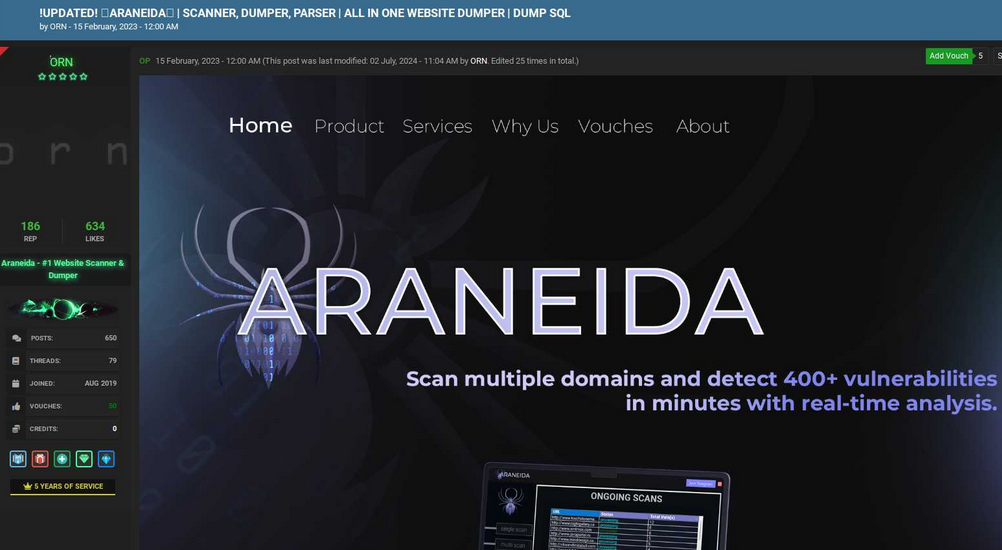
Orn advertising Araneida Scanner in Feb. 2023 on the forum Cracked. Image: Ke-la.com.

The Sirorny Telegram identity also was referenced as a point of contact for a current user on the cybercrime forum Nulled who is selling website development services, and who references araneida[.]co as one of their projects. That user, “Exorn,” has posts dating back to August 2018.

In early 2020, Exorn promoted a website called “orndorks[.]com,” which they described as a service for automating the scanning for web-based vulnerabilities. A passive DNS lookup on this domain at DomainTools shows that its email records pointed to the address ori0nbusiness@protonmail.com.

Constella Intelligence, a company that tracks information exposed in data breaches, finds this email address was used to register an account at Breachforums in July 2024 under the nickname “Ornie.” Constella also finds the same email registered at the website netguard[.]codes in 2021 using the password “ceza2003” [full disclosure: Constella is currently an advertiser on KrebsOnSecurity].

A search on the password ceza2003 in Constella finds roughly a dozen email addresses that used it in an exposed data breach, most of them featuring some variation on the name “altugsara,” including altugsara321@gmail.com. Constella further finds altugsara321@gmail.com was used to create an account at the cybercrime community RaidForums under the username “ori0n,” from an Internet address in Istanbul.

According to DomainTools, altugsara321@gmail.com was used in 2020 to register the domain name altugsara[.]com. Archive.org’s history for that domain shows that in 2021 it featured a website for a then 18-year-old Altuğ Şara from Ankara, Turkey.
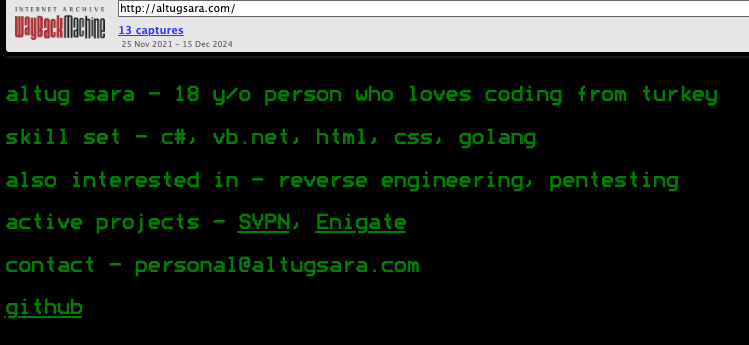
Archive.org’s recollection of what altugsara dot com looked like in 2021.

LinkedIn finds this same altugsara[.]com domain listed in the “contact info” section of a profile for an Altug Sara from Ankara, who says he has worked the past two years as a senior software developer for a Turkish IT firm called Bilitro Yazilim.

Neither Altug Sara nor Bilitro Yazilim responded to requests for comment.

Invicti’s website states that it has offices in Ankara, but the company’s CEO said none of their employees recognized either name.

“We do have a small team in Ankara, but as far as I know we have no connection to the individual other than the fact that they are also in Ankara,” Invicti CEO Neil Roseman told KrebsOnSecurity.

Researchers at Silent Push say despite Araneida using a seemingly endless supply of proxies to mask the true location of its users, it is a fairly “noisy” scanner that will kick off a large volume of requests to various API endpoints, and make requests to random URLs associated with different content management systems.

What’s more, the cracked version of Acunetix being resold to cybercriminals invokes legacy Acunetix SSL certificates on active control panels, which Silent Push says provides a solid pivot for finding some of this infrastructure, particularly from the Chinese threat actors.

Further reading: Silent Push’s research on Araneida Scanner.

 

Read More

Schneider Electric Modicon Controllers

 ​View CSAF
1. EXECUTIVE SUMMARY

CVSS v3 5.4
ATTENTION: Exploitable remotely/low attack complexity
Vendor: Schneider Electric
Equipment: Modicon Controllers
Vulnerability: Cross-site Scripting

2. RISK EVALUATION
Successful exploitation of this vulnerability could allow an attacker to cause a victim’s browser to run arbitrary JavaScript when visiting a page containing injected payload.
3. TECHNICAL DETAILS
3.1 AFFECTED PRODUCTS
Schneider Electric reports that the following products are affected:

Schneider Electric Modicon Controllers M258 / LMC058: All versions
Schneider Electric Modicon Controllers M262: Versions prior to 5.2.8.26
Schneider Electric Modicon Controllers M251: Versions prior to 5.2.11.24
Schneider Electric Modicon Controllers M241: Versions prior to 5.2.11.24

3.2 Vulnerability Overview
3.2.1 IMPROPER NEUTRALIZATION OF INPUT DURING WEB PAGE GENERATION (‘CROSS-SITE SCRIPTING’) CWE-79
A Cross-site Scripting  vulnerability exists  where an attacker could cause a victim’s browser run arbitrary JavaScript when they visit a page containing the injected payload.
CVE-2024-6528 has been assigned to this vulnerability. A CVSS v3 base score of 5.4 has been assigned; the CVSS vector string is (CVSS:3.1/AV:N/AC:L/PR:L/UI:R/S:C/C:L/I:L/A:N).
3.3 BACKGROUND

CRITICAL INFRASTRUCTURE SECTORS: Commercial Facilities, Critical Manufacturing, and Energy
COUNTRIES/AREAS DEPLOYED: Worldwide
COMPANY HEADQUARTERS LOCATION: France

3.4 RESEARCHER
Schneider Electric CPCERT reported this vulnerability to CISA.
4. MITIGATIONS
Schneider Electric has identified the following specific workarounds and mitigations users can apply to reduce risk:

Schneider Electric Modicon Controllers Version prior to v5.2.11.24: Modicon Controller M241 Firmware version 5.2.11.24 delivered with EcoStruxure Machine Expert v2.2.2 includes a fix for this vulnerability and can be updated through the Schneider Electric Software Update (SESU) application. https://www.se.com/ww/en/product-range/2226-ecostruxure-machine-expert-software/ On the engineering workstation, update to v2.2.2 of EcoStruxure Machine Expert. Update Modicon Controller M241 to the latest Firmware and perform reboot
Schneider Electric Modicon Controllers Version prior to v5.2.11.24: Modicon Controller M251 Firmware version 5.2.11.24 delivered with EcoStruxure Machine Expert v2.2.2 includes a fix for this vulnerability and can be updated through the Schneider Electric Software Update (SESU) application. https://www.se.com/ww/en/product-range/2226-ecostruxure-machine-expert-software/ On the engineering workstation, update to v2.2.2 of EcoStruxure Machine Expert. Update Modicon Controller M251 to the latest Firmware and perform reboot
Schneider Electric Modicon Controllers M262 Versions prior to v5.2.8.26: Modicon Controller M262 Firmware version 5.2.8.26 delivered with EcoStruxure Machine Expert v2.2.2 includes a fix for this vulnerability and can be updated through the Schneider Electric Software Update (SESU) application.https://www.se.com/ww/en/product-range/2226-ecostruxure-machine-expert-software/ On the engineering workstation, update to v2.2.2 of EcoStruxure Machine Expert. Update Modicon Controller M262 to the latest Firmware and perform reboot
Schneider Electric Modicon Controllers Version prior to v5.2.11.24, Schneider Electric Modicon Controllers M258 / LMC058 All versions , Schneider Electric Modicon Controllers M262 Versions prior to v5.2.8.26, Schneider Electric Modicon Controllers Version prior to v5.2.11.24: Users should immediately apply the following mitigations to reduce the risk of exploit: Use controllers and devices only in a protected environment to minimize network exposure and ensure that they are not accessible from public internet or untrusted networks. Ensure usage of user management and password features. User rights are enabled by default and forced to create a strong password at first use. Deactivate the Webserver after use when not needed. Use encrypted communication links. Setup network segmentation and implement a firewall to block all unauthorized access to port 80/HTTP and 443/HTTPS. Use VPN (Virtual Private Networks) tunnels if remote access is required. The “Cybersecurity Guidelines for EcoStruxure Machine Expert, Modicon and PacDrive Controllers and Associated Equipment” provide product specific chapters to ensure you are informed of all updates, including details on affected products and remediation plans, subscribe to Schneider Electric’s security notification service here

For more information refer to the Schneider Electric Recommended Cybersecurity Best Practices document and the associated Schneider Electric Security Notification SEVD-2024-191-04 in PDF and CSAF.
CISA recommends users take defensive measures to minimize the risk of exploitation of this vulnerability, such as:

Minimize network exposure for all control system devices and/or systems, ensuring they are not accessible from the internet.
Locate control system networks and remote devices behind firewalls and isolating them from business networks.
When remote access is required, use more secure methods, such as Virtual Private Networks (VPNs). Recognize VPNs may have vulnerabilities, should be updated to the most recent version available, and are only as secure as the connected devices.

CISA reminds organizations to perform proper impact analysis and risk assessment prior to deploying defensive measures.
CISA also provides a section for control systems security recommended practices on the ICS webpage on cisa.gov. Several CISA products detailing cyber defense best practices are available for reading and download, including Improving Industrial Control Systems Cybersecurity with Defense-in-Depth Strategies.
CISA encourages organizations to implement recommended cybersecurity strategies for proactive defense of ICS assets.
Additional mitigation guidance and recommended practices are publicly available on the ICS webpage at cisa.gov in the technical information paper, ICS-TIP-12-146-01B–Targeted Cyber Intrusion Detection and Mitigation Strategies.
Organizations observing suspected malicious activity should follow established internal procedures and report findings to CISA for tracking and correlation against other incidents.
CISA also recommends users take the following measures to protect themselves from social engineering attacks:

Do not click web links or open attachments in unsolicited email messages.
Refer to Recognizing and Avoiding Email Scams for more information on avoiding email scams.
Refer to Avoiding Social Engineering and Phishing Attacks for more information on social engineering attacks.

No known public exploitation specifically targeting this vulnerability has been reported to CISA at this time.
5. UPDATE HISTORY

December 19, 2024: Initial Publication 

View CSAF

1. EXECUTIVE SUMMARY

  • CVSS v3 5.4
  • ATTENTION: Exploitable remotely/low attack complexity
  • Vendor: Schneider Electric
  • Equipment: Modicon Controllers
  • Vulnerability: Cross-site Scripting

2. RISK EVALUATION

Successful exploitation of this vulnerability could allow an attacker to cause a victim’s browser to run arbitrary JavaScript when visiting a page containing injected payload.

3. TECHNICAL DETAILS

3.1 AFFECTED PRODUCTS

Schneider Electric reports that the following products are affected:

  • Schneider Electric Modicon Controllers M258 / LMC058: All versions
  • Schneider Electric Modicon Controllers M262: Versions prior to 5.2.8.26
  • Schneider Electric Modicon Controllers M251: Versions prior to 5.2.11.24
  • Schneider Electric Modicon Controllers M241: Versions prior to 5.2.11.24

3.2 Vulnerability Overview

3.2.1 IMPROPER NEUTRALIZATION OF INPUT DURING WEB PAGE GENERATION (‘CROSS-SITE SCRIPTING’) CWE-79

A Cross-site Scripting  vulnerability exists  where an attacker could cause a victim’s browser run arbitrary JavaScript when they visit a page containing the injected payload.

CVE-2024-6528 has been assigned to this vulnerability. A CVSS v3 base score of 5.4 has been assigned; the CVSS vector string is (CVSS:3.1/AV:N/AC:L/PR:L/UI:R/S:C/C:L/I:L/A:N).

3.3 BACKGROUND

  • CRITICAL INFRASTRUCTURE SECTORS: Commercial Facilities, Critical Manufacturing, and Energy
  • COUNTRIES/AREAS DEPLOYED: Worldwide
  • COMPANY HEADQUARTERS LOCATION: France

3.4 RESEARCHER

Schneider Electric CPCERT reported this vulnerability to CISA.

4. MITIGATIONS

Schneider Electric has identified the following specific workarounds and mitigations users can apply to reduce risk:

  • Schneider Electric Modicon Controllers Version prior to v5.2.11.24: Modicon Controller M241 Firmware version 5.2.11.24 delivered with EcoStruxure Machine Expert v2.2.2 includes a fix for this vulnerability and can be updated through the Schneider Electric Software Update (SESU) application. https://www.se.com/ww/en/product-range/2226-ecostruxure-machine-expert-software/ On the engineering workstation, update to v2.2.2 of EcoStruxure Machine Expert. Update Modicon Controller M241 to the latest Firmware and perform reboot
  • Schneider Electric Modicon Controllers Version prior to v5.2.11.24: Modicon Controller M251 Firmware version 5.2.11.24 delivered with EcoStruxure Machine Expert v2.2.2 includes a fix for this vulnerability and can be updated through the Schneider Electric Software Update (SESU) application. https://www.se.com/ww/en/product-range/2226-ecostruxure-machine-expert-software/ On the engineering workstation, update to v2.2.2 of EcoStruxure Machine Expert. Update Modicon Controller M251 to the latest Firmware and perform reboot
  • Schneider Electric Modicon Controllers M262 Versions prior to v5.2.8.26: Modicon Controller M262 Firmware version 5.2.8.26 delivered with EcoStruxure Machine Expert v2.2.2 includes a fix for this vulnerability and can be updated through the Schneider Electric Software Update (SESU) application.https://www.se.com/ww/en/product-range/2226-ecostruxure-machine-expert-software/ On the engineering workstation, update to v2.2.2 of EcoStruxure Machine Expert. Update Modicon Controller M262 to the latest Firmware and perform reboot
  • Schneider Electric Modicon Controllers Version prior to v5.2.11.24, Schneider Electric Modicon Controllers M258 / LMC058 All versions , Schneider Electric Modicon Controllers M262 Versions prior to v5.2.8.26, Schneider Electric Modicon Controllers Version prior to v5.2.11.24: Users should immediately apply the following mitigations to reduce the risk of exploit: Use controllers and devices only in a protected environment to minimize network exposure and ensure that they are not accessible from public internet or untrusted networks. Ensure usage of user management and password features. User rights are enabled by default and forced to create a strong password at first use. Deactivate the Webserver after use when not needed. Use encrypted communication links. Setup network segmentation and implement a firewall to block all unauthorized access to port 80/HTTP and 443/HTTPS. Use VPN (Virtual Private Networks) tunnels if remote access is required. The “Cybersecurity Guidelines for EcoStruxure Machine Expert, Modicon and PacDrive Controllers and Associated Equipment” provide product specific chapters to ensure you are informed of all updates, including details on affected products and remediation plans, subscribe to Schneider Electric’s security notification service here

For more information refer to the Schneider Electric Recommended Cybersecurity Best Practices document and the associated Schneider Electric Security Notification SEVD-2024-191-04 in PDF and CSAF.

CISA recommends users take defensive measures to minimize the risk of exploitation of this vulnerability, such as:

  • Minimize network exposure for all control system devices and/or systems, ensuring they are not accessible from the internet.
  • Locate control system networks and remote devices behind firewalls and isolating them from business networks.
  • When remote access is required, use more secure methods, such as Virtual Private Networks (VPNs). Recognize VPNs may have vulnerabilities, should be updated to the most recent version available, and are only as secure as the connected devices.

CISA reminds organizations to perform proper impact analysis and risk assessment prior to deploying defensive measures.

CISA also provides a section for control systems security recommended practices on the ICS webpage on cisa.gov. Several CISA products detailing cyber defense best practices are available for reading and download, including Improving Industrial Control Systems Cybersecurity with Defense-in-Depth Strategies.

CISA encourages organizations to implement recommended cybersecurity strategies for proactive defense of ICS assets.

Additional mitigation guidance and recommended practices are publicly available on the ICS webpage at cisa.gov in the technical information paper, ICS-TIP-12-146-01B–Targeted Cyber Intrusion Detection and Mitigation Strategies.

Organizations observing suspected malicious activity should follow established internal procedures and report findings to CISA for tracking and correlation against other incidents.

CISA also recommends users take the following measures to protect themselves from social engineering attacks:

No known public exploitation specifically targeting this vulnerability has been reported to CISA at this time.

5. UPDATE HISTORY

  • December 19, 2024: Initial Publication

 Read More

Ossur Mobile Logic Application

 ​View CSAF
1. EXECUTIVE SUMMARY

CVSS v4 5.6
ATTENTION: Low attack complexity
Vendor: Ossur
Equipment: Mobile Logic Application
Vulnerabilities: Exposure of Sensitive System Information to an Unauthorized Control Sphere, Command Injection, Use of Hard-coded Credentials

2. RISK EVALUATION
Successful exploitation of these vulnerabilities could allow an attacker unauthorized access to sensitive information.
3. TECHNICAL DETAILS
3.1 AFFECTED PRODUCTS
The following Ossur products are affected:

Logic Mobile Application: Versions prior to 1.5.5

3.2 Vulnerability Overview
3.2.1 EXPOSURE OF SENSITIVE SYSTEM INFORMATION TO AN UNAUTHORIZED CONTROL SPHERE CWE-497
A valid set of credentials in a .js file and a static token for communication were obtained from the decompiled IPA. An attacker could use the information to disrupt normal use of the application by changing the translation files and thus weaken the integrity of normal use.
CVE-2024-53683 has been assigned to this vulnerability. A CVSS v3.1 base score of 4.4 has been calculated; the CVSS vector string is (AV:L/AC:L/PR:H/UI:N/S:U/C:N/I:H/A:N).
A CVSS v4 score has also been calculated for CVE-2024-53683. A base score of 5.6 has been calculated; the CVSS vector string is (CVSS4.0/AV:L/AC:L/AT:P/PR:H/UI:N/VC:N/VI:H/VA:N/SC:N/SI:N/SA:N).
3.2.2 IMPROPER NEUTRALIZATION OF SPECIAL ELEMENTS USED IN A COMMAND (‘COMMAND INJECTION’) CWE-77
Multiple bash files were present in the application’s private directory. Bash files can be used on their own, by an attacker that has already full access to the mobile platform to compromise the translations for the application.
CVE-2024-54681 has been assigned to this vulnerability. A CVSS v3.1 base score of 3.5 has been calculated; the CVSS vector string is (AV:N/AC:L/PR:L/UI:R/S:U/C:N/I:N/A:L).
A CVSS v4 score has also been calculated for CVE-2024-54681. A base score of 2.0 has been calculated; the CVSS vector string is (CVSS4.0/AV:N/AC:L/AT:P/PR:L/UI:A/VC:N/VI:N/VA:L/SC:N/SI:N/SA:N).
3.2.3 USE OF HARD-CODED CREDENTIALS CWE-798
Hard-coded credentials were included as part of the application binary. These credentials served as part of the application authentication flow and communication with the mobile application. An attacker could access unauthorized information.
CVE-2024-45832 has been assigned to this vulnerability. A CVSS v3.1 base score of 4.3 has been calculated; the CVSS vector string is (AV:P/AC:L/PR:N/UI:N/S:U/C:L/I:L/A:L).
A CVSS v4 score has also been calculated for CVE-2024-45832. A base score of 2.0 has been calculated; the CVSS vector string is (CVSS4.0/AV:P/AC:L/AT:P/PR:N/UI:N/VC:L/VI:L/VA:L/SC:L/SI:H/SA:N).
3.3 BACKGROUND

CRITICAL INFRASTRUCTURE SECTORS: Healthcare and Public Health
COUNTRIES/AREAS DEPLOYED: Worldwide
COMPANY HEADQUARTERS LOCATION: Iceland

3.4 RESEARCHER
Bryan Riggins reported these vulnerabilities to CISA.
4. MITIGATIONS
Ossur recommends users download Version 1.5.5 or later of the mobile application. The latest version of the application can be obtained through the app store on respective mobile devices. No additional action is required by users.
CISA recommends users take defensive measures to minimize the risk of exploitation of these vulnerabilities, such as:

Minimize network exposure for all control system devices and/or systems, ensuring they are not accessible from the Internet.
Locate control system networks and remote devices behind firewalls and isolating them from business networks.
When remote access is required, use more secure methods, such as Virtual Private Networks (VPNs), recognizing VPNs may have vulnerabilities and should be updated to the most current version available. Also recognize VPN is only as secure as the connected devices.

CISA reminds organizations to perform proper impact analysis and risk assessment prior to deploying defensive measures.
CISA also provides a section for control systems security recommended practices on the ICS webpage on cisa.gov/ics. Several CISA products detailing cyber defense best practices are available for reading and download, including Improving Industrial Control Systems Cybersecurity with Defense-in-Depth Strategies.
CISA encourages organizations to implement recommended cybersecurity strategies for proactive defense of ICS assets.
Additional mitigation guidance and recommended practices are publicly available on the ICS webpage at cisa.gov/ics in the technical information paper, ICS-TIP-12-146-01B–Targeted Cyber Intrusion Detection and Mitigation Strategies.
Organizations observing suspected malicious activity should follow established internal procedures and report findings to CISA for tracking and correlation against other incidents.
CISA also recommends users take the following measures to protect themselves from social engineering attacks:

Do not click web links or open attachments in unsolicited email messages.
Refer to Recognizing and Avoiding Email Scams for more information on avoiding email scams.
Refer to Avoiding Social Engineering and Phishing Attacks for more information on social engineering attacks.

No known public exploitation specifically targeting these vulnerabilities has been reported to CISA at this time. These vulnerabilities are not exploitable remotely.
5. UPDATE HISTORY

December 19, 2024: Initial Publication 

View CSAF

1. EXECUTIVE SUMMARY

  • CVSS v4 5.6
  • ATTENTION: Low attack complexity
  • Vendor: Ossur
  • Equipment: Mobile Logic Application
  • Vulnerabilities: Exposure of Sensitive System Information to an Unauthorized Control Sphere, Command Injection, Use of Hard-coded Credentials

2. RISK EVALUATION

Successful exploitation of these vulnerabilities could allow an attacker unauthorized access to sensitive information.

3. TECHNICAL DETAILS

3.1 AFFECTED PRODUCTS

The following Ossur products are affected:

  • Logic Mobile Application: Versions prior to 1.5.5

3.2 Vulnerability Overview

3.2.1 EXPOSURE OF SENSITIVE SYSTEM INFORMATION TO AN UNAUTHORIZED CONTROL SPHERE CWE-497

A valid set of credentials in a .js file and a static token for communication were obtained from the decompiled IPA. An attacker could use the information to disrupt normal use of the application by changing the translation files and thus weaken the integrity of normal use.

CVE-2024-53683 has been assigned to this vulnerability. A CVSS v3.1 base score of 4.4 has been calculated; the CVSS vector string is (AV:L/AC:L/PR:H/UI:N/S:U/C:N/I:H/A:N).

A CVSS v4 score has also been calculated for CVE-2024-53683. A base score of 5.6 has been calculated; the CVSS vector string is (CVSS4.0/AV:L/AC:L/AT:P/PR:H/UI:N/VC:N/VI:H/VA:N/SC:N/SI:N/SA:N).

3.2.2 IMPROPER NEUTRALIZATION OF SPECIAL ELEMENTS USED IN A COMMAND (‘COMMAND INJECTION’) CWE-77

Multiple bash files were present in the application’s private directory. Bash files can be used on their own, by an attacker that has already full access to the mobile platform to compromise the translations for the application.

CVE-2024-54681 has been assigned to this vulnerability. A CVSS v3.1 base score of 3.5 has been calculated; the CVSS vector string is (AV:N/AC:L/PR:L/UI:R/S:U/C:N/I:N/A:L).

A CVSS v4 score has also been calculated for CVE-2024-54681. A base score of 2.0 has been calculated; the CVSS vector string is (CVSS4.0/AV:N/AC:L/AT:P/PR:L/UI:A/VC:N/VI:N/VA:L/SC:N/SI:N/SA:N).

3.2.3 USE OF HARD-CODED CREDENTIALS CWE-798

Hard-coded credentials were included as part of the application binary. These credentials served as part of the application authentication flow and communication with the mobile application. An attacker could access unauthorized information.

CVE-2024-45832 has been assigned to this vulnerability. A CVSS v3.1 base score of 4.3 has been calculated; the CVSS vector string is (AV:P/AC:L/PR:N/UI:N/S:U/C:L/I:L/A:L).

A CVSS v4 score has also been calculated for CVE-2024-45832. A base score of 2.0 has been calculated; the CVSS vector string is (CVSS4.0/AV:P/AC:L/AT:P/PR:N/UI:N/VC:L/VI:L/VA:L/SC:L/SI:H/SA:N).

3.3 BACKGROUND

  • CRITICAL INFRASTRUCTURE SECTORS: Healthcare and Public Health
  • COUNTRIES/AREAS DEPLOYED: Worldwide
  • COMPANY HEADQUARTERS LOCATION: Iceland

3.4 RESEARCHER

Bryan Riggins reported these vulnerabilities to CISA.

4. MITIGATIONS

Ossur recommends users download Version 1.5.5 or later of the mobile application. The latest version of the application can be obtained through the app store on respective mobile devices. No additional action is required by users.

CISA recommends users take defensive measures to minimize the risk of exploitation of these vulnerabilities, such as:

  • Minimize network exposure for all control system devices and/or systems, ensuring they are not accessible from the Internet.
  • Locate control system networks and remote devices behind firewalls and isolating them from business networks.
  • When remote access is required, use more secure methods, such as Virtual Private Networks (VPNs), recognizing VPNs may have vulnerabilities and should be updated to the most current version available. Also recognize VPN is only as secure as the connected devices.

CISA reminds organizations to perform proper impact analysis and risk assessment prior to deploying defensive measures.

CISA also provides a section for control systems security recommended practices on the ICS webpage on cisa.gov/ics. Several CISA products detailing cyber defense best practices are available for reading and download, including Improving Industrial Control Systems Cybersecurity with Defense-in-Depth Strategies.

CISA encourages organizations to implement recommended cybersecurity strategies for proactive defense of ICS assets.

Additional mitigation guidance and recommended practices are publicly available on the ICS webpage at cisa.gov/ics in the technical information paper, ICS-TIP-12-146-01B–Targeted Cyber Intrusion Detection and Mitigation Strategies.

Organizations observing suspected malicious activity should follow established internal procedures and report findings to CISA for tracking and correlation against other incidents.

CISA also recommends users take the following measures to protect themselves from social engineering attacks:

No known public exploitation specifically targeting these vulnerabilities has been reported to CISA at this time. These vulnerabilities are not exploitable remotely.

5. UPDATE HISTORY

  • December 19, 2024: Initial Publication

 Read More

Tibbo AggreGate Network Manager

 ​View CSAF
1. EXECUTIVE SUMMARY

CVSS v4 8.7
ATTENTION: Exploitable remotely/low attack complexity
Vendor: Tibbo
Equipment: AggreGate Network Manager
Vulnerability: Unrestricted Upload of File with Dangerous Type

2. RISK EVALUATION
Successful exploitation of this vulnerability could allow an attacker to achieve code execution on the affected device.
3. TECHNICAL DETAILS
3.1 AFFECTED PRODUCTS
The following Tibbo products are affected:

Aggregate Network Manager: Versions 6.34.02 and prior

3.2 Vulnerability Overview
3.2.1 Unrestricted Upload of File with Dangerous Type CWE-434
There is an unrestricted file upload vulnerability where it is possible for an authenticated user (low privileged) to upload an jsp shell and execute code with the privileges of user running the web server.
CVE-2024-12700 has been assigned to this vulnerability. A CVSS v3.1 base score of 8.8 has been calculated; the CVSS vector string is (AV:N/AC:L/PR:L/UI:N/S:U/C:H/I:H/A:H).
A CVSS v4 score has also been calculated for CVE-2024-12700. A base score of 8.7 has been calculated; the CVSS vector string is (CVSS:4.0/AV:N/AC:L/AT:N/PR:L/UI:N/VC:H/VI:H/VA:H/SC:N/SI:N/SA:N).
3.3 BACKGROUND

CRITICAL INFRASTRUCTURE SECTORS: Communications, Critical Manufacturing
COUNTRIES/AREAS DEPLOYED: Worldwide
COMPANY HEADQUARTERS LOCATION: Taiwan

3.4 RESEARCHER
Vu Khanh Trinh (@Sonicrr) of VNPT Cyber Immunity working with Trend Micro Zero Day Initiative reported this vulnerability to CISA.
4. MITIGATIONS
Tibbo recommends users update to Versions 6.40.02, 6.34.03, or latest version.
CISA recommends users take defensive measures to minimize the risk of exploitation of this vulnerability, such as:

Minimize network exposure for all control system devices and/or systems, ensuring they are not accessible from the Internet.
Locate control system networks and remote devices behind firewalls and isolating them from business networks.
When remote access is required, use more secure methods, such as Virtual Private Networks (VPNs), recognizing VPNs may have vulnerabilities and should be updated to the most current version available. Also recognize VPN is only as secure as the connected devices.

CISA reminds organizations to perform proper impact analysis and risk assessment prior to deploying defensive measures.
CISA also provides a section for control systems security recommended practices on the ICS webpage on cisa.gov/ics. Several CISA products detailing cyber defense best practices are available for reading and download, including Improving Industrial Control Systems Cybersecurity with Defense-in-Depth Strategies.
CISA encourages organizations to implement recommended cybersecurity strategies for proactive defense of ICS assets.
Additional mitigation guidance and recommended practices are publicly available on the ICS webpage at cisa.gov/ics in the technical information paper, ICS-TIP-12-146-01B–Targeted Cyber Intrusion Detection and Mitigation Strategies.
Organizations observing suspected malicious activity should follow established internal procedures and report findings to CISA for tracking and correlation against other incidents.
CISA also recommends users take the following measures to protect themselves from social engineering attacks:

Do not click web links or open attachments in unsolicited email messages.
Refer to Recognizing and Avoiding Email Scams for more information on avoiding email scams.
Refer to Avoiding Social Engineering and Phishing Attacks for more information on social engineering attacks.

No known public exploitation specifically targeting this vulnerability has been reported to CISA at this time.
5. UPDATE HISTORY

December 19, 2024: Initial Publication 

View CSAF

1. EXECUTIVE SUMMARY

  • CVSS v4 8.7
  • ATTENTION: Exploitable remotely/low attack complexity
  • Vendor: Tibbo
  • Equipment: AggreGate Network Manager
  • Vulnerability: Unrestricted Upload of File with Dangerous Type

2. RISK EVALUATION

Successful exploitation of this vulnerability could allow an attacker to achieve code execution on the affected device.

3. TECHNICAL DETAILS

3.1 AFFECTED PRODUCTS

The following Tibbo products are affected:

  • Aggregate Network Manager: Versions 6.34.02 and prior

3.2 Vulnerability Overview

3.2.1 Unrestricted Upload of File with Dangerous Type CWE-434

There is an unrestricted file upload vulnerability where it is possible for an authenticated user (low privileged) to upload an jsp shell and execute code with the privileges of user running the web server.

CVE-2024-12700 has been assigned to this vulnerability. A CVSS v3.1 base score of 8.8 has been calculated; the CVSS vector string is (AV:N/AC:L/PR:L/UI:N/S:U/C:H/I:H/A:H).

A CVSS v4 score has also been calculated for CVE-2024-12700. A base score of 8.7 has been calculated; the CVSS vector string is (CVSS:4.0/AV:N/AC:L/AT:N/PR:L/UI:N/VC:H/VI:H/VA:H/SC:N/SI:N/SA:N).

3.3 BACKGROUND

  • CRITICAL INFRASTRUCTURE SECTORS: Communications, Critical Manufacturing
  • COUNTRIES/AREAS DEPLOYED: Worldwide
  • COMPANY HEADQUARTERS LOCATION: Taiwan

3.4 RESEARCHER

Vu Khanh Trinh (@Sonicrr) of VNPT Cyber Immunity working with Trend Micro Zero Day Initiative reported this vulnerability to CISA.

4. MITIGATIONS

Tibbo recommends users update to Versions 6.40.02, 6.34.03, or latest version.

CISA recommends users take defensive measures to minimize the risk of exploitation of this vulnerability, such as:

  • Minimize network exposure for all control system devices and/or systems, ensuring they are not accessible from the Internet.
  • Locate control system networks and remote devices behind firewalls and isolating them from business networks.
  • When remote access is required, use more secure methods, such as Virtual Private Networks (VPNs), recognizing VPNs may have vulnerabilities and should be updated to the most current version available. Also recognize VPN is only as secure as the connected devices.

CISA reminds organizations to perform proper impact analysis and risk assessment prior to deploying defensive measures.

CISA also provides a section for control systems security recommended practices on the ICS webpage on cisa.gov/ics. Several CISA products detailing cyber defense best practices are available for reading and download, including Improving Industrial Control Systems Cybersecurity with Defense-in-Depth Strategies.

CISA encourages organizations to implement recommended cybersecurity strategies for proactive defense of ICS assets.

Additional mitigation guidance and recommended practices are publicly available on the ICS webpage at cisa.gov/ics in the technical information paper, ICS-TIP-12-146-01B–Targeted Cyber Intrusion Detection and Mitigation Strategies.

Organizations observing suspected malicious activity should follow established internal procedures and report findings to CISA for tracking and correlation against other incidents.

CISA also recommends users take the following measures to protect themselves from social engineering attacks:

No known public exploitation specifically targeting this vulnerability has been reported to CISA at this time.

5. UPDATE HISTORY

  • December 19, 2024: Initial Publication

 Read More

Schneider Electric Accutech Manager

 ​View CSAF
1. EXECUTIVE SUMMARY

CVSS v3 7.5
ATTENTION: Exploitable remotely/low attack complexity
Vendor: Schneider Electric
Equipment: Accutech Manager

Vulnerability: Classic Buffer Overflow
2. RISK EVALUATION

Successful exploitation could allow an attacker to cause a crash of the Accutech Manager when receiving a specially crafted request over port 2536/TCP.
3. TECHNICAL DETAILS
3.1 AFFECTED PRODUCTS
Schneider Electric reports that the following products are affected:

Schneider Electric Accutech Manager: Versions 2.08.01 and prior

3.2 Vulnerability Overview
3.2.1 BUFFER COPY WITHOUT CHECKING SIZE OF INPUT (‘CLASSIC BUFFER OVERFLOW’) CWE-120
A Classic Buffer Overflow vulnerability exists that could cause a crash of the Accutech Manager when receiving a specially crafted request over port 2536/TCP.
CVE-2024-6918 has been assigned to this vulnerability. A CVSS v3 base score of 7.5 has been assigned; the CVSS vector string is (CVSS:3.1/AV:N/AC:L/PR:N/UI:N/S:U/C:N/I:N/A:H).
3.3 BACKGROUND

CRITICAL INFRASTRUCTURE SECTORS: Energy, Water and Wastewater, Critical Manufacturing
COUNTRIES/AREAS DEPLOYED: Worldwide
COMPANY HEADQUARTERS LOCATION: France

3.4 RESEARCHER
Schneider Electric reported this vulnerability to CISA.
4. MITIGATIONS
Schneider Electric has identified the following specific workarounds and mitigations users can apply to reduce risk:

Update Schneider Electric Accutech Manager to version 2.10.0.
Instructions are provided with the software installation package on how to verify software revision.

For more information refer to the Schneider Electric Recommended Cybersecurity Best Practices document and the associated Schneider Electric Security Notification SEVD-2024-226-01 in PDF and CSAF.
CISA recommends users take defensive measures to minimize the risk of exploitation of this vulnerability, such as:

Minimize network exposure for all control system devices and/or systems, ensuring they are not accessible from the internet.
Locate control system networks and remote devices behind firewalls and isolating them from business networks.
When remote access is required, use more secure methods, such as Virtual Private Networks (VPNs). Recognize VPNs may have vulnerabilities, should be updated to the most recent version available, and are only as secure as the connected devices.

CISA reminds organizations to perform proper impact analysis and risk assessment prior to deploying defensive measures.
CISA also provides a section for control systems security recommended practices on the ICS webpage on cisa.gov. Several CISA products detailing cyber defense best practices are available for reading and download, including Improving Industrial Control Systems Cybersecurity with Defense-in-Depth Strategies.
CISA encourages organizations to implement recommended cybersecurity strategies for proactive defense of ICS assets.
Additional mitigation guidance and recommended practices are publicly available on the ICS webpage at cisa.gov in the technical information paper, ICS-TIP-12-146-01B–Targeted Cyber Intrusion Detection and Mitigation Strategies.
Organizations observing suspected malicious activity should follow established internal procedures and report findings to CISA for tracking and correlation against other incidents.
No known public exploitation specifically targeting this vulnerability has been reported to CISA at this time.
5. UPDATE HISTORY

December 19, 2024: Initial Publication 

View CSAF

1. EXECUTIVE SUMMARY

  • CVSS v3 7.5
  • ATTENTION: Exploitable remotely/low attack complexity
  • Vendor: Schneider Electric
  • Equipment: Accutech Manager
  • Vulnerability: Classic Buffer Overflow

    2. RISK EVALUATION

Successful exploitation could allow an attacker to cause a crash of the Accutech Manager when receiving a specially crafted request over port 2536/TCP.

3. TECHNICAL DETAILS

3.1 AFFECTED PRODUCTS

Schneider Electric reports that the following products are affected:

  • Schneider Electric Accutech Manager: Versions 2.08.01 and prior

3.2 Vulnerability Overview

3.2.1 BUFFER COPY WITHOUT CHECKING SIZE OF INPUT (‘CLASSIC BUFFER OVERFLOW’) CWE-120

A Classic Buffer Overflow vulnerability exists that could cause a crash of the Accutech Manager when receiving a specially crafted request over port 2536/TCP.

CVE-2024-6918 has been assigned to this vulnerability. A CVSS v3 base score of 7.5 has been assigned; the CVSS vector string is (CVSS:3.1/AV:N/AC:L/PR:N/UI:N/S:U/C:N/I:N/A:H).

3.3 BACKGROUND

  • CRITICAL INFRASTRUCTURE SECTORS: Energy, Water and Wastewater, Critical Manufacturing
  • COUNTRIES/AREAS DEPLOYED: Worldwide
  • COMPANY HEADQUARTERS LOCATION: France

3.4 RESEARCHER

Schneider Electric reported this vulnerability to CISA.

4. MITIGATIONS

Schneider Electric has identified the following specific workarounds and mitigations users can apply to reduce risk:

  • Update Schneider Electric Accutech Manager to version 2.10.0.
  • Instructions are provided with the software installation package on how to verify software revision.

For more information refer to the Schneider Electric Recommended Cybersecurity Best Practices document and the associated Schneider Electric Security Notification SEVD-2024-226-01 in PDF and CSAF.

CISA recommends users take defensive measures to minimize the risk of exploitation of this vulnerability, such as:

  • Minimize network exposure for all control system devices and/or systems, ensuring they are not accessible from the internet.
  • Locate control system networks and remote devices behind firewalls and isolating them from business networks.
  • When remote access is required, use more secure methods, such as Virtual Private Networks (VPNs). Recognize VPNs may have vulnerabilities, should be updated to the most recent version available, and are only as secure as the connected devices.

CISA reminds organizations to perform proper impact analysis and risk assessment prior to deploying defensive measures.

CISA also provides a section for control systems security recommended practices on the ICS webpage on cisa.gov. Several CISA products detailing cyber defense best practices are available for reading and download, including Improving Industrial Control Systems Cybersecurity with Defense-in-Depth Strategies.

CISA encourages organizations to implement recommended cybersecurity strategies for proactive defense of ICS assets.

Additional mitigation guidance and recommended practices are publicly available on the ICS webpage at cisa.gov in the technical information paper, ICS-TIP-12-146-01B–Targeted Cyber Intrusion Detection and Mitigation Strategies.

Organizations observing suspected malicious activity should follow established internal procedures and report findings to CISA for tracking and correlation against other incidents.

No known public exploitation specifically targeting this vulnerability has been reported to CISA at this time.

5. UPDATE HISTORY

  • December 19, 2024: Initial Publication

 Read More

Hitachi Energy RTU500 series CMU

 ​View CSAF
1. EXECUTIVE SUMMARY

CVSS v3 5.9
ATTENTION: Exploitable remotely
Vendor: Hitachi Energy
Equipment: RTU500 series CMU
Vulnerability: Buffer Copy without Checking Size of Input (‘Classic Buffer Overflow’)

2. RISK EVALUATION
Successful exploitation of this vulnerability could allow an attacker to cause a denial-of-service condition.
3. TECHNICAL DETAILS
3.1 AFFECTED PRODUCTS
The following Hitachi Energy products are affected:

RTU500 series CMU Firmware: Versions 12.0.1 through 12.0.14
RTU500 series CMU Firmware: Versions 12.2.1 through 12.2.11
RTU500 series CMU Firmware: Versions 12.4.1 through 12.4.11
RTU500 series CMU Firmware: Versions 12.6.1 through 12.6.9
RTU500 series CMU Firmware: Versions 12.7.1 through 12.7.6
RTU500 series CMU Firmware: Versions 13.2.1 through 13.2.6
RTU500 series CMU Firmware: Versions 13.4.1 through 13.4.3
RTU500 series CMU Firmware: Version 13.5.1

3.2 Vulnerability Overview
3.2.1 Buffer Copy without Checking Size of Input (‘Classic Buffer Overflow’) CWE-120
A vulnerability exists in SCI IEC 60870-5-104 and HCI IEC 60870-5-104 that affects the RTU500 series product. Specially crafted messages sent to the mentioned components are not validated properly and can result in buffer overflow and as final consequence to a reboot of an RTU500 CMU.
CVE-2023-6711 has been assigned to this vulnerability. A CVSS v3 base score of 5.9 has been assigned; the CVSS vector string is (CVSS:3.1/AV:N/AC:H/PR:N/UI:N/S:U/C:N/I:N/A:H).
3.3 BACKGROUND

CRITICAL INFRASTRUCTURE SECTORS: Energy
COUNTRIES/AREAS DEPLOYED: Worldwide
COMPANY HEADQUARTERS LOCATION: Switzerland

3.4 RESEARCHER
Toralf Gimpel from GAI NetConsult GmbH reported this vulnerability to Hitachi Energy.
4. MITIGATIONS
Hitachi Energy recommends that users update to the respective series CMU firmware version as below.

Hitachi Energy RTU500 series CMU Firmware 12.0.15
Hitachi Energy RTU500 series CMU Firmware 12.2.12
Hitachi Energy RTU500 series CMU Firmware 12.4.12
Hitachi Energy RTU500 series CMU Firmware 12.6.10
Hitachi Energy RTU500 series CMU Firmware 12.7.7
Hitachi Energy RTU500 series CMU Firmware 13.2.7
Hitachi Energy RTU500 series CMU Firmware 13.4.4
Hitachi Energy RTU500 series CMU Firmware 13.5.2

Hitachi Energy recommends that users follow the “Remote Terminal Units Security Deployment Guideline” as well to apply mitigation as described below.
Hitachi Energy recommends users implementing recommended security practices and firewall configurations to help protect the process control network from attacks originating from outside the network. Process control systems should be physically protected from direct access by unauthorized personnel, have no direct connections to the Internet, and be separated from other networks by means of a firewall system with a minimal number of ports exposed. Process control systems should not be used for Internet surfing, instant messaging, or receiving e-mails. Portable computers and removable storage media should be carefully scanned for viruses before they are connected to a control system.
For more information, see Hitachi Energy Cybersecurity Advisory “DoS Vulnerability in Hitachi Energy’s RTU500 series products”.
For additional information and support please contact your product provider or Hitachi Energy service organization at https://www.hitachienergy.com/contact-us/.
CISA recommends users take defensive measures to minimize the risk of exploitation of this vulnerability. CISA reminds organizations to perform proper impact analysis and risk assessment prior to deploying defensive measures.
CISA also provides a section for control systems security recommended practices on the ICS webpage on cisa.gov. Several CISA products detailing cyber defense best practices are available for reading and download, including Improving Industrial Control Systems Cybersecurity with Defense-in-Depth Strategies.
CISA encourages organizations to implement recommended cybersecurity strategies for proactive defense of ICS assets.
Additional mitigation guidance and recommended practices are publicly available on the ICS webpage at cisa.gov in the technical information paper, ICS-TIP-12-146-01B–Targeted Cyber Intrusion Detection and Mitigation Strategies.
Organizations observing suspected malicious activity should follow established internal procedures and report findings to CISA for tracking and correlation against other incidents.
No known public exploitation specifically targeting this vulnerability has been reported to CISA at this time. This vulnerability has a high attack complexity.
5. UPDATE HISTORY

December 19, 2024: Initial Publication 

View CSAF

1. EXECUTIVE SUMMARY

  • CVSS v3 5.9
  • ATTENTION: Exploitable remotely
  • Vendor: Hitachi Energy
  • Equipment: RTU500 series CMU
  • Vulnerability: Buffer Copy without Checking Size of Input (‘Classic Buffer Overflow’)

2. RISK EVALUATION

Successful exploitation of this vulnerability could allow an attacker to cause a denial-of-service condition.

3. TECHNICAL DETAILS

3.1 AFFECTED PRODUCTS

The following Hitachi Energy products are affected:

  • RTU500 series CMU Firmware: Versions 12.0.1 through 12.0.14
  • RTU500 series CMU Firmware: Versions 12.2.1 through 12.2.11
  • RTU500 series CMU Firmware: Versions 12.4.1 through 12.4.11
  • RTU500 series CMU Firmware: Versions 12.6.1 through 12.6.9
  • RTU500 series CMU Firmware: Versions 12.7.1 through 12.7.6
  • RTU500 series CMU Firmware: Versions 13.2.1 through 13.2.6
  • RTU500 series CMU Firmware: Versions 13.4.1 through 13.4.3
  • RTU500 series CMU Firmware: Version 13.5.1

3.2 Vulnerability Overview

3.2.1 Buffer Copy without Checking Size of Input (‘Classic Buffer Overflow’) CWE-120

A vulnerability exists in SCI IEC 60870-5-104 and HCI IEC 60870-5-104 that affects the RTU500 series product. Specially crafted messages sent to the mentioned components are not validated properly and can result in buffer overflow and as final consequence to a reboot of an RTU500 CMU.

CVE-2023-6711 has been assigned to this vulnerability. A CVSS v3 base score of 5.9 has been assigned; the CVSS vector string is (CVSS:3.1/AV:N/AC:H/PR:N/UI:N/S:U/C:N/I:N/A:H).

3.3 BACKGROUND

  • CRITICAL INFRASTRUCTURE SECTORS: Energy
  • COUNTRIES/AREAS DEPLOYED: Worldwide
  • COMPANY HEADQUARTERS LOCATION: Switzerland

3.4 RESEARCHER

Toralf Gimpel from GAI NetConsult GmbH reported this vulnerability to Hitachi Energy.

4. MITIGATIONS

Hitachi Energy recommends that users update to the respective series CMU firmware version as below.

  • Hitachi Energy RTU500 series CMU Firmware 12.0.15
  • Hitachi Energy RTU500 series CMU Firmware 12.2.12
  • Hitachi Energy RTU500 series CMU Firmware 12.4.12
  • Hitachi Energy RTU500 series CMU Firmware 12.6.10
  • Hitachi Energy RTU500 series CMU Firmware 12.7.7
  • Hitachi Energy RTU500 series CMU Firmware 13.2.7
  • Hitachi Energy RTU500 series CMU Firmware 13.4.4
  • Hitachi Energy RTU500 series CMU Firmware 13.5.2

Hitachi Energy recommends that users follow the “Remote Terminal Units Security Deployment Guideline” as well to apply mitigation as described below.

Hitachi Energy recommends users implementing recommended security practices and firewall configurations to help protect the process control network from attacks originating from outside the network. Process control systems should be physically protected from direct access by unauthorized personnel, have no direct connections to the Internet, and be separated from other networks by means of a firewall system with a minimal number of ports exposed. Process control systems should not be used for Internet surfing, instant messaging, or receiving e-mails. Portable computers and removable storage media should be carefully scanned for viruses before they are connected to a control system.

For more information, see Hitachi Energy Cybersecurity Advisory “DoS Vulnerability in Hitachi Energy’s RTU500 series products”.

For additional information and support please contact your product provider or Hitachi Energy service organization at https://www.hitachienergy.com/contact-us/.

CISA recommends users take defensive measures to minimize the risk of exploitation of this vulnerability. CISA reminds organizations to perform proper impact analysis and risk assessment prior to deploying defensive measures.

CISA also provides a section for control systems security recommended practices on the ICS webpage on cisa.gov. Several CISA products detailing cyber defense best practices are available for reading and download, including Improving Industrial Control Systems Cybersecurity with Defense-in-Depth Strategies.

CISA encourages organizations to implement recommended cybersecurity strategies for proactive defense of ICS assets.

Additional mitigation guidance and recommended practices are publicly available on the ICS webpage at cisa.gov in the technical information paper, ICS-TIP-12-146-01B–Targeted Cyber Intrusion Detection and Mitigation Strategies.

Organizations observing suspected malicious activity should follow established internal procedures and report findings to CISA for tracking and correlation against other incidents.

No known public exploitation specifically targeting this vulnerability has been reported to CISA at this time. This vulnerability has a high attack complexity.

5. UPDATE HISTORY

  • December 19, 2024: Initial Publication

 Read More

CISA Releases Eight Industrial Control Systems Advisories

 ​CISA released eight Industrial Control Systems (ICS) advisories on December 19, 2024. These advisories provide timely information about current security issues, vulnerabilities, and exploits surrounding ICS.

ICSA-24-354-01 Hitachi Energy RTU500 series CMU
ICSA-24-354-02 Hitachi Energy SDM600
ICSA-24-354-03 Delta Electronics DTM Soft
ICSA-24-354-04 Siemens User Management Component
ICSA-24-354-05 Tibbo AggreGate Network Manager
ICSA-24-354-06 Schneider Electric Accutech Manager
ICSA-24-354-07 Schneider Electric Modicon Controllers 
ICSMA-24-354-01 Ossur Mobile Logic Application

CISA encourages users and administrators to review newly released ICS advisories for technical details and mitigations. 

CISA released eight Industrial Control Systems (ICS) advisories on December 19, 2024. These advisories provide timely information about current security issues, vulnerabilities, and exploits surrounding ICS.

CISA encourages users and administrators to review newly released ICS advisories for technical details and mitigations.

 Read More

Delta Electronics DTM Soft

 ​View CSAF
1. EXECUTIVE SUMMARY

CVSS v4 8.5
ATTENTION: Low attack complexity
Vendor: Delta Electronics
Equipment: DTM Soft
Vulnerability: Deserialization of Untrusted Data

2. RISK EVALUATION
Successful exploitation of this vulnerability could allow an attacker to execute arbitrary code.
3. TECHNICAL DETAILS
3.1 AFFECTED PRODUCTS
The following Delta Electronics products are affected:

DTM Soft: Versions 1.30 and prior

3.2 Vulnerability Overview
3.2.1 DESERIALIZATION OF UNTRUSTED DATA CWE-502
The affected product deserializes objects, which could allow an attacker to execute arbitrary code.
CVE-2024-12677 has been assigned to this vulnerability. A CVSS v3.1 base score of 7.8 has been calculated; the CVSS vector string is (AV:L/AC:L/PR:N/UI:R/S:U/C:H/I:H/A:H).
A CVSS v4 score has also been calculated for CVE-2024-12677. A base score of 8.5 has been calculated; the CVSS vector string is (CVSS4.0/AV:L/AC:L/AT:N/PR:N/UI:P/VC:H/VI:H/VA:H/SC:N/SI:N/SA:N).
3.3 BACKGROUND

CRITICAL INFRASTRUCTURE SECTORS: Critical Manufacturing
COUNTRIES/AREAS DEPLOYED: Worldwide
COMPANY HEADQUARTERS LOCATION: Taiwan

3.4 RESEARCHER
kimiya working with Trend Micro Zero Day Initiative reported this vulnerability to CISA.
4. MITIGATIONS
Delta Electronics recommends users update DTM Soft to version 1.60.
CISA recommends users take defensive measures to minimize the risk of exploitation of this vulnerability, such as:

Minimize network exposure for all control system devices and/or systems, ensuring they are not accessible from the internet.
Locate control system networks and remote devices behind firewalls and isolating them from business networks.
When remote access is required, use more secure methods, such as Virtual Private Networks (VPNs), recognizing VPNs may have vulnerabilities and should be updated to the most current version available. Also recognize VPN is only as secure as the connected devices.

CISA reminds organizations to perform proper impact analysis and risk assessment prior to deploying defensive measures.
CISA also provides a section for control systems security recommended practices on the ICS webpage on cisa.gov/ics. Several CISA products detailing cyber defense best practices are available for reading and download, including Improving Industrial Control Systems Cybersecurity with Defense-in-Depth Strategies.
CISA encourages organizations to implement recommended cybersecurity strategies for proactive defense of ICS assets.
Additional mitigation guidance and recommended practices are publicly available on the ICS webpage at cisa.gov/ics in the technical information paper, ICS-TIP-12-146-01B–Targeted Cyber Intrusion Detection and Mitigation Strategies.
Organizations observing suspected malicious activity should follow established internal procedures and report findings to CISA for tracking and correlation against other incidents.
No known public exploitation specifically targeting this vulnerability has been reported to CISA at this time. This vulnerability is not exploitable remotely.
5. UPDATE HISTORY

December 19, 2024: Initial Publication 

View CSAF

1. EXECUTIVE SUMMARY

  • CVSS v4 8.5
  • ATTENTION: Low attack complexity
  • Vendor: Delta Electronics
  • Equipment: DTM Soft
  • Vulnerability: Deserialization of Untrusted Data

2. RISK EVALUATION

Successful exploitation of this vulnerability could allow an attacker to execute arbitrary code.

3. TECHNICAL DETAILS

3.1 AFFECTED PRODUCTS

The following Delta Electronics products are affected:

  • DTM Soft: Versions 1.30 and prior

3.2 Vulnerability Overview

3.2.1 DESERIALIZATION OF UNTRUSTED DATA CWE-502

The affected product deserializes objects, which could allow an attacker to execute arbitrary code.

CVE-2024-12677 has been assigned to this vulnerability. A CVSS v3.1 base score of 7.8 has been calculated; the CVSS vector string is (AV:L/AC:L/PR:N/UI:R/S:U/C:H/I:H/A:H).

A CVSS v4 score has also been calculated for CVE-2024-12677. A base score of 8.5 has been calculated; the CVSS vector string is (CVSS4.0/AV:L/AC:L/AT:N/PR:N/UI:P/VC:H/VI:H/VA:H/SC:N/SI:N/SA:N).

3.3 BACKGROUND

  • CRITICAL INFRASTRUCTURE SECTORS: Critical Manufacturing
  • COUNTRIES/AREAS DEPLOYED: Worldwide
  • COMPANY HEADQUARTERS LOCATION: Taiwan

3.4 RESEARCHER

kimiya working with Trend Micro Zero Day Initiative reported this vulnerability to CISA.

4. MITIGATIONS

Delta Electronics recommends users update DTM Soft to version 1.60.

CISA recommends users take defensive measures to minimize the risk of exploitation of this vulnerability, such as:

  • Minimize network exposure for all control system devices and/or systems, ensuring they are not accessible from the internet.
  • Locate control system networks and remote devices behind firewalls and isolating them from business networks.
  • When remote access is required, use more secure methods, such as Virtual Private Networks (VPNs), recognizing VPNs may have vulnerabilities and should be updated to the most current version available. Also recognize VPN is only as secure as the connected devices.

CISA reminds organizations to perform proper impact analysis and risk assessment prior to deploying defensive measures.

CISA also provides a section for control systems security recommended practices on the ICS webpage on cisa.gov/ics. Several CISA products detailing cyber defense best practices are available for reading and download, including Improving Industrial Control Systems Cybersecurity with Defense-in-Depth Strategies.

CISA encourages organizations to implement recommended cybersecurity strategies for proactive defense of ICS assets.

Additional mitigation guidance and recommended practices are publicly available on the ICS webpage at cisa.gov/ics in the technical information paper, ICS-TIP-12-146-01B–Targeted Cyber Intrusion Detection and Mitigation Strategies.

Organizations observing suspected malicious activity should follow established internal procedures and report findings to CISA for tracking and correlation against other incidents.

No known public exploitation specifically targeting this vulnerability has been reported to CISA at this time. This vulnerability is not exploitable remotely.

5. UPDATE HISTORY

  • December 19, 2024: Initial Publication

 Read More

Scroll to Top