Siemens User Management Component

 ​As of January 10, 2023, CISA will no longer be updating ICS security advisories for Siemens product vulnerabilities beyond the initial advisory. For the most up-to-date information on vulnerabilities in this advisory, see Siemens’ ProductCERT Security Advisories (CERT Services | Services | Siemens Global).
View CSAF
1. EXECUTIVE SUMMARY

CVSS v4 9.3
ATTENTION: Exploitable remotely/low attack complexity
Vendor: Siemens
Equipment: User Management Component (UMC)
Vulnerability: Heap-based Buffer Overflow

2. RISK EVALUATION
Successful exploitation of this vulnerability could allow an unauthenticated remote attacker arbitrary code execution.
3. TECHNICAL DETAILS
3.1 AFFECTED PRODUCTS
Siemens reports the following products are affected:

Opcenter Execution Foundation: All versions
Opcenter Intelligence: All versions
Opcenter Quality: All versions
Opcenter RDL: All versions
SIMATIC PCS neo V4.0: All versions
SIMATIC PCS neo V4.1: All versions
SIMATIC PCS neo V5.0: All versions prior to V5.0 Update 1
SINEC NMS: All versions
Totally Integrated Automation Portal (TIA Portal) V16: All versions
Totally Integrated Automation Portal (TIA Portal) V17: All versions
Totally Integrated Automation Portal (TIA Portal) V18: All versions
Totally Integrated Automation Portal (TIA Portal) V19: All versions

3.2 Vulnerability Overview
3.2.1 HEAP-BASED BUFFER OVERFLOW CWE-122
Affected products contain a heap-based buffer overflow vulnerability in the integrated UMC component. This could allow an unauthenticated remote attacker to execute arbitrary code.
CVE-2024-49775 has been assigned to this vulnerability. A CVSS v3 base score of 9.8 has been calculated; the CVSS vector string is (CVSS:3.1/AV:N/AC:L/PR:N/UI:N/S:U/C:H/I:H/A:H).
A CVSS v4 score has also been calculated for CVE-2024-49775. A base score of 9.3 has been calculated; the CVSS vector string is (CVSS:4.0/AV:N/AC:L/AT:N/PR:N/UI:N/VC:H/VI:H/VA:H/SC:N/SI:N/SA:N).
3.3 BACKGROUND

CRITICAL INFRASTRUCTURE SECTORS: Critical Manufacturing
COUNTRIES/AREAS DEPLOYED: Worldwide
COMPANY HEADQUARTERS LOCATION: Germany

3.4 RESEARCHER
Tenable reported this vulnerability to Siemens.
4. MITIGATIONS
Siemens has released new versions for several affected products and recommends updating to the latest versions. Siemens is preparing further fix versions and recommends countermeasures for products where fixes are not, or are not yet, available.

SIMATIC PCS neo V5.0: Update to V5.0 Update 1 or later version
SINEC NMS: Update SINEC NMS to V3.0 SP2 or later version and UMC to V2.15 or later version. Contact customer support to receive patch and update information.

Siemens has identified the following specific workarounds and mitigations users can apply to reduce risk:

Filter the Ports 4002 and 4004 to only accept connections to/from the IP addresses of machines that run UMC and are part of the UMC network e.g. with an external firewall
In addition if no RT server machines are used, Port 4004 can be blocked completely.

As a general security measure, Siemens recommends protecting network access to devices with appropriate mechanisms. To operate the devices in a protected IT environment, Siemens recommends configuring the environment according to Siemens’ operational guidelines for industrial security and following recommendations in the product manuals.
Additional information on industrial security by Siemens can be found on the Siemens industrial security webpage.
For more information see the associated Siemens security advisory SSA-928984 in HTML and CSAF.
CISA recommends users take defensive measures to minimize the risk of exploitation of this vulnerability. CISA reminds organizations to perform proper impact analysis and risk assessment prior to deploying defensive measures.
CISA also provides a section for control systems security recommended practices on the ICS webpage on cisa.gov. Several CISA products detailing cyber defense best practices are available for reading and download, including Improving Industrial Control Systems Cybersecurity with Defense-in-Depth Strategies.
CISA encourages organizations to implement recommended cybersecurity strategies for proactive defense of ICS assets.
Additional mitigation guidance and recommended practices are publicly available on the ICS webpage at cisa.gov in the technical information paper, ICS-TIP-12-146-01B–Targeted Cyber Intrusion Detection and Mitigation Strategies.
Organizations observing suspected malicious activity should follow established internal procedures and report findings to CISA for tracking and correlation against other incidents.
No known public exploitation specifically targeting this vulnerability has been reported to CISA at this time.
5. UPDATE HISTORY

December 19, 2024: Initial Publication 

As of January 10, 2023, CISA will no longer be updating ICS security advisories for Siemens product vulnerabilities beyond the initial advisory. For the most up-to-date information on vulnerabilities in this advisory, see Siemens’ ProductCERT Security Advisories (CERT Services | Services | Siemens Global).

View CSAF

1. EXECUTIVE SUMMARY

  • CVSS v4 9.3
  • ATTENTION: Exploitable remotely/low attack complexity
  • Vendor: Siemens
  • Equipment: User Management Component (UMC)
  • Vulnerability: Heap-based Buffer Overflow

2. RISK EVALUATION

Successful exploitation of this vulnerability could allow an unauthenticated remote attacker arbitrary code execution.

3. TECHNICAL DETAILS

3.1 AFFECTED PRODUCTS

Siemens reports the following products are affected:

  • Opcenter Execution Foundation: All versions
  • Opcenter Intelligence: All versions
  • Opcenter Quality: All versions
  • Opcenter RDL: All versions
  • SIMATIC PCS neo V4.0: All versions
  • SIMATIC PCS neo V4.1: All versions
  • SIMATIC PCS neo V5.0: All versions prior to V5.0 Update 1
  • SINEC NMS: All versions
  • Totally Integrated Automation Portal (TIA Portal) V16: All versions
  • Totally Integrated Automation Portal (TIA Portal) V17: All versions
  • Totally Integrated Automation Portal (TIA Portal) V18: All versions
  • Totally Integrated Automation Portal (TIA Portal) V19: All versions

3.2 Vulnerability Overview

3.2.1 HEAP-BASED BUFFER OVERFLOW CWE-122

Affected products contain a heap-based buffer overflow vulnerability in the integrated UMC component. This could allow an unauthenticated remote attacker to execute arbitrary code.

CVE-2024-49775 has been assigned to this vulnerability. A CVSS v3 base score of 9.8 has been calculated; the CVSS vector string is (CVSS:3.1/AV:N/AC:L/PR:N/UI:N/S:U/C:H/I:H/A:H).

A CVSS v4 score has also been calculated for CVE-2024-49775. A base score of 9.3 has been calculated; the CVSS vector string is (CVSS:4.0/AV:N/AC:L/AT:N/PR:N/UI:N/VC:H/VI:H/VA:H/SC:N/SI:N/SA:N).

3.3 BACKGROUND

  • CRITICAL INFRASTRUCTURE SECTORS: Critical Manufacturing
  • COUNTRIES/AREAS DEPLOYED: Worldwide
  • COMPANY HEADQUARTERS LOCATION: Germany

3.4 RESEARCHER

Tenable reported this vulnerability to Siemens.

4. MITIGATIONS

Siemens has released new versions for several affected products and recommends updating to the latest versions. Siemens is preparing further fix versions and recommends countermeasures for products where fixes are not, or are not yet, available.

Siemens has identified the following specific workarounds and mitigations users can apply to reduce risk:

  • Filter the Ports 4002 and 4004 to only accept connections to/from the IP addresses of machines that run UMC and are part of the UMC network e.g. with an external firewall
  • In addition if no RT server machines are used, Port 4004 can be blocked completely.

As a general security measure, Siemens recommends protecting network access to devices with appropriate mechanisms. To operate the devices in a protected IT environment, Siemens recommends configuring the environment according to Siemens’ operational guidelines for industrial security and following recommendations in the product manuals.

Additional information on industrial security by Siemens can be found on the Siemens industrial security webpage.

For more information see the associated Siemens security advisory SSA-928984 in HTML and CSAF.

CISA recommends users take defensive measures to minimize the risk of exploitation of this vulnerability. CISA reminds organizations to perform proper impact analysis and risk assessment prior to deploying defensive measures.

CISA also provides a section for control systems security recommended practices on the ICS webpage on cisa.gov. Several CISA products detailing cyber defense best practices are available for reading and download, including Improving Industrial Control Systems Cybersecurity with Defense-in-Depth Strategies.

CISA encourages organizations to implement recommended cybersecurity strategies for proactive defense of ICS assets.

Additional mitigation guidance and recommended practices are publicly available on the ICS webpage at cisa.gov in the technical information paper, ICS-TIP-12-146-01B–Targeted Cyber Intrusion Detection and Mitigation Strategies.

Organizations observing suspected malicious activity should follow established internal procedures and report findings to CISA for tracking and correlation against other incidents.

No known public exploitation specifically targeting this vulnerability has been reported to CISA at this time.

5. UPDATE HISTORY

  • December 19, 2024: Initial Publication
 Read More

Hitachi Energy SDM600

 ​View CSAF
1. EXECUTIVE SUMMARY

CVSS v3 8.0
ATTENTION: Exploitable from adjacent network
Vendor: Hitachi Energy
Equipment: SDM600
Vulnerabilities: Origin Validation Error, Incorrect Authorization

2. RISK EVALUATION
Successful exploitation of these vulnerabilities could allow an attacker to escalate privileges and access sensitive information.
3. TECHNICAL DETAILS
3.1 AFFECTED PRODUCTS
Hitachi Energy reports that the following products are affected:

Hitachi Energy SDM600: Versions prior to 1.3.4

3.2 Vulnerability Overview
3.2.1 ORIGIN VALIDATION ERROR CWE-346
A vulnerability exists in the too permissive HTTP response header web server settings of the SDM600. An attacker can take advantage of this and possibly carry out privileged actions and access sensitive information.
CVE-2024-2377 has been assigned to this vulnerability. A CVSS v3 base score of 7.6 has been assigned; the CVSS vector string is (CVSS:3.1/AV:A/AC:H/PR:L/UI:R/S:C/C:H/I:H/A:H).
3.2.2 INCORRECT AUTHORIZATION CWE-863
A vulnerability exists in the web-authentication component of the SDM600. If exploited an attacker could escalate privileges on affected installations.
CVE-2024-2378 has been assigned to this vulnerability. A CVSS v3 base score of 8.0 has been assigned; the CVSS vector string is (CVSS:3.1/AV:A/AC:H/PR:L/UI:N/S:C/C:H/I:H/A:H).
3.3 BACKGROUND

CRITICAL INFRASTRUCTURE SECTORS: Energy
COUNTRIES/AREAS DEPLOYED: Worldwide
COMPANY HEADQUARTERS LOCATION: Switzerland

3.4 RESEARCHER
Hitachi Energy PSIRT reported these vulnerabilities to CISA.
4. MITIGATIONS
Hitachi Energy has identified the following specific workarounds and mitigations users can apply to reduce risk:

SDM600 versions below 1.3.4: Update to version 1.3.4 (Build Number 1.3.4.574).

CISA recommends users take defensive measures to minimize the risk of exploitation of these vulnerabilities, such as:

Minimize network exposure for all control system devices and/or systems, ensuring they are not accessible from the internet.
Locate control system networks and remote devices behind firewalls and isolating them from business networks.
When remote access is required, use more secure methods, such as Virtual Private Networks (VPNs). Recognize VPNs may have vulnerabilities, should be updated to the most recent version available, and are only as secure as the connected devices.

CISA reminds organizations to perform proper impact analysis and risk assessment prior to deploying defensive measures.
CISA also provides a section for control systems security recommended practices on the ICS webpage on cisa.gov. Several CISA products detailing cyber defense best practices are available for reading and download, including Improving Industrial Control Systems Cybersecurity with Defense-in-Depth Strategies.
CISA encourages organizations to implement recommended cybersecurity strategies for proactive defense of ICS assets.
Additional mitigation guidance and recommended practices are publicly available on the ICS webpage at cisa.gov in the technical information paper, ICS-TIP-12-146-01B–Targeted Cyber Intrusion Detection and Mitigation Strategies.
Organizations observing suspected malicious activity should follow established internal procedures and report findings to CISA for tracking and correlation against other incidents.
CISA also recommends users take the following measures to protect themselves from social engineering attacks:

Do not click web links or open attachments in unsolicited email messages.
Refer to Recognizing and Avoiding Email Scams for more information on avoiding email scams.
Refer to Avoiding Social Engineering and Phishing Attacks for more information on social engineering attacks.

No known public exploitation specifically targeting these vulnerabilities has been reported to CISA at this time. These vulnerabilities are not exploitable remotely. These vulnerabilities have a high attack complexity.
5. UPDATE HISTORY

December 19, 2024: Initial Publication 
View CSAF

1. EXECUTIVE SUMMARY

  • CVSS v3 8.0
  • ATTENTION: Exploitable from adjacent network
  • Vendor: Hitachi Energy
  • Equipment: SDM600
  • Vulnerabilities: Origin Validation Error, Incorrect Authorization

2. RISK EVALUATION

Successful exploitation of these vulnerabilities could allow an attacker to escalate privileges and access sensitive information.

3. TECHNICAL DETAILS

3.1 AFFECTED PRODUCTS

Hitachi Energy reports that the following products are affected:

  • Hitachi Energy SDM600: Versions prior to 1.3.4

3.2 Vulnerability Overview

3.2.1 ORIGIN VALIDATION ERROR CWE-346

A vulnerability exists in the too permissive HTTP response header web server settings of the SDM600. An attacker can take advantage of this and possibly carry out privileged actions and access sensitive information.

CVE-2024-2377 has been assigned to this vulnerability. A CVSS v3 base score of 7.6 has been assigned; the CVSS vector string is (CVSS:3.1/AV:A/AC:H/PR:L/UI:R/S:C/C:H/I:H/A:H).

3.2.2 INCORRECT AUTHORIZATION CWE-863

A vulnerability exists in the web-authentication component of the SDM600. If exploited an attacker could escalate privileges on affected installations.

CVE-2024-2378 has been assigned to this vulnerability. A CVSS v3 base score of 8.0 has been assigned; the CVSS vector string is (CVSS:3.1/AV:A/AC:H/PR:L/UI:N/S:C/C:H/I:H/A:H).

3.3 BACKGROUND

  • CRITICAL INFRASTRUCTURE SECTORS: Energy
  • COUNTRIES/AREAS DEPLOYED: Worldwide
  • COMPANY HEADQUARTERS LOCATION: Switzerland

3.4 RESEARCHER

Hitachi Energy PSIRT reported these vulnerabilities to CISA.

4. MITIGATIONS

Hitachi Energy has identified the following specific workarounds and mitigations users can apply to reduce risk:

  • SDM600 versions below 1.3.4: Update to version 1.3.4 (Build Number 1.3.4.574).

CISA recommends users take defensive measures to minimize the risk of exploitation of these vulnerabilities, such as:

  • Minimize network exposure for all control system devices and/or systems, ensuring they are not accessible from the internet.
  • Locate control system networks and remote devices behind firewalls and isolating them from business networks.
  • When remote access is required, use more secure methods, such as Virtual Private Networks (VPNs). Recognize VPNs may have vulnerabilities, should be updated to the most recent version available, and are only as secure as the connected devices.

CISA reminds organizations to perform proper impact analysis and risk assessment prior to deploying defensive measures.

CISA also provides a section for control systems security recommended practices on the ICS webpage on cisa.gov. Several CISA products detailing cyber defense best practices are available for reading and download, including Improving Industrial Control Systems Cybersecurity with Defense-in-Depth Strategies.

CISA encourages organizations to implement recommended cybersecurity strategies for proactive defense of ICS assets.

Additional mitigation guidance and recommended practices are publicly available on the ICS webpage at cisa.gov in the technical information paper, ICS-TIP-12-146-01B–Targeted Cyber Intrusion Detection and Mitigation Strategies.

Organizations observing suspected malicious activity should follow established internal procedures and report findings to CISA for tracking and correlation against other incidents.

CISA also recommends users take the following measures to protect themselves from social engineering attacks:

No known public exploitation specifically targeting these vulnerabilities has been reported to CISA at this time. These vulnerabilities are not exploitable remotely. These vulnerabilities have a high attack complexity.

5. UPDATE HISTORY

  • December 19, 2024: Initial Publication
 Read More

CISA Releases Best Practice Guidance for Mobile Communications

 ​Today, CISA released Mobile Communications Best Practice Guidance. The guidance was crafted in response to identified cyber espionage activity by People’s Republic of China (PRC) government-affiliated threat actors targeting commercial telecommunications infrastructure, specifically addressing “highly targeted” individuals who are in senior government or senior political positions and likely to possess information of interest to these threat actors.
Highly targeted individuals should assume that all communications between mobile devices—including government and personal devices—and internet services are at risk of interception or manipulation.
CISA strongly urges highly targeted individuals to immediately review and apply the best practices provided in the guidance to protect mobile communications, including consistent use of end-to-end encryption. 

Today, CISA released Mobile Communications Best Practice Guidance. The guidance was crafted in response to identified cyber espionage activity by People’s Republic of China (PRC) government-affiliated threat actors targeting commercial telecommunications infrastructure, specifically addressing “highly targeted” individuals who are in senior government or senior political positions and likely to possess information of interest to these threat actors.

Highly targeted individuals should assume that all communications between mobile devices—including government and personal devices—and internet services are at risk of interception or manipulation.

CISA strongly urges highly targeted individuals to immediately review and apply the best practices provided in the guidance to protect mobile communications, including consistent use of end-to-end encryption.

 Read More

CISA Adds Four Known Exploited Vulnerabilities to Catalog

 ​CISA has added four new vulnerabilities to its Known Exploited Vulnerabilities Catalog, based on evidence of active exploitation.

CVE-2018-14933 NUUO NVRmini Devices OS Command Injection Vulnerability
CVE-2022-23227 NUUO NVRmini 2 Devices Missing Authentication Vulnerability
CVE-2019-11001 Reolink Multiple IP Cameras OS Command Injection Vulnerability
CVE-2021-40407 Reolink RLC-410W IP Camera OS Command Injection Vulnerability

These types of vulnerabilities are frequent attack vectors for malicious cyber actors and pose significant risks to the federal enterprise.
Binding Operational Directive (BOD) 22-01: Reducing the Significant Risk of Known Exploited Vulnerabilities established the Known Exploited Vulnerabilities Catalog as a living list of known Common Vulnerabilities and Exposures (CVEs) that carry significant risk to the federal enterprise. BOD 22-01 requires Federal Civilian Executive Branch (FCEB) agencies to remediate identified vulnerabilities by the due date to protect FCEB networks against active threats. See the BOD 22-01 Fact Sheet for more information.
Although BOD 22-01 only applies to FCEB agencies, CISA strongly urges all organizations to reduce their exposure to cyberattacks by prioritizing timely remediation of Catalog vulnerabilities as part of their vulnerability management practice. CISA will continue to add vulnerabilities to the catalog that meet the specified criteria. 

CISA has added four new vulnerabilities to its Known Exploited Vulnerabilities Catalog, based on evidence of active exploitation.

  • CVE-2018-14933 NUUO NVRmini Devices OS Command Injection Vulnerability
  • CVE-2022-23227 NUUO NVRmini 2 Devices Missing Authentication Vulnerability
  • CVE-2019-11001 Reolink Multiple IP Cameras OS Command Injection Vulnerability
  • CVE-2021-40407 Reolink RLC-410W IP Camera OS Command Injection Vulnerability

These types of vulnerabilities are frequent attack vectors for malicious cyber actors and pose significant risks to the federal enterprise.

Binding Operational Directive (BOD) 22-01: Reducing the Significant Risk of Known Exploited Vulnerabilities established the Known Exploited Vulnerabilities Catalog as a living list of known Common Vulnerabilities and Exposures (CVEs) that carry significant risk to the federal enterprise. BOD 22-01 requires Federal Civilian Executive Branch (FCEB) agencies to remediate identified vulnerabilities by the due date to protect FCEB networks against active threats. See the BOD 22-01 Fact Sheet for more information.

Although BOD 22-01 only applies to FCEB agencies, CISA strongly urges all organizations to reduce their exposure to cyberattacks by prioritizing timely remediation of Catalog vulnerabilities as part of their vulnerability management practice. CISA will continue to add vulnerabilities to the catalog that meet the specified criteria.

 Read More

How to Lose a Fortune with Just One Bad Click

​Adam Griffin is still in disbelief over how quickly he was robbed of nearly $500,000 in cryptocurrencies. A scammer called using a real Google phone number to warn his Gmail account was being hacked, sent email security alerts directly from google.com, and ultimately seized control over the account by convincing him to click “yes” to a Google prompt on his mobile device. 

Image: Shutterstock, iHaMoo.

Adam Griffin is still in disbelief over how quickly he was robbed of nearly $500,000 in cryptocurrencies. A scammer called using a real Google phone number to warn his Gmail account was being hacked, sent email security alerts directly from google.com, and ultimately seized control over the account by convincing him to click “yes” to a Google prompt on his mobile device.

Griffin is a battalion chief firefighter in the Seattle area, and on May 6 he received a call from someone claiming they were from Google support saying his account was being accessed from Germany. A Google search on the phone number calling him — (650) 203-0000 — revealed it was an official number for Google Assistant, an AI-based service that can engage in two-way conversations.

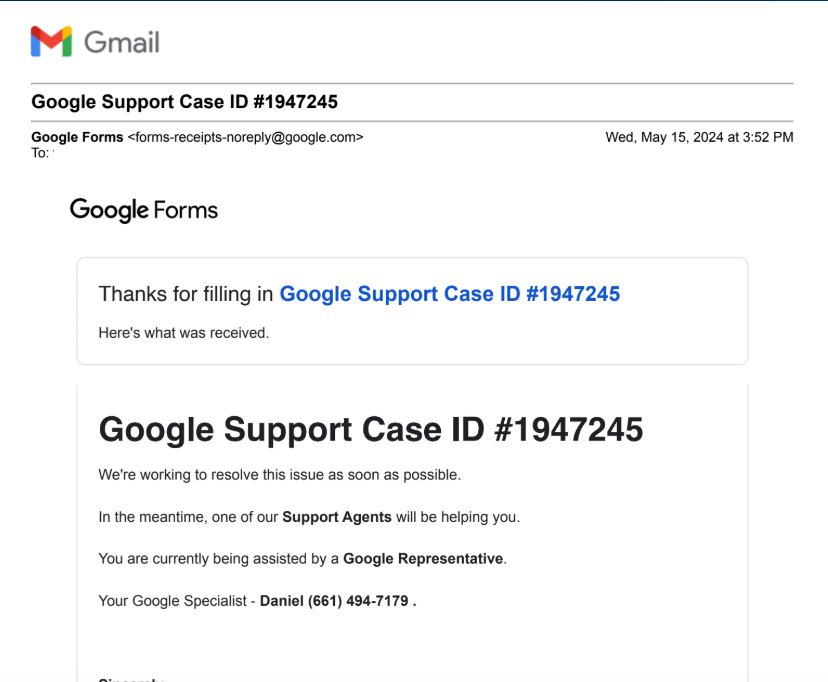
At the same time, he received an email that came from a google.com email address, warning his Google account was compromised. The message included a “Google Support Case ID number” and information about the Google representative supposedly talking to him on the phone, stating the rep’s name as “Ashton” — the same name given by the caller.

Griffin didn’t learn this until much later, but the email he received had a real google.com address because it was sent via Google Forms, a service available to all Google Docs users that makes it easy to send surveys, quizzes and other communications.

A phony security alert Griffin received prior to his bitcoin heist, via Google Forms.

According to tripwire.com’s Graham Cluely, phishers will use Google Forms to create a security alert message, and then change the form’s settings to automatically send a copy of the completed form to any email address entered into the form. The attacker then sends an invitation to complete the form to themselves, not to their intended victim.

“So, the attacker receives the invitation to fill out the form – and when they complete it, they enter their intended victim’s email address into the form, not their own,” Cluely wrote in a December 2023 post. “The attackers are taking advantage of the fact that the emails are being sent out directly by Google Forms (from the google.com domain). It’s an established legitimate domain that helps to make the email look more legitimate and is less likely to be intercepted en route by email-filtering solutions.”

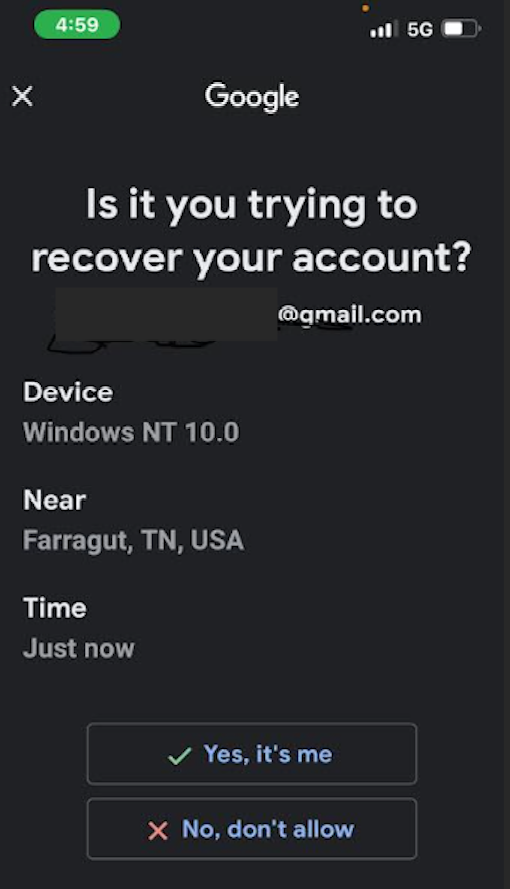
The fake Google representative was polite, patient, professional and reassuring. Ashton told Griffin he was going to receive a notification that would allow him to regain control of the account from the hackers. Sure enough, a Google prompt instantly appeared on his phone asking, “Is it you trying to recover your account?”

Adam Griffin clicked “yes,” to an account recovery notification similar to this one on May 6.

Griffin said that after receiving the pop-up prompt from Google on his phone, he felt more at ease that he really was talking to someone at Google. In reality, the thieves caused the alert to appear on his phone merely by stepping through Google’s account recovery process for Griffin’s Gmail address.

“As soon as I clicked yes, I gave them access to my Gmail, which was synched to Google Photos,” Griffin said.

Unfortunately for Griffin, years ago he used Google Photos to store an image of the secret seed phrase that was protecting his cryptocurrency wallet. Armed with that phrase, the phishers could drain all of his funds.

“From there they were able to transfer approximately $450,000 out of my Exodus wallet,” Griffin recalled.

Griffin said just minutes after giving away access to his Gmail account he received a call from someone claiming to be with Coinbase, who likewise told him someone in Germany was trying to take over his account.

Griffin said a follow-up investigation revealed the attackers had used his Gmail account to gain access to his Coinbase account from a VPN connection in California, providing the multi-factor code from his Google Authenticator app. Unbeknownst to him at the time, Google Authenticator by default also makes the same codes available in one’s Google account online.

But when the thieves tried to move $100,000 worth of cryptocurrency out of his account, Coinbase sent an email stating that the account had been locked, and that he would have to submit additional verification documents before he could do anything with it.

GRAND THEFT AUTOMATED

Just days after Griffin was robbed, a scammer impersonating Google managed to phish 45 bitcoins — approximately $4,725,000 at today’s value — from Tony, a 42-year-old professional from northern California. Tony agreed to speak about his harrowing experience on condition that his last name not be used.

Tony got into bitcoin back in 2013 and has been investing in it ever since. On the evening of May 15, 2024, Tony was putting his three- and one-year-old boys to bed when he received a message from Google about an account security issue, followed by a phone call from a “Daniel Alexander” at Google who said his account was compromised by hackers.

Tony said he had just signed up for Google’s Gemini AI (an artificial intelligence platform formerly known as “Bard”), and mistakenly believed the call was part of that service. Daniel told Tony his account was being accessed by someone in Frankfurt, Germany, and that he could evict the hacker and recover access to the account by clicking “yes” to the prompt that Google was going to send to his phone.

The Google prompt arrived seconds later. And to his everlasting regret, Tony clicked the “Yes, it’s me” button.

Then came another call, this one allegedly from security personnel at Trezor, a company that makes encrypted hardware devices made to store cryptocurrency seed phrases securely offline. The caller said someone had submitted a request to Trezor to close his account, and they forwarded Tony a message sent from his Gmail account that included his name, Social Security number, date of birth, address, phone number and email address.

Tony said he began to believe then that his Trezor account truly was compromised. The caller convinced him to “recover” his account by entering his cryptocurrency seed phrase at a phishing website (verify-trezor[.]io) that mimicked the official Trezor website.

“At this point I go into fight or flight mode,” Tony recalled. “I’ve got my kids crying, my wife is like what the heck is going on? My brain went haywire. I put my seed phrase into a phishing site, and that was it.”

Almost immediately, all of the funds he was planning to save for retirement and for his children’s college fund were drained from his account.

“I made mistakes due to being so busy and not thinking correctly,” Tony told KrebsOnSecurity. “I had gotten so far away from the security protocols in bitcoin as life had changed so much since having kids.”

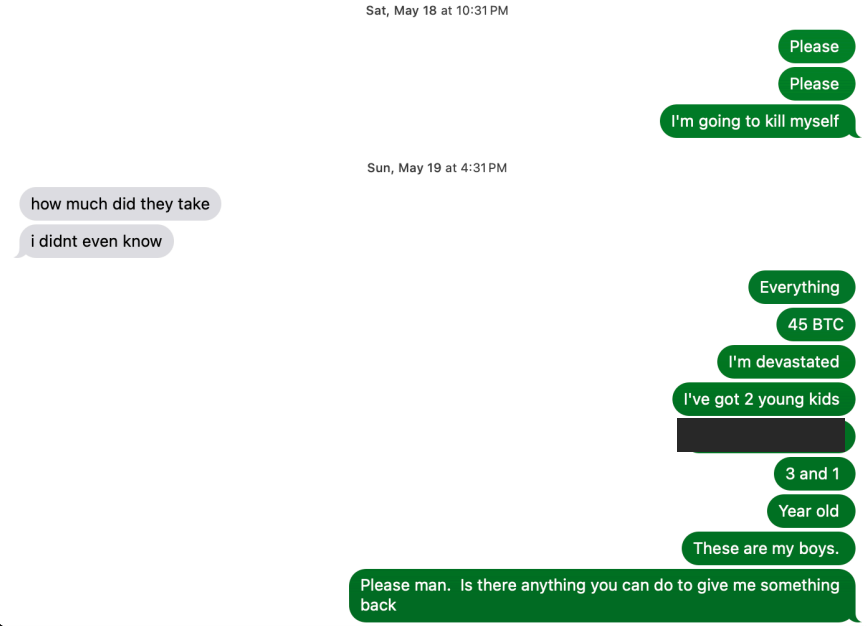
Tony shared this text message exchange of him pleading with his tormentors after being robbed of 45 bitcoins.

Tony said the theft left him traumatized and angry for months.

“All I was thinking about was protecting my boys and it ended up costing me everything,” he said. “Needless to say I’m devastated and have had to do serious therapy to get through it.”

MISERY LOVES COMPANY

Tony told KrebsOnSecurity that in the weeks following the theft of his 45 bitcoins, he became so consumed with rage and shame that he was seriously contemplating suicide. Then one day, while scouring the Internet for signs that others may have been phished by Daniel, he encountered Griffin posting on Reddit about the phone number involved in his recent bitcoin theft.

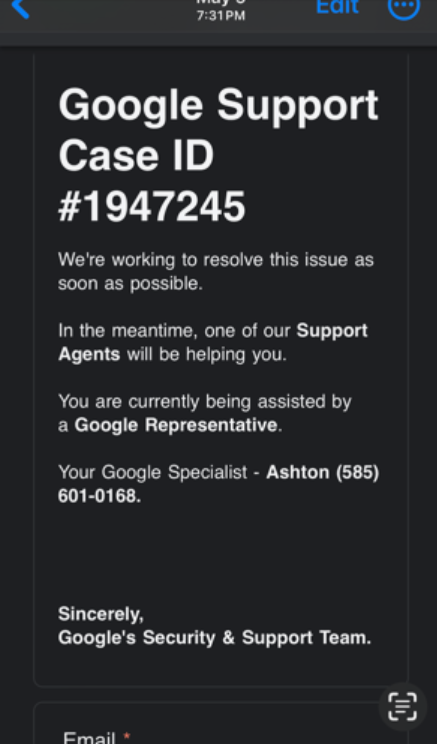
Griffin said the two of them were initially suspicious of each other — exchanging cautious messages for about a week — but he decided Tony was telling the truth after contacting the FBI agent that Tony said was working his case. Comparing notes, they discovered the fake Google security alerts they received just prior to their individual bitcoin thefts referenced the same phony “Google Support Case ID” number.

Adam Griffin and Tony said they received the same Google Support Case ID number in advance of their thefts. Both were sent via Google Forms, which sends directly from the google.com domain name.

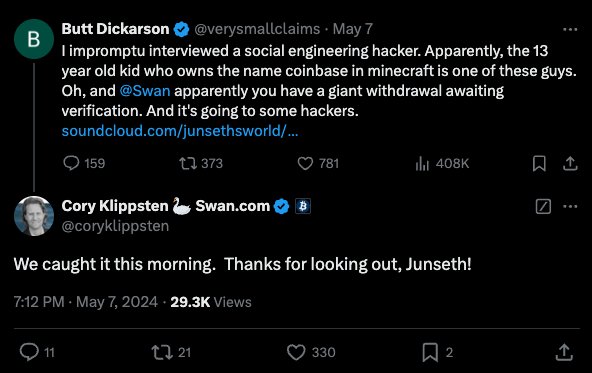
More importantly, Tony recognized the voice of “Daniel from Google” when it was featured in an interview by Junseth, a podcaster who covers cryptocurrency scams. The same voice that had coaxed Tony out of his considerable cryptocurrency holdings just days earlier also had tried to phish Junseth, who played along for several minutes before revealing he knew it was a scam.

Daniel told Junseth he was a teenager and worked with other scam callers who had all met years ago on the game Minecraft, and that he recently enjoyed a run of back-to-back Gmail account compromises that led to crypto theft paydays.

“No one gets arrested,” Daniel enthused to Junseth in the May 7 podcast, which quickly went viral on social media. “It’s almost like there’s no consequences. I have small legal side hustles, like businesses and shit that I can funnel everything through. If you were to see me in real life, I look like a regular child going to school with my backpack and shit, you’d never expect this kid is stealing all this shit.”

Daniel explained that they often use an automated bot that initiates calls to targets warning that their account is experiencing suspicious activity, and that they should press “1” to speak with a representative. This process, he explained, essentially self-selects people who are more likely to be susceptible to their social engineering schemes. [It is possible — but not certain — that this bot Daniel referenced explains the incoming call to Griffin from Google Assistant that precipitated his bitcoin heist].

Daniel told Junseth he and his co-conspirators had just scored a $1.2 million theft that was still pending on the bitcoin investment platform SwanBitcoin. In response, Junseth tagged SwanBitcoin in a post about his podcast on Twitter/X, and the CEO of Swan quickly replied that they caught the $1.2 million transaction that morning.

Apparently, Daniel didn’t appreciate having his voice broadcast to the world (or his $1.2 million bitcoin heist disrupted) because according to Junseth someone submitted a baseless copyright infringement claim about it to Soundcloud, which was hosting the recording.

The complaint alleged the recording included a copyrighted song, but that wasn’t true: Junseth later posted a raw version of the recording to Telegram, and it clearly had no music in the background. Nevertheless, Soundcloud removed the audio file.

“All these companies are very afraid of copyright,” Junseth explained in a May 2024 interview with the podcast whatbitcoindid.com, which features some of the highlights from his recorded call with Daniel.

“It’s interesting because copyright infringement really is an act that you’re claiming against the publisher, but for some reason these companies have taken a very hard line against it, so if you even claim there’s copyrighted material in it they just take it down and then they leave it to you to prove that you’re innocent,” Junseth said. “In Soundcloud’s instance, part of declaring your innocence is you have to give them your home address and everything else, and it says right on there, ‘this will be provided to the person making the copyright claim.’”

AFTERMATH

When Junseth asked how potential victims could protect themselves, Daniel explained that if the target doesn’t have their Google Authenticator synced to their Google cloud account, the scammers can’t easily pivot into the victim’s accounts at cryptocurrency exchanges, as they did with Griffin.

By default, Google Authenticator syncs all one-time codes with a Gmail user’s account, meaning if someone gains access to your Google account, they can then access all of the one-time codes handed out by your Google Authenticator app.

To change this setting, open Authenticator on your mobile device, select your profile picture, and then choose “Use without an Account” from the menu. If you disable this, it’s a good idea to keep a printed copy of one-time backup codes, and to store those in a secure place.

You may also wish to download Google Authenticator to another mobile device that you control. Otherwise, if you turn off cloud synching and lose that sole mobile device with your Google Authenticator app, it could be difficult or impossible to recover access to your account if you somehow get locked out.

Griffin told KrebsOnSecurity he had no idea it was so easy for thieves to take over his account, and to abuse so many different Google services in the process.

“I know I definitely made mistakes, but I also know Google could do a lot better job protecting people,” he said.

In response to questions from KrebsOnSecurity, Google said it can confirm that this was a narrow phishing campaign, reaching a “very small group of people.”

“We’re aware of this narrow and targeted attack, and have hardened our defenses to block recovery attempts from this actor,” the company said in a written statement, which emphasized that the real Google will never call you.

“While these types of social engineering campaigns are constantly evolving, we are continuously working to harden our systems with new tools and technical innovations, as well as sharing updated guidance with our users to stay ahead of attackers,” the statement reads.

Both Griffin and Tony say they continue to receive “account security” calls from people pretending to work for Google or one of the cryptocurrency platforms.

“It’s like you get put on some kind of list, and then those lists get recycled over and over,” Tony said.

Griffin said that for several months after his ordeal, he accepted almost every cryptocurrency scam call that came his way, playing along in the vain hope of somehow tricking the caller into revealing details about who they are in real life. But he stopped after his taunting caused one of the scammers to start threatening him personally.

“I probably shouldn’t have, but I recorded two 30-minute conversations with these guys,” Griffin said, acknowledging that maybe it wasn’t such a great idea to antagonize cybercriminals who clearly already knew everything about him. “One guy I talked to about his personal life, and then his friend called me up and said he was going to dox me and do all this other bad stuff. My FBI contact later told me not to talk to these guys anymore.”

Sound advice. So is hanging up whenever anyone calls you about a security problem with one of your accounts. Even security-conscious people tend to underestimate the complex and shifting threat from phone-based phishing scams, but they do so at their peril.

When in doubt: Hang up, look up, and call back. If your response to these types of calls involves anything other than hanging up, researching the correct phone number, and contacting the entity that claims to be calling, you may be setting yourself up for a costly and humbling learning experience.

Understand that your email credentials are more than likely the key to unlocking your entire digital identity. Be sure to use a long, unique passphrase for your email address, and never pick a passphrase that you have ever used anywhere else (not even a variation on an old password).

Finally, it’s also a good idea to take advantage of the strongest multi-factor authentication methods offered. For Gmail/Google accounts, that includes the use of passkeys or physical security keys, which are heavily phishing resistant. For Google users holding measurable sums of cryptocurrency, the most secure option is Google’s free Advanced Protection program, which includes more extensive account security features but also comes with some serious convenience trade-offs.


Read More

CISA Issues BOD 25-01, Implementing Secure Practices for Cloud Services

 ​Today, CISA issued Binding Operational Directive (BOD) 25-01, Implementing Secure Practices for Cloud Services to safeguard federal information and information systems. This Directive requires federal civilian agencies to identify specific cloud tenants, implement assessment tools, and align cloud environments to CISA’s Secure Cloud Business Applications (SCuBA) secure configuration baselines. 
Recent cybersecurity incidents highlight the significant risks posed by misconfigurations and weak security controls, which attackers can use to gain unauthorized access, exfiltrate data, or disrupt services. As part of CISA and the broad U.S. government’s effort to move the federal civilian enterprise to a more defensible posture, this Directive will further reduce the attack surface of the federal government networks.
The new Directive can be found at Binding Operational Directive (BOD) 25-01. To learn more about CISA Directives, visit Cybersecurity Directives webpage. 

Today, CISA issued Binding Operational Directive (BOD) 25-01, Implementing Secure Practices for Cloud Services to safeguard federal information and information systems. This Directive requires federal civilian agencies to identify specific cloud tenants, implement assessment tools, and align cloud environments to CISA’s Secure Cloud Business Applications (SCuBA) secure configuration baselines. 

Recent cybersecurity incidents highlight the significant risks posed by misconfigurations and weak security controls, which attackers can use to gain unauthorized access, exfiltrate data, or disrupt services. As part of CISA and the broad U.S. government’s effort to move the federal civilian enterprise to a more defensible posture, this Directive will further reduce the attack surface of the federal government networks.

The new Directive can be found at Binding Operational Directive (BOD) 25-01. To learn more about CISA Directives, visit Cybersecurity Directives webpage.

 Read More

BD Diagnostic Solutions Products

 ​View CSAF
1. EXECUTIVE SUMMARY

CVSS v3 8.0
ATTENTION: Low attack complexity
Vendor: Becton, Dickinson and Company (BD)
Equipment: Diagnostic Solutions Products
Vulnerability: Use of Default Credentials

2. RISK EVALUATION
Successful exploitation of this vulnerability could allow an attacker to use default credentials to access, modify, or delete sensitive data, which could impact the availability of the system or cause a system shutdown.
3. TECHNICAL DETAILS
3.1 AFFECTED PRODUCTS
The following BD Diagnostic Solutions products are affected:

BD BACTEC Blood Culture System: All versions
BD COR System: All versions
BD EpiCenter Microbiology Data Management System: All versions
BD MAX System: All versions
BD Phoenix M50 Automated Microbiology System: All versions
BD Synapsys Informatics Solution: All versions

3.2 Vulnerability Overview
3.2.1 USE OF DEFAULT CREDENTIALS CWE-1392
Default credentials are used in the above listed BD Diagnostic Solutions products. If exploited, threat actors may be able to access, modify or delete data, including sensitive information such as protected health information (PHI) and personally identifiable information (PII). Exploitation of this vulnerability may allow an attacker to shut down or otherwise impact the availability of the system.
CVE-2024-10476 has been assigned to this vulnerability. A CVSS v3.1 base score of 8.0 has been calculated; the CVSS vector string is (AV:A/AC:L/PR:L/UI:N/S:U/C:H/I:H/A:H).
3.3 BACKGROUND

CRITICAL INFRASTRUCTURE SECTORS: Healthcare and Public Health
COUNTRIES/AREAS DEPLOYED: Worldwide
COMPANY HEADQUARTERS LOCATION: United States

3.4 RESEARCHER
BD reported this vulnerability to CISA.
4. MITIGATIONS
BD has already communicated to users with affected products and is working with them to update default credentials on affected products. For this vulnerability to be exploited, a threat actor will need direct access, whether logical or physical, into the clinical setting.
Note: BD Synapsys Informatics Solution is only in scope of this vulnerability when installed on a NUC server. BD Synapsys Informatics Solution installed on a customer-provided virtual machine or on the BD Kiestra SCU hardware is not in scope.
The BD Diagnostic Solutions products’ default credentials are intended for use by BD technical support teams for the above-mentioned BD products within the clinical setting. A threat actor would have to compromise your local network and, in some cases, may also need to be physically present at the instrument in order to use these product service credentials.
The BD RSS platform has not been impacted by and is not in scope of this vulnerability.
BD strongly recommends users execute actions which strengthen the controls around the logical and physical environments where Diagnostic Solutions instruments are located. The following best practices are recommended for maintaining strong security measures to protect user networks and associated medical devices including:

Ensure access to potentially vulnerable devices is limited to authorized personnel
Inform authorized users of issue, and ensure all relevant passwords are tightly controlled
Monitor and log network traffic attempting to reach medical device management environments for suspicious activity
Where possible, isolate affected devices in a secure VLAN or behind firewalls with restricted access that only permits communication with trusted hosts in other networks when needed
Impacted devices do not require use of RDP ports and these should be disabled or blocked if enabled
Ensure permissions on file shares are appropriately established and enforced, and monitor and log access for evidence of suspicious activity
Disconnect devices from the network if connectivity is not necessary

For more information, refer to BD’s security bulletin.
CISA recommends users take defensive measures to minimize the risk of exploitation of this vulnerability, such as:

When remote access is required, use more secure methods, such as Virtual Private Networks (VPNs), recognizing VPNs may have vulnerabilities and should be updated to the most current version available. Also recognize VPN is only as secure as the connected devices.

CISA reminds organizations to perform proper impact analysis and risk assessment prior to deploying defensive measures.
CISA also provides a section for control systems security recommended practices on the ICS webpage on cisa.gov/ics. Several CISA products detailing cyber defense best practices are available for reading and download, including Improving Industrial Control Systems Cybersecurity with Defense-in-Depth Strategies.
CISA encourages organizations to implement recommended cybersecurity strategies for proactive defense of ICS assets.
Additional mitigation guidance and recommended practices are publicly available on the ICS webpage at cisa.gov/ics in the technical information paper, ICS-TIP-12-146-01B–Targeted Cyber Intrusion Detection and Mitigation Strategies.
Organizations observing suspected malicious activity should follow established internal procedures and report findings to CISA for tracking and correlation against other incidents.
No known public exploitation specifically targeting this vulnerability has been reported to CISA at this time. This vulnerability is not exploitable remotely.
5. UPDATE HISTORY

December 17, 2024: Initial Publication 

View CSAF

1. EXECUTIVE SUMMARY

  • CVSS v3 8.0
  • ATTENTION: Low attack complexity
  • Vendor: Becton, Dickinson and Company (BD)
  • Equipment: Diagnostic Solutions Products
  • Vulnerability: Use of Default Credentials

2. RISK EVALUATION

Successful exploitation of this vulnerability could allow an attacker to use default credentials to access, modify, or delete sensitive data, which could impact the availability of the system or cause a system shutdown.

3. TECHNICAL DETAILS

3.1 AFFECTED PRODUCTS

The following BD Diagnostic Solutions products are affected:

  • BD BACTEC Blood Culture System: All versions
  • BD COR System: All versions
  • BD EpiCenter Microbiology Data Management System: All versions
  • BD MAX System: All versions
  • BD Phoenix M50 Automated Microbiology System: All versions
  • BD Synapsys Informatics Solution: All versions

3.2 Vulnerability Overview

3.2.1 USE OF DEFAULT CREDENTIALS CWE-1392

Default credentials are used in the above listed BD Diagnostic Solutions products. If exploited, threat actors may be able to access, modify or delete data, including sensitive information such as protected health information (PHI) and personally identifiable information (PII). Exploitation of this vulnerability may allow an attacker to shut down or otherwise impact the availability of the system.

CVE-2024-10476 has been assigned to this vulnerability. A CVSS v3.1 base score of 8.0 has been calculated; the CVSS vector string is (AV:A/AC:L/PR:L/UI:N/S:U/C:H/I:H/A:H).

3.3 BACKGROUND

  • CRITICAL INFRASTRUCTURE SECTORS: Healthcare and Public Health
  • COUNTRIES/AREAS DEPLOYED: Worldwide
  • COMPANY HEADQUARTERS LOCATION: United States

3.4 RESEARCHER

BD reported this vulnerability to CISA.

4. MITIGATIONS

BD has already communicated to users with affected products and is working with them to update default credentials on affected products. For this vulnerability to be exploited, a threat actor will need direct access, whether logical or physical, into the clinical setting.

Note: BD Synapsys Informatics Solution is only in scope of this vulnerability when installed on a NUC server. BD Synapsys Informatics Solution installed on a customer-provided virtual machine or on the BD Kiestra SCU hardware is not in scope.

The BD Diagnostic Solutions products’ default credentials are intended for use by BD technical support teams for the above-mentioned BD products within the clinical setting. A threat actor would have to compromise your local network and, in some cases, may also need to be physically present at the instrument in order to use these product service credentials.

The BD RSS platform has not been impacted by and is not in scope of this vulnerability.

BD strongly recommends users execute actions which strengthen the controls around the logical and physical environments where Diagnostic Solutions instruments are located. The following best practices are recommended for maintaining strong security measures to protect user networks and associated medical devices including:

  • Ensure access to potentially vulnerable devices is limited to authorized personnel
  • Inform authorized users of issue, and ensure all relevant passwords are tightly controlled
  • Monitor and log network traffic attempting to reach medical device management environments for suspicious activity
  • Where possible, isolate affected devices in a secure VLAN or behind firewalls with restricted access that only permits communication with trusted hosts in other networks when needed
  • Impacted devices do not require use of RDP ports and these should be disabled or blocked if enabled
  • Ensure permissions on file shares are appropriately established and enforced, and monitor and log access for evidence of suspicious activity
  • Disconnect devices from the network if connectivity is not necessary

For more information, refer to BD’s security bulletin.

CISA recommends users take defensive measures to minimize the risk of exploitation of this vulnerability, such as:

  • When remote access is required, use more secure methods, such as Virtual Private Networks (VPNs), recognizing VPNs may have vulnerabilities and should be updated to the most current version available. Also recognize VPN is only as secure as the connected devices.

CISA reminds organizations to perform proper impact analysis and risk assessment prior to deploying defensive measures.

CISA also provides a section for control systems security recommended practices on the ICS webpage on cisa.gov/ics. Several CISA products detailing cyber defense best practices are available for reading and download, including Improving Industrial Control Systems Cybersecurity with Defense-in-Depth Strategies.

CISA encourages organizations to implement recommended cybersecurity strategies for proactive defense of ICS assets.

Additional mitigation guidance and recommended practices are publicly available on the ICS webpage at cisa.gov/ics in the technical information paper, ICS-TIP-12-146-01B–Targeted Cyber Intrusion Detection and Mitigation Strategies.

Organizations observing suspected malicious activity should follow established internal procedures and report findings to CISA for tracking and correlation against other incidents.

No known public exploitation specifically targeting this vulnerability has been reported to CISA at this time. This vulnerability is not exploitable remotely.

5. UPDATE HISTORY

  • December 17, 2024: Initial Publication

 Read More

CISA Releases Five Industrial Control Systems Advisories

 ​CISA released five Industrial Control Systems (ICS) advisories on December 17, 2024. These advisories provide timely information about current security issues, vulnerabilities, and exploits surrounding ICS.

ICSA-24-352-01 ThreatQuotient ThreatQ Platform
ICSA-24-352-02 Hitachi Energy TropOS Devices Series 1400/2400/6400
ICSA-24-352-03 Rockwell Automation PowerMonitor 1000 Remote
ICSA-24-352-04 Schneider Electric Modicon
ICSMA-24-352-01 BD Diagnostic Solutions Products

CISA encourages users and administrators to review newly released ICS advisories for technical details and mitigations. 

CISA released five Industrial Control Systems (ICS) advisories on December 17, 2024. These advisories provide timely information about current security issues, vulnerabilities, and exploits surrounding ICS.

CISA encourages users and administrators to review newly released ICS advisories for technical details and mitigations.

 Read More

CISA Adds One Known Exploited Vulnerability to Catalog

 ​CISA has added one new vulnerability to its Known Exploited Vulnerabilities Catalog, based on evidence of active exploitation.

CVE-2024-55956 Cleo Multiple Products Unauthenticated File Upload Vulnerability

These types of vulnerabilities are frequent attack vectors for malicious cyber actors and pose significant risks to the federal enterprise.
Binding Operational Directive (BOD) 22-01: Reducing the Significant Risk of Known Exploited Vulnerabilities established the Known Exploited Vulnerabilities Catalog as a living list of known Common Vulnerabilities and Exposures (CVEs) that carry significant risk to the federal enterprise. BOD 22-01 requires Federal Civilian Executive Branch (FCEB) agencies to remediate identified vulnerabilities by the due date to protect FCEB networks against active threats. See the BOD 22-01 Fact Sheet for more information.
Although BOD 22-01 only applies to FCEB agencies, CISA strongly urges all organizations to reduce their exposure to cyberattacks by prioritizing timely remediation of Catalog vulnerabilities as part of their vulnerability management practice. CISA will continue to add vulnerabilities to the catalog that meet the specified criteria. 

CISA has added one new vulnerability to its Known Exploited Vulnerabilities Catalog, based on evidence of active exploitation.

  • CVE-2024-55956 Cleo Multiple Products Unauthenticated File Upload Vulnerability

These types of vulnerabilities are frequent attack vectors for malicious cyber actors and pose significant risks to the federal enterprise.

Binding Operational Directive (BOD) 22-01: Reducing the Significant Risk of Known Exploited Vulnerabilities established the Known Exploited Vulnerabilities Catalog as a living list of known Common Vulnerabilities and Exposures (CVEs) that carry significant risk to the federal enterprise. BOD 22-01 requires Federal Civilian Executive Branch (FCEB) agencies to remediate identified vulnerabilities by the due date to protect FCEB networks against active threats. See the BOD 22-01 Fact Sheet for more information.

Although BOD 22-01 only applies to FCEB agencies, CISA strongly urges all organizations to reduce their exposure to cyberattacks by prioritizing timely remediation of Catalog vulnerabilities as part of their vulnerability management practice. CISA will continue to add vulnerabilities to the catalog that meet the specified criteria.

 Read More

CISA and ONCD Release Playbook for Strengthening Cybersecurity in Federal Grant Programs for Critical Infrastructure

 ​Today, CISA and the Office of the National Cyber Director (ONCD) published Playbook for Strengthening Cybersecurity in Federal Grant Programs for Critical Infrastructure to assist grant-making agencies to incorporate cybersecurity into their grant programs and assist grant-recipients to build cyber resilience into their grant-funded infrastructure projects. 
This guide is for federal grant program managers, critical infrastructure owners and operators, and organizations such as state, local, tribal, and territorial governments who subaward grant program funds, and grant program recipients. The guide includes:

Recommended actions to incorporate cybersecurity into grant programs throughout the grant management lifecycle.
Model language for grant program managers and sub-awarding organizations to incorporate into Notices of Funding Opportunity (NOFOs) and Terms & Conditions. 
Templates for recipients to leverage when developing a Cyber Risk Assessment and Project Cybersecurity Plan.
Comprehensive list of cybersecurity resources available to support grant recipient project execution.

CISA encourages organizations to review and apply recommended actions to secure the nation’s critical infrastructure and enhance resilience. 

Today, CISA and the Office of the National Cyber Director (ONCD) published Playbook for Strengthening Cybersecurity in Federal Grant Programs for Critical Infrastructure to assist grant-making agencies to incorporate cybersecurity into their grant programs and assist grant-recipients to build cyber resilience into their grant-funded infrastructure projects. 

This guide is for federal grant program managers, critical infrastructure owners and operators, and organizations such as state, local, tribal, and territorial governments who subaward grant program funds, and grant program recipients. The guide includes:

  • Recommended actions to incorporate cybersecurity into grant programs throughout the grant management lifecycle.
  • Model language for grant program managers and sub-awarding organizations to incorporate into Notices of Funding Opportunity (NOFOs) and Terms & Conditions. 
  • Templates for recipients to leverage when developing a Cyber Risk Assessment and Project Cybersecurity Plan.
  • Comprehensive list of cybersecurity resources available to support grant recipient project execution.

CISA encourages organizations to review and apply recommended actions to secure the nation’s critical infrastructure and enhance resilience.

 Read More

Scroll to Top