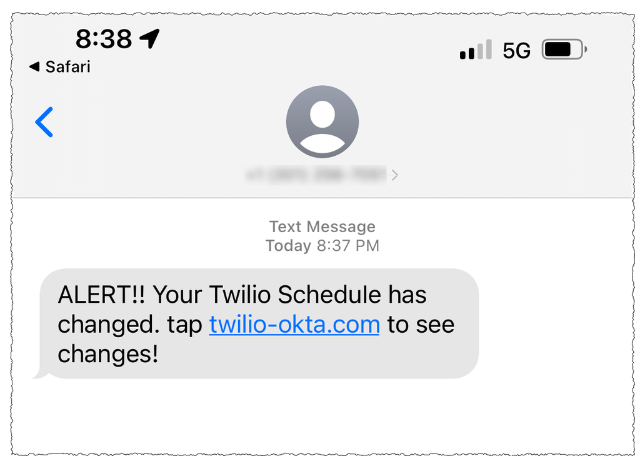
Hacker in Snowflake Extortions May Be a U.S. Soldier

​Two men have been arrested for allegedly stealing data from and extorting dozens of companies that used the cloud data storage company Snowflake, but a third suspect — a prolific hacker known as Kiberphant0m — remains at large and continues to publicly extort victims. However, this person’s identity may not remain a secret for long: A careful review of Kiberphant0m’s daily chats across multiple cybercrime personas suggests they are a U.S. Army soldier who is or was recently stationed in South Korea. 

Two men have been arrested for allegedly stealing data from and extorting dozens of companies that used the cloud data storage company Snowflake, but a third suspect — a prolific hacker known as Kiberphant0m — remains at large and continues to publicly extort victims. However, this person’s identity may not remain a secret for long: A careful review of Kiberphant0m’s daily chats across multiple cybercrime personas suggests they are a U.S. Army soldier who is or was recently stationed in South Korea.

Kiberphant0m’s identities on cybercrime forums and on Telegram and Discord chat channels have been selling data stolen from customers of the cloud data storage company Snowflake. At the end of 2023, malicious hackers discovered that many companies had uploaded huge volumes of sensitive customer data to Snowflake accounts that were protected with nothing more than a username and password (no multi-factor authentication required).

After scouring darknet markets for stolen Snowflake account credentials, the hackers began raiding the data storage repositories for some of the world’s largest corporations. Among those was AT&T, which disclosed in July that cybercriminals had stolen personal information, phone and text message records for roughly 110 million people.  Wired.com reported in July that AT&T paid a hacker $370,000 to delete stolen phone records.

On October 30, Canadian authorities arrested Alexander Moucka, a.k.a. Connor Riley Moucka of Kitchener, Ontario, on a provisional arrest warrant from the United States, which has since indicted him on 20 criminal counts connected to the Snowflake breaches. Another suspect in the Snowflake hacks, John Erin Binns, is an American who is currently incarcerated in Turkey.

A surveillance photo of Connor Riley Moucka, a.k.a. “Judische” and “Waifu,” dated Oct 21, 2024, 9 days before Moucka’s arrest. This image was included in an affidavit filed by an investigator with the Royal Canadian Mounted Police (RCMP).

Investigators say Moucka, who went by the handles Judische and Waifu, had tasked Kiberphant0m with selling data stolen from Snowflake customers who refused to pay a ransom to have their information deleted. Immediately after news broke of Moucka’s arrest, Kiberphant0m was clearly furious, and posted on the hacker community BreachForums what they claimed were the AT&T call logs for President-elect Donald J. Trump and for Vice President Kamala Harris.

“In the event you do not reach out to us @ATNT all presidential government call logs will be leaked,” Kiberphant0m threatened, signing his post with multiple “#FREEWAIFU” tags. “You don’t think we don’t have plans in the event of an arrest? Think again.”

On the same day, Kiberphant0m posted what they claimed was the “data schema” from the U.S. National Security Agency.

“This was obtained from the ATNT Snowflake hack which is why ATNT paid an extortion,” Kiberphant0m wrote in a thread on BreachForums. “Why would ATNT pay Waifu for the data when they wouldn’t even pay an extortion for over 20M+ SSNs?”
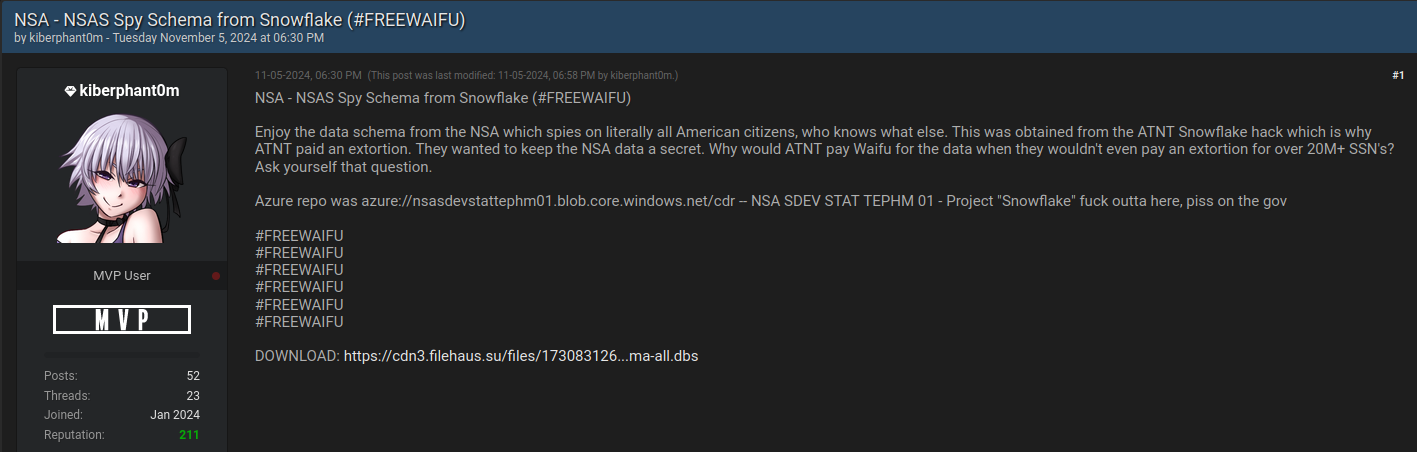
Kiberphant0m posting what he claimed was a “data schema” stolen from the NSA via AT&T.

Also on Nov. 5, Kiberphant0m offered call logs stolen from Verizon’s push-to-talk (PTT) customers — mainly U.S. government agencies and emergency first responders. On Nov. 9, Kiberphant0m posted a sales thread on BreachForums offering a “SIM-swapping” service targeting Verizon PTT customers. In a SIM-swap, fraudsters use credentials that are phished or stolen from mobile phone company employees to divert a target’s phone calls and text messages to a device they control.

MEET ‘BUTTHOLIO’

Kiberphant0m joined BreachForums in January 2024, but their public utterances on Discord and Telegram channels date back to at least early 2022. On their first post to BreachForums, Kiberphant0m said they could be reached at the Telegram handle @cyb3rph4nt0m.

A review of @cyb3rph4nt0m shows this user has posted more than 4,200 messages since January 2024. Many of these messages were attempts to recruit people who could be hired to deploy a piece of malware that enslaved host machines in an Internet of Things (IoT) botnet.

On BreachForums, Kiberphant0m has sold the source code to “Shi-Bot,” a custom Linux DDoS botnet based on the Mirai malware. Kiberphant0m had few sales threads on BreachForums prior to the Snowflake attacks becoming public in May, and many of those involved databases stolen from companies in South Korea.

On June 5, 2024, a Telegram user by the name “Buttholio” joined the fraud-focused Telegram channel “Comgirl” and claimed to be Kiberphant0m. Buttholio made the claim after being taunted as a nobody by another denizen of Comgirl, referring to their @cyb3rph4nt0m account on Telegram and the Kiberphant0m user on cybercrime forums.

“Type ‘kiberphant0m’ on google with the quotes,” Buttholio told another user. “I’ll wait. Go ahead. Over 50 articles. 15+ telecoms breached. I got the IMSI number to every single person that’s ever registered in Verizon, Tmobile, ATNT and Verifone.”

On Sept. 17, 2023, Buttholio posted in a Discord chat room dedicated to players of the video game Escape from Tarkov. “Come to Korea, servers there is pretty much no extract camper or cheater,” Buttholio advised.

In another message that same day in the gaming Discord, Buttholio told others they bought the game in the United States, but that they were playing it in Asia.

“USA is where the game was purchased from, server location is actual in game servers u play on. I am a u.s. soldier so i bought it in the states but got on rotation so i have to use asian servers,” they shared.

‘REVERSESHELL’

The account @Kiberphant0m was assigned the Telegram ID number 6953392511. A review of this ID at the cyber intelligence platform Flashpoint shows that on January 4, 2024 Kibertphant0m posted to the Telegram channel “Dstat,” which is populated by cybercriminals involved in launching distributed denial-of-service (DDoS) attacks and selling DDoS-for-hire services [Full disclosure: Flashpoint is currently an advertiser on this website].

Immediately after Kiberphant0m logged on to the Dstat channel, another user wrote “hi buttholio,” to which Kiberphant0m replied with an affirmative greeting “wsg,” or “what’s good.” On Nov. 1, Dstat’s website dstat[.]cc was seized as part of “Operation PowerOFF,” an international law enforcement action against DDoS services.

Flashpoint’s data shows that @kiberphant0m told a fellow member of Dstat on April 10, 2024 that their alternate Telegram username was “@reverseshell,” and did the same two weeks later in the Telegram chat The Jacuzzi. The Telegram ID for this account is 5408575119.

Way back on Nov. 15, 2022, @reverseshell told a fellow member of a Telegram channel called Cecilio Chat that they were a soldier in the U.S. Army. This user also shared the following image of someone pictured waist-down in military fatigues, with a camouflaged backpack at their feet:

Kiberphant0m’s apparent alias ReverseShell posted this image on a Telegram channel Cecilio Chat, on Nov. 15, 2022. Image: Flashpoint.

In September 2022, Reverseshell was embroiled in an argument with another member who had threatened to launch a DDoS attack against Reverseshell’s Internet address. After the promised attack materialized, Reverseshell responded, “Yall just hit military base contracted wifi.”

In a chat from October 2022, Reverseshell was bragging about the speed of the servers they were using, and in reply to another member’s question said that they were accessing the Internet via South Korea Telecom.

Telegram chat logs archived by Flashpoint show that on Aug. 23, 2022, Reverseshell bragged they’d been using automated tools to find valid logins for Internet servers that they resold to others.

“I’ve hit US gov servers with default creds,” Reverseshell wrote, referring to systems with easy-to-guess usernames and/or passwords. “Telecom control servers, machinery shops, Russian ISP servers, etc. I sold a few big companies for like $2-3k a piece. You can sell the access when you get a big SSH into corporation.”

On July 29, 2023, Reverseshell posted a screenshot of a login page for a major U.S. defense contractor, claiming they had an aerospace company’s credentials to sell.

PROMAN AND VARS_SECC

Flashpoint finds the Telegram ID 5408575119 has used several aliases since 2022, including Reverseshell and Proman557.

A search on the username Proman557 at the cyber intelligence platform Intel 471 shows that a hacker by the name “Proman554” registered on Hackforums in September 2022, and in messages to other users Proman554 said they can be reached at the Telegram account Buttholio.

Intel 471 also finds the Proman557 moniker is one of many used by a person on the Russian-language hacking forum Exploit in 2022 who sold a variety of Linux-based botnet malware.

Proman557 was eventually banned — allegedly for scamming a fellow member out of $350 — and the Exploit moderator warned forum users that Proman557 had previously registered under several other nicknames, including an account called “Vars_Secc.”

Vars_Secc’s thousands of comments on Telegram over two years show this user divided their time between online gaming, maintaining a DDoS botnet, and promoting the sale or renting of their botnets to other users.

“I use ddos for many things not just to be a skid,” Vars_Secc pronounced. “Why do you think I haven’t sold my net?” They then proceeded to list the most useful qualities of their botnet:

-I use it to hit off servers that ban me or piss me off
-I used to ddos certain games to get my items back since the data reverts to when u joined
-I use it for server side desync RCE vulnerabilities
-I use it to sometimes ransom
-I use it when bored as a source of entertainment

Flashpoint shows that in June 2023, Vars_Secc responded to taunting from a fellow member in the Telegram channel SecHub who had threatened to reveal their personal details to the federal government for a reward.

“Man I’ve been doing this shit for 4 years,” Vars_Secc replied nonchalantly. “I highly doubt the government is going to pay millions of dollars for data on some random dude operating a pointless ddos botnet and finding a few vulnerabilities here and there.”

For several months in 2023, Vars_Secc also was an active member of the Russian-language crime forum XSS, where they sold access to a U.S. government server for $2,000. However, Vars_Secc would be banned from XSS after attempting to sell access to the Russian telecommunications giant Rostelecom. [In this, Vars_Secc violated the Number One Rule for operating on a Russia-based crime forum: Never offer to hack or sell data stolen from Russian entities or citizens].

On June 20, 2023, Vars_Secc posted a sales thread on the cybercrime forum Ramp 2.0 titled, “Selling US Gov Financial Access.”

“Server within the network, possible to pivot,” Vars_Secc’s sparse sales post read. “Has 3-5 subroutes connected to it. Price $1,250. Telegram: Vars_Secc.”

Vars_Secc also used Ramp in June 2023 to sell access to a “Vietnam government Internet Network Information Center.”

“Selling access server allocated within the network,” Vars_Secc wrote. “Has some data on it. $500.”

BUG BOUNTIES

The Vars_Secc identity claimed on Telegram in May 2023 that they made money by submitting reports about software flaws to HackerOne, a company that helps technology firms field reports about security vulnerabilities in their products and services. Specifically, Vars_Secc said they had earned financial rewards or “bug bounties” from reddit.com, the U.S. Department of Defense, and Coinbase, among 30 others.

“I make money off bug bounties, it’s quite simple,” Vars_Secc said when asked what they do for a living. “That’s why I have over 30 bug bounty reports on HackerOne.”

A month before that, Vars_Secc said they’d found a vulnerability in reddit.com.

“I poisoned Reddit’s cache,” they explained. “I’m going to exploit it further, then report it to reddit.”

KrebsOnSecurity sought comment from HackerOne, which said it would investigate the claims. This story will be updated if they respond.

The Vars_Secc telegram handle also has claimed ownership of the BreachForums member “Boxfan,” and Intel 471 shows Boxfan’s early posts on the forum had the Vars_Secc Telegram account in their signature. In their most recent post to BreachForums in January 2024, Boxfan disclosed a security vulnerability they found in Naver, the most popular search engine in South Korea (according to statista.com). Boxfan’s comments suggest they have strong negative feelings about South Korean culture.

“Have fun exploiting this vulnerability,” Boxfan wrote on BreachForums, after pasting a long string of computer code intended to demonstrate the flaw. “Fuck you South Korea and your discriminatory views. Nobody likes ur shit kpop you evil fucks. Whoever can dump this DB [database] congrats. I don’t feel like doing it so I’ll post it to the forum.”

The many identities tied to Kiberphant0m strongly suggest they are or until recently were a U.S. Army soldier stationed in South Korea. Kiberphant0m’s alter egos never mentioned their military rank, regiment, or specialization.

However, it is likely that Kiberphant0m’s facility with computers and networking was noticed by the Army, which undoubtedly would have placed them in some kind of role involving both.

According to the U.S. Army’s website, the bulk of its forces in South Korea reside within the Eighth Army, which has a dedicated cyber operations unit focused on defending against cyber threats.

On April 1, 2023, Vars_Secc posted to a public Telegram chat channel a screenshot of the National Security Agency’s website. The image indicated the visitor had just applied for some type of job at the NSA.
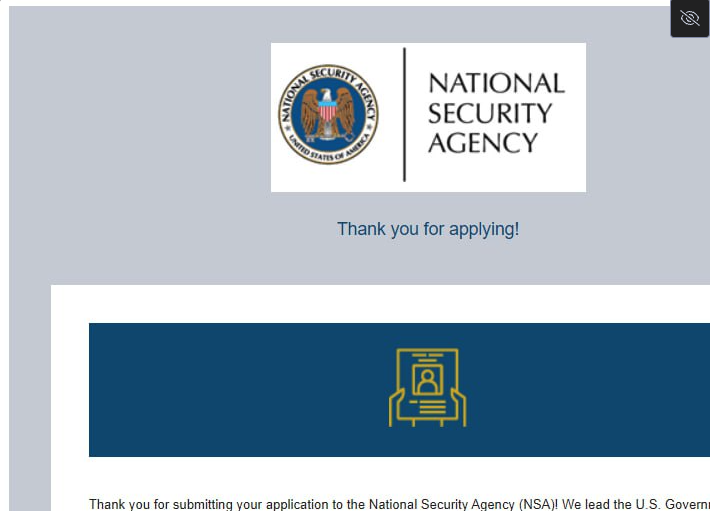
A screenshot posted by Vars_Secc on Telegram on April 1, 2023, suggesting they just applied for a job at the National Security Agency.

The NSA has not yet responded to requests for comment.

Reached via Telegram, Kiberphant0m acknowledged that KrebsOnSecurity managed to unearth their old handles.

“I see you found the IP behind it no way,” Kiberphant0m replied. “I see you managed to find my old aliases LOL.”

Kiberphant0m denied being in the U.S. Army or ever being in South Korea, and said all of that was a lengthy ruse designed to create a fictitious persona. “Epic opsec troll,” they claimed.

Asked if they were at all concerned about getting busted, Kiberphant0m called that an impossibility.

“I literally can’t get caught,” Kiberphant0m said, declining an invitation to explain why. “I don’t even live in the USA Mr. Krebs.”

Below is a mind map that hopefully helps illustrate some of the connections between and among Kiberphant0m’s apparent alter egos.
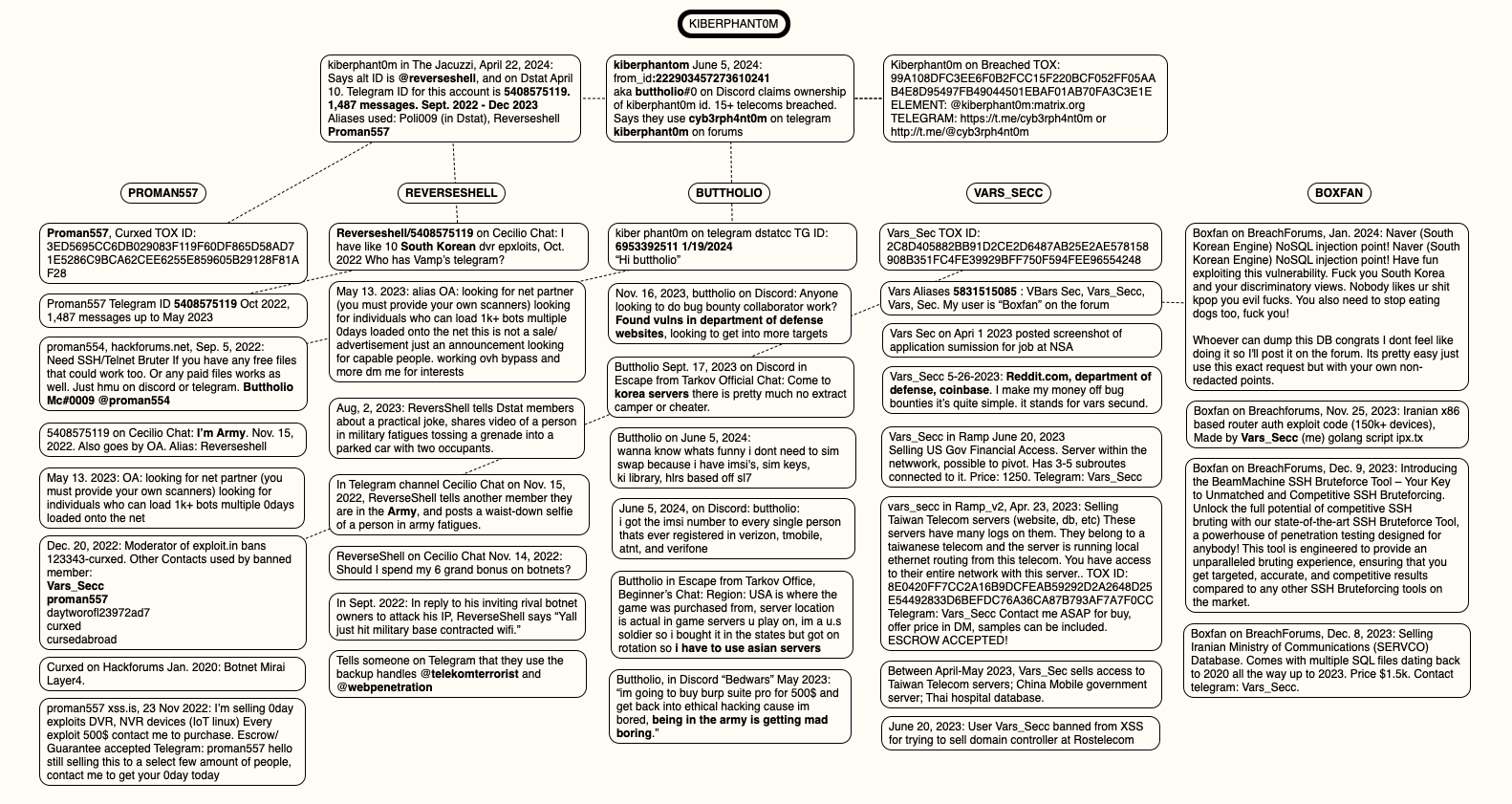
A mind map of the connections between and among the identities apparently used by Kiberphant0m. Click to enlarge.
 

Read More

Hitachi Energy MicroSCADA Pro/X SYS600

 ​View CSAF
1. EXECUTIVE SUMMARY

CVSS v3 9.9
ATTENTION: Exploitable remotely/low attack complexity
Vendor: Hitachi Energy
Equipment: MicroSCADA Pro/X SYS600
Vulnerabilities: Improper Neutralization of Special Elements in Data Query Logic, Improper Limitation of a Pathname to a Restricted Directory (‘Path Traversal’), Authentication Bypass by Capture-replay, Missing Authentication for Critical Function, URL Redirection to Untrusted Site (‘Open Redirect’)

2. RISK EVALUATION
Successful exploitation of these vulnerabilities could allow an attacker to inject code towards persistent data, manipulate the file system, hijack a session, or engage in phishing attempts against users.
3. TECHNICAL DETAILS
3.1 AFFECTED PRODUCTS
The following Hitachi Energy products are affected:

Hitachi Energy MicroSCADA Pro/X SYS600: Version 10.0 to Version 10.5 (CVE-2024-4872, CVE-2024-3980, CVE-2024-3982, CVE-2024-7941)
Hitachi Energy MicroSCADA Pro/X SYS600: Version 10.2 to Version 10.5 (CVE-2024-7940)
Hitachi Energy MicroSCADA Pro/X SYS600: Version 10.5 (CVE-2024-7941)
Hitachi Energy MicroSCADA Pro/X SYS600: Version 9.4 FP1 (CVE-2024-3980)
Hitachi Energy MicroSCADA Pro/X SYS600: Version 9.4 FP2 HF1 to Version 9.4 FP2 HF5 (CVE-2024-4872, CVE-2024-3980)

3.2 Vulnerability Overview
3.2.1 IMPROPER NEUTRALIZATION OF SPECIAL ELEMENTS IN DATA QUERY LOGIC CWE-943
A vulnerability exists in the query validation of the MicroSCADA Pro/X SYS600 product. If exploited this could allow an authenticated attacker to inject code towards persistent data. Note that to successfully exploit this vulnerability an attacker must have a valid credential.
CVE-2024-4872 has been assigned to this vulnerability. A CVSS v3 base score of 9.9 has been assigned; the CVSS vector string is (CVSS:3.1/AV:N/AC:L/PR:L/UI:N/S:C/C:H/I:H/A:H).
3.2.2 IMPROPER LIMITATION OF A PATHNAME TO A RESTRICTED DIRECTORY (‘PATH TRAVERSAL’) CWE-22
The MicroSCADA Pro/X SYS600 product allows an authenticated user input to control or influence paths or file names that are used in filesystem operations. If exploited the vulnerability allows the attacker to access or modify system files or other files that are critical to the application.
CVE-2024-3980 has been assigned to this vulnerability. A CVSS v3 base score of 8.8 has been assigned; the CVSS vector string is (CVSS:3.1/AV:L/AC:L/PR:L/UI:N/S:C/C:H/I:H/A:H).
3.2.3 AUTHENTICATION BYPASS BY CAPTURE-REPLAY CWE-294
An attacker with local access to a machine where MicroSCADA X SYS600 is installed could enable session logging and try to exploit a session hijacking of an already established session. By default, the session logging level is not enabled and only users with administrator rights can enable it.
CVE-2024-3982 has been assigned to this vulnerability. A CVSS v3 base score of 8.2 has been assigned; the CVSS vector string is (CVSS:3.1/AV:L/AC:L/PR:H/UI:N/S:C/C:H/I:H/A:H).
3.2.4 MISSING AUTHENTICATION FOR CRITICAL FUNCTION CWE-306
The product exposes a service that is intended for local only to all network interfaces without any authentication.
CVE-2024-7940 has been assigned to this vulnerability. A CVSS v3 base score of 8.3 has been assigned; the CVSS vector string is (CVSS:3.1/AV:N/AC:H/PR:N/UI:R/S:C/C:H/I:H/A:H).
3.2.5 URL REDIRECTION TO UNTRUSTED SITE (‘OPEN REDIRECT’) CWE-601
A HTTP parameter may contain a URL value and could cause the web application to redirect the request to the specified URL. By modifying the URL value to a malicious site, an attacker may successfully launch a phishing scam and steal user credentials.
CVE-2024-7941 has been assigned to this vulnerability. A CVSS v3 base score of 4.3 has been assigned; the CVSS vector string is (CVSS:3.1/AV:N/AC:L/PR:N/UI:R/S:U/C:N/I:L/A:N).
3.3 PRODUCT IMPACT
Product-specific impact for an affected product vulnerable to the CVE:

CVE-2024-4872

(Hitachi Energy MicroSCADA Pro/X SYS600): A CVSS v3 base score of 9.9 has been assigned; the CVSS vector string is (CVSS:3.1/AV:N/AC:L/PR:L/UI:N/S:C/C:H/I:H/A:H).
(Hitachi Energy MicroSCADA Pro/X SYS600): A CVSS v3 base score of 8.8 has been assigned; the CVSS vector string is (CVSS:3.1/AV:L/AC:L/PR:L/UI:N/S:C/C:H/I:H/A:H).

CVE-2024-3980

(Hitachi Energy MicroSCADA Pro/X SYS600): A CVSS v3 base score of 9.9 has been assigned; the CVSS vector string is (CVSS:3.1/AV:N/AC:L/PR:L/UI:N/S:C/C:H/I:H/A:H).

3.4 BACKGROUND

CRITICAL INFRASTRUCTURE SECTORS: Critical Manufacturing
COUNTRIES/AREAS DEPLOYED: Worldwide
COMPANY HEADQUARTERS LOCATION: Switzerland

3.5 RESEARCHER
Hitachi Energy PSIRT reported these vulnerabilities to CISA.
4. MITIGATIONS
Hitachi Energy has identified the following specific workarounds and mitigations users can apply to reduce risk:

Hitachi Energy MicroSCADA X SYS600: Update to Version 10.6
(CVE-2024-4872, CVE-2024-3980) Hitachi Energy MicroSCADA Pro SYS600: Apply Patch 9.4 FP2 HF6 (Installation of previous FP2 hotfixes are required prior to the installation of HF6)
(CVE-2024-4872, CVE-2024-3980) Hitachi Energy MicroSCADA X SYS600, Hitachi Energy MicroSCADA Pro SYS600: Follow the general mitigation factors below.
(CVE-2024-3982, CVE-2024-7940, CVE-2024-7941) Hitachi Energy MicroSCADA X SYS600: Follow the general mitigation factors below.

Hitachi Energy recommends the following security practices and firewall configurations to help protect process control networks from attacks that originate from outside the network:

Ensure process control systems are physically protected from direct access by unauthorized personnel, have no direct connections to the Internet, and are separated from other networks by means of a firewall system that has a minimal number of ports exposed.
Process control systems should not be used for Internetsurfing, instant messaging, or receiving e-mails.
Portable computers and removable storage media should be carefully scanned for viruses before they are connected to a control system.
Proper password policies and processes should be followed.

For detailed mitigation strategies, users can approach their Hitachi Energy organization contact.
Hitachi Electric highly recommends deploying the product following the “MicroSCADA cybersecurity deployment guideline” document. Users should maintain their systems with products running on supported versions and follow maintenance releases.
For more information, see Hitachi Energy Cybersecurity Advisory “Multiple vulnerabilities in Hitachi Energy MicroSCADA Pro/X SYS600 product”
CISA recommends users take defensive measures to minimize the risk of exploitation of these vulnerabilities. CISA reminds organizations to perform proper impact analysis and risk assessment prior to deploying defensive measures.
CISA also provides a section for control systems security recommended practices on the ICS webpage on cisa.gov. Several CISA products detailing cyber defense best practices are available for reading and download, including Improving Industrial Control Systems Cybersecurity with Defense-in-Depth Strategies.
CISA encourages organizations to implement recommended cybersecurity strategies for proactive defense of ICS assets.
Additional mitigation guidance and recommended practices are publicly available on the ICS webpage at cisa.gov in the technical information paper, ICS-TIP-12-146-01B–Targeted Cyber Intrusion Detection and Mitigation Strategies.
Organizations observing suspected malicious activity should follow established internal procedures and report findings to CISA for tracking and correlation against other incidents.
CISA also recommends users take the following measures to protect themselves from social engineering attacks:

Do not click web links or open attachments in unsolicited email messages.
Refer to Recognizing and Avoiding Email Scams for more information on avoiding email scams.
Refer to Avoiding Social Engineering and Phishing Attacks for more information on social engineering attacks.

No known public exploitation specifically targeting these vulnerabilities has been reported to CISA at this time.
5. UPDATE HISTORY

November 26, 2024: Initial Publication 

View CSAF

1. EXECUTIVE SUMMARY

  • CVSS v3 9.9
  • ATTENTION: Exploitable remotely/low attack complexity
  • Vendor: Hitachi Energy
  • Equipment: MicroSCADA Pro/X SYS600
  • Vulnerabilities: Improper Neutralization of Special Elements in Data Query Logic, Improper Limitation of a Pathname to a Restricted Directory (‘Path Traversal’), Authentication Bypass by Capture-replay, Missing Authentication for Critical Function, URL Redirection to Untrusted Site (‘Open Redirect’)

2. RISK EVALUATION

Successful exploitation of these vulnerabilities could allow an attacker to inject code towards persistent data, manipulate the file system, hijack a session, or engage in phishing attempts against users.

3. TECHNICAL DETAILS

3.1 AFFECTED PRODUCTS

The following Hitachi Energy products are affected:

  • Hitachi Energy MicroSCADA Pro/X SYS600: Version 10.0 to Version 10.5 (CVE-2024-4872, CVE-2024-3980, CVE-2024-3982, CVE-2024-7941)
  • Hitachi Energy MicroSCADA Pro/X SYS600: Version 10.2 to Version 10.5 (CVE-2024-7940)
  • Hitachi Energy MicroSCADA Pro/X SYS600: Version 10.5 (CVE-2024-7941)
  • Hitachi Energy MicroSCADA Pro/X SYS600: Version 9.4 FP1 (CVE-2024-3980)
  • Hitachi Energy MicroSCADA Pro/X SYS600: Version 9.4 FP2 HF1 to Version 9.4 FP2 HF5 (CVE-2024-4872, CVE-2024-3980)

3.2 Vulnerability Overview

3.2.1 IMPROPER NEUTRALIZATION OF SPECIAL ELEMENTS IN DATA QUERY LOGIC CWE-943

A vulnerability exists in the query validation of the MicroSCADA Pro/X SYS600 product. If exploited this could allow an authenticated attacker to inject code towards persistent data. Note that to successfully exploit this vulnerability an attacker must have a valid credential.

CVE-2024-4872 has been assigned to this vulnerability. A CVSS v3 base score of 9.9 has been assigned; the CVSS vector string is (CVSS:3.1/AV:N/AC:L/PR:L/UI:N/S:C/C:H/I:H/A:H).

3.2.2 IMPROPER LIMITATION OF A PATHNAME TO A RESTRICTED DIRECTORY (‘PATH TRAVERSAL’) CWE-22

The MicroSCADA Pro/X SYS600 product allows an authenticated user input to control or influence paths or file names that are used in filesystem operations. If exploited the vulnerability allows the attacker to access or modify system files or other files that are critical to the application.

CVE-2024-3980 has been assigned to this vulnerability. A CVSS v3 base score of 8.8 has been assigned; the CVSS vector string is (CVSS:3.1/AV:L/AC:L/PR:L/UI:N/S:C/C:H/I:H/A:H).

3.2.3 AUTHENTICATION BYPASS BY CAPTURE-REPLAY CWE-294

An attacker with local access to a machine where MicroSCADA X SYS600 is installed could enable session logging and try to exploit a session hijacking of an already established session. By default, the session logging level is not enabled and only users with administrator rights can enable it.

CVE-2024-3982 has been assigned to this vulnerability. A CVSS v3 base score of 8.2 has been assigned; the CVSS vector string is (CVSS:3.1/AV:L/AC:L/PR:H/UI:N/S:C/C:H/I:H/A:H).

3.2.4 MISSING AUTHENTICATION FOR CRITICAL FUNCTION CWE-306

The product exposes a service that is intended for local only to all network interfaces without any authentication.

CVE-2024-7940 has been assigned to this vulnerability. A CVSS v3 base score of 8.3 has been assigned; the CVSS vector string is (CVSS:3.1/AV:N/AC:H/PR:N/UI:R/S:C/C:H/I:H/A:H).

3.2.5 URL REDIRECTION TO UNTRUSTED SITE (‘OPEN REDIRECT’) CWE-601

A HTTP parameter may contain a URL value and could cause the web application to redirect the request to the specified URL. By modifying the URL value to a malicious site, an attacker may successfully launch a phishing scam and steal user credentials.

CVE-2024-7941 has been assigned to this vulnerability. A CVSS v3 base score of 4.3 has been assigned; the CVSS vector string is (CVSS:3.1/AV:N/AC:L/PR:N/UI:R/S:U/C:N/I:L/A:N).

3.3 PRODUCT IMPACT

Product-specific impact for an affected product vulnerable to the CVE:

3.4 BACKGROUND

  • CRITICAL INFRASTRUCTURE SECTORS: Critical Manufacturing
  • COUNTRIES/AREAS DEPLOYED: Worldwide
  • COMPANY HEADQUARTERS LOCATION: Switzerland

3.5 RESEARCHER

Hitachi Energy PSIRT reported these vulnerabilities to CISA.

4. MITIGATIONS

Hitachi Energy has identified the following specific workarounds and mitigations users can apply to reduce risk:

  • Hitachi Energy MicroSCADA X SYS600: Update to Version 10.6
  • (CVE-2024-4872, CVE-2024-3980) Hitachi Energy MicroSCADA Pro SYS600: Apply Patch 9.4 FP2 HF6 (Installation of previous FP2 hotfixes are required prior to the installation of HF6)
  • (CVE-2024-4872, CVE-2024-3980) Hitachi Energy MicroSCADA X SYS600, Hitachi Energy MicroSCADA Pro SYS600: Follow the general mitigation factors below.
  • (CVE-2024-3982, CVE-2024-7940, CVE-2024-7941) Hitachi Energy MicroSCADA X SYS600: Follow the general mitigation factors below.

Hitachi Energy recommends the following security practices and firewall configurations to help protect process control networks from attacks that originate from outside the network:

  • Ensure process control systems are physically protected from direct access by unauthorized personnel, have no direct connections to the Internet, and are separated from other networks by means of a firewall system that has a minimal number of ports exposed.
  • Process control systems should not be used for Internet
    surfing, instant messaging, or receiving e-mails.
  • Portable computers and removable storage media should be carefully scanned for viruses before they are connected to a control system.
  • Proper password policies and processes should be followed.

For detailed mitigation strategies, users can approach their Hitachi Energy organization contact.

Hitachi Electric highly recommends deploying the product following the “MicroSCADA cybersecurity deployment guideline” document. Users should maintain their systems with products running on supported versions and follow maintenance releases.

For more information, see Hitachi Energy Cybersecurity Advisory “Multiple vulnerabilities in Hitachi Energy MicroSCADA Pro/X SYS600 product”

CISA recommends users take defensive measures to minimize the risk of exploitation of these vulnerabilities. CISA reminds organizations to perform proper impact analysis and risk assessment prior to deploying defensive measures.

CISA also provides a section for control systems security recommended practices on the ICS webpage on cisa.gov. Several CISA products detailing cyber defense best practices are available for reading and download, including Improving Industrial Control Systems Cybersecurity with Defense-in-Depth Strategies.

CISA encourages organizations to implement recommended cybersecurity strategies for proactive defense of ICS assets.

Additional mitigation guidance and recommended practices are publicly available on the ICS webpage at cisa.gov in the technical information paper, ICS-TIP-12-146-01B–Targeted Cyber Intrusion Detection and Mitigation Strategies.

Organizations observing suspected malicious activity should follow established internal procedures and report findings to CISA for tracking and correlation against other incidents.

CISA also recommends users take the following measures to protect themselves from social engineering attacks:

No known public exploitation specifically targeting these vulnerabilities has been reported to CISA at this time.

5. UPDATE HISTORY

  • November 26, 2024: Initial Publication

 Read More

Schneider Electric EcoStruxure Control Expert, EcoStruxure Process Expert, and Modicon M340, M580 and M580 Safety PLCs

 ​View CSAF
1. EXECUTIVE SUMMARY

CVSS v3 8.1
ATTENTION: Exploitable remotely
Vendor: Schneider Electric
Equipment: EcoStruxure Control Expert, EcoStruxure Process Expert and Modicon M340, M580 and M580 Safety PLCs
Vulnerabilities: Improper Enforcement of Message Integrity During Transmission in a Communication Channel, Use of Hard-coded Credentials, Insufficiently Protected Credentials

2. RISK EVALUATION
Successful exploitation of these vulnerabilities could allow a denial of service, a loss of confidentiality, and threaten the integrity of controllers.
3. TECHNICAL DETAILS
3.1 AFFECTED PRODUCTS
The following Schneider Electric products are affected:

Modicon M340 CPU (part numbers BMXP34*): Versions prior to sv3.60 (CVE-2023-6408)
Modicon M580 CPU (part numbers BMEP* and BMEH* excluding M580 CPU Safety): Versions prior to SV4.20 (CVE-2023-6408)
Modicon M580 CPU Safety: Versions prior to SV4.21 (CVE-2023-6408)
EcoStruxure Control Expert: Versions prior to v16.0
EcoStruxure Process Expert: Versions prior to v2023
Modicon MC80 (part numbers BMKC80): All versions (CVE-2023-6408)
Modicon Momentum Unity M1E Processor (171CBU*): All versions (CVE-2023-6408)

3.2 Vulnerability Overview
3.2.1 IMPROPER ENFORCEMENT OF MESSAGE INTEGRITY DURING TRANSMISSION IN A COMMUNICATION CHANNEL CWE-924
An improper enforcement of message integrity during transmission in a communication channel vulnerability exists that could cause a denial of service, a loss of confidentiality, and threaten the integrity of controllers through a man-in-the-middle attack.
CVE-2023-6408 has been assigned to this vulnerability. A CVSS v3 base score of 8.1 has been calculated; the CVSS vector string is (CVSS:3.1/AV:N/AC:H/PR:N/UI:N/S:U/C:H/I:H/A:H).
3.2.2 USE OF HARD-CODED CREDENTIALS CWE-798
A use of hard-coded credentials vulnerability exists that could cause unauthorized access to a project file protected with application password when opening the file with EcoStruxure Control Expert.
CVE-2023-6409 has been assigned to this vulnerability. A CVSS v3 base score of 7.7 has been calculated; the CVSS vector string is (CVSS:3.1/AV:L/AC:L/PR:N/UI:N/S:U/C:H/I:H/A:N).
3.2.3 INSUFFICIENTLY PROTECTED CREDENTIALS CWE-522
An insufficiently protected credentials vulnerability exists that could cause unauthorized access to the project file in EcoStruxure Control Expert when a local user tampers with the memory of the engineering workstation.
CVE-2023-27975 has been assigned to this vulnerability. A CVSS v3 base score of 7.1 has been calculated; the CVSS vector string is (CVSS:3.1/AV:L/AC:L/PR:L/UI:N/S:U/C:H/I:H/A:N).
3.3 BACKGROUND

CRITICAL INFRASTRUCTURE SECTORS: Critical Manufacturing
COUNTRIES/AREAS DEPLOYED: Worldwide
COMPANY HEADQUARTERS LOCATION: France

3.4 RESEARCHER
Gao Jian, Jianshuang Ding, and Kaikai Yang reported these vulnerabilities to Schneider Electric.
4. MITIGATIONS
Schneider Electric has identified the following remediations and mitigations users can apply to reduce risk:
Modicon M340 CPU (part numbers BMXP34*):

Firmware Version SV3.60 includes a fix for this vulnerability and is available for download.
Set up an application password in the project properties.
Set up network segmentation and implement a firewall to block all unauthorized access to Port 502/TCP.
Configure the access control list following the recommendations of the user manuals: “Modicon M340 for Ethernet Communications Modules and Processors User Manual” in chapter “Messaging Configuration Parameters”:
Set up a secure communication according to the following guideline “Modicon Controllers Platform Cyber Security Reference Manual,” in chapter “Set up secured communications”:
Consider use of external firewall devices such as EAGLE40-07 from Belden to establish VPN connections for M340 & M580 architectures. For more details refer to the chapter “How to protect M580 and M340 architectures with EAGLE40 using VPN”
Ensure the M340 CPU is running with the memory protection activated by configuring the input bit to a physical input, for more details refer to the following guideline “Modicon Controllers Platform Cyber Security Reference Manual”, “CPU Memory Protection section”.

Modicon M580 CPU (part numbers BMEP* and BMEH* excluding M580 CPU Safety):

Firmware Versions SV4.20 includes a fix for this vulnerability and is available for download.
Set up an application password in the project properties
Setup network segmentation and implement a firewall to block all unauthorized access to Port 502/TCP.
Configure the access control list following the recommendations of the user manuals: “Modicon M580, Hardware, Reference Manual”.
Set up a secure communication according to the following guideline “Modicon Controllers Platform Cyber Security Reference Manual,” in chapter “Set up secured communications”:
Use a BMENOC module and follow the instructions to configure IPSEC feature as described in the guideline “Modicon M580 – BMENOC03.1 Ethernet Communications Schneider Electric Security Notification Module, Installation and Configuration Guide” in the chapter “Configuring IPSEC communications”:
Use a BMENUA0100 module and follow the instructions to configure IPSEC feature as described in the chapter “Configuring the BMENUA0100 Cybersecurity Settings”.
Consider use of external firewall devices such as EAGLE40-07 from Belden to establish VPN connections for M340 & M580 architectures. For more details refer to the chapter “How to protect M580 and M340 architectures with EAGLE40 using VPN”.
Ensure the M580 CPU is running with the memory protection activated by configuring the input bit to a physical input, for more details refer to the following guideline “Modicon Controllers Platform Cyber Security Reference Manual”, “CPU Memory Protection section”.
The CPU memory protection cannot be configured with M580 Hot Standby CPUs. In such cases, use IPsec encrypted communication .

Modicon M580 CPU Safety (part numbers BMEP58S and BMEH58S):

Firmware SV4.21 includes a fix for CVE-2023-6408 and is available for download. Important: users needs to use version of EcoStruxure Control Expert v16.0 HF001 minimum to connect with the latest version of M580 CPU Safety.
If users choose not to apply the remediation, they are encouraged to immediately apply the following mitigations to reduce the risk of exploit:
Set up an application password in the project properties.
Setup network segmentation and implement a firewall to block all unauthorized access to Port 502/TCP.
Configure the Access Control List following the recommendations of “Modicon M580, Hardware, Reference Manual”
Set up a secure communication according to the following guideline “Modicon Controllers Platform Cyber Security Reference Manual,” in chapter “Set up secured communications”.
Use a BMENOC module and follow the instructions to configure IPSEC feature as described in the guideline “Modicon M580 – BMENOC03.1 Ethernet Communications Schneider Electric Security Notification Module, Installation and Configuration Guide” in the chapter “Configuring IPSEC communications”: https://www.se.com/ww/en/download/document/HRB62665/
Use a BMENUA0100 module and follow the instructions to configure IPSEC feature as described in the chapter “Configuring the BMENUA0100 Cybersecurity Settings”
Consider use of external firewall devices such as EAGLE40-07 from Belden to establish VPN connections for M340 & M580 architectures. For more details refer to the chapter “How to protect M580 and M340 architectures with EAGLE40 using VPN”
Ensure the M580 CPU is running with the memory protection activated by configuring the input bit to a physical input, for more details refer to the following guideline “Modicon Controllers Platform Cyber Security Reference Manual”, “CPU Memory Protection section”
NOTE: The CPU memory protection cannot be configured with M580 Hot Standby CPUs. In such cases, use IPsec encrypted communication.
To further reduce the attack surface on Modicon M580 CPU Safety: Ensure the CPU is running in Safety mode and maintenance input is configured to maintain this Safety mode during operation – refer to the document Modicon M580 – Safety System Planning Guide – in the chapter “Operating Mode Transitions”.
Schneider Electric is establishing a remediation plan for all future versions of EcoStruxure Process Expert that will include a fix for CVE-2023-6409 and CVE-2023-27975. They will update SEVD-2024-317-04 when the remediation is available. Until then, users should immediately apply the above mitigations to reduce the risk of exploit.

Modicon MC80 (part numbers BMKC80):

Set up an application password in the project properties.
Set up network segmentation and implement a firewall to block all unauthorized access to Port 502/TCP.
Configure the access control list following the recommendations of “Modicon MC80 Programmable Logic Controller (PLC) manual” in the chapter “Access Control List (ACL)” a secure communication according to “Modicon Controller Systems Cybersecurity, User Guide” in chapter “Set Up Encrypted Communication”.
(CVE-2023-6408) Schneider Electric Modicon Momentum Unity M1E Processor (171CBU*) All versions: Setup an application password in the project properties

Setup network segmentation and implement a firewall to block all unauthorized access to Port 502/TCP
Setup a secure communication according to the following guideline “Modicon Controller Systems Cybersecurity, User Guide” in chapter “Set Up Encrypted Communication”:

EcoStruxure Control Expert:

Version 16.0 includes a fix for these vulnerabilities and is available for download. Reboot the computer after installation is completed.
Enable encryption on application project and store application files in secure location with restricted access only for legitimate users.
Schneider Electric recommends using McAfee Application and Change Control software for application control. Refer to the Cybersecurity Application Note.
Follow workstation, network and site-hardening guidelines in the Recommended Cybersecurity Best Practices.

EcoStruxure Process Expert:

Version 15.3 HF008 includes the fix for these vulnerabilities and is available for download.
EcoStruxure Process Expert manages application files within its database in secure way. Do not export & store them outside the application.
Schneider Electric recommends using McAfee Application and Change Control software for application control. Refer to the Cybersecurity Application Note.
Follow workstation, network and site-hardening guidelines in the Recommended Cybersecurity Best Practices.

For more information refer to the Schneider Electric Recommended Cybersecurity Best Practices and the associated Schneider Electric Security Notification SEVD-2024-044-01 in PDF and CSAF.
CISA recommends users take defensive measures to minimize the risk of exploitation of these vulnerabilities. CISA reminds organizations to perform proper impact analysis and risk assessment prior to deploying defensive measures.
CISA also provides a section for control systems security recommended practices on the ICS webpage on cisa.gov. Several CISA products detailing cyber defense best practices are available for reading and download, including Improving Industrial Control Systems Cybersecurity with Defense-in-Depth Strategies.
CISA encourages organizations to implement recommended cybersecurity strategies for proactive defense of ICS assets.
Additional mitigation guidance and recommended practices are publicly available on the ICS webpage at cisa.gov in the technical information paper, ICS-TIP-12-146-01B–Targeted Cyber Intrusion Detection and Mitigation Strategies.
Organizations observing suspected malicious activity should follow established internal procedures and report findings to CISA for tracking and correlation against other incidents.
No known public exploitation specifically targeting these vulnerabilities has been reported to CISA at this time. These vulnerabilities have a high attack complexity.
5. UPDATE HISTORY

November 26, 2024: Initial Publication 

View CSAF

1. EXECUTIVE SUMMARY

  • CVSS v3 8.1
  • ATTENTION: Exploitable remotely
  • Vendor: Schneider Electric
  • Equipment: EcoStruxure Control Expert, EcoStruxure Process Expert and Modicon M340, M580 and M580 Safety PLCs
  • Vulnerabilities: Improper Enforcement of Message Integrity During Transmission in a Communication Channel, Use of Hard-coded Credentials, Insufficiently Protected Credentials

2. RISK EVALUATION

Successful exploitation of these vulnerabilities could allow a denial of service, a loss of confidentiality, and threaten the integrity of controllers.

3. TECHNICAL DETAILS

3.1 AFFECTED PRODUCTS

The following Schneider Electric products are affected:

  • Modicon M340 CPU (part numbers BMXP34*): Versions prior to sv3.60 (CVE-2023-6408)
  • Modicon M580 CPU (part numbers BMEP* and BMEH* excluding M580 CPU Safety): Versions prior to SV4.20 (CVE-2023-6408)
  • Modicon M580 CPU Safety: Versions prior to SV4.21 (CVE-2023-6408)
  • EcoStruxure Control Expert: Versions prior to v16.0
  • EcoStruxure Process Expert: Versions prior to v2023
  • Modicon MC80 (part numbers BMKC80): All versions (CVE-2023-6408)
  • Modicon Momentum Unity M1E Processor (171CBU*): All versions (CVE-2023-6408)

3.2 Vulnerability Overview

3.2.1 IMPROPER ENFORCEMENT OF MESSAGE INTEGRITY DURING TRANSMISSION IN A COMMUNICATION CHANNEL CWE-924

An improper enforcement of message integrity during transmission in a communication channel vulnerability exists that could cause a denial of service, a loss of confidentiality, and threaten the integrity of controllers through a man-in-the-middle attack.

CVE-2023-6408 has been assigned to this vulnerability. A CVSS v3 base score of 8.1 has been calculated; the CVSS vector string is (CVSS:3.1/AV:N/AC:H/PR:N/UI:N/S:U/C:H/I:H/A:H).

3.2.2 USE OF HARD-CODED CREDENTIALS CWE-798

A use of hard-coded credentials vulnerability exists that could cause unauthorized access to a project file protected with application password when opening the file with EcoStruxure Control Expert.

CVE-2023-6409 has been assigned to this vulnerability. A CVSS v3 base score of 7.7 has been calculated; the CVSS vector string is (CVSS:3.1/AV:L/AC:L/PR:N/UI:N/S:U/C:H/I:H/A:N).

3.2.3 INSUFFICIENTLY PROTECTED CREDENTIALS CWE-522

An insufficiently protected credentials vulnerability exists that could cause unauthorized access to the project file in EcoStruxure Control Expert when a local user tampers with the memory of the engineering workstation.

CVE-2023-27975 has been assigned to this vulnerability. A CVSS v3 base score of 7.1 has been calculated; the CVSS vector string is (CVSS:3.1/AV:L/AC:L/PR:L/UI:N/S:U/C:H/I:H/A:N).

3.3 BACKGROUND

  • CRITICAL INFRASTRUCTURE SECTORS: Critical Manufacturing
  • COUNTRIES/AREAS DEPLOYED: Worldwide
  • COMPANY HEADQUARTERS LOCATION: France

3.4 RESEARCHER

Gao Jian, Jianshuang Ding, and Kaikai Yang reported these vulnerabilities to Schneider Electric.

4. MITIGATIONS

Schneider Electric has identified the following remediations and mitigations users can apply to reduce risk:

Modicon M340 CPU (part numbers BMXP34*):

Modicon M580 CPU (part numbers BMEP* and BMEH* excluding M580 CPU Safety):

Modicon M580 CPU Safety (part numbers BMEP58S and BMEH58S):

  • Firmware SV4.21 includes a fix for CVE-2023-6408 and is available for download. Important: users needs to use version of EcoStruxure Control Expert v16.0 HF001 minimum to connect with the latest version of M580 CPU Safety.
  • If users choose not to apply the remediation, they are encouraged to immediately apply the following mitigations to reduce the risk of exploit:
  • Set up an application password in the project properties.
  • Setup network segmentation and implement a firewall to block all unauthorized access to Port 502/TCP.
  • Configure the Access Control List following the recommendations of “Modicon M580, Hardware, Reference Manual”
  • Set up a secure communication according to the following guideline “Modicon Controllers Platform Cyber Security Reference Manual,” in chapter “Set up secured communications”.
  • Use a BMENOC module and follow the instructions to configure IPSEC feature as described in the guideline “Modicon M580 – BMENOC03.1 Ethernet Communications Schneider Electric Security Notification Module, Installation and Configuration Guide” in the chapter “Configuring IPSEC communications”: https://www.se.com/ww/en/download/document/HRB62665/
  • Use a BMENUA0100 module and follow the instructions to configure IPSEC feature as described in the chapter “Configuring the BMENUA0100 Cybersecurity Settings”
  • Consider use of external firewall devices such as EAGLE40-07 from Belden to establish VPN connections for M340 & M580 architectures. For more details refer to the chapter “How to protect M580 and M340 architectures with EAGLE40 using VPN”
  • Ensure the M580 CPU is running with the memory protection activated by configuring the input bit to a physical input, for more details refer to the following guideline “Modicon Controllers Platform Cyber Security Reference Manual”, “CPU Memory Protection section”
  • NOTE: The CPU memory protection cannot be configured with M580 Hot Standby CPUs. In such cases, use IPsec encrypted communication.
  • To further reduce the attack surface on Modicon M580 CPU Safety: Ensure the CPU is running in Safety mode and maintenance input is configured to maintain this Safety mode during operation – refer to the document Modicon M580 – Safety System Planning Guide – in the chapter “Operating Mode Transitions”.
  • Schneider Electric is establishing a remediation plan for all future versions of EcoStruxure Process Expert that will include a fix for CVE-2023-6409 and CVE-2023-27975. They will update SEVD-2024-317-04 when the remediation is available. Until then, users should immediately apply the above mitigations to reduce the risk of exploit.

Modicon MC80 (part numbers BMKC80):

  • Set up an application password in the project properties.
  • Set up network segmentation and implement a firewall to block all unauthorized access to Port 502/TCP.
  • Configure the access control list following the recommendations of “Modicon MC80 Programmable Logic Controller (PLC) manual” in the chapter “Access Control List (ACL)” a secure communication according to “Modicon Controller Systems Cybersecurity, User Guide” in chapter “Set Up Encrypted Communication”.
  • (CVE-2023-6408) Schneider Electric Modicon Momentum Unity M1E Processor (171CBU*) All versions: Setup an application password in the project properties
    • Setup network segmentation and implement a firewall to block all unauthorized access to Port 502/TCP
    • Setup a secure communication according to the following guideline “Modicon Controller Systems Cybersecurity, User Guide” in chapter “Set Up Encrypted Communication”:

EcoStruxure Control Expert:

  • Version 16.0 includes a fix for these vulnerabilities and is available for download. Reboot the computer after installation is completed.
  • Enable encryption on application project and store application files in secure location with restricted access only for legitimate users.
  • Schneider Electric recommends using McAfee Application and Change Control software for application control. Refer to the Cybersecurity Application Note.
  • Follow workstation, network and site-hardening guidelines in the Recommended Cybersecurity Best Practices.

EcoStruxure Process Expert:

  • Version 15.3 HF008 includes the fix for these vulnerabilities and is available for download.
  • EcoStruxure Process Expert manages application files within its database in secure way. Do not export & store them outside the application.
  • Schneider Electric recommends using McAfee Application and Change Control software for application control. Refer to the Cybersecurity Application Note.
  • Follow workstation, network and site-hardening guidelines in the Recommended Cybersecurity Best Practices.

For more information refer to the Schneider Electric Recommended Cybersecurity Best Practices and the associated Schneider Electric Security Notification SEVD-2024-044-01 in PDF and CSAF.

CISA recommends users take defensive measures to minimize the risk of exploitation of these vulnerabilities. CISA reminds organizations to perform proper impact analysis and risk assessment prior to deploying defensive measures.

CISA also provides a section for control systems security recommended practices on the ICS webpage on cisa.gov. Several CISA products detailing cyber defense best practices are available for reading and download, including Improving Industrial Control Systems Cybersecurity with Defense-in-Depth Strategies.

CISA encourages organizations to implement recommended cybersecurity strategies for proactive defense of ICS assets.

Additional mitigation guidance and recommended practices are publicly available on the ICS webpage at cisa.gov in the technical information paper, ICS-TIP-12-146-01B–Targeted Cyber Intrusion Detection and Mitigation Strategies.

Organizations observing suspected malicious activity should follow established internal procedures and report findings to CISA for tracking and correlation against other incidents.

No known public exploitation specifically targeting these vulnerabilities has been reported to CISA at this time. These vulnerabilities have a high attack complexity.

5. UPDATE HISTORY

  • November 26, 2024: Initial Publication

 Read More

Schneider Electric PowerLogic PM55xx and PowerLogic PM8ECC

 ​View CSAF
1. EXECUTIVE SUMMARY

CVSS v4 9.5
ATTENTION: Exploitable remotely/low attack complexity
Vendor: Schneider Electric
Equipment: PowerLogic PM5500 and PowerLogic PM8ECC
Vulnerabilities: Weak Password Recovery Mechanism for Forgotten Password, Improper Authentication

2. RISK EVALUATION
Successful exploitation of these vulnerabilities could result in an attacker gaining escalated privileges and obtaining control of the device.
3. TECHNICAL DETAILS
3.1 AFFECTED PRODUCTS
The following versions of PowerLogic PM55xx power metering devices and PowerLogic PM8ECC ethernet communication module are affected:

PM5560: Versions prior to v2.7.8
PM5561: Versions prior to v10.7.3
PM5562: v2.5.4 and prior
PM5563: Versions prior to v2.7.8
PM8ECC: All versions

3.2 Vulnerability Overview
3.2.1 WEAK PASSWORD RECOVERY MECHANISM FOR FORGOTTEN PASSWORD CWE-640
The affected product is vulnerable due to weak password recovery mechanisms, which may allow an attacker to gain unauthorized access and potentially deny service to legitimate system users.
CVE-2021-22763 has been assigned to this vulnerability. A CVSS v3.1 base score of 8.1 has been calculated; the CVSS vector string is (CVSS:3.1/AV:N/AC:H/PR:N/UI:N/S:U/C:H/I:H/A:H).
A CVSS v4 score has also been calculated for CVE-2021-22763. A base score of 9.5 has been calculated; the CVSS vector string is (CVSS:4.0/AV:N/AC:H/AT:N/PR:N/UI:N/VC:H/VI:H/VA:H/SC:H/SI:H/SA:H).
3.2.2 IMPROPER AUTHENTICATION CWE-287
The affected product is vulnerable due to improper authentication, which may provide an attacker with sensitive information or allow an attacker to remotely execute arbitrary code.
CVE-2021-22764 has been assigned to this vulnerability. A CVSS v3.1 base score of 5.3 has been calculated; the CVSS vector string is (CVSS:3.1/AV:N/AC:L/PR:N/UI:N/S:U/C:N/I:N/A:L).
A CVSS v4 score has also been calculated for CVE-2021-22764. A base score of 6.9 has been calculated; the CVSS vector string is (CVSS4.0/AV:N/AC:L/AT:N/PR:N/UI:N/VC:N/VI:N/VA:L/SC:N/SI:N/SA:N).
3.3 BACKGROUND

CRITICAL INFRASTRUCTURE SECTORS: Energy
COUNTRIES/AREAS DEPLOYED: Multiple
COMPANY HEADQUARTERS LOCATION: France

3.4 RESEARCHER
Jacob Baines of Dragos reported these vulnerabilities to CISA.
4. MITIGATIONS
Schneider has provided the following remediations:

Users should consider blocking HTTP access to the device at the firewall level or disable the HTTP web service to reduce the risk of exposure.
Version 2.8.3 of the PowerLogic PM5560, 5563, 5580 firmware includes fixes for these vulnerabilities.
Version 10.7.3 of the PowerLogic PM5561 firmware includes fixes for these vulnerabilities.
Version 4.3.5 of the PowerLogic PM5562 firmware. includes fixes for these vulnerabilities.
PowerLogic PM8ECC has reached end of service and is no longer supported.

Schneider Electric recommends the following industry cybersecurity best practices:

Locate control and safety system networks and remote devices behind firewalls and isolate them from the business network.
Install physical controls so no unauthorized personnel can access your industrial control and safety systems, components, peripheral equipment, and networks.
Place all controllers in locked cabinets and never leave them in the “Program” mode.
Never connect programming software to any network other than the network intended for that device.
Scan all methods of mobile data exchange with the isolated network such as CDs, USB drives, etc. before use in the terminals or any node connected to these networks.
Never allow mobile devices that have connected to any other network besides the intended network to connect to the safety or control networks without proper sanitation.
Minimize network exposure for all control system devices and systems and ensure that they are not accessible from the Internet.
When remote access is required, use secure methods, such as virtual private networks (VPNs). Recognize that VPNs may have vulnerabilities and should be updated to the most current versionavailable. Also, understand that VPNs are only as secure as the connected devices.

For more information refer to the Schneider Electric Recommended Cybersecurity Best Practices document and the associated Schneider Electric Security Notification SEVD-2021-159-02 in PDF and CSAF.
CISA recommends users take defensive measures to minimize the risk of exploitation of these vulnerabilities. CISA reminds organizations to perform proper impact analysis and risk assessment prior to deploying defensive measures.
CISA also provides a section for control systems security recommended practices on the ICS webpage on cisa.gov/ics. Several CISA products detailing cyber defense best practices are available for reading and download, including Improving Industrial Control Systems Cybersecurity with Defense-in-Depth Strategies.
CISA encourages organizations to implement recommended cybersecurity strategies for proactive defense of ICS assets.
Additional mitigation guidance and recommended practices are publicly available on the ICS webpage at cisa.gov/ics in the technical information paper, ICS-TIP-12-146-01B–Targeted Cyber Intrusion Detection and Mitigation Strategies.
Organizations observing suspected malicious activity should follow established internal procedures and report findings to CISA for tracking and correlation against other incidents.
No known public exploitation specifically targeting these vulnerabilities has been reported to CISA at this time.
5. UPDATE HISTORY

November 26, 2024: Initial Publication 

View CSAF

1. EXECUTIVE SUMMARY

  • CVSS v4 9.5
  • ATTENTION: Exploitable remotely/low attack complexity
  • Vendor: Schneider Electric
  • Equipment: PowerLogic PM5500 and PowerLogic PM8ECC
  • Vulnerabilities: Weak Password Recovery Mechanism for Forgotten Password, Improper Authentication

2. RISK EVALUATION

Successful exploitation of these vulnerabilities could result in an attacker gaining escalated privileges and obtaining control of the device.

3. TECHNICAL DETAILS

3.1 AFFECTED PRODUCTS

The following versions of PowerLogic PM55xx power metering devices and PowerLogic PM8ECC ethernet communication module are affected:

  • PM5560: Versions prior to v2.7.8
  • PM5561: Versions prior to v10.7.3
  • PM5562: v2.5.4 and prior
  • PM5563: Versions prior to v2.7.8
  • PM8ECC: All versions

3.2 Vulnerability Overview

3.2.1 WEAK PASSWORD RECOVERY MECHANISM FOR FORGOTTEN PASSWORD CWE-640

The affected product is vulnerable due to weak password recovery mechanisms, which may allow an attacker to gain unauthorized access and potentially deny service to legitimate system users.

CVE-2021-22763 has been assigned to this vulnerability. A CVSS v3.1 base score of 8.1 has been calculated; the CVSS vector string is (CVSS:3.1/AV:N/AC:H/PR:N/UI:N/S:U/C:H/I:H/A:H).

A CVSS v4 score has also been calculated for CVE-2021-22763. A base score of 9.5 has been calculated; the CVSS vector string is (CVSS:4.0/AV:N/AC:H/AT:N/PR:N/UI:N/VC:H/VI:H/VA:H/SC:H/SI:H/SA:H).

3.2.2 IMPROPER AUTHENTICATION CWE-287

The affected product is vulnerable due to improper authentication, which may provide an attacker with sensitive information or allow an attacker to remotely execute arbitrary code.

CVE-2021-22764 has been assigned to this vulnerability. A CVSS v3.1 base score of 5.3 has been calculated; the CVSS vector string is (CVSS:3.1/AV:N/AC:L/PR:N/UI:N/S:U/C:N/I:N/A:L).

A CVSS v4 score has also been calculated for CVE-2021-22764. A base score of 6.9 has been calculated; the CVSS vector string is (CVSS4.0/AV:N/AC:L/AT:N/PR:N/UI:N/VC:N/VI:N/VA:L/SC:N/SI:N/SA:N).

3.3 BACKGROUND

  • CRITICAL INFRASTRUCTURE SECTORS: Energy
  • COUNTRIES/AREAS DEPLOYED: Multiple
  • COMPANY HEADQUARTERS LOCATION: France

3.4 RESEARCHER

Jacob Baines of Dragos reported these vulnerabilities to CISA.

4. MITIGATIONS

Schneider has provided the following remediations:

Schneider Electric recommends the following industry cybersecurity best practices:

  • Locate control and safety system networks and remote devices behind firewalls and isolate them from the business network.
  • Install physical controls so no unauthorized personnel can access your industrial control and safety systems, components, peripheral equipment, and networks.
  • Place all controllers in locked cabinets and never leave them in the “Program” mode.
  • Never connect programming software to any network other than the network intended for that device.
  • Scan all methods of mobile data exchange with the isolated network such as CDs, USB drives, etc. before use in the terminals or any node connected to these networks.
  • Never allow mobile devices that have connected to any other network besides the intended network to connect to the safety or control networks without proper sanitation.
  • Minimize network exposure for all control system devices and systems and ensure that they are not accessible from the Internet.
  • When remote access is required, use secure methods, such as virtual private networks (VPNs). Recognize that VPNs may have vulnerabilities and should be updated to the most current version
    available. Also, understand that VPNs are only as secure as the connected devices.

For more information refer to the Schneider Electric Recommended Cybersecurity Best Practices document and the associated Schneider Electric Security Notification SEVD-2021-159-02 in PDF and CSAF.

CISA recommends users take defensive measures to minimize the risk of exploitation of these vulnerabilities. CISA reminds organizations to perform proper impact analysis and risk assessment prior to deploying defensive measures.

CISA also provides a section for control systems security recommended practices on the ICS webpage on cisa.gov/ics. Several CISA products detailing cyber defense best practices are available for reading and download, including Improving Industrial Control Systems Cybersecurity with Defense-in-Depth Strategies.

CISA encourages organizations to implement recommended cybersecurity strategies for proactive defense of ICS assets.

Additional mitigation guidance and recommended practices are publicly available on the ICS webpage at cisa.gov/ics in the technical information paper, ICS-TIP-12-146-01B–Targeted Cyber Intrusion Detection and Mitigation Strategies.

Organizations observing suspected malicious activity should follow established internal procedures and report findings to CISA for tracking and correlation against other incidents.

No known public exploitation specifically targeting these vulnerabilities has been reported to CISA at this time.

5. UPDATE HISTORY

  • November 26, 2024: Initial Publication

 Read More

Schneider Electric PowerLogic P5

 ​View CSAF
1. EXECUTIVE SUMMARY

CVSS v3 6.1
ATTENTION: Low attack complexity
Vendor: Schneider Electric
Equipment: PowerLogic P5
Vulnerability: Use of a Broken or Risky Cryptographic Algorithm

2. RISK EVALUATION
If an attacker has physical access to the device, it is possible to reboot the device, cause a denial of service condition, or gain full control of the relay by abusing a specially crafted reset token.
3. TECHNICAL DETAILS
3.1 AFFECTED PRODUCTS
Schneider Electric reports the following products are affected:

Schneider Electric PowerLogic P5: Versions 01.500.104 and prior

3.2 Vulnerability Overview
3.2.1 USE OF A BROKEN OR RISKY CRYPTOGRAPHIC ALGORITHM CWE-327
A vulnerability exists, which could cause denial of service, a device reboot, or an attacker to gain full control of the relay. When a specially-crafted reset token is entered into the front panel of the device, an exploit exists due to the device’s utilization of a risky cryptographic algorithm.
CVE-2024-5559 has been assigned to this vulnerability. A CVSS v3 base score of 6.1 has been assigned; the CVSS vector string is (CVSS:3.1/AV:P/AC:L/PR:N/UI:N/S:U/C:N/I:H/A:H).
3.3 BACKGROUND

CRITICAL INFRASTRUCTURE SECTORS: Critical Manufacturing
COUNTRIES/AREAS DEPLOYED: Worldwide
COMPANY HEADQUARTERS LOCATION: France

3.4 RESEARCHER
Schneider Electric CPCERT reported this vulnerability to CISA.
4. MITIGATIONS
Schneider Electric has identified the following specific workarounds and mitigations users can apply to reduce risk:

Schneider Electric PowerLogic P5 v01.500.104 and prior: PowerLogic P5 Wave 4.2.3 P5L30 firmware includes a fix for this vulnerability. Contact Schneider Electric’s Customer Care Center to download this firmware.

For more information see the associated Schneider Electric Security Notification SEVD-2024-163-02 in PDF and CSAF.
Schneider Electric recommends the following industry cybersecurity best practices:

Locate control and safety system networks and remote devices behind firewalls and isolate them from the business network.
Install physical controls so no unauthorized personnel can access industrial control and safety systems, components, peripheral equipment, and networks.
Place all controllers in locked cabinets and never leave them in the “Program” mode.
Never connect programming software to any network other than the network intended for that device.
Scan all methods of mobile data exchange with the isolated network such as CDs, USB drives, etc. before use in the terminals or any node connected to these networks.
Never allow mobile devices that have connected to any other network besides the intended network to connect to the safety or control networks without proper sanitation.
Minimize network exposure for all control system devices and systems and ensure that they are not accessible from the Internet.
When remote access is required, use secure methods, such as virtual private networks (VPNs). Recognize that VPNs may have vulnerabilities and should be updated to the most current version available. Also, understand that VPNs are only as secure as the connected devices.

For more information refer to the Schneider Electric Recommended Cybersecurity Best Practices document.
CISA recommends users take defensive measures to minimize the risk of exploitation of this vulnerability. CISA reminds organizations to perform proper impact analysis and risk assessment prior to deploying defensive measures.
CISA also provides a section for control systems security recommended practices on the ICS webpage on cisa.gov. Several CISA products detailing cyber defense best practices are available for reading and download, including Improving Industrial Control Systems Cybersecurity with Defense-in-Depth Strategies.CISA encourages organizations to implement recommended cybersecurity strategies for proactive defense of ICS assets.
Additional mitigation guidance and recommended practices are publicly available on the ICS webpage at cisa.gov in the technical information paper, ICS-TIP-12-146-01B–Targeted Cyber Intrusion Detection and Mitigation Strategies.
Organizations observing suspected malicious activity should follow established internal procedures and report findings to CISA for tracking and correlation against other incidents.
No known public exploitation specifically targeting this vulnerability has been reported to CISA at this time. This vulnerability is not exploitable remotely.
5. UPDATE HISTORY

November 26, 2024: Initial Publication 

View CSAF

1. EXECUTIVE SUMMARY

  • CVSS v3 6.1
  • ATTENTION: Low attack complexity
  • Vendor: Schneider Electric
  • Equipment: PowerLogic P5
  • Vulnerability: Use of a Broken or Risky Cryptographic Algorithm

2. RISK EVALUATION

If an attacker has physical access to the device, it is possible to reboot the device, cause a denial of service condition, or gain full control of the relay by abusing a specially crafted reset token.

3. TECHNICAL DETAILS

3.1 AFFECTED PRODUCTS

Schneider Electric reports the following products are affected:

  • Schneider Electric PowerLogic P5: Versions 01.500.104 and prior

3.2 Vulnerability Overview

3.2.1 USE OF A BROKEN OR RISKY CRYPTOGRAPHIC ALGORITHM CWE-327

A vulnerability exists, which could cause denial of service, a device reboot, or an attacker to gain full control of the relay. When a specially-crafted reset token is entered into the front panel of the device, an exploit exists due to the device’s utilization of a risky cryptographic algorithm.

CVE-2024-5559 has been assigned to this vulnerability. A CVSS v3 base score of 6.1 has been assigned; the CVSS vector string is (CVSS:3.1/AV:P/AC:L/PR:N/UI:N/S:U/C:N/I:H/A:H).

3.3 BACKGROUND

  • CRITICAL INFRASTRUCTURE SECTORS: Critical Manufacturing
  • COUNTRIES/AREAS DEPLOYED: Worldwide
  • COMPANY HEADQUARTERS LOCATION: France

3.4 RESEARCHER

Schneider Electric CPCERT reported this vulnerability to CISA.

4. MITIGATIONS

Schneider Electric has identified the following specific workarounds and mitigations users can apply to reduce risk:

  • Schneider Electric PowerLogic P5 v01.500.104 and prior: PowerLogic P5 Wave 4.2.3 P5L30 firmware includes a fix for this vulnerability. Contact Schneider Electric’s Customer Care Center to download this firmware.

For more information see the associated Schneider Electric Security Notification SEVD-2024-163-02 in PDF and CSAF.

Schneider Electric recommends the following industry cybersecurity best practices:

  • Locate control and safety system networks and remote devices behind firewalls and isolate them from the business network.
  • Install physical controls so no unauthorized personnel can access industrial control and safety systems, components, peripheral equipment, and networks.
  • Place all controllers in locked cabinets and never leave them in the “Program” mode.
  • Never connect programming software to any network other than the network intended for that device.
  • Scan all methods of mobile data exchange with the isolated network such as CDs, USB drives, etc. before use in the terminals or any node connected to these networks.
  • Never allow mobile devices that have connected to any other network besides the intended network to connect to the safety or control networks without proper sanitation.
  • Minimize network exposure for all control system devices and systems and ensure that they are not accessible from the Internet.
  • When remote access is required, use secure methods, such as virtual private networks (VPNs). Recognize that VPNs may have vulnerabilities and should be updated to the most current version available. Also, understand that VPNs are only as secure as the connected devices.

For more information refer to the Schneider Electric Recommended Cybersecurity Best Practices document.

CISA recommends users take defensive measures to minimize the risk of exploitation of this vulnerability. CISA reminds organizations to perform proper impact analysis and risk assessment prior to deploying defensive measures.

CISA also provides a section for control systems security recommended practices on the ICS webpage on cisa.gov. Several CISA products detailing cyber defense best practices are available for reading and download, including Improving Industrial Control Systems Cybersecurity with Defense-in-Depth Strategies.
CISA encourages organizations to implement recommended cybersecurity strategies for proactive defense of ICS assets.

Additional mitigation guidance and recommended practices are publicly available on the ICS webpage at cisa.gov in the technical information paper, ICS-TIP-12-146-01B–Targeted Cyber Intrusion Detection and Mitigation Strategies.

Organizations observing suspected malicious activity should follow established internal procedures and report findings to CISA for tracking and correlation against other incidents.

No known public exploitation specifically targeting this vulnerability has been reported to CISA at this time. This vulnerability is not exploitable remotely.

5. UPDATE HISTORY

  • November 26, 2024: Initial Publication

 Read More

Hitachi Energy RTU500 Scripting Interface

 ​View CSAF
1. EXECUTIVE SUMMARY

CVSS v3 7.4
ATTENTION: Exploitable remotely
Vendor: Hitachi Energy
Equipment: RTU500 Scripting Interface
Vulnerability: Improper Certificate Validation

2. RISK EVALUATION
Successful exploitation of this vulnerability could allow attackers to spoof the identity of the service.
3. TECHNICAL DETAILS
3.1 AFFECTED PRODUCTS
The following products of Hitachi Energy are affected:

RTU500 Scripting Interface: Version 1.0.1.30
RTU500 Scripting Interface: Version 1.0.2
RTU500 Scripting Interface: Version 1.1.1
RTU500 Scripting Interface: Version 1.2.1
RTU500 Scripting Interface: All versions

3.2 Vulnerability Overview
3.2.1 IMPROPER CERTIFICATE VALIDATION CWE-295
Hitachi Energy is aware of a reported vulnerability in the RTU500 Scripting interface. When a client connects to a server using TLS, the server presents a certificate. This certificate links a public key to the identity of the service and is signed by a certification authority (CA), allowing the client to validate that the remote service can be trusted and is not malicious. If the client does not validate the parameters of the certificate, then attackers could be able to spoof the identity of the service.
CVE-2023-1514 has been assigned to this vulnerability. A CVSS v3 base score of 7.4 has been assigned; the CVSS vector string is (CVSS:3.1/AV:N/AC:H/PR:N/UI:N/S:U/C:H/I:H/A:N).
3.3 BACKGROUND

CRITICAL INFRASTRUCTURE SECTORS: Energy, Water and Wastewater Systems
COUNTRIES/AREAS DEPLOYED: Worldwide
COMPANY HEADQUARTERS LOCATION: Switzerland

3.4 RESEARCHER
Hitachi Energy PSIRT reported this vulnerability to CISA.
4. MITIGATIONS
Hitachi Energy has identified the following specific workarounds and mitigations users can apply to reduce risk:

RTU500 Scripting interface Version 1.0.1.30, RTU500 Scripting interface Version 1.0.2, RTU500 Scripting interface Version 1.1.1: Update to RTU500 Scripting interface Version 1.2.1
RTU500 Scripting interface All versions: Hitachi Energy recommends that users follow the “Remote Terminal Units Security Deployment Guideline,” as well as to apply mitigations as described in the Mitigation Factors/Workarounds Section.

Hitachi Energy recommends the following security practices and firewall configurations to help protect a process control network from attacks that originate from outside the network:

Physically protect from direct access by unauthorized personnel
Do not directly connect to the Internet
Separate from other networks by means of a firewall system that has a minimal number of ports exposed
Process control systems should not be used for Internet surfing, instant messaging, or receiving e-mails
Portable computers and removable storage media should be carefully scanned for viruses before they are connected to a control system

For more information, see Hitachi Energy Cybersecurity Advisory “Improper Certificate Validation in Hitachi Energy’s RTU500 series Product”
CISA recommends users take defensive measures to minimize the risk of exploitation of this vulnerability. CISA reminds organizations to perform proper impact analysis and risk assessment prior to deploying defensive measures.
CISA also provides a section for control systems security recommended practices on the ICS webpage on cisa.gov. Several CISA products detailing cyber defense best practices are available for reading and download, including Improving Industrial Control Systems Cybersecurity with Defense-in-Depth Strategies.
CISA encourages organizations to implement recommended cybersecurity strategies for proactive defense of ICS assets.
Additional mitigation guidance and recommended practices are publicly available on the ICS webpage at cisa.gov in the technical information paper, ICS-TIP-12-146-01B–Targeted Cyber Intrusion Detection and Mitigation Strategies.
Organizations observing suspected malicious activity should follow established internal procedures and report findings to CISA for tracking and correlation against other incidents.
No known public exploitation specifically targeting this vulnerability has been reported to CISA at this time. This vulnerability has a high attack complexity.
5. UPDATE HISTORY

November 26, 2024: Initial Publication 

View CSAF

1. EXECUTIVE SUMMARY

  • CVSS v3 7.4
  • ATTENTION: Exploitable remotely
  • Vendor: Hitachi Energy
  • Equipment: RTU500 Scripting Interface
  • Vulnerability: Improper Certificate Validation

2. RISK EVALUATION

Successful exploitation of this vulnerability could allow attackers to spoof the identity of the service.

3. TECHNICAL DETAILS

3.1 AFFECTED PRODUCTS

The following products of Hitachi Energy are affected:

  • RTU500 Scripting Interface: Version 1.0.1.30
  • RTU500 Scripting Interface: Version 1.0.2
  • RTU500 Scripting Interface: Version 1.1.1
  • RTU500 Scripting Interface: Version 1.2.1
  • RTU500 Scripting Interface: All versions

3.2 Vulnerability Overview

3.2.1 IMPROPER CERTIFICATE VALIDATION CWE-295

Hitachi Energy is aware of a reported vulnerability in the RTU500 Scripting interface. When a client connects to a server using TLS, the server presents a certificate. This certificate links a public key to the identity of the service and is signed by a certification authority (CA), allowing the client to validate that the remote service can be trusted and is not malicious. If the client does not validate the parameters of the certificate, then attackers could be able to spoof the identity of the service.

CVE-2023-1514 has been assigned to this vulnerability. A CVSS v3 base score of 7.4 has been assigned; the CVSS vector string is (CVSS:3.1/AV:N/AC:H/PR:N/UI:N/S:U/C:H/I:H/A:N).

3.3 BACKGROUND

  • CRITICAL INFRASTRUCTURE SECTORS: Energy, Water and Wastewater Systems
  • COUNTRIES/AREAS DEPLOYED: Worldwide
  • COMPANY HEADQUARTERS LOCATION: Switzerland

3.4 RESEARCHER

Hitachi Energy PSIRT reported this vulnerability to CISA.

4. MITIGATIONS

Hitachi Energy has identified the following specific workarounds and mitigations users can apply to reduce risk:

  • RTU500 Scripting interface Version 1.0.1.30, RTU500 Scripting interface Version 1.0.2, RTU500 Scripting interface Version 1.1.1: Update to RTU500 Scripting interface Version 1.2.1
  • RTU500 Scripting interface All versions: Hitachi Energy recommends that users follow the “Remote Terminal Units Security Deployment Guideline,” as well as to apply mitigations as described in the Mitigation Factors/Workarounds Section.

Hitachi Energy recommends the following security practices and firewall configurations to help protect a process control network from attacks that originate from outside the network:

  • Physically protect from direct access by unauthorized personnel
  • Do not directly connect to the Internet
  • Separate from other networks by means of a firewall system that has a minimal number of ports exposed
  • Process control systems should not be used for Internet surfing, instant messaging, or receiving e-mails
  • Portable computers and removable storage media should be carefully scanned for viruses before they are connected to a control system

For more information, see Hitachi Energy Cybersecurity Advisory “Improper Certificate Validation in Hitachi Energy’s RTU500 series Product”

CISA recommends users take defensive measures to minimize the risk of exploitation of this vulnerability. CISA reminds organizations to perform proper impact analysis and risk assessment prior to deploying defensive measures.

CISA also provides a section for control systems security recommended practices on the ICS webpage on cisa.gov. Several CISA products detailing cyber defense best practices are available for reading and download, including Improving Industrial Control Systems Cybersecurity with Defense-in-Depth Strategies.

CISA encourages organizations to implement recommended cybersecurity strategies for proactive defense of ICS assets.

Additional mitigation guidance and recommended practices are publicly available on the ICS webpage at cisa.gov in the technical information paper, ICS-TIP-12-146-01B–Targeted Cyber Intrusion Detection and Mitigation Strategies.

Organizations observing suspected malicious activity should follow established internal procedures and report findings to CISA for tracking and correlation against other incidents.

No known public exploitation specifically targeting this vulnerability has been reported to CISA at this time. This vulnerability has a high attack complexity.

5. UPDATE HISTORY

  • November 26, 2024: Initial Publication

 Read More

CISA Releases Six Industrial Control Systems Advisories

 ​CISA released six Industrial Control Systems (ICS) advisories on November 26, 2024. These advisories provide timely information about current security issues, vulnerabilities, and exploits surrounding ICS.

ICSA-24-331-01 Schneider Electric PowerLogic PM55xx and PowerLogic PM8ECC
ICSA-24-331-02 Schneider Electric PowerLogic P5
ICSA-24-331-03 Schneider Electric EcoStruxure Control Expert, EcoStruxure Process Expert, and Modicon M340, M580 and M580 Safety PLCs
ICSA-24-331-04 Hitachi Energy MicroSCADA Pro/X SYS600
ICSA-24-331-05 Hitachi Energy RTU500 Scripting Interface
ICSMA-24-200-01 Philips Vue PACS (Update A)

CISA encourages users and administrators to review newly released ICS advisories for technical details and mitigations. 

CISA released six Industrial Control Systems (ICS) advisories on November 26, 2024. These advisories provide timely information about current security issues, vulnerabilities, and exploits surrounding ICS.

CISA encourages users and administrators to review newly released ICS advisories for technical details and mitigations.

 Read More

CISA Adds One Known Exploited Vulnerability to Catalog

 ​CISA has added one new vulnerability to its Known Exploited Vulnerabilities Catalog, based on evidence of active exploitation.

CVE-2023-28461 Array Networks AG and vxAG ArrayOS Improper Authentication Vulnerability

These types of vulnerabilities are frequent attack vectors for malicious cyber actors and pose significant risks to the federal enterprise.
Binding Operational Directive (BOD) 22-01: Reducing the Significant Risk of Known Exploited Vulnerabilities established the Known Exploited Vulnerabilities Catalog as a living list of known Common Vulnerabilities and Exposures (CVEs) that carry significant risk to the federal enterprise. BOD 22-01 requires Federal Civilian Executive Branch (FCEB) agencies to remediate identified vulnerabilities by the due date to protect FCEB networks against active threats. See the BOD 22-01 Fact Sheet for more information.
Although BOD 22-01 only applies to FCEB agencies, CISA strongly urges all organizations to reduce their exposure to cyberattacks by prioritizing timely remediation of Catalog vulnerabilities as part of their vulnerability management practice. CISA will continue to add vulnerabilities to the catalog that meet the specified criteria. 

CISA has added one new vulnerability to its Known Exploited Vulnerabilities Catalog, based on evidence of active exploitation.

  • CVE-2023-28461 Array Networks AG and vxAG ArrayOS Improper Authentication Vulnerability

These types of vulnerabilities are frequent attack vectors for malicious cyber actors and pose significant risks to the federal enterprise.

Binding Operational Directive (BOD) 22-01: Reducing the Significant Risk of Known Exploited Vulnerabilities established the Known Exploited Vulnerabilities Catalog as a living list of known Common Vulnerabilities and Exposures (CVEs) that carry significant risk to the federal enterprise. BOD 22-01 requires Federal Civilian Executive Branch (FCEB) agencies to remediate identified vulnerabilities by the due date to protect FCEB networks against active threats. See the BOD 22-01 Fact Sheet for more information.

Although BOD 22-01 only applies to FCEB agencies, CISA strongly urges all organizations to reduce their exposure to cyberattacks by prioritizing timely remediation of Catalog vulnerabilities as part of their vulnerability management practice. CISA will continue to add vulnerabilities to the catalog that meet the specified criteria.

 Read More

Feds Charge Five Men in ‘Scattered Spider’ Roundup

​Federal prosecutors in Los Angeles this week unsealed criminal charges against five men alleged to be members of a hacking group responsible for dozens of cyber intrusions at major U.S. technology companies between 2021 and 2023, including LastPass, MailChimp, Okta, T-Mobile and Twilio. 

Federal prosecutors in Los Angeles this week unsealed criminal charges against five men alleged to be members of a hacking group responsible for dozens of cyber intrusions at major U.S. technology companies between 2021 and 2023, including LastPass, MailChimp, Okta, T-Mobile and Twilio.

A visual depiction of the attacks by the SMS phishing group known as Scattered Spider, and Oktapus. Image: Amitai Cohen twitter.com/amitaico.

The five men, aged 20 to 25, are allegedly members of a hacking conspiracy dubbed “Scattered Spider” and “Oktapus,” which specialized in SMS-based phishing attacks that tricked employees at tech firms into entering their credentials and one-time passcodes at phishing websites.

The targeted SMS scams asked employees to click a link and log in at a website that mimicked their employer’s Okta authentication page. Some SMS phishing messages told employees their VPN credentials were expiring and needed to be changed; other phishing messages advised employees about changes to their upcoming work schedule.

These attacks leveraged newly-registered domains that often included the name of the targeted company, such as twilio-help[.]com and ouryahoo-okta[.]com. The phishing websites were normally kept online for just one or two hours at a time, meaning they were often yanked offline before they could be flagged by anti-phishing and security services.

The phishing kits used for these campaigns featured a hidden Telegram instant message bot that forwarded any submitted credentials in real-time. The bot allowed the attackers to use the phished username, password and one-time code to log in as that employee at the real employer website.

In August 2022, multiple security firms gained access to the server that was receiving data from that Telegram bot, which on several occasions leaked the Telegram ID and handle of its developer, who used the nickname “Joeleoli.”

The Telegram username “Joeleoli” can be seen sandwiched between data submitted by people who knew it was a phish, and data phished from actual victims. Click to enlarge.

That Joeleoli moniker registered on the cybercrime forum OGusers in 2018 with the email address joelebruh@gmail.com, which also was used to register accounts at several websites for a Joel Evans from North Carolina. Indeed, prosecutors say Joeleoli’s real name is Joel Martin Evans, and he is a 25-year-old from Jacksonville, North Carolina.

One of Scattered Spider’s first big victims in its 2022 SMS phishing spree was Twilio, a company that provides services for making and receiving text messages and phone calls. The group then used their access to Twilio to attack at least 163 of its customers. According to prosecutors, the group mainly sought to steal cryptocurrency from victim companies and their employees.

“The defendants allegedly preyed on unsuspecting victims in this phishing scheme and used their personal information as a gateway to steal millions in their cryptocurrency accounts,” said Akil Davis, the assistant director in charge of the FBI’s Los Angeles field office.

Many of the hacking group’s phishing domains were registered through the registrar NameCheap, and FBI investigators said records obtained from NameCheap showed the person who managed those phishing websites did so from an Internet address in Scotland. The feds then obtained records from Virgin Media, which showed the address was leased for several months to Tyler Buchanan, a 22-year-old from Dundee, Scotland.

A Scattered Spider phishing lure sent to Twilio employees.

As first reported here in June, Buchanan was arrested in Spain as he tried to board a flight bound for Italy. The Spanish police told local media that Buchanan, who allegedly went by the alias “Tylerb,” at one time possessed Bitcoins worth $27 million.

The government says much of Tylerb’s cryptocurrency wealth was the result of successful SIM-swapping attacks, wherein crooks transfer the target’s phone number to a device they control and intercept any text messages or phone calls sent to the victim — including one-time passcodes for authentication, or password reset links sent via SMS.

According to several SIM-swapping channels on Telegram where Tylerb was known to frequent, rival SIM-swappers hired thugs to invade his home in February 2023. Those accounts state that the intruders assaulted Tylerb’s mother in the home invasion, and that they threatened to burn him with a blowtorch if he didn’t give up the keys to his cryptocurrency wallets. Tylerb was reputed to have fled the United Kingdom after that assault.

A still frame from a video released by the Spanish national police, showing Tyler Buchanan being taken into custody at the airport.

Prosecutors allege Tylerb worked closely on SIM-swapping attacks with Noah Michael Urban, another alleged Scattered Spider member from Palm Coast, Fla. who went by the handles “Sosa,” “Elijah,” and “Kingbob.”

Sosa was known to be a top member of the broader cybercriminal community online known as “The Com,” wherein hackers boast loudly about high-profile exploits and hacks that almost invariably begin with social engineering — tricking people over the phone, email or SMS into giving away credentials that allow remote access to corporate networks.

In January 2024, KrebsOnSecurity broke the news that Urban had been arrested in Florida in connection with multiple SIM-swapping attacks. That story noted that Sosa’s alter ego Kingbob routinely targeted people in the recording industry to steal and share “grails,” a slang term used to describe unreleased music recordings from popular artists.

FBI investigators identified a fourth alleged member of the conspiracy – Ahmed Hossam Eldin Elbadawy, 23, of College Station, Texas — after he used a portion of cryptocurrency funds stolen from a victim company to pay for an account used to register phishing domains.

The indictment unsealed Wednesday alleges Elbadawy controlled a number of cryptocurrency accounts used to receive stolen funds, along with another Texas man — Evans Onyeaka Osiebo, 20, of Dallas.

Members of Scattered Spider are reputed to have been involved in a September 2023 ransomware attack against the MGM Resorts hotel chain that quickly brought multiple MGM casinos to a standstill. In September 2024, KrebsOnSecurity reported that a 17-year-old from the United Kingdom was arrested last year by U.K. police as part of an FBI investigation into the MGM hack.

Evans, Elbadawy, Osiebo and Urban were all charged with one count of conspiracy to commit wire fraud, one count of conspiracy, and one count of aggravated identity theft. Buchanan, who is named as an indicted co-conspirator, was charged with conspiracy to commit wire fraud, conspiracy, wire fraud, and aggravated identity theft.

A Justice Department press release states that if convicted, each defendant would face a statutory maximum sentence of 20 years in federal prison for conspiracy to commit wire fraud, up to five years in federal prison for the conspiracy count, and a mandatory two-year consecutive prison sentence for aggravated identity theft. Buchanan would face up to 20 years in prison for the wire fraud count as well.

Further reading:

The redacted complaint against Buchanan (PDF)

Charges against Urban and the other defendants (PDF).


Read More

CISA Adds Three Known Exploited Vulnerabilities to Catalog

 ​CISA has added three new vulnerabilities to its Known Exploited Vulnerabilities Catalog, based on evidence of active exploitation.

CVE-2024-44308 Apple Multiple Products Code Execution Vulnerability
CVE-2024-44309 Apple Multiple Products Cross-Site Scripting (XSS) Vulnerability
CVE-2024-21287 Oracle Agile Product Lifecycle Management (PLM) Incorrect Authorization Vulnerability

Users and administrators are also encouraged to review the Palo Alto Threat Brief: Operation Lunar Peek related to CVE-2024-0012, the Palo Alto Security Bulletin for CVE-2024-0012, and the Palo Alto Security Bulletin for CVE-2024-9474 for additional information. 
These types of vulnerabilities are frequent attack vectors for malicious cyber actors and pose significant risks to the federal enterprise.
Binding Operational Directive (BOD) 22-01: Reducing the Significant Risk of Known Exploited Vulnerabilities established the Known Exploited Vulnerabilities Catalog as a living list of known Common Vulnerabilities and Exposures (CVEs) that carry significant risk to the federal enterprise. BOD 22-01 requires Federal Civilian Executive Branch (FCEB) agencies to remediate identified vulnerabilities by the due date to protect FCEB networks against active threats. See the BOD 22-01 Fact Sheet for more information.
Although BOD 22-01 only applies to FCEB agencies, CISA strongly urges all organizations to reduce their exposure to cyberattacks by prioritizing timely remediation of Catalog vulnerabilities as part of their vulnerability management practice. CISA will continue to add vulnerabilities to the catalog that meet the specified criteria. 

CISA has added three new vulnerabilities to its Known Exploited Vulnerabilities Catalog, based on evidence of active exploitation.

  • CVE-2024-44308 Apple Multiple Products Code Execution Vulnerability
  • CVE-2024-44309 Apple Multiple Products Cross-Site Scripting (XSS) Vulnerability
  • CVE-2024-21287 Oracle Agile Product Lifecycle Management (PLM) Incorrect Authorization Vulnerability

Users and administrators are also encouraged to review the Palo Alto Threat Brief: Operation Lunar Peek related to CVE-2024-0012, the Palo Alto Security Bulletin for CVE-2024-0012, and the Palo Alto Security Bulletin for CVE-2024-9474 for additional information. 

These types of vulnerabilities are frequent attack vectors for malicious cyber actors and pose significant risks to the federal enterprise.

Binding Operational Directive (BOD) 22-01: Reducing the Significant Risk of Known Exploited Vulnerabilities established the Known Exploited Vulnerabilities Catalog as a living list of known Common Vulnerabilities and Exposures (CVEs) that carry significant risk to the federal enterprise. BOD 22-01 requires Federal Civilian Executive Branch (FCEB) agencies to remediate identified vulnerabilities by the due date to protect FCEB networks against active threats. See the BOD 22-01 Fact Sheet for more information.

Although BOD 22-01 only applies to FCEB agencies, CISA strongly urges all organizations to reduce their exposure to cyberattacks by prioritizing timely remediation of Catalog vulnerabilities as part of their vulnerability management practice. CISA will continue to add vulnerabilities to the catalog that meet the specified criteria.

 Read More

Scroll to Top