CISA and Partners Release Update to BianLian Ransomware Cybersecurity Advisory

 ​Today, CISA, the Federal Bureau of Investigation (FBI), and the Australian Signals Directorate’s Australian Cyber Security Centre (ASD’s ACSC) released updates to #StopRansomware: BianLian Ransomware Group on observed tactics, techniques, and procedures (TTPs) and indicators of compromise attributed to data extortion group, BianLian.
The advisory, originally published May 2023, has been updated with additional TTPs obtained through FBI and ASD’s ACSC investigations and industry threat intelligence as of June 2024.
BianLian is likely based in Russia, with Russia-based affiliates, and has affected organizations in multiple U.S. critical infrastructure sectors since June 2022. They have also targeted Australian critical infrastructure sectors, professional services, and property development.
CISA and partners encourage infrastructure organizations and small- to medium-sized organizations implement mitigations in this advisory to reduce the likelihood and impact of BianLian and other ransomware incidents. These mitigations align with the Cross-Sector Cybersecurity Performance Goals developed by CISA and the National Institute of Standards and Technology.
This advisory is part of CISA’s ongoing #StopRansomware effort.  

Today, CISA, the Federal Bureau of Investigation (FBI), and the Australian Signals Directorate’s Australian Cyber Security Centre (ASD’s ACSC) released updates to #StopRansomware: BianLian Ransomware Group on observed tactics, techniques, and procedures (TTPs) and indicators of compromise attributed to data extortion group, BianLian.

The advisory, originally published May 2023, has been updated with additional TTPs obtained through FBI and ASD’s ACSC investigations and industry threat intelligence as of June 2024.

BianLian is likely based in Russia, with Russia-based affiliates, and has affected organizations in multiple U.S. critical infrastructure sectors since June 2022. They have also targeted Australian critical infrastructure sectors, professional services, and property development.

CISA and partners encourage infrastructure organizations and small- to medium-sized organizations implement mitigations in this advisory to reduce the likelihood and impact of BianLian and other ransomware incidents. These mitigations align with the Cross-Sector Cybersecurity Performance Goals developed by CISA and the National Institute of Standards and Technology.

This advisory is part of CISA’s ongoing #StopRansomware effort. 

 Read More

Apple Releases Security Updates for Multiple Products

 ​Apple released security updates to address vulnerabilities in multiple Apple products. A cyber threat actor could exploit some of these vulnerabilities to take control of an affected system.
CISA encourages users and administrators to review the following advisories and apply necessary updates:

iOS 18.1.1 and iPadOS 18.1.1
macOS Sequoia 15.1.1
iOS 17.7.2 and iPadOS 17.7.2
visionOS 2.1.1
Safari 18.1.1 

Apple released security updates to address vulnerabilities in multiple Apple products. A cyber threat actor could exploit some of these vulnerabilities to take control of an affected system.

CISA encourages users and administrators to review the following advisories and apply necessary updates:

 Read More

2024 CWE Top 25 Most Dangerous Software Weaknesses

 ​The Cybersecurity and Infrastructure Security Agency (CISA), in collaboration with the Homeland Security Systems Engineering and Development Institute (HSSEDI), operated by MITRE, has released the 2024 CWE Top 25 Most Dangerous Software Weaknesses. This annual list identifies the most critical software weaknesses that adversaries frequently exploit to compromise systems, steal sensitive data, or disrupt essential services.Organizations are strongly encouraged to review this list and use it to inform their software security strategies. Prioritizing these weaknesses in development and procurement processes helps prevent vulnerabilities at the core of the software lifecycle.
Addressing these weaknesses is integral to CISA’s Secure by Design and Secure by Demand initiatives, which advocate for building and procuring secure technology solutions:

Secure by Design: Encourages software manufacturers to implement security best practices throughout the design and development phases. By proactively addressing common weaknesses found in the CWE Top 25, manufacturers can deliver inherently secure products that reduce risk to end users. Learn more about Secure by Design here.
Secure by Demand: Provides guidelines for organizations to drive security improvements when procuring software. Leveraging the CWE Top 25, customers can establish security expectations and ensure that their software vendors are committed to mitigating high-risk weaknesses from the outset. Explore how you can integrate Secure by Demand principles here.

Recommendations for Stakeholders:

For Developers and Product Teams: Review the 2024 CWE Top 25 to identify high-priority weaknesses and adopt Secure by Design practices in your development processes.
For Security Teams: Incorporate the CWE Top 25 into your vulnerability management and application security testing practices to assess and mitigate the most critical weaknesses.
For Procurement and Risk Managers: Use the CWE Top 25 as a benchmark when evaluating vendors, and apply Secure by Demand guidelines to ensure that your organization is investing in secure products.

By following CISA’s initiatives, organizations can reduce vulnerabilities and strengthen application and infrastructure security. Incorporating the 2024 CWE Top 25 into cybersecurity and procurement strategies will enhance overall resilience.
For further details, refer to the full 2024 CWE Top 25 list here. 

The Cybersecurity and Infrastructure Security Agency (CISA), in collaboration with the Homeland Security Systems Engineering and Development Institute (HSSEDI), operated by MITRE, has released the 2024 CWE Top 25 Most Dangerous Software Weaknesses. This annual list identifies the most critical software weaknesses that adversaries frequently exploit to compromise systems, steal sensitive data, or disrupt essential services.

Organizations are strongly encouraged to review this list and use it to inform their software security strategies. Prioritizing these weaknesses in development and procurement processes helps prevent vulnerabilities at the core of the software lifecycle.

Addressing these weaknesses is integral to CISA’s Secure by Design and Secure by Demand initiatives, which advocate for building and procuring secure technology solutions:

  • Secure by Design: Encourages software manufacturers to implement security best practices throughout the design and development phases. By proactively addressing common weaknesses found in the CWE Top 25, manufacturers can deliver inherently secure products that reduce risk to end users. Learn more about Secure by Design here.
  • Secure by Demand: Provides guidelines for organizations to drive security improvements when procuring software. Leveraging the CWE Top 25, customers can establish security expectations and ensure that their software vendors are committed to mitigating high-risk weaknesses from the outset. Explore how you can integrate Secure by Demand principles here.

Recommendations for Stakeholders:

  • For Developers and Product Teams: Review the 2024 CWE Top 25 to identify high-priority weaknesses and adopt Secure by Design practices in your development processes.
  • For Security Teams: Incorporate the CWE Top 25 into your vulnerability management and application security testing practices to assess and mitigate the most critical weaknesses.
  • For Procurement and Risk Managers: Use the CWE Top 25 as a benchmark when evaluating vendors, and apply Secure by Demand guidelines to ensure that your organization is investing in secure products.

By following CISA’s initiatives, organizations can reduce vulnerabilities and strengthen application and infrastructure security. Incorporating the 2024 CWE Top 25 into cybersecurity and procurement strategies will enhance overall resilience.

For further details, refer to the full 2024 CWE Top 25 list here.

 Read More

CISA Adds Two Known Exploited Vulnerabilities to Catalog

 ​CISA has added two new vulnerabilities to its Known Exploited Vulnerabilities Catalog, based on evidence of active exploitation.

CVE-2024-38812 VMware vCenter Server Heap-Based Buffer Overflow Vulnerability
CVE-2024-38813 VMware vCenter Server Privilege Escalation Vulnerability

These types of vulnerabilities are frequent attack vectors for malicious cyber actors and pose significant risks to the federal enterprise.
Binding Operational Directive (BOD) 22-01: Reducing the Significant Risk of Known Exploited Vulnerabilities established the Known Exploited Vulnerabilities Catalog as a living list of known Common Vulnerabilities and Exposures (CVEs) that carry significant risk to the federal enterprise. BOD 22-01 requires Federal Civilian Executive Branch (FCEB) agencies to remediate identified vulnerabilities by the due date to protect FCEB networks against active threats. See the BOD 22-01 Fact Sheet for more information.
Although BOD 22-01 only applies to FCEB agencies, CISA strongly urges all organizations to reduce their exposure to cyberattacks by prioritizing timely remediation of Catalog vulnerabilities as part of their vulnerability management practice. CISA will continue to add vulnerabilities to the catalog that meet the specified criteria. 

CISA has added two new vulnerabilities to its Known Exploited Vulnerabilities Catalog, based on evidence of active exploitation.

  • CVE-2024-38812 VMware vCenter Server Heap-Based Buffer Overflow Vulnerability
  • CVE-2024-38813 VMware vCenter Server Privilege Escalation Vulnerability

These types of vulnerabilities are frequent attack vectors for malicious cyber actors and pose significant risks to the federal enterprise.

Binding Operational Directive (BOD) 22-01: Reducing the Significant Risk of Known Exploited Vulnerabilities established the Known Exploited Vulnerabilities Catalog as a living list of known Common Vulnerabilities and Exposures (CVEs) that carry significant risk to the federal enterprise. BOD 22-01 requires Federal Civilian Executive Branch (FCEB) agencies to remediate identified vulnerabilities by the due date to protect FCEB networks against active threats. See the BOD 22-01 Fact Sheet for more information.

Although BOD 22-01 only applies to FCEB agencies, CISA strongly urges all organizations to reduce their exposure to cyberattacks by prioritizing timely remediation of Catalog vulnerabilities as part of their vulnerability management practice. CISA will continue to add vulnerabilities to the catalog that meet the specified criteria.

 Read More

USDA Releases Success Story Detailing the Implementation of Phishing-Resistant Multi-Factor Authentication

 ​Today, the Cybersecurity and Infrastructure Security Agency (CISA) and the U.S. Department of Agriculture (USDA) released Phishing-Resistant Multi-Factor Authentication (MFA) Success Story: USDA’s FIDO Implementation. This report details how USDA successfully implemented phishing-resistant authentication for its personnel in situations where USDA could not exclusively rely on personal identity verification (PIV) cards. 

USDA turned to Fast IDentity Online (FIDO) capabilities, a set of authentication protocols that uses cryptographic keys on user devices, to offer a secure way to authenticate user identities without passwords. USDA’s adoption of FIDO highlights the importance of organizations moving away from password authentication and adopting more secure MFA technologies. 

This report offers examples to help organizations strengthen their cybersecurity posture through use cases, recommended actions, and resources. USDA successfully implemented MFA by adopting a centralized model, making incremental improvements, and addressing specific use cases. Organizations facing challenges with phishing-resistant authentication are encouraged to review this report. 

For more information about phishing-resistant MFA, visit Phishing-Resistant MFA is Key to Peace of Mind and Implementing Phishing-Resistant MFA.  

Today, the Cybersecurity and Infrastructure Security Agency (CISA) and the U.S. Department of Agriculture (USDA) released Phishing-Resistant Multi-Factor Authentication (MFA) Success Story: USDA’s FIDO Implementation. This report details how USDA successfully implemented phishing-resistant authentication for its personnel in situations where USDA could not exclusively rely on personal identity verification (PIV) cards. 

USDA turned to Fast IDentity Online (FIDO) capabilities, a set of authentication protocols that uses cryptographic keys on user devices, to offer a secure way to authenticate user identities without passwords. USDA’s adoption of FIDO highlights the importance of organizations moving away from password authentication and adopting more secure MFA technologies. 

This report offers examples to help organizations strengthen their cybersecurity posture through use cases, recommended actions, and resources. USDA successfully implemented MFA by adopting a centralized model, making incremental improvements, and addressing specific use cases. Organizations facing challenges with phishing-resistant authentication are encouraged to review this report. 

For more information about phishing-resistant MFA, visit Phishing-Resistant MFA is Key to Peace of Mind and Implementing Phishing-Resistant MFA

 Read More

Rockwell Automation Verve Reporting (Update A)

 ​View CSAF
1. EXECUTIVE SUMMARY

CVSS v4 8.6
ATTENTION: Exploitable remotely/low attack complexity
Vendor: Rockwell Automation
Equipment: Verve Reporting
Vulnerability: Dependency on Vulnerable Third-Party Component

2. RISK EVALUATION
Successful exploitation of this vulnerability could lead to arbitrary code execution.
3. TECHNICAL DETAILS
3.1 AFFECTED PRODUCTS
The following versions of Verve Reporting are affected:

Verve Reporting: Versions prior to 1.39

3.2 Vulnerability Overview
3.2.1 DEPENDENCY ON VULNERABLE THIRD-PARTY COMPONENT CWE-1395
Verve Reporting utilizes Kibana, which contains a remote code execution vulnerability that allows an attacker with access to ML and alerting connecting features as well as write access to internal ML to trigger a prototype pollution vulnerability, which can ultimately lead to arbitrary code execution. The code execution is limited to the container.
CVE-2024-37287 has been assigned to this vulnerability. A CVSS v3.1 base score of 7.2 has been calculated; the CVSS vector string is (AV:N/AC:L/PR:H/UI:N/S:U/C:H/I:H/A:H).
A CVSS v4 score has also been calculated for CVE-2024-37287. A base score of 8.6 has been calculated; the CVSS vector string is (CVSS:4.0/AV:N/AC:L/AT:N/PR:H/UI:N/VC:H/VI:H/VA:H/SC:N/SI:N/SA:N).
3.3 BACKGROUND

CRITICAL INFRASTRUCTURE SECTORS: Critical Manufacturing
COUNTRIES/AREAS DEPLOYED: Worldwide
COMPANY HEADQUARTERS LOCATION: United States

3.4 RESEARCHER
Rockwell Automation reported this vulnerability to CISA.
4. MITIGATIONS
Rockwell recommends users to apply the following mitigation and follow their security best practices:

Restrict Access to Built-in Verve Account

Access to the built-in “verve” account should be limited to only administrators who need to perform administrative functions and should only be used for administrative purposes. Separate accounts should be used for day-to-day functions.
Change the password for the built-in “verve” account if it has been shared.

Restrict Privileges for Other Accounts

Verve Reporting comes with built-in roles to simplify the delegation of user permissions. Assigning a user the following two roles will allow them access to most Verve Reporting features (excluding user administration), but will not give them permission to execute this vulnerability.

all-all
feature-all-all

Disable Machine Learning

Machine learning can be disabled in the Elasticsearch configuration override. Contact Verve support for assistance if needed.

Connect to the Reporting server via SSH or terminal.
Copy the Elasticsearch configuration override to the working directory.

docker exec $(docker ps –filter “name=Reporting_elasticsearch” –format “{{ .ID }}”) cat /usr/share/elasticsearch/config-templates/elasticsearch.override.yml > elasticsearch.override.yml

Add the following line and save.

xpack.ml.enabled: false

Disable Verve Reporting from the Verve Software Manager.
Update the Elasticsearch configuration override.

docker config rm elasticsearchymloverride
docker config create elasticsearchymloverride ./elasticsearch.override.yml

Enable Verve Reporting from the Verve Software Manager and confirm that the application starts and “Machine Learning” is no longer listed in the main navigation bar under Analytics.
Delete the copy of the Elasticsearch configuration override.

rm elasticsearch.override.yml

Security Best Practices

For more information, please see the Rockwell Automation security advisory.
CISA recommends users take defensive measures to minimize the risk of exploitation of this vulnerability, such as:

Minimize network exposure for all control system devices and/or systems, ensuring they are not accessible from the Internet.
Locate control system networks and remote devices behind firewalls and isolating them from business networks.
When remote access is required, use more secure methods, such as Virtual Private Networks (VPNs), recognizing VPNs may have vulnerabilities and should be updated to the most current version available. Also recognize VPN is only as secure as the connected devices.

CISA reminds organizations to perform proper impact analysis and risk assessment prior to deploying defensive measures.
CISA also provides a section for control systems security recommended practices on the ICS webpage on cisa.gov/ics. Several CISA products detailing cyber defense best practices are available for reading and download, including Improving Industrial Control Systems Cybersecurity with Defense-in-Depth Strategies.
CISA encourages organizations to implement recommended cybersecurity strategies for proactive defense of ICS assets.
Additional mitigation guidance and recommended practices are publicly available on the ICS webpage at cisa.gov/ics in the technical information paper, ICS-TIP-12-146-01B–Targeted Cyber Intrusion Detection and Mitigation Strategies.
Organizations observing suspected malicious activity should follow established internal procedures and report findings to CISA for tracking and correlation against other incidents.
CISA also recommends users take the following measures to protect themselves from social engineering attacks:

Do not click web links or open attachments in unsolicited email messages.
Refer to Recognizing and Avoiding Email Scams for more information on avoiding email scams.
Refer to Avoiding Social Engineering and Phishing Attacks for more information on social engineering attacks.

No known public exploitation specifically targeting this vulnerability has been reported to CISA at this time.
5. UPDATE HISTORY

November 14, 2024: Initial Publication
November 18, 2024: Update A – Corrected affected product name and version range 

View CSAF

1. EXECUTIVE SUMMARY

  • CVSS v4 8.6
  • ATTENTION: Exploitable remotely/low attack complexity
  • Vendor: Rockwell Automation
  • Equipment: Verve Reporting
  • Vulnerability: Dependency on Vulnerable Third-Party Component

2. RISK EVALUATION

Successful exploitation of this vulnerability could lead to arbitrary code execution.

3. TECHNICAL DETAILS

3.1 AFFECTED PRODUCTS

The following versions of Verve Reporting are affected:

  • Verve Reporting: Versions prior to 1.39

3.2 Vulnerability Overview

3.2.1 DEPENDENCY ON VULNERABLE THIRD-PARTY COMPONENT CWE-1395

Verve Reporting utilizes Kibana, which contains a remote code execution vulnerability that allows an attacker with access to ML and alerting connecting features as well as write access to internal ML to trigger a prototype pollution vulnerability, which can ultimately lead to arbitrary code execution. The code execution is limited to the container.

CVE-2024-37287 has been assigned to this vulnerability. A CVSS v3.1 base score of 7.2 has been calculated; the CVSS vector string is (AV:N/AC:L/PR:H/UI:N/S:U/C:H/I:H/A:H).

A CVSS v4 score has also been calculated for CVE-2024-37287. A base score of 8.6 has been calculated; the CVSS vector string is (CVSS:4.0/AV:N/AC:L/AT:N/PR:H/UI:N/VC:H/VI:H/VA:H/SC:N/SI:N/SA:N).

3.3 BACKGROUND

  • CRITICAL INFRASTRUCTURE SECTORS: Critical Manufacturing
  • COUNTRIES/AREAS DEPLOYED: Worldwide
  • COMPANY HEADQUARTERS LOCATION: United States

3.4 RESEARCHER

Rockwell Automation reported this vulnerability to CISA.

4. MITIGATIONS

Rockwell recommends users to apply the following mitigation and follow their security best practices:

  • Restrict Access to Built-in Verve Account
    • Access to the built-in “verve” account should be limited to only administrators who need to perform administrative functions and should only be used for administrative purposes. Separate accounts should be used for day-to-day functions.
    • Change the password for the built-in “verve” account if it has been shared.
  • Restrict Privileges for Other Accounts
    • Verve Reporting comes with built-in roles to simplify the delegation of user permissions. Assigning a user the following two roles will allow them access to most Verve Reporting features (excluding user administration), but will not give them permission to execute this vulnerability.
      • all-all
      • feature-all-all
  • Disable Machine Learning
    • Machine learning can be disabled in the Elasticsearch configuration override. Contact Verve support for assistance if needed.
      1. Connect to the Reporting server via SSH or terminal.
      2. Copy the Elasticsearch configuration override to the working directory.
        • docker exec $(docker ps –filter “name=Reporting_elasticsearch” –format “{{ .ID }}”) cat /usr/share/elasticsearch/config-templates/elasticsearch.override.yml > elasticsearch.override.yml
      3. Add the following line and save.
        • xpack.ml.enabled: false
      4. Disable Verve Reporting from the Verve Software Manager.
      5. Update the Elasticsearch configuration override.
        • docker config rm elasticsearchymloverride
        • docker config create elasticsearchymloverride ./elasticsearch.override.yml
      6. Enable Verve Reporting from the Verve Software Manager and confirm that the application starts and “Machine Learning” is no longer listed in the main navigation bar under Analytics.
      7. Delete the copy of the Elasticsearch configuration override.
        • rm elasticsearch.override.yml
  • Security Best Practices

For more information, please see the Rockwell Automation security advisory.

CISA recommends users take defensive measures to minimize the risk of exploitation of this vulnerability, such as:

  • Minimize network exposure for all control system devices and/or systems, ensuring they are not accessible from the Internet.
  • Locate control system networks and remote devices behind firewalls and isolating them from business networks.
  • When remote access is required, use more secure methods, such as Virtual Private Networks (VPNs), recognizing VPNs may have vulnerabilities and should be updated to the most current version available. Also recognize VPN is only as secure as the connected devices.

CISA reminds organizations to perform proper impact analysis and risk assessment prior to deploying defensive measures.

CISA also provides a section for control systems security recommended practices on the ICS webpage on cisa.gov/ics. Several CISA products detailing cyber defense best practices are available for reading and download, including Improving Industrial Control Systems Cybersecurity with Defense-in-Depth Strategies.

CISA encourages organizations to implement recommended cybersecurity strategies for proactive defense of ICS assets.

Additional mitigation guidance and recommended practices are publicly available on the ICS webpage at cisa.gov/ics in the technical information paper, ICS-TIP-12-146-01B–Targeted Cyber Intrusion Detection and Mitigation Strategies.

Organizations observing suspected malicious activity should follow established internal procedures and report findings to CISA for tracking and correlation against other incidents.

CISA also recommends users take the following measures to protect themselves from social engineering attacks:

No known public exploitation specifically targeting this vulnerability has been reported to CISA at this time.

5. UPDATE HISTORY

  • November 14, 2024: Initial Publication
  • November 18, 2024: Update A – Corrected affected product name and version range

 Read More

Fintech Giant Finastra Investigating Data Breach

​The financial technology firm Finastra is investigating the alleged large-scale theft of information from its internal file transfer platform, KrebsOnSecurity has learned. Finastra, which provides software and services to 45 of the world’s top 50 banks, notified customers of a potential breach after a cybercriminal began selling more than 400 gigabytes of data purportedly stolen from the company.  

The financial technology firm Finastra is investigating the alleged large-scale theft of information from its internal file transfer platform, KrebsOnSecurity has learned. Finastra, which provides software and services to 45 of the world’s top 50 banks, notified customers of the security incident after a cybercriminal began selling more than 400 gigabytes of data purportedly stolen from the company.

London-based Finastra has offices in 42 countries and reported $1.9 billion in revenues last year. The company employs more than 7,000 people and serves approximately 8,100 financial institutions around the world. A major part of Finastra’s day-to-day business involves processing huge volumes of digital files containing instructions for wire and bank transfers on behalf of its clients.

On November 8, 2024, Finastra notified financial institution customers that on Nov. 7 its security team detected suspicious activity on Finastra’s internally hosted file transfer platform. Finastra also told customers that someone had begun selling large volumes of files allegedly stolen from its systems.

“On November 8, a threat actor communicated on the dark web claiming to have data exfiltrated from this platform,” reads Finastra’s disclosure, a copy of which was shared by a source at one of the customer firms.

“There is no direct impact on customer operations, our customers’ systems, or Finastra’s ability to serve our customers currently,” the notice continued. “We have implemented an alternative secure file sharing platform to ensure continuity, and investigations are ongoing.”

But its notice to customers does indicate the intruder managed to extract or “exfiltrate” an unspecified volume of customer data.

“The threat actor did not deploy malware or tamper with any customer files within the environment,” the notice reads. “Furthermore, no files other than the exfiltrated files were viewed or accessed. We remain focused on determining the scope and nature of the data contained within the exfiltrated files.”

In a written statement in response to questions about the incident, Finastra said it has been “actively and transparently responding to our customers’ questions and keeping them informed about what we do and do not yet know about the data that was posted.” The company also shared an updated communication to its clients, which said while it was still investigating the root cause, “initial evidence points to credentials that were compromised.”

“Additionally, we have been sharing Indicators of Compromise (IOCs) and our CISO has been speaking directly with our customers’ security teams to provide updates on the investigation and our eDiscovery process,” the statement continues. Here is the rest of what they shared:

“In terms of eDiscovery, we are analyzing the data to determine what specific customers were affected, while simultaneously assessing and communicating which of our products are not dependent on the specific version of the SFTP platform that was compromised. The impacted SFTP platform is not used by all customers and is not the default platform used by Finastra or its customers to exchange data files associated with a broad suite of our products, so we are working as quickly as possible to rule out affected customers. However, as you can imagine, this is a time-intensive process because we have many large customers that leverage different Finastra products in different parts of their business. We are prioritizing accuracy and transparency in our communications.

Importantly, for any customers who are deemed to be affected, we will be reaching out and working with them directly.”

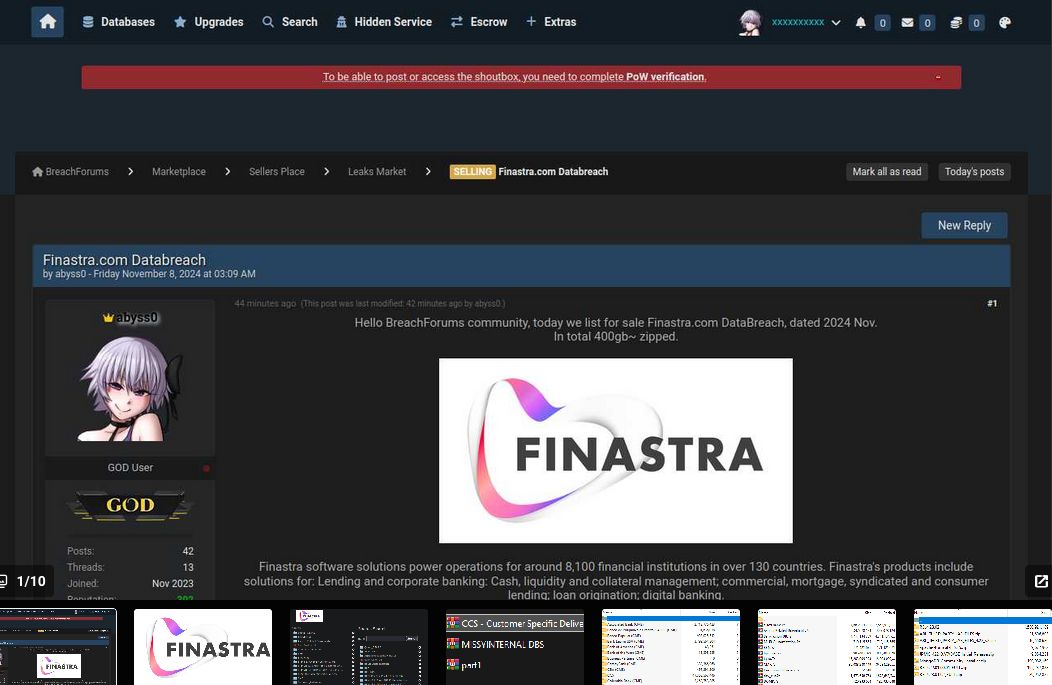
On Nov. 8, a cybercriminal using the nickname “abyss0” posted on the English-language cybercrime community BreachForums that they’d stolen files belonging to some of Finastra’s largest banking clients. The data auction did not specify a starting or “buy it now” price, but said interested buyers should reach out to them on Telegram.

abyss0’s Nov. 7 sales thread on BreachForums included many screenshots showing the file directory listings for various Finastra customers. Image: Ke-la.com.

According to screenshots collected by the cyber intelligence platform Ke-la.com, abyss0 first attempted to sell the data allegedly stolen from Finastra on October 31, but that earlier sales thread did not name the victim company. However, it did reference many of the same banks called out as Finastra customers in the Nov. 8 post on BreachForums.

The original October 31 post from abyss0, where they advertise the sale of data from several large banks that are customers of a large financial software company. Image: Ke-la.com.

The October sales thread also included a starting price: $20,000. By Nov. 3, that price had been reduced to $10,000. A review of abyss0’s posts to BreachForums reveals this user has offered to sell databases stolen in several dozen other breaches advertised over the past six months.

The apparent timeline of this breach suggests abyss0 gained access to Finastra’s file sharing system at least a week before the company says it first detected suspicious activity, and that the Nov. 7 activity cited by Finastra may have been the intruder returning to exfiltrate more data.

Maybe abyss0 found a buyer who paid for their early retirement. We may never know, because this person has effectively vanished. The Telegram account that abyss0 listed in their sales thread appears to have been suspended or deleted. Likewise, abyss0’s account on BreachForums no longer exists, and all of their sales threads have since disappeared.

It seems improbable that both Telegram and BreachForums would have given this user the boot at the same time. The simplest explanation is that something spooked abyss0 enough for them to abandon a number of pending sales opportunities, in addition to a well-manicured cybercrime persona.

In March 2020, Finastra suffered a ransomware attack that sidelined a number of the company’s core businesses for days. According to reporting from Bloomberg, Finastra was able to recover from that incident without paying a ransom.

This is a developing story. Updates will be noted with timestamps. If you have any additional information about this incident, please reach out to krebsonsecurity @ gmail.com or at protonmail.com.


Read More

Mitsubishi Electric MELSEC iQ-F Series

 ​View CSAF
1. EXECUTIVE SUMMARY

CVSS v3 7.5
ATTENTION: Exploitable remotely/low attack complexity
Vendor: Mitsubishi Electric Corporation
Equipment: MELSEC iQ-F Series
Vulnerability: Improper Validation of Specified Type of Input

2. RISK EVALUATION
Successful exploitation of this vulnerability could allow a remote attacker to cause a denial-of-service condition in Ethernet communication on the module. A system reset of the module is required for recovery.
3. TECHNICAL DETAILS
3.1 AFFECTED PRODUCTS
Mitsubishi Electric reports that the following versions of MELSEC iQ-F Series Ethernet module and EtherNet/IP module are affected:

MELSEC iQ-F Series FX5-ENET: version 1.100 and later
MELSEC iQ-F Series FX5-ENET/IP: version 1.100 to 1.104

3.2 Vulnerability Overview
3.2.1 Improper Validation of Specified Type of Input CWE-1287
A denial-of-service vulnerability due to improper validation of a specified type of input exists in MELSEC iQ-F Ethernet Module and EtherNet/IP Module.
CVE-2024-8403 has been assigned to this vulnerability. A CVSS v3.1 base score of 7.5 has been calculated; the CVSS vector string is (CVSS:3.1/AV:N/AC:L/PR:N/UI:N/S:U/C:N/I:N/A:H).
3.3 BACKGROUND

CRITICAL INFRASTRUCTURE SECTORS: Critical Manufacturing
COUNTRIES/AREAS DEPLOYED: Worldwide
COMPANY HEADQUARTERS LOCATION: Japan

3.4 RESEARCHER
Mitsubishi Electric reported this vulnerability to CISA.
4. MITIGATIONS
Mitsubishi Electric has fixed this issue in MELSEC iQ-F Series FX5-ENET/IP version 1.106 or later. The firmware update file can be found on Mitsubishi Electric’s download page. Refer to “9 FIRMWARE UPDATE FUNCTION” in the “MELSEC iQ-F FX5 User’s Manual (Application)” for information on how to update the firmware.
Mitsubishi Electric recommends that users take the following mitigations/workarounds to minimize the risk of exploiting this vulnerability:

Use within a LAN and block access from untrusted networks and hosts through firewalls.
Restrict physical access to the product, as well as to computers and network devices located within the same network as the product.
Use a firewall or virtual private network (VPN), etc. to prevent unauthorized access when internet access is required.
Use IP filter function to block access from untrusted hosts. For details on the IP filter function, please refer to the following manual: MELSEC iQ-F FX5 User’s Manual (Communication) “13.1 IP Filter Function”

For specific update instructions and additional details see the Mitsubishi Electric advisory.
Please contact your local Mitsubishi Electric representative.
CISA recommends users take defensive measures to minimize the risk of exploitation of this vulnerability, such as:

Minimize network exposure for all control system devices and/or systems, ensuring they are not accessible from the internet.
Locate control system networks and remote devices behind firewalls and isolating them from business networks.
When remote access is required, use more secure methods, such as virtual private networks (VPNs), recognizing VPNs may have vulnerabilities and should be updated to the most current version available. Also recognize VPN is only as secure as the connected devices.

CISA reminds organizations to perform proper impact analysis and risk assessment prior to deploying defensive measures.
CISA also provides a section for control systems security recommended practices on the ICS webpage on cisa.gov/ics. Several CISA products detailing cyber defense best practices are available for reading and download, including Improving Industrial Control Systems Cybersecurity with Defense-in-Depth Strategies.
CISA encourages organizations to implement recommended cybersecurity strategies for proactive defense of ICS assets.
Additional mitigation guidance and recommended practices are publicly available on the ICS webpage at cisa.gov/ics in the technical information paper, ICS-TIP-12-146-01B–Targeted Cyber Intrusion Detection and Mitigation Strategies.
Organizations observing suspected malicious activity should follow established internal procedures and report findings to CISA for tracking and correlation against other incidents.
No known public exploitation specifically targeting this vulnerability has been reported to CISA at this time.
5. UPDATE HISTORY

November 19, 2024: Initial Publication 

View CSAF

1. EXECUTIVE SUMMARY

  • CVSS v3 7.5
  • ATTENTION: Exploitable remotely/low attack complexity
  • Vendor: Mitsubishi Electric Corporation
  • Equipment: MELSEC iQ-F Series
  • Vulnerability: Improper Validation of Specified Type of Input

2. RISK EVALUATION

Successful exploitation of this vulnerability could allow a remote attacker to cause a denial-of-service condition in Ethernet communication on the module. A system reset of the module is required for recovery.

3. TECHNICAL DETAILS

3.1 AFFECTED PRODUCTS

Mitsubishi Electric reports that the following versions of MELSEC iQ-F Series Ethernet module and EtherNet/IP module are affected:

  • MELSEC iQ-F Series FX5-ENET: version 1.100 and later
  • MELSEC iQ-F Series FX5-ENET/IP: version 1.100 to 1.104

3.2 Vulnerability Overview

3.2.1 Improper Validation of Specified Type of Input CWE-1287

A denial-of-service vulnerability due to improper validation of a specified type of input exists in MELSEC iQ-F Ethernet Module and EtherNet/IP Module.

CVE-2024-8403 has been assigned to this vulnerability. A CVSS v3.1 base score of 7.5 has been calculated; the CVSS vector string is (CVSS:3.1/AV:N/AC:L/PR:N/UI:N/S:U/C:N/I:N/A:H).

3.3 BACKGROUND

  • CRITICAL INFRASTRUCTURE SECTORS: Critical Manufacturing
  • COUNTRIES/AREAS DEPLOYED: Worldwide
  • COMPANY HEADQUARTERS LOCATION: Japan

3.4 RESEARCHER

Mitsubishi Electric reported this vulnerability to CISA.

4. MITIGATIONS

Mitsubishi Electric has fixed this issue in MELSEC iQ-F Series FX5-ENET/IP version 1.106 or later. The firmware update file can be found on Mitsubishi Electric’s download page. Refer to “9 FIRMWARE UPDATE FUNCTION” in the “MELSEC iQ-F FX5 User’s Manual (Application)” for information on how to update the firmware.

Mitsubishi Electric recommends that users take the following mitigations/workarounds to minimize the risk of exploiting this vulnerability:

  • Use within a LAN and block access from untrusted networks and hosts through firewalls.
  • Restrict physical access to the product, as well as to computers and network devices located within the same network as the product.
  • Use a firewall or virtual private network (VPN), etc. to prevent unauthorized access when internet access is required.
  • Use IP filter function to block access from untrusted hosts. For details on the IP filter function, please refer to the following manual: MELSEC iQ-F FX5 User’s Manual (Communication) “13.1 IP Filter Function”

For specific update instructions and additional details see the Mitsubishi Electric advisory.

Please contact your local Mitsubishi Electric representative.

CISA recommends users take defensive measures to minimize the risk of exploitation of this vulnerability, such as:

  • Minimize network exposure for all control system devices and/or systems, ensuring they are not accessible from the internet.
  • Locate control system networks and remote devices behind firewalls and isolating them from business networks.
  • When remote access is required, use more secure methods, such as virtual private networks (VPNs), recognizing VPNs may have vulnerabilities and should be updated to the most current version available. Also recognize VPN is only as secure as the connected devices.

CISA reminds organizations to perform proper impact analysis and risk assessment prior to deploying defensive measures.

CISA also provides a section for control systems security recommended practices on the ICS webpage on cisa.gov/ics. Several CISA products detailing cyber defense best practices are available for reading and download, including Improving Industrial Control Systems Cybersecurity with Defense-in-Depth Strategies.

CISA encourages organizations to implement recommended cybersecurity strategies for proactive defense of ICS assets.

Additional mitigation guidance and recommended practices are publicly available on the ICS webpage at cisa.gov/ics in the technical information paper, ICS-TIP-12-146-01B–Targeted Cyber Intrusion Detection and Mitigation Strategies.

Organizations observing suspected malicious activity should follow established internal procedures and report findings to CISA for tracking and correlation against other incidents.

No known public exploitation specifically targeting this vulnerability has been reported to CISA at this time.

5. UPDATE HISTORY

  • November 19, 2024: Initial Publication

 Read More

CISA Releases One Industrial Control Systems Advisory

 ​CISA released one Industrial Control Systems (ICS) advisory on November 19, 2024. These advisories provide timely information about current security issues, vulnerabilities, and exploits surrounding ICS.

ICSA-24-324-01 Mitsubishi Electric MELSEC iQ-F Series

CISA encourages users and administrators to review newly released ICS advisories for technical details and mitigations. 

CISA released one Industrial Control Systems (ICS) advisory on November 19, 2024. These advisories provide timely information about current security issues, vulnerabilities, and exploits surrounding ICS.

CISA encourages users and administrators to review newly released ICS advisories for technical details and mitigations.

 Read More

CISA Adds Three Known Exploited Vulnerabilities to Catalog

 ​CISA has added three new vulnerabilities to its Known Exploited Vulnerabilities Catalog, based on evidence of active exploitation.

CVE-2024-1212 Progress Kemp LoadMaster OS Command Injection Vulnerability
CVE-2024-0012 Palo Alto Networks PAN-OS Management Interface Authentication Bypass Vulnerability
CVE-2024-9474 Palo Alto Networks PAN-OS Management Interface OS Command Injection Vulnerability

Users and administrators are also encouraged to review the Palo Alto Threat Brief: Operation Lunar Peek related to CVE-2024-0012 for additional information. 
These types of vulnerabilities are frequent attack vectors for malicious cyber actors and pose significant risks to the federal enterprise.
Binding Operational Directive (BOD) 22-01: Reducing the Significant Risk of Known Exploited Vulnerabilities established the Known Exploited Vulnerabilities Catalog as a living list of known Common Vulnerabilities and Exposures (CVEs) that carry significant risk to the federal enterprise. BOD 22-01 requires Federal Civilian Executive Branch (FCEB) agencies to remediate identified vulnerabilities by the due date to protect FCEB networks against active threats. See the BOD 22-01 Fact Sheet for more information.
Although BOD 22-01 only applies to FCEB agencies, CISA strongly urges all organizations to reduce their exposure to cyberattacks by prioritizing timely remediation of Catalog vulnerabilities as part of their vulnerability management practice. CISA will continue to add vulnerabilities to the catalog that meet the specified criteria. 

CISA has added three new vulnerabilities to its Known Exploited Vulnerabilities Catalog, based on evidence of active exploitation.

  • CVE-2024-1212 Progress Kemp LoadMaster OS Command Injection Vulnerability
  • CVE-2024-0012 Palo Alto Networks PAN-OS Management Interface Authentication Bypass Vulnerability
  • CVE-2024-9474 Palo Alto Networks PAN-OS Management Interface OS Command Injection Vulnerability

Users and administrators are also encouraged to review the Palo Alto Threat Brief: Operation Lunar Peek related to CVE-2024-0012 for additional information. 

These types of vulnerabilities are frequent attack vectors for malicious cyber actors and pose significant risks to the federal enterprise.

Binding Operational Directive (BOD) 22-01: Reducing the Significant Risk of Known Exploited Vulnerabilities established the Known Exploited Vulnerabilities Catalog as a living list of known Common Vulnerabilities and Exposures (CVEs) that carry significant risk to the federal enterprise. BOD 22-01 requires Federal Civilian Executive Branch (FCEB) agencies to remediate identified vulnerabilities by the due date to protect FCEB networks against active threats. See the BOD 22-01 Fact Sheet for more information.

Although BOD 22-01 only applies to FCEB agencies, CISA strongly urges all organizations to reduce their exposure to cyberattacks by prioritizing timely remediation of Catalog vulnerabilities as part of their vulnerability management practice. CISA will continue to add vulnerabilities to the catalog that meet the specified criteria.

 Read More

Scroll to Top